light CITROEN C4 PICASSO 2019 Repair Manual
[x] Cancel search | Manufacturer: CITROEN, Model Year: 2019, Model line: C4 PICASSO, Model: CITROEN C4 PICASSO 2019Pages: 316, PDF Size: 10.36 MB
Page 199 of 316

197
Maximum load, distributed over the roof
bars, for a loading height not exceeding
40
cm: 80 kg.
As this value may be changed, please
verify the maximum load quoted in the
user guide supplied with the roof bars.
If the height exceeds 40
cm, adapt the
speed of the vehicle to the profile of the
road to avoid damaging the roof bars and
the fixings on the vehicle.
Be sure to refer to national legislation in
order to comply with the regulations for
transporting objects which are longer than
the vehicle.
When carrying long objects, it is
recommended that the motorised tailgate
function is deactivated.
Very cold climate screen(s)
(Depending on the country where the product
is sold.)
Removable screen(s) which prevent snow
accumulating at the radiator cooling fan.
Depending on the version, you have one or two
screens. Before fitting or removing a
screen,
ensure that the engine is off and the
cooling fan has stopped.
Fitting Removing
F Use a
screwdriver as a lever to release each
of the fixings of each screen in turn.
It is essential to remove the very cold
climate screen (or screens):
-
w
hen the exterior temperature exceeds
10°C,
-
w
hen towing,
-
a
t speeds above 75 mph (120 km/h).
Vision 360
system
The pre-cut section must be removed
before fitting the screen on the front
bumper, in order to be able to release the
camera.
When the very cold climate screen is
present, the camera image is slightly
altered.
F
O
ffer up the corresponding very cold
climate screen to the lower or upper section
of the front bumper.
F
P
ress around its edge to engage the fixing
clips of each screen one by one.
7
Practical information
Page 206 of 316

204
Only use products recommended by
CITROËN or products of equivalent quality
and specification.
In order to optimise the operation of
components as important as those in the
braking system, CITROËN selects and
offers very specific products.
After washing the vehicle, dampness, or
in wintry conditions, ice can form on the
brake discs and pads: braking efficiency
may be reduced. Make light brake
applications to dry and defrost the brakes.
AdBlue® (BlueHDi engines)
To respect the environment and ensure
compliance with the Euro 6 standard, without
adversely affecting the per formance or fuel
consumption of Diesel engines, CITROËN
has taken the decision to equip its vehicles
with a
system that associates SCR (Selective
Catalytic Reduction) with a
Diesel particle filter
(DPF) for the treatment of exhaust gases.
SCR system
Using a fluid called AdBlue® that contains
urea, a catalytic converter turns up to 85%
of nitrogen oxides (NOx) into nitrogen and
water, which are harmless to health and the
environment.
The AdBlue
® is contained in
a
special tank holding about
17
litres.
Its capacity allows a
driving range of around
12,500
miles (20,000
km). An alert system is
triggered automatically once the reser ve level
is reached: you can then drive for a
further
1,500
miles (2,400
km) before the tank is
e m pt y. Once the AdBlue
® tank is empty, a system
required by regulations prevents starting
of the engine.
If the SCR system is defective, the level of
emissions from your vehicle will no longer
meet the Euro 6
standard: your vehicle
becomes polluting.
In the event of a
confirmed fault with the
SCR system, you must go to a
CITROËN
dealer or a
qualified workshop as soon
as possible: after a
running distance of
685
miles (1,100
km), a system will be
triggered automatically to prevent engine
starting.
In either case, a range indicator gives you
the distance you can travel before the
vehicle is immobilised.
For more information on the Warning and
indicator lamps and associated alerts,
refer to the corresponding section.
Freezing of the AdBlue
®
AdBlue® freezes at temperatures below
around -11°C.
The SCR system includes a
heater for the
AdBlue
® tank, allowing you to continue
driving in very cold conditions.
Practical information
Page 207 of 316
205
Topping up the AdBlue®
Filling the AdBlue® tank is an operation
included in every routine ser vice on your
vehicle by a
CITROËN dealer or a qualified
workshop.
Nevertheless, given the capacity of the tank, it
may be necessary to top up the fluid between
services, more particularly if an alert (warning
lamps and a
message) signals the requirement.
You can go to a
CITROËN dealer or a qualified
workshop.
If you envisage topping up yourself, please
read the following warnings carefully.
Supply of AdBlue®
It is recommended that the AdBlue® is
topped up as soon as the first alert is
issued indicating that the reser ve level has
been reached.
In order to ensure that the SCR system
operates correctly:
-
U
se only AdBlue
® liquid that meets the
ISO
22241
standard.
-
N
ever transfer AdBlue
® to another
container: it would lose its purity.
-
N
ever dilute AdBlue
® with water. You can obtain AdBlue
® from a CITROËN
d
ealer or a
qualified workshop.
You can also visit a
petrol station
equipped with AdBlue
® pumps specially
designed for passenger vehicles (for those
versions with access to the AdBlue
® tank
via the fuel filler flap).
Never top up from an AdBlue
® dispenser
reserved for heavy goods vehicles.
Recommendations on
storage
AdBlue® freezes at about -11°C and
deteriorates above 25°C. It should be stored in
a
cool place and protected from direct sunlight.
Under these conditions, the fluid can be kept
for at least a
year.
If the additive has frozen, it can be used once it
has completely thawed out.
Never keep containers or bottles of
AdBlue
® in your vehicle.
Precautions for use
AdBlue® is a urea-based solution. This liquid
is
non-flammable, colourless and odourless
(when kept in a
cool place).
In the event of contact with the skin, wash the
affected area with soap and water. In the event
of contact with the eyes, wash (irrigate) the
eyes with large amounts of water or with an eye
wash solution for at least 15
minutes. If you feel
a
persistent burning sensation or irritation, get
medical attention.
If swallowed, immediately wash out the mouth
with clean water and then drink plenty of water.
In certain conditions (at high temperature,
for example), the risk of release of ammonia
cannot be excluded: do not inhale the vapour.
Ammonia has an irritant effect on mucous
membranes (eyes, nose and throat).
Keep AdBlue
® out of the reach of children,
in its original container or bottle.
Procedure
Before starting the top-up procedure, ensure
that the vehicle is parked on a flat and level
sur face.
7
Practical information
Page 222 of 316
220
Changing a bulb
The lamps have polycarbonate lenses with
a
protective coating:
F
d
o not clean them using a dr y or
abrasive cloth, nor with a
detergent
or solvent product,
F
u
se a sponge and soapy water or a pH
neutral product,
F
w
hen using a high pressure washer
on persistent marks, do not keep the
lance directed towards the lamps or
their edges for too long, so as not to
damage their protective coating and
seals.
Changing a
bulb should only be done after
the lamp has been switched off for several
minutes (risk of serious burns).
F
D
o not touch the bulb directly with your
fingers, use a
lint-free cloth.
It is essential only to use anti-ultraviolet
(UV) type bulbs, so as not to damage the
headlamp.
Always replace a
failed bulb with a new
bulb with the same type and specification. In some weather conditions (e.g. low
temperature or humidity), the presence
of misting on the internal sur face of the
glass of the headlamps and rear lamps is
normal; it disappears after the lamps have
been on for a
few minutes.
Risk of electrocution
Xenon bulbs (D5S-25W) must be replaced
by a
CITROËN dealer or a qualified
workshop.
Light-emitting diodes (LED)
For the replacement of this type of bulb,
you must contact a
CITROËN dealer or
a
qualified workshop.
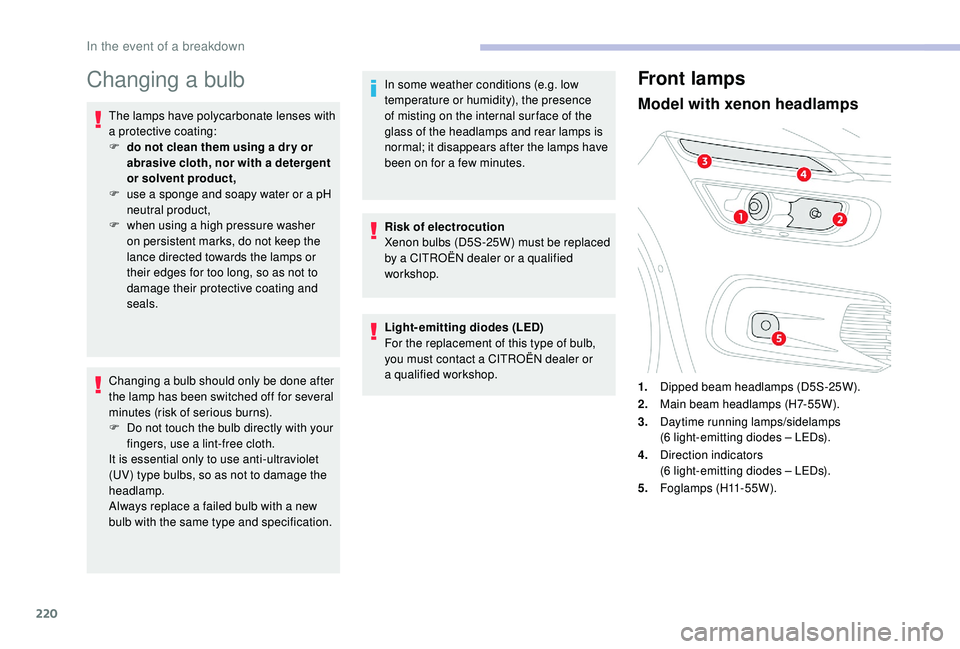
Front lamps
Model with xenon headlamps
1.Dipped beam headlamps (D5S-25W).
2. Main beam headlamps (H7-55W).
3. Daytime running lamps/sidelamps
(6
light-emitting diodes – LEDs).
4. Direction indicators
(6
light-emitting diodes – LEDs).
5. Foglamps (H11-55W).
In the event of a breakdown
Page 223 of 316
221
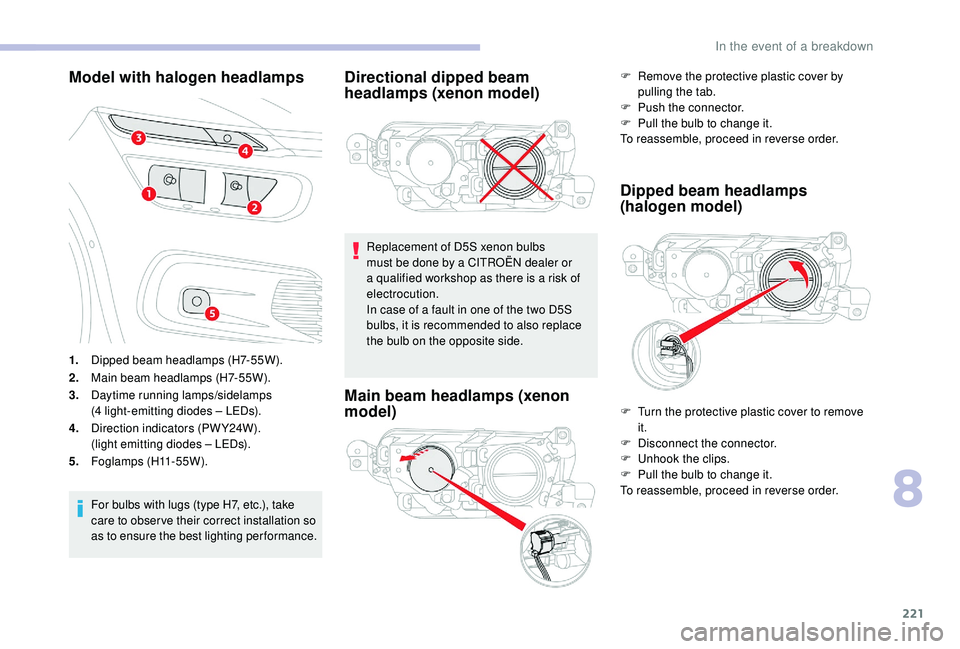
Model with halogen headlamps
1.Dipped beam headlamps (H7-55W).
2. Main beam headlamps (H7-55W).
3. Daytime running lamps/sidelamps
(4
light-emitting diodes – LEDs).
4. Direction indicators (PW Y24W).
(light emitting diodes – LEDs).
5. Foglamps (H11-55W).
For bulbs with lugs (type H7, etc.), take
care to obser ve their correct installation so
as to ensure the best lighting per formance.
Directional dipped beam
headlamps (xenon model)
Replacement of D5S xenon bulbs
must be done by a
CITROËN dealer or
a
qualified workshop as there is a risk of
electrocution.
In case of a
fault in one of the two D5S
bulbs, it is recommended to also replace
the bulb on the opposite side.
Main beam headlamps (xenon
model) Dipped beam headlamps
(halogen model)
F Remove the protective plastic cover by
pulling the tab.
F
P
ush the connector.
F
P
ull the bulb to change it.
To reassemble, proceed in reverse order.
F
T
urn the protective plastic cover to remove
it.
F
D
isconnect the connector.
F
U
nhook the clips.
F
P
ull the bulb to change it.
To reassemble, proceed in reverse order.
8
In the event of a breakdown
Page 224 of 316
222
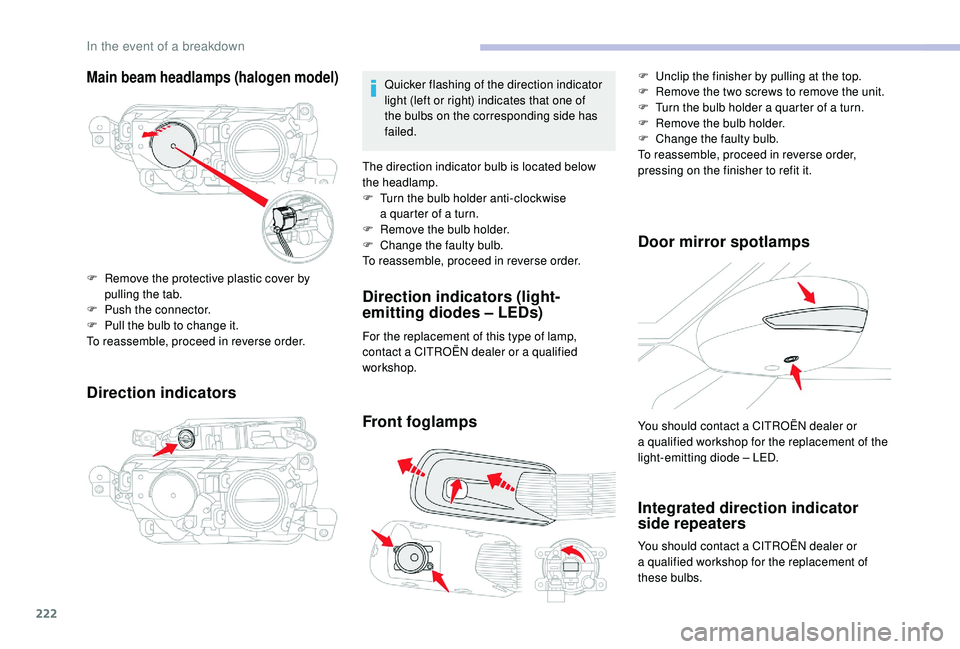
Main beam headlamps (halogen model)
Direction indicators
F Remove the protective plastic cover by pulling the tab.
F
P
ush the connector.
F
P
ull the bulb to change it.
To reassemble, proceed in reverse order. Quicker flashing of the direction indicator
light (left or right) indicates that one of
the bulbs on the corresponding side has
failed.
The direction indicator bulb is located below
the headlamp.
F
T
urn the bulb holder anti-clockwise
a quarter of a turn.
F
R
emove the bulb holder.
F
C
hange the faulty bulb.
To reassemble, proceed in reverse order.
Direction indicators (light-
emitting diodes – LEDs)
For the replacement of this type of lamp,
contact a CITROËN dealer or a qualified
workshop.
Front foglamps
F Unclip the finisher by pulling at the top.
F R emove the two screws to remove the unit.
F
T
urn the bulb holder a quarter of a turn.
F
R
emove the bulb holder.
F
C
hange the faulty bulb.
To reassemble, proceed in reverse order,
pressing on the finisher to refit it.
Door mirror spotlamps
You should contact a CITROËN dealer or
a qualified workshop for the replacement of the
light-emitting diode – LED.
Integrated direction indicator
side repeaters
You should contact a CITROËN dealer or
a qualified workshop for the replacement of
these bulbs.
In the event of a breakdown
Page 225 of 316
223
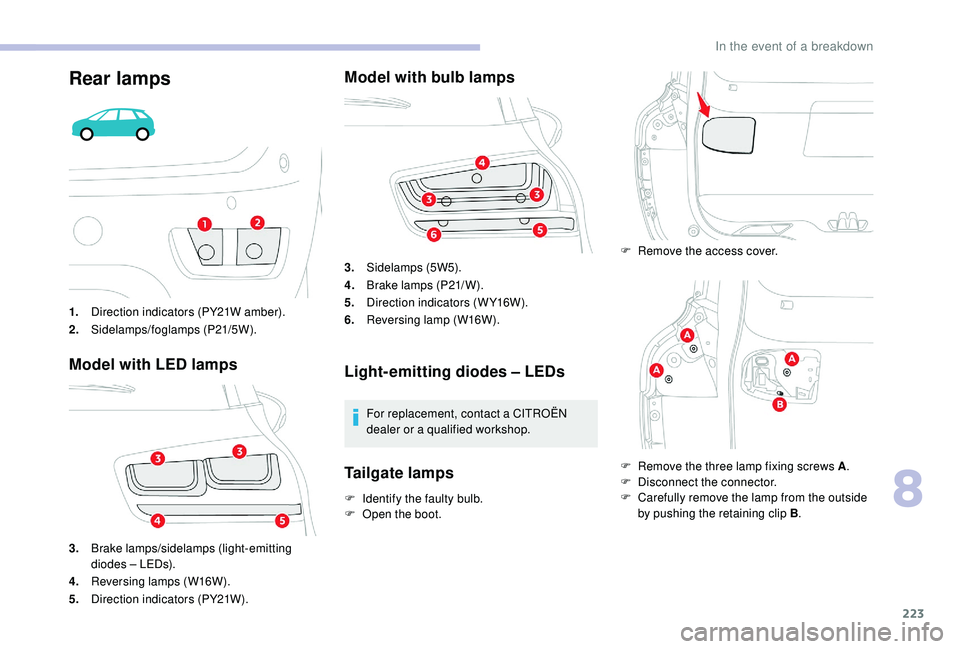
Rear lamps
1.Direction indicators (PY21W amber).
2. Sidelamps/foglamps (P21/5W).
Model with LED lamps
3.Brake lamps/sidelamps (light-emitting
diodes – LEDs).
4. Reversing lamps (W16W).
5. Direction indicators (PY21W).
Model with bulb lamps
3.Sidelamps (5W5).
4. Brake lamps (P21/ W).
5. Direction indicators (WY16W).
6. Reversing lamp (W16W).
Light- emitting diodes – LEDs
For replacement, contact a CITROËN
d ealer or a qualified workshop.
Tailgate lamps
F Identify the faulty bulb.
F O pen the boot. F
R
emove the access cover.
F
R
emove the three lamp fixing screws A
.
F
D
isconnect the connector.
F C arefully remove the lamp from the outside
by pushing the retaining clip B .
8
In the event of a breakdown
Page 226 of 316
224
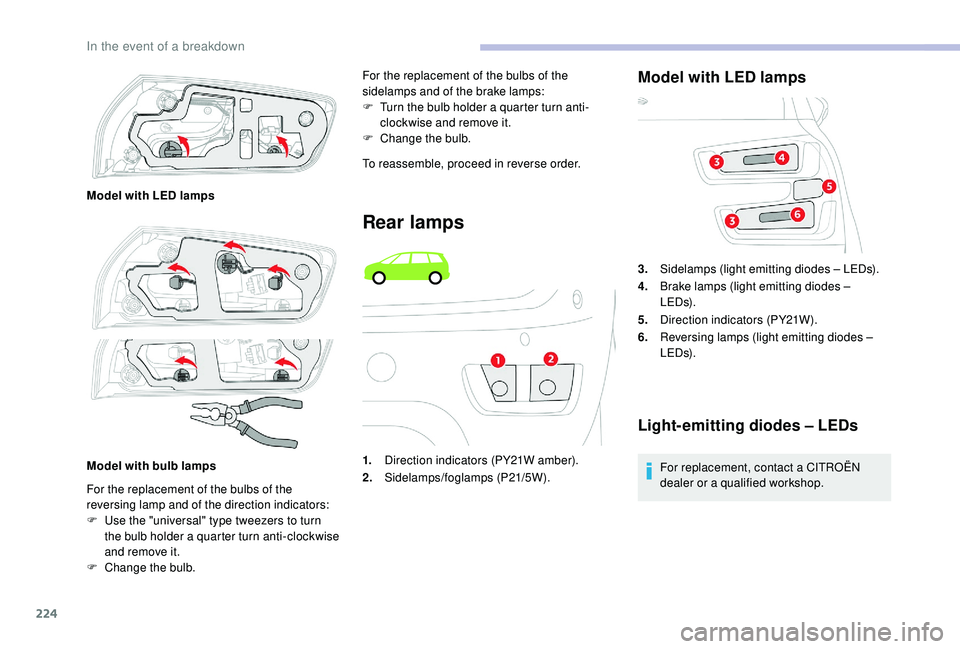
For the replacement of the bulbs of the
reversing lamp and of the direction indicators:
F
U
se the "universal" type tweezers to turn
the bulb holder a
quarter turn anti-clockwise
and remove it.
F
C
hange the bulb. For the replacement of the bulbs of the
sidelamps and of the brake lamps:
F
T
urn the bulb holder a quarter turn anti-
clockwise and remove it.
F
C
hange the bulb.
To reassemble, proceed in reverse order.
Rear lamps
1. Direction indicators (PY21W amber).
2. Sidelamps/foglamps (P21/5W).
Model with LED lamps
3.Sidelamps (light emitting diodes – LEDs).
4. Brake lamps (light emitting diodes –
L ED s).
5. Direction indicators (PY21W).
6. Reversing lamps (light emitting diodes –
L ED s).
Light- emitting diodes – LEDs
For replacement, contact a CITROËN
d ealer or a qualified workshop.
Model with LED lamps
Model with bulb lamps
In the event of a breakdown
Page 228 of 316

226
Third brake lamp (light- emitting
diodes – LEDs)
Number plate lamps (W5W)
F Insert a thin screwdriver into one of the cut-
outs in the lens.
F
P
ush it outwards to unclip it.
F
R
emove the lens.
F
C
hange the faulty bulb.
To refit, press on the lens to clip it in place.
You can also contact a
CITROËN dealer or
a
qualified workshop for the replacement of
these bulbs.
For the replacement of this type of lamp,
contact a
CITROËN dealer or a
qualified
workshop.
Changing a fuse
Access to tooling
The extraction tweezers are fitted in the
dashboard fuses compartment.
F
U
nclip the cover by pulling at the top right,
then left,
F
C
ompletely remove the cover by carefully
pulling it in the axis indicated by the arrow,
F
R
emove the tweezers. F
O
pen the glove box
F U nclip the cover by pulling at the top left,
then right.
F
C
ompletely remove the cover by carefully
pulling it in the axis indicated by the arrow.
F
R
emove the tweezers.
Changing a fuse
Before changing a fuse, it is necessary to:
F i dentify the cause of the failure and correct
it,
F
s
witch off all electrical loads,
F
i
mmobilise the vehicle and switch off the
ignition,
F
i
dentify the defective fuse using the existing
allocation tables and diagrams.
In the event of a breakdown
Page 231 of 316
229
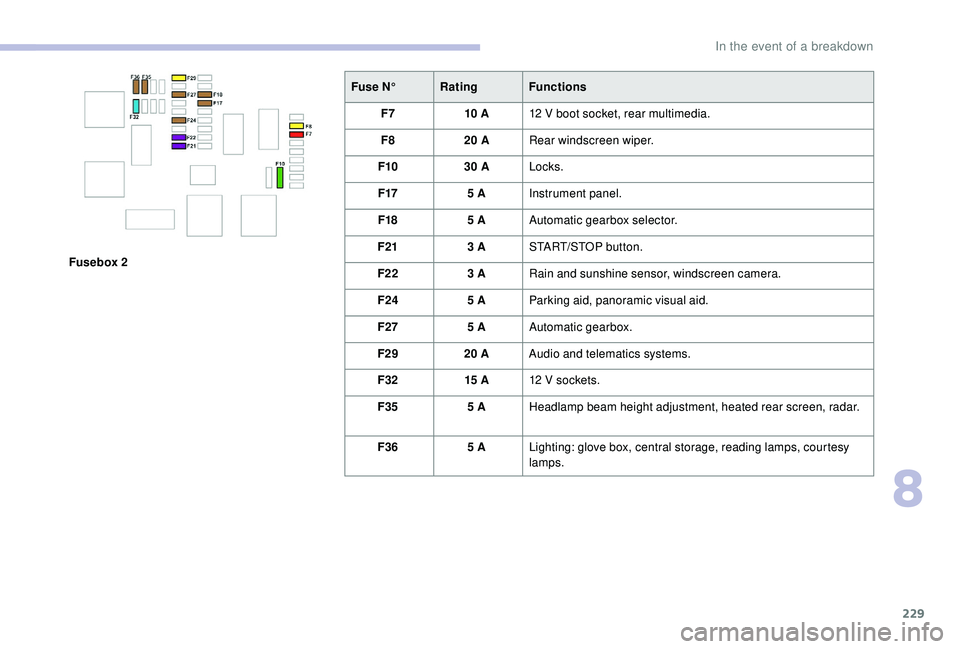
Fusebox 2Fuse N°
Rating Functions
F7 10
A
12 V boot socket, rear multimedia.
F8 20 A
Rear windscreen wiper.
F10 30 A
Locks.
F17 5 A
Instrument panel.
F18 5 A
Automatic gearbox selector.
F21 3 A
START/STOP button.
F22 3
ARain and sunshine sensor, windscreen camera.
F24 5
AParking aid, panoramic visual aid.
F27 5
AAutomatic gearbox.
F29 20
AAudio and telematics systems.
F32 15
A12
V sockets.
F35 5
AHeadlamp beam height adjustment, heated rear screen, radar.
F36 5
ALighting: glove box, central storage, reading lamps, courtesy
lamps.
8
In the event of a breakdown