Engine light CITROEN C4 PICASSO 2022 User Guide
[x] Cancel search | Manufacturer: CITROEN, Model Year: 2022, Model line: C4 PICASSO, Model: CITROEN C4 PICASSO 2022Pages: 316, PDF Size: 10.36 MB
Page 110 of 316

108
At a speed above 12 mph (20 km/h), these
w arning lamps flash, associated with an
audible signal, for two minutes. Beyond this
period of time, the warning lamps stay on
continuously until the seat belts are fastened.
Rear seat belts not fastened alert
When the ignition is switched on, with the
engine running or the vehicle moving above
6
mph (10 km/h), warning lamp A and the
corresponding dots in warning lamp B come on
for around thirty seconds, if one or more rear
passengers have not fastened their seat belts.
Seat belts unfastened alert
After the ignition is switched on, warning lamp
A and the corresponding dots in warning lamp
B come on if the driver and/or one or more
passengers unfasten their seat belts.
These warning lamps flash for 30
seconds,
accompanied by an audible signal. Beyond
this period of time, the warning lamps stay on
continuously until the seat belts are fastened.
Advice
The driver must ensure that passengers
use the seat belts correctly and that they
are all fastened before setting off.
Wherever you are seated in the vehicle,
always fasten your seat belt, even for
short journeys.
Do not interchange the seat belt buckles
as they will not fulfil their role fully.
The seat belts are fitted with an inertia
reel permitting automatic adjustment of
the length of the strap to your size. The
seat belt is stowed automatically when not
in use.
The inertia reels have an automatic
locking device at the time of a
collision,
during sudden braking or if the vehicle
turns over. You can release the device by
pulling the strap firmly and then releasing
it so that it reels in slightly.
Before and after use, ensure that the seat
belt is reeled in correctly.
After folding or moving a
seat or rear
bench seat, ensure that the seat belt is
positioned and reeled in correctly. Installation
The lower part of the strap must be
positioned as low as possible on the
pelvis.
The upper part must be positioned in the
hollow of the shoulder.
In order to be effective, a seat belt must:
-
b
e tightened as close to the body as
possible,
-
b
e pulled in front of you with a smooth
movement, checking that it does not
twist,
-
b
e used to restrain only one person,
-
n
ot show any signs of cuts or fraying,
-
n
ot be converted or modified to avoid
affecting its performance.
Recommendations for children
Use a
suitable child seat if the passenger
is less than 12
years old or shorter than
one and a
half metres.
Never use the same seat belt to secure
more than one child.
Never allow a
child to travel on your lap.
For more information on Child seats ,
refer to the corresponding section.
Safety
Page 128 of 316

126
Driving advice
Observe driving regulations and remain vigilant
whatever the traffic conditions.
Pay close attention to the traffic and keep your
hands on the wheel so that you are ready to
react at any time to any eventuality.
As a safety measure, the driver should only
carry out any operations that require close
attention when the vehicle is stationary.
On a
long journey, taking a break every two
hours is strongly recommended.
In difficult weather, drive smoothly, anticipate
the need to brake and increase the distance
from other vehicles.
Never leave the engine running in
an enclosed area without adequate
ventilation: internal combustion engines
emit toxic exhaust gases, such as carbon
monoxide. There is a
risk of poisoning and
death!
In very severe wintry conditions
(temperatures below -23°C), to guarantee
correct operation and the longevity of
the mechanical elements of your vehicle
(engine and gearbox), the engine must be
left running for 4
minutes before driving.
Important!
Never drive with the parking brake applied
– Risk of overheating and damage to the
braking system!
As the exhaust system of your vehicle
is very hot, even several minutes after
switching off the engine, never park or run
the engine on inflammable sur faces (dry
grass, fallen leaves, etc.) – Risk of fire!
Never leave a vehicle unsuper vised with
the engine running. If you have to leave
your vehicle with the engine running, apply
the parking brake and put the gearbox into
neutral or position N or P , depending on
the type of gearbox.
Driving on flooded roads
We strongly advise against driving on flooded
roads, as this could cause serious damage
to the engine or gearbox, as well as to the
electrical systems of your vehicle. If you are obliged to drive on a
flooded road:
-
c
heck that the depth of water does not
exceed 15 cm, taking account of waves that
might be generated by other users,
-
d
eactivate the Stop & Start function,
-
d
rive as slowly as possible without stalling.
In all cases, do not exceed 6 mph (10 km/h),
-
d
o not stop and do not switch off the engine.
On leaving the flooded road, as soon as safety
conditions allow, make several light brake
applications to dry the brake discs and pads.
If in doubt on the state of your vehicle, contact
a CITROËN dealer or a qualified workshop.
Driving
Page 129 of 316

127
In case of towing
Driving with a trailer places greater
d emands on the towing vehicle and
requires extra care from the driver.
Side wind
F Take into account the increased sensitivity to wind.
Cooling
Towing a trailer on a slope increases the
t emperature of the coolant.
As the fan is electrically controlled, its cooling
capacity is not dependent on the engine speed.
F
T
o lower the engine speed, reduce your
speed.
The maximum towable load on an incline
depends on the gradient and the exterior
temperature.
In all cases, keep a
check on the coolant
temperature.
F
I
f this warning lamp and the
STOP warning lamp come on,
stop the vehicle and switch off
the engine as soon as possible.
New vehicle
Do not pull a trailer before having driven at least
approximately 620
miles (1,000
kilometres).
Braking
Towing a trailer increases the braking distance.
T o avoid overheating of the brakes, the use of
engine braking is recommended.
Ty r e s
F Check the tyre pressures of the towing vehicle and of the trailer, observing the
recommended pressures.
Lighting
F Check the electrical lighting and signalling on the trailer and the headlamp beam height
of your vehicle.
For more information on Headlamp
adjustment , refer to the corresponding
section.
Certain driving or manoeuvring aid
functions are automatically disabled if an
approved towing system is used.
Anti-theft protection
Electronic immobiliser
The keys contain an electronic chip which has
a secret code. When the ignition is switched
on, this code must be recognised in order for
starting to be possible.
This electronic engine immobiliser locks the
engine management system a
few moments
after the ignition is switched off, and prevents
starting of the engine by anyone who does not
have the key.
In the event of a
malfunction, you are informed
by a
message in the instrument panel screen.
If this happens, your vehicle will not start;
contact a
CITROËN dealer if required.
Starting/switching off
the engine using the
electronic key
Starting the engine
6
Driving
Page 130 of 316

128
F Place the gear selector at P or N for vehicles with an automatic gearbox or
neutral for vehicles with a
manual gearbox.
F
P
lace the electronic key in the reader.
F
P
ress the brake pedal for vehicles with an
automatic gearbox, or fully depress the
clutch pedal for vehicles with a
manual
gearbox.
F
B
riefly press the " START/STOP" button.
The steering column unlocks and the engine
starts more or less instantly.
On certain versions with the automatic gearbox
(EAT6/EAT8), the steering column does not
lock.
For Diesel vehicles , in sub-zero temperatures
the engine will not start until the pre-heater
warning lamp has gone off. If one of the starting conditions is not met,
a reminder message is displayed in the
instrument panel. In some circumstances, it is
necessary to turn the steering wheel slightly
while pressing the "START/STOP" button to
assist unlocking of the steering; a message
warns you when this is needed.
With petrol engines , after a
cold start,
preheating the catalytic converter can
cause noticeable engine vibrations for
anything up to 2
minutes while stationary
with the engine running (accelerated idle
speed).
If this warning lamp comes on after
pressing the "START/STOP" button,
press down on the brake or clutch
pedal until the warning lamp goes
off, without pressing the "START/
STOP" button again, until the engine
starts and runs.
Switching off the engine
F Immobilise the vehicle.
F P lace the gear selector at P or N for
vehicles with an automatic gearbox or
neutral for vehicles with a
manual gearbox.
F
P
ress the " START/STOP " button.
The engine stops and the steering column
locks.
On certain versions with the automatic gearbox
(EAT6/EAT8), the steering column does not
lock.
F
R
emove the electronic key from the reader. If the vehicle is not immobilised, the
engine will not stop.
Switching off the engine leads to a
loss of
braking assistance.
Emergency switch-off
In the event of an emergency only, the engine
can be switched off without conditions (even
when driving).
Press the " START/STOP " button for about
three seconds.
In this case, the steering column locks as soon
as the vehicle stops.
On certain versions with the automatic gearbox
(EAT6/EAT8), the steering column does not
lock.
Electronic key left in the reader
You will be warned by a
message if the
electronic key is still in the reader on
opening the driver's door.
Driving
Page 131 of 316

129
Starting/switching off the
engine with Keyless Entry
and Starting
Starting the engine
The Keyless Entry and Starting electronic
key must be inside the vehicle.
If the electronic key is not detected in this
zone, a message is displayed.
Move the electronic key into this zone so
that the engine can be started.
If there is still a problem, refer to the "Key
not detected – Back-up starting" section.
F
P
ress the " START/STOP " button while
maintaining pressure on the pedal until the
engine starts.
The steering column unlocks and the engine
starts.
On certain versions with the automatic gearbox
(EAT6/EAT8), the steering column does not
lock.
For Diesel engines , when the temperature is
negative and/or the engine is cold, the start
will only take place once the preheater warning
lamp is off. F
W ith an automatic gearbox
, you should
keep the brake pedal fully depressed and
not press the " START/STOP" button again
until the engine is running.
If one of the starting conditions is not met,
a reminder message is displayed in the
instrument panel.
In some circumstances, it is necessary to turn
the steering wheel slightly while pressing the
" START/STOP " button to assist unlocking of
the steering column.
With petrol engines , after a
cold start,
preheating the catalytic converter can
cause noticeable engine vibrations for
up to 2
minutes while stationary with the
engine running (accelerated idle speed).
As a
safety measure, never leave the
vehicle while the engine is running.
Switching off the engine
F Immobilise the vehicle, engine at idle.
F W ith a manual gearbox , preferably put the
gear lever into neutral.
F
W
ith a
manual gearbox
, put the gear lever
into neutral.
F
W
ith the electronic key inside the vehicle,
fully depress the clutch pedal.
or
F
W
ith an automatic gearbox
, place the gear
selector in mode P or N .
F
W
ith the electronic key inside the vehicle,
press the brake pedal.
If this warning lamp comes on after
pressing the "START/STOP " button:
F
W
ith a
manual gearbox , you should keep
the clutch pedal fully depressed and not
press the " START/STOP " button again until
the engine is running.
6
Driving
Page 142 of 316

140
The information appears in the
instrument panel in the form of an
ar row.
With a
manual gearbox, the arrow may be
accompanied by the gear recommended.
This arrow may be pointing up or down,
depending on the context.
The system adapts its gear efficiency
recommendation according to the driving
conditions (slope, load, etc.) and the
driver's requirements (power, acceleration,
b r a k i n g , e t c .) .
The system never suggests:
-
e
ngaging first gear,
-
enga
ging reverse gear.
Stop & Start
Per fect for urban use, the Stop & Start system
reduces fuel consumption and exhaust
emissions as well as the noise level when
stationary.
The Stop & Start system puts the engine
temporarily into standby – STOP mode – during
stops in the traffic (red lights, traffic jams, or
other, etc.). The engine restarts automatically –
START mode – as soon as you wish to move off
again.
Restarting occurs instantaneously, quickly and
silently.
Operation
Going into engine STOP mode
This indicator lamp comes on in the
instrument panel and the engine
goes into standby automatically.
-
W
ith a manual gearbox , at speeds below
12
mph (20 km/h), or with the vehicle
stationary (with the PureTech 110, 130
and
BlueHDi 100, 130
versions), when you place
the gear lever in neutral and you release the
clutch pedal,
-
W
ith an automatic gearbox , at speeds
below 2
mph (3 km/h), or when the vehicle
is stationary (depending on version), when
you press the brake pedal or place the gear
selector into position N .
If your vehicle is fitted with this system, a time
counter calculates the sum of the periods in
STOP mode during a
journey. It resets to zero
every time the ignition is switched on with the
"START/STOP" button. For your convenience, during parking
manoeuvres, STOP mode is not available
for a
few seconds after coming out of
reverse gear.
The Stop & Start system does not modify
the vehicle's functions, such as, for
example, braking, power steering, etc.
Never refuel with the engine in STOP
mode; you must switch off the ignition with
the "START/STOP" button.
Special cases: STOP mode not
available
STOP mode is not invoked when:
- t he driver's door is open,
-
t
he driver's seat belt is not fastened,
-
t
he vehicle has not exceeded 6 mph
(10
km/h) since the last engine start using
the "START/STOP" button,
-
t
he electric parking brake is applied or being
applied,
-
t
he engine is needed to maintain
a
comfortable temperature in the passenger
compartment,
-
d
emisting is active,
Driving
Page 143 of 316
141
Going into engine START mode
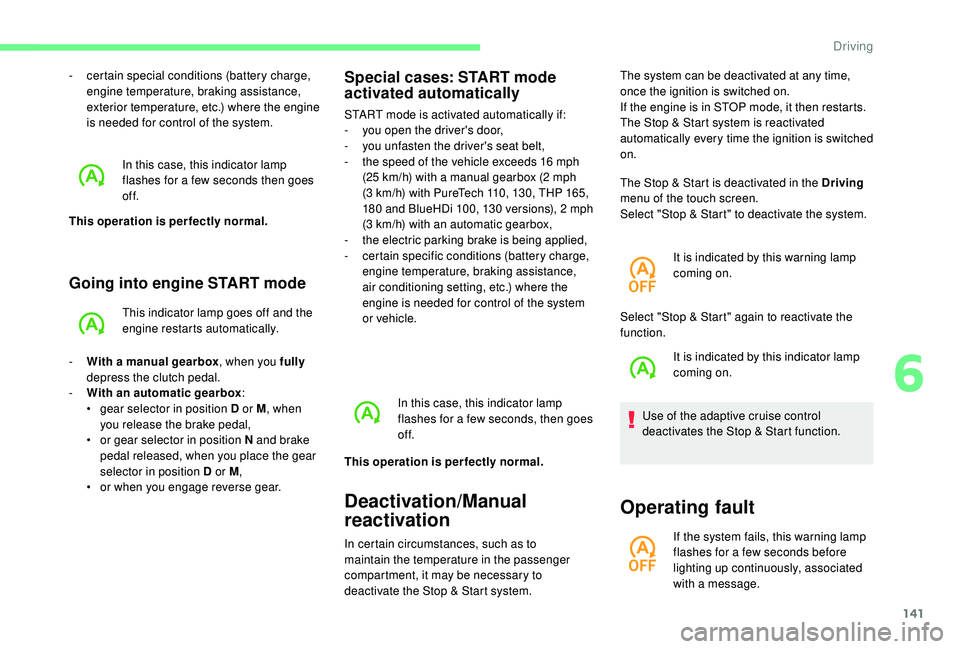
This indicator lamp goes off and the
engine restarts automatically.
-
W
ith a manual gearbox , when you fully
depress the clutch pedal.
-
W
ith an automatic gearbox :
•
g
ear selector in position D or M , when
you release the brake pedal,
•
o
r gear selector in position N and brake
pedal released, when you place the gear
selector in position D or M ,
•
o
r when you engage reverse gear.
Special cases: START mode
activated automatically
START mode is activated automatically if:
- y ou open the driver's door,
-
y
ou unfasten the driver's seat belt,
-
t
he speed of the vehicle exceeds 16 mph
(25
km/h) with a manual gearbox (2 mph
(3
km/h) with PureTech 110, 130, THP 165,
180
and BlueHDi 100, 130 versions), 2 mph
(3
km/h) with an automatic gearbox,
-
t
he electric parking brake is being applied,
-
c
ertain specific conditions (battery charge,
engine temperature, braking assistance,
air conditioning setting, etc.) where the
engine is needed for control of the system
or vehicle.
Deactivation/Manual
reactivation
- certain special conditions (battery charge, engine temperature, braking assistance,
exterior temperature, etc.) where the engine
is needed for control of the
system.
In this case, this indicator lamp
flashes for a
few seconds then goes
of f.
This operation is perfectly normal.
In this case, this indicator lamp
flashes for a
few seconds, then goes
of f.
This operation is perfectly normal.
In certain circumstances, such as to
maintain the temperature in the passenger
compartment, it may be necessary to
deactivate the Stop & Start system. The system can be deactivated at any time,
once the ignition is switched on.
If the engine is in STOP mode, it then restarts.
The Stop & Start system is reactivated
automatically every time the ignition is switched
on.
The Stop & Start is deactivated in the Driving
menu of the touch screen.
Select "Stop & Start" to deactivate the system.
It is indicated by this warning lamp
coming on.
Select "Stop & Start" again to reactivate the
function. It is indicated by this indicator lamp
coming on.
Use of the adaptive cruise control
deactivates the Stop & Start function.
Operating fault
If the system fails, this warning lamp
flashes for a few seconds before
lighting up continuously, associated
with a
message.
6
Driving
Page 168 of 316

166
The vehicle has a camera located at the top of
t he windscreen, and, depending on the version,
a radar located in the front bumper.
This system is designed to assist the
driver and improve road safety.
It is the driver's responsibility to
continuously monitor the state of the
traffic, observing the driving regulations.
This system does not replace the need for
vigilance on the part of the driver.
As soon as the system detects a
potential
obstacle, it prepares the braking circuit in
case automatic braking is needed. This
may cause a
slight noise and a slight
sensation of deceleration.
Deactivation/Activation
By default, the system is automatically
activated at every engine start.
The system can be deactivated or activated via
the vehicle settings menu.
Deactivation of the system is
signalled by the illumination of this
indicator lamp, accompanied by the
display of a
message.
Operating conditions and
limits
The ESC system must not be faulty.
The ASR must not be deactivated.
All passenger seat belts must be fastened.
Driving at a steady speed on roads with few
bends is required. The following situations may interfere with
the operation of the system or prevent it
from working:
-
p
oor visibility (inadequate street
lighting, falling snow, heavy rain, dense
f o g , e t c .),
-
d
azzle (headlamps of an oncoming
vehicle, low sun, reflections on a damp
road, leaving a tunnel, alternating
shade and light, etc.),
-
c
amera or radar obstructed (mud, frost,
snow, condensation, etc.).
On versions with camera alone, this
message indicates to you that the camera
is obstructed: " Driving aids camera:
visibility limited, see user guide ".
In these situations, detection performance
may be reduced.
Driving
Page 192 of 316
190
Fuel
Fuel tank capacity: approximately 57 litres
(petrol) or 55 litres (Diesel).
Low fuel level
When the low fuel level is reached,
this warning lamp in the instrument
panel comes on, accompanied by
an audible warning, a message and
the last bar of the fuel gauge lights
up orange.
When it first comes on there remains
approximately 6
litres of fuel in the tank.
Until sufficient fuel has been added, this
warning lamp appears every time the ignition
is switched on, accompanied by an audible
warning and a
message. This audible warning
and this message are repeated with increasing
frequency as the fuel level drops towards " 0".
Refuel as soon as possible to avoid running
out.
Refilling
A self-adhesive label on the inner face of the
filler flap reminds you of the type of fuel to use,
depending on your engine.
Additions of fuel must be of at least 5
litres, in
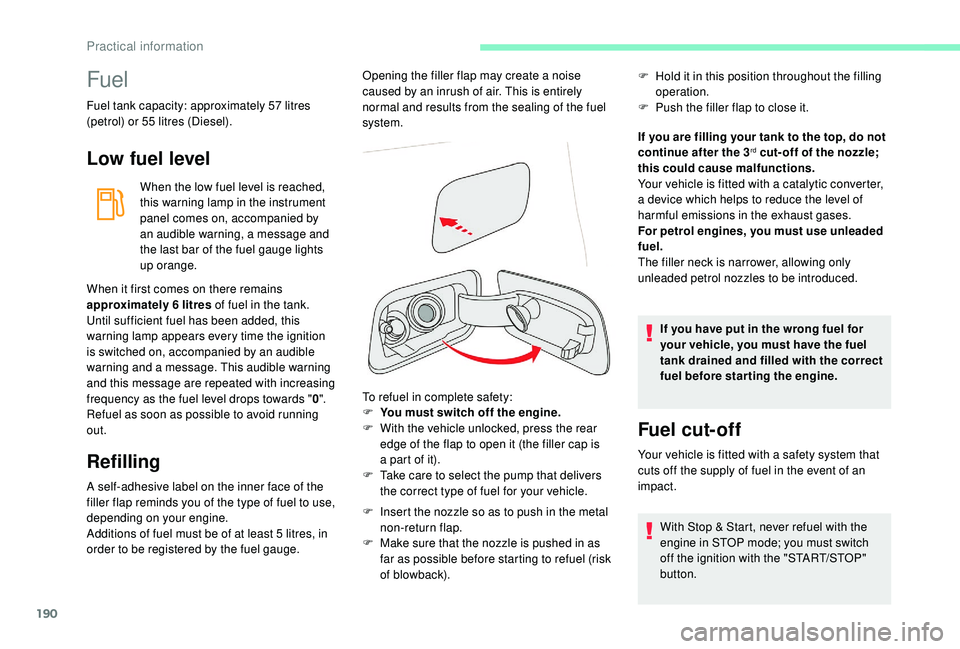
order to be registered by the fuel gauge. To refuel in complete safety:
F
Y
ou must switch off the engine.
F
W
ith the vehicle unlocked, press the rear
edge of the flap to open it (the filler cap is
a part of it).
F T ake care to select the pump that delivers
the correct type of fuel for your vehicle.
F
I
nsert the nozzle so as to push in the metal
non-return flap.
F
M
ake sure that the nozzle is pushed in as
far as possible before starting to refuel (risk
of blowback). If you are filling your tank to the top, do not
continue after the 3
rd cut- off of the nozzle;
this could cause malfunctions.
Your vehicle is fitted with a
catalytic converter,
a device which helps to reduce the level of
harmful emissions in the exhaust gases.
For petrol engines, you must use unleaded
fuel.
The filler neck is narrower, allowing only
unleaded petrol nozzles to be introduced.
If you have put in the wrong fuel for
your vehicle, you must have the fuel
tank drained and filled with the correct
fuel before star ting the engine.
Fuel cut- of f
Your vehicle is fitted with a safety system that
c uts off the supply of fuel in the event of an
impact.
Opening the filler flap may create a
noise
caused by an inrush of air. This is entirely
normal and results from the sealing of the fuel
system. F
H
old it in this position throughout the filling
operation.
F
P
ush the filler flap to close it.
With Stop & Start, never refuel with the
engine in STOP mode; you must switch
off the ignition with the "START/STOP"
button.
Practical information
Page 199 of 316
197
Maximum load, distributed over the roof
bars, for a loading height not exceeding
40
cm: 80 kg.
As this value may be changed, please
verify the maximum load quoted in the
user guide supplied with the roof bars.
If the height exceeds 40
cm, adapt the
speed of the vehicle to the profile of the
road to avoid damaging the roof bars and
the fixings on the vehicle.
Be sure to refer to national legislation in
order to comply with the regulations for
transporting objects which are longer than
the vehicle.
When carrying long objects, it is
recommended that the motorised tailgate
function is deactivated.
Very cold climate screen(s)
(Depending on the country where the product
is sold.)
Removable screen(s) which prevent snow
accumulating at the radiator cooling fan.
Depending on the version, you have one or two
screens. Before fitting or removing a
screen,
ensure that the engine is off and the
cooling fan has stopped.
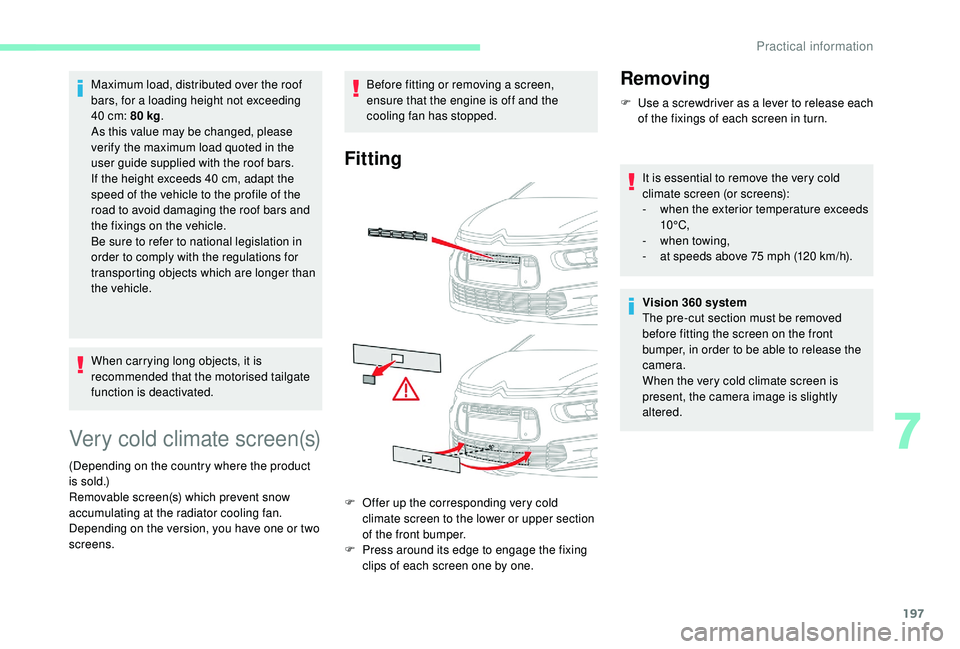
Fitting Removing
F Use a
screwdriver as a lever to release each
of the fixings of each screen in turn.
It is essential to remove the very cold
climate screen (or screens):
-
w
hen the exterior temperature exceeds
10°C,
-
w
hen towing,
-
a
t speeds above 75 mph (120 km/h).
Vision 360
system
The pre-cut section must be removed
before fitting the screen on the front
bumper, in order to be able to release the
camera.
When the very cold climate screen is
present, the camera image is slightly
altered.
F
O
ffer up the corresponding very cold
climate screen to the lower or upper section
of the front bumper.
F
P
ress around its edge to engage the fixing
clips of each screen one by one.
7
Practical information