cooling Citroen C4 PICASSO RHD 2014.5 1.G Owner's Manual
[x] Cancel search | Manufacturer: CITROEN, Model Year: 2014.5, Model line: C4 PICASSO RHD, Model: Citroen C4 PICASSO RHD 2014.5 1.GPages: 428, PDF Size: 10.03 MB
Page 33 of 428

31
Warning lamps
When the engine is running or the vehicle is being driven, illumination of one of the following warning lamps indicates a fault which requires action on the part of the driver.
Any
fault resulting in the illumination of a warning lamp must be investigated further using the associated message.
If
you encounter any problems, contact a CITROËN dealer or a qualified workshop.
Warning / indicator lamp StateCause Action / Observations
STOP fixed,
associated with
a
nother warning lamp,
a
ccompanied by an
a
udible signal and a
m
essage.Illumination
of this warning lamp is
r
elated to a serious fault detected
w
ith the braking or power steering
s
ystems, the electrical system, or
w
ith engine lubrication or cooling or
a pu
ncture.Stop
as soon as it is safe to do so as the engine may
c
ut out.
Park,
switch off the ignition and call a CITROËN
d
ealer or a qualified workshop.
1
Monitoring
Page 38 of 428
36
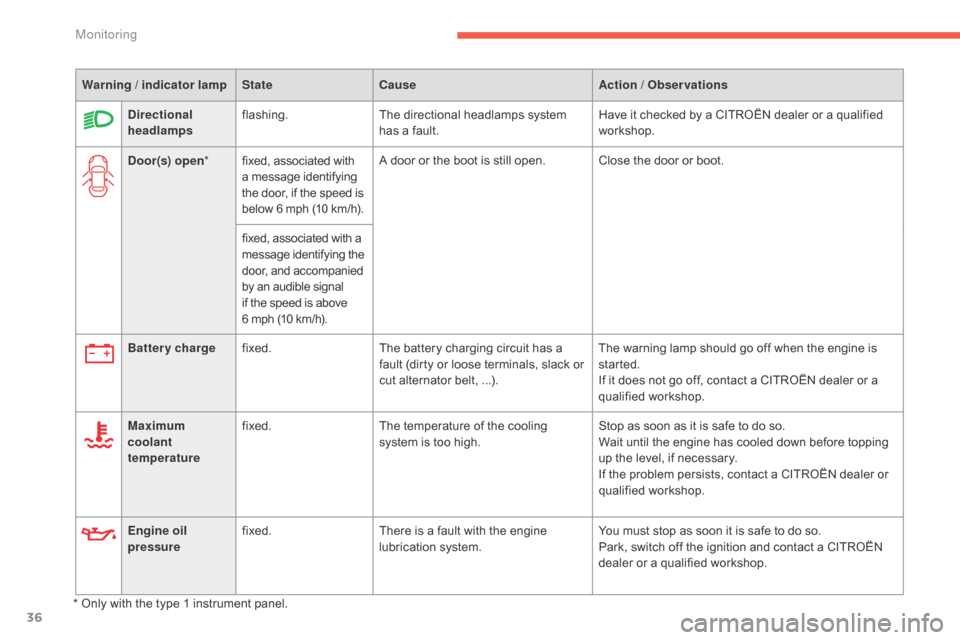
Warning / indicator lampStateCause Action / Observations
Battery charge fixed. The
battery charging circuit has a
f
ault (dirty or loose terminals, slack or
c
ut alternator belt, ...).The
warning lamp should go off when the engine is
s
tarted.
If
it does not go off, contact a CITROËN dealer or a
q
ualified
w
orkshop.
Maximum
coolant
temperature fixed.
The
temperature of the cooling
s
ystem is too high.Stop
as soon as it is safe to do so.
Wait
until the engine has cooled down before topping
u
p the level, if necessary.
If
the problem persists, contact a CITROËN dealer or
q
ualified
w
orkshop.
Directional
headlamps
flashing.
The
directional headlamps system
h
as a fault.Have
it checked by a CITROËN dealer or a qualified
w
orkshop.
Door(s) open *fixed,
associated with
a m
essage
id
entifying
t
he door, if the speed is
b
elow 6 mph (10 km/h).A
door or the boot is still open. Close the door or boot.
fixed,
associated with a
m
essage
id
entifying
th
e
d
oor, and accompanied
b
y an audible signal
i
f the speed is above
6
mph (10 km/h).
*
Only with the type 1 instrument panel.
Engine oil
pressure
fixed.
There
is a fault with the engine
l
ubrication system.You
must stop as soon it is safe to do so.
Park,
switch off the ignition and contact a CITROËN
d
ealer or a qualified workshop.
Monitoring
Page 96 of 428

94
Ventilation
Air intake
The air circulating in the passenger compartment is filtered and originates either from the outside via t
he grille located at the base of the windscreen or
f
rom the inside in air recirculation mode.
Air treatment
The incoming air follows various routes depending on the controls selected by the
d
river:
-
d
irect arrival in the passenger
c
ompartment (air intake),
-
p
assage through a heating circuit (heating),
-
p
assage through a cooling circuit (air
c
onditioning).
Control panel
The controls of this system are accessible in the " Air conditioning "
menu of the touch
s
creen tablet A .
The
demisting/defrosting controls for the
w
indscreen and rear screen are located on the
l
eft of the touch screen tablet. 1. W
indscreen d emisting-defrosting v ents.
2. F ront quarter light demisting-defrosting
ve
nts.
3.
F
ront side window demisting/defrosting
ve
nts.
A
djustable side air vents.4. C
entral adjustable air vents.
5. A ir outlets for the front footwells.
6.
S
ide vents for the 2
nd row.
7. A
ir
outlets
for
2nd row footwells.
8. S
unshine s
ensor.
Air distribution
Comfort
Page 104 of 428

102
Avoid prolonged operation of the air recirculation function (risk of misting
a
nd of deterioration of the air quality).
"Mono" function
The comfort setting for the passenger's side can be indexed to the driver's comfort setting
(
mono-zone).
From
the secondary page of the "Air
conditioning "
menu:
F
P
ress this button to activate /
d
eactivate the "Mono" function.
T
he indicator lamp in the button
i
s on when the function is
activated.
The
function is deactivated automatically when
t
he
p
assenger
u
ses
t
heir
t
emperature
se
tting
b
uttons.
It
allows
you:
-
i
n
summer,
to
lower
the
temperature,
-
i
n
winter,
above
3
°C,
to
improve
demisting.
Switching off
F
P
ress the "A /C "
button
again
to
deactivate
t
he
air
conditioning.
W
hen
the
indicator
lamp
under
the
button
i
s
off,
the
air
conditioning
function
is
d
eactivated.
Switching on
F
P
ress the " A/C" button to activate the air
conditioning
W
hen
the
indicator
lamp
under
the
button
i
s
on,
the
air
conditioning
function
is
a
ctivated.
The
air
conditioning
cannot
operate
when
the
a
ir
flow
is
set
to
off.
Air conditioning On/Off
The air conditioning is designed to o perate efficiently in all seasons, with
the
windows closed. The
intake of exterior air avoids misting of the w
indscreen and side windows.
Air intake/Air recirculation
Air recirculation prevents exterior odours and s
moke from entering the passenger compartment.
This
function also allows faster heating
o
r cooling of the air in the passenger
c
ompartment. F
P
ress this button to choose
the
mode for air entry to the
p
assenger
c
ompartment.
When
the indicator lamp under the button is off,
t
he intake of exterior air is active.
When
the indicator lamp under the button is
o
n, air recirculation is activated, the intake of
e
xterior air is off.
Comfort
Page 300 of 428

298
Driving advice
Distribution of loads
F Distribute the load in the trailer so that the h
eaviest items are as close as possible to t
he axle and the nose weight approaches the
m
aximum permitted without exceeding it.
Air
density decreases with altitude, thus
r
educing engine per formance. Above
1 0
00 metres, the maximum towed load must
b
e reduced by 10 % for every 1 000 metres of
al
titude.
Side wind
F Take into account the increased sensitivity t
o side wind.
Cooling
Towing a trailer on a slope increases the temperature of the coolant.
As
the fan is electrically controlled, its cooling
c
apacity is not dependent on the engine speed.
F
T
o lower the engine speed, reduce your
s
peed.
The
maximum towed load on a long incline
d
epends on the gradient and the ambient
t
emperature.
In
all cases, keep a check on the coolant
t
emperature. F
I
f the warning lamp and the
S
TOP
warning lamp come on,
s
top the vehicle and switch off
t
he engine as soon as possible.
Braking
Towing a trailer increases the braking distance.
T o avoid overheating of the brakes on a long
m
ountain type of descent, the use of engine
b
raking is recommended.
Ty r e s
F Check the tyre pressures of the towing v
ehicle and of the trailer, observing the
re
commended
p
ressures.
Lighting
F Check the electrical lighting and signalling o
n the trailer.
Refer
to
the
"Technical
data"
section
for
details
o
f
the
weights
and
towed
loads
which
apply
to
y
our
vehicle.
When
not
towing
a
trailer,
remove
the
q
uickly-detachable
tow
ball
before
d
riving. The
rear parking sensors will be
d
eactivated automatically if a genuine
C
ITROËN towbar is used.
Practical information
Page 303 of 428

301
Very cold climate screen*
Removable protective screen which prevents the accumulation of snow at the radiator cooling fan.
F
O
ffer up the very cold climate screen to
t
he front of the lower section of the front
b u m p e r.
F
P
ress around its edge to engage its fixing
c
lips one by one. F
U
se a screwdriver as a lever to release
e
ach fixing clip in turn.
*
According to country.
Do
not forget to remove the very cold climate
s
creen
w
hen:
-
t
he ambient temperature exceeds 10 °C,
-
tow
ing,
-
d
riving at speeds above 75 mph
(120
km/h).
Removal
Fitting
360 Vision system
The pre-cut zone must be removed b
efore fitting the screen to the front
b
umper, to allow operation of the
c
amera.
When
the very cold climate screen
i
s fitted, the image provided by the
c
amera is slightly different.
7
Practical information
Page 307 of 428
305
bonnet
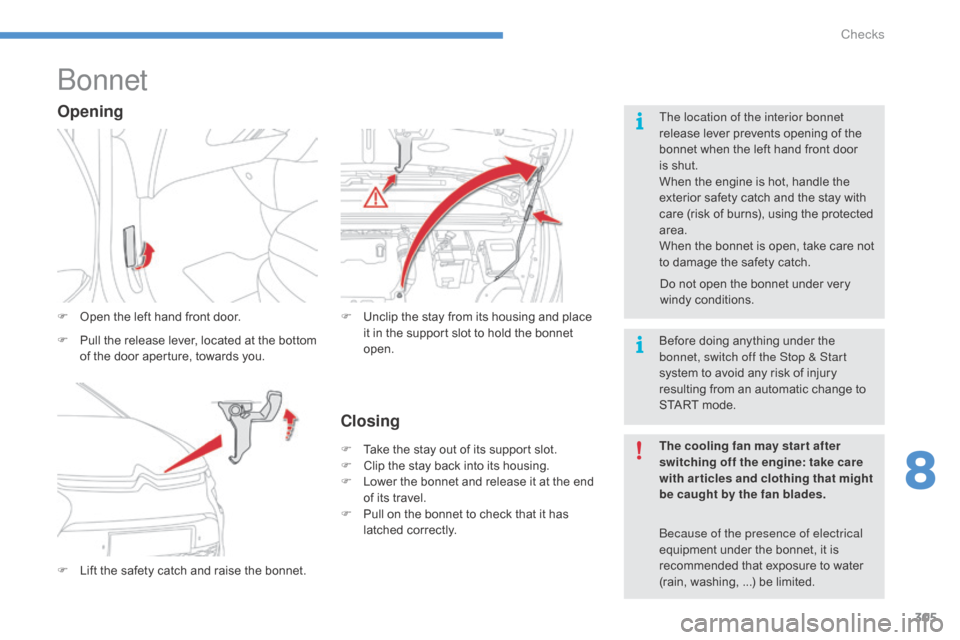
F Open the left hand front door.
F
L
ift the safety catch and raise the bonnet.F
U nclip the stay from its housing and place i
t in the support slot to hold the bonnet
ope
n.
Opening
F Pull the release lever, located at the bottom o
f the door aperture, towards you.
Closing
F Take the stay out of its support slot.
F C lip the stay back into its housing.
F
L
ower the bonnet and release it at the end
o
f its travel.
F
P
ull on the bonnet to check that it has
l
atched correctly. Before
doing anything under the
b
onnet, switch off the Stop & Start
system to avoid any risk of injury
r
esulting from an automatic change to
S
TART mode.
The cooling fan may star t after
switching off the engine: take care
with articles and clothing that might
be caught by the fan blades. Do
not open the bonnet under very
wi
ndy
c
onditions.
The location of the interior bonnet
release lever prevents opening of the
b
onnet when the left hand front door
i
s shut.
When the engine is hot, handle the
e
xterior safety catch and the stay with
c
are (risk of burns), using the protected
a
rea.
When the bonnet is open, take care not
t
o damage the safety catch.
be
cause of the presence of electrical
equipment
under the bonnet, it is
r
ecommended that exposure to water
(
rain, washing, ...) be limited.
8
Checks
Page 315 of 428

313
Checking levels
Take care when working under the bonnet, as certain areas of the engine may be extremely hot (risk of burns) and the cooling fan could start at any time (even with the ignition off).
Engine oil level
The check is carried out either when the ignition is switched on using the
o
il level indicator in the instrument
p
anel for vehicles with an electric oil
level
gauge, or using the dipstick.Checking using the dipstick
Refer to the "Petrol engine" or "Diesel engine" section for the location of the dipstick in the
e
ngine compartment of your vehicle.
F
T
ake the dipstick by its coloured grip and
r
emove it completely.
F
W
ipe the end of the dipstick using a clean
n
on-fluffy cloth.
F
R
efit the dipstick and push fully down, then
p
ull it out again to make the visual check:
t
he correct level is between the marks A
and
B.
It
is
normal
to
top
up
the
oil
level
between
t
wo
services
(or
oil
changes).
CITROËN
r
ecommends
that
you
check
the
level,
and
top
u
p
if
necessary,
every
3
000
miles
(5
000
kms).
Check
all
of
these
levels
regularly,
in
line
with
the
manufacturer's service schedule. Top them up if necessary, unless other wise indicated.
If
a
level
drops
significantly,
have
the
corresponding system checked by a CITROËN dealer or a qualified workshop.
To
ensure
that
the
reading
is
correct,
y
our
vehicle
must
be
parked
on
a
level
s
ur face
with
the
engine
having
been
off
f
or
more
than
30
minutes. A = M
aX
B
= MI
n
I
f you find that the level is above the A mark or
belo
w the B mark, do not star t the engine.
-
I
f the level is above the MAX
mark (risk
o
f damage to the engine), contact a
C
ITROËN dealer or a qualified workshop.
-
I
f the level is below the MIN
mark, you
m
ust top up the engine oil.
8
Checks
Page 317 of 428

315
Coolant level
The coolant level should be close to the "MA X" mark but should never
e
xceed it.
In
addition, as the cooling system is pressurised,
w
ait
at
least one hour after switching off the
e
ngine
before carrying out any work.
To
avoid
any risk of scalding, unscrew the cap
b
y
two
turns to allow the pressure to drop. When
t
he
pressure has dropped, remove the cap and
t
op
up
the
level.
Fluid specification
The coolant must conform to the ma nufacturer's r ecommendations.
The
brake
fluid
level
should
be
close
t
o
the
"MA X"
mark.
If
it
is
not,
check
t
he
brake
pad
wear.
Brake fluid level
Changing the fluid
Refer to the manufacturer's service schedule f
or details of the interval for this operation.
Fluid specification
The brake fluid must conform to the manufacturer's r ecommendations. The cooling fan may star t after switching
off the engine: take care with ar ticles and
clothing that might be caught by the fan
blades. When the engine is warm, the temperature of
t
he coolant is regulated by the fan.
8
Checks