ignition Citroen C4 RHD 2012 2.G Repair Manual
[x] Cancel search | Manufacturer: CITROEN, Model Year: 2012, Model line: C4 RHD, Model: Citroen C4 RHD 2012 2.GPages: 324, PDF Size: 28.17 MB
Page 163 of 324
9
DRIVING
161
BLIND SPOT SENSORS
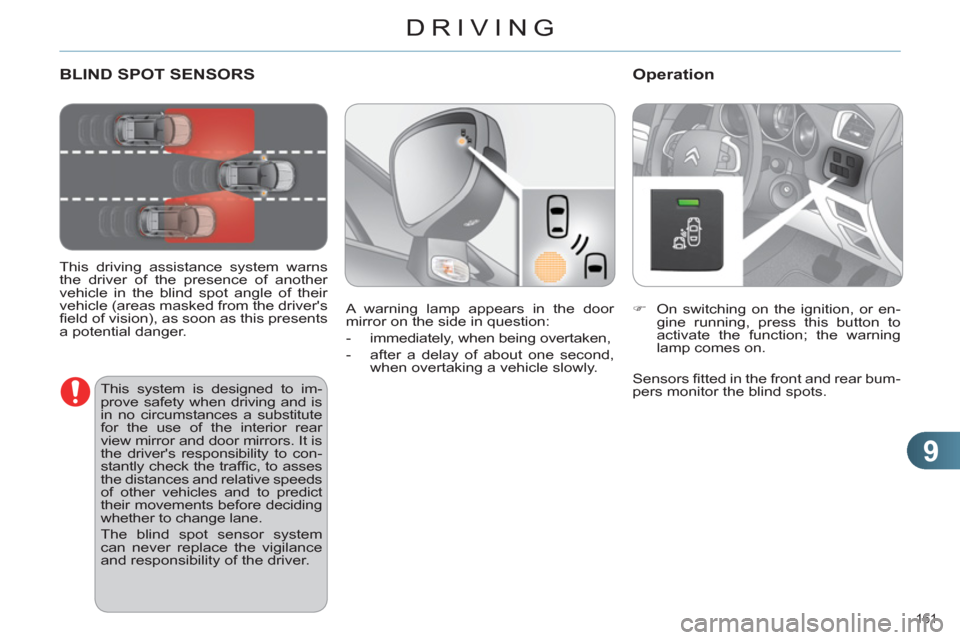
This driving assistance system warns
the driver of the presence of another
vehicle in the blind spot angle of their
vehicle (areas masked from the driver's
fi eld of vision), as soon as this presents
a potential danger.
Operation
)
On switching on the ignition, or en-
gine running, press this button to
activate the function; the warning
lamp comes on.
This system is designed to im-
prove safety when driving and is
in no circumstances a substitute
for the use of the interior rear
view mirror and door mirrors. It is
the driver's responsibility to con-
stantly check the traffi c, to asses
the distances and relative speeds
of other vehicles and to predict
their movements before deciding
whether to change lane.
The blind spot sensor system
can never replace the vigilance
and responsibility of the driver.
Sensors fi tted in the front and rear bum-
pers monitor the blind spots. A warning lamp appears in the door
mirror on the side in question:
- immediately, when being overtaken,
- after a delay of about one second,
when overtaking a vehicle slowly.
Page 165 of 324
9
DRIVING
163
The system may suffer tem-
porary interference in certain
weather conditions (rain, hail...).
In particular, driving on a wet sur-
face or moving from a dry area to
a wet area can cause false alerts
(for example, the presence of a
fog of water droplets in the blind
spot angle is interpreted as a ve-
hicle).
In bad or wintry weather, ensure
that the sensors are not covered
by mud, ice or snow.
Take care not to cover the warn-
ing zone in the door mirrors or
the detection zones on the front
and rear bumpers with adhesive
labels or other objects; they may
hamper the correct operation of
the system.
)
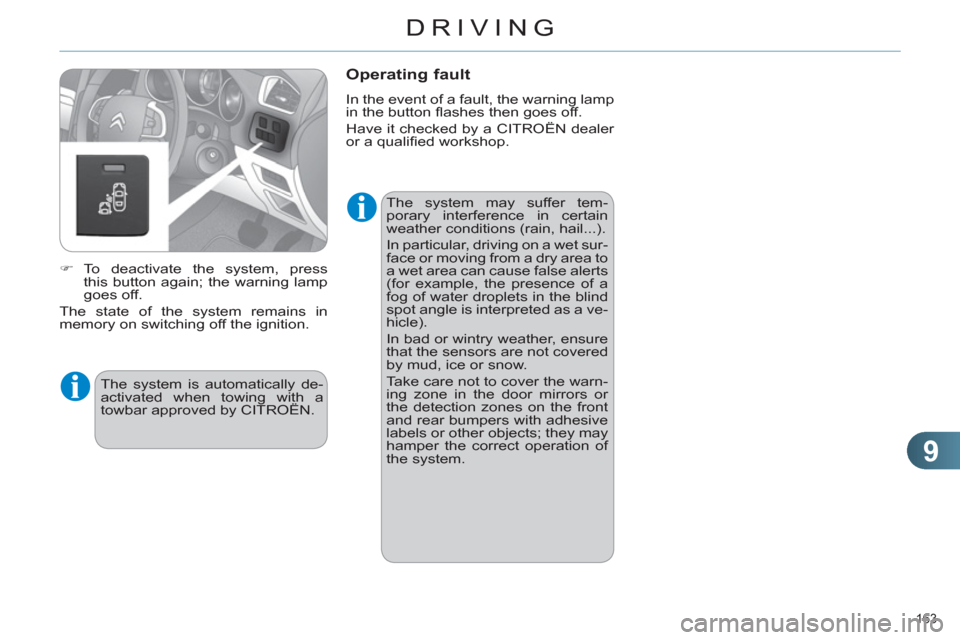
To deactivate the system, press
this button again; the warning lamp
goes off.
The state of the system remains in
memory on switching off the ignition.
Operating fault
In the event of a fault, the warning lamp
in the button fl ashes then goes off.
Have it checked by a CITROËN dealer
or a qualifi ed workshop.
The system is automatically de-
activated when towing with a
towbar approved by CITROËN.
Page 167 of 324
9
DRIVING
165
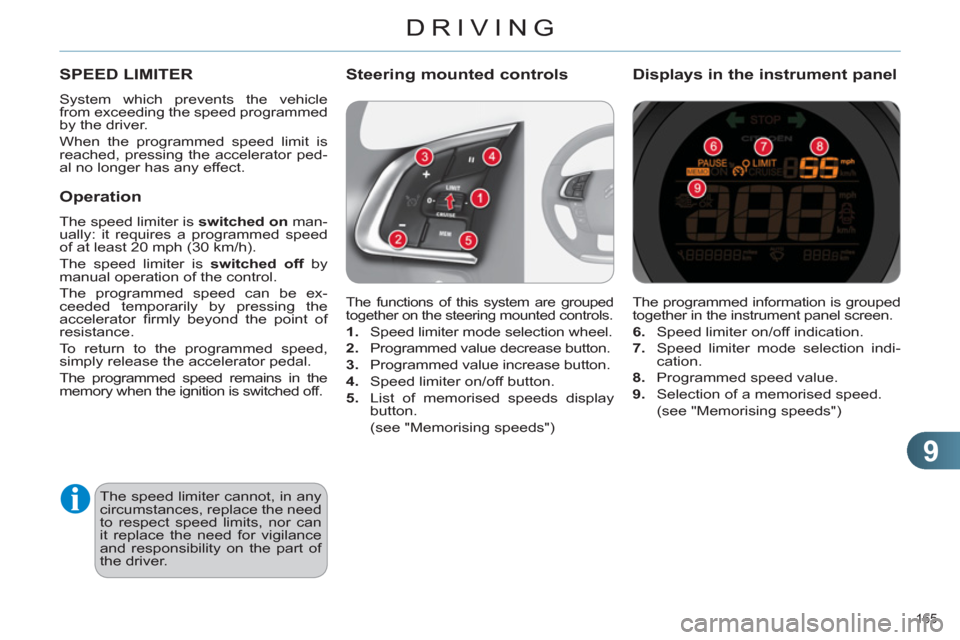
The programmed information is grouped
together in the instrument panel screen.
6.
Speed limiter on/off indication.
7.
Speed limiter mode selection indi-
cation.
8.
Programmed speed value.
9.
Selection of a memorised speed.
(see "Memorising speeds")
Displays in the instrument panel
SPEED LIMITER
System which prevents the vehicle
from exceeding the speed programmed
by the driver.
When the programmed speed limit is
reached, pressing the accelerator ped-
al no longer has any effect.
The speed limiter cannot, in any
circumstances, replace the need
to respect speed limits, nor can
it replace the need for vigilance
and responsibility on the part of
the driver.
The functions of this system are grouped
together on the steering mounted controls.
1.
Speed limiter mode selection wheel.
2.
Programmed value decrease button.
3.
Programmed value increase button.
4.
Speed limiter on/off button.
5.
List of memorised speeds display
button.
(see "Memorising speeds")
Steering mounted controls
Operation
The speed limiter is switched on
man-
ually: it requires a programmed speed
of at least 20 mph (30 km/h).
The speed limiter is switched off
by
manual operation of the control.
The programmed speed can be ex-
ceeded temporarily by pressing the
accelerator fi rmly beyond the point of
resistance.
To return to the programmed speed,
simply release the accelerator pedal.
The programmed speed remains in the
memory when the ignition is switched off.
Page 169 of 324
9
DRIVING
167
The cruise control system can-
not, in any circumstances, re-
place the need to respect speed
limits, nor can it replace the need
for vigilance and responsibility
on the part of the driver.
You are advised to keep your
feet near the pedals at all times.
CRUISE CONTROL
System which automatically maintains
the speed of the vehicle at the value
programmed by the driver, without any
action on the accelerator pedal.
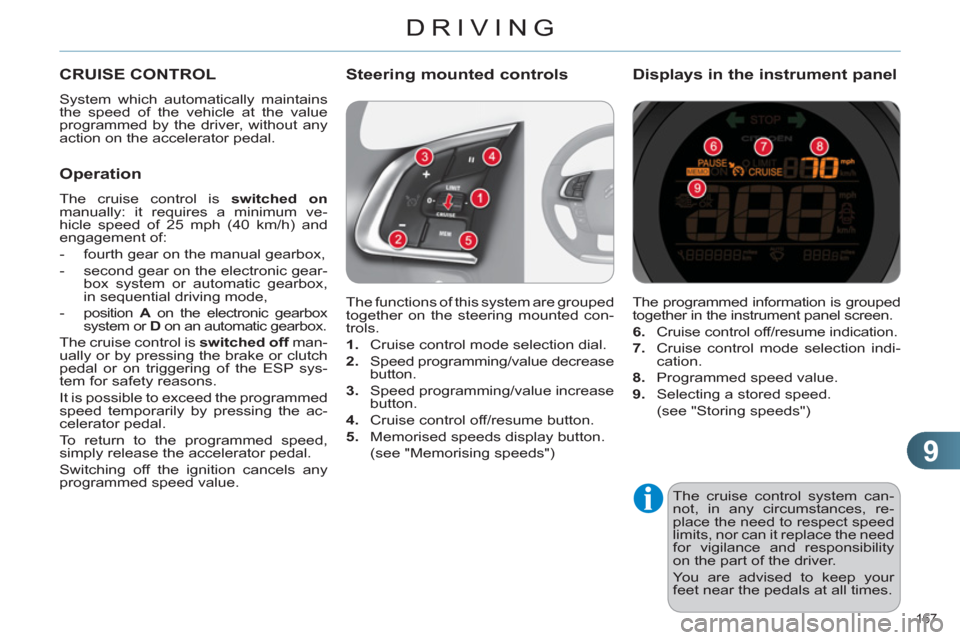
The functions of this system are grouped
together on the steering mounted con-
trols.
1.
Cruise control mode selection dial.
2.
Speed programming/value decrease
button.
3.
Speed programming/value increase
button.
4.
Cruise control off/resume button.
5.
Memorised speeds display button.
(see "Memorising speeds")
Steering mounted controls
The programmed information is grouped
together in the instrument panel screen.
6.
Cruise control off/resume indication.
7.
Cruise control mode selection indi-
cation.
8.
Programmed speed value.
9.
Selecting a stored speed.
(see "Storing speeds")
Displays in the instrument panel
Operation
The cruise control is switched on
manually: it requires a minimum ve-
hicle speed of 25 mph (40 km/h) and
engagement of:
- fourth gear on the manual gearbox,
- second gear on the electronic gear-
box system or automatic gearbox,
in sequential driving mode,
-
position A
on the electronic gearbox
system or D
on an automatic gearbox.
The cruise control is switched off
man-
ually or by pressing the brake or clutch
pedal or on triggering of the ESP sys-
tem for safety reasons.
It is possible to exceed the programmed
speed temporarily by pressing the ac-
celerator pedal.
To return to the programmed speed,
simply release the accelerator pedal.
Switching off the ignition cancels any
programmed speed value.
Page 172 of 324
9
DRIVING
170
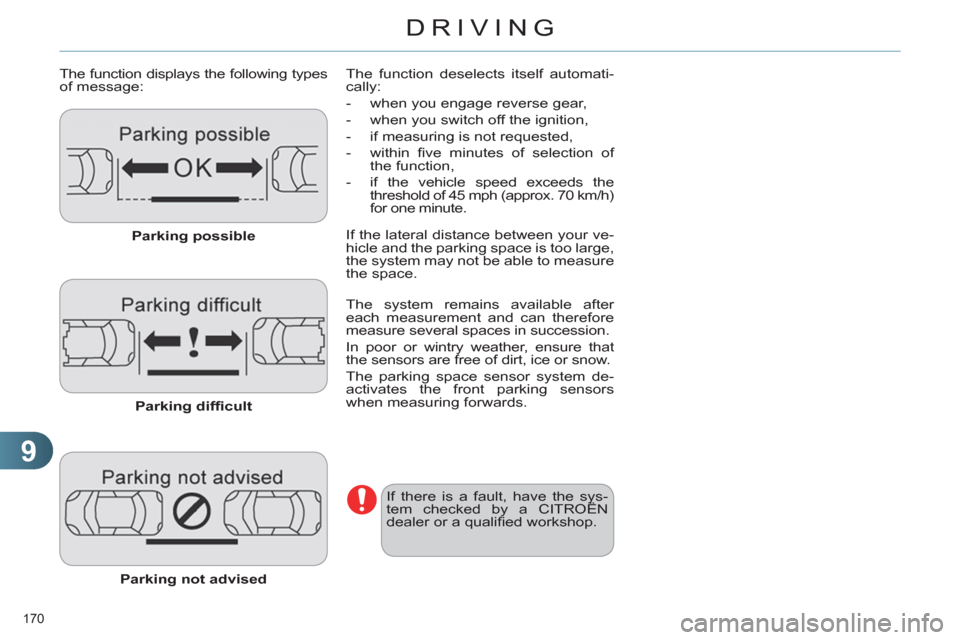
The function displays the following types
of message:
Parking possible
Parking diffi cult
Parking not advised
The function deselects itself automati-
cally:
- when you engage reverse gear,
- when you switch off the ignition,
- if measuring is not requested,
- within fi ve minutes of selection of
the function,
- if the vehicle speed exceeds the
threshold of 45 mph (approx. 70 km/h)
for one minute.
If the lateral distance between your ve-
hicle and the parking space is too large,
the system may not be able to measure
the space.
If there is a fault, have the sys-
tem checked by a CITROËN
dealer or a qualifi ed workshop.
The system remains available after
each measurement and can therefore
measure several spaces in succession.
In poor or wintry weather, ensure that
the sensors are free of dirt, ice or snow.
The parking space sensor system de-
activates the front parking sensors
when measuring forwards.
Page 180 of 324
10
CHECKS
178
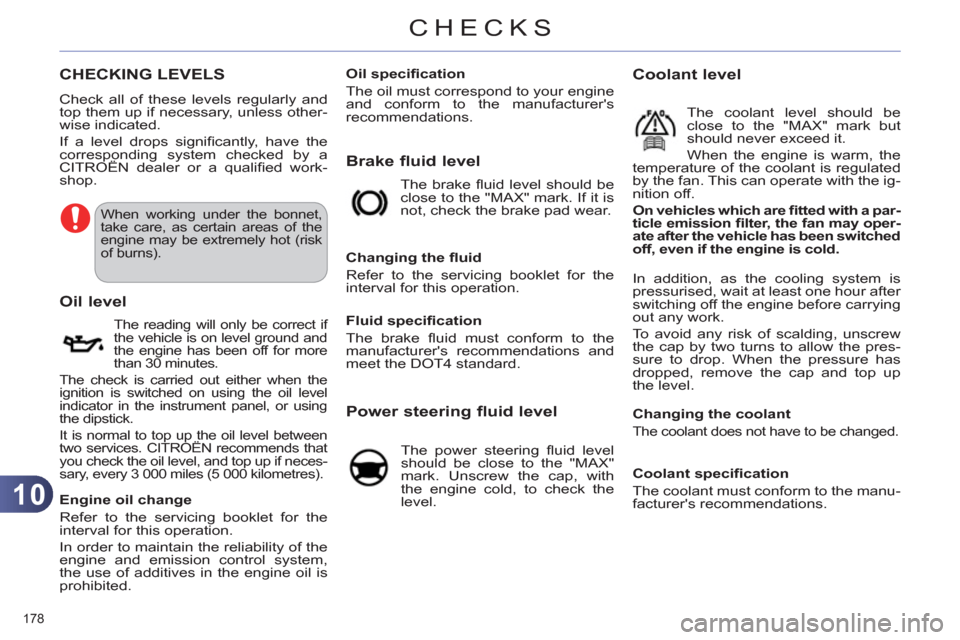
CHECKING LEVELS
Check all of these levels regularly and
top them up if necessary, unless other-
wise indicated.
If a level drops signifi cantly, have the
corresponding system checked by a
CITROËN dealer or a qualifi ed work-
shop.
When working under the bonnet,
take care, as certain areas of the
engine may be extremely hot (risk
of burns).
The reading will only be correct if
the vehicle is on level ground and
the engine has been off for more
than 30 minutes.
The check is carried out either when the
ignition is switched on using the oil level
indicator in the instrument panel, or using
the dipstick.
It is normal to top up the oil level between
two services. CITROËN recommends that
you check the oil level, and top up if neces-
sary, every 3 000 miles (5 000 kilometres).
Oil level
Engine oil change
Refer to the servicing booklet for the
interval for this operation.
In order to maintain the reliability of the
engine and emission control system,
the use of additives in the engine oil is
prohibited.
Oil specifi cation
The oil must correspond to your engine
and conform to the manufacturer's
recommendations.
Brake fluid level
The brake fl uid level should be
close to the "MAX" mark. If it is
not, check the brake pad wear.
Changing the fl uid
Refer to the servicing booklet for the
interval for this operation.
Fluid specifi cation
The brake fl uid must conform to the
manufacturer's recommendations and
meet the DOT4 standard.
Power steering fluid level
The power steering fl uid level
should be close to the "MAX"
mark. Unscrew the cap, with
the engine cold, to check the
level.
Coolant level
The coolant level should be
close to the "MAX" mark but
should never exceed it.
When the engine is warm, the
temperature of the coolant is regulated
by the fan. This can operate with the ig-
nition off.
On vehicles which are fi tted with a par-
ticle emission fi lter, the fan may oper-
ate after the vehicle has been switched
off, even if the engine is cold.
In addition, as the cooling system is
pressurised, wait at least one hour after
switching off the engine before carrying
out any work.
To avoid any risk of scalding, unscrew
the cap by two turns to allow the pres-
sure to drop. When the pressure has
dropped, remove the cap and top up
the level.
Changing the coolant
The coolant does not have to be changed.
Coolant specifi cation
The coolant must conform to the manu-
facturer's recommendations.
Page 185 of 324
11
PRACTICAL INFORMATION
183
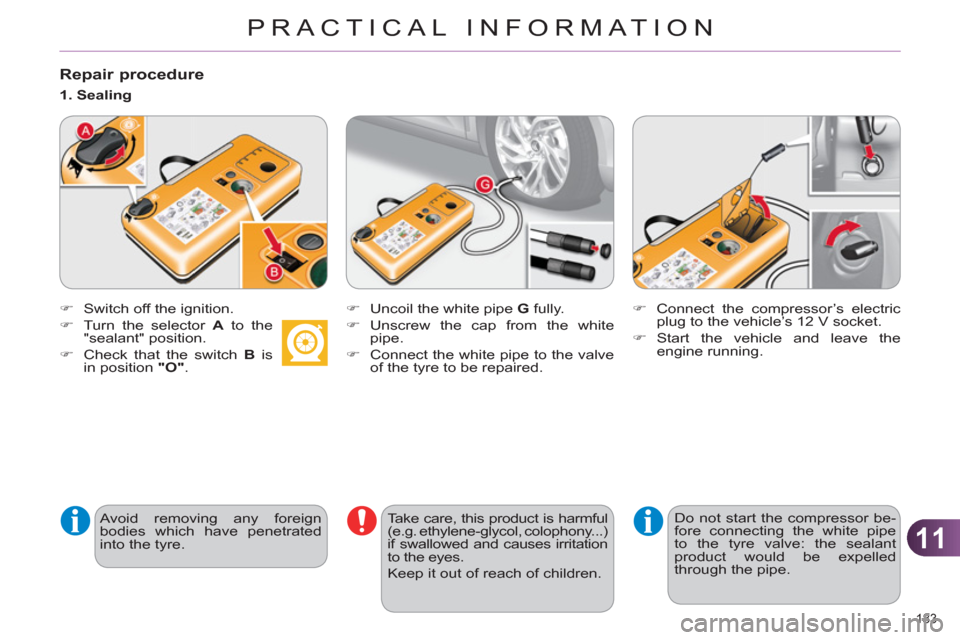
Repair procedure
)
Switch off the ignition.
)
Turn the selector A
to the
"sealant" position.
)
Check that the switch B
is
in position "O"
.
Avoid removing any foreign
bodies which have penetrated
into the tyre.
1. Sealing
)
Uncoil the white pipe G
fully.
)
Unscrew the cap from the white
pipe.
)
Connect the white pipe to the valve
of the tyre to be repaired.
)
Connect the compressor’s electric
plug to the vehicle’s 12 V socket.
)
Start the vehicle and leave the
engine running.
Do not start the compressor be-
fore connecting the white pipe
to the tyre valve: the sealant
product would be expelled
through the pipe.
Take care, this product is harmful
(e.g. ethylene-glycol, colophony...)
if swallowed and causes irritation
to the eyes.
Keep it out of reach of children.
Page 191 of 324
11
PRACTICAL INFORMATION
189
Removing a wheel
Parking the vehicle
Immobilise the vehicle where it
does not block traffi c: the ground
must be level, stable and non-
slippery ground.
Apply the parking brake unless it
has been programmed to auto-
matic mode, switch off the ignition
and engage fi rst gear * to lock the
wheels.
Check that the braking warning
lamps in the instrument panel
are on (not fl ashing).
The occupants must get out of
the vehicle and wait where they
are safe.
If necessary, place a chock under
the wheel diagonally opposite the
wheel to be changed.
Never go underneath a vehicle
raised using a jack; use an axle
stand.
*
position R
for the electronic gearbox
system; P
for an automatic gearbox.
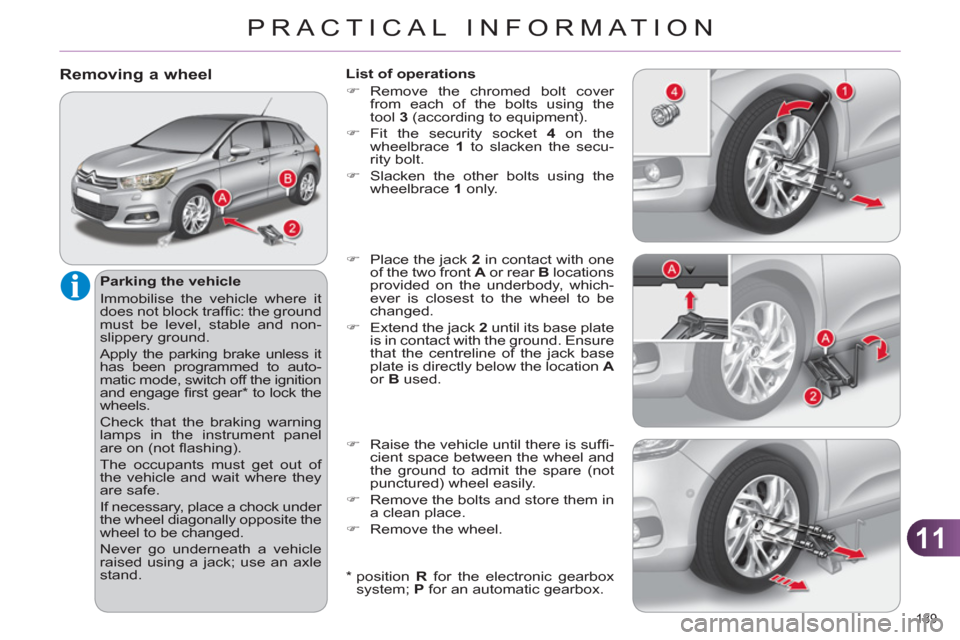
List of operations
)
Remove the chromed bolt cover
from each of the bolts using the
tool 3
(according to equipment).
)
Fit the security socket 4
on the
wheelbrace 1
to slacken the secu-
rity bolt.
)
Slacken the other bolts using the
wheelbrace 1
only.
)
Place the jack 2
in contact with one
of the two front A
or rear B
locations
provided on the underbody, which-
ever is closest to the wheel to be
changed.
)
Extend the jack 2
until its base plate
is in contact with the ground. Ensure
that the centreline of the jack base
plate is directly below the location A
or B
used.
)
Raise the vehicle until there is suffi -
cient space between the wheel and
the ground to admit the spare (not
punctured) wheel easily.
)
Remove the bolts and store them in
a clean place.
)
Remove the wheel.
Page 199 of 324
11
PRACTICAL INFORMATION
197
CHANGING A FUSE
Access to the tools
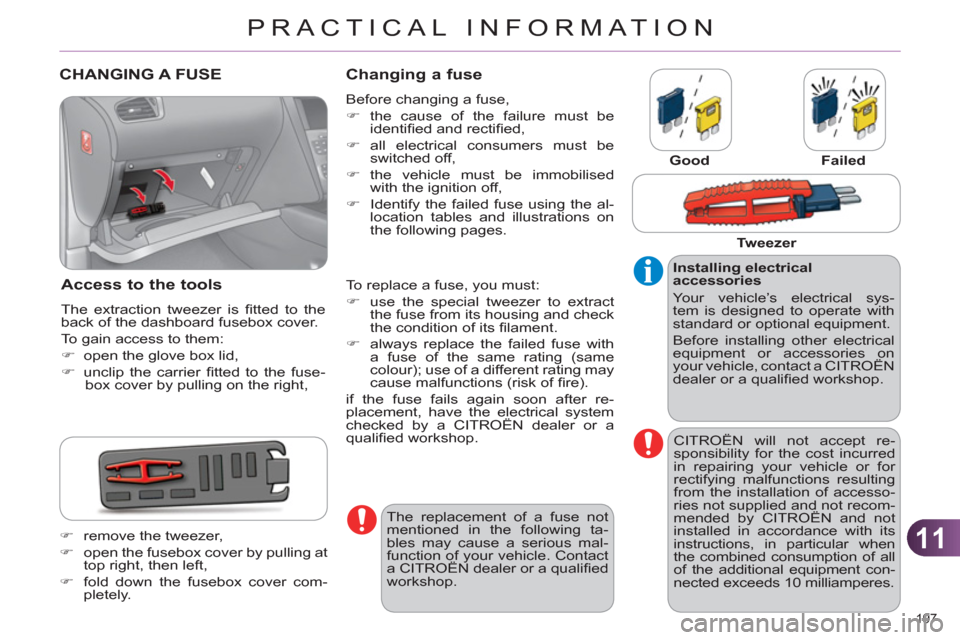
The extraction tweezer is fi tted to the
back of the dashboard fusebox cover.
To gain access to them:
)
open the glove box lid,
)
unclip the carrier fi tted to the fuse-
box cover by pulling on the right,
Changing a fuse
Before changing a fuse,
)
the cause of the failure must be
identifi ed and rectifi ed,
)
all electrical consumers must be
switched off,
)
the vehicle must be immobilised
with the ignition off,
)
Identify the failed fuse using the al-
location tables and illustrations on
the following pages.
Good
Failed
To replace a fuse, you must:
)
use the special tweezer to extract
the fuse from its housing and check
the condition of its fi lament.
)
always replace the failed fuse with
a fuse of the same rating (same
colour); use of a different rating may
cause malfunctions (risk of fi re).
if the fuse fails again soon after re-
placement, have the electrical system
checked by a CITROËN dealer or a
qualifi ed workshop.
Installing electrical
accessories
Your vehicle’s electrical sys-
tem is designed to operate with
standard or optional equipment.
Before installing other electrical
equipment or accessories on
your vehicle, contact a CITROËN
dealer or a qualifi ed workshop.
CITROËN will not accept re-
sponsibility for the cost incurred
in repairing your vehicle or for
rectifying malfunctions resulting
from the installation of accesso-
ries not supplied and not recom-
mended by CITROËN and not
installed in accordance with its
instructions, in particular when
the combined consumption of all
of the additional equipment con-
nected exceeds 10 milliamperes.
The replacement of a fuse not
mentioned in the following ta-
bles may cause a serious mal-
function of your vehicle. Contact
a CITROËN dealer or a qualifi ed
workshop.
Tweezer
)
remove the tweezer,
)
open the fusebox cover by pulling at
top right, then left,
)
fold down the fusebox cover com-
pletely.
Page 204 of 324
11
PRACTICAL INFORMATION
202
Charging the battery using a
battery charger
)
Operate the starter, let the engine
run.
)
Wait until the engine returns to idle
and disconnect the cables.
It is advisable to disconnect the
battery if the vehicle is to be left
unused for more than one month. The batteries contain harmful
substances such as sulphuric
acid and lead. They must be
disposed of in accordance with
regulations and must not, in any
circumstances, be discarded
with household waste.
Take used remote control bat-
teries and vehicle batteries to a
special collection point.
)
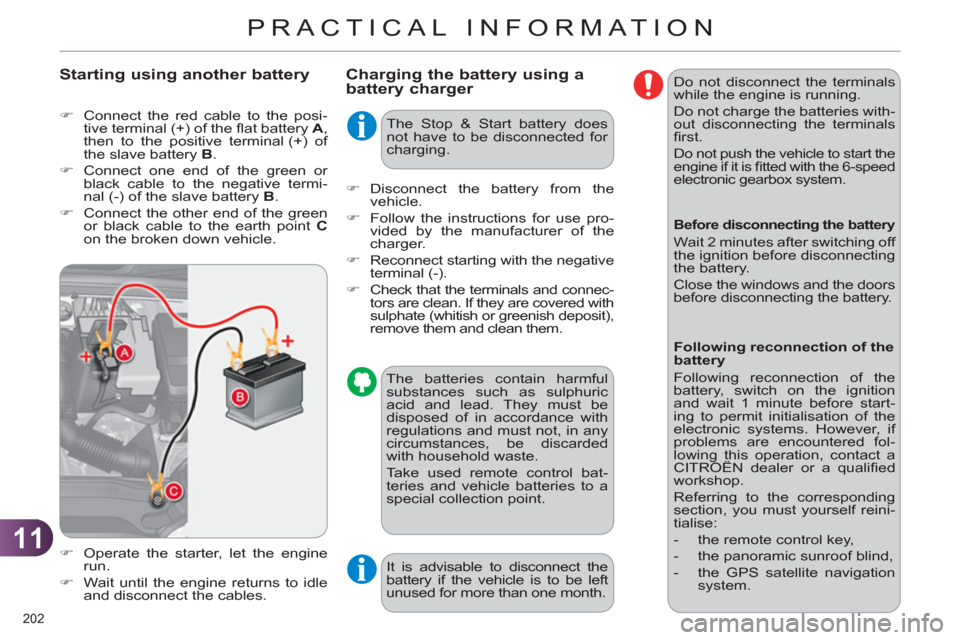
Connect the red cable to the posi-
tive terminal (+) of the fl at battery A
,
then to the positive terminal (+) of
the slave battery B
.
)
Connect one end of the green or
black cable to the negative termi-
nal (-) of the slave battery B
.
)
Connect the other end of the green
or black cable to the earth point C
on the broken down vehicle.
Starting using another battery
The Stop & Start battery does
not have to be disconnected for
charging.
)
Disconnect the battery from the
vehicle.
)
Follow the instructions for use pro-
vided by the manufacturer of the
charger.
)
Reconnect starting with the negative
terminal (-).
)
Check that the terminals and connec-
tors are clean. If they are covered with
sulphate (whitish or greenish deposit),
remove them and clean them.
Do not disconnect the terminals
while the engine is running.
Do not charge the batteries with-
out disconnecting the terminals
fi rst.
Do not push the vehicle to start the
engine if it is fi tted with the 6-speed
electronic gearbox system.
Before disconnecting the battery
Wait 2 minutes after switching off
the ignition before disconnecting
the battery.
Close the windows and the doors
before disconnecting the battery.
Following reconnection of the
battery
Following reconnection of the
battery, switch on the ignition
and wait 1 minute before start-
ing to permit initialisation of the
electronic systems. However, if
problems are encountered fol-
lowing this operation, contact a
CITROËN dealer or a qualifi ed
workshop.
Referring to the corresponding
section, you must yourself reini-
tialise:
- the remote control key,
- the panoramic sunroof blind,
- the GPS satellite navigation
system.