air condition CITROEN C5 2011 User Guide
[x] Cancel search | Manufacturer: CITROEN, Model Year: 2011, Model line: C5, Model: CITROEN C5 2011Pages: 348, PDF Size: 10.72 MB
Page 76 of 348

74
C5_en_Chap03_ergonomie-et-confort_ed01-2016
5. Air flow adjustment
Reducing the air flow to minimum switches
the air conditioning system OFF.
To prevent condensation and deterioration
of the quality of the air in the passenger
compartment, ensure that an adequate flow of
air is maintained.
6. Air conditioning
The air conditioning will only
operate when the engine is running.
The air blower control (air flow
adjustment) must be active in order
to obtain air conditioning.
7. Recirculation of interior air
F Press control 7 once to activate recycling of the
interior air.
This function permits recirculation
of the air and isolation of the
passenger compartment from
exterior fumes and odours.
F
P
ress button 7 again
to activate automatic
recirculation with pollution
detection. F
P
ress control 7 a third time
to return to the standard
automatic mode (without
pollution detection).
Using a pollution sensor, the system
automatically activates recirculation of the
interior air once it detects a certain level of
pollutants in the interior air.
When the air quality returns to a satisfactory
level, the recirculation of interior air is
automatically deactivated.
F
P
ress the control:
-
t
o increase the air flow,
-
t
o reduce the air flow.
The air flow level is indicated by the
progressive illumination of the fan
blade indicator lamps.
Avoid prolonged use of air
recirculation
- Risk of misting and
deterioration of air quality!
You can store the settings of the air
conditioning system.
For more information on the Front
seats (and in particular storing driving
positions), refer to the corresponding
section.
F
P
ress control 6 . The indicator lamp comes
on.
In order to be effective, the air conditioning
must be used with the windows closed. Recirculation of the interior air is automatically
activated when engaging reverse or if the
screenwash is used.
The system is inactive when the ambient
temperature is below +5 °C to avoid the risk of
formation of mist on the windscreen and side
windows. This system is not designed to detect
unpleasant odours.
The system is inactive when the exterior
temperature is below +5 °C to avoid the risk of
formation of mist on the windscreen and side
windows.
Ease of use and comfort
Page 77 of 348
75
C5_en_Chap03_ergonomie-et-confort_ed01-2016
9. Front demisting / defrosting
In certain cases, the "AUTO"
mode may not be sufficient to
demist or defrost the windows
(humidity, several passengers,
i c e).
8. Rear demisting / defrosting
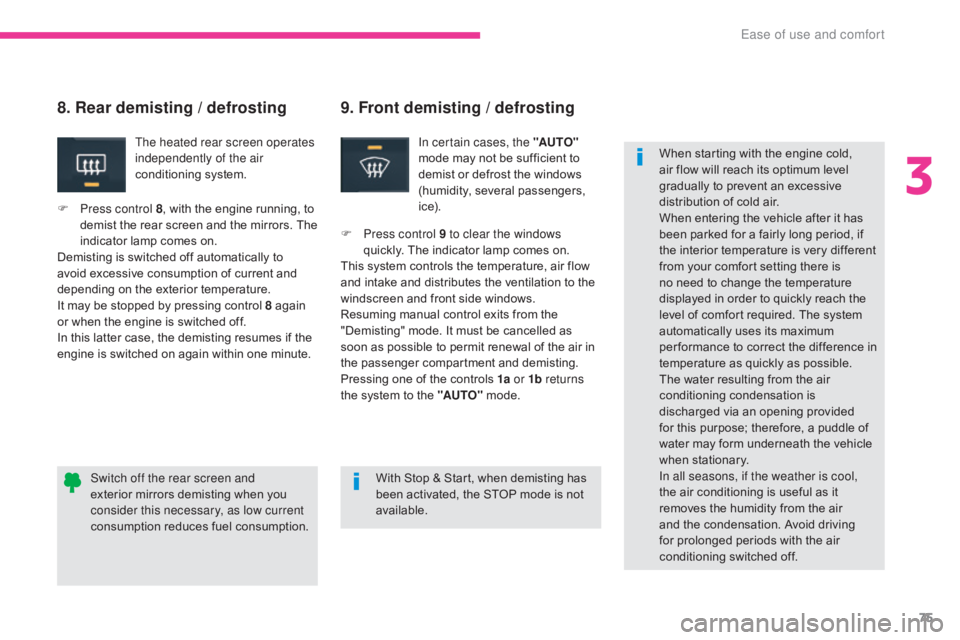
The heated rear screen operates
independently of the air
conditioning system.
F
P
ress control 8 , with the engine running, to
demist the rear screen and the mirrors. The
indicator lamp comes on.
Demisting is switched off automatically to
avoid excessive consumption of current and
depending on the exterior temperature.
It may be stopped by pressing control 8 again
or when the engine is switched off.
In this latter case, the demisting resumes if the
engine is switched on again within one minute. F
P
ress control 9 to clear the windows
quickly. The indicator lamp comes on.
This system controls the temperature, air flow
and intake and distributes the ventilation to the
windscreen and front side windows.
Resuming manual control exits from the
"Demisting" mode. It must be cancelled as
soon as possible to permit renewal of the air in
the passenger compartment and demisting.
Pressing one of the controls 1a or 1b returns
the system to the "AUTO" mode.
With Stop & Start, when demisting has
been activated, the STOP mode is not
available. When starting with the engine cold,
air flow will reach its optimum level
gradually to prevent an excessive
distribution of cold air.
When entering the vehicle after it has
been parked for a fairly long period, if
the interior temperature is very different
from your comfort setting there is
no need to change the temperature
displayed in order to quickly reach the
level of comfort required. The system
automatically uses its maximum
per formance to correct the difference in
temperature as quickly as possible.
The water resulting from the air
conditioning condensation is
discharged via an opening provided
for this purpose; therefore, a puddle of
water may form underneath the vehicle
when stationary.
In all seasons, if the weather is cool,
the air conditioning is useful as it
removes the humidity from the air
and the condensation. Avoid driving
for prolonged periods with the air
conditioning switched off.
Switch off the rear screen and
exterior mirrors demisting when you
consider this necessary, as low current
consumption reduces fuel consumption.
3
Ease of use and comfort
Page 113 of 348
111
C5_en_Chap04_conduite_ed01-2016
- with a manual gearbox, when you fully
depress the clutch pedal,
-
w
ith an automatic gearbox:
●
g
ear selector in position D or M , when
you release the brake pedal,
●
o
r gear selector in position N and brake
pedal released, when you place the gear
selector in position D or M ,
●
o
r when you engage reverse gear.
Going into engine START
mode
The "ECO" warning lamp goes off
and the engine starts automatically:
Special cases: START invoked
automatically
In this case the "ECO" warning
lamp flashes for few seconds, then
goes off.
This operation is perfectly normal. For safety reasons or to ensure smooth
operation, START mode is invoked
automatically when:
-
y
ou open the driver's door,
-
y
ou unfasten the driver's seat belt,
-
t
he speed of the vehicle exceeds 16 mph
(25 km/h) with a manual gearbox or 2 mph
(3 km/h) with an automatic gearbox for
BlueHDi Diesel versions,
-
t
he electric parking brake is being applied,
-
s
ome special conditions (battery charge,
engine temperature, braking assistance, air
conditioning setting...) where the engine is
needed to assure control of a system.
Special cases: STOP mode
unavailable
In this case, the "ECO" warning
lamp flashes for a few seconds, then
goes off.
This operation is perfectly normal. STOP mode is not invoked when:
-
t
he vehicle is on a steep slope
(up or down),
-
t
he driver's door is open,
-
t
he driver's seat belt is not fastened,
-
t
he vehicle has not exceeded 6 mph
(10 km/h) since the last engine start using
the key,
-
t
he electric parking brake is applied or
being applied,
-
t
he engine is needed to maintain a
comfortable temperature in the passenger
compartment,
-
d
emisting is active,
-
s
ome special conditions (battery charge,
engine temperature, braking assistance,
exterior temperature...) where the engine is
needed to assure control of a system.
With a manual gearbox in STOP mode,
if a gear is engaged without fully
depressing the clutch pedal, a warning
lamp comes on or an alert message
is displayed asking you to depress the
clutch pedal to restart the engine.
4
Driving
Page 134 of 348
132
C5_en_Chap05_eclairage-et-visibilite_ed01-2016
Exterior lighting controls
Main lighting
The various front and rear lamps of the
vehicle are designed to adapt the driver's
visibility progressively in relation to the climatic
conditions:
-
s
idelamps, to be seen,
-
d
ipped beam headlamps to see without
dazzling other drivers,
-
m
ain beam headlamps to see clearly when
the road is clear.
Additional lighting
Other lamps are fitted to meet the requirements
of particular driving conditions:
-
r
ear foglamps, to be seen from a distance,
-
f
ront foglamps for even better for ward
vision,
-
d
irectional headlamps for improved
visibility when cornering,
-
d
aytime running lamps to be seen during
the day.
Settings
You can configure some functions:
- d aytime running lamps,
-
a
utomatic illumination of headlamps,
-
d
irectional lighting,
-
g
uide-me-home lighting.
In some weather conditions (e.g. low
temperature or humidity), the presence
of misting on the internal sur face of the
glass of the headlamps and rear lamps
is normal; it disappears after the lamps
have been on for a few minutes.
Control stalk for the selection and control of the various front and rear lamps providing the vehicle's lighting.
Lighting and visibility
Page 136 of 348

134
C5_en_Chap05_eclairage-et-visibilite_ed01-2016
- 1st turn for wards: front foglamps on.
-
2nd turn for wards: rear foglamps on.
-
1st turn rear wards: rear foglamps off.
-
2nd turn rear wards: front foglamps off.
Front and rear foglamps
In good or rainy weather, both day and
night, use of the front and rear foglamps
is prohibited. In these situations, the
power of their beams may dazzle other
drivers. They should only be used in fog
or falling snow.
In these weather conditions, it is your
responsibility to switch on the foglamps
and dipped headlamps manually as the
sunshine sensor may detect sufficient
light.
Do not forget to switch off the front and
rear foglamps when they are no longer
needed.Switching off the lighting when
switching off the ignition
When the ignition is switched off, all of the
lamps switch off immediately, except for
the dipped beam headlamps if automatic
guide-me-home lighting is activated.
Switching on the lighting
after switching off the
ignition
To reactivate the lighting control stalk,
turn the ring A to position "0" - lighting
off, then to the position of your choice.
When the driver's door is opened, a
temporary audible signal warns you that
the vehicle's lighting is on.
They switch off automatically after a
period which depends on the state of
charge of the battery (entry to energy
economy mode).
Lighting and visibility
Page 142 of 348
140
C5_en_Chap05_eclairage-et-visibilite_ed01-2016
Wiper controls
Programming
You can modify the settings for the following
functions:
-
a
utomatic rain sensitive windscreen wipers,
-
r
ear wiping on engaging reverse gear.
Manual controls
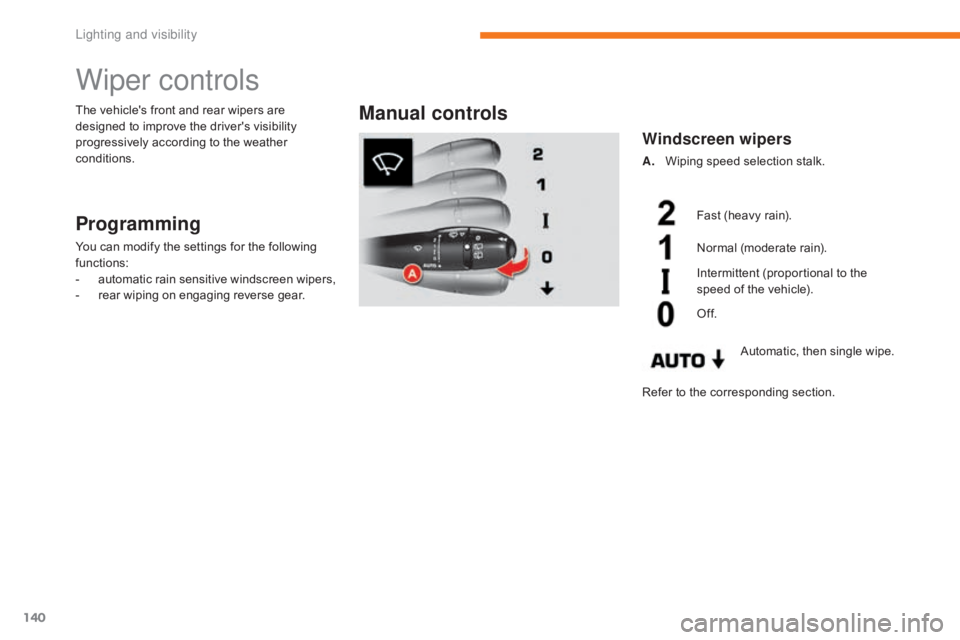
Fast (heavy rain).
Normal (moderate rain).
Intermittent (proportional to the
speed of the vehicle).
Of f.
Windscreen wipers
A. Wiping speed selection stalk.
Automatic, then single wipe.
The vehicle's front and rear wipers are
designed to improve the driver's visibility
progressively according to the weather
conditions.
Refer to the corresponding section.
Lighting and visibility
Page 152 of 348
150
C5_en_Chap06_securite_ed01-2016
The DSC and ASR systems offer increased safety in normal driving, but they should not
encourage the driver to take extra risks or drive at high speed.
It is in conditions of reduced grip (rain, snow, black ice) that the risk of loss of grip
increases. It is therefore important for your safety to keep the DSC and ASR systems
activated in all conditions, and particularly in difficult conditions.
The correct operation of these systems depends on observation of the manufacturer's
recommendations regarding as much the wheels (tyres and rims), braking and electronic
components as the assembly and repair procedures used by CITROËN dealers.
To benefit in full from the effectiveness of the DSC and ASR systems in wintry conditions,
the vehicle must be fitted with four snow tyres, allowing the vehicle to retain neutral
handling on the road.After an impact, have these systems
checked by a CITROËN dealer or a
qualified workshop.
DSC/ASR
Safety
Page 156 of 348
154
C5_en_Chap06_securite_ed01-2016
Airbags
System designed to contribute towards
improving the safety of the occupants (with
the exception of the rear centre passenger)
in the event of a violent collision. The airbags
supplement the action of the force-limiting
seat belts.
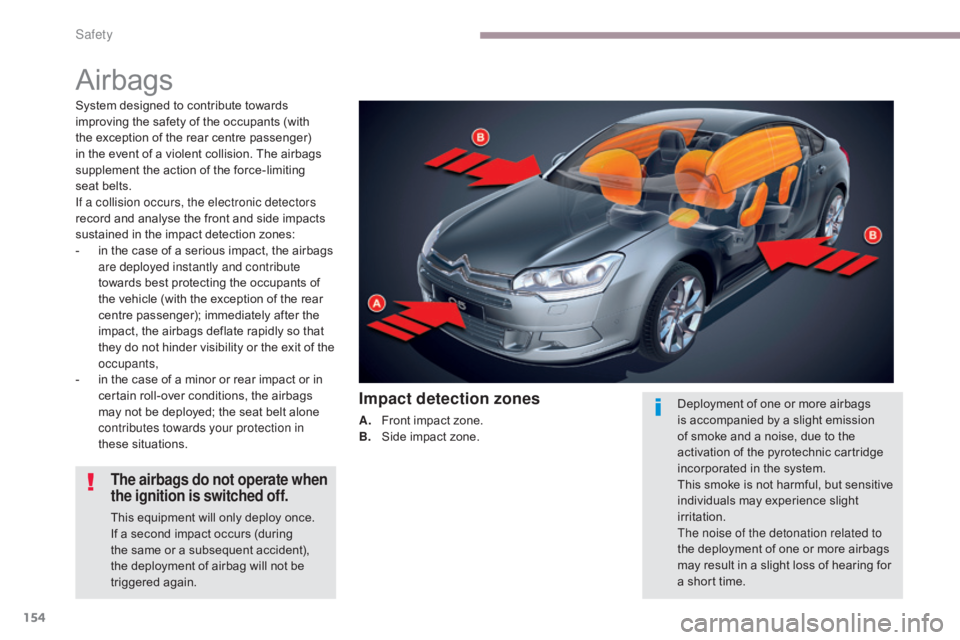
If a collision occurs, the electronic detectors
record and analyse the front and side impacts
sustained in the impact detection zones:
-
i
n the case of a serious impact, the airbags
are deployed instantly and contribute
towards best protecting the occupants of
the vehicle (with the exception of the rear
centre passenger); immediately after the
impact, the airbags deflate rapidly so that
they do not hinder visibility or the exit of the
occupants,
-
i
n the case of a minor or rear impact or in
certain roll-over conditions, the airbags
may not be deployed; the seat belt alone
contributes towards your protection in
these situations.
Impact detection zones
A. Front impact zone.
B. S ide impact zone.
The airbags do not operate when
the ignition is switched off.
This equipment will only deploy once.
If a second impact occurs (during
the same or a subsequent accident),
the deployment of airbag will not be
triggered again. Deployment of one or more airbags
is accompanied by a slight emission
of smoke and a noise, due to the
activation of the pyrotechnic cartridge
incorporated in the system.
This smoke is not harmful, but sensitive
individuals may experience slight
irritation.
The noise of the detonation related to
the deployment of one or more airbags
may result in a slight loss of hearing for
a short time.
Safety
Page 194 of 348
192
C5_en_Chap07_info-pratiques_ed01-2016
Checks
12 V battery
The battery does not require any
maintenance.
However, check regularly that the terminals are
correctly tightened (versions without quick release
terminals) and that the connections are clean.
Unless other wise indicated, check these components in accordance with the manufacturer's service schedule and according to your engine.
Other wise, have them checked by a CITROËN dealer or a qualified workshop.
Air filter and passenger compartment filter
Depending on the environment (e.g. dusty
atmosphere) and the use of the vehicle (e.g.
city driving), replace them twice as often if
necessary.
A clogged passenger compartment filter may
have an adverse effect on the per formance
of the air conditioning system and generate
undesirable odours. Replace the oil filter each time the
engine oil is changed.
Oil filter
Refer to the manufacturer's service schedule
for details of the replacement interval for this
component.
Refer to the manufacturer's
service schedule for details of the
replacement intervals for these
components.
For more information and the precautions to
take before starting work on the 12 V batter y ,
refer to the corresponding section.
Versions equipped with Stop & Start are
fitted with a 12 V lead-acid battery of
specific technology and specification.
Its replacement should be carried out
only by a CITROËN dealer or a qualified
workshop.
Practical information
Page 195 of 348
193
C5_en_Chap07_info-pratiques_ed01-2016
Manual gearbox
The gearbox does not require any
maintenance (no oil change).
Automatic gearbox
The gearbox does not require any
maintenance (no oil change).
Refer to the manufacturer's service schedule
for the checking interval for this component.
Refer to the manufacturer's service schedule
for the checking interval for this component.
Particle filter system (Diesel)
Complementary to the catalytic converter,
this filter makes an active contribution to the
preservation of air quality by trapping unburnt
pollutant particles. Black exhaust fumes are
thus no longer emitted.
After prolonged idling or driving at very low
speeds, you may occasionally notice water
vapour being emitted from the exhaust when
accelerating. This is of no consequence to the
running of the vehicle or to the environment.
If there is risk of blockage, a message
appears in the instrument panel screen,
accompanied by an audible signal and
illumination of the service warning lamp.
This alert tells you that the particle filter
is approaching saturation (in conditions
of urban driving of exceptionally long
duration: low speeds, traffic jams etc.)
To regenerate the filter, it is advised to
drive as soon as possible, when traffic
conditions permit, at a speed of 40 mph
(around 60 km/h) or more for at least
five minutes (until the alert message
disappears).
If this alert persists, contact a CITROËN
dealer or a qualified workshop.
7
Practical information