wipers CITROEN C5 2011 User Guide
[x] Cancel search | Manufacturer: CITROEN, Model Year: 2011, Model line: C5, Model: CITROEN C5 2011Pages: 348, PDF Size: 10.72 MB
Page 238 of 348
236
C5_en_Chap08_en-cas-de-panne_ed01-2016
Starting using another battery
When your vehicle's battery is discharged, the
engine can be started using a slave battery
(external or on another vehicle) and jump lead
cables or a battery booster.F
S tart the engine of the vehicle with the
good battery and leave it running for a few
minutes.
F
O
perate the starter on the broken down
vehicle and let the engine run.
I
f the engine does not start straight away,
switch off the ignition and wait a few
moments before trying again.
Never try to start the engine by
connecting a battery charger.
Never use a 24 V or higher battery
b o o s t e r.
First check that the slave battery has a
nominal voltage of 12 V and a capacity
at least equal to that of the discharged
battery.
The two vehicles must not be in contact
with each other.
Switch off the electrical consumers on
both vehicles (audio system, wipers,
lighting, ...).
Ensure that the jump lead cables do
not pass close to moving parts of the
engine (cooling fan, belts, ...).
Do not disconnect the (+) terminal when
the engine is running. Some functions, including Stop & Start,
are not available if the battery is not
sufficiently charged.
F
R
aise the plastic cover on the (+) terminal,
if your vehicle has one.
F
C
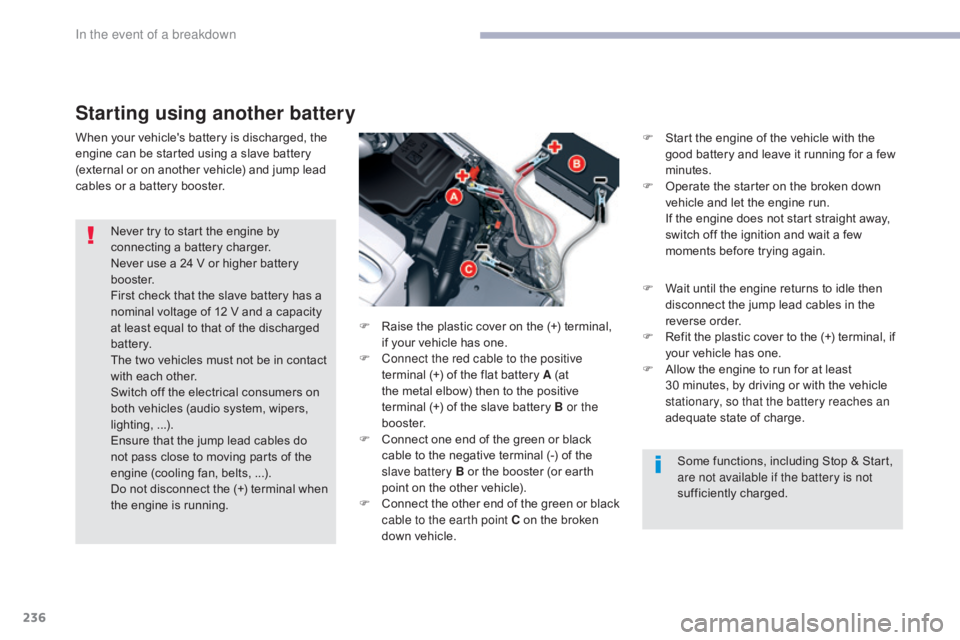
onnect the red cable to the positive
terminal (+) of the flat battery A (at
the metal elbow) then to the positive
terminal
(+) of the slave battery B or the
b o o s t e r.
F
C
onnect one end of the green or black
cable to the negative terminal (-) of the
slave battery B or the booster (or earth
point on the other vehicle).
F
C
onnect the other end of the green or black
cable to the earth point C on the broken
down vehicle. F
W
ait until the engine returns to idle then
disconnect the jump lead cables in the
reverse order.
F
R
efit the plastic cover to the (+) terminal, if
your vehicle has one.
F
A
llow the engine to run for at least
30
minutes, by driving or with the vehicle
stationary, so that the battery reaches an
adequate state of charge.
In the event of a breakdown
Page 239 of 348
237
C5_en_Chap08_en-cas-de-panne_ed01-2016
Charging the battery using a battery charger
For optimum service life of the battery, it is
essential to maintain an adequate state of
charge.
In some circumstances it may be necessary to
charge the battery:
-
i
f you use your vehicle essentially for short
journeys,
-
i
f the vehicle is to be taken off the road for
several weeks.
Contact a CITROËN dealer or a qualified
workshop.
If you envisage charging your vehicle's
battery yourself, use only a charger
compatible with lead-acid batteries of a
nominal voltage of 12 V.
Never try to charge a frozen battery.
If the battery has been frozen, have
it checked by a CITROËN dealer or a
qualified workshop, who will check that
the internal components have not been
damaged and the casing is not cracked,
which could cause a leak of toxic and
corrosive acid.
It is not necessary to disconnect the
battery. Follow the instructions for use provided
by the manufacturer of the charger.
Never reverse polarities.
If this label is present, it is essential
to use only a 12 V charger, to avoid
causing irreversible damage to the
electrical components related to the
Stop & Start system. F
S
witch off the ignition.
F
S
witch off all electrical consumers (audio
system, lighting, wipers, ...).
F
S
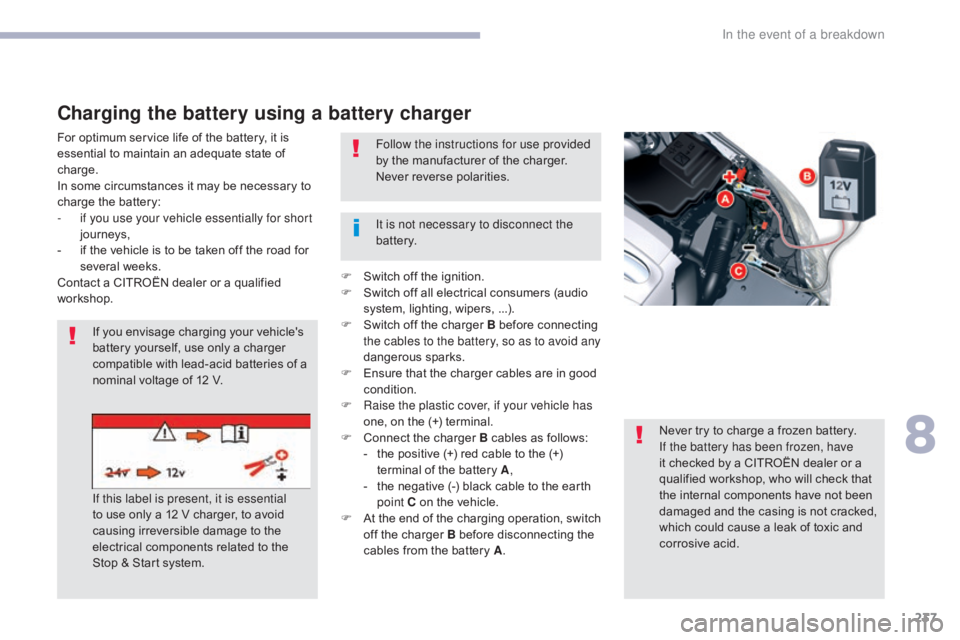
witch off the charger B before connecting
the cables to the battery, so as to avoid any
dangerous sparks.
F
E
nsure that the charger cables are in good
condition.
F
R
aise the plastic cover, if your vehicle has
one, on the (+) terminal.
F
C
onnect the charger B cables as follows:
-
t
he positive (+) red cable to the (+)
terminal of the battery A ,
-
t
he negative (-) black cable to the earth
point C on the vehicle.
F
A
t the end of the charging operation, switch
off the charger B before disconnecting the
cables from the battery A .
8
In the event of a breakdown
Page 240 of 348
238
C5_en_Chap08_en-cas-de-panne_ed01-2016
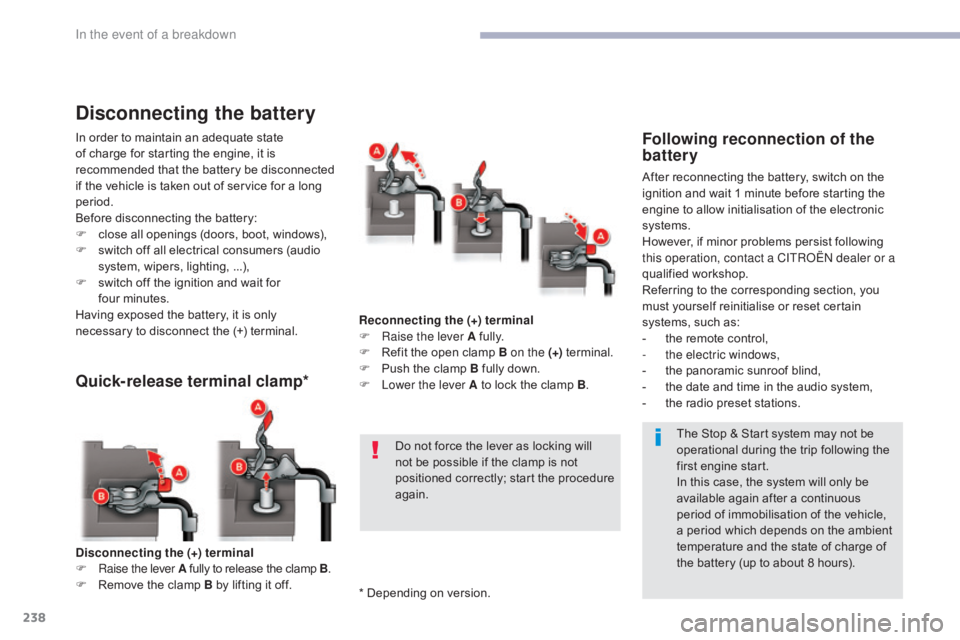
Disconnecting the (+) terminal
F Ra ise the lever A fully to release the clamp B .
F
R
emove the clamp B by lifting it off.
Quick-release terminal clamp*
Reconnecting the (+) terminal
F Ra ise the lever A fully.
F
R
efit the open clamp B on the (+) terminal.
F
P
ush the clamp B fully down.
F
L
ower the lever A to lock the clamp B .
Do not force the lever as locking will
not be possible if the clamp is not
positioned correctly; start the procedure
again.
Disconnecting the battery
In order to maintain an adequate state
of charge for starting the engine, it is
recommended that the battery be disconnected
if the vehicle is taken out of service for a long
period.
Before disconnecting the battery:
F
c
lose all openings (doors, boot, windows),
F
s
witch off all electrical consumers (audio
system, wipers, lighting, ...),
F
s
witch off the ignition and wait for
four
m
inutes.
Having exposed the battery, it is only
necessary to disconnect the (+) terminal.Following reconnection of the
battery
After reconnecting the battery, switch on the
ignition and wait 1 minute before starting the
engine to allow initialisation of the electronic
systems.
However, if minor problems persist following
this operation, contact a CITROËN dealer or a
qualified workshop.
Referring to the corresponding section, you
must yourself reinitialise or reset certain
systems, such as:
-
t
he remote control,
-
t
he electric windows,
-
t
he panoramic sunroof blind,
-
t
he date and time in the audio system,
-
t
he radio preset stations.The Stop & Start system may not be
operational during the trip following the
first engine start.
In this case, the system will only be
available again after a continuous
period of immobilisation of the vehicle,
a period which depends on the ambient
temperature and the state of charge of
the battery (up to about 8 hours).
* Depending on version.
In the event of a breakdown
Page 336 of 348
334
C5_en_Chap11_index-alpha_ed01-2016
G
F
D
Gauge, fuel.............................................. 21, 175
Gearbox, automatic ........ 1 2, 105, 110, 193, 235
Gearbox, electronic
........................................ 12
G
earbox, manual
.................... 1
2, 104, 110, 193
Gear shift indicator
....................................... 10
9
Gear lever
..............................
.........................12
Gear lever, automatic gearbox
.....................10
5
Gear lever, manual gearbox
.........................10
4
Glove box
........................................................ 81
F
illing the fuel tank
................................. 17
5 -17 7
Filter, air
...............
......................................... 192
Filter, oil
......................................................... 19
2
Filter, particle
........................................ 19
1, 193
DAB (Digital Audio Broadcasting) - Digital
radio
...............
.....................................
280, 281
Date (setting)
...............................
.............. 37, 43
Daytime running lamps
......................... 1
35, 218
Deactivating ESP
..........................................
14
9
Deactivating the passenger airbag
....... 15
5, 162
Deadlocking
...............................
.....................
46
Demisting / Defrosting
....................................
7
2
Demisting / Defrosting, rear screen .................................................... 72
Dimensions
..............................
..................... 245
Dipstick
................
.................................... 24, 188
Direction indicators
....................... 1
45, 218, 224
Display screen, instrument panel
................................................1
4, 17, 109
Display screen, multifunction.......................... 37
Doors
..............................................................
. 54
Driving economically ....................................... 12 Filter, passenger compartment
.....................
19
2
Fitting a wheel
...............................
................
214
Fitting roof bars
.............................................
18
2
Fittings, boot
............................................. 8
6, 87
Fittings, interior
............................................... 81
F
ittings, rear
...............................
.....................
84
Flap, fuel filler
...............................
.........
175 , 17 7
Flashing indicators
........................................ 14
5
Foglamps, front
...............................
..............
13 3
Foglamps, rear
..............................1
33, 222, 224
Folding the rear seats
.....................................
68
F
requency (radio)
.................................. 2
78, 279
Fuel .................................................. 12, 175, 176
Fuel consumption
............................................ 12
F
uel tank........................................................
17 7
Fusebox, dashboard
..................................... 2
29
Fusebox, engine compartment
..................... 2
29
Fuses
................
.............................................
229
Eco-driving (advice)
........................................
12
E
conomy mode
...............................
..............
179
Electronic brake force distribution (EBFD)
...
14
7
Emergency braking assistance (EBA)
..........
14
7
Emergency call
..................................... 1
46, 250
Emergency warning lamps
........................... 14
5
Emissions control system, SCR
.....................
33
E
nergy economy mode
.................................
17
9
Engine compartment
............................ 1
86, 187
Engines, Diesel
..................... 1
76, 187, 243, 244
Engines, petrol
...................... 1
76, 186, 241, 242
Environment
...............................
............... 12, 48
E
Control, emergency door ................................
56
C ontrol, heated seats ...................................... 62
C
ontrol, panoramic sunroof blind
...................79
C
ontrol stalk, lighting
.................................... 13
2
Control stalk, wipers
..............................14
0 -142
Courtesy lamps
............................................... 76
C
ruise control
................................................ 12
1
Cup holder
...............................
.................. 83, 84Driving positions (storing)
...............................64
D
ynamic stability control (DSC) ...... 2 9, 148, 150
Alphabetical index
Page 340 of 348
338
C5_en_Chap11_index-alpha_ed01-2016
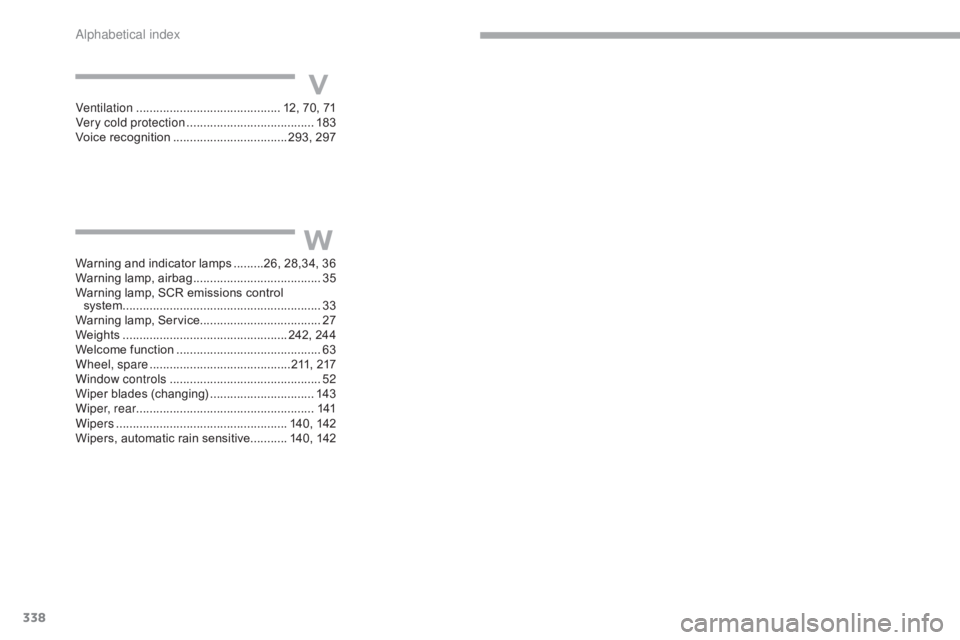
V
W
Warning and indicator lamps .........26, 28,34, 36
Warning lamp, airbag ...................................... 35
W
arning lamp, SCR emissions control
system
................
........................................... 33
Warning lamp, Service.................................... 27
Weights
...............
.................................. 242, 244
Welcome function
........................................... 63
W
heel, spare
.......................................... 21
1, 217
Window controls
............................................. 52
W
iper blades (changing)
............................... 14
3
Wiper, rear ..................................................... 141
Wipers
................................................... 14
0, 142
Wipers, automatic rain sensitive
...........14
0, 142
Ventilation
..............................
............. 12, 70, 71
Very cold protection
...................................... 18
3
Voice recognition
...............................
... 293, 297
Alphabetical index