instrument panel CITROEN C5 2011 Workshop Manual
[x] Cancel search | Manufacturer: CITROEN, Model Year: 2011, Model line: C5, Model: CITROEN C5 2011Pages: 348, PDF Size: 10.72 MB
Page 159 of 348
157
C5_en_Chap06_securite_ed01-2016
Operating fault
If this symbol is displayed in
the instrument panel screen,
accompanied by an audible signal
and a message, contact a CITROËN
dealer or a qualified workshop to
have the system checked. The
airbags may no longer be deployed in
the event of a serious impact.
In the event of a minor impact or bump
on the side of the vehicle or if the
vehicle rolls over, the airbags may not
be deployed.
No lateral airbag is deployed in the
event of a rear or front collision.
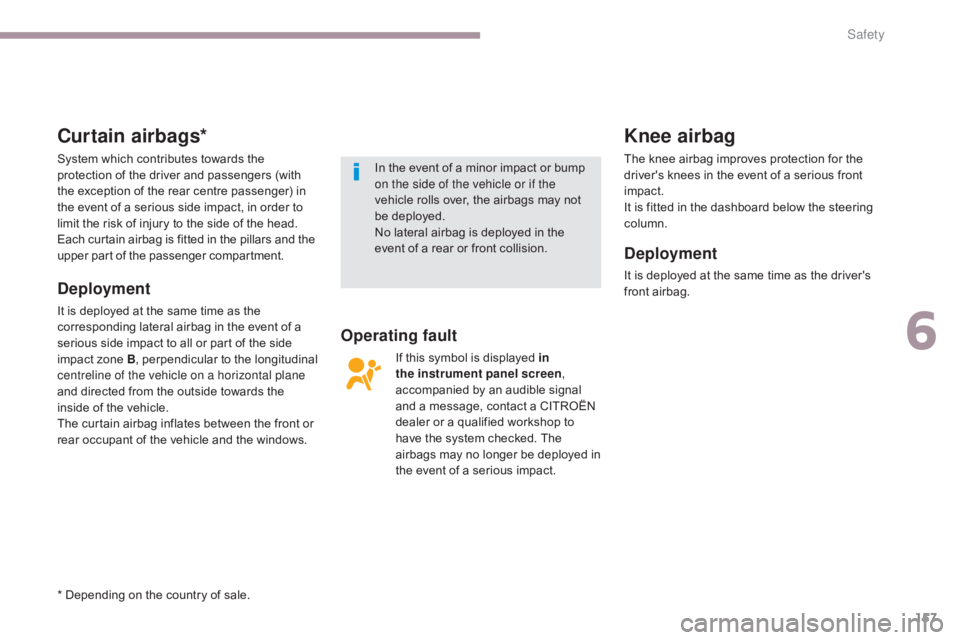
Curtain airbags*
System which contributes towards the
protection of the driver and passengers (with
the exception of the rear centre passenger) in
the event of a serious side impact, in order to
limit the risk of injury to the side of the head.
Each curtain airbag is fitted in the pillars and the
upper part of the passenger compartment.
Deployment
It is deployed at the same time as the
corresponding lateral airbag in the event of a
serious side impact to all or part of the side
impact zone
B, perpendicular to the longitudinal
centreline of the vehicle on a horizontal plane
and directed from the outside towards the
inside of the vehicle.
The curtain airbag inflates between the front or
rear occupant of the vehicle and the windows.
* Depending on the country of sale.
Knee airbag
The knee airbag improves protection for the
driver's knees in the event of a serious front
impact.
It is fitted in the dashboard below the steering
column.
Deployment
It is deployed at the same time as the driver's
front airbag.
6
Safety
Page 164 of 348
162
C5_en_Chap06_securite_ed01-2016
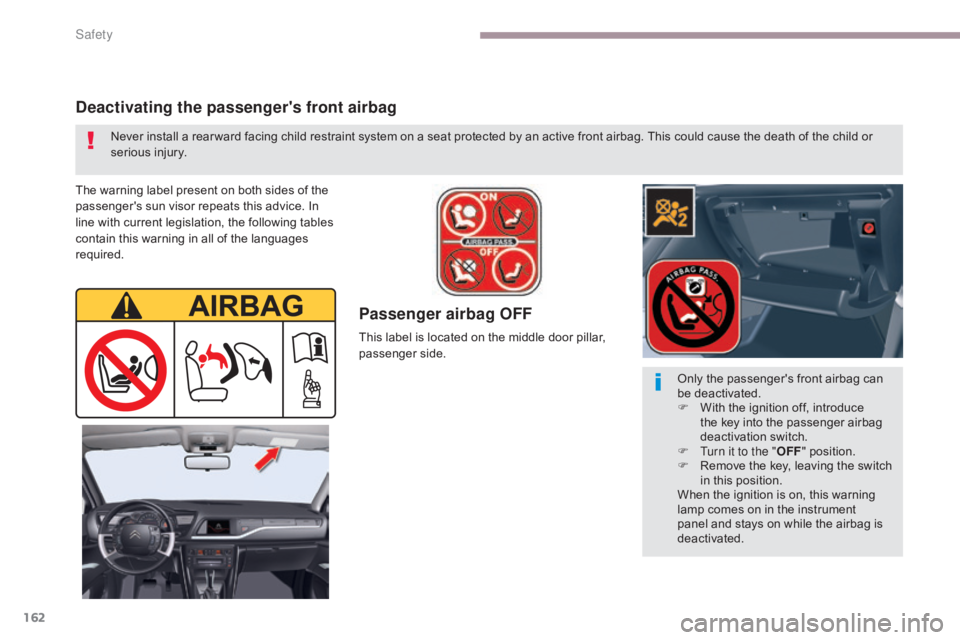
Passenger airbag OFF
The warning label present on both sides of the
passenger's sun visor repeats this advice. In
line with current legislation, the following tables
contain this warning in all of the languages
required.Never install a rear ward facing child restraint system on a seat protected by an active front airbag. This could cause the death of the child or
serious injury.
Only the passenger's front airbag can
be deactivated.
F
W
ith the ignition off, introduce
the key into the passenger airbag
deactivation switch.
F
T
urn it to the "OFF" position.
F
R
emove the key, leaving the switch
in this position.
When the ignition is on, this warning
lamp comes on in the instrument
panel and stays on while the airbag is
deactivated.
Deactivating the passenger's front airbag
This label is located on the middle door pillar,
passenger side.
Safety
Page 175 of 348
173
C5_en_Chap06_securite_ed01-2016
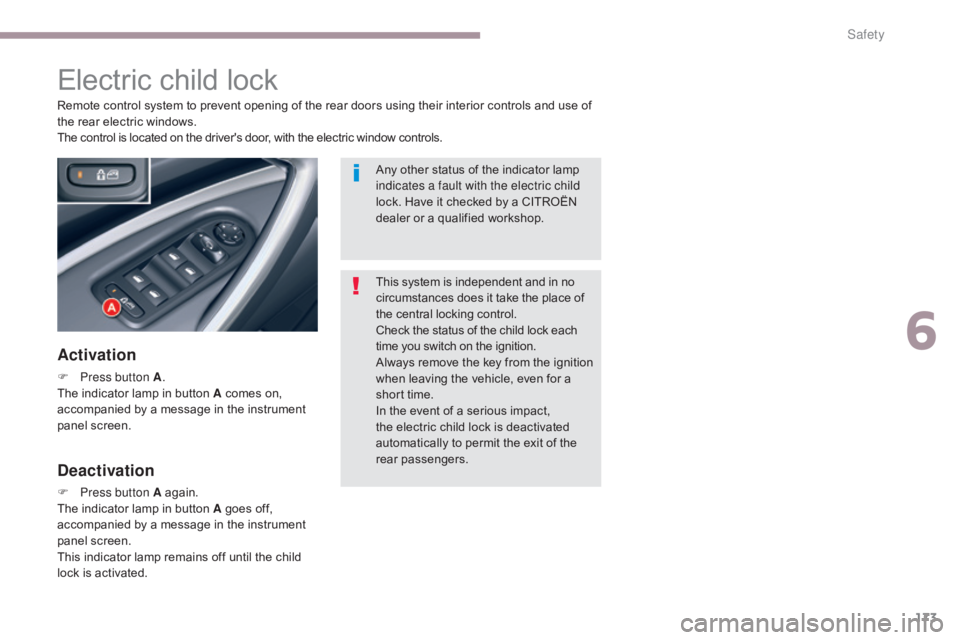
Electric child lock
Activation
F Press button A.
The indicator lamp in button A comes on,
accompanied by a message in the instrument
panel screen. Remote control system to prevent opening of the rear doors using their interior controls and use of
the rear electric windows.
The control is located on the driver's door, with the electric window controls.
Deactivation
F Press button A again.
The indicator lamp in button A goes off,
accompanied by a message in the instrument
panel screen.
This indicator lamp remains off until the child
lock is activated. This system is independent and in no
circumstances does it take the place of
the central locking control.
Check the status of the child lock each
time you switch on the ignition.
Always remove the key from the ignition
when leaving the vehicle, even for a
short time.
In the event of a serious impact,
the electric child lock is deactivated
automatically to permit the exit of the
rear passengers. Any other status of the indicator lamp
indicates a fault with the electric child
lock. Have it checked by a CITROËN
dealer or a qualified workshop.
6
Safety
Page 177 of 348
175
C5_en_Chap07_info-pratiques_ed01-2016
Fuel tank
Capacity of the tank: approximately 71 litres*.
Low fuel level
When the low fuel level in the
tank is reached, this warning
lamp comes on in the instrument
panel, accompanied by an
audible warning and a message
in the display screen. When it
first comes on, there remains
around 5 litres of fuel in the tank.
F
P
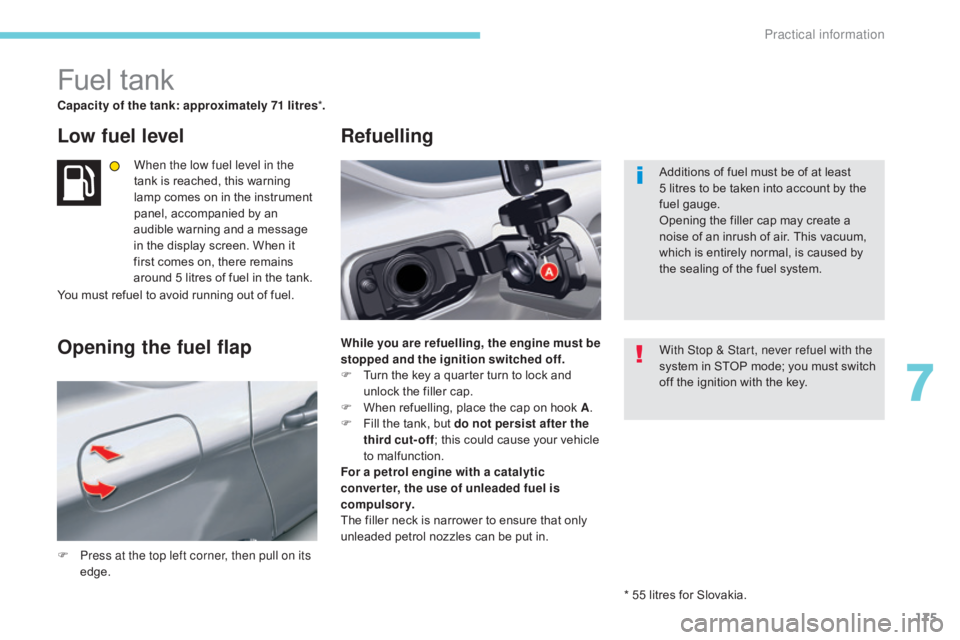
ress at the top left corner, then pull on its
edge. While you are refuelling, the engine must be
stopped and the ignition switched off.
F
T
urn the key a quarter turn to lock and
unlock the filler cap.
F
W
hen refuelling, place the cap on hook A.
F
F
ill the tank, but do not persist after the
third cut-off ; this could cause your vehicle
to malfunction.
For a petrol engine with a catalytic
converter, the use of unleaded fuel is
compulsory.
The filler neck is narrower to ensure that only
unleaded petrol nozzles can be put in.
Opening the fuel flap Refuelling
Additions of fuel must be of at least
5
litres to be taken into account by the
fuel gauge.
Opening the filler cap may create a
noise of an inrush of air. This vacuum,
which is entirely normal, is caused by
the sealing of the fuel system.
With Stop & Start, never refuel with the
system in STOP mode; you must switch
off the ignition with the key.
* 55 litres for Slovakia.
You must refuel to avoid running out of fuel.
7
Practical information
Page 181 of 348
179
C5_en_Chap07_info-pratiques_ed01-2016
Energy economy mode
System which manages the duration of use of
certain functions to conserve a sufficient level
of charge in the battery.
After the engine has stopped, you can still use
functions such as the audio and telematics
system, windscreen wipers, dipped beam
headlamps,
courtesy lamps, etc. for a
maximum combined duration of about forty
minutes.Switching to economy mode
A message appears in the instrument panel
screen indicating that the vehicle has switched
to economy mode and the active functions are
put on standby.
If a telephone call is being made at this
time, it will be maintained for around
10
minutes with the Bluetooth
® hands-
free system of your audio system.
Exiting economy mode
These functions are reactivated automatically
next time the vehicle is driven.
In order to restore the use of these functions
immediately, start the engine and let it run:
-
f
or less than ten minutes, to use the
equipment for approximately five minutes,
-
f
or more than ten minutes, to use the
equipment for up to approximately
thirty
m
inutes.
Let the engine run for the duration specified to
ensure that the battery charge is sufficient.
Do not repeatedly and continuously restart the
engine in order to charge the battery.
A flat battery prevents the engine from
starting.
For more information on the
12
V batter y, refer to the corresponding
section.
7
Practical information
Page 190 of 348
188
C5_en_Chap07_info-pratiques_ed01-2016
Checking levels
Engine oil level
The check is carried out either when
the ignition is switched on using the
oil level indicator in the instrument
panel for vehicles so equipped, or
using the dipstick.
Check all of these levels regularly, in line with the manufacturer's service schedule. Top them up if necessary, unless other wise indicated.
If a level drops significantly, have the corresponding system checked by a CITROËN dealer or a qualified workshop.
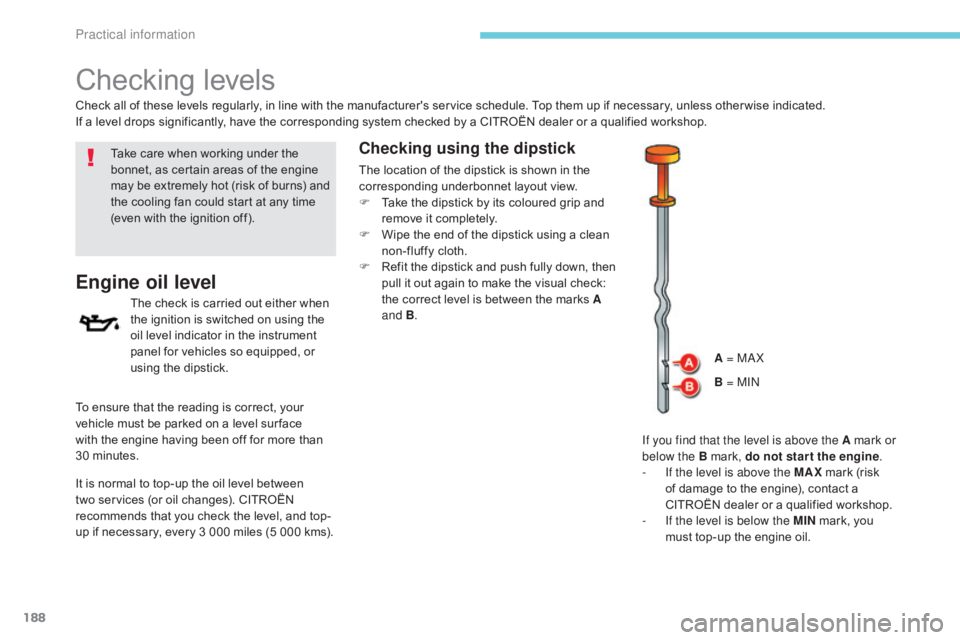
If you find that the level is above the A mark or
below the B mark, do not star t the engine.
-
I
f the level is above the MAX mark (risk
of damage to the engine), contact a
CITROËN dealer or a qualified workshop.
-
I
f the level is below the MIN mark, you
must top-up the engine oil.
Take care when working under the
bonnet, as certain areas of the engine
may be extremely hot (risk of burns) and
the cooling fan could start at any time
(even with the ignition off).
To ensure that the reading is correct, your
vehicle must be parked on a level sur face
with the engine having been off for more than
30
m
inutes.
It is normal to top-up the oil level between
two services (or oil changes). CITROËN
recommends that you check the level, and top-
up if necessary, every 3 000 miles (5 000 kms).
Checking using the dipstick
The location of the dipstick is shown in the
corresponding underbonnet layout view.
F
T
ake the dipstick by its coloured grip and
remove it completely.
F
W
ipe the end of the dipstick using a clean
non-fluffy cloth.
F
R
efit the dipstick and push fully down, then
pull it out again to make the visual check:
the correct level is between the marks A
and B .
A = MA X
B = MIN
Practical information
Page 191 of 348
189
C5_en_Chap07_info-pratiques_ed01-2016
Oil grade
Before topping-up the oil or changing the oil,
check that the oil is the correct grade for your
engine and conforms to the manufacturer's
recommendations.
Topping-up the engine oil level
The location of the oil filler cap is shown in the
corresponding underbonnet layout view.
F
U
nscrew the oil filler cap to reveal the filler
aperture.
F
A
dd oil in small quantities, avoiding any
spills on engine components (risk of fire).
F
W
ait a few minutes before checking the
level again using the dipstick.
F
A
dd more oil if necessary.
F
A
fter checking the level, carefully refit the
oil filler cap and the dipstick in its tube.
After topping-up the oil, the check when
switching on the ignition with the oil
level indicator in the instrument panel
is not valid during the 30 minutes after
topping-up.
Engine oil change
Refer to the manufacturer's service schedule
for details of the interval for this operation.
In order to maintain the reliability of the engine
and emission control system, never use
additives in the engine oil.
7
Practical information
Page 193 of 348
191
C5_en_Chap07_info-pratiques_ed01-2016
Diesel additive level
(Diesel engine with
particle filter)
To p p i n g u p
This additive must be topped up by a CITROËN
dealer or a qualified workshop without delay.
Used products
A low additive level is indicated by
illumination of this warning lamp,
accompanied by an audible warning
and a message in the instrument
panel screen.
Screenwash and headlamp
wash fluid
In the case of vehicles fitted with
headlamp washers, the low fluid level
is indicated by an audible signal and
a message in the screen.
Fluid specification
For optimum cleaning and to avoid freezing,
this fluid must not be topped up with or
replaced with plain water.
Reservoir capacity (depending on version).
-
s
creenwash fluid: approximately 3.5 litres,
-
s
creenwash and headlamp wash fluid:
approximately 6.15 litres.
Top up the reservoir when you next stop
the
vehicle. Avoid prolonged contact of used oil or
fluids with the skin.
Most of these fluids are harmful to
health or indeed very corrosive.
Do not discard used oil or fluids into
sewers or onto the ground.
Take used oil to a CITROËN dealer or
a qualified workshop (France) or to an
authorised waste disposal site.
7
Practical information
Page 195 of 348
193
C5_en_Chap07_info-pratiques_ed01-2016
Manual gearbox
The gearbox does not require any
maintenance (no oil change).
Automatic gearbox
The gearbox does not require any
maintenance (no oil change).
Refer to the manufacturer's service schedule
for the checking interval for this component.
Refer to the manufacturer's service schedule
for the checking interval for this component.
Particle filter system (Diesel)
Complementary to the catalytic converter,
this filter makes an active contribution to the
preservation of air quality by trapping unburnt
pollutant particles. Black exhaust fumes are
thus no longer emitted.
After prolonged idling or driving at very low
speeds, you may occasionally notice water
vapour being emitted from the exhaust when
accelerating. This is of no consequence to the
running of the vehicle or to the environment.
If there is risk of blockage, a message
appears in the instrument panel screen,
accompanied by an audible signal and
illumination of the service warning lamp.
This alert tells you that the particle filter
is approaching saturation (in conditions
of urban driving of exceptionally long
duration: low speeds, traffic jams etc.)
To regenerate the filter, it is advised to
drive as soon as possible, when traffic
conditions permit, at a speed of 40 mph
(around 60 km/h) or more for at least
five minutes (until the alert message
disappears).
If this alert persists, contact a CITROËN
dealer or a qualified workshop.
7
Practical information
Page 198 of 348
196
C5_en_Chap07_info-pratiques_ed01-2016
AdBlue® fluid range indicators
Once the AdBlue® tank is on reserve or after
detection of a fault with the SCR emissions
control system, when the ignition is switched
on, an indicator displays an estimate of the
distance that can be covered, the range, before
engine starting is prevented.
In the event of simultaneous system fault and
low AdBlue
® level, the shortest range figure is
the one displayed.
In the event of the risk of non-starting related to a lack of AdBlue®
Range greater than 1 500 miles (2 400 km)
When the ignition is switched on, no
information on range is displayed automatically
in the instrument panel.
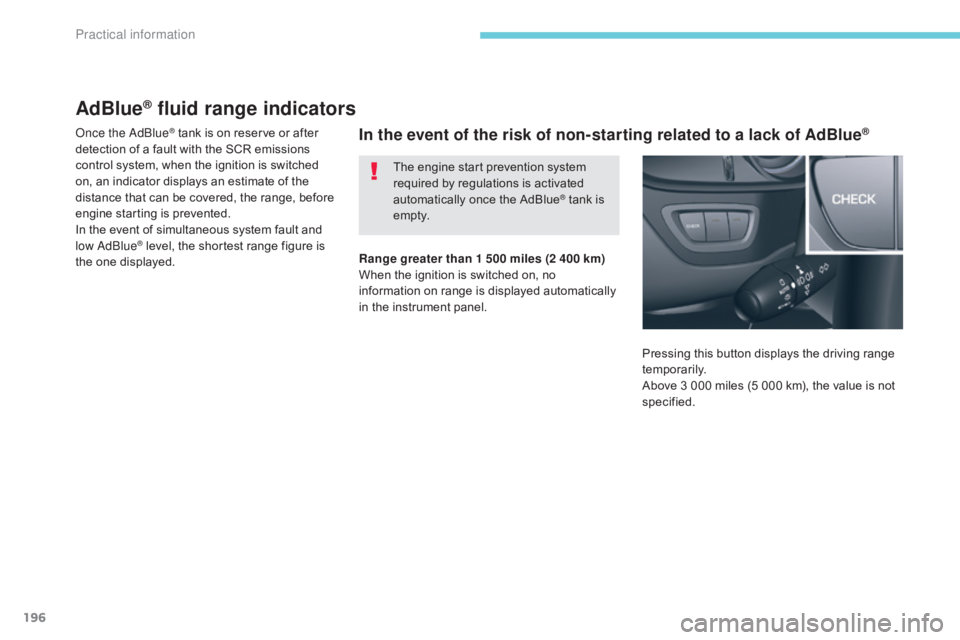
Pressing this button displays the driving range
temporarily.
Above 3 000 miles (5 000 km), the value is not
specified.
The engine start prevention system
required by regulations is activated
automatically once the AdBlue
® tank is
e m pt y.
Practical information