instrument panel CITROEN C5 2013 Owner's Manual
[x] Cancel search | Manufacturer: CITROEN, Model Year: 2013, Model line: C5, Model: CITROEN C5 2013Pages: 348, PDF Size: 10.72 MB
Page 98 of 348
96
C5_en_Chap04_conduite_ed01-2016
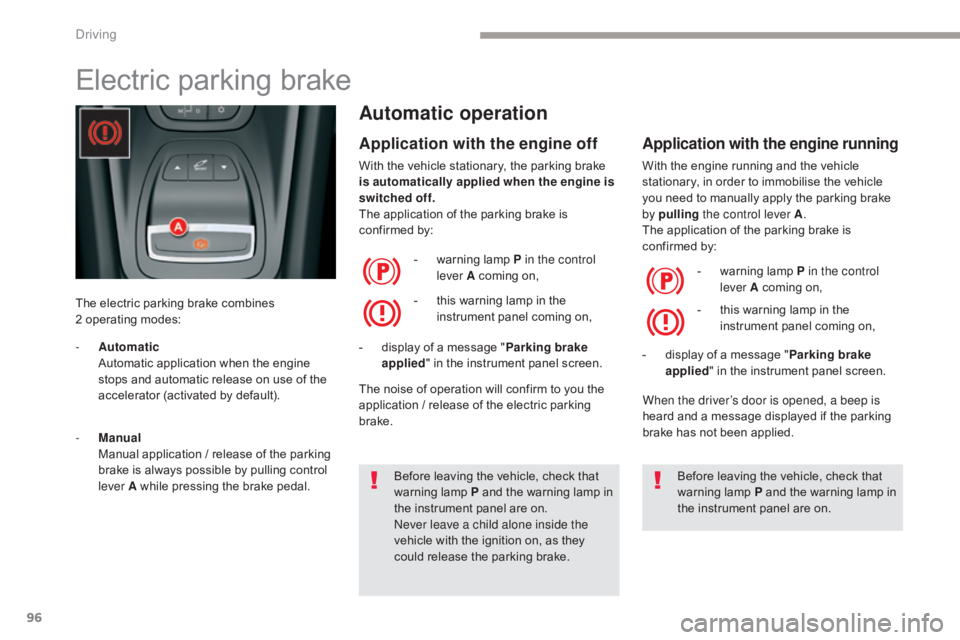
Electric parking brake
The electric parking brake combines
2 operating modes:
Automatic operation
Application with the engine off
With the vehicle stationary, the parking brake
is automatically applied when the engine is
switched off.
The application of the parking brake is
confirmed by:
Application with the engine running
With the engine running and the vehicle
stationary, in order to immobilise the vehicle
you need to manually apply the parking brake
by pulling the control lever A .
The application of the parking brake is
confirmed by:
-
w
arning lamp P in the control
lever A coming on,
-
d
isplay of a message " Parking brake
applied " in the instrument panel screen. -
w
arning lamp P in the control
lever A coming on,
-
d
isplay of a message " Parking brake
applied " in the instrument panel screen.
-
t
his warning lamp in the
instrument panel coming on, -
t
his warning lamp in the
instrument panel coming on,
Before leaving the vehicle, check that
warning lamp P and the warning lamp in
the instrument panel are on.
Never leave a child alone inside the
vehicle with the ignition on, as they
could release the parking brake. Before leaving the vehicle, check that
warning lamp
P and the warning lamp in
the instrument panel are on.
-
A
utomatic
A
utomatic application when the engine
stops and automatic release on use of the
accelerator (activated by default).
-
M
anual
M
anual application / release of the parking
brake is always possible by pulling control
lever A while pressing the brake pedal. When the driver’s door is opened, a beep is
heard and a message displayed if the parking
brake has not been applied.
The noise of operation will confirm to you the
application / release of the electric parking
brake.
Driving
Page 99 of 348
97
C5_en_Chap04_conduite_ed01-2016
Release
The electric parking brake releases
automatically and progressively as the
vehicle moves off :
F
w
ith a manual gearbox (first gear or
reverse gear engaged), press down fully
on the clutch pedal, then press on the
accelerator pedal and move off,
F
w
ith an automatic gearbox , accelerate
with the selector in position D , M or R.
Full release of the parking brake is
confirmed
by:
-
w
arning lamp P in the control
lever A going off,
-
d
isplay of a message " Parking brake
released " in the instrument panel screen.
Activation / Deactivation of the
automatic functions
Depending on the country of sale, automatic
application when switching off the engine and
automatic release when moving off can be
deactivated. The activation / deactivation is
done in the vehicle parameters menu.
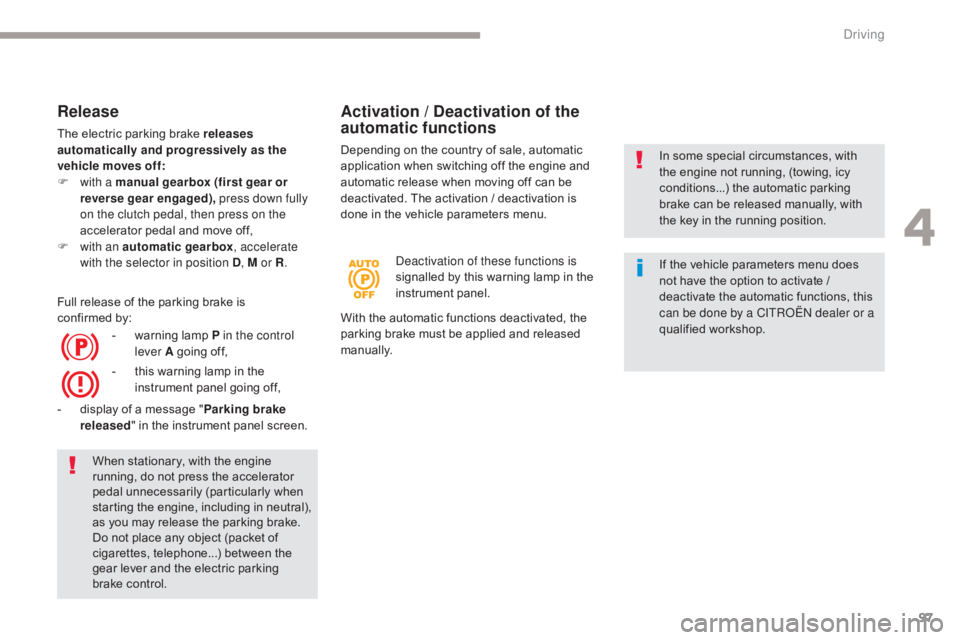
Deactivation of these functions is
signalled by this warning lamp in the
instrument panel.
-
t
his warning lamp in the
instrument panel going off, In some special circumstances, with
the engine not running, (towing, icy
conditions...) the automatic parking
brake can be released manually, with
the key in the running position.
If the vehicle parameters menu does
not have the option to activate /
deactivate the automatic functions, this
can be done by a CITROËN dealer or a
qualified workshop.
With the automatic functions deactivated, the
parking brake must be applied and released
manually.
When stationary, with the engine
running, do not press the accelerator
pedal unnecessarily (particularly when
starting the engine, including in neutral),
as you may release the parking brake.
Do not place any object (packet of
cigarettes, telephone...) between the
gear lever and the electric parking
brake control.
4
Driving
Page 100 of 348
98
C5_en_Chap04_conduite_ed01-2016
Manual operation
Application
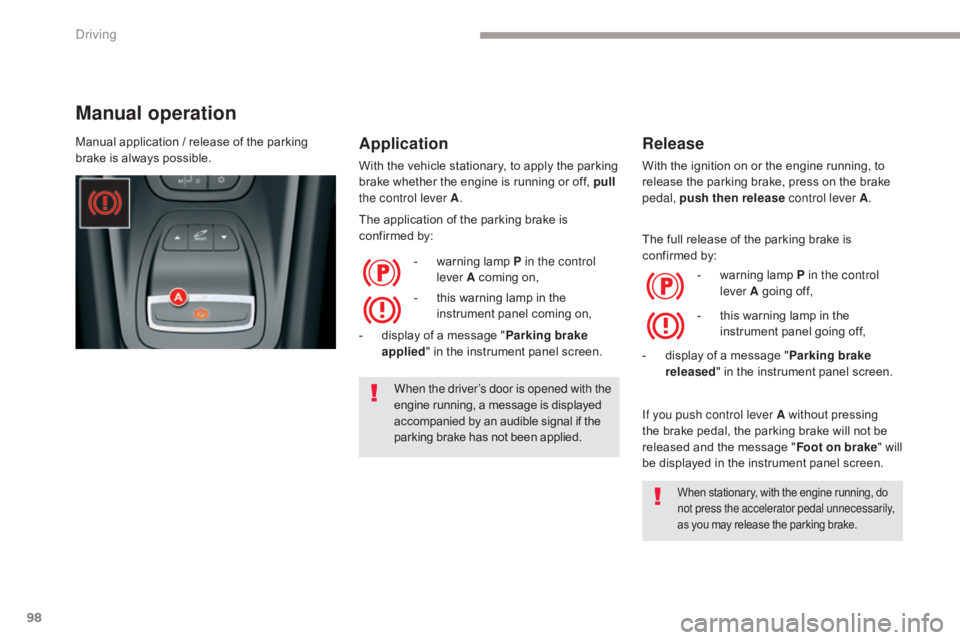
With the vehicle stationary, to apply the parking
brake whether the engine is running or off, pull
the control lever A .
The application of the parking brake is
confirmed by:
-
w
arning lamp P in the control
lever A coming on,
-
d
isplay of a message " Parking brake
applied " in the instrument panel screen.
-
t
his warning lamp in the
instrument panel coming on,
When the driver’s door is opened with the
engine running, a message is displayed
accompanied by an audible signal if the
parking brake has not been applied.
Manual application / release of the parking
brake is always possible.
Release
With the ignition on or the engine running, to
release the parking brake, press on the brake
pedal, push then release
control lever A.
The full release of the parking brake is
confirmed by: -
w
arning lamp P in the control
lever A going off,
-
d
isplay of a message " Parking brake
released " in the instrument panel screen.
-
t
his warning lamp in the
instrument panel going off,
When stationary, with the engine running, do
not press the accelerator pedal unnecessarily,
as you may release the parking brake.
If you push control lever A without pressing
the brake pedal, the parking brake will not be
released and the message " Foot on brake" will
be displayed in the instrument panel screen.
Driving
Page 101 of 348
99
C5_en_Chap04_conduite_ed01-2016
Maximum application
If necessary, you can make a maximum
application of the parking brake. It is obtained
by means of a long pull on control lever A,
until you see the message " Max application
of the parking brake" and an audible signal
is heard.
Maximum application is essential:
-
i
n the case of a vehicle towing a caravan
or a trailer, if the automatic functions are
activated but you are applying the parking
brake manually,
-
w
hen the effective gradient you are parked
on is variable (e.g. on a ferry, in a lorry,
during towing).
Particular situations
In certain situations (starting the engine...), the
parking brake can automatically alter its level of
application. This is normal operation.
To advance your vehicle a few centimetres
without starting the engine, but with the ignition
on, press on the brake pedal and release the
parking brake by pushing then releasing
control lever A .
The full release of the parking brake is
confirmed by the warning lamp P in the control
lever and the warning lamp in the instrument
panel going off and the display of a message
" Parking brake released" in the instrument
panel screen.
To ensure correct operation of the parking
brake and therefore your safety, the number of
successive application / release operations is
limited to eight.
If this number is exceeded, you are warned by
the message " Parking brake faulty " and a
warning lamp flashes. In the event of a battery failure, it will
not be possible to operate the electric
parking brake.
As a safety measure if the parking
brake is not applied, immobilise the
vehicle by engaging a gear or by
placing a chock against one of the
wheels.
Contact a CITROËN dealer or a
qualified workshop.
Please note...
-
i
n the case of towing, a loaded vehicle or
parking on a gradient, turn the front wheels
towards the pavement and engage a gear
when you park,
-
a
fter a maximum application, the release
time will be longer.
4
Driving
Page 102 of 348
100
C5_en_Chap04_conduite_ed01-2016
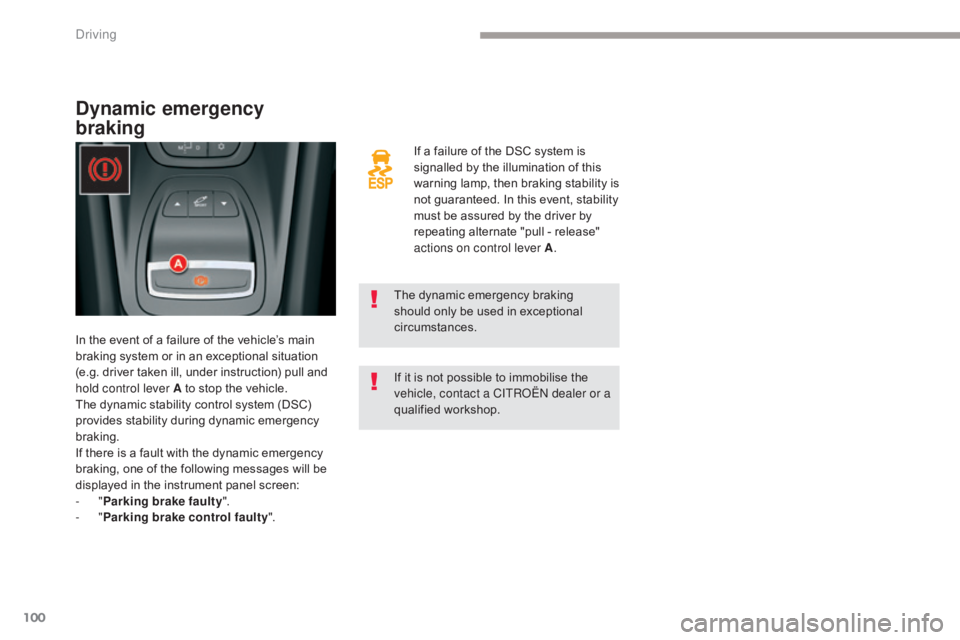
If a failure of the DSC system is
signalled by the illumination of this
warning lamp, then braking stability is
not guaranteed. In this event, stability
must be assured by the driver by
repeating alternate "pull - release"
actions on control lever A.
The dynamic emergency braking
should only be used in exceptional
circumstances.
If it is not possible to immobilise the
vehicle, contact a CITROËN dealer or a
qualified workshop.
Dynamic emergency
braking
In the event of a failure of the vehicle’s main
braking system or in an exceptional situation
(e.g. driver taken ill, under instruction) pull and
hold control lever A to stop the vehicle.
The dynamic stability control system (DSC)
provides stability during dynamic emergency
braking.
If there is a fault with the dynamic emergency
braking, one of the following messages will be
displayed in the instrument panel screen:
-
"Parking brake faulty ".
-
"Parking brake control faulty ".
Driving
Page 105 of 348
103
C5_en_Chap04_conduite_ed01-2016
Hill start assist
System which keeps your vehicle immobilised
temporarily (approximately 2 seconds) when
starting on a gradient, the time to move your
foot from the brake pedal to the accelerator
pedal.
This function is only active when:
-
t
he vehicle is completely stationary, with
your foot on the brake pedal,
-
i
n certain conditions on a gradient,
-
w
ith the driver’s door closed.
The hill start assist function cannot be
deactivated.Operation
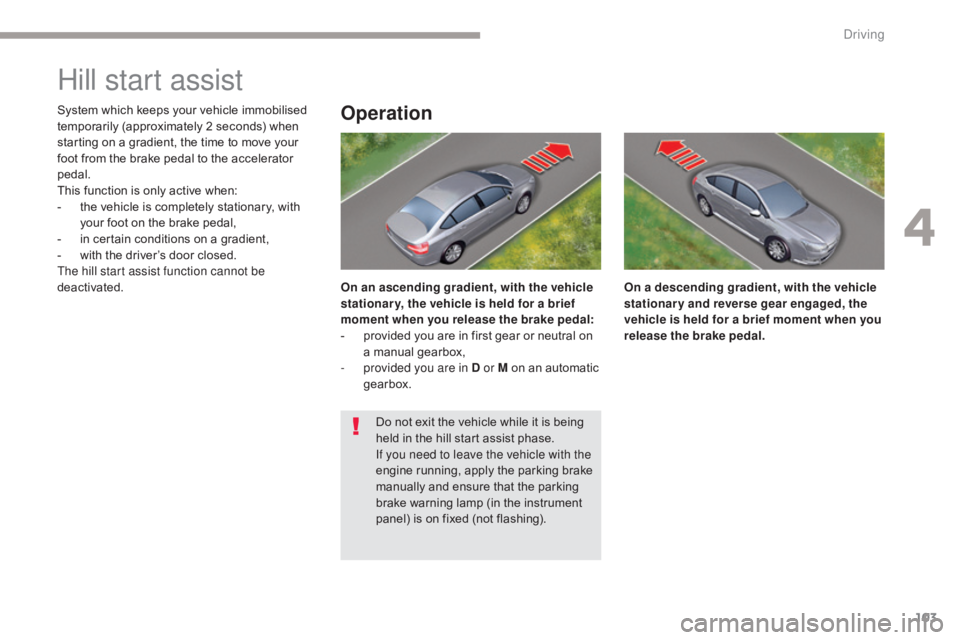
On an ascending gradient, with the vehicle
stationar y, the vehicle is held for a brief
moment when you release the brake pedal:
-
p
rovided you are in first gear or neutral on
a manual gearbox,
-
p
rovided you are in D or M on an automatic
gearbox. On a descending gradient, with the vehicle
stationary and reverse gear engaged, the
vehicle is held for a brief moment when you
release the brake pedal.
Do not exit the vehicle while it is being
held in the hill start assist phase.
If you need to leave the vehicle with the
engine running, apply the parking brake
manually and ensure that the parking
brake warning lamp (in the instrument
panel) is on fixed (not flashing).
4
Driving
Page 107 of 348
105
C5_en_Chap04_conduite_ed01-2016
Mode selectionDisplays in the instrument panel
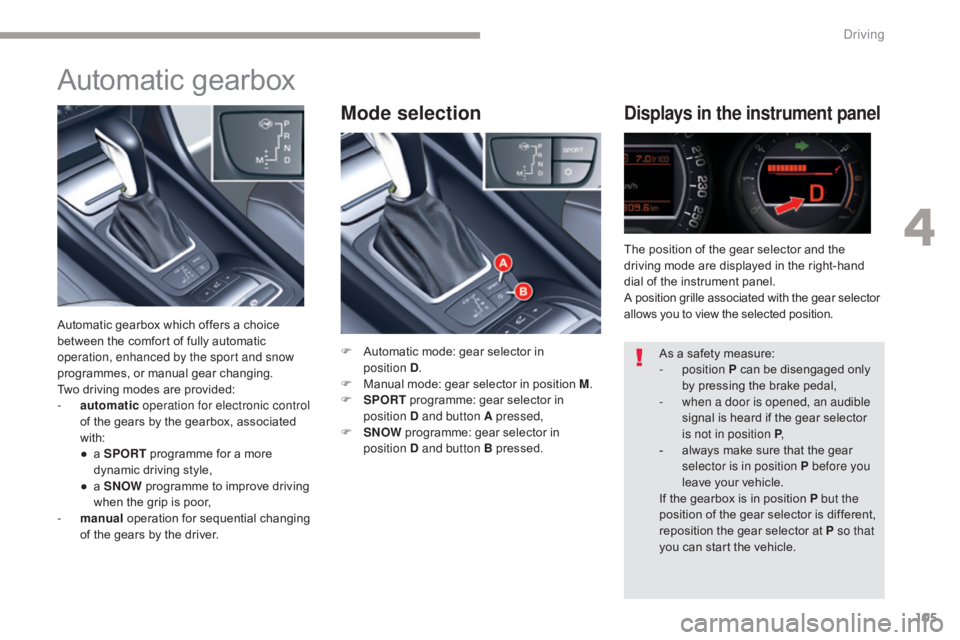
F Automatic mode: gear selector in position D.
F
M
anual mode: gear selector in position M .
F
S
PORT programme: gear selector in
position D and button A pressed,
F
S
NOW programme: gear selector in
position D and button B pressed. The position of the gear selector and the
driving mode are displayed in the right-hand
dial of the instrument panel.
A position grille associated with the gear selector
allows you to view the selected position.
Automatic gearbox
Automatic gearbox which offers a choice
between the comfort of fully automatic
operation, enhanced by the sport and snow
programmes, or manual gear changing.
Two driving modes are provided:
-
a
utomatic operation for electronic control
of the gears by the gearbox, associated
with:
●
a
SPORT programme for a more
dynamic driving style,
●
a
SNOW programme to improve driving
when the grip is poor,
-
m
anual operation for sequential changing
of the gears by the driver. As a safety measure:
-
position P can be disengaged only
by pressing the brake pedal,
-
w
hen a door is opened, an audible
signal is heard if the gear selector
is not in position P ,
-
a
lways make sure that the gear
selector is in position P before you
leave your vehicle.
If the gearbox is in position P but the
position of the gear selector is different,
reposition the gear selector at P so that
you can start the vehicle.
4
Driving
Page 108 of 348
106
C5_en_Chap04_conduite_ed01-2016
Moving off
F To start the engine, the gear selector must be in position P or N .
F
O
perate the starter.
F
W
hen the engine is running, place the gear
selector at R , D or M.
F
C
heck in the instrument panel, the position
engaged.
F
R
elease the brake pedal and accelerate.
F
T
o avoid a possible difference between the
position of the gear selector and the actual
position of the gearbox, always come out
of position P with the ignition on and brake
pedal applied.
Otherwise, when the ignition is on or the engine
is running:
F
r
eposition the gear selector at position P ,
F
p
ut your foot on the brake pedal and then
select the gear you want.
Park
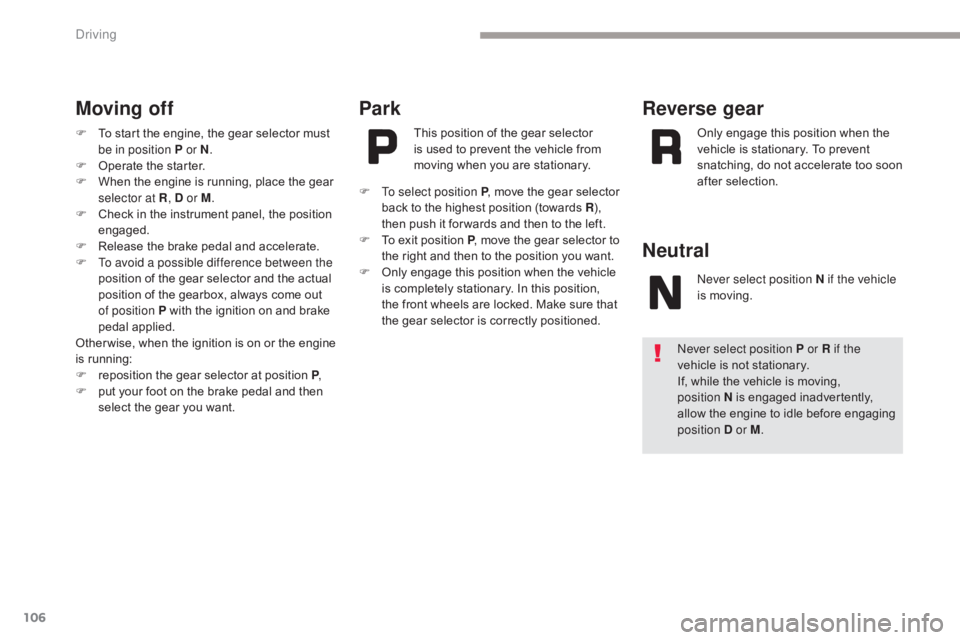
This position of the gear selector
is used to prevent the vehicle from
moving when you are stationary.
Reverse gear
Only engage this position when the
vehicle is stationary. To prevent
snatching, do not accelerate too soon
after selection.
Neutral
Never select position N if the vehicle
is moving.
F
T
o select position P
, move the gear selector
back to the highest position (towards R ),
then push it for wards and then to the left.
F
T
o exit position
P, move the gear selector to
the right and then to the position you want.
F
O
nly engage this position when the vehicle
is completely stationary. In this position,
the front wheels are locked. Make sure that
the gear selector is correctly positioned.
Never select position P or R if the
vehicle is not stationary.
If, while the vehicle is moving,
position
N is engaged inadvertently,
allow the engine to idle before engaging
position D or M .
Driving
Page 110 of 348
108
C5_en_Chap04_conduite_ed01-2016
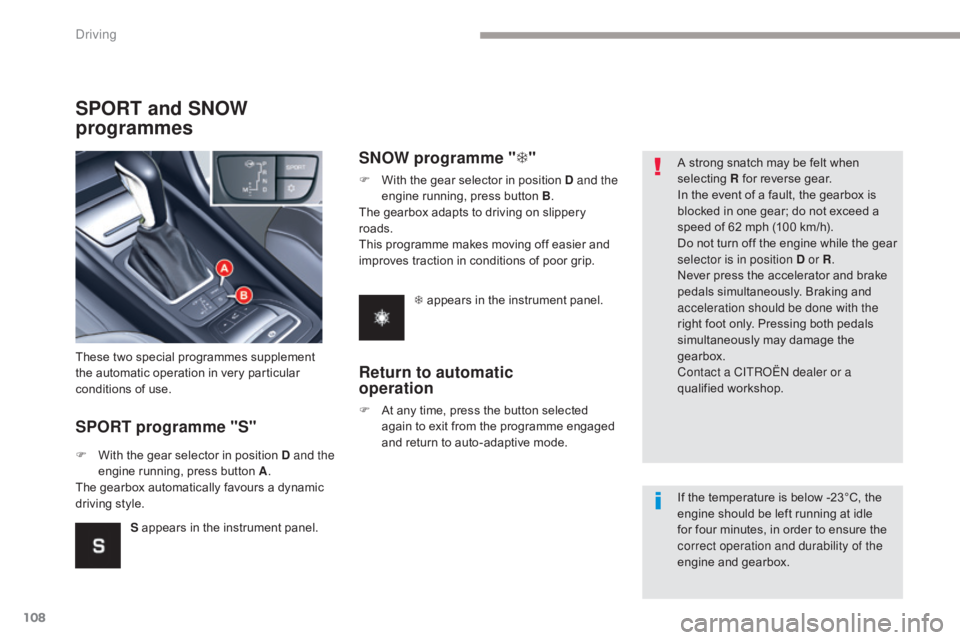
SPORT and SNOW
programmes
SPORT programme "S"
These two special programmes supplement
the automatic operation in very particular
conditions of use.
F
W
ith the gear selector in position D and the
engine running, press button A .
The gearbox automatically favours a dynamic
driving style.
SNOW programme " T"
F With the gear selector in position D and the
engine running, press button B .
The gearbox adapts to driving on slippery
roads.
This programme makes moving off easier and
improves traction in conditions of poor grip.
T appears in the instrument panel.
S appears in the instrument panel.
Return to automatic
operation
F At any time, press the button selected again to exit from the programme engaged
and return to auto-adaptive mode. A strong snatch may be felt when
selecting
R for reverse gear.
In the event of a fault, the gearbox is
blocked in one gear; do not exceed a
speed of 62 mph (100 km/h).
Do not turn off the engine while the gear
selector is in position D or R .
Never press the accelerator and brake
pedals simultaneously. Braking and
acceleration should be done with the
right foot only. Pressing both pedals
simultaneously may damage the
gearbox.
Contact a CITROËN dealer or a
qualified workshop.
If the temperature is below -23°C, the
engine should be left running at idle
for four minutes, in order to ensure the
correct operation and durability of the
engine and gearbox.
Driving
Page 111 of 348
109
C5_en_Chap04_conduite_ed01-2016
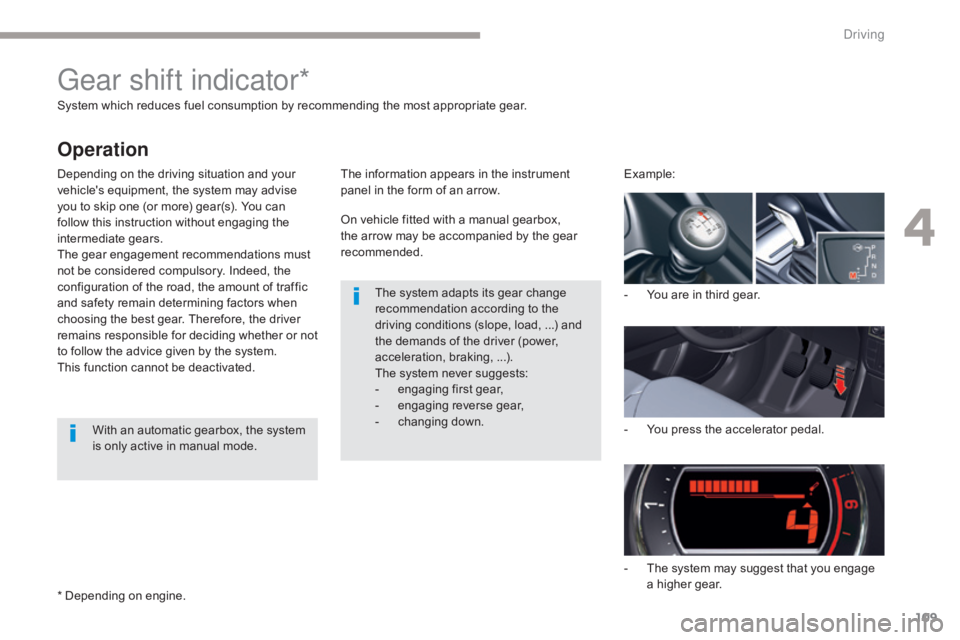
System which reduces fuel consumption by recommending the most appropriate gear.
Depending on the driving situation and your
vehicle's equipment, the system may advise
you to skip one (or more) gear(s). You can
follow this instruction without engaging the
intermediate gears.
The gear engagement recommendations must
not be considered compulsory. Indeed, the
configuration of the road, the amount of traffic
and safety remain determining factors when
choosing the best gear. Therefore, the driver
remains responsible for deciding whether or not
to follow the advice given by the system.
This function cannot be deactivated.Example:
-
Y
ou are in third gear.
-
Y
ou press the accelerator pedal.
Gear shift indicator*
Operation
With an automatic gearbox, the system
is only active in manual mode.
* Depending on engine. The information appears in the instrument
panel in the form of an arrow.
On vehicle fitted with a manual gearbox,
the arrow may be accompanied by the gear
recommended.
The system adapts its gear change
recommendation according to the
driving conditions (slope, load, ...) and
the demands of the driver (power,
acceleration, braking, ...).
The system never suggests:
-
e
ngaging first gear,
-
enga
ging reverse gear,
- c hanging down.
-
T
he system may suggest that you engage
a higher gear.
4
Driving