seats Citroen C5 2016 (RD/TD) / 2.G User Guide
[x] Cancel search | Manufacturer: CITROEN, Model Year: 2016, Model line: C5, Model: Citroen C5 2016 (RD/TD) / 2.GPages: 366, PDF Size: 30.93 MB
Page 76 of 366
74
C5_en_Chap03_ergo-et-confort_ed01-2015
We recommend use of the automatic regulation
of the air conditioning.
It permits automatic and optimised control
of all of the following functions: air flow,
temperature in the passenger compartment
and air distribution, by means of various
sensors (ambient temperature, sunshine).
This eliminates any need for you to change
your settings other than the temperature value
displayed.
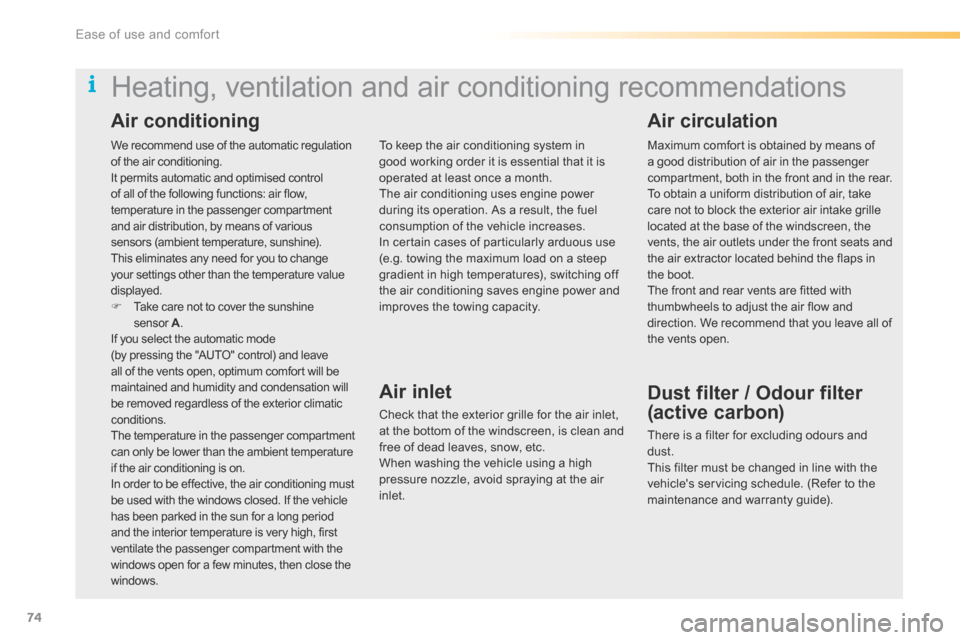
F Take care not to cover the sunshine
sensor A.
If you select the automatic mode
(by pressing the "AUTO" control) and leave
all of the vents open, optimum comfort will be
maintained and humidity and condensation will
be removed regardless of the exterior climatic
conditions.
The temperature in the passenger compartment
can only be lower than the ambient temperature
if the air conditioning is on.
In order to be effective, the air conditioning must
be used with the windows closed. If the vehicle
has been parked in the sun for a long period
and the interior temperature is very high, first
ventilate the passenger compartment with the
windows open for a few minutes, then close the
windows.
Heating, ventilation and air conditioning recommendations
To keep the air conditioning system in
good working order it is essential that it is
operated at least once a month.
The air conditioning uses engine power
during its operation. As a result, the fuel
consumption of the vehicle increases.
In certain cases of particularly arduous use
(e.g. towing the maximum load on a steep
gradient in high temperatures), switching off
the air conditioning saves engine power and
improves the towing capacity.
Air inlet
Check that the exterior grille for the air inlet,
at the bottom of the windscreen, is clean and
free of dead leaves, snow, etc.
When washing the vehicle using a high
pressure nozzle, avoid spraying at the air
inlet. Maximum comfort is obtained by means of
a good distribution of air in the passenger
compartment, both in the front and in the rear.
To obtain a uniform distribution of air, take
care not to block the exterior air intake grille
located at the base of the windscreen, the
vents, the air outlets under the front seats and
the air extractor located behind the flaps in
the boot.
The front and rear vents are fitted with
thumbwheels to adjust the air flow and
direction. We recommend that you leave all of
the vents open.
Dust filter / Odour filter
(active carbon)
There is a filter for excluding odours and
dust.
This filter must be changed in line with the
vehicle's servicing schedule. (Refer to the
maintenance and warranty guide).
Air conditioning
Air circulation
Ease of use and comfort
Page 96 of 366

94
C5_en_Chap03_ergo-et-confort_ed01-2015
High load retaining net
(Tourer)
Hooked onto the special upper and lower
fixings, this permits use of the entire loading
volume up to the roof:
- behind the rear seats (row 2),
- behind the front seats (row 1) when the rear
seats are folded.
When positioning the net, check that the strap
loops are visible from the boot; this will make
slackening or tightening easier.
Installation
F Fold down the backrests of the rear seats.
F Position the high load retaining net roller
above the two rails 1 located behind the
rear seats (2/3 bench seat). The two
notches 2 must be placed above the
two rails. F
Slide the two rails 1 into the notches 2 and
push the roller (lengthways) from right to
left to secure it.
F Reposition the rear seat backrests.
Ease of use and comfort
Page 97 of 366

95
C5_en_Chap03_ergo-et-confort_ed01-2015
Row 1
To use it in row 1:
F fold down the backrests of the rear seats,
F open the covers 3 of the corresponding
upper fixings,
F unroll the high load retaining net and
position one of the ends of the net's metal
bar in the corresponding fixing cover.
Check that the hook is secured in the rail
located inside the cover 3 ,
F pull the high load retaining net's metal bar
to position the other hook in the second
fixing cover.
Row 2
To use it in row 2:
F open the covers 4 of the corresponding
upper fixings,
F from the rear bench seat, unroll the high
load retaining net, pushing it to detach it
from the retaining hooks,
F position one of the ends of the net's metal
bar in the corresponding fixing cover.
Check that the hook is secured in the rail,
located inside the cover 4 ,
F position the other hook in the second fixing
cover and pull the metal bar towards you.
3
Ease of use and comfort
Page 143 of 366
141
C5_en_Chap05_visibilite_ed01-2015
Manual headlamp
adjustment
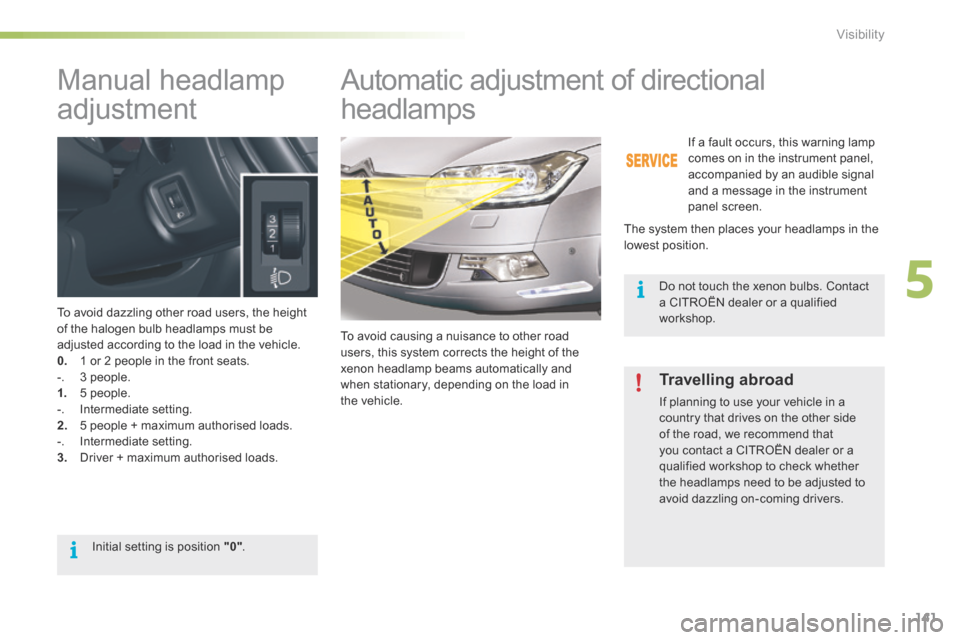
To avoid dazzling other road users, the height
of the halogen bulb headlamps must be
adjusted according to the load in the vehicle.
0. 1 or 2 people in the front seats.
-. 3 people.
1. 5 people.
-. Intermediate setting.
2. 5 people + maximum authorised loads.
-. Intermediate setting.
3. Driver + maximum authorised loads.
Automatic adjustment of directional
headlamps
The system then places your headlamps in the
lowest position. If a fault occurs, this warning lamp
comes on in the instrument panel,
accompanied by an audible signal
and a message in the instrument
panel screen.
Initial setting is position "0" .To avoid causing a nuisance to other road
users, this system corrects the height of the
xenon headlamp beams automatically and
when stationary, depending on the load in
the vehicle.
Do not touch the xenon bulbs. Contact
a CITROËN dealer or a qualified
workshop.
Travelling abroad
If planning to use your vehicle in a
country that drives on the other side
of the road, we recommend that
you contact a CITR
oËn dealer or a
qualified workshop to check whether
the headlamps need to be adjusted to
avoid dazzling on-coming drivers.
5
Visibility
Page 156 of 366
154
C5_en_Chap06_securite_ed01-2015
Seat belts
Front seat belts
Fastening
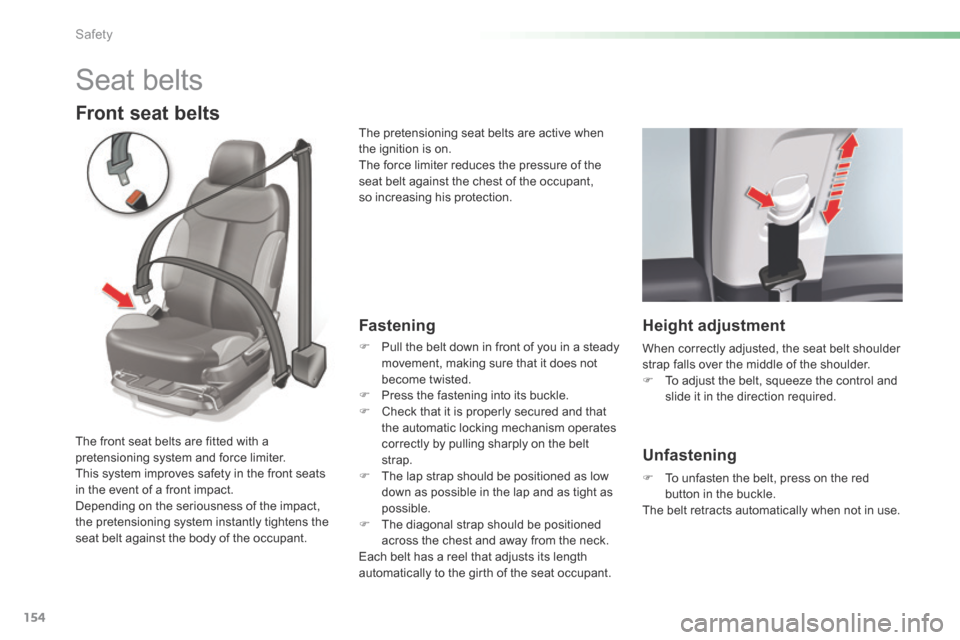
F Pull the belt down in front of you in a steady
movement, making sure that it does not
become twisted.
F Press the fastening into its buckle.
F Check that it is properly secured and that
the automatic locking mechanism operates
correctly by pulling sharply on the belt
strap.
F The lap strap should be positioned as low
down as possible in the lap and as tight as
possible.
F The diagonal strap should be positioned
across the chest and away from the neck.
Each belt has a reel that adjusts its length
automatically to the girth of the seat occupant.
The front seat belts are fitted with a
pretensioning system and force limiter.
This system improves safety in the front seats
in the event of a front impact.
Depending on the seriousness of the impact,
the pretensioning system instantly tightens the
seat belt against the body of the occupant. The pretensioning seat belts are active when
the ignition is on.
The force limiter reduces the pressure of the
seat belt against the chest of the occupant,
so increasing his protection.
Height adjustment
When correctly adjusted, the seat belt shoulder
strap falls over the middle of the shoulder.
F
To adjust the belt, squeeze the control and
slide it in the direction required.
Unfastening
F To unfasten the belt, press on the red
button in the buckle.
The belt retracts automatically when not in use.
Safety
Page 158 of 366
156
C5_en_Chap06_securite_ed01-2015
Advice
In order to be effective, a seat belt must:
- be tightened as close to the body as
possible,
- be pulled in front of you with a smooth
movement, checking that it does not
twist,
- be used to restrain only one person,
- not bear any trace of cuts or fraying,
- not be converted or modified to avoid
affecting its performance.
Recommendations
for children
Use a suitable child seat if the passenger is
less than 12 years old or shorter than one
and a half metres.
Never use the same seat belt to secure more
than one person.
Never allow a child to travel on your lap.
For more information, refer to the "Child
seats" section.
In accordance with current safety
regulations, for all repairs on your vehicle's
seat belts, go to a qualified workshop with
the skills and equipment needed, which a
CITROËN dealer is able to provide.
Have your seat belts checked regularly by
a CITROËN dealer or a qualified workshop,
particularly if the straps show signs of
damage.
Clean the seat belt straps with soapy
water or a textile cleaning product, sold by
CITROËN dealers.
After folding or moving a seat or rear bench
seat, ensure that the seat belt is positioned
and reeled in correctly.
In the event of an impact
Depending on the nature and seriousness
of the impact , the pretensioning device may
be deployed before and independently of the
airbags. Deployment of the pretensioners
is accompanied by a slight discharge of
harmless smoke and a noise, due to the
activation of the pyrotechnic cartridge
incorporated in the system.
In all cases, the airbag warning lamp
comes on.
Following an impact, have the seat belts
system checked, and if necessary replaced,
by a CITROËN dealer or a qualified
workshop.
The driver must ensure that passengers use
the seat belts correctly and that they are all
restrained securely before setting off.
Wherever you are seated in the vehicle,
always fasten your seat belt, even for short
journeys.
Do not interchange the seat belt buckles as
they will not fulfil their role fully.
The seat belts are fitted with an inertia reel
permitting automatic adjustment of the length
of the strap to your size. The seat belt is
stowed automatically when not in use.
b
efore and after use, ensure that the seat
belt is reeled in correctly.
The lower part of the strap must be
positioned as low as possible on the pelvis.
The upper part must be positioned in the
hollow of the shoulder.
The inertia reels are fitted with an automatic
locking device which comes into operation in
the event of a collision, emergency braking
or if the vehicle rolls over. You can release
the device by pulling the strap firmly and
then releasing it so that it reels in slightly.
Safety
Page 163 of 366
161
C5_en_Chap06_securite_ed01-2015
For the airbags to be fully effective, observe the safety recommendations below:Front airbags
Do not drive holding the steering wheel by its spokes or resting your hands on the centre part
of the wheel.
Passengers must not place their feet on the dashboard.
Do not smoke as deployment of the airbags can cause burns or the risk of injury from a
cigarette or pipe.
Never remove or pierce the steering wheel or hit it violently.
Do not fit or attach anything to the steering wheel or dashboard, this could cause injuries with
deployment of the airbags.
Lateral airbags
Use only approved covers on the seats, compatible with the deployment the lateral airbags.
For information on the range of seat covers suitable for your vehicle, you can contact a
CITROËN dealer.
Refer to the "Accessories" section.
Do not fix or attach anything to the seat backs (clothing...). This could cause injury to the chest
or arms if the lateral airbag is deployed.
Do not sit with the upper part of the body any nearer to the door than necessary.
Curtain airbags
Do not fix or attach anything to the roof. This could cause injury to the head if the curtain
airbag is deployed.
If fitted on your vehicle, do not remove the grab handles installed on the roof, they play a part
in securing the curtain airbags.
Advice
Sit in a normal upright position.
Wear a correctly adjusted seat belt.
Do not leave anything between the
occupants and the airbags (a child, pet,
object...), nor fix or attach anything close to
the inflation trajectory of the airbags; this
could cause injuries during their deployment.
Never modify the original definition of your
vehicle, particularly in the area directly
around the airbags.
after an accident or if the vehicle has been
stolen or broken into, have the airbag
systems checked.
All work on the airbag system must be
carried out by a CITR oËn dealer or a
qualified workshop.
Even if all of the precautions mentioned
are observed, a risk of injury or of minor
burns to the head, chest or arms when an
airbag is deployed cannot be ruled out. The
bag inflates almost instantly (within a few
milliseconds) then deflates within the same
time discharging the hot gas via openings
provided for this purpose.
6
Safety
Page 164 of 366
162
C5_en_Chap07_securite-enfant_ed01-2015
Although one of CITROËN main criteria when designing your vehicle, the safety of your children
also depends on you.
General points relating to child seats
For maximum safety, please observe the
following recommendations:* The regulations on carrying children are
specific to each country. Refer to the
legislation in force in your country. CITROËN recommends
that children
should travel on the rear seats of your
vehicle:
- rearward facing up to the age of 3,
- forward facing over the age of 3.
-
in accordance with European regulations,
all children under the age of 12 or less
than one and a half metres tall must
travel in approved child seats suited to
their weight , on seats fitted with a seat
belt or ISOFIX mountings*,
- statistically, the safest seats in your
vehicle for carr ying children are the
rear seats,
- a child weighing less than 9 kg must
travel in the rear ward facing position
both in the front and in the rear.
Child safety
Page 165 of 366
163
C5_en_Chap07_securite-enfant_ed01-2015
Child seat at the rear
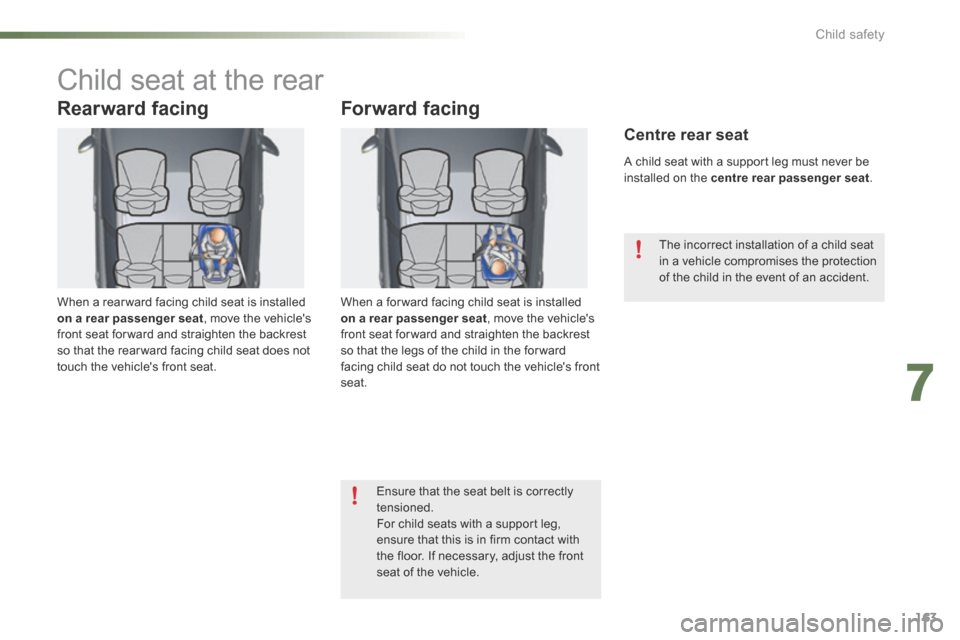
Rearward facing
When a rear ward facing child seat is installed
on a rear passenger seat, move the vehicle's
front seat for ward and straighten the backrest
so that the rear ward facing child seat does not
touch the vehicle's front seat.
Forward facing
When a for ward facing child seat is installed
on a rear passenger seat , move the vehicle's
front seat for ward and straighten the backrest
so that the legs of the child in the for ward
facing child seat do not touch the vehicle's front
seat.
Centre rear seat
A child seat with a support leg must never be
installed on the centre rear passenger seat .
Ensure that the seat belt is correctly
tensioned.
For child seats with a support leg,
ensure that this is in firm contact with
the floor. If necessary, adjust the front
seat of the vehicle. The incorrect installation of a child seat
in a vehicle compromises the protection
of the child in the event of an accident.
7
Child safety
Page 166 of 366
164
C5_en_Chap07_securite-enfant_ed01-2015
Rearward facingForward facing
Child seat in the front*
Ensure that the seat belt is correctly
tensioned.
For child seats with a support leg,
ensure that the support leg is in stable
contact with the floor. If necessary,
adjust the passenger seat.
* Refer to the current legislation in your country
before installing a child seat on this seat.
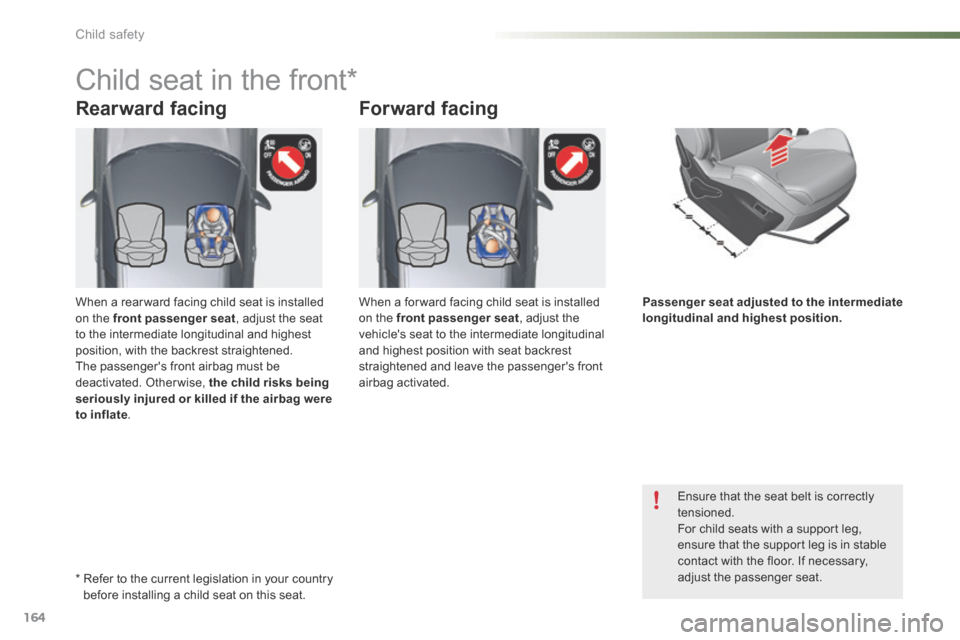
When a rear ward facing child seat is installed
on the front passenger seat
, adjust the seat
to the intermediate longitudinal and highest
position, with the backrest straightened.
The passenger's front airbag must be
deactivated. Otherwise, the child risks being
seriously injured or killed if the airbag were
to inflate . When a for ward facing child seat is installed
on the front passenger seat
, adjust the
vehicle's seat to the intermediate longitudinal
and highest position with seat backrest
straightened and leave the passenger's front
airbag activated. Passenger seat adjusted to the intermediate
longitudinal and highest position.
Child safety