fuel Citroen C5 RHD 2012 (RD/TD) / 2.G User Guide
[x] Cancel search | Manufacturer: CITROEN, Model Year: 2012, Model line: C5 RHD, Model: Citroen C5 RHD 2012 (RD/TD) / 2.GPages: 340, PDF Size: 39.41 MB
Page 32 of 340
I
30
MONITORING
A few definitions…
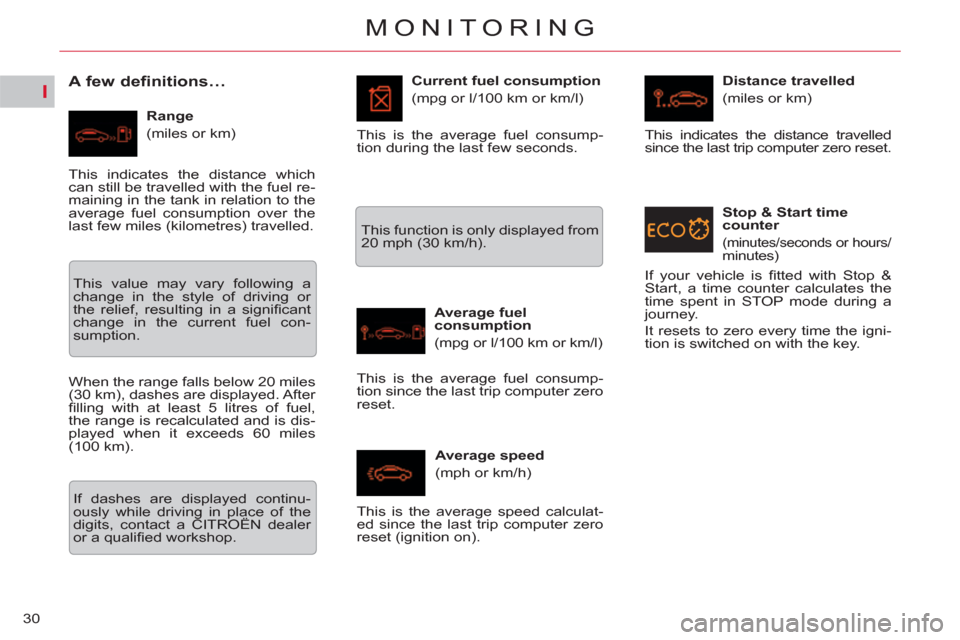
Range
(miles or km)
Current fuel consumption
(mpg or l/100 km or km/l)
Average fuel
consumption
(mpg or l/100 km or km/l)
Average speed
(mph or km/h)
Distance travelled
(miles or km)
This indicates the distance which
can still be travelled with the fuel re-
maining in the tank in relation to the
average fuel consumption over the
last few miles (kilometres) travelled.
This value may vary following a
change in the style of driving or
the relief, resulting in a signifi cant
change in the current fuel con-
sumption.
When the range falls below 20 miles
(30 km), dashes are displayed. After
fi lling with at least 5 litres of fuel,
the range is recalculated and is dis-
played when it exceeds 60 miles
(100 km).
If dashes are displayed continu-
ously while driving in place of the
digits, contact a CITROËN dealer
or a qualifi ed workshop. This function is only displayed from
20 mph (30 km/h). This is the average fuel consump-
tion during the last few seconds.
This is the average fuel consump-
tion since the last trip computer zero
reset.
This is the average speed calculat-
ed since the last trip computer zero
reset (ignition on). This indicates the distance travelled
since the last trip computer zero reset.
Stop & Start time
counter
(minutes/seconds or hours/minutes)
If your vehicle is fi tted with Stop &
Start, a time counter calculates the
time spent in STOP mode during a
journey.
It resets to zero every time the igni-
tion is switched on with the key.
Page 37 of 340

I
35
MONITORING
Warning lamp
is on
Cause
Action/Observations
Low fuel
level
fi xed. When it fi rst comes on there
remains approximately
5 litres of
fuel
in the tank. You must refuel as soon as possible to
avoid running out of fuel.
This warning lamp wil come on every time
the ignition is switched on, until a suffi cient
addition of fuel is made.
Fuel tank capacity: 71 litres.
Never continue to drive until you run out
of fuel, this could damage the emission
control and injection systems.
Maximum
coolant
temperature
fi xed red. The temperature of the
cooling system is too high. Stop as soon as it is safe to do so.
Wait until the engine has cooled down
before topping up the level, if necessary.
If the problem persists, contact a
CITROËN dealer or qualifi ed workshop.
Battery
charge
fi xed. The battery charging circuit
has a fault (dirty or loose
terminals, slack or cut
alternator belt, ...). The warning lamp should go off when the
engine is started.
If it does not go off, contact a CITROËN
dealer or a qualifi ed workshop.
+
Seat belt not
fastened/
unfastened
fi xed.
The driver and/or the front/
rear passenger has not
fastened or has unfastened
their seat belt. Pull the strap then insert the tongue in
the buckle.
Seat belts
not fastened/
unfastened
fi xed, associated
with the seat belt
not fastened/
unfastened
warning lampl. The illuminated dots represent the not
fastened/unfastened passengers. They come on:
- fi xed for 30 about seconds on starting the
vehicle,
- fi xed from 0 to 12 mph (0 to 20 km/h) when
driving,
-
fl ashing above 12 mph (20 km/h), accompanied
by an audible signal for about 120 seconds.
Page 43 of 340
I
41
MONITORING
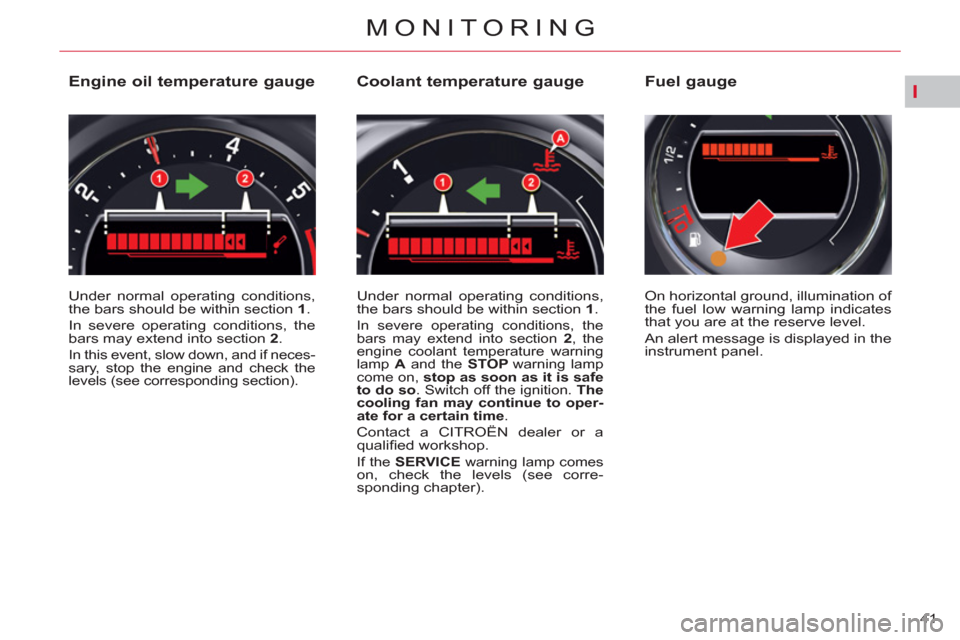
Engine oil temperature gauge
Under normal operating conditions,
the bars should be within section 1
.
In severe operating conditions, the
bars may extend into section 2
.
In this event, slow down, and if neces-
sary, stop the engine and check the
levels (see corresponding section).
Coolant temperature gauge
Under normal operating conditions,
the bars should be within section 1
.
In severe operating conditions, the
bars may extend into section 2
, the
engine coolant temperature warning
lamp A
and the STOP
warning lamp
come on, stop as soon as it is safe
to do so
. Switch off the ignition. The
cooling fan may continue to oper-
ate for a certain time
.
Contact a CITROËN dealer or a
qualifi ed workshop.
If the SERVICE
warning lamp comes on, check the levels (see corre-
sponding chapter). On horizontal ground, illumination of
the fuel low warning lamp indicates
that you are at the reserve level.
An alert message is displayed in the
instrument panel.
Fuel gauge
Page 52 of 340
III
50
COMFORT
Air conditioning
We recommend use of the automatic
regulation of the air conditioning.
It permits automatic and optimised
control of all of the following functions:
air fl ow, temperature in the passenger
compartment and air distribution, by
means of various sensors (ambient
temperature, sunshine). This elimi-
nates any need for you to change
your settings other than the tempera-
ture value displayed.
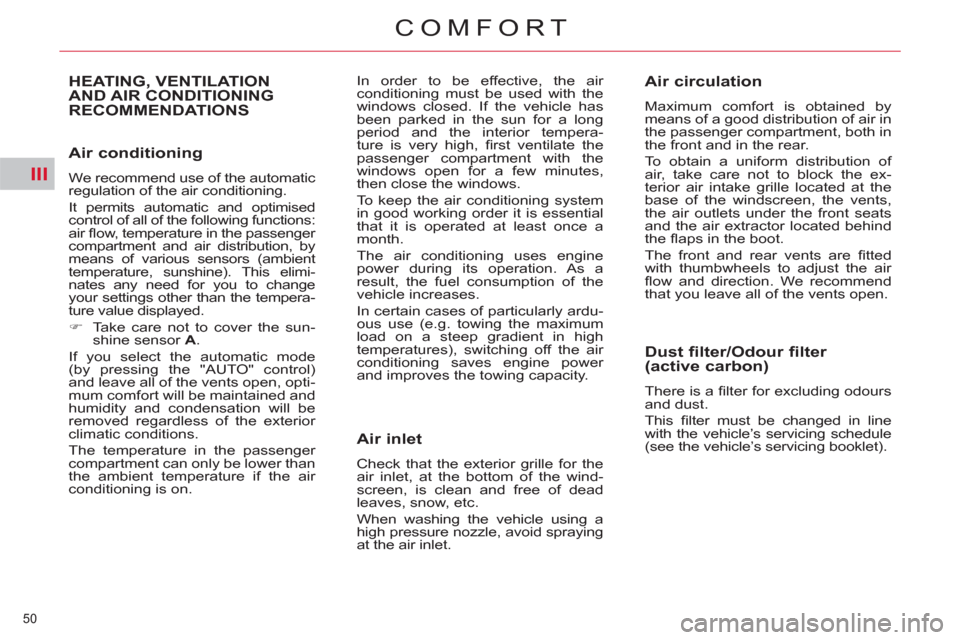
)
Take care not to cover the sun-
shine sensor A
.
If you select the automatic mode
(by pressing the "AUTO" control)
and leave all of the vents open, opti-
mum comfort will be maintained and
humidity and condensation will be
removed regardless of the exterior
climatic conditions.
The temperature in the passenger
compartment can only be lower than
the ambient temperature if the air
conditioning is on.
HEATING, VENTILATION
AND AIR CONDITIONING
RECOMMENDATIONS In order to be effective, the air
conditioning must be used with the
windows closed. If the vehicle has
been parked in the sun for a long
period and the interior tempera-
ture is very high, fi rst ventilate the
passenger compartment with the
windows open for a few minutes,
then close the windows.
To keep the air conditioning system
in good working order it is essential
that it is operated at least once a
month.
The air conditioning uses engine
power during its operation. As a
result, the fuel consumption of the
vehicle increases.
In certain cases of particularly ardu-
ous use (e.g. towing the maximum
load on a steep gradient in high
temperatures), switching off the air
conditioning saves engine power
and improves the towing capacity.
Air inlet
Check that the exterior grille for the
air inlet, at the bottom of the wind-
screen, is clean and free of dead
leaves, snow, etc.
When washing the vehicle using a
high pressure nozzle, avoid spraying
at the air inlet.
Air circulation
Maximum comfort is obtained by
means of a good distribution of air in
the passenger compartment, both in
the front and in the rear.
To obtain a uniform distribution of
air, take care not to block the ex-
terior air intake grille located at the
base of the windscreen, the vents,
the air outlets under the front seats
and the air extractor located behind
the fl aps in the boot.
The front and rear vents are fi tted
with thumbwheels to adjust the air
fl ow and direction. We recommend
that you leave all of the vents open.
Dust filter/Odour filter
(active carbon)
There is a fi lter for excluding odours
and dust.
This fi lter must be changed in line
with the vehicle’s servicing schedule
(see the vehicle’s servicing booklet).
Page 55 of 340
III
53
COMFORT
It controls the temperature, air fl ow
and intake and distributes the ven-
tilation to the windscreen and front
side windows.
Resuming manual control exits from
"Demisting" mode. It must be can-
celled to permit renewal of the air
in the passenger compartment and
demisting.
Once the screen is clear, pressing
control 1
returns the system to "AUTO"
mode.
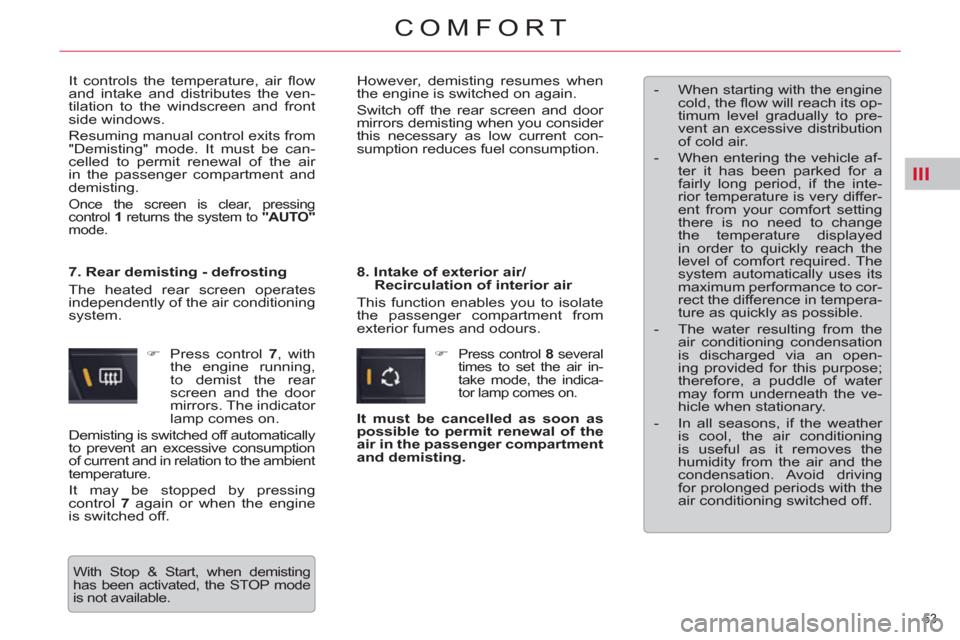
)
Press control 7
, with
the engine running,
to demist the rear
screen and the door
mirrors. The indicator
lamp comes on.
Demisting is switched off automatically
to prevent an excessive consumption
of current and in relation to the ambient
temperature.
It may be stopped by pressing
control 7
again or when the engine
is switched off.
7. Rear demisting - defrosting
The heated rear screen operates
independently of the air conditioning
system.
8. Intake of exterior air/
Recirculation of interior air
This function enables you to isolate
the passenger compartment from
exterior fumes and odours.
- When starting with the engine
cold, the fl ow will reach its op-
timum level gradually to pre-
vent an excessive distribution
of cold air.
- When entering the vehicle af-
ter it has been parked for a
fairly long period, if the inte-
rior temperature is very differ-
ent from your comfort setting
there is no need to change
the temperature displayed
in order to quickly reach the
level of comfort required. The
system automatically uses its
maximum performance to cor-
rect the difference in tempera-
ture as quickly as possible.
- The water resulting from the
air conditioning condensation
is discharged via an open-
ing provided for this purpose;
therefore, a puddle of water
may form underneath the ve-
hicle when stationary.
- In all seasons, if the weather
is cool, the air conditioning
is useful as it removes the
humidity from the air and the
condensation. Avoid driving
for prolonged periods with the
air conditioning switched off.
However, demisting resumes when
the engine is switched on again.
Switch off the rear screen and door
mirrors demisting when you consider
this necessary as low current con-
sumption reduces fuel consumption.
)
Press control 8
several
times to set the air in-
take mode, the indica-
tor lamp comes on.
It must be cancelled as soon as
possible to permit renewal of the
air in the passenger compartment
and demisting.
With Stop & Start, when demisting
has been activated, the STOP mode
is not available.
Page 59 of 340
III
57
COMFORT
When starting with the engine
cold, air fl ow will reach its opti-
mum level gradually to prevent an
excessive distribution of cold air.
When entering the vehicle after it
has been parked for a fairly long
period, if the interior temperature
is very different from your comfort
setting there is no need to change
the temperature displayed in or-
der to quickly reach the level of
comfort required. The system
automatically uses its maximum
performance to correct the differ-
ence in temperature as quickly as
possible.
The water resulting from the air
conditioning condensation is dis-
charged via an opening provided
for this purpose; therefore, a pud-
dle of water may form underneath
the vehicle when stationary.
In all seasons, if the weather is
cool, the air conditioning is use-
ful as it removes the humidity
from the air and the condensa-
tion. Avoid driving for prolonged
periods with the air conditioning
switched off.
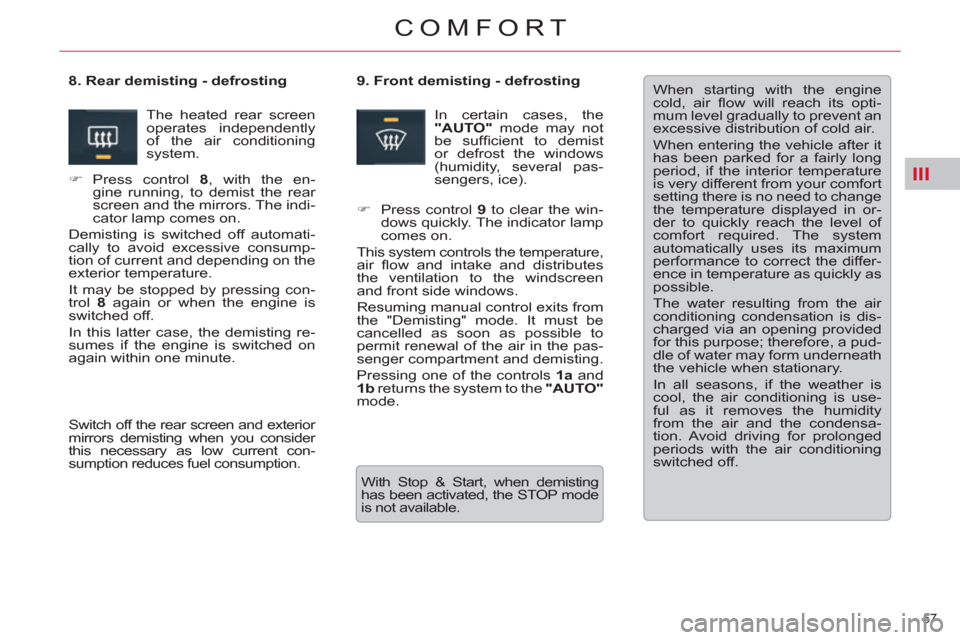
9. Front demisting - defrosting
In certain cases, the
"AUTO"
mode may not
be suffi cient to demist
or defrost the windows
(humidity, several pas-
sengers, ice).
)
Press control 9
to clear the win-
dows quickly. The indicator lamp
comes on.
This system controls the temperature,
air fl ow and intake and distributes
the ventilation to the windscreen
and front side windows.
Resuming manual control exits from
the "Demisting" mode. It must be
cancelled as soon as possible to
permit renewal of the air in the pas-
senger compartment and demisting.
Pressing one of the controls 1a
and
1b
returns the system to the "AUTO"
mode.
8. Rear demisting - defrosting
Switch off the rear screen and exterior
mirrors demisting when you consider
this necessary as low current con-
sumption reduces fuel consumption. The heated rear screen
operates independently
of the air conditioning
system.
)
Press control 8
, with the en-
gine running, to demist the rear
screen and the mirrors. The indi-
cator lamp comes on.
Demisting is switched off automati-
cally to avoid excessive consump-
tion of current and depending on the
exterior temperature.
It may be stopped by pressing con-
trol 8
again or when the engine is
switched off.
In this latter case, the demisting re-
sumes if the engine is switched on
again within one minute.
With Stop & Start, when demisting
has been activated, the STOP mode
is not available.
Page 63 of 340
III
!
61
COMFORT
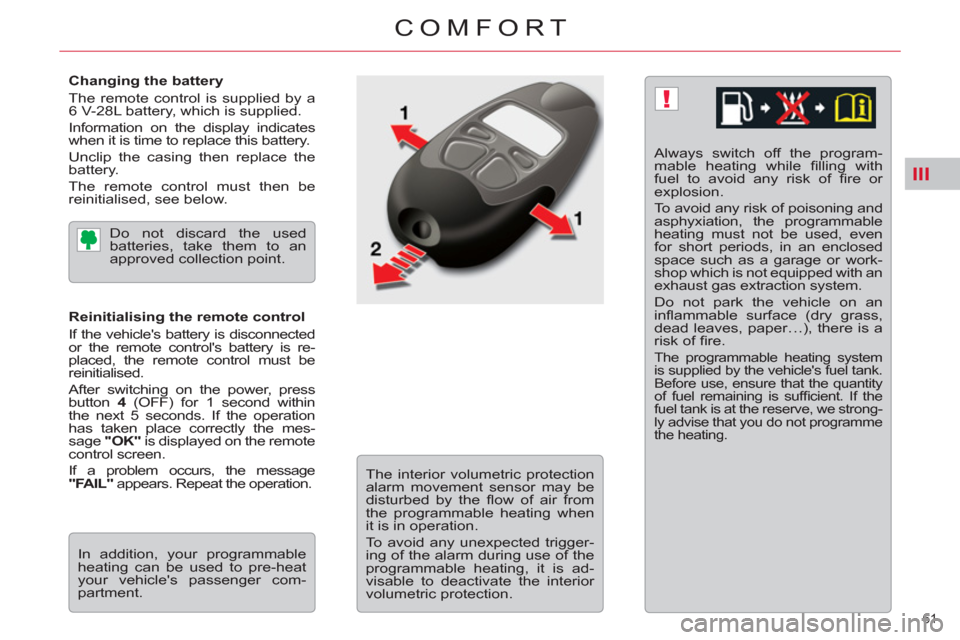
Changing the battery
The remote control is supplied by a
6 V-28L battery, which is supplied.
Information on the display indicates
when it is time to replace this battery.
Unclip the casing then replace the
battery.
The remote control must then be
reinitialised, see below.
Always switch off the program-
mable heating while fi lling with
fuel to avoid any risk of fi re or
explosion.
To avoid any risk of poisoning and
asphyxiation, the programmable
heating must not be used, even
for short periods, in an enclosed
space such as a garage or work-
shop which is not equipped with an
exhaust gas extraction system.
Do not park the vehicle on an
infl ammable surface (dry grass,
dead leaves, paper…), there is a
risk of fi re.
The programmable heating system
is supplied by the vehicle's fuel tank.
Before use, ensure that the quantity
of fuel remaining is suffi cient. If the
fuel tank is at the reserve, we strong-
ly advise that you do not programme
the heating.
Do not discard the used
batteries, take them to an
approved collection point.
Reinitialising the remote control
If the vehicle's battery is disconnected
or the remote control's battery is re-
placed, the remote control must be
reinitialised.
After switching on the power, press
button 4
(OFF) for 1 second within
the next 5 seconds. If the operation
has taken place correctly the mes-
sage "OK"
is displayed on the remote
control screen.
If a problem occurs, the message
"FAIL"
appears. Repeat the operation.
In addition, your programmable
heating can be used to pre-heat
your vehicle's passenger com-
partment.
The interior volumetric protection
alarm movement sensor may be
disturbed by the fl ow of air from
the programmable heating when
it is in operation.
To avoid any unexpected trigger-
ing of the alarm during use of the
programmable heating, it is ad-
visable to deactivate the interior
volumetric protection.
Page 88 of 340

IV
!
86
ACCESS
FUEL TANK
Capacity of the tank: approxi-
mately
71 litres
*
.
Low fuel level
When the minimum level
in the tank is reached,
this warning lamp comes
on in the instrument
panel, accompanied by an audible
warning and a message on the mul-
tifunction screen. When it fi rst comes
on, there remains around 5 litres of
fuel in the tank.
You must refuel to avoid running out
of fuel.
)
Press at the top left corner, then
pull open from the left.
)
turn the key a quarter turn to lock
and unlock the fi ller cap,
)
when refuelling, place the cap on
hook A
,
)
fi ll the tank, but do not persist
after the third cut-off
; this could
cause your vehicle to malfunction.
While you are refuelling, the engine
must be stopped and the ignition
switched off.
For a petrol engine with a cata-
lytic converter, unleaded fuel is
compulsory.
Opening the fuel flap
Additions of fuel must be of at least
5 litres to be taken into account by
the fuel gauge.
The fi ller neck is narrower to en-
sure that only unleaded petrol noz-
zles can be put in.
Opening the fi ller cap may create
a noise of an inrush of air. This
vacuum, which is entirely normal,
is caused by the sealing of the fuel
system.
Refuelling
With Stop & Start, never re-
fuel with the system in STOP
mode; you must switch off
the ignition with the key.
*
55 litres for Slovakia.
Page 89 of 340

IV
87
ACCESS
Quality of the fuel used for
petrol engines
The petrol engines are perfectly
compatible with E10 type petrol
biofuels (containing 10 % ethanol),
conforming to European standards
EN 228 and EN 15376.
E85 type fuels (containing up to 85 %
ethanol) are reserved exclusively for
vehicles marketed for the use of this
type of fuel (BioFlex vehicles). The
quality of the ethanol must comply
with European standard EN 15293.
For Brazil only, special vehicles are
marketed to run on fuels containing
up to 100 % ethanol (E100 type).
Quality of the fuel used for
Diesel engines
The Diesel engines are perfectly
compatible with biofuels which con-
form to current and future European
standards (Diesel fuel which com-
plies with standard EN 590 mixed
with a biofuel which complies with
standard EN 14214) available at the
pumps (containing up to 7 % Fatty
Acid Methyl Ester).
The B30 biofuel can be used in cer-
tain Diesel engines; however, this
use is subject to strict application
of the special servicing conditions.
Contact a CITROËN dealer or a
qualifi ed workshop.
The use of any other type of (bio)fuel
(vegetable or animal oils, pure or
diluted, domestic fuel...) is strictly
prohibited (risk of damage to the en-
gine and fuel system).
MISFUEL PREVENTION
(DIESEL) *
Mechanical device which prevents
fi lling the tank of a Diesel vehicle
with petrol. It avoids the risk of en-
gine damage that can result from fi ll-
ing with the wrong fuel.
Located in the fi ller neck, the misfuel
prevention device appears when the
fi ller cap is removed.
Operation
When a petrol fi ller nozzle is intro-
duced into the fuel fi ller neck of your
Diesel vehicle, it comes into contact
with the fl ap. The system remains
closed and prevents fi lling.
Do not persist but introduce a
Diesel type fi ller nozzle.
It remains possible to use a fuel
can to fi ll the tank; this must be
done slowly.
In order to ensure a good fl ow of
fuel, do not place the nozzle of the
fuel can in direct contact with the fl ap of the misfuel prevention device.
*
According to country of sale.
Page 140 of 340

IX
!
138
DRIVING
GEAR EFFICIENCY
INDICATOR *
System which reduces fuel con-
sumption by advising the driver to
change up on vehicles fi tted with a
manual gearbox.
Operation
The system intervenes only when
driving economically.
Depending on the driving situation
and your vehicle's equipment, the
system may advise you to skip one
or more gears. You can follow this
instruction without engaging the in-
termediate gears.
The gear engagement recommen-
dations must not be considered
compulsory. In fact, the confi gu-
ration of the road, the amount of
traffi c and safety remain determin-
ing factors when choosing the best
gear. Therefore, the driver remains
responsible for deciding whether or
not to follow the advice given by the
system.
This function cannot be deactivated.
* According to engine.
Example:
- You are in third gear.
- You press the accelerator pedal
moderately.
- The system may suggest that
you engage a higher gear, if ap-
propriate.
The information appears in the in-
strument panel screen in the form of
an arrow accompanied by the sug-
gested gear.
In the case of driving which
makes particular demands on
the performance of the engine
(fi rm pressure on the accelerator
pedal, for example, when overtak-
ing...), the system will not recom-
mend a gear change.
The system never suggests:
- engaging fi rst gear,
- engaging reverse gear,
- engaging a lower gear.