belt CITROEN C5 X 2023 Owner's Manual
[x] Cancel search | Manufacturer: CITROEN, Model Year: 2023, Model line: C5 X, Model: CITROEN C5 X 2023Pages: 228, PDF Size: 6.78 MB
Page 115 of 228

11 3
Driving
6Information displayed on
the instrument panel
5.Cruise control activated (green)/paused
(grey)
6. Speed setting value
7. Speed suggested by the Road signs
recognition
8. Vehicle held
stationary
9. Inter-vehicle distance setting
10. Position of the vehicle detected by the
system
Use
Selecting the system
► With the engine running, press successively
on 1-ASSIST until cruise control mode is
displayed on the instrument panel. ►
After a few seconds, cruise control mode is
selected.
The Driving aids mini-view is displayed
(grey) and cruise control is ready to be activated.
Switching on cruise control
The vehicle speed must be between 0 and
112 mph (0 and 180 km/h).
System activation is also subject to the following
conditions:
–
driver's door closed.
–
driver's seat belt fastened.
–
mode D selected on the automatic gearbox.
–
parking brake released.
–
if the vehicle is stationary
, brake pedal
depressed.
The message “OK?" is displayed if all the
activation conditions are met.
►
Press
on 4-OK: the current speed becomes
the speed setting (minimum 19 mph (30
km/h))
and cruise control is immediately activated
(green display).
Modifying the speed setting
To change the speed setting using the vehicle’s
current speed:
►
For steps of +/- 1 mph (1 km/h), make
successive short presses upwards/downwards
on
3 to increase/decrease.
►
For steps of +/- 5 mph (5
km/h), press and
hold upwards/downwards on 3 to increase/
decrease.
Prolonged pressing and holding
upwards/downwards on 3 causes a rapid
change in vehicle speed.
When the function is activated, it is possible
to change the speed setting using the speed
suggested by the Road signs recognition
function displayed on the instrument panel:
–
When passing the sign:
►
Press
4-OK to save the suggested speed.
This value is then immediately shown as the new
speed setting on the instrument panel.
–
After passing the sign:
►
Press
4-OK. The message “OK?" is
displayed to confirm the request to save.
►
Press
4-OK again to save the suggested
speed. The new speed setting value is displayed
on the instrument panel.
Pausing/resumption of cruise control
► Press 2-I I> or depress the brake pedal.
The symbol "I I>” is displayed if all the activation
conditions are met.
Cruise control may also have been paused:
–
automatically
, if the electronic stability control
(ESC) system is triggered.
–
by shifting to neutral or engaging reverse gear
.
–
by using the electric parking brake.
–
by unfastening the seat belt.
–
by opening the driver's door
.
►
Press
2-I I> or 4-OK to reactivate cruise
control.
Following braking that has brought the vehicle
to a complete stop, if the traffic conditions do
Page 127 of 228
125
Driving
6Deactivation/Activation
By default, the system is automatically activated
at every engine start.
It is configured in the ADAS touch screen
application.
Deactivation of the system is signalled by
the illumination of this warning lamp,
accompanied by the display of a message.
Operating conditions and
limits
Vehicle moving forward without trailer.
Brake system operational.
ASR / ESP system activated.
Seat belts fastened for all passengers.
Stabilised speed on roads with no or low
curvature.
This warning lamp lights up on the instrument panel without any additional
message, to indicate that the “automatic braking
system” is not available. This is a normal
behavior indicating that a condition is not fulfilled
and which does not request the support of a
workshop.
In any situations with ignition on where automatic
braking presents a risk, deactivating the
system via ADAS touch screen application is
recommended, for instance:
–
T
owing a trailer (particularly a trailer without its
own braking system).
–
Carrying long objects on roof bars.
–
Driving with snow chains.
– Using an automatic car wash.
– Performing any maintenance (e.g. changing a
wheel, working underhood).
–
Placing the vehicle on a rolling bench in a
workshop.
–
T
owing the vehicle.
–
Following a front bumper deformation (version
with radar).
–
Following
an impact to the windscreen close to
the detection camera.
The system is automatically deactivated if:
–
A
spare wheel with a too small diameter is
detected.
–
A
fault with the brake pedal switch or with
the right or left brake lamp is detected.
–
A
fault in the sensors, in the electronic or in
the brake system is detected.
–
A
trailer is detected by the equipped vehicle
hitch (with an electrical connection plug).
The system diagnoses permanently its capability and may inhibit itself without
specific driver indication, if the system is
outside of the regular operating conditions.
Examples: sensor initialization, board voltage
out of regular range, activation of stability
system…
Therefore the system may not be available
just after starting the vehicle.
It can be dangerous to drive if the brake
lamps are not in perfect working order.
The driver must not load his vehicle excessively (respect of MTAC values,
MTRA values and loading height on roof
bars).
Following an impact (e.g. a collision), the
system is automatically deactivated.
Have it checked by a CITROËN dealer or a
qualified workshop.
Collision Risk Alert
This function warns the driver if there is a risk
of collision with the preceding vehicle, or with a
pedestrian or cyclist.
Modifying the alert trigger threshold
The trigger threshold determines the sensitivity
with which the function warns of the risk of
collision.
It is configured in the ADAS touch screen
application.
►
Select one of the 3 preset thresholds: “ Far
”,
“Medium” or “Near”.
The selected threshold is memorised when the
ignition is switched off.
Operation
Depending on the collision risk detected by the
system and the alert trigger threshold chosen
Page 130 of 228

128
Driving
if the front camera or the front radar is covered
by dirt, snow, ice or anything preventing the
sensing.
In the event of a malfunction, this warning
lamp lights up on the instrument panel,
accompanied by the display of a message and
an audible signal.
Have it checked by a CITROËN dealer or a
qualified workshop.
If these warning lamps come on
after the engine has been switched
off and then restarted, contact a CITROËN
dealer or a qualified workshop to have the
system checked.
These warning lamps light up on the instrument panel and/or in the
warning lamp display for seat belts and front
passenger airbag to indicate that the driver's
and/or front passenger's seat belt is not fastened
(depending on version). The automatic braking
system is deactivated until the seat belts are
fastened.
Distraction detection
For more information, refer to the
General recommendations on the use
of driving and manoeuvring aids .
The function comprises the "Coffee Break Alert"
system combined with the "Driver Attention
Warning" system.
These systems are in no way designed to keep the driver awake or to prevent
the driver from falling asleep at the wheel.
It is the driver’s responsibility to stop if feeling
tired.
Take a break if you are feeling tired or at least
every 2 hours.
Activation/Deactivation
By default, the function is automatically activated
at every engine start.
It is configured in the ADAS touch screen
application.
Coffee Break Alert
The system triggers an alert when it detects that the driver has not taken a
break after two hours of driving at a speed above
43 mph (70
km/h).
This alert is issued via the display of a message
encouraging the driver to take a break,
accompanied by an audible signal.
If the driver does not follow this advice, the alert
is repeated hourly until the vehicle is stopped.
The system resets itself if one of the following
conditions is met:
–
With the engine running, the vehicle has been
stationary for more than 15 minutes.
–
The ignition has been switched off for a few
minutes.
–
The driver's seat belt is unfastened and their
door is opened.
As soon as the speed of the vehicle drops below 43 mph (70 km/h), the
system goes into standby.
Driving time starts being counted again once
the speed reaches above 43
mph (70 km/h).
Driver Attention Warning
The system assesses the driver's level of alertness, fatigue and distraction by
identifying trajectory changes in relation to the
lane markings.
To do this, the system uses a camera, placed on
the upper part of the windscreen.
This system is particularly suited to fast roads
(speed higher than 43 mph (70
km/h)).
At a first alert level, the driver is warned by
the message "Caution!“, accompanied by an
audible signal.
After three first-level alerts, the system triggers
a further alert with the message " Driving
Page 176 of 228

174
In the event of a breakdown
Accessing the battery
The battery is located under the bonnet.
For access to the (+) terminal:
► Release the bonnet by pulling the internal
release lever
, then the external safety catch.
►
Raise the bonnet.
(+)
Positive terminal with a quick-release clamp.
(-) Negative terminal.
As the battery's negative terminal is not
accessible, a remote earth point is located near
the battery.
Starting using another battery
If the vehicle's battery is flat, the engine can be
started using a backup battery (either external or
from another vehicle) and jump leads or using a
battery booster.
Never start the engine by connecting a
battery charger.
Never use a 24
V or higher battery booster.
Check beforehand that the backup battery
has a nominal voltage of 12
V and a capacity
at least equal to that of the discharged
battery.
The two vehicles must not be in contact with
each other.
Switch off all electricity-consuming equipment
on both vehicles (audio system, wipers,
lighting, etc.).
Make sure that the jump leads are well away
from the engine’s moving parts (fan, belt,
etc.).
Do not disconnect the (+) terminal while the
engine is running.
► Lift the plastic cover on the (+) terminal, if the
vehicle has one.
►
Connect the red cable to the (+) terminal of
flat battery
A (at the metal elbow), then to the
(+) terminal of the backup battery
B or of the
booster.
►
Connect one end of the green or black cable
to the (-) terminal of the backup battery
B or of
the booster (or to an earth point on the assisting
vehicle).
► Connect the other end of the green or black
cable to the earth point C .
►
Start the engine on the assisting vehicle and
leave it running for a few minutes.
►
Operate the starter on the broken down
vehicle and let the engine run.
If the engine does not start immediately
, switch
off the ignition and wait a few moments before
trying again.
►
W
ait for it to return to idle.
►
Disconnect the jump leads in reverse order.
►
Refit the plastic cover to the (+) terminal, if
the vehicle has one.
►
Allow the engine to run for at least
30
minutes, with the vehicle stationary, so that
the battery reaches an adequate state of charge.
Driving immediately without having
reached a sufficient level of charge may
affect some of the vehicle's functionalities.
Charging the battery using a battery
charger
For optimum service life of the battery, it is
essential to maintain an adequate state of
charge.
In some circumstances, it may be necessary to
charge the battery:
–
When using the vehicle mainly for short
journeys.
–
If the vehicle is to be taken off the road for
several weeks.
Page 203 of 228
201
Event data recorders
11Recording event data
Electronic control units are installed in your
vehicle. These control units process data
received from the vehicle's sensors, for example,
or data they generate themselves or exchange
with each other. Some of these control units are
required for the correct operation of your vehicle,
some others assist you while driving (driving or
manoeuvring aids), while others provide comfort
or infotainment functions.
The following contains general information about
how data is processed within the vehicle.
You will find additional information about the
specific data which is downloaded, stored
and transmitted to third parties and what it is
used for in your vehicle under the keyword
"Data protection". This information is directly
associated with the references for the functions
in question contained in the corresponding
vehicle handbook, or in the general terms and
conditions of sale.
This information is also available online.
Vehicle operating data
The control units process the data used for the
operation of the vehicle.
This data includes, for example:
–
Information about the state of the vehicle (e.g.
speed, travel time, lateral acceleration, wheel
rotation rate, fastened seat belts display). –
Environmental conditions (e.g. temperature,
rain sensor
, distance sensor).
As a general rule, this data is temporary, is
not stored for longer than one operating cycle
and is only used within the vehicle itself. The
control units often record this data (including the
vehicle's key). This function allows either the
temporary or permanent storage of information
about the state of the vehicle, stresses on
components, servicing requirements, as well as
events and technical errors.
Depending on the vehicle's equipment level, the
data stored is as follows:
–
Operating state of system components (e.g.
filling level, tyre pressures, battery charge
status).
–
Faults and malfunctions in important system
components (e.g. lamps, brakes).
–
System reactions in specific driving situations
(e.g. deployment of an airbag, triggering of
stability control and braking systems).
–
Information about events which have
damaged the vehicle.
–
For electric and rechargeable hybrid vehicles,
the traction battery charge level and the
estimated driving range.
In particular circumstances (e.g. if the vehicle
has detected a malfunction), it may be necessary
to record data which would otherwise simply not
be stored.
When taking your vehicle in for servicing (e.g.
repairs, maintenance), the stored operating
data may be read along with the vehicle's identification number and used if necessary
.
The personnel working for the servicing network
(e.g. garages, manufacturers) or third parties
(e.g. roadside assistance agents) may read
the vehicle's data. This also applies to work
carried out under warranty and quality assurance
measures.
This data is generally read via the OBD
(On-Board Diagnostics) port fitted by law to
the vehicle. It is used to report on the technical
state of the vehicle or its components and
facilitates the diagnosis of malfunctions, in
compliance with warranty obligations and for
quality improvement. This data, in particular the
information relating to stress on components,
technical events, operator errors and other
malfunctions, is sent to the Manufacturer, if
necessary, along with the vehicle's identification
number. The Manufacturer's liability may also be
engaged. The Manufacturer may also use the
operating data taken from the vehicle for product
recalls. This data may also be used to check the
customer's warranty and any claims made under
warranty.
Any malfunctions stored in the vehicle may be
reset by an after-sales service company during
servicing or repair work, or at your request.
Page 209 of 228
207
Alphabetical index
Lane departure warning active 129
Leather (care)
163
LEDs - Light-emitting diodes
62
Level, brake fluid
159
Level, engine coolant
19, 159
Level, engine oil
18, 158
Levels and checks
158–159
Level, screenwash fluid
66, 159
Light-emitting diodes - LEDs
62
Lighting dimmer
20
Lighting, directional
65
Lighting, exterior
61, 64
Lighting, guide-me home
63
Lighting, interior
57
Lighting, mood
57
Lighting, welcome
63
Loading
154–155
Load reduction mode
156
Locating your vehicle
26
Locking
26, 28
Locking from the inside
29
Locking the doors
29
Log, alerts
20
Long objects, transporting
58
Low fuel level
140
Lumbar
43
M
Mains socket (domestic network) 143–144
Maintenance (advice)
142, 162
Maintenance, routine
103, 159, 161
Manoeuvring aids (recommendations) 101
Map reading lamps
57
Markings, identification
184
Massage function
45
Massage, multi-point
45
Mat
57, 103
Menu short cuts
22
Mirror, rear view
47
Mirrors, door
46, 52, 131
Mirror, vanity
54
Mobile application
23, 53, 148, 150
Motor, electric
97, 141, 183
Motorised tailgate
32–33
Mountings, ISOFIX
82, 85–86
N
Net, luggage retaining 59
O
Obstacle detection 132
Oil change
158
Oil consumption
158
OIl, engine
158
On-board tools
60, 165–166
Opening the bonnet
157
Opening the boot
27, 32
Opening the doors
27, 31
Opening the windows
25
P
Pads, brake 160
Paint
162, 184
Paint colour code
184
Parcel shelf, rear
59
Parking brake, electric
91–93, 160
Parking sensors, audible and visual
132
Parking sensors, front
133
Parking sensors, rear
133
Passenger compartment temperature pre-
conditioning (Rechargeable hybrid)
23, 53
Pedestrian horn (Rechargeable hybrid)
70
Personalisation
11
Plates, identification
184
Port, USB
54, 58
Post Collision Safety Brake
73
Power
19
Power indicator (Rechargeable hybrid)
8, 19
Pressures, tyres
160, 167, 184
Pre-tensioning seat belts
76
Profiles
186
Protecting children
77, 79–84
Proximity Keyless Entry & Start
27
Puncture
166–167, 169
R
Radar (warnings) 102
Radio
195–196
Reading lamps
57
READY lamp
157
Page 210 of 228
208
Alphabetical index
Rear screen, demisting 52
Rear traffic alert
137
Rechargeable hybrid engine
8, 22, 157, 178, 183
Rechargeable hybrid system
6, 8, 22,
90, 97, 141
Recharging the battery
173–174, 176
Recharging the traction battery
145
Recharging the traction battery
(Rechargeable hybrid)
141, 148–150
Recirculation, air
51–52
Recovery
178–180
Recovery of the vehicle
178–179
Reduction of electrical load
156
Regenerative braking (deceleration
by engine braking)
95
Reinitialisation of the under-inflation
detection system
101
Reinitialising the remote control
31
Reminder, lighting on
61–62
Remote control
25–29
Remote functions
150
Remotely operable functions (Rechargeable
hybrid)
23, 53
Removing a wheel
170–171
Removing the mat
57
Replacing bulbs
171–172
Replacing fuses
173
Replacing the air filter
160
Replacing the oil filter
160
Replacing the passenger compartment
filter
160
Reservoir, screenwash
159Reset trip 20–21
Reversing camera
102, 134–135
Reversing lamps
172
Roof bars
154–155
Roof, opening
39
S
Safety, children 77, 79–84
Screens, very cold conditions
155
Screenwash
66
Screenwash, front
66
Seat angle
43
Seat belts
75–76, 82
Seat belts, rear
75
Seat, rear bench
47
Seats, electric
43–44
Seats, front
42–44
Seats, heated
44
Seats, rear
47–48, 80
Selector, gear
93, 95–96
Semi-automatic lane changing
120
Sensors (warnings)
102
Serial number, vehicle
184
Service indicator
17
Servicing
17, 159, 161
Settings, equipment
11, 22
Sidelamps
62
Silent vehicle warning sound (Rechargeable
hybrid)
70
Ski flap
58
Smartphone
23–24, 55
Snow chains 101, 155–156
Snow screen
155
Socket, 12 V accessory
54, 60
Speakers
55
Speed adjustment during cornering
119
Speed limiter
106–108
Speed limit recognition
104–105
Speedometer
103
Sport mode
96–97
Spotlamps, side
64
Stability control (ESC)
72, 74
Starting the engine
90
Starting the vehicle
89–90, 95
Starting using another battery
90, 174
State of charge, battery
22
Station, radio
195–196
Steering wheel
45, 103
Steering wheel, adjustment
45
Stickers, customising ~ Stickers,
expressive
162
Stopping the vehicle
89–90, 95
Stop & Start
21, 50, 52, 99–100,
140, 156, 160, 176
Storage
54, 56, 58
Storage box
60
Storage wells
60
Storing driving positions
44
Stowing rings
59
Sunshine sensor
49
Sun visor
54
Suspension
161
Synchronising the remote control
31
Page 211 of 228
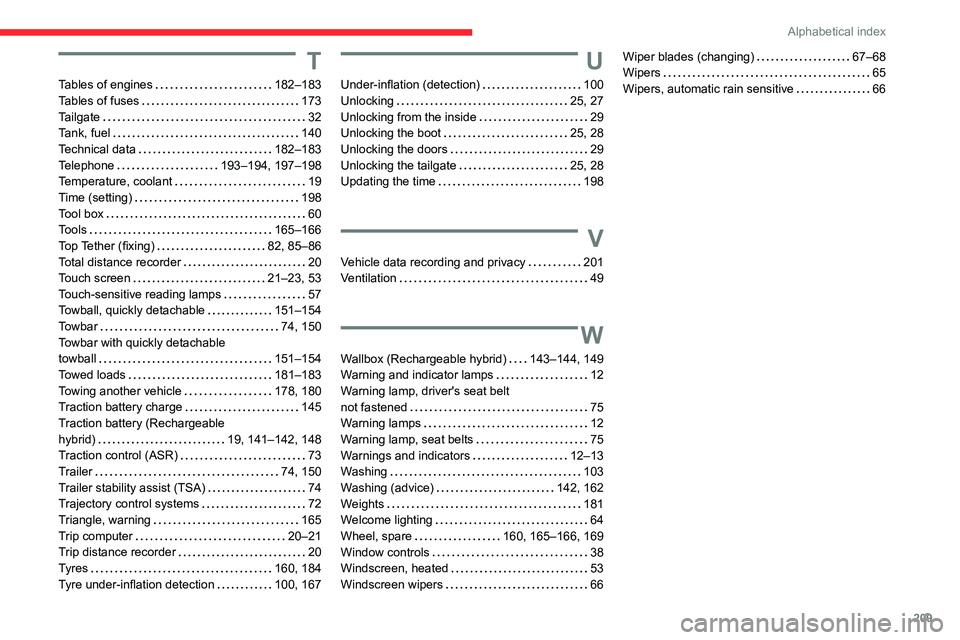
209
Alphabetical index
T
Tables of engines 182–183
Tables of fuses
173
Tailgate
32
Tank, fuel
140
Technical data
182–183
Telephone
193–194, 197–198
Temperature, coolant
19
Time (setting)
198
Tool box
60
Tools
165–166
Top Tether (fixing)
82, 85–86
Total distance recorder
20
Touch screen
21–23, 53
Touch-sensitive reading lamps
57
Towball, quickly detachable
151–154
Towbar
74, 150
Towbar with quickly detachable
towball
151–154
Towed loads
181–183
Towing another vehicle
178, 180
Traction battery charge
145
Traction battery (Rechargeable
hybrid)
19, 141–142, 148
Traction control (ASR)
73
Trailer
74, 150
Trailer stability assist (TSA)
74
Trajectory control systems
72
Triangle, warning
165
Trip computer
20–21
Trip distance recorder
20
Tyres
160, 184
Tyre under-inflation detection
100, 167
U
Under-inflation (detection) 100
Unlocking
25, 27
Unlocking from the inside
29
Unlocking the boot
25, 28
Unlocking the doors
29
Unlocking the tailgate
25, 28
Updating the time
198
V
Vehicle data recording and privacy 201
Ventilation
49
W
Wallbox (Rechargeable hybrid) 143–144, 149
Warning and indicator lamps
12
Warning lamp, driver's seat belt
not fastened
75
Warning lamps
12
Warning lamp, seat belts
75
Warnings and indicators
12–13
Washing
103
Washing (advice)
142, 162
Weights
181
Welcome lighting
64
Wheel, spare
160, 165–166, 169
Window controls
38
Windscreen, heated
53
Windscreen wipers
66
Wiper blades (changing) 67–68
Wipers
65
Wipers, automatic rain sensitive
66