sensor CITROEN C6 2005 Owner's Manual
[x] Cancel search | Manufacturer: CITROEN, Model Year: 2005, Model line: C6, Model: CITROEN C6 2005Pages: 223, PDF Size: 4.26 MB
Page 178 of 223

Downloaded from www.Manualslib.com manuals search engine 172
BRAKES
B3FP7GFC
BRAKING SYSTEM: GENERAL SPECIFICATIONSComponents Supplier Reference Observations
Hydraulic valve blockLocated on the front LH chassis member:
TRWESP 4regulation channels
ECUVSC 440
25-way connector
Integral to the hydraulic valve block
2-way blackconnector
Front wheel sensor The sensors, of inductive type, are fitted on the pivot
SIEMENSAir gap non-adjustable: 0.25 to 1.65 mm
VDO 2-way blackconnector
Rear wheel sensor The sensors, of inductive type, are fitted on the pivot
Air gap non-adjustable: 0.23 to 1.35 mm
Front pivot bearingThe hub has a bearing with integral magnetic wheel
NSK(48 pairs of poles)
Rear hub bearingThe rear hub-bearing has a radial ABS target
(48 pairsof poles)
ABS/ESP hydraulic valve block
Angl-C6-PAGE170-194-2005 4/02/05 17:35 Page 172
Page 180 of 223

Downloaded from www.Manualslib.com manuals search engine 174
BRAKES
TIGHTENING TORQUES: BRAKING SYSTEM
Front brakes
1 Front brake disc 1 ± 0,12 Yoke on brake caliper 3 ± 0,23 Unions on brake piping 4 ± 0,54 Front brake caliper 11,5 ± 1
5 Hydraulic valve block on intermediate support
0,8 ± 0,26 Intermediate support on support7 Front wheel sensor 0,8 ± 0,1
B3FP7HNDB3FP7HMD
B3FP7HPD
Angl-C6-PAGE170-194-2005 4/02/05 17:35 Page 174
Page 182 of 223

Downloaded from www.Manualslib.com manuals search engine 176
BRAKES
TIGHTENING TORQUES: BRAKING SYSTEM
Rear brakes
11 Rear brake caliper 3,5 ± 0,312 Unions on brake piping 1,5 ± 0,113 Rear brake caliper support 10,8 ± 114 Rear wheel sensor 0,8 ± 0,1
B3FP7HTDB3FP7HSD
Angl-C6-PAGE170-194-2005 4/02/05 17:35 Page 176
Page 183 of 223

Downloaded from www.Manualslib.com manuals search engine 177
BRAKES
TIGHTENING TORQUES: BRAKING SYSTEM
15 Electric parking brake system (FSE) 0,4 ± 0,0616 Nut for parking brake cables 6 ± 0,617 Gyrometer/accelerometer sensor on support 0,9 ± 0,118 Sensor support on body 0,4 ± 0,06
B3FP7HVDB3FP7HUD
Parking brake
Gyrometer/accelerometer sensor
Angl-C6-PAGE170-194-2005 4/02/05 17:35 Page 177
Page 202 of 223

Downloaded from www.Manualslib.com manuals search engine 196
HYDRAULICS
SAFETY REQUIREMENTS: ACTIVE SUSPENSION WITH VARIABLE DAMPING
During the operation.
Wait for the pressure in the hydraulic circuit to fall fully before disconnecting the unions on the following components (risk of sudden sinking of the
vehicle):
- Built-in Hydro-electronic Interface (BHI).
- Front suspension cylinder.
- Rear suspension cylinder.
- Front stiffness regulator.
- Rear stiffness regulator.
- Suspension pressure sensors.
IMPERATIVE: Do not operate on the hydraulic circuit without making the pressure drop (see corresponding operation).
Engine running.
Do not operate on the hydraulic suspension circuit.
Always remain out of range of any possible projections of fluid, as these could cause serious injuries.
NOTE:In the event of contact of LDSfluid with the eyes, rinse them with copious amounts of water and seek specialist advice.
NOTE:In the event of lengthy contact of LDSfluid with the skin, wash it with soap and water.
WARNING: After the engine has stopped, wait 30 seconds before commencing any operation.
Angl-C6-page195-202-2005 4/02/05 17:36 Page 196
Page 203 of 223
Downloaded from www.Manualslib.com manuals search engine HYDRAULICS
197
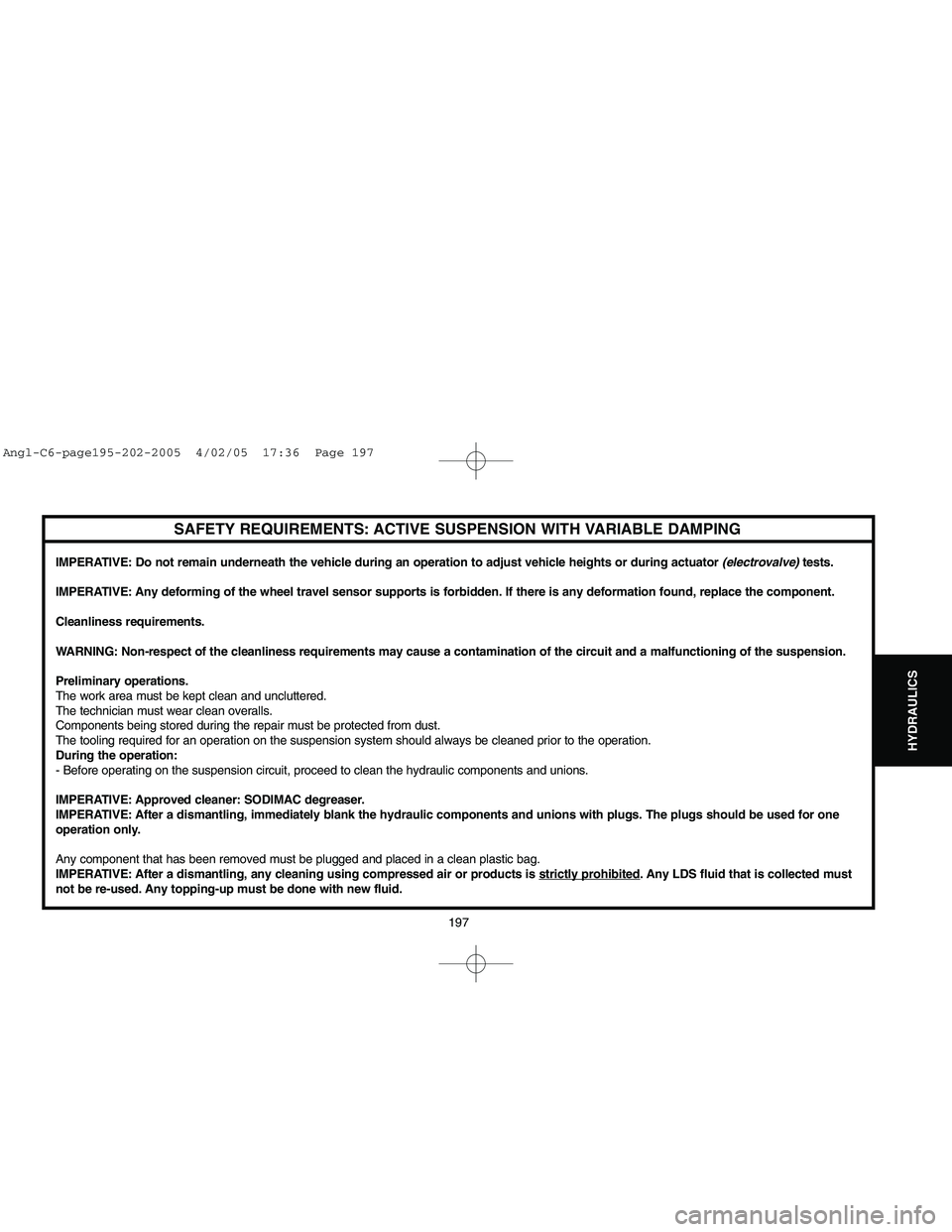
SAFETY REQUIREMENTS: ACTIVE SUSPENSION WITH VARIABLE DAMPING
IMPERATIVE: Do not remain underneath the vehicle during an operation to adjust vehicle heights or during actuator (electrovalve) tests.
IMPERATIVE: Any deforming of the wheel travel sensor supports is forbidden. If there is any deformation found, replace the component.
Cleanliness requirements.
WARNING: Non-respect of the cleanliness requirements may cause a contamination of the circuit and a malfunctioning of the suspension.
Preliminary operations.
The work area must be kept clean and uncluttered.
The technician must wear clean overalls.
Components being stored during the repair must be protected from dust.
The tooling required for an operation on the suspension system should always be cleaned prior to the operation.
During the operation:
- Before operating on the suspension circuit, proceed to clean the hydraulic components and unions.
IMPERATIVE: Approved cleaner: SODIMAC degreaser.
IMPERATIVE: After a dismantling, immediately blank the hydraulic components and unions with plugs. The plugs should be used for one
operation only.
Any component that has been removed must be plugged and placed in a clean plastic bag.
IMPERATIVE: After a dismantling, any cleaning using compressed air or products is strictly prohibited
. Any LDS fluid that is collected must
not be re-used. Any topping-up must be done with new fluid.
Angl-C6-page195-202-2005 4/02/05 17:36 Page 197
Page 218 of 223
Downloaded from www.Manualslib.com manuals search engine 212
AIR
CONDITIONING
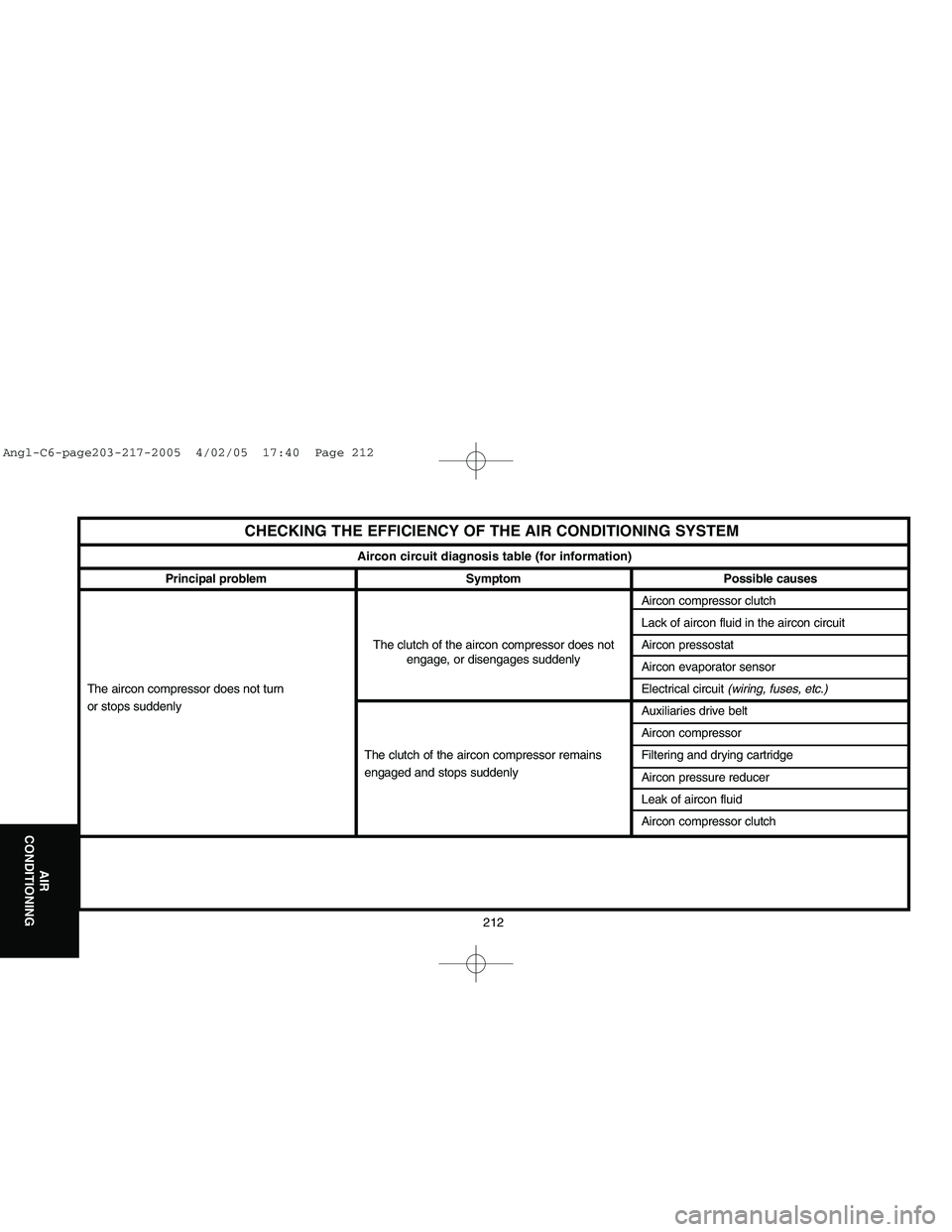
CHECKING THE EFFICIENCY OF THE AIR CONDITIONING SYSTEM
Aircon circuit diagnosis table (for information)
Principal problem Symptom Possible causes
Aircon compressor clutch
Lack of aircon fluid in the aircon circuit
The clutch of the aircon compressor does not Aircon pressostat
engage, or disengages suddenly
Aircon evaporator sensor
The aircon compressor does not turn Electrical circuit (wiring, fuses, etc.)
or stops suddenly
Auxiliaries drive belt
Aircon compressor
The clutch of the aircon compressor remains Filtering and drying cartridge
engaged and stops suddenly
Aircon pressure reducer
Leak of aircon fluid
Aircon compressor clutch
Angl-C6-page203-217-2005 4/02/05 17:40 Page 212
Page 220 of 223

Downloaded from www.Manualslib.com manuals search engine 214
AIR
CONDITIONING
CHECKING THE EFFICIENCY OF THE AIR CONDITIONING SYSTEM
Aircon circuit diagnosis table (for information)
Principal problem Symptom Possible causes
Low pressure and high pressure too highAircon pressure reducer defective
Duct clogged
Low pressure too high and high pressure too low Aircon compressor seal defective
Aircon evaporator sensor defective
Low pressure too low and high pressure too high Aircon pressure reducer jammed
Abnormal levels of pressuretoo high
Filtering and drying cartridge obstructed
Duct clogged
Duct clogged
Aircon pressure reducer jammed
Low pressure and high pressure too low
Lack of aircon fluid in the aircon circuit
Aircon compressor defective
Angl-C6-page203-217-2005 4/02/05 17:40 Page 214
Page 221 of 223
Downloaded from www.Manualslib.com manuals search engine 215
AIR
CONDITIONING
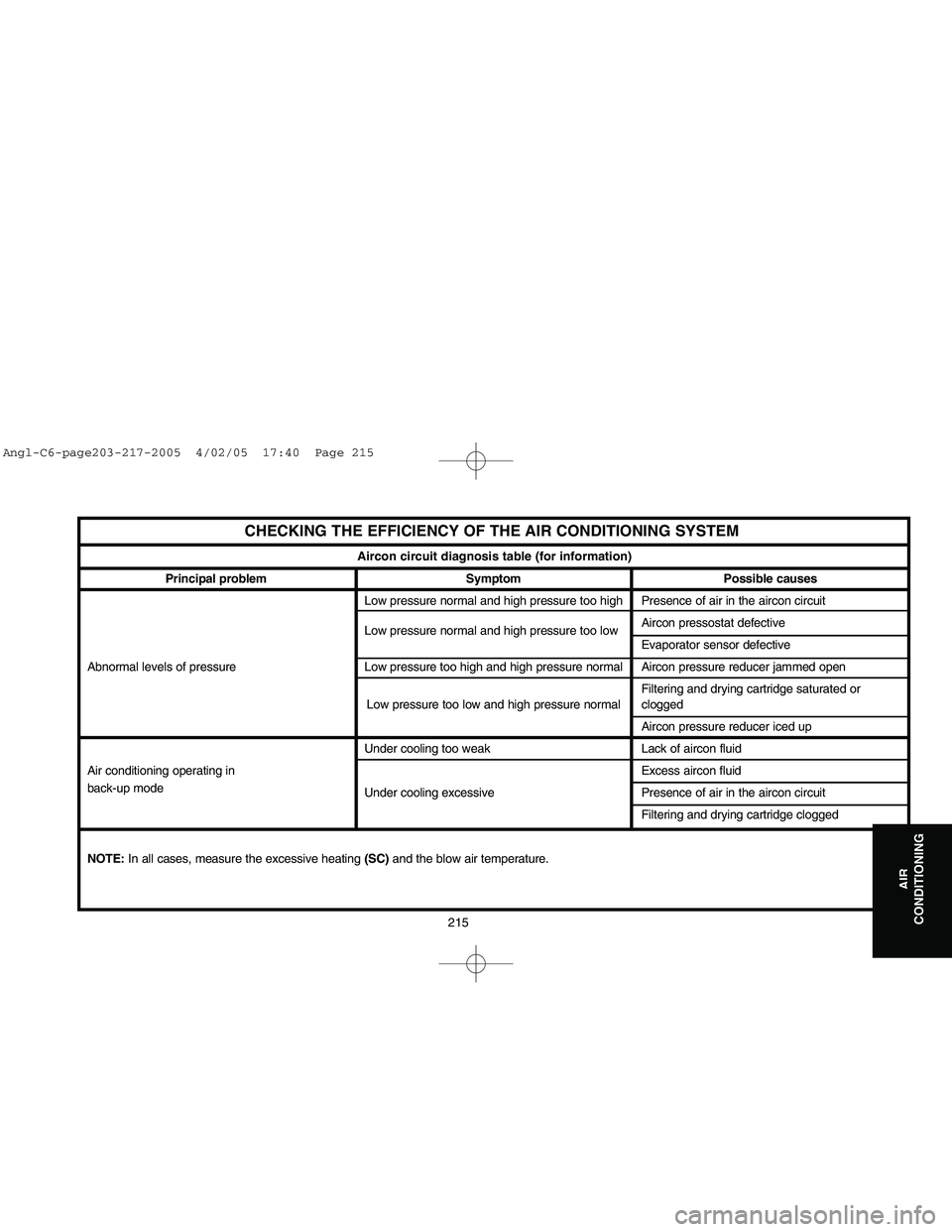
CHECKING THE EFFICIENCY OF THE AIR CONDITIONING SYSTEM
Aircon circuit diagnosis table (for information)
Principal problem Symptom Possible causes
Low pressure normal and high pressure too high Presence of air in the aircon circuit
Low pressure normal and high pressure too lowAircon pressostat defective
Evaporator sensor defective
Abnormal levels of pressure Low pressure too high and high pressure normal Aircon pressure reducer jammed open
Filtering and drying cartridge saturated or
Low pressure too low and high pressure normal clogged
Aircon pressure reducer iced up
Under cooling too weak Lack of aircon fluid
Air conditioning operating inExcess aircon fluid
back-up mode
Under cooling excessive Presence of air in the aircon circuit
Filtering and drying cartridge clogged
NOTE: In all cases, measure the excessive heating (SC)and the blow air temperature.
Angl-C6-page203-217-2005 4/02/05 17:40 Page 215