engine Citroen C8 2013 1.G User Guide
[x] Cancel search | Manufacturer: CITROEN, Model Year: 2013, Model line: C8, Model: Citroen C8 2013 1.GPages: 234, PDF Size: 8.86 MB
Page 40 of 234
Gearbox and stearing wheel
38
Automatic changing of the six gears
.
Moving off
- It is essential to press
the brake pedal to exit
position P
,
- select position R
or D
,
You can also move off from position N
.
- gradually release the
pressure on the brake
pedal; the vehicle moves
off immediately.
- With your foot on
the brake, release
the handbrake,
- select position R
, D
or M
,
- gradually release the
pressure on the brake
pedal; the vehicle moves
off immediately.
The gearbox always selects the most
suitable gear according to the following
parameters:
- the style of driving,
- the road profi le,
- the vehicle load.
The gearbox is then operating in auto-
adaptive mode, without any action on
your part. For immediate maximum
acceleration without touching the
gear lever, press the accelerator
pedal down as far as it will go to the
end of its travel passing the point of
resistance (kickdown). The gearbox will
automatically change down or maintain
the gear selected until maximum
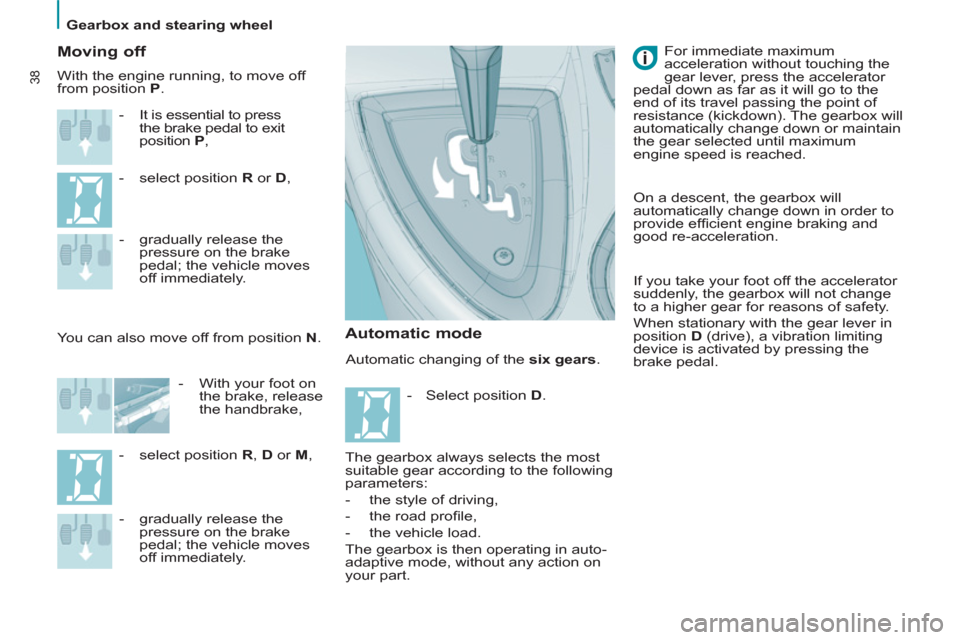
engine speed is reached. With the engine running, to move off
from position P
.
Automatic mode
On a descent, the gearbox will
automatically change down in order to
provide effi cient engine braking and
good re-acceleration.
If you take your foot off the accelerator
suddenly, the gearbox will not change
to a higher gear for reasons of safety.
When stationary with the gear lever in
position D
(drive), a vibration limiting
device is activated by pressing the
brake pedal.
- Select position D
.
Page 41 of 234
Gearbox and stearing wheel
READY TO GO
2
39
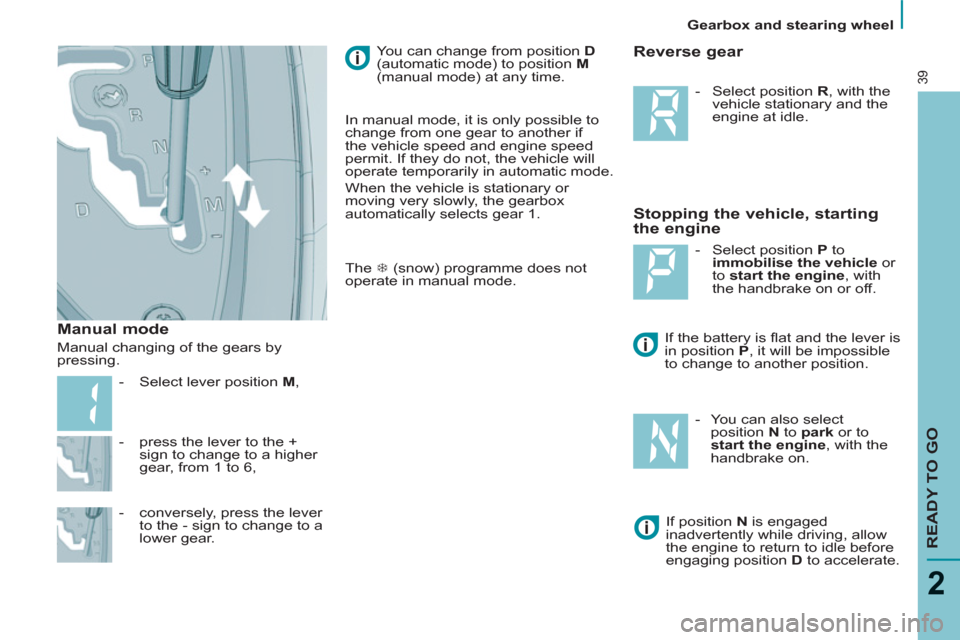
- press the lever to the +
sign to change to a higher
gear, from 1 to 6,
- conversely, press the lever
to the - sign to change to a
lower gear. You can change from position D
(automatic mode) to position M
(manual mode) at any time.
Stopping the vehicle, starting
the engine
Reverse gear
- Select position R
, with the
vehicle stationary and the
engine at idle.
If the battery is fl at and the lever is
in position P
, it will be impossible
to change to another position.
- Select position P
to
immobilise the vehicle
or
to start the engine
, with
the handbrake on or off.
- You can also select
position N
to park
or to
start the engine
, with the
handbrake on.
If position N
is engaged
inadvertently while driving, allow
the engine to return to idle before
engaging position D
to accelerate.
Manual mode
Manual changing of the gears by
pressing.
- Select lever position M
, In manual mode, it is only possible to
change from one gear to another if
the vehicle speed and engine speed
permit. If they do not, the vehicle will
operate temporarily in automatic mode.
When the vehicle is stationary or
moving very slowly, the gearbox
automatically selects gear 1.
The
7 (snow) programme does not
operate in manual mode.
Page 42 of 234
Gearbox and stearing wheel
40
Good practice
Never select position N
when the
vehicle is moving.
Never select positions P
or R
unless
the vehicle is stationary.
Never change between positions to
optimise braking on a slippery surface.
There is a risk of damage to the
gearbox:
- if you press the accelerator and
brake pedals at the same time,
- if you force the lever from position P
to another position in the event of a
battery failure.
When the engine is at idle, brakes
not applied, if position R
, D
or M
is
selected the vehicle moves even
without the accelerator being pressed.
For this reason, do not leave children
unsupervised inside the vehicle,
with the engine running
.
Operating abnormality
Any operating abnormality is indicated
by an audible signal, accompanied by
the message "Automatic gear fault"
on the display and fl ashing of the Snow
snowfl ake on the instrument panel.
In this situation the gearbox operates
in downgrade mode (locked in 3rd
gear). You may feel a substantial knock
when changing from P
to R
and from N
to R
(this will not cause any damage to
the gearbox).
Do not exceed 60 mph (100 km/h),
keeping within the limit of local speed
restrictions.
Contact a CITROËN dealer as soon as
possible.
You can return to the automatic
programme at any time.
- Press button
7 again to switch off
the programme you are in.
Snow programme
In addition to the automatic
programme, there is a special
Snow programme.
This improves starting
and drive when traction is
poor. The snowfl ake appears on the
instrument panel display.
- Press button
7 once the
vehicle has been started
and position D
selected.
The gearbox adapts to driving
on slippery roads.
Page 44 of 234
42
Starting and stopping
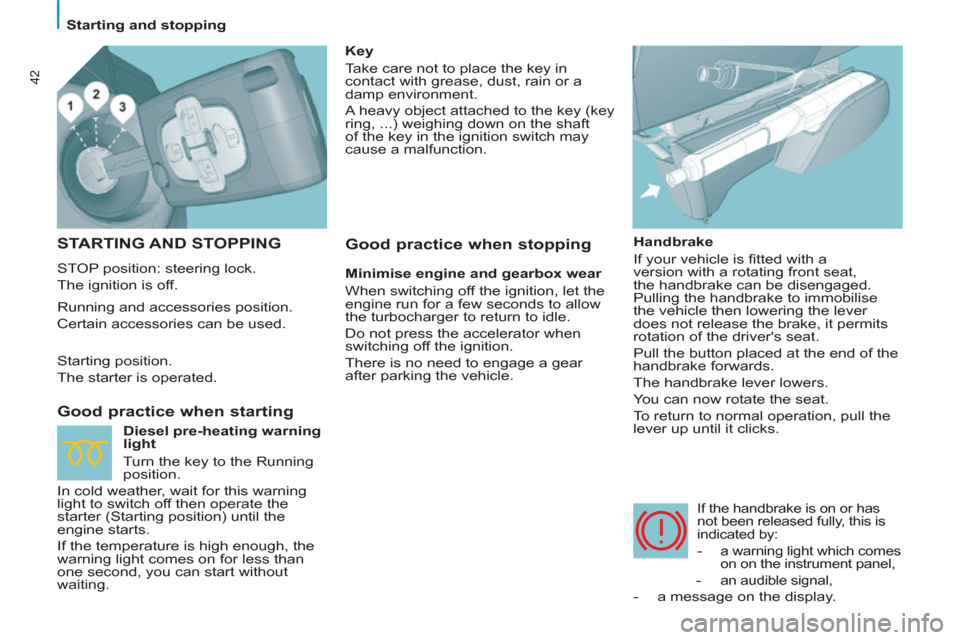
STARTING AND STOPPING
STOP position: steering lock.
The ignition is off.
Good practice when starting
Handbrake
If your vehicle is fi tted with a
version with a rotating front seat,
the handbrake can be disengaged.
Pulling the handbrake to immobilise
the vehicle then lowering the lever
does not release the brake, it permits
rotation of the driver's seat.
Pull the button placed at the end of the
handbrake forwards.
The handbrake lever lowers.
You can now rotate the seat.
To return to normal operation, pull the
lever up until it clicks.
If the handbrake is on or has
not been released fully, this is
indicated by:
- a warning light which comes
on on the instrument panel,
- an audible signal,
- a message on the display.
Key
Take care not to place the key in
contact with grease, dust, rain or a
damp environment.
A heavy object attached to the key (key
ring, ...) weighing down on the shaft
of the key in the ignition switch may
cause a malfunction.
Running and accessories position.
Certain accessories can be used.
Starting position.
The starter is operated.
Diesel pre-heating warning
light
Turn the key to the Running
position.
In cold weather, wait for this warning
light to switch off then operate the
starter (Starting position) until the
engine starts.
If the temperature is high enough, the
warning light comes on for less than
one second, you can start without
waiting.
Good practice when stopping
Minimise engine and gearbox wear
When switching off the ignition, let the
engine run for a few seconds to allow
the turbocharger to return to idle.
Do not press the accelerator when
switching off the ignition.
There is no need to engage a gear
after parking the vehicle.
Page 49 of 234

Steering wheel controls
EASE OF USE and COMFORT
3
47
Activation
Press the control downwards.
Activation of the function is
accompanied by a message on the
display.
The automatic windscreen wipers
function must be reactivated
if the
ignition has been switched off for more
than one minute, by pressing the stalk
downwards.
Rear windscreen wiper
Turn the ring to the fi rst
notch. The wiping speed is
inversely proportional to the
speed of the vehicle.
Rear windscreen wash
Turn the ring past the fi rst
notch: the windscreen wash
then the windscreen wiper
operate for a fi xed time.
Good practice
When using an automatic car
wash, switch off the ignition without
setting the alarm.
In winter, it is advisable to wait until the
windscreen is completely clear of ice
before activating the automatic wiping.
In the event of a considerable amount
of snow or ice, switch on the rear
screen demister. Once de-icing is
complete, remove the snow or ice
which has accumulated on the rear
wiper blade. You can now operate the
rear windscreen wiper.
If a tailgate bicycle carrier
is used, deactivate the rear
wiper by going to the display’s
confi guration menu.
Deactivation/Switching off
Place the windscreen wipers stalk in
position I
, 1
or 2
. Deactivation of the
function is accompanied by a message
on the display.
In the event of malfunction
of the
automatic windscreen wipers, the
windscreen wipers will operate in
intermittent mode.
Contact a CITROËN dealer to have the
system checked.
Automatic wiping - reverse gear
- place the front wipers stalk in a
position other than 0
.
-
engage reverse gear.
-
the rear wiper operates with
intermittent wiping.
When using an automatic car
wash, switch off the engine.
In winter, it is advisable to wait
until the windscreen is completely
clear of ice before activating the
automatic wiping.
Page 50 of 234

Steering mounted controls
48
CRUISE CONTROL "CRUISE"
On vehicles fi tted with an automatic
gearbox, the lever must be in
position D
(Drive) or at least 2nd gear
must be engaged in manual mode. Function selected,
displaying of the
"Cruise Control"
symbol.
Function deactivated,
OFF (example at
65 mph (107 km/h)).
Function activated
(example at 65 mph
(107 km/h)).
Vehicle speed above
(e.g. 70 mph
(118 km/h)),
the programmed
speed is displayed
fl ashing.
Operating fault
detected,
OFF - the dashes
fl ash. This cruise control shows the function
selection status on the instrument
panel and displays the programmed
speed:
"This is the speed at which the driver
wishes to drive".
This aid to driving in free-fl owing
traffi c enables the vehicle to maintain
the speed programmed by the driver,
unless a steep gradient makes this
impossible.
In order for it to be programmed or
activated, the vehicle speed must be
greater than 25 mph (40 km/h) with at
least 4th gear engaged in the case of
vehicles fi tted with a manual gearbox. If the vehicle is fi tted with a speed
limiter and cruise control (according
to the country in which the vehicle is
sold and the engine), these functions
cannot be activated at the same time.
Page 53 of 234

Steering wheel controls
EASE OF USE and COMFORT
3
51
SPEED LIMITER "LIMIT"
To resume use of the limiter, simply
reduce the pressure on the accelerator
pedal gradually and return to a speed
below that programmed.
If the vehicle is fi tted with a speed
limiter and cruise control (according
to the country in which the vehicle is
sold and the engine), these functions
cannot be activated at the same time
.
The operating actions can be carried
out when stationary, with the engine
running, or with the vehicle moving.
Function selected,
displaying of the
"Speed Limiter"
symbol.
Function deactivated,
last programmed
speed - OFF
(example at 65 mph
(107 km/h)).
Function activated
(example at 65 mph
(107 km/h)).
Vehicle speed above
(example at 70 mph
(118 km/h)),
the programmed
speed is displayed
fl ashing.
Operating fault
detected,
OFF -
the dashes fl ash. This speed limiter shows the function
selection status on the instrument
panel and displays the programmed
speed:
"This is the selected speed which the
driver does not wish to exceed".
This selection is made with the engine
running while stationary or with the
vehicle moving. The minimum speed
which can be programmed is 20 mph
(30 km/h).
The speed of the vehicle responds
to the pressure of the driver's foot as
far as the accelerator pedal point of
resistance which indicates that the
programmed speed has been reached.
However, pressing the pedal beyond
this point of resistance to the fl oor
permits exceeding of the programmed
speed.
Page 54 of 234

Steering mounted controls
52
Selecting the function
- Place the dial in the LIMIT
position.
The limiter is selected but is not yet
active. The display indicates the
last programmed speed.
Programming a speed
A speed can be programmed without
activating the limiter but with the
engine running.
To memorise a speed higher than the
previous one:
- press the Set +
button.
A brief press increases the speed by
1 mph (km/h).
A maintained press increases the
speed in steps of 5 mph (km/h).
Activation/Deactivation (off)
Pressing this button once activates
the limiter, pressing the button again
deactivates it (OFF).
To memorise a speed lower than the
previous one:
- press the Set -
button.
A brief press decreases the speed by
1 mph (km/h).
A maintained press decreases the
speed in steps of 5 mph (km/h).
Page 57 of 234

EASE OF USE and COMFORT
3
55
Ventilation
De-icing the rear screen
and mirrors
Demisting,
visibility programme DE-ICING AND DEMI
STING
The comfort programme
may not be suffi cient to
quickly demist or de-ice the
windows (humidity, several
passengers, ice).
In this case, select the visibility
programme. The visibility programme
indicator light comes on.
It activates the air conditioning, the air
fl ow, the de-icing of the rear screen
and provides optimum distribution of
the ventilation to the windscreen and
side windows.
It deactivates the air recirculation. Press this button, with the
engine running, to de-ice the
rear screen and mirrors.
The de-icing indicator light
comes on. The duration
of de-icing depends on the exterior
temperature.
Pressing the button again reactivates
the de-icing.
It is possible to stop the de-
icing before it is switched off
automatically by pressing this
button again.
ADDITIONAL HEATER
To improve your comfort, vehicles fi tted
with an HDi engine may be fi tted with
automatic additional heating.
However, with the engine at idle or
when the vehicle is stationary,
it is normal to notice a high-pitched
whistling and a slight emission of
smoke and odour.
Page 58 of 234

56
Ventilation
Do not cover the sunshine sensor
located in the centre of the fascia.
This is used to regulate the air
conditioning. Located on the centre console, the
control panel is to the right of the gear
lever.
1 - AUTO mode
This is the normal air
conditioning operating mode.
Refer to the beginning of the
"Ventilation" section of chapter 6.
The driver and front passenger can
each adjust the air temperature to suit
their requirements.
They can also activate or disarm the
rear ventilation adjustment controls.
For your comfort, the settings selected
when the ignition is switched off will be
retained when it is switched on again, if the
temperature in the passenger compartment
has not changed signifi cantly; otherwise,
operation will resume in automatic mode.
- Press the "AUTO"
button.
Depending on the comfort temperature
selected, the system controls the air
distribution, fl ow and intake so that the
passenger compartment is comfortable
and has an adequate circulation of air.
You do not have to make any further
adjustments.
When the engine is cold, in order
to prevent a rush of cold air, the
ventilation will reach its optimum level
progressively.
The "AUTO"
symbol is displayed.