suspension Citroen CX 1976 1.G User Guide
[x] Cancel search | Manufacturer: CITROEN, Model Year: 1976, Model line: CX, Model: Citroen CX 1976 1.GPages: 394
Page 239 of 394
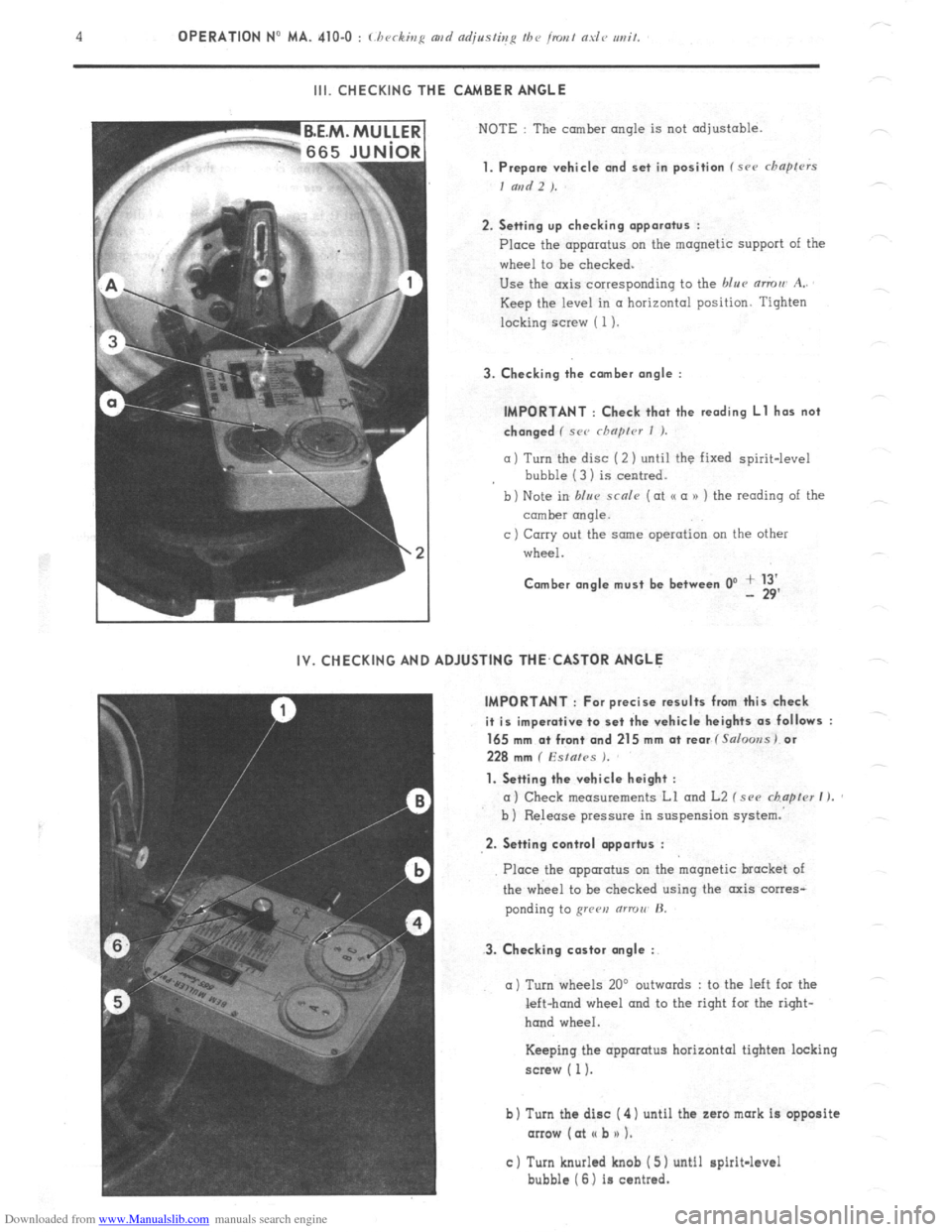
Downloaded from www.Manualslib.com manuals search engine III. CHECKING THE CAMBER ANGLE
NOTE : The camber angle is not adjustable.
1. Prepare vehicle and set in position f src chapfrrs
I and 2 ).
2. Setting up checking apparatus :
Place the apparatus on the magnetic support of the
wheel to be checked.
Use the axis corresponding to the blue mmu A..
Keep the level in a horizontal position. Tighten
locking screw ( 1).
3. Checking the comber angle :
IMPORTANT : Check that the reading Ll has not
changed ( SC<’ rhnprcr I ).
a) Turn the disc (2 ) until the fixed spirit-level
bubble (3 1 is centred.
b) Note in blur scnle (at o a n ) the reading of the
comber rmqle.
c ) Carry out the same operation on the other
wheel.
Comber angle must be between 0’ + 13’ - 29’
IV. CHECKING AND ADJUSTING THE,CASTOR ANGLE
IMPORTANT : For precise results from this check
it is imperative to set the vehicle heights as follows :
165 mm a+ front and 215 mm at rear f Salooss) or
228 mm ( Esfafes ).
1. Setting the vehicle height :
a) Check measurements Ll and L2 f see chapter I ).
b ) Release pressure in suspension system.
2. Setting control opportus :
3. Checking castor angle :
Place the apparatus on the magnetic bracket of
the wheel to be checked using the axis corres-
ponding to grren (ITTOII’ H.
a) Turn wheels 20’ outwards : to the left for the
left-hand wheel and to the right for the right-
hand wheel.
Keeping the apparatus horizontal tighten locking
screw ( 1).
b) Turn the disc ( 4) until the zaro mark is opposite
arrow (at I( b n 1.
c) Turn knurled knob ( 5) until spirit-level
bubble (6) is centred.
Page 252 of 394
Downloaded from www.Manualslib.com manuals search engine SUSPENSION
OPERATION No MA. 430-00 : ( hnmrtcristics mrd spccinl jeatrrres oj /ha susp~~sio~~. Op. MA. 430-00 1
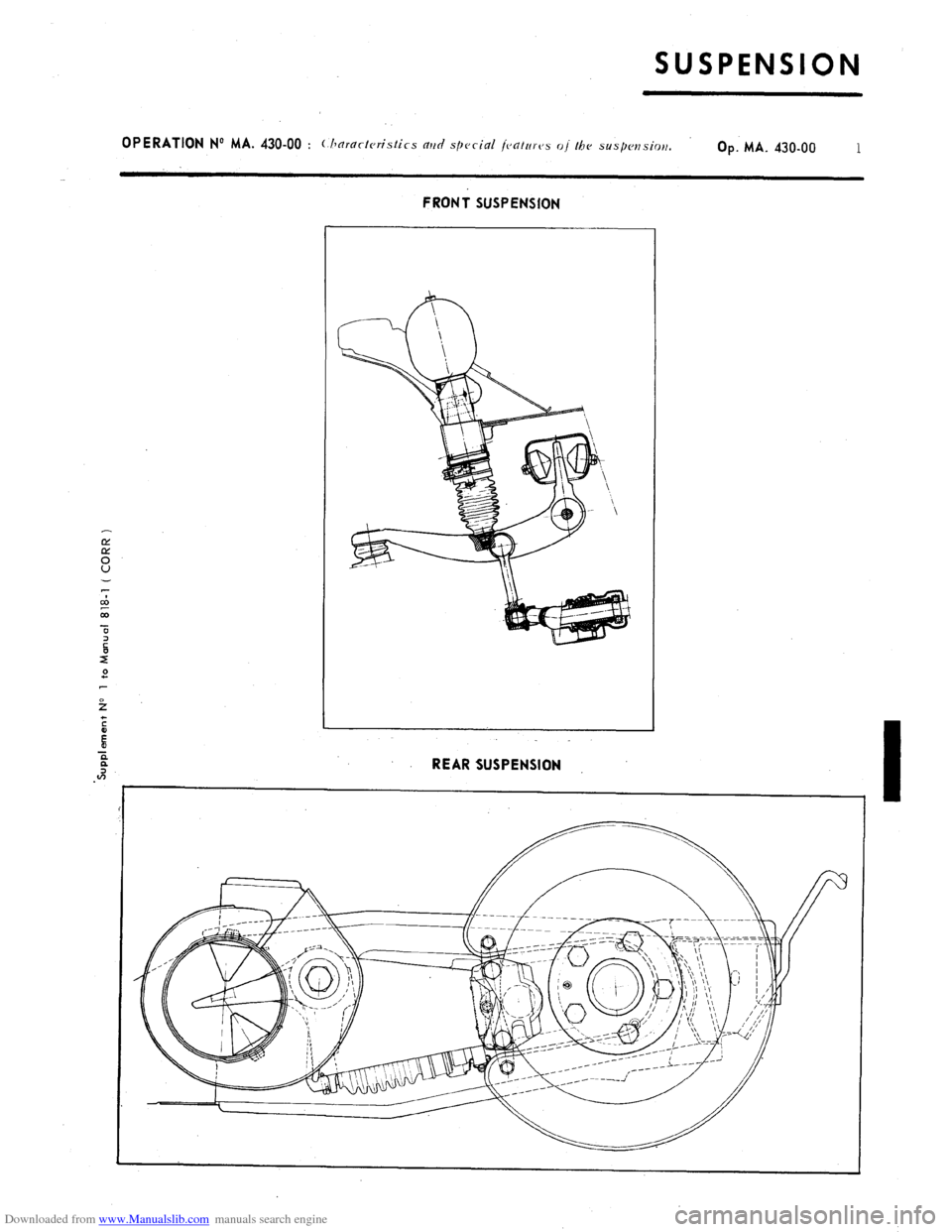
FRONT SUSPENSION
f
c
s
6
-E
J REAR SUSPENSION
I
,
Page 253 of 394

Downloaded from www.Manualslib.com manuals search engine I. CHARACTERISTICS
..-.-..- --~~~
HEIGHT CORRECTOR
SUSPENSION CYLINDER ( All Saloon vehicles )
L.43-6
SUSPENSION CYLINDER ( Estate vehicles )
-- --.
Page 255 of 394
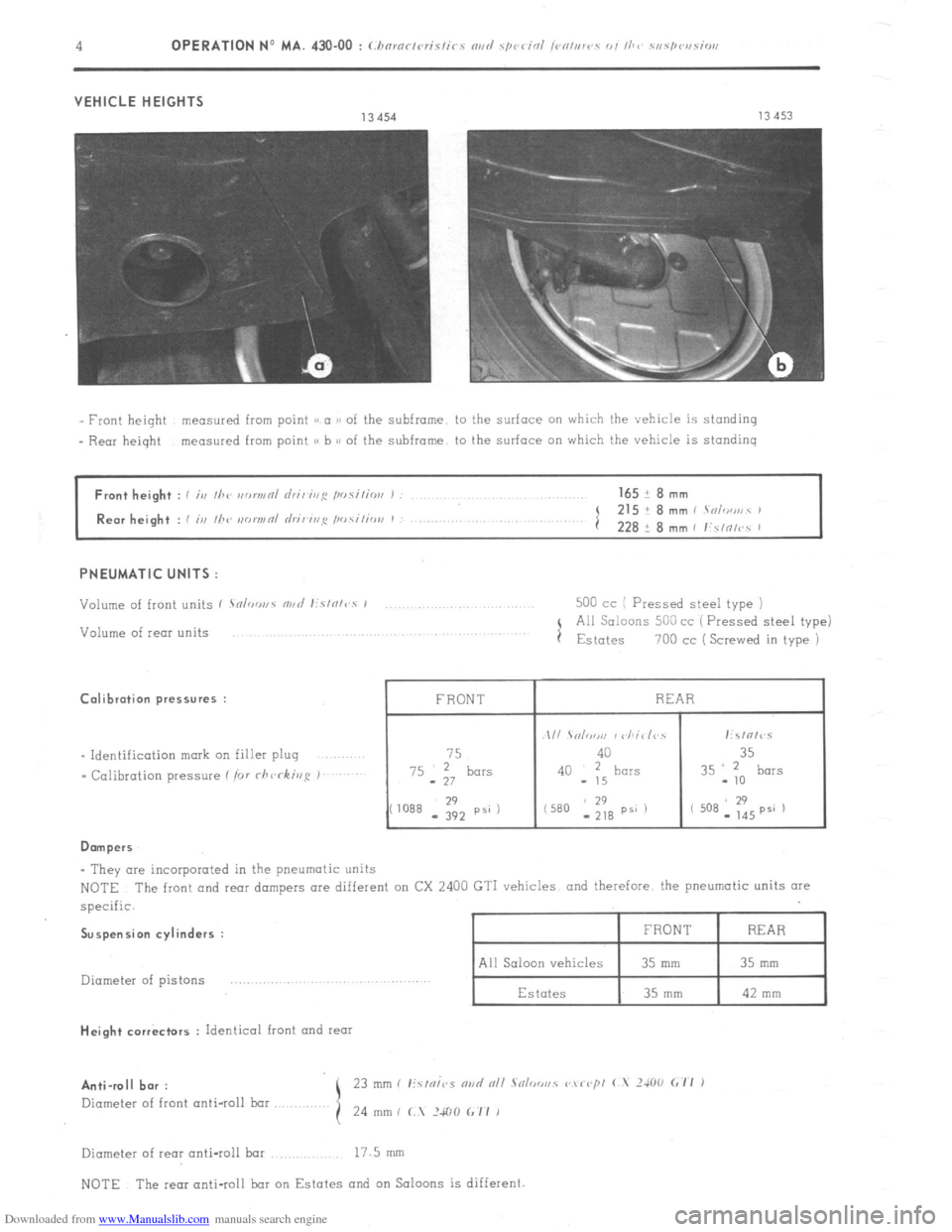
Downloaded from www.Manualslib.com manuals search engine VEHICLE HEIGHTS 13454
- Front height measured from point SG a 8) of the subfrome. to the surface on which the vehicle is stondinq
_ Rear height measured from point (, b )B of the subfrome to the surface on which the vehicle is standinq Calibration pressures :
FRONT REAR
\// \~~lr~r,,i J v/xii
/c,.5 I:\lol,‘s
_ Identification mark on filler plug 75 40 35
- Calibration pressure ( /or rhc’rkiqg 1. 75 2 bars 40 2 bars
- 27 - 15 35 1 ;, bars
(1088 _ ;;, P51 1
(580 : ;;, P51 i ( 508; :',, PSP 1 Dampers
- They are incorporated in the pneumatic units
NOTE The front and rear dampers ore different on CX 2400 GTI vehicles and therefore the pneumatic units are PNEUMATIC UNITS :
Volume of front units i Soloor, mid I:s/fll<,s 1
500 cc f Pressed steel type )
Volume of rear units
i All Saloons 500 cc ‘j Pressed steel type)
Estates 700 cc (Screwed in type i
I
specific. Suspension cylinders :
Diameter of pistons ,,,, Height
corr&tors : Identical front and rear Anti-roll bar :
23 mm i lisfoir~s mid o/l Salormc <~,c,,,,, ( Y ‘Xl(i VII I
Diameter of front anti-roll bar.
i 24 mm , (. 2400 (.‘/I J
Diameter of rear anti-roll bar 17.5 mm
NOTE The rear anti-roll bar on Estates and on Saloons is different.
Page 256 of 394
Downloaded from www.Manualslib.com manuals search engine OPERATION No MA. 430.00 : c ,,<,,a< ,<,r;s,;rs mi/ .s/wrin/ ,vn/srrs oi /he srmf~rw.~ion Op. MA. 430-00 5
II. SPECIAL FEATURES
Adjusting the anti-roll bars :
A, t/xv ,ms,
- Lateral positioning equal protrusion on either side to within 2 mm
- Anti-roll bar bearing preload 300 N ( 30kg) ( 66 lb )
- Lateral clearance of anti-roll bar. under pressure of 500 N i 50kq I( 110 fb i 0.2 to 1 mm
,I, l/X“ rcnr :
- Lateral positioning same thickness of shim on both sides. within 1 mm
- Shimming, if necessary. level with the split collars to within 0.6 mm
Greasing of the suspension piston con-rod ioint :
( Carried out with LHM liquid contained in the dust cover )
- Front suspension cylinder
- Rear suspension cylinder
Upper front wheelarm stops :
WARNING ‘,hc ,,,;,,,i<~, ~,op ,,,I (i, he ii,,, r/ 01 //I< ,,I?<,<‘/ wd. 7cm3
25 cm3
Tightening torques :
- Anti-roll bar link-rod on upper wheelarm. i Bush nut 3 doNm ( 21 11 2 ft.lb )
NYLSTOP nut 4.5 to 5daNd32 1/‘2to 36ft.lb)
- Link-rod on anti-roll bar 4.5 to SdaNm(32 1/2to36ft.lb)
. Screw securing front anti-roll bar bearing 2.7 daNm ( 19 l/2 ft.lb )
^ - Clamps for adjusting pie-load on front anti-roll bar 13 doNm ( 9 l/2 ft.lb)
b2 - 1.5 daNm [ 11 ft.lb i
0 Clomp for height corrector control
rod ( front and rem )
”
6 daNm ( 43 l/ 2 ft.lb ) - . An+iwroff bar 0” rear &&arm ( rear fixing
points ) I /nc<’ nvrl /hrcn,l~r
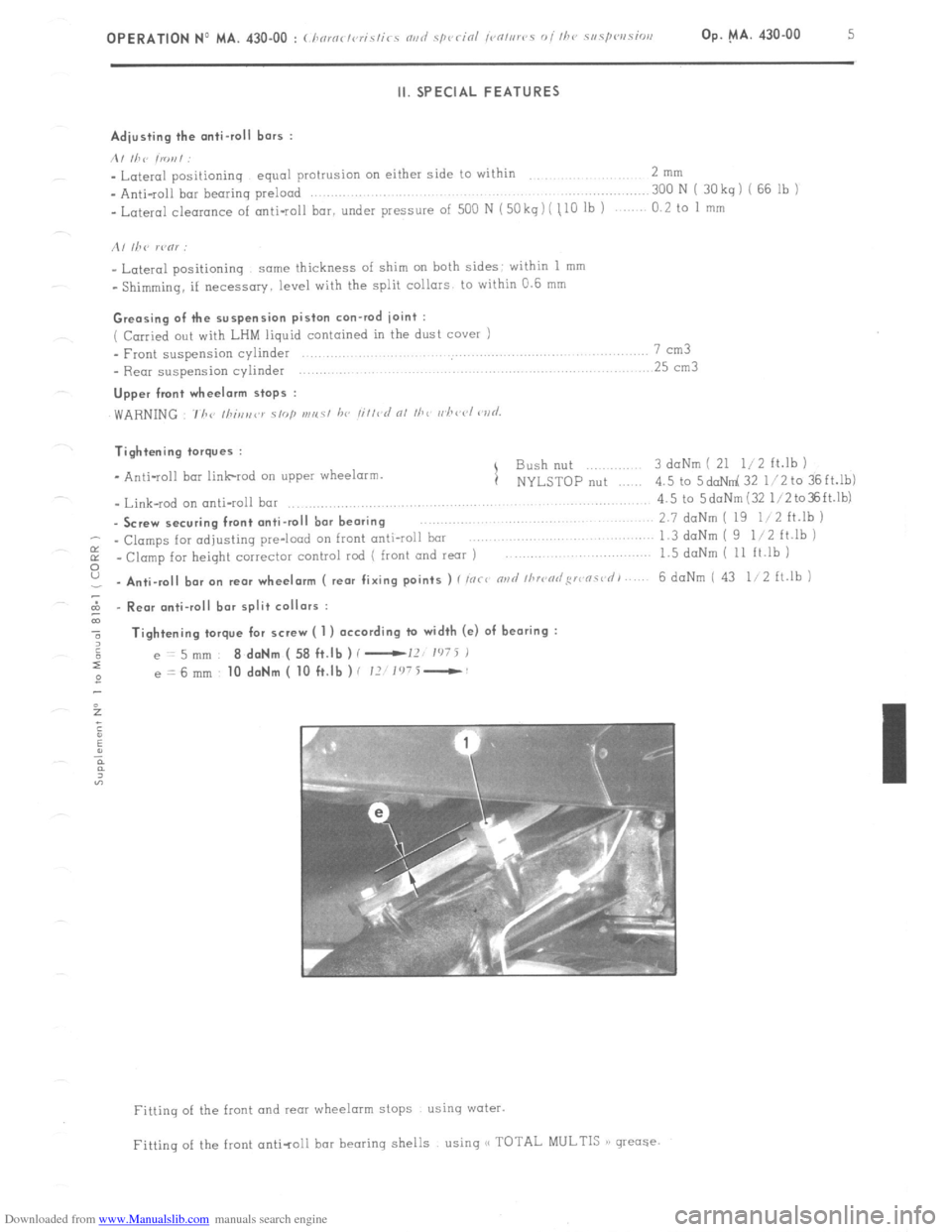
- Rear anti-roll bar split collars :
cc
-5 Tightening torque for screw ( 1 )
according to width (e) of bearing :
:
2
e = 5 mm 8 d.aNm ( 58 ft.lb ) f -I’, I’JiS,
P
e-6mm lOdoNm( lOft.lb)i 121Vi-’
Fitting of the front and rear wheelarm stops using water
Fitting of the front anti-011 bar bearing shells using ,< TOTAL MULTIS I) grease.
Page 273 of 394
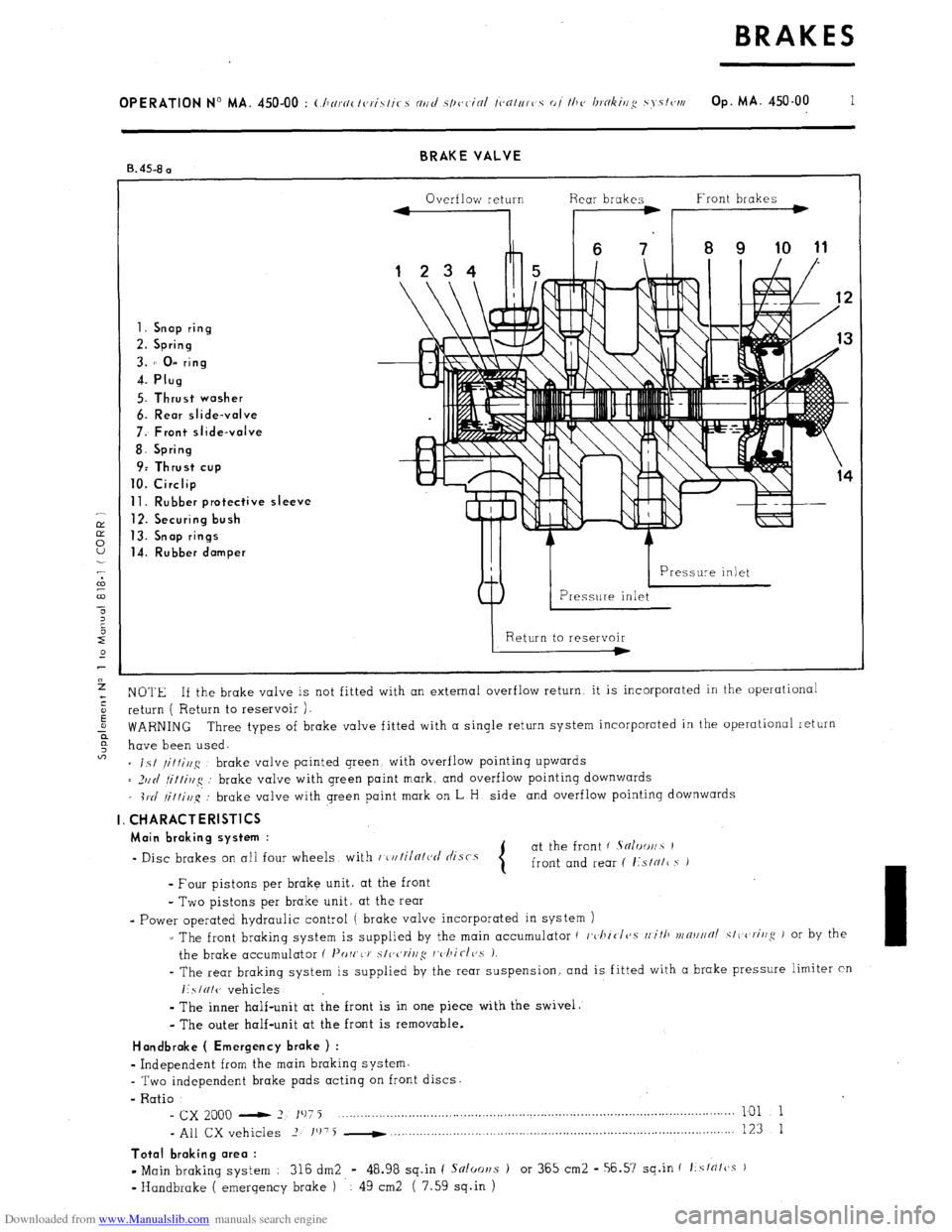
Downloaded from www.Manualslib.com manuals search engine BRAKE VALVE
B. 45-8 a
Overflow return Rear brakes Front brakes
1. Snap ring
2. Spring
3. 1’ 0” ring
4. Plug
5. Thrust washer
6. Rear slide-valve
7: Front slide-valve
8. Spring
9: Thrust cup
10. Circlip
11. Rubber protective sleeve
12. Securing bush
13. Snap rings
14. Rubber damper
NOTE If the brake valve is not fitted with an external overflow return, it is incorporated in the operational
return ( Return to reservoir ).
WARNING Three types of brake valve fitted with a single return system incorporated in the operational return
have been used.
= is/
/it/i//g brake valve painted green with overflow pointing upwards
= _)IIII
fi/tirlg : brake valve with green paint mark, and overflow pointing downwards
_ i1.d
/it/i,l~q’: brake valve with green paint mark on L H side and overflow pointing downwards
I. CHARACTERlSTlCS
Main braking system :
- Disc brakes on all four wheels with r~u/iln/ct/ tlisrs at the front ( Sn/oo//~ I
front and rear ( I:sIN/~ s i
- Four pistons per brake unit. at the front
- Two pistons per brake unit, at the rear
- Power operated hydraulic control ( brake valve incorporated in system )
z The front braking system is supplied by the main accumulator ( c,~l~icI~~.s
rli/ll vrn~l//~/ SIC criug J or by the
the brake accumulator ( I’orr,< J’
s/ccrivg rc,/~iclc,s 1.
- The rear braking system is supplied by the rear suspension. and is fitted with a brake pressure limiter cn
I:SIUI(J vehicles
-
The inner half-unit at the front is in one piece with the swivel.
- The outer half-unit at the front is removable.
Handbroke ( Emergency brake ) :
w
Independent from the main braking system.
- Two independent brake pads acting on front discs.
- Ratio
- cx 2000 - 2 197 j ___._....._..._..._.........,............................................................................... 101 1
- All CX vehicles 2 1’j75 -
. . . . . . 123 1
Total braking area :
- Main braking system : 316 dm2 - 48.98 sq.in ( Snloor~s ) or 365 cm2 - 56.57 sq.in f f:sfrffcss )
v
Handbrake ( emergency brake ) 49 cm2 ( 7.59 sq.in )
Page 277 of 394
Downloaded from www.Manualslib.com manuals search engine OPERATION No MA. 450-00 : Ch nrnclcrislics ortd sp~~c-i~l (c~c~trlrc>s 01 the hokiug S SI~IN Op. MA. 450.00 5
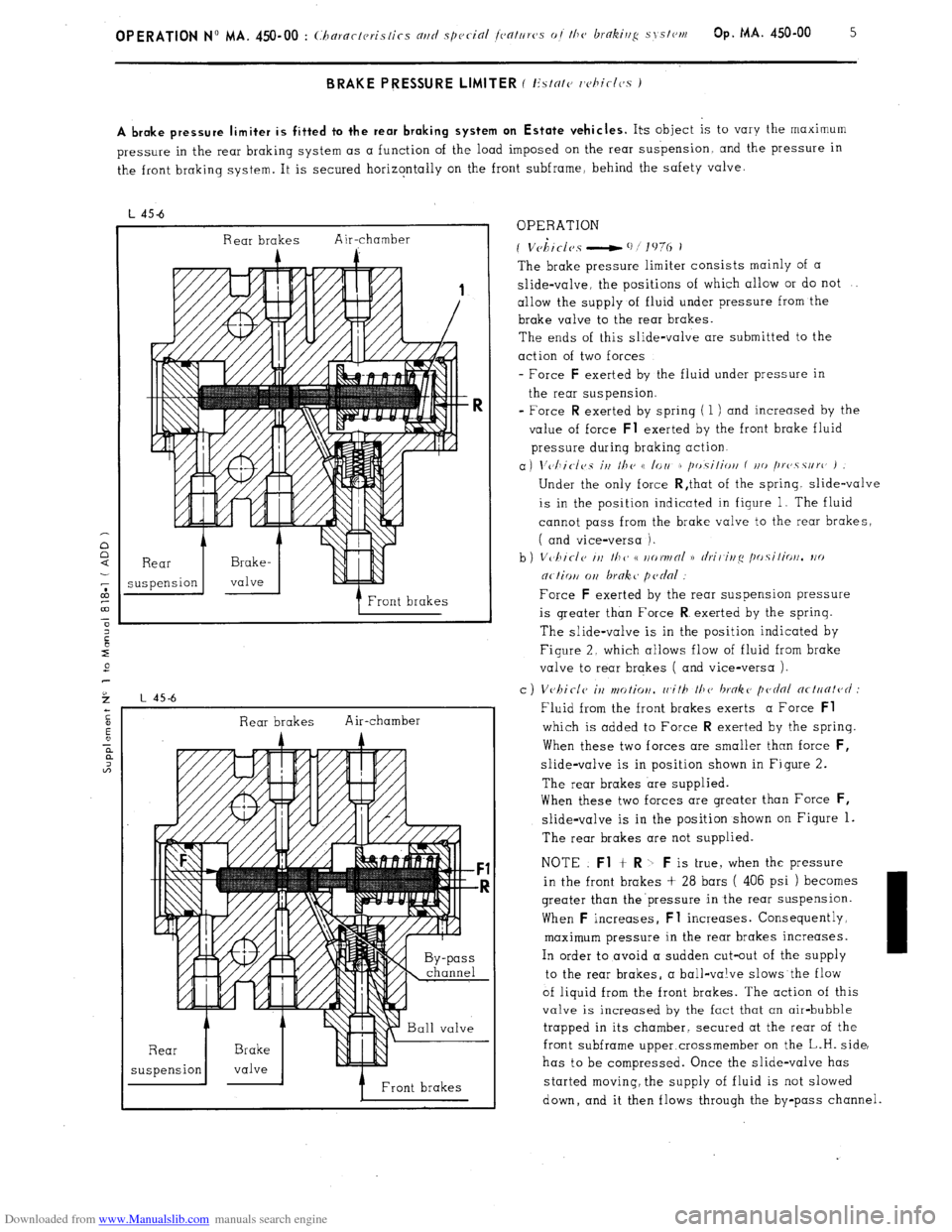
A brake pressure limiter is fitted to the rear braking system on Estate vehicles.
Its object is to vary the maximum
pressure in the rear braking system as a function of the load imposed on the rear suspension and the pressure in
the front braking system. It is secured horizontally on the front subframe, behind the safety valve.
L 45-6
Rear brakes Air-chamber
A
Front brakes
Rear brakes Air-chamber
A A --
7 Front brakes OPERATION
* I
f Vchtclcs - ‘I/]‘,?(, i
The brake pressure limiter consists mainly of a
slide-valve, the positions of which allow or do not
allow the supply of fluid under pressure from the
brake valve to the rear brakes.
The ends of this slide-valve are submitted to the
action of two forces
- Force F
exerted by the fluid under pressure in
the rear suspension.
= Force R
exerted by spring ( 1 ) and increased by the
value of force Fl
exerted by the front brake fluid
pressure during braking action.
a) \‘~~I~i~-/~~s irt Ilte t( lorl r /tr,.silioti f t/o /trc~.s.surc’ )
Under the only force R,that of the spring. slide-valve
is in the position indicated in figure 1. The fluid
cannot pass from the brake valve to the rear brakes,
( and vice-versa ).
Force
F exerted by the rear suspension pressure
is greater than Force R
exerted by the sprinq.
The slide-valve is in the position indicated by
Figure 2. which allows flow of fluid from brake
valve to rear brakes ( and vice-versa ).
c ) Vvhiclc il2 ntotior/. rr,ith 111~’ broke pednl ncl~~fit~~c/ :
Fluid from the front brakes exerts a Force Fl
which is added to Force R exerted by the spring.
When these two forces are smaller than force F,
slide-valve is in position shown in Figure 2.
The rear brakes are supplied.
When these two forces are greater than Force
F,
slide-valve is in the position shown on Figure 1.
The rear brakes are not supplied.
NOTE Fl
+ R -b F is true, when the pressure
in the front brakes + 28 bars ( 406 psi ) becomes
greater than the’pressure in the rear suspension.
When F
increases, Fl increases. Consequently,
maximum pressure in the rear brakes increases.
In order to avoid a sudden cut-out of the supply
to the rear brakes, a ball-valve slows the flow
of liquid from the front brakes. The action of this
valve is increased by the fact that an air-bubble
trapped in its chamber, secured at the rear of the
front subframe upper.crossmember on the L.H. side,
has to be compressed. Once the slide-valve has
started moving, the supply of fluid is not slowed
down, and it then flows through the by-pass channel.
Page 278 of 394
Downloaded from www.Manualslib.com manuals search engine FIG. 1
Supply to brake valve Rear suspension
i
Filter
\--Iii
I
Rear brak
. .
One-way valve
I units
Rl
Feed to brake valve F Rear suspension /
One-way valve II Rear brake
Rl Fl
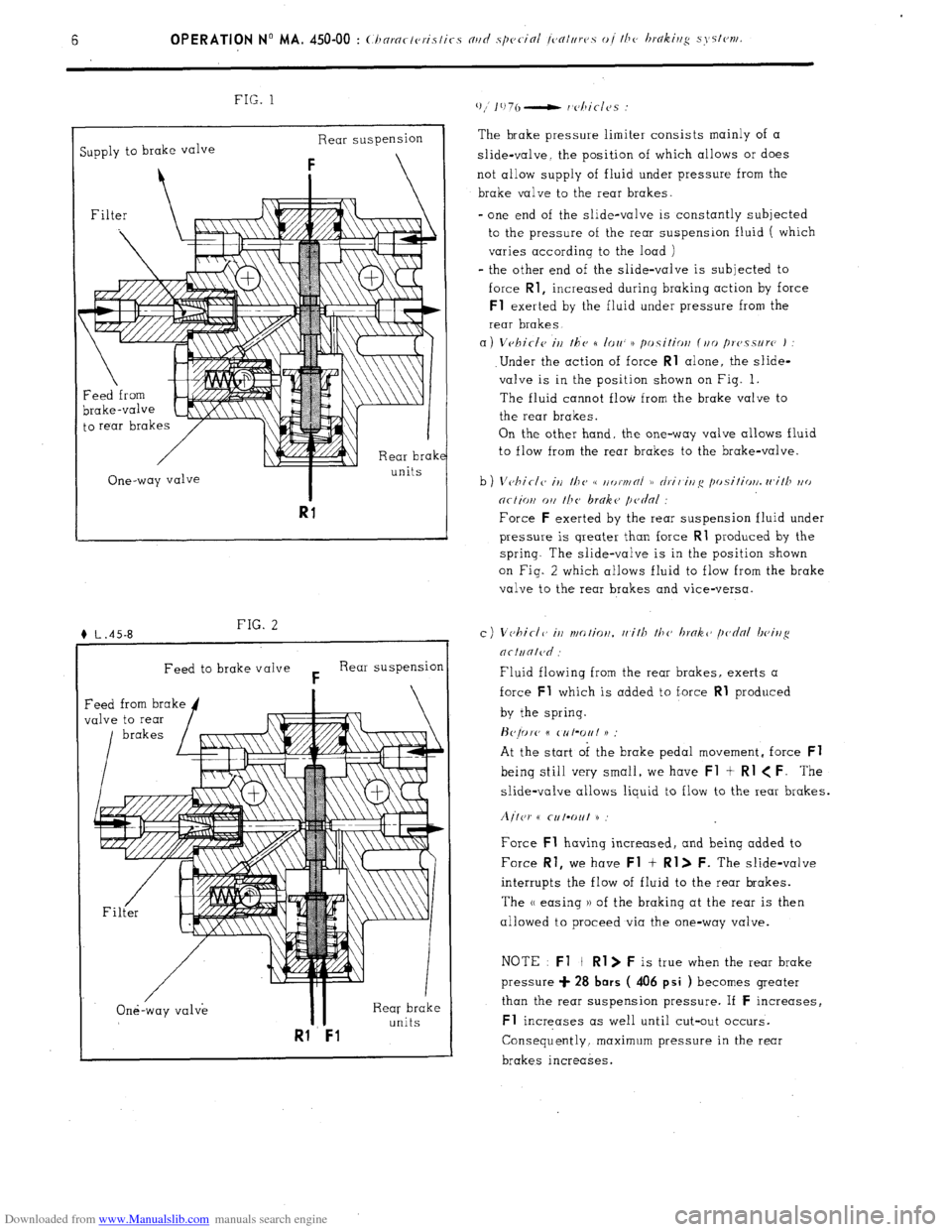
units The brake pressure limiter consists mainly of a
slide-valve, the position of which allows or does
not allow supply of fluid under pressure from the
brake valve to the rear brakes.
-
one end of the slide-valve is constantly subjected
to the pressure of the rear suspension fluid ( which
varies according to the load )
- the other end of the slide-valve is subjected to
force Rl,
increased during braking action by force Fl
exerted by the fluid under pressure from the
rear brakes
a)
Vvhirlc, irl the n IOU N positiolt (,,o /)rc,.ssurc, )
.Under the action of force Rl alone, the slide-
valve is in the position shown on Fig. 1.
The fluid cannot flow from the brake valve to
the rear brakes.
On the other hand, the one-way valve allows fluid
to flow from the rear brakes to the brake-valve.
Force F
exerted by the rear suspension fluid under
pressure is qreater than force Rl
produced by the
spring. The slide-valve is in the position shown
on Fig. 2 which allows fluid to flow from the brake
valve to the rear brakes and vice-versa.
Fluid flowing from the rear brakes, exerts a
force Fl
which is added to force Rl produced
by the spring.
H~prc 6
CNt’Out 11
At the start of the brake pedal movement, force Fl
being still very small, we have Fl t Rl < F. The
slide-valve allows liquid to flow to the rear brakes.
Aitcr t( CIIIW~~ H
Force Fl
having increased, and being added to
Force Rl,
we have Fl + Rl> F. The slide-valve
interrupts the flow of fluid to the rear brakes.
The (( easing )) of the braking at the rear is then
allowed to proceed via the one-way valve.
NOTE : Fl
+ Rl> F is true when the rear brake
pressure + 28 bars
( 406 psi ) becomes greater
than the rear suspension pressure. If F
increases, Fl
Increases as well until cut-out occurs.
Consequently, maximum pressure in the rear
brakes increases.