interior Citroen CX 1981 1.G Owner's Manual
[x] Cancel search | Manufacturer: CITROEN, Model Year: 1981, Model line: CX, Model: Citroen CX 1981 1.GPages: 394
Page 341 of 394
Downloaded from www.Manualslib.com manuals search engine dent,
nark
B9
90
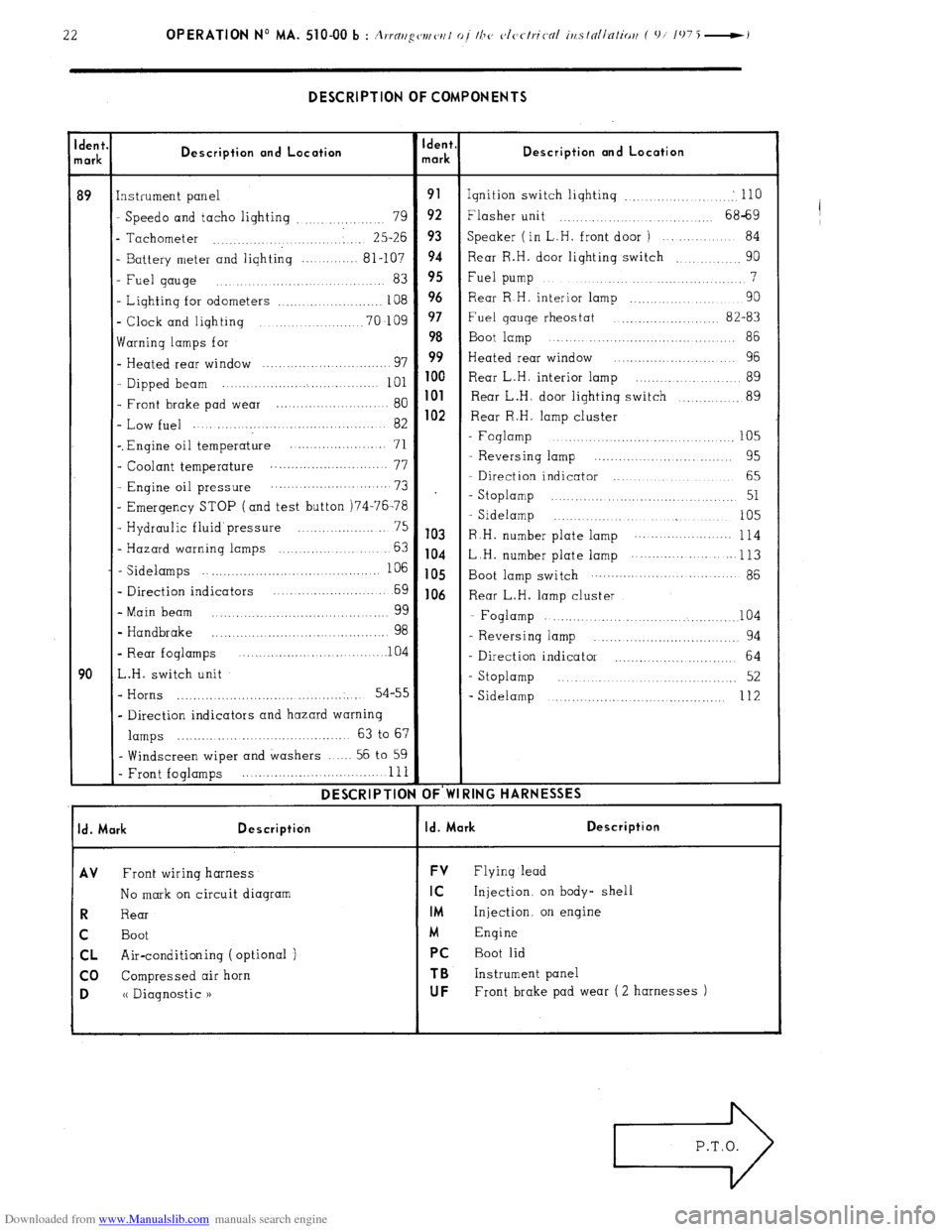
DESCRIPTION OF COMPONENTS
Description and Location
instrument panel
Speed0 and tacho lighting
79 ..............
. Tachometer 25-26
........... ............
I Battery meter and lighting ............ 81-107
Fuel gauge ...................... 83
- Lighting for odometers
...................... 108
- Clock and lighting
.................... 70-109
warning lamps for
- Heated rear window ............................... 97
- Dipped beam ... ..... ............................ 101
- Front brake pad wear ...................... 80
- Low fuel ....
............................ 82
-. Engine oil temperature ..... .................
71
- Coolant temperature ...........................
77
- Engine oil pressure ....... .... ............ ...
73
- Emergency STOP (and test button )74-76-78
- Hydraulic fluid’pressure ................... 75
- Hazard warning lamps ....................... 63
- Sidelamps 106
....................... ..... ..............
- Direction indicators ....... ............... 69
- Main beam
99 .....
.............................. ...
- Handbrake
98 ........ ............ ., .............. ...
- Rear foglamps .......... ................. ..lO 4
L.H. switch unit
- Horns 54-55
..... ....................................
- Direction indicators and hazard warning
lamps ...................................... 63 to 67
- Windscreen wiper and washers ...... 56 to 59
- Front foglamps ........ ....... ................. 111
DESCRIPTIOI dent
nark
91
92
93
94
95
96
97
98
99
100
101
102
103
104
105
106 Description and Location
Ignition switch lighting .................... : 110
Flasher unit ....................... 68-69
Speaker ( in L..H. front door )
......... 84
Rear R.H. door lighting switch
90 ..........
Fuel pump 7
.............................
Rear R H. interior lamp ....................
90
Fuel qauge rheostat
.................... 82-83
Boot lamp
....................................... 86
Heated rear window
......................... 96
Rear L.H. interior lamp
.................. 89
Rear L.H. door lighting switch
............ 89
Rear R.H. lamp cluster
- Foglamp
..................................... 105
- Reversing lamp .............................
95
- Direction indicator ...................
65
- Stoplamp ........... ......................... 51
- Sidelamp ...........................
105
R .H. number plate lamp .......... ... ........
114
L H. number plate lamp ..... ........... ...
113 Boot lamp switch .................................
86
Rear L.H. lamp cluster
- Foglamp
....................................... 104
- Reversing lamp ................................
94
- Direction indicator ............................. 64
- Stoplamp
........................................ 52
- Sidelamp
... ..... ................................. 112
IING HARNESSES
I Id. Mark Description
I Id. Mark Description
AV
Front wiring harness FV Flying lead
No mark on circuit diaqram
IC Injection. on body- shell
R Rear IM Injection, on engine
C Boot
M Engine
CL Air-conditioning (optional ) PC Boot lid
co Compressed air horn
TB Instrument panel
D (( Diagnostic 1) UF Front brake pad wear ( 2 harnesses )
Page 388 of 394
Downloaded from www.Manualslib.com manuals search engine 2
OPERATION No MA. 852.0 : Acfirrr~isg /hr, bos,rv/ I II. UNLOCKING A BONNET
(when interior control is disconnected )
‘I
NOTE :
-! It is possible to unlock (I bonnet when the control
has become discpnnected, because either :
- the control cable is not attached to the catch,
or the cable is broken.
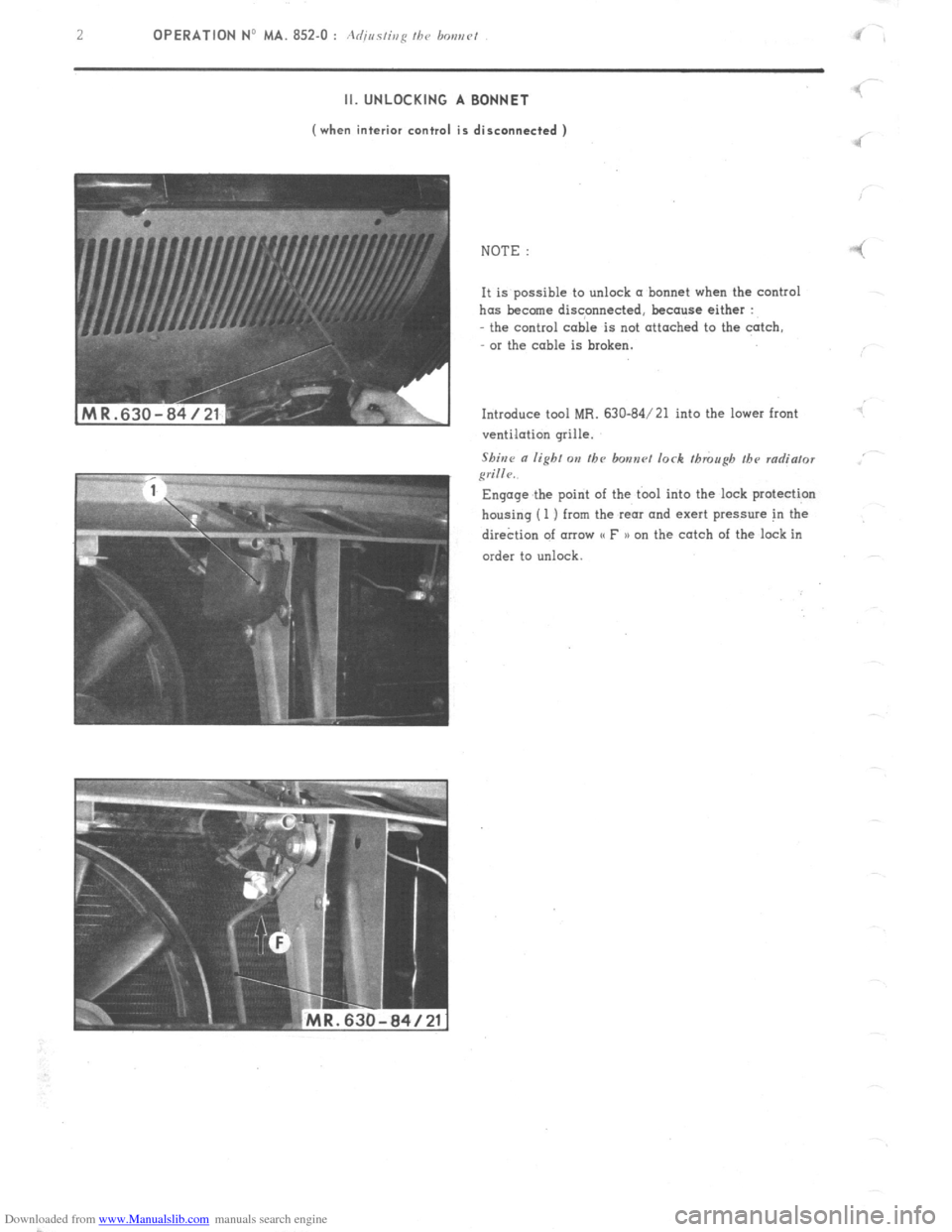
Introduce tool MR. 630-84/21 into the lower front
ventilation grille.
Shine
a lighf on tbc bonnrl lock though the radia/or
grille.. Engage the point of the tbol into the lock protection
housing (1 ) from the rear and exert pressure in the
dire&on of arrow CC F n on the catch of the lock in
order to unlock
Page 389 of 394
Downloaded from www.Manualslib.com manuals search engine OPERATION No MA. 961-O : C/ 3fc ztzg and repairing a war winabzc’ hrating elcmcnt k’ Op. MA. 961-O 1
I. CHECKING
Power of heating resistance :
S&Ions ., 140 to 160 watts at 13.5 1: 0.2 volts
Estates .,.,............: . . . . . . . .._.... . . . . . . . . . . . . . . . . . . . . . . . . . . . . . . . . . . . . . . . . . . . . . . . . . . . . . . . ~.. 130 to 150 watts at 13.5 t 0.2 volts
To check :he heating resistance of a rear window. measure
Either the current flowing in the resistance, using an ammeter connected in series to the supply lead of
the element. The current should be :
Saloons ,..., ., ,. ,. ,..,. ,,., ,,,., _, ,. .,., ..l_. 9.2 to 10.6 amps at 12 volts
Estates . . .., ,,..._.__.. .:_._ ._ . ..8 5 to 9.8 amps at 12 volts
Or the resistance using an ohmmeter. Resistance should be :
Saloons . . . . . . . . . . . . . . . . . . . . . . . . . . . . . . . . . j _..__.._....,. 1.1 to 1.3Q
Estates . .._...........,.,.,...,.....,..,..................................,,..,.,.,.,........,. 1 .2 to 1.4 !J
II. REPAIRING
1. Replacement of terminals : Tin that part of the terminal to be soldered. Solder it in the required location ( soldering iron ).
2. Repairing a section of the heating element : a) Obtain from the Replacement Parts Department :
- 1 Repair kit .,,..,,..,,.,.,.,.,,,.,.,,....,................,,,,,...,., ZC. 9 855 128 U
This M SECURIGLACE ))‘outfit includes :
- 1 Bottle of abrasive cleaning powder
- 1 Small bottle of conductive enamel
- 1 Tube of adhesive
- 1 Tube of hardener for adhesive
- 1 Small bottle of metallic powder
- 1 Roll of thick self-adhesive tape
- 1 Warning lamp for detecting cuts
- 1 Roll of self-adhesive tape for detecting cuts ( thermopaper )
- 1 Plastic spatula
- 1 Small glass plate ( for preparation of mixtures )
b)
Locating the cut : With the resistance fed as normal :
- Locate the defective resistance wire by sticking the adhesive detection tape at the centre of the rear
window ( interior side ) and on all resistance wires so that the tape is perpendicular to the latter.
The unbroken wires will turn the thermo-paper blue when they increase in temperature.
- Slide the two pointed probes of the warning lamp support on the cut wire. When the lamp lights up,
the pointed probes are on both sides of the break in the wire.
By slightly moving the probes along the length of the wire, the exact extent of the cut can be determined.