fuel CITROEN CX 1988 User Guide
[x] Cancel search | Manufacturer: CITROEN, Model Year: 1988, Model line: CX, Model: CITROEN CX 1988Pages: 648, PDF Size: 95.8 MB
Page 216 of 648
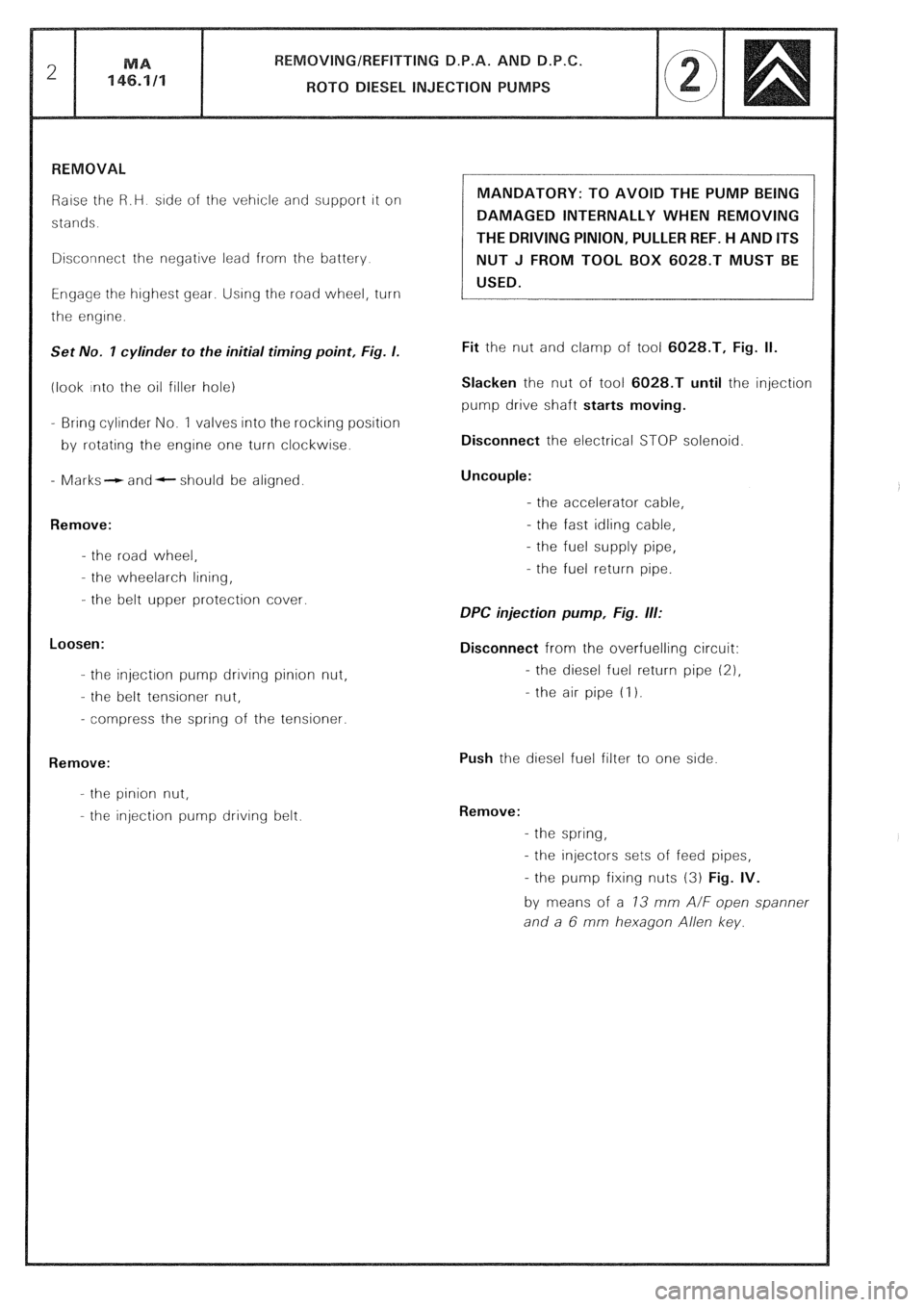
Raise the R.H side of the vehicle and support it on
stands.
Disconnect the negative lead from the battery
Engage the highest gear. Using the road wheel, turn
the engine.
Set No. I cylinder to the initial timing point, Fig. I.
(look into the oil filler hole)
- Bring cylinder No. 1 valves into the rocking position
by rotating the engine one turn clockwise.
- Marks- and- should be aligned.
Remove:
- the road wheel,
- the wheelarch lining,
- the belt upper protection cover.
Loosen:
- the injection pump drrvrng pinion nut,
- the belt tensioner nut,
- compress the spring of the tensioner.
Remove:
- the pinion nut,
- the injection pump driving belt. MANDATORY: TO AVOID THE PUMP BEING
DAMAGED INTERNALLY WHEN REMOVING
THE DRIVING PINION, PULLER REF. H AND ITS
NUT J FROM TOOL BOX 6028.T MUST BE
USED.
Fit the nut and clamp of tool 6028.T, Fig. II.
Slacken the nut of tool 6028.T until the injection
pump drive shaft starts moving.
Disconnect the electrical STOP solenoid
Uncouple:
- the accelerator cable,
- the fast idling cable,
- the fuel supply pipe,
- the fuel return pipe.
DPC injection pump, Fig. ill:
Disconnect from the overfuelling circuit:
- the diesel fuel return pipe (21,
- the air pipe (I 1.
Push the diesel fuel filter to one side
Remove:
- the spring,
- the injectors sets of feed pipes,
- the pump fixing nuts (3) Fig. IV.
by means of a 73 mm A/F open spanner
and a 6 mm hexagon Allen key.
Page 218 of 648
REMOVING/REFITTING D.P.A. AND D.P.C.
ROT0 DIESEL INJECTION PUMPS MA
146.1/l 5
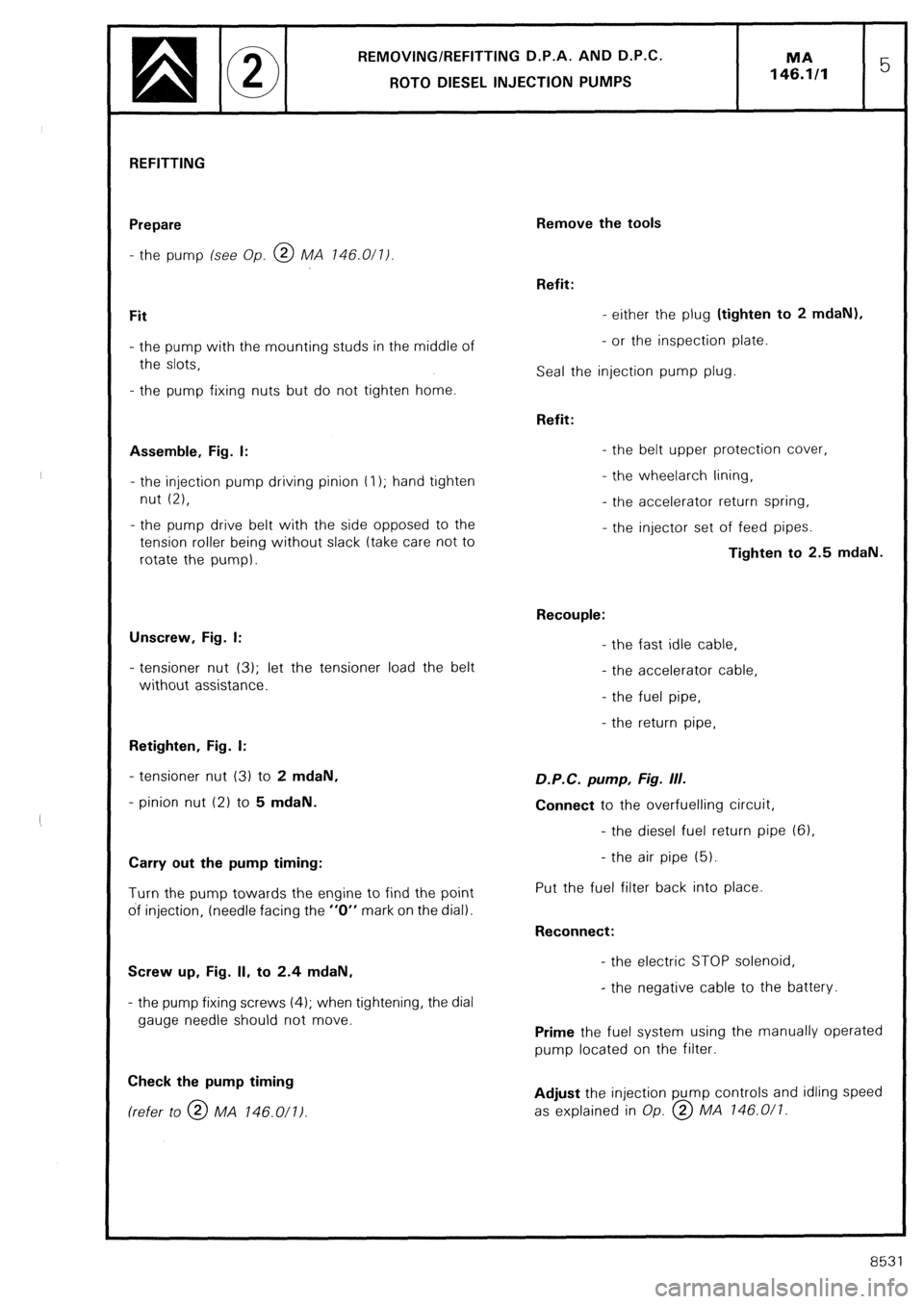
REFITTING
Prepare
- the pump (see Op. @ MA 146.0/l/
Fit
- the pump with the mounting studs in the middle of
the slots,
- the pump fixing nuts but do not tighten home.
Assemble, Fig. I:
- the injection pump driving pinion t I); hand tighten
nut (2),
- the pump drive belt with the side opposed to the
tension roller being without slack (take care not to
rotate the pump).
Unscrew, Fig. I:
- tensioner nut (3); let the tensioner load the belt
without assistance.
Retighten, Fig. I:
- tensioner nut (3) to 2 mdaN,
- pinion nut (2) to 5 mdaN.
Carry out the pump timing:
Turn the pump towards the engine to find the point
of injection, (needle facing the “0” mark on the dial).
Screw up, Fig. II, to 2.4 mdaN,
- the pump fixing screws (4); when tightening, the dial
gauge needle should not move.
Check the pump timing (refer to @ MA 146.011)
Remove the tools
Refit:
- either the plug (tighten to 2 mdaN),
- or the inspection plate.
Seal the injection pump plug.
Refit:
- the belt upper protection cover,
- the wheelarch lining,
- the accelerator return spring,
- the injector set of feed pipes.
Tighten to 2.5 mdaN.
Recouple:
- the fast idle cable,
- the accelerator cable,
- the fuel pipe,
- the return pipe, D.P.C. pump, Fig. III.
Connect to the overfuelling circuit,
- the diesel fuel return pipe (61,
- the air pipe (5).
Put the fuel filter back into place.
Reconnect:
- the electric STOP solenoid,
- the negative cable to the battery.
Prime the fuel system using the manually operated
pump located on the filter.
Adjust the injection pump controls and idling speed
as explained in Op. @ MA 146.0/l.
8531
Page 224 of 648
CHECKING THE PETROL SUPPLY
829.A5-J6T.A500
Pump AC DELCO TYPE: PB3
CHECKING THE PETROL PRESSURE WITH APPARATUS 4005-T:
- Position apparatus 4005-T.
- Disconnect the carburettor fuel return pipe; fit plug (2)
- Unscrew tap @ by one turn approx.
- Start the engine.
a) Check the petrol pressure at zero delivery:
- Fully screw up the tap; the pressure should not show a reading of more than 325 m.bar for the stabilised
pressure.
b) Check the tightness of the pump delivery valve:
- Stop the engine: there should not be a sudden drop in pressure.
c) Check the tightness of the carburettor needle valve:
- Unscrew tap @ ; start the engine, leave it running for a few minutes.
- Stop the engine: there should not be a sudden drop in pressure.
- Remove apparatus 4005-T and fit the fuel supply pipe and the fuel return pipe to the carburettor
(after plug (2) has been removed).
CHECKING THE PUMP FOR LEAKS:
Close the pump delivery tube. Blow compressed air under 800 m.bar pressure into the suction pipe. Immerse the
pump in a container filled with clean White Spirit: no leak should be detected.
Page 260 of 648
CHECKING THE INTEGRATED ELECTRONlC
IGNITION (I.E.I.)
TEST PROCEDURE USING CONVENTIONAL EQUIPMENT
on the CX 2500 vehicle with M 25/659 type engine
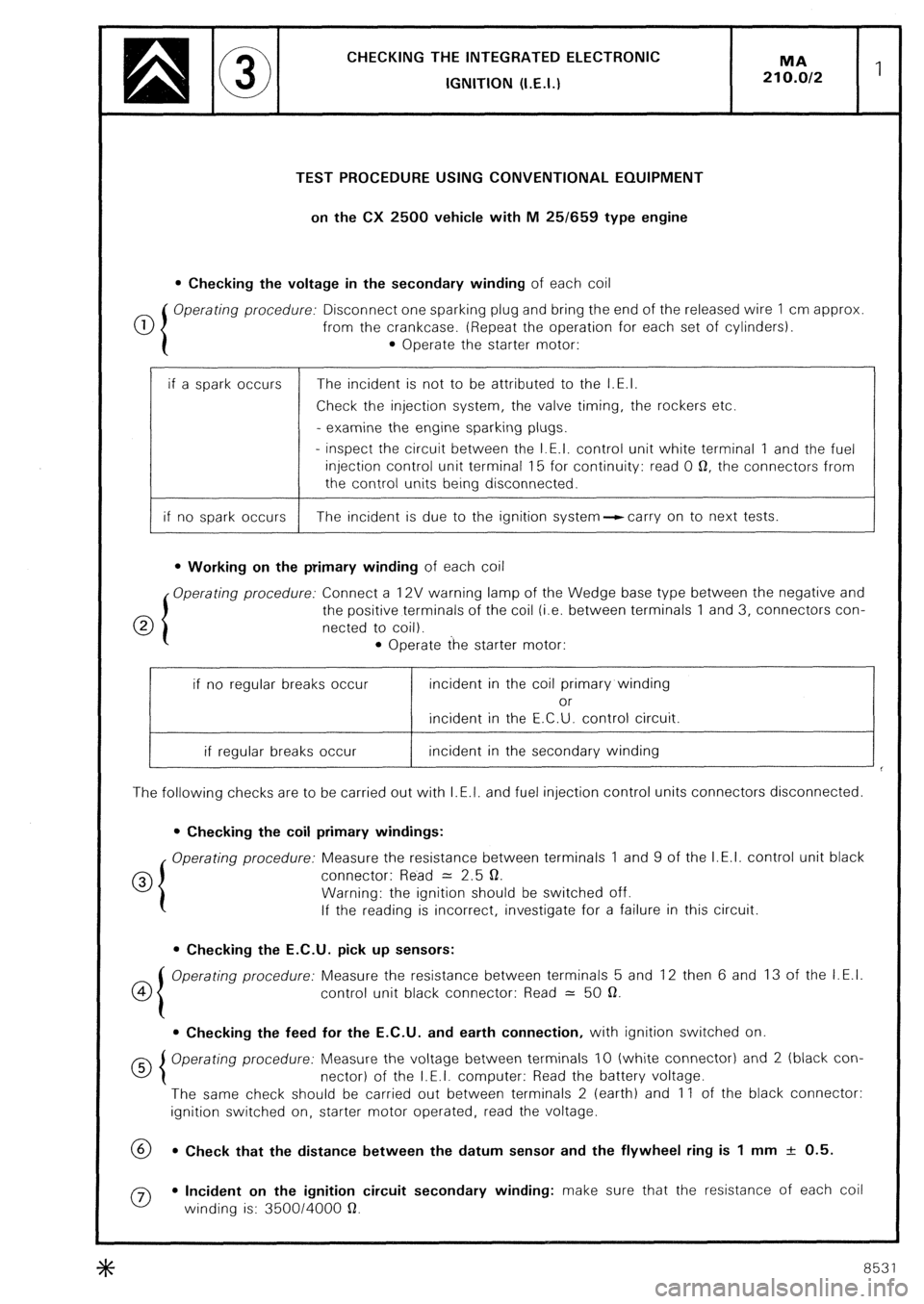
l Checking the voltage in the secondary winding of each coil
0 Operating procedure: Disconnect one sparking plug and bring the end of the released wire 1 cm approx
from the crankcase. (Repeat the operation for each set of cylinders).
l Operate the starter motor:
if a spark occurs The incident is not to be attributed to the I.E.I.
Check the injection system, the valve timing, the rockers etc.
- examine the engine sparking plugs.
- inspect the circuit between the I.E.I. control unit white terminal 1 and the fuel
injection control unit terminal 15 for continuity: read 0 0, the connectors from
the control units being disconnected.
if no spark occurs The incident is due to the ignition system--ccarry on to next tests.
l Working on the primary winding of each coil
Operating procedure: Connect a 12V warning lamp of the Wedge base type between the negative and
0 the positive terminals of the coil (i.e. between terminals 1 and 3, connectors con-
netted to coil).
l Operate the starter motor:
if no regular breaks occur incident in the coil primary winding
or
incident in the E.C.U. control circuit.
if regular breaks occur incident in the secondary winding
The following checks are to be carried out with I.E.I. and fuel injection control units connectors disconnected.
l Checking the coil primary windings:
Operating procedure: Measure the resistance between terminals 1 and 9 of the I.E.I. control unit black
0 connector: Read = 2.5 0.
Warning: the ignition should be switched off.
If the reading is incorrect, investigate for a failure in this circuit.
l Checking the E.C.U. pick up sensors:
co Operating procedure: Measure the resistance between terminals 5 and 12 then 6 and 13 of the I.E.I.
control unit black connector: Read = 50 a.
l Checking the feed for the E.C.U. and earth connection, with ignition switched on
Operating procedure: Measure the voltage between terminals IO (white connector) and 2 (black con-
nector) of the I.E.I. computer: Read the battery voltage.
The same check should be carried out between terminals 2 (earth) and 11 of the black connector:
ignition switched on, starter motor operated, read the voltage.
69 l Check that the distance between the datum sensor and the flywheel ring is 1 mm + 0.5.
0 l Incident on the ignition circuit secondary winding: make sure that the resistance of each coil
winding is: 350014000 a.
8531
Page 261 of 648
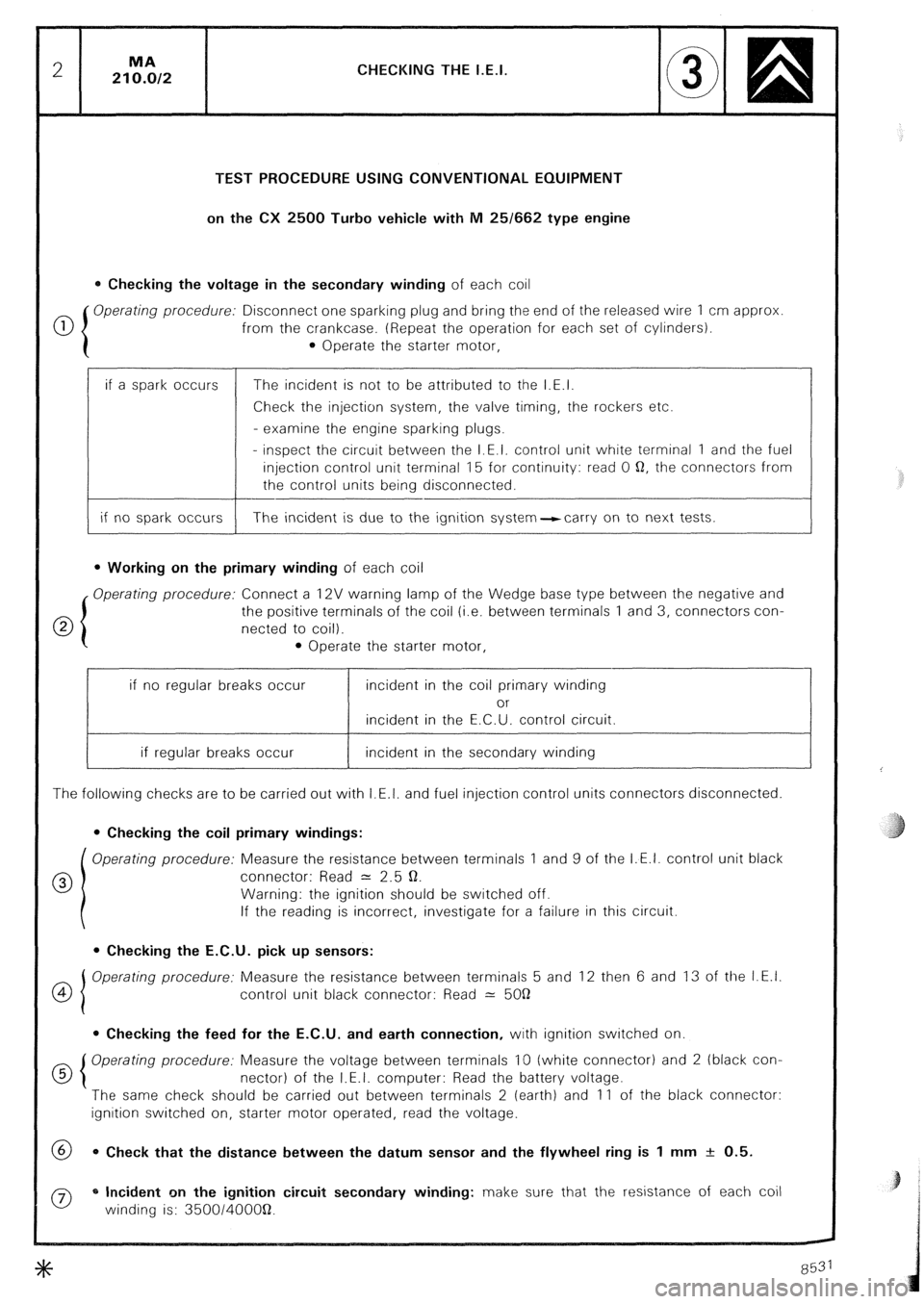
CHECKING THE I.E.I.
TEST PROCEDURE USING CONVENTIONAL EQUIPMENT
on the CX 2500 Turbo vehicle with M 25/662 type engine
0 Checking the voltage in the secondary winding of each coil
0 Operating procedure: Disconnect one sparking plug and bring the end of the released wire 1 cm approx
from the crankcase. (Repeat the operation for each set of cylinders).
0 Operate the starter motor,
if a spark occurs
if no spark occurs The incident is not to be attributed to the I.E.I.
Check the injection system, the valve timing, the rockers etc.
- examine the engine sparking plugs.
- inspect the circuit between the I.E.I. control unit white terminal 1 and the fuel
injection control unit terminal 15 for continuity: read 0 Q, the connectors from
the control units being disconnected.
The incident is due to the ignition system-carry on to next tests.
l Working on the primary winding of each coil
Operating procedure: Connect a 12V warning lamp of the Wedge base type between the negative and
the positive terminals of the coil (i.e. between terminals 1 and 3, connectors con-
netted to coil).
l Operate the starter motor,
if no regular breaks occur incident in the coil primary winding
or
incident in the E.C.U. control circuit.
if regular breaks occur incident in the secondary winding
The following checks are to be carried out with I.E.I. and fuel injection control units connectors disconnected.
0 Checking the coil primary windings:
Operating procedure: Measure the resistance between terminals 1 and 9 of the I.E.I. control unit black
0 connector: Read = 2.5 Q.
Warning: the ignition should be switched off.
If the reading is incorrect, investigate for a failure in this circuit.
l Checking the E.C.U. pick up sensors:
OI Operating procedure: Measure the resistance between terminals 5 and 12 then 6 and 13 of the I.E.I.
4
control unit black connector: Read 2: 5OQ
0 Checking the feed for the E.C.U. and earth connection, with ignition switched on.
d 5 Operating procedure: Measure the voltage between terminals 10 (white connector) and 2 (black con-
nectar) of the I.E.I. computer: Read the battery voltage.
The same check should be carried out between terminals 2 (earth) and 11 of the black connector:
ignition switched on, starter motor operated, read the voltage.
@ 0 Check that the distance between the datum sensor and the flywheel ring is 1 mm + 0.5.
0 * Incident on the ignition circuit secondary winding: make sure that the resistance of each coil
winding is: 350014OOOQ.
Page 264 of 648

CHECKING THE IGNITION SYSTEM
USING CHECKING EQUIPMENT OUT 106 029T
The instrument can be utilised on CX 2400 I.E. with naturally aspirated engine and CX 2500 I.E. TURBO. Howe-
ver, on CX 2400 I.E. having an integrated electronic ignition system with a single connector E.C.U., it is neces-
sary to proceed as follows:
- connect the I.E.I. control unit to the black connector of OUT 105 029.T
- set the switch of the apparatus to the “1 connector” position
- I.E.I. with 1 or 2 sensors can be checked with this device.
a) Testing the ignition coil primary winding:
- The warning lamps, one at each coil, blink rythmically with the impulses transmitted to their primary win-
ding. Steady blinks indicate that there is enough current to generate a spark in the secondary winding.
- The switch situated under the warning lamps makes it possible for the primary windings of both coils to
be insulated, by pushing, in the “out of circuit“ position, any interference coming from the HT circuit when
the frequency of illumination for sensor warning lamps is checked.
- If the warning lamps blinking is correct, the failure may be caused by:
- the ignition information to the fuel injection control unit, (paragraph c),
- the secondary winding (coil wires, coils),
- any other item required for a correct operation of the engine such as injection, valve gear, rockers etc.) -
If the warning lamps blinking is not correct, examine the control unit warning lamps, (paragraph b),
b) Testing the sensors: -
The warning lamp connected with the “datum” sensor blinks rythmically with the impulses transmitted by
the peg, i.e. one blink per engine revolution, (2 sensors fitted).
- The warning lamp connected with the “flywheel pick up” sensor, blinks rythmically with the impulses sent ’
by the flywheel teeth.
The frequency of the flashes is such as they can hardly be seen.
Apparently, the lamp stays on, (1 or 2 sensors fitted).
On the CX 2400 I.E. and 2500 I.E. with normally aspirated engine, the vacuum pressure warning lamp lights
up momentarily after a sharp acceleration: this warning lamp is no longer usable on the CX 2500 I.E. with
turbocharger.
c) Tests related with the I.E.I. control unit:
E.C.U. functions: -
The rev. counter warning lamp blinks rythmically with the impulses transmitted to the rev. counter.
- The injection warning lamp blinks rythmically with the impulses sent to the fuel injection control unit
+k 8531
Page 385 of 648
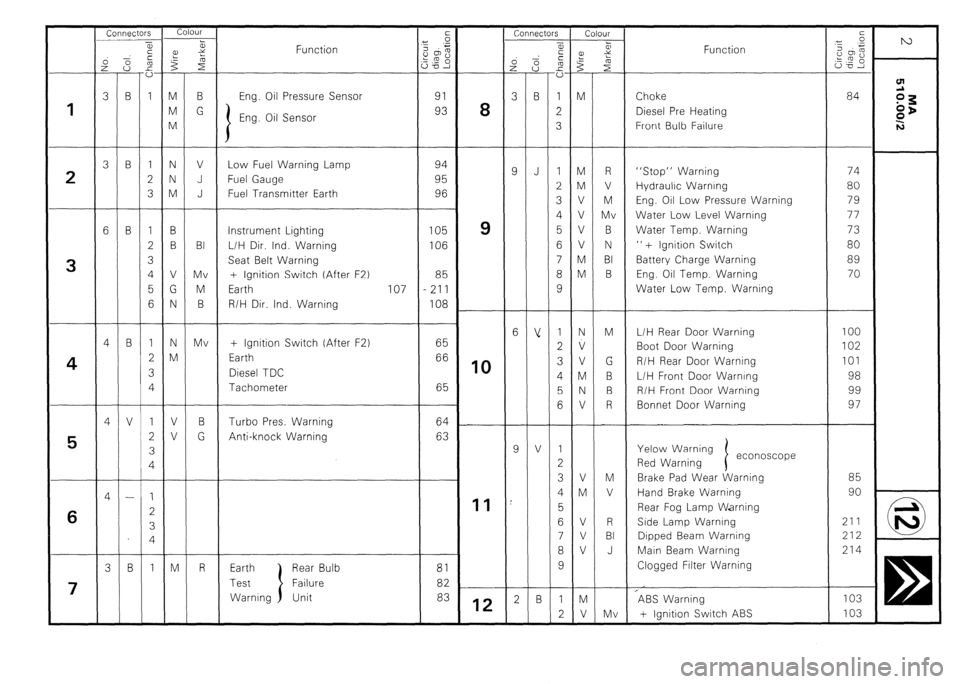
Connectors
l.-~l
a,
- Connectors
,”
9 r, 75 Colour
FiY
E
vl
-
M
M
V
V
V
V
M
M
-
N
v
V
M
N
V
-
V
M
V
V
V
-
M
V
2
$
R
V
M
Mv
B
N
BI
B
Mv . -
z
Y
i
r”
B
G Function Function
:
m
.e-
1
-
1
2
3
-
1
2
3
4
1
2
3
4
I
2
3
4
-
1 .-
f
-
M
M
M
-
N
N
M
-
B
B
V
G
N
-
N
M
-
V
V
-
-
M 1
2
3
-
-
-
-
1
2 -
3 -
6 -
4 -
4 -
4 -
3
1
3
-
9
-
6
-
9
-
2
L.
B
-
J
-
v
-
V
-
B
m
sg
ZD
‘N
B
-
B
-
B
-
B
-
V
-
-
-
B Eng. Oil Pressure Sensor
94
95
96 Choke
Diesel Pre Heating
Front Bulb Failure 84
I 8
1
Eng. Oil Sensor
V
J
J Low Fuel Warning Lamp
Fuel Gauge
Fuel Transmitter Earth “Stop” Warning
Hydraulic Warning
Eng. Oil Low Pressure Warning
Water Low Level Warning
Water Temp. Warning
” + Ignition Switch
Battery Charge Warning
Eng. Oil Temp. Warning
Water Low Temp. Warning
2 74
80
79
77
73
80
89
70
100
102
101
98
99
97
85
90
211
212
214
103
103
9
10
11 Instrument Lighting
L/H Dir. Ind. Warning
Seat Belt Warning
+ Ignition Switch (After F2)
Earth 107
R/H Dir. Ind. Warning 105
106
85
211
108
65
66
65 BI
Mv
M
B
Mv
3
L/H Rear Door Warning
Boot Door Warning
R/H Rear Door Warning
L/H Front Door Warning
R/H Front Door Warning
Bonnet Door Warning + Ignition Switch (After F.2)
Earth
Diesel TDC
Tachometer
4
B
G Turbo Pres. Warning
Anti-knock Warning 64
63
Yelow Warning
Red Warning econoscope
5
Brake Pad Wear Warning
Hand Brake Warning
Rear Fog Lamp Warning
Side Lamp Warning
Dipped Beam Warning
Main Beam Warning
Clogged Filter Warning
0 ic 6
R Earth
Test
Warning Rear Bulb
Failure
Unit 81
82
83
7
12 ?ABS Warning
+ Ignition Switch ABS
Page 388 of 648
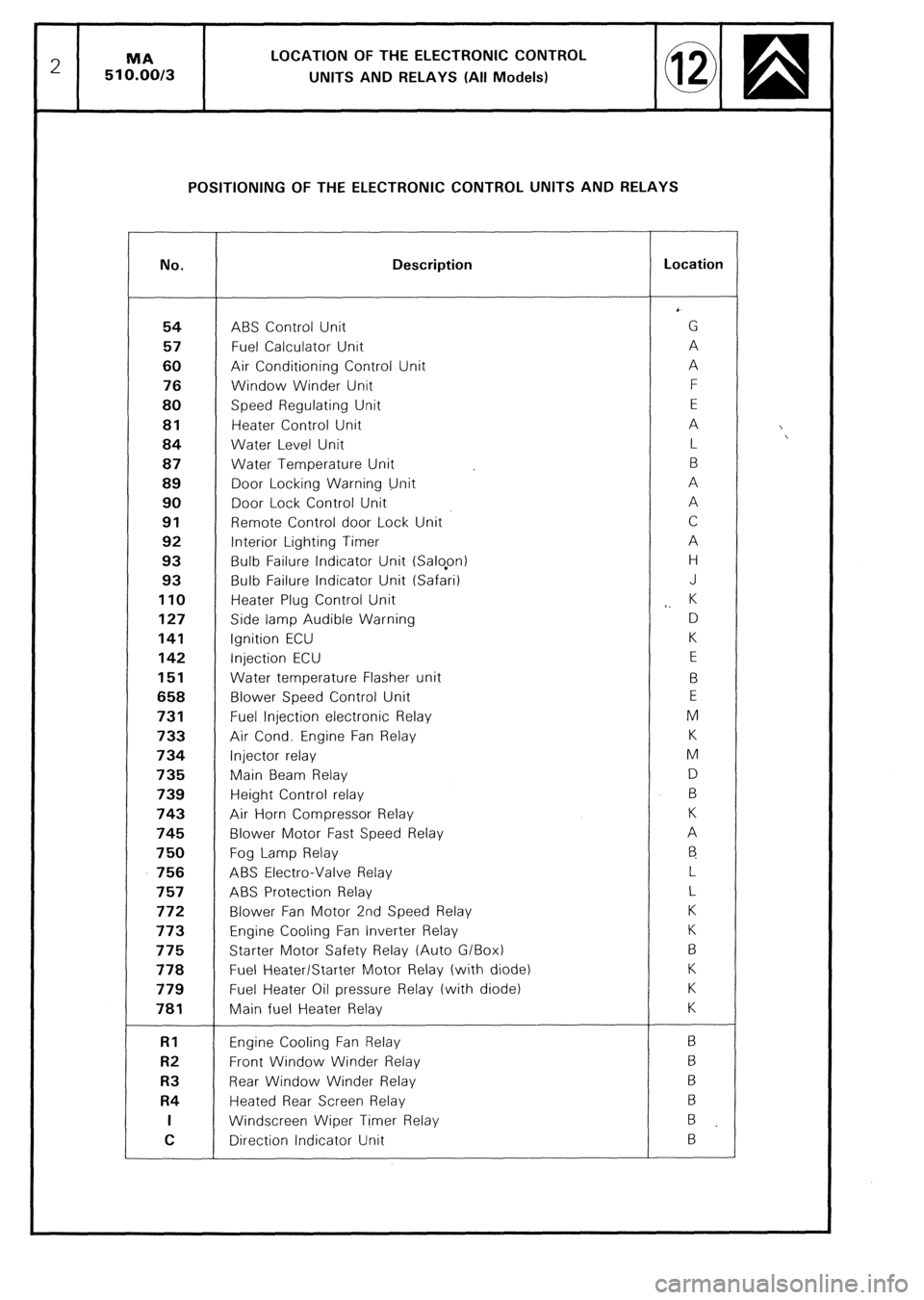
2 MA LOCATION OF THE ELECTRONIC CONTROL
510.00/3
UNITS AND RELAYS (All Models)
POSITIONING OF THE ELECTRONIC CONTROL UNITS AND RELAYS
No. Description Location
54 ABS Control Unit G
57 Fuel Calculator Unit A
60 Air Conditioning Control Unit A
76 Window Winder Unit F
80 Speed Regulating Unit E 81
Heater Control Unit A
84 Water Level Unit L
87 Water Temperature Unit B
89 Door Locking Warning Unit A
90 Door Lock Control Unit A 91
Remote Control door Lock Unit C
92 Interior Lighting Timer A
93 Bulb Failure Indicator Unit (Salopn) H
93 Bulb Failure Indicator Unit (Safari) J 110
Heater Plug Control Unit
,. K 127
Side lamp Audible Warning D 141
Ignition ECU K 142
Injection ECU E 151
Water temperature Flasher unit B 658
Blower Speed Control Unit E 731
Fuel Injection electronic Relay M 733
Air Cond. Engine Fan Relay K 734
Injector relay M 735
Main Beam Relay D
739 Height Control relay B 743
Air Horn Compressor Relay K 745
Blower Motor Fast Speed Relay A 750
Fog Lamp Relay
6 756
ABS Electra-Valve Relay L 757
ABS Protection Relay L 772
Blower Fan Motor 2nd Speed Relay K 773
Engine Cooling Fan lnverter Relay K 775
Starter Motor Safety Relay (Auto G/Box) B 778
Fuel Heater/Starter Motor Relay (with diode) K
779 Fuel Heater Oil pressure Relay (with diode) K 781
Main fuel Heater Relay K RI
Engine Cooling Fan Relay B R2
Front Window Winder Relay 6 R3
Rear Window Winder Relay B R4
Heated Rear Screen Relay 6 I
Windscreen Wiper Timer Relay
B
C Direction Indicator Unit B
Page 393 of 648
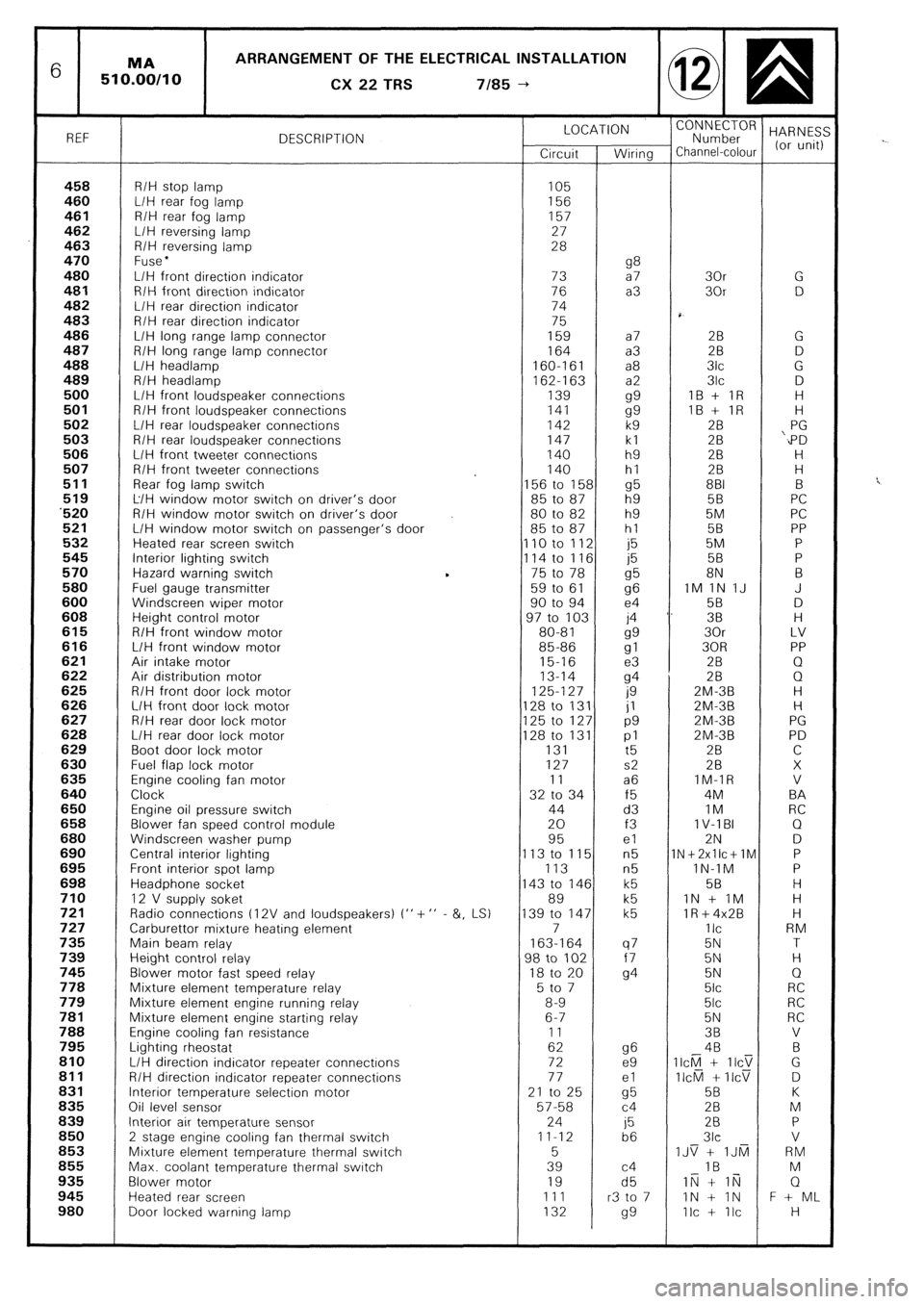
6 ARRANGEMENT OF THE ELECTRICAL INSTALLATION
CX
22 TRS 7185 --)
REF DESCRIPTION LOCATION
“;;;;;roR HARNES:
Circuit Wiring Channel-colour (or unit)
458 R/H stop lamp 105 460 L/H rear fog lamp 156 461 R/H rear fog lamp 157
462 L/H reversing lamp 27
463 R/H reversing lamp 28
470 Fuse l 480 g8 L/H front direction indicator 73 a7 30r G 481 R/H front direction indicator 76 a3 30r D 482 L/H rear direction indicator 74
483 R/H rear direction indicator 75
486 L/H long range lamp connector 159 a7 28 G 487 R/H long range lamp connector 164 a3 2B D 488 L/H headlamp 160-161 a8 3lc G
489 R/H headlamp
162-l 63 a2 3lc D 500 L/H front loudspeaker connections 139
gg IB + IR H 501 R/H front loudspeaker connections 141
gg IB + IR H 502 L/H rear loudspeaker connections 142 k9 28 PG 503 R/H rear loudspeaker connections 147 kl 28 ‘,PD 506 L/H front tweeter connections 140 h9 2B H 507 R/H front tweeter connections 140 hl 28 H
511 Rear fog lamp switch 156 to 158 g5 881 B 519 L/H window motor switch on driver’s door 85 to 87 h9 5B PC ‘520 R/H window motor switch on driver’s door 80 to 82 h9 5M PC 521 L/H window motor switch on passenger’s door 85 to 87 hl 58 PP 532 Heated rear screen switch 110 to 112 j5 5M P 545 Interior lighting switch
114 to 116 j5 58 P 570 Hazard warning switch 75 to 78
g5 8N B 580 Fuel gauge transmitter 59 to 61
96 IM 1N IJ J 600 Windscreen wiper motor 90 to 94 e4 58 D 608 Height control motor 97 to 103 j4 ‘. 38 H 615 R/H front window motor 80-81
gg 30r LV 616 L/H front window motor 85-86
gl 30R PP 621 Air intake motor 15-16 e3 2B Q 622 Air distribution motor 13-14
94 28 0 625 R/H front door lock motor 125-127
0 ZM-3B H 626 L/H front door lock motor 128 to 131 jl ZM-3B H 627 R/H rear door lock motor 125 to 127 p9 2M-3B PG 628 L/H rear door lock motor 128 to 131 pl 2M-3B PD 629 Boot door lock motor 131
t5 2B C 630 Fuel flap lock motor 127 s2 28 X 635 Engine cooling fan motor 11 a6 IM-IR V 640 Clock 32 to 34 f5 4M BA 650 Engine oil pressure switch 44 d3 IM RC 658 Blower fan speed control module 20 f3 1 V-l BI Q 680 Windscreen washer pump 95 el 2N D 690 Central interior lighting 113 to 115 n5 1N+2xllc+lM P 695 Front interior spot lamp 113 n5 lN-1M P 698 Headphone socket 143 to 146 k5 58 H 710 12 V supply soket 89 k5 IN + IM H 721 Radio connections t 12V and loudspeakers) I” + ” - &, LS) 139 to 147 k5 lR+4x2B H 727 Carburettor mixture heating element 7 IIC RM 735 Main beam relay 163-164 q7 5N T 739 Height control relay 98 to 102 f7 5N H 745 Blower motor fast speed relay 18 to 20
94 5N Q 778 Mixture element temperature relay 5 to 7 5lc RC 779 Mixture element engine running relay 8-9 5lc RC 781 Mixture element engine starting relay 6-7 5N RC 788 Engine cooling fan resistance 11 38 V 795 Lighting rheostat 62 g6 4B B 810 L/H direction indicator repeater connectrons 72 e9 II&l + IICT G 811 R/H direction indicator repeater connections 77 el II&l + IICV D 831 Interior temperature selection motor 21 to 25
cl5 5B K 836 Oil level sensor 57-58 c4 28 M 839 Interior air temperature sensor 24
j5 28 P 850
2 stage engine cooling fan thermal switch 11-12
b6 3lc V 853 Mixture element temperature thermal switch 5 IJS + IJti RM 855 Max. coolant temperature thermal switch 39 c4 IB M 935 Blower motor 19 d5 IN + li;j Q 945 Heated rear screen 111 r3 to 7 IN + IN F + ML 980 Door locked warning lamp 132
99 Ilc + Ilc H
Page 399 of 648
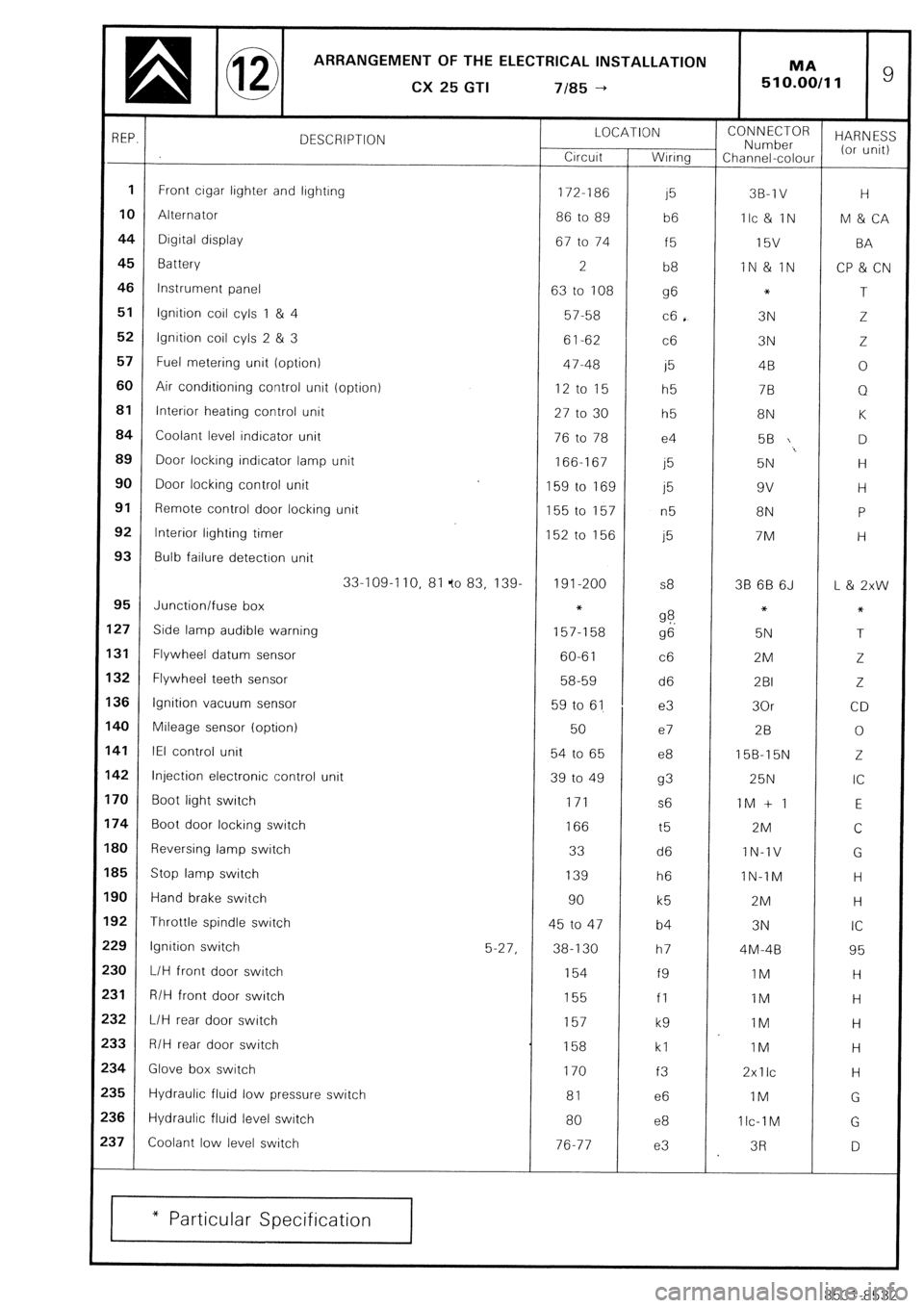
ARRANGEMENT OF THE ELECTRICAL INSTALLATION
a @ CX25GTI 7185-t MA ’ 510.00/11
REP.
DESCRIPTION LOCATION
Crrcurt Wrnng CONNECTOR
Number HARN ES:
Channel-colour (or unit)
1 Front lighter and lrghtrng
crgar 172-186 15 3B-1 V H
10 Alternator
86 to 89
b6 Ilc & IN M & CA
44 Dtgital display
67 to 74 f5 l5V BA
45
Battery
2
b8 IN & IN
CP & CN
46 Instrument panel
63 to 108 g6 *
T
51 Ignition coil cyls 1 & 4
57-58 c6 . 3N Z
52 lgnrtion coil cyls 2 & 3
61-62 c6 3N Z
57 Fuel metering unit (option)
47-48 i5 4B 0
60 Air conditioning control unit (option)
12 to 15
h5 7B Q
81 Interior heating control unit
27 to 30 h5 8N K
84 Coolant level indicator unit
76 to 78 e4 56 D
89
Door locking indicator lamp unit
166-167
j5 5N H
90 Door locking control unit
159 to 169 j5 9v H
91
Remote control door locking unit
155 to 157
n5 8N P
92 Interior lighting timer
152 to 156 j5 7M H
93 Bulb failure detectron unit
33-109-I 10, 81 fo 83, 139. 191-200 s8 38 6B 6J L & 2xw
95 Junction/fuse box *
27 Side lamp audible warning 9 ?. *
*
157-l 58
g6 5N T
31
Flywheel datum sensor
60-61 c6 2M
Z
32 Flywheel teeth sensor
58-59 d6 2BI 2.
36 Ignition vacuum sensor
59 to 61 e3 30r CD
40 Mileage sensor (option)
50 e7 28 0
41 IEI control unit
54 to 65 e8 15B-15N Z
42 Injection electronic control unit
39 to 49 93 25N IC
70 Boot light switch
171 s6 1M + 1 E
74
Boot door locking switch
166 t5 2M
C
BO
Reversing lamp switch 33
d6 IN-1V
G
B5 Stop lamp switch
139 h6 IN-TM H
90 Hand brake switch
90
k5 2M H
92 Throttle spindle switch
45 to 47 b4 3N IC
29 lgnrtion switch
5-27, 38-130 h7 4M-48 95
30
L/H front door switch 154
f9 IM H
31 R/H front door switch
155
fl IM H
32 L/H rear door switch
157
k9 IM H
33 R/H rear door switch
158 kl 1M H
34
Glove box switch
170
f3 2xllc
H
35 Hydraulic fluid low pressure switch
81 e6 IM
G
$6
Hydraulic fluid level swatch
80 e8 1 Ic-1 M
G
$7
Coolant low level switch
76-77 e3 3R
D
* Particular Specification
8531-8532