parking brake CITROEN DISPATCH SPACETOURER DAG 2018 Handbook (in English)
[x] Cancel search | Manufacturer: CITROEN, Model Year: 2018, Model line: DISPATCH SPACETOURER DAG, Model: CITROEN DISPATCH SPACETOURER DAG 2018Pages: 400, PDF Size: 16.99 MB
Page 194 of 400

192
Automatic operation
F Select position D for automatic
changing of the six gears.
The gearbox then operates in auto-adaptive
mode, without any inter vention on the part
of the driver. It continuously selects the most
suitable gear according to the style of driving,
the profile of the road and the load in the
vehicle.
For maximum acceleration without
touching the selector, depress
the accelerator fully (kick-down).
The gearbox changes down
automatically or holds the gear
selected until the maximum engine
speed is reached.
When braking, the gearbox changes down
automatically to provide effective engine
braking.
For better safety, the gearbox will not shift up if
you release the accelerator sharply. Never select position N while the vehicle
is moving.
Never select position P or R unless the
vehicle is completely stationary.
Temporary manual control
of gear changes
Self-sufficient traction
(moving without using the
accelerator)
This function facilitates manoeuvring of the
vehicle at low speed (when parking, in traffic
jams, etc.).
With the engine at idle, parking brake released
and position D
, M or R selected, the vehicle
moves as soon as you take your foot off the
brake pedal (even without depressing the
accelerator).
As a safety measure (children on board),
never leave the vehicle with the engine
running and the doors closed.
Manual operation
You can temporarily take over control of gear
changes using the " +" and " -" steering mounted
controls. If the engine speed allows, the gear
change is carried out.
This function allows you to anticipate certain
situations, such as overtaking another vehicle
or approaching a bend in the road.
After a few moments with no action on the
control paddles, the gearbox returns to
automatic operation.
Driving
Page 195 of 400
193
The indicator light for the button goes off.In manual mode it is not necessary to
release the accelerator pedal when
changing gear.
It is only possible to change from one gear
to another if the vehicle speed and engine
speed permit.
If the engine speed is too low or too
high, the selected gear flashes for a few
seconds, then the actual activated gear is
displayed.
When the vehicle is stationary or moving
very slowly, the gearbox selects
gear M1
automatically.
To save the brakes when descending
a steep incline, use engine braking to
reduce your speed (take your foot off the
accelerator pedal or change down).
Keeping the brake pedal pressed
continuously for long periods can overheat
the brakes, with the risk of damaging the
braking system or making it inoperative.
Only use the brakes when necessary, to
slow or stop the vehicle. Depending on the road configuration
(example: mountain road), manual
operation is preferable.
This is because automatic operation may
not be best suited, not allowing the use of
engine braking.
Invalid value during manual
operation
This symbol is displayed if a gear is
not engaged correctly (gear selector
between two positions).
F
P
lace the selector "correctly" at a position.
Stopping the vehicle
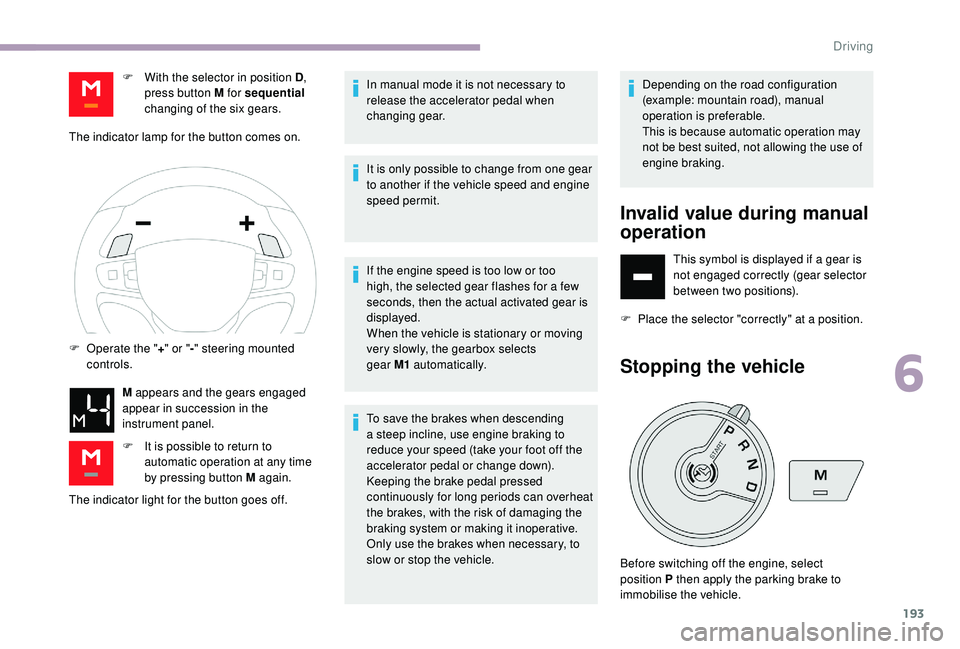
F With the selector in position D ,
press button M for sequential
changing of the six gears.
The indicator lamp for the button comes on.
F
O
perate the " +" or " -" steering mounted
controls.
M appears and the gears engaged
appear in succession in the
instrument panel.
F
I
t is possible to return to
automatic operation at any time
by pressing button M again.
Before switching off the engine, select
position P then apply the parking brake to
immobilise the vehicle.
6
Driving
Page 196 of 400

194
A stiff point may be noticed when moving
to position P.
If the selector is not in position P , when the
driver's door is opened or approximately
45
seconds after the ignition is switched
off, an audible signal sounds and a
message appears.
F
R
eturn the selector to position P ; the
audible signal stops and the message
disappears.
On a steep slope with a loaded vehicle,
depress the brake pedal, select
position P , apply the parking brake then
release the brake pedal.
In all circumstances, ensure that the
selector is in position P before leaving
your vehicle.Malfunction
When the ignition is on, a message appears
in the instrument panel screen to indicate a
gearbox fault.
In this case, the gearbox switches to back-up
mode and is locked in 3rd gear. You may feel a
substantial jolt when changing from P to R and
from N to R. This will not cause any damage to
the gearbox.
Do not exceed around 60
mph (100 km/h), local
speed restrictions permitting.
Have it checked by a CITROËN dealer or a
qualified workshop.
There is a risk of damage to the gearbox:
-
i
f you depress the accelerator and
brake pedals at the same time (braking
or acceleration must be done only with
the right foot),
-
i
f you force the selector from position P
to another position when the battery is
flat. To reduce fuel consumption when
stationary for long periods with the
engine running (traffic jam, etc.),
position the selector to N and apply the
parking brake.
If your vehicle has an automatic gearbox,
never try to start the engine by pushing
the vehicle.
Driving
Page 198 of 400

196
Starting the vehicle
F Select position N.
F D epress the brake pedal firmly.
F
S
tart the engine.
N appears in the instrument panel
screen.
If the engine does not star t:
If N flashes in the instrument panel,
accompanied by an audible signal and a
message, move the selector to position A
then to position N .
F
Sel
ect automatic operation (position A ),
manual operation (position M ), or reverse
(position R ).
F
R
elease the parking brake.
F
P
rogressively take your foot off the brake
pedal; the vehicle then moves off.
Automatic operation
F After starting the engine, select position A for automatic gear changes
AUTO and the gear engaged are
displayed in the instrument panel.
The gearbox then operates in auto-active
mode, without any inter vention on the part
of the driver. It continuously selects the most
suitable gear according to the following
parameters:
-
s
tyle of driving,
-
p
rofile of the road. For optimum acceleration,
for example when overtaking
another vehicle, depress the
accelerator pedal firmly past the
point of resistance.
Temporary manual control of
gear changes
If the Foot on brake warning
lamp comes on the instrument
panel, accompanied by an
audible signal and a message
"Foot on brake", depress the
brake pedal firmly. You can temporarily
take over control of gear
changes using the " +" and " -" steering mounted
controls. If the engine speed allows, the gear
change is carried out.
This function allows you to anticipate certain
situations, such as overtaking another vehicle
or approaching a bend in the road.
After a few moments with no action on the
control paddles, the gearbox returns to
automatic operation.
Driving
Page 200 of 400
198
Stopping the vehicle
When immobilising the vehicle, with
the engine running, you must move the
selector to neutral N.
Before doing anything under the bonnet
ensure that the selector is in neutral N and
that the parking brake is applied.
Malfunction
With the ignition on, the flashing of A or
AUTO , accompanied by an audible signal and
a message, indicates a malfunction of the
gearbox.
Have it checked by a CITROËN dealer or a
qualified workshop.
You must keep your foot on the brake
pedal while starting the engine.
In all parking situations, you must apply
the parking brake to immobilise the
vehicle.
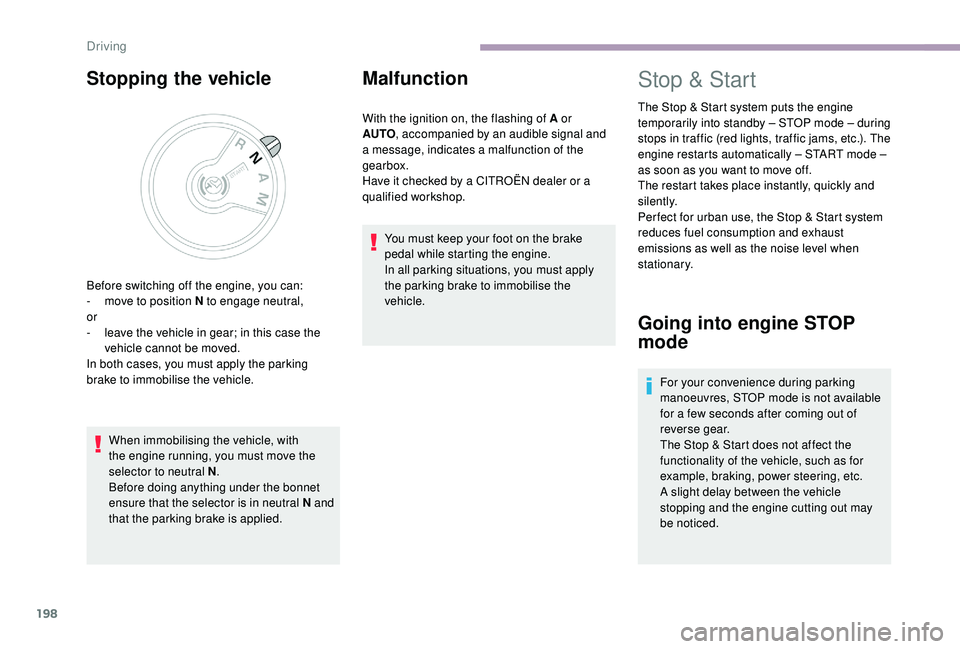
Before switching off the engine, you can:
-
m
ove to position N to engage neutral,
or
-
l
eave the vehicle in gear; in this case the
vehicle cannot be moved.
In both cases, you must apply the parking
brake to immobilise the vehicle.
Stop & Start
The Stop & Start system puts the engine
temporarily into standby – STOP mode – during
stops in traffic (red lights, traffic jams, etc.). The
engine restarts automatically – START mode –
as soon as you want to move off.
The restart takes place instantly, quickly and
silently.
Per fect for urban use, the Stop & Start system
reduces fuel consumption and exhaust
emissions as well as the noise level when
stationary.
Going into engine STOP
mode
For your convenience during parking
manoeuvres, STOP mode is not available
for a few seconds after coming out of
reverse gear.
The Stop & Start does not affect the
functionality of the vehicle, such as for
example, braking, power steering, etc.
A slight delay between the vehicle
stopping and the engine cutting out may
be noticed.
Driving
Page 201 of 400

199
With a manual gearbox, when
vehicle speed is below 12 mph (20
km/h) or the vehicle is stationary
(depending on engine), the Stop &
Start warning lamp comes on in the
instrument panel and the engine
goes into standby automatically
when you place the gear lever in
neutral and you release the clutch
pedal.
With an automatic gearbox , vehicle
stationary, the Stop & Start warning lamp
on the instrument panel comes on and the
engine goes into standby automatically when
you press the brake pedal or place the gear
selector in position N .
With an electronic gearbox , vehicle speed
below 5
mph (8 km/h), the Stop & Start warning
lamp on the instrument panel comes on and the
engine goes into standby automatically when
you press the brake pedal or place the gear
selector in position N .
Stop & Start time counter
If your vehicle is fitted with Stop & Start, a time
counter adds up the time spent in STOP mode
during a journey.
It resets to zero every time the ignition is
switched on.
Special cases: STOP mode
not available
STOP mode is not invoked in certain temporary
conditions (examples: battery charge, engine
temperature, braking assistance, exterior
temperature) to assure correct operation of the
system and mainly when:
-
t
he vehicle is on a steep slope (uphill or
downhill),
-
t
he driver's door is open,
-
a s
liding side door is open,
-
t
he driver's seat belt is not fastened,
-
t
he vehicle has not exceeded 6 mph
(10
km/h) since the last engine start by the
driver, In this case, this warning lamp
flashes for a few seconds then
goes off.
Going into engine START
mode
With an automatic gearbox
, the Stop & Start
warning lamp on the instrument panel goes off
and the engine restarts automatically when:
-
y
ou release the brake pedal with the gear
selector in position D or M ,
-
y
ou are in position N with the brake pedal
released and you move the gear selector to
position D or M,
-
y
ou engage reverse.
or
(minutes/seconds or hours/minutes) -
t
he electric parking brake is applied or being
applied,
-
t
he engine is needed to maintain a
comfortable temperature in the passenger
compartment,
-
d
emisting/defrosting is active.
This operation is perfectly normal.
Never refuel with the engine in STOP
mode; you must switch off the ignition with
the button.
With a manual gearbox, the Stop
& Start warning lamp goes off on
the instrument panel and the engine
restarts automatically when you
press the clutch pedal fully down to
t h e f l o o r.
6
Driving
Page 242 of 400
240
Snow chains
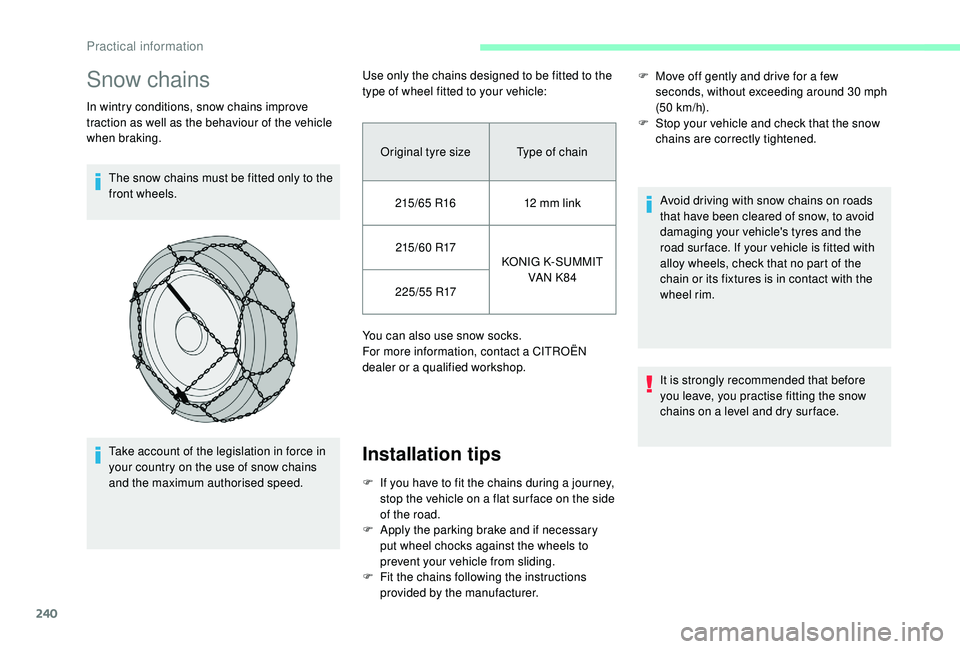
In wintry conditions, snow chains improve
traction as well as the behaviour of the vehicle
when braking.The snow chains must be fitted only to the
front wheels.
Take account of the legislation in force in
your country on the use of snow chains
and the maximum authorised speed. Use only the chains designed to be fitted to the
type of wheel fitted to your vehicle:
You can also use snow socks.
For more information, contact a CITROËN
dealer or a qualified workshop.
Installation tips
F Move off gently and drive for a few
seconds, without exceeding around 30 mph
(50
km/h).
F
S
top your vehicle and check that the snow
chains are correctly tightened.
Original tyre size Type of chain
215/65
R16 12
mm link
215/60
R17 KONIG K-SUMMIT
VA N K8 4
2 2 5 / 5 5
R17
F
I
f you have to fit the chains during a journey,
stop the vehicle on a flat sur face on the side
of the road.
F
A
pply the parking brake and if necessary
put wheel chocks against the wheels to
prevent your vehicle from sliding.
F
F
it the chains following the instructions
provided by the manufacturer. Avoid driving with snow chains on roads
that have been cleared of snow, to avoid
damaging your vehicle's tyres and the
road sur face. If your vehicle is fitted with
alloy wheels, check that no part of the
chain or its fixtures is in contact with the
wheel rim.
It is strongly recommended that before
you leave, you practise fitting the snow
chains on a level and dry sur face.
Practical information
Page 251 of 400
249
Passenger compartment filter
Refer to the manufacturer's
ser vice schedule for details of
the replacement inter val for this
component.
Depending on the environment (e.g. dusty
atmosphere) and the use of the vehicle
(e.g. city driving), replace it twice as often if
necessary .
A clogged passenger compartment
filter may have an adverse effect on
the per formance of the air conditioning
system and generate undesirable odours.
Oil filter
Change the oil filter each time the
engine oil is changed.
Refer to the manufacturer’s
ser vice schedule for details of
the replacement inter val for this
component.
Particle filter (Diesel)
The start of saturation of the particle
filter is indicated by the temporary
illumination of this warning lamp
accompanied by a message about
the risk of the filter clogging up. As soon as the traffic conditions permit,
regenerate the filter by driving at a speed
of at least 37
mph (60 km/h) until the
warning lamp goes off.
If the warning lamp stays on, this indicates
a low Diesel additive level.
For more information on Checking levels ,
refer to the corresponding section.
On a new vehicle, the first particle
filter regeneration operations may be
accompanied by a "burning" smell, which
is per fectly normal.
Following prolonged operation of the
vehicle at very low speed or at idle,
you may, in exceptional circumstances,
notice the emission of water vapour at the
exhaust on acceleration. This does not
affect the behaviour of the vehicle or the
environment.
Manual gearbox
The gearbox does not require any
maintenance (no oil change).
Automatic gearbox
The gearbox does not require any
maintenance (no oil change).
Electronic gearbox
The gearbox does not require any
maintenance (no oil change).
Parking brakeIf excessive travel or a loss of
effectiveness of this system is
noticed, the parking brake must
be checked, even between two
services.
Checking this system must be done by a
CITROËN dealer or a qualified workshop.
Brake padsBrake wear depends on the style
of driving, particularly in the case
of vehicles used in town, over short
distances. It may be necessary to
have the condition of the brakes
checked, even between vehicle
services.
Unless there is a leak in the circuit, a drop in
the brake fluid level indicates that the brake
pads are worn.
7
Practical information
Page 268 of 400

266
Removing a wheel
Parking the vehicle
Park the vehicle where it does not block
traffic: the ground must be level, stable
and non-slippery.
With a manual gearbox, engage first gear
then switch off the ignition to block the
wheels.
With an automatic gearbox, place the gear
selector to position P then switch off the
ignition to block the wheels.
With an electronic gearbox, place the gear
selector to position A then switch off the
ignition to block the wheels.
Apply the parking brake and check that
the warning lamp is on in the instrument
panel.
The passengers must get out of the
vehicle and wait where they are safe.
Never go underneath a vehicle raised
using a jack; use an axle stand.F
P
lace the foot of the jack on the ground and
ensure that it is directly below the A or B
jacking point provided on the underbody,
whichever is closest to the wheel to be
changed.
Do not use:
-
t
he jack for any other purpose than
lifting the vehicle,
-
a j
ack other than the one supplied by
the manufacturer.
F
I
f your vehicle has steel wheels, remove the
hub cap using tool 3 .
F
I
f your vehicle has alloy wheels, remove the
cap from each wheel bolt using tool 3 .
F
I
f your vehicle has security wheel bolts, fit
security bolt socket 4
to wheelbrace 1 to
slacken the security bolt.
F
S
lacken (without removing) the other wheel
bolts using just wheelbrace 1 .
In the event of a breakdown
Page 290 of 400

288
With a manual gearbox, move the gear
lever into neutral.
With an automatic or electronic gearbox,
place the gear selector into position N.
Failure to adhere to this specification
may lead to damage to braking system
components and the lack of braking
assistance on restarting the engine.
Towing your vehicle Towing another vehicle
F In the front bumper, slide a finger from the
centre of the cover plate to the upper corner
(as shown above) to unclip it.
F
S
crew the towing eye in fully, until it reaches
a stop. F
I
nstall the towbar.
F
S
witch on the hazard warning lamps on the
towed vehicle.
F
M
ove off gently and drive slowly over a
short distance only. General recommendations
Obser ve the legislation in force in your
c o u nt r y.
Ensure that the weight of the towing
vehicle is higher than that of the towed
vehicle.
The driver must remain at the wheel of
the towed vehicle and must have a valid
driving licence.
When towing a vehicle with all four
wheels on the ground, always use an
approved towing arm; rope and straps are
prohibited.
The towing vehicle must move off gently.
When the vehicle is towed with its engine
off, there is no longer braking and steering
assistance.
In the following cases, you must always
call on a professional recovery ser vice:
-
v
ehicle broken down on a motor way or
fast road,
-
f
our-wheel drive vehicle,
-
w
hen it is not possible to put the
gearbox into neutral, unlock the
steering, or release the parking brake,
-
t
owing with only two wheels on the
ground,
- w here there is no approved towing arm
available.
F
O
n the rear bumper, press the cover (as
shown above) to unclip it.
F
S
crew the towing eye in fully, until it reaches
a stop.
F
I
nstall the towbar.
F
S
witch on the hazard warning lamps on the
towed vehicle.
F M ove off gently and drive slowly over a
short distance only.
In the event of a breakdown