brakes CITROEN DISPATCH SPACETOURER DAG 2018 Handbook (in English)
[x] Cancel search | Manufacturer: CITROEN, Model Year: 2018, Model line: DISPATCH SPACETOURER DAG, Model: CITROEN DISPATCH SPACETOURER DAG 2018Pages: 400, PDF Size: 16.99 MB
Page 16 of 400
14
Warning/indicator lampStateCause Action/Observations
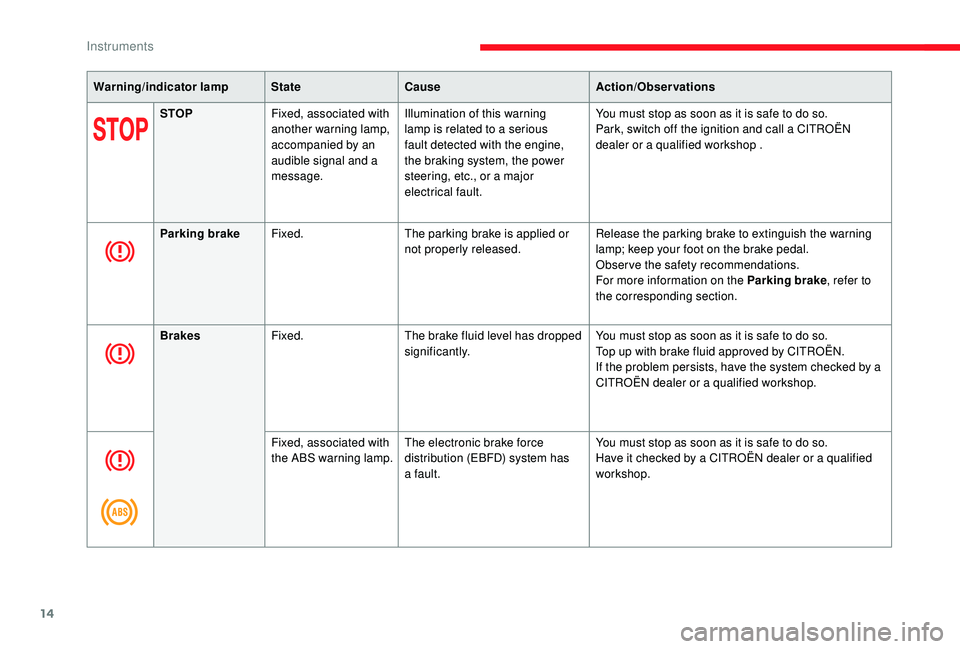
STOP Fixed, associated with
another warning lamp,
accompanied by an
audible signal and a
message. Illumination of this warning
lamp is related to a serious
fault detected with the engine,
the braking system, the power
steering, etc., or a major
electrical fault. You must stop as soon as it is safe to do so.
Park, switch off the ignition and call a CITROËN
dealer or a qualified workshop .
Parking brake Fixed. The parking brake is applied or
not properly released. Release the parking brake to extinguish the warning
lamp; keep your foot on the brake pedal.
Observe the safety recommendations.
For more information on the Parking brake
, refer to
the corresponding section.
Brakes Fixed. The brake fluid level has dropped
significantly. You must stop as soon as it is safe to do so.
Top up with brake fluid approved by CITROËN.
If the problem persists, have the system checked by a
CITROËN dealer or a qualified workshop.
Fixed, associated with
the ABS warning lamp. The electronic brake force
distribution (EBFD) system has
a fault. You must stop as soon as it is safe to do so.
Have it checked by a CITROËN dealer or a qualified
workshop.
Instruments
Page 21 of 400
19
Warning/indicator lampStateCause Action/Observations
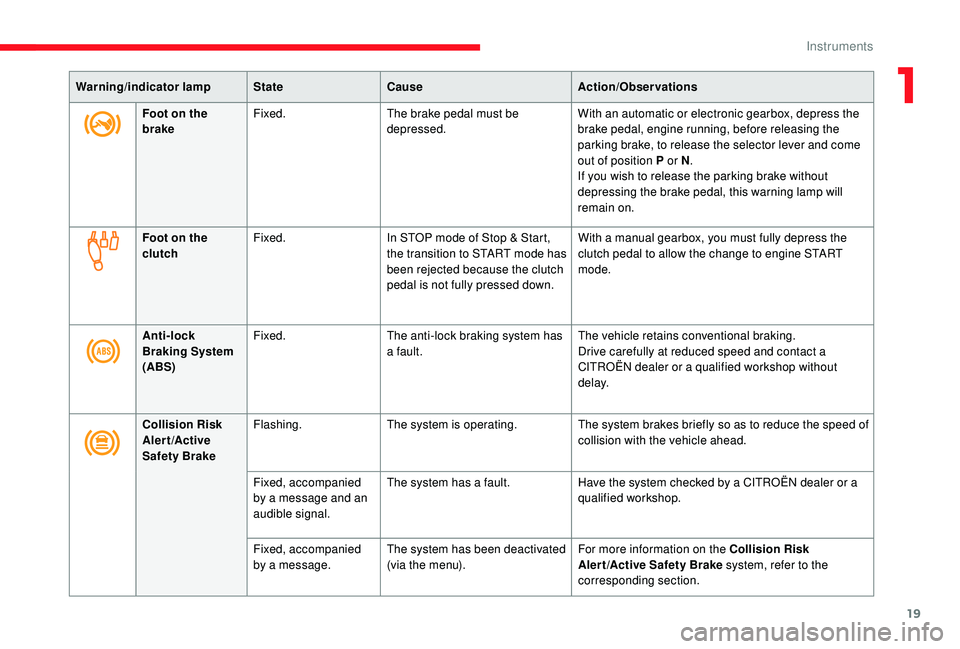
Foot on the
brake Fixed.
The brake pedal must be
depressed. With an automatic or electronic gearbox, depress the
brake pedal, engine running, before releasing the
parking brake, to release the selector lever and come
out of position P or N
.
If you wish to release the parking brake without
depressing the brake pedal, this warning lamp will
remain on.
Foot on the
clutch Fixed.
In STOP mode of Stop & Start,
the transition to START mode has
been rejected because the clutch
pedal is not fully pressed down. With a manual gearbox, you must fully depress the
clutch pedal to allow the change to engine START
mode.
Anti-lock
Braking System
(ABS) Fixed.
The anti-lock braking system has
a fault. The vehicle retains conventional braking.
Drive carefully at reduced speed and contact a
CITROËN dealer or a qualified workshop without
d e l ay.
Collision Risk
Alert/Active
Safety Brake Flashing.
The system is operating. The system brakes briefly so as to reduce the speed of
collision with the vehicle ahead.
Fixed, accompanied
by a message and an
audible signal. The system has a fault.
Have the system checked by a CITROËN dealer or a
qualified workshop.
Fixed, accompanied
by a message. The system has been deactivated
(via the menu). For more information on the Collision Risk
Aler t /Active Safety Brake system, refer to the
corresponding section.
1
Instruments
Page 145 of 400

143
Emergency braking assistance
(EBA)
In an emergency, this system permits the
optimum braking pressure to be reached
more quickly, therefore reducing the stopping
distance.
It is triggered in relation to the speed at which
the brake pedal is pressed. The effect of this is
a reduction in the resistance of the pedal and
an increase in braking efficiency.
Anti-slip regulation (ASR)
The ASR system (also known as Traction
Control) optimises traction in order to limit
wheel slip by acting on the brakes of the driving
wheels and on the engine. It also improves
the directional stability of the vehicle on
acceleration.
Dynamic stability control (DSC)
If there is a difference between the path
followed by the vehicle and that required by
the driver, the DSC monitors each wheel and
automatically acts on the brake of one or more
wheels and on the engine to return the vehicle
to the required path, within the limits of the laws
of physics.
Intelligent traction control
If your vehicle has this system, it features a
system to help driving on snow: intelligent
traction control.
This system detects situations of difficult
sur face grip that could make it difficult to move
off or make progress on deep fresh snow or
compacted snow.
In these situations, the intelligent traction
control limits the amount of wheel spin to
provide the best traction and trajectory control
for your vehicle.
The use of snow tyres is strongly
recommended on sur faces offering low
levels of grip.
Anti-lock braking system
(ABS) and electronic brake
force distribution (EBFD)
The fixed illumination of this warning
lamp indicates that there is a fault
with the ABS. If this warning lamp comes on, in
conjunction with the STOP
and
ABS warning lamps, an audible
signal and a message, it means
that the electronic brake force
distribution (EBFD) is defective.
You must stop as soon as it is
safe to do so.
In both cases, have the system
checked by a CITROËN dealer or
a qualified workshop as soon as
possible.
When changing wheels (tyres and rims),
ensure that these are approved for your
vehicle.
Normal operation of the ABS may make
itself felt by slight vibrations of the brake
pedal.
If you need to brake in an emergency,
press the brake pedal ver y firmly and
keep the pressure applied.
After an impact, have the system checked
by a CITROËN dealer or a qualified
workshop.
5
Safety
Page 146 of 400
144
Dynamic stability control (DSC)
and anti-slip regulation (ASR)
Activation
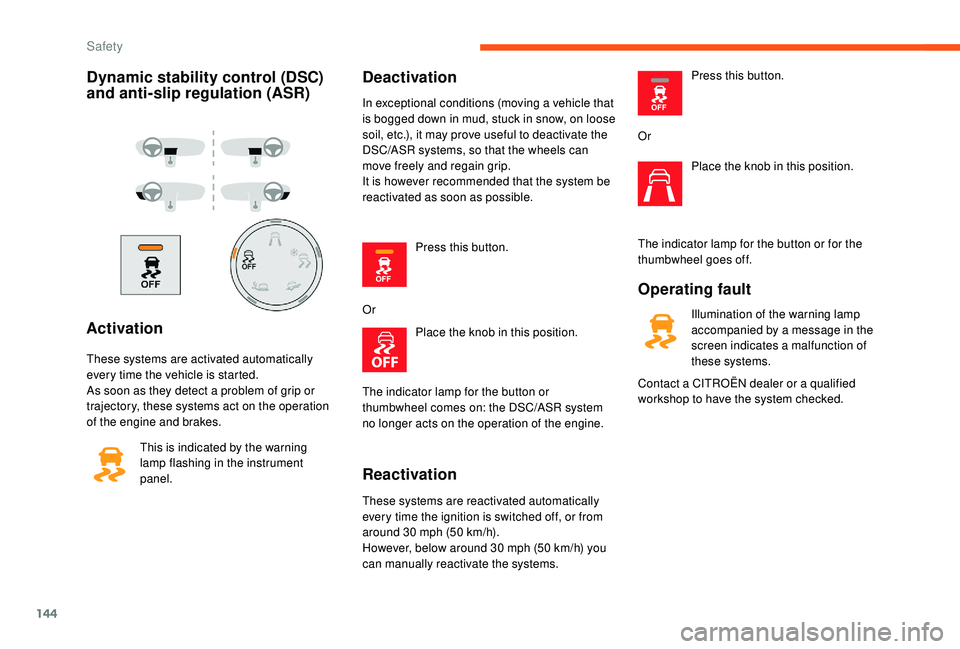
These systems are activated automatically
every time the vehicle is started.
As soon as they detect a problem of grip or
trajectory, these systems act on the operation
of the engine and brakes. This is indicated by the warning
lamp flashing in the instrument
panel.
Deactivation
In exceptional conditions (moving a vehicle that
is bogged down in mud, stuck in snow, on loose
soil, etc.), it may prove useful to deactivate the
DSC/ASR systems, so that the wheels can
move freely and regain grip.
It is however recommended that the system be
reactivated as soon as possible.
Press this button.
Or Place the knob in this position.
The indicator lamp for the button or
thumbwheel comes on: the DSC/ASR system
no longer acts on the operation of the engine.
Reactivation
These systems are reactivated automatically
every time the ignition is switched off, or from
around 30 mph (50 km/h).
However, below around 30
mph (50 km/h) you
can manually reactivate the systems. Press this button.
Or Place the knob in this position.
The indicator lamp for the button or for the
thumbwheel goes off.
Operating fault
Illumination of the warning lamp
accompanied by a message in the
screen indicates a malfunction of
these systems.
Contact a CITROËN dealer or a qualified
workshop to have the system checked.
Safety
Page 148 of 400
146
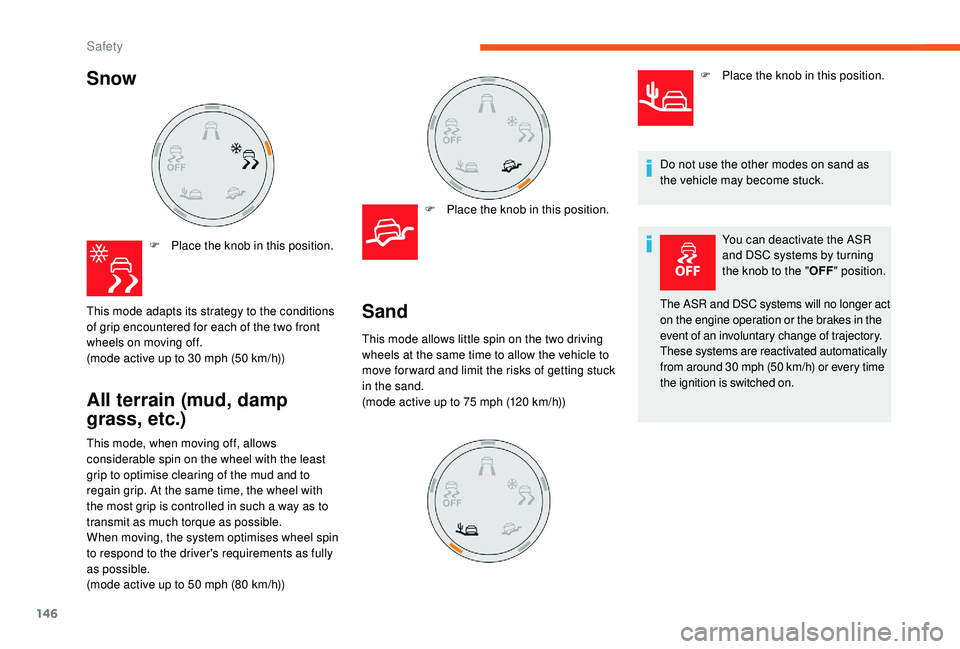
Snow
F Place the knob in this position.
All terrain (mud, damp
grass, etc.)
F Place the knob in this position.
This mode, when moving off, allows
considerable spin on the wheel with the least
grip to optimise clearing of the mud and to
regain grip. At the same time, the wheel with
the most grip is controlled in such a way as to
transmit as much torque as possible.
When moving, the system optimises wheel spin
to respond to the driver's requirements as fully
as possible.
(mode active up to 50
mph (80
km/h))
Sand
This mode allows little spin on the two driving
wheels at the same time to allow the vehicle to
move for ward and limit the risks of getting stuck
in the sand.
(mode active up to 75 mph (120 km/h))F
P
lace the knob in this position.
Do not use the other modes on sand as
the vehicle may become stuck. You can deactivate the ASR
and DSC systems by turning
the knob to the " OFF" position.
The ASR and DSC systems will no longer act
on the engine operation or the brakes in the
event of an involuntary change of trajectory.
These systems are reactivated automatically
from around 30 mph (50 km/h) or every time
the ignition is switched on.
This mode adapts its strategy to the conditions
of grip encountered for each of the two front
wheels on moving off.
(mode active up to 30 mph (50 km/h))
Safety
Page 181 of 400
179
Cooling
Towing a trailer on a slope increases the
temperature of the coolant.
As the fan is electrically controlled, its cooling
capacity is not dependent on the engine speed.
F
T
o lower the engine speed, reduce your
speed.
The maximum towable load on an incline
depends on the gradient and the exterior
temperature.
In all cases, keep a check on the coolant
temperature.
F
I
f this warning lamp and the
STOP warning lamp come on,
stop the vehicle and switch off
the engine as soon as possible.
New vehicle
Do not pull a trailer before having driven at
least around 600
miles (1,000 kilometres).
When the exterior temperature is high,
leaving the engine running for 1
to
2
minutes after stopping the vehicle to
allow it to cool is recommended.
Braking
Towing a trailer increases the braking distance.
To avoid overheating of the brakes, the use of
engine braking is recommended.
Ty r e s
F Check the tyre pressures of the towing vehicle and of the trailer, observing the
recommended pressures.
Lighting
F Check the electrical lighting and signalling on the trailer and the headlamp beam height
of your vehicle.
For more information on Headlamp
beam height adjustment , refer to the
corresponding section.
The rear parking sensors will be
deactivated automatically to avoid the
audible signal if a genuine CITROËN
towbar is used.
Starting/switching off
the engine, manual key,
remote control
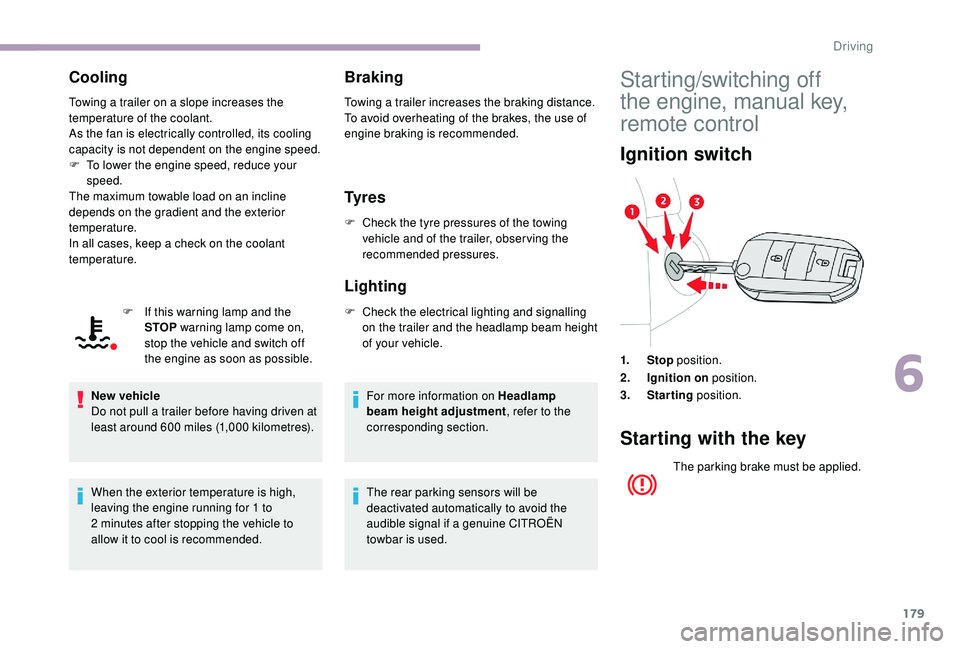
Ignition switch
1. Stop position.
2. Ignition on position.
3. Starting position.
Starting with the key
The parking brake must be applied.
6
Driving
Page 193 of 400

191
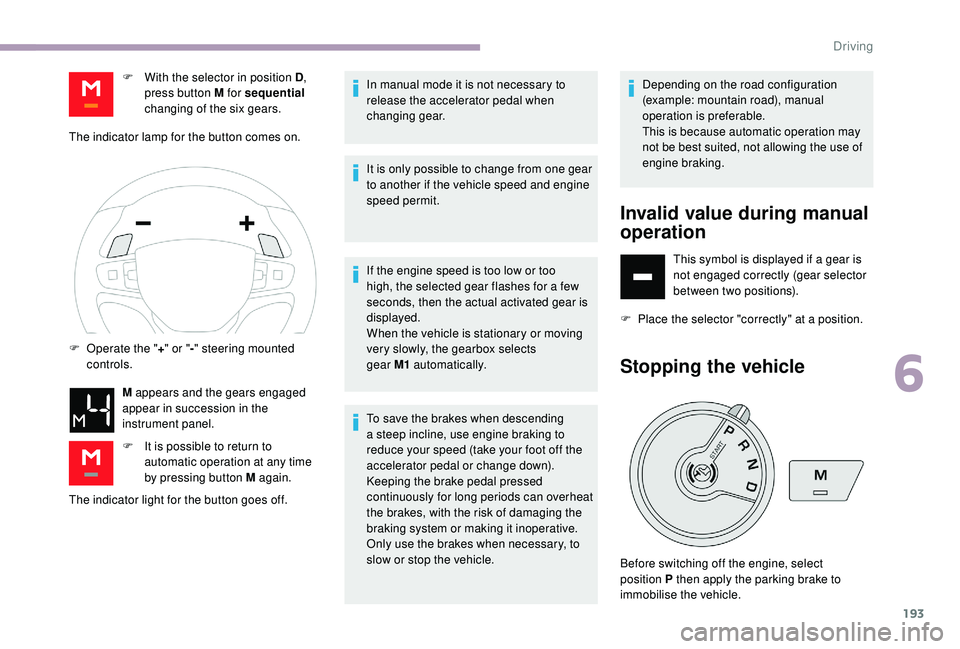
Display on the instrument panel
When you move the gear selector or press the
M button, the corresponding symbol appears in
the instrument panel.
P.Parking
R. Reverse
N. Neutral
D. Drive (automatic operation)
M. Manual
1
to 6. Gear engaged
- Invalid value
F
I
f the message " Foot on the
brake " is displayed in the
instrument panel, press the
brake pedal firmly.
Starting the vehicle
F Start the engine.
If the conditions are not met, there is an audible
signal, accompanied by a message on the
instrument panel screen.
F
R
elease the parking brake.
F
Sel
ect position R , N or D.
If you have to move off on a steep slope
with a loaded vehicle, depress the brake
pedal , select position D , release the
parking brake, then release the brake
pedal.
F
P
rogressively release the brake pedal.
The vehicle moves off immediately. If P is displayed on the instrument panel
but the selector is in another position,
place the selector in position P to allow
the engine to be started.
If position N is selected inadvertently while
driving, allow the engine to return to idle,
then select position D to accelerate.
If position R
, D or M is selected when the
engine is running at idle, with the brakes
released, the vehicle moves even without
the accelerator being depressed.
Never leave children in the vehicle
unsupervised.
As a safety measure, never leave the
vehicle without taking your key or remote
control with you, even for a short time.
When carrying out maintenance with the
engine running, apply the parking brake
and select position P .
If your vehicle has an automatic gearbox,
never try to start the engine by pushing
the vehicle.
F
W
ith your foot on the brake,
select position P .
6
Driving
Page 195 of 400
193
The indicator light for the button goes off.In manual mode it is not necessary to
release the accelerator pedal when
changing gear.
It is only possible to change from one gear
to another if the vehicle speed and engine
speed permit.
If the engine speed is too low or too
high, the selected gear flashes for a few
seconds, then the actual activated gear is
displayed.
When the vehicle is stationary or moving
very slowly, the gearbox selects
gear M1
automatically.
To save the brakes when descending
a steep incline, use engine braking to
reduce your speed (take your foot off the
accelerator pedal or change down).
Keeping the brake pedal pressed
continuously for long periods can overheat
the brakes, with the risk of damaging the
braking system or making it inoperative.
Only use the brakes when necessary, to
slow or stop the vehicle. Depending on the road configuration
(example: mountain road), manual
operation is preferable.
This is because automatic operation may
not be best suited, not allowing the use of
engine braking.
Invalid value during manual
operation
This symbol is displayed if a gear is
not engaged correctly (gear selector
between two positions).
F
P
lace the selector "correctly" at a position.
Stopping the vehicle
F With the selector in position D ,
press button M for sequential
changing of the six gears.
The indicator lamp for the button comes on.
F
O
perate the " +" or " -" steering mounted
controls.
M appears and the gears engaged
appear in succession in the
instrument panel.
F
I
t is possible to return to
automatic operation at any time
by pressing button M again.
Before switching off the engine, select
position P then apply the parking brake to
immobilise the vehicle.
6
Driving
Page 221 of 400
219
The adaptive cruise control operates by
day and night, in fog or moderate rainfall.
The system does not act on the braking
system, but works only with engine
braking.
The regulation range is limited: there will
no longer be any adjustment of speed if
the difference between the programmed
speed setting and the speed of the vehicle
in front becomes too high.
If the difference between the programmed
speed setting and the speed of the
vehicle in front is too great, the speed
cannot be adjusted: the cruise control is
automatically deactivated.Collision Risk Alert and
Active Safety Brake
Conditions for operation
The Collision Risk Alert system only operates:
- w ith a vehicle pointing in the same direction,
moving or stationary,
-
w
ith pedestrians,
-
a
bove 4 mph (7 km/h) (and deactivates at
3
mph (5 km/h)).
The Active Safety Brake system only operates:
-
b
etween 3 and 87 mph (5 and 140 km/h), in
the case of a moving vehicle,
-
a
t a speed below 50 mph (80 km/h), in the
case of a stationary vehicle,
-
a
t a speed below 37 mph (60 km/h), in the
case of a pedestrian,
-
i
f the passenger seat belts are fastened,
-
i
f the vehicle is not accelerating sharply,
-
i
f the vehicle is not in a tight corner.
The Active Safety Brake system does not
operate:
-
i
f the front bumper is damaged,
-
i
f the system has been triggered in the last
10
seconds,
-
i
f the electronic stability control system has
a fault.
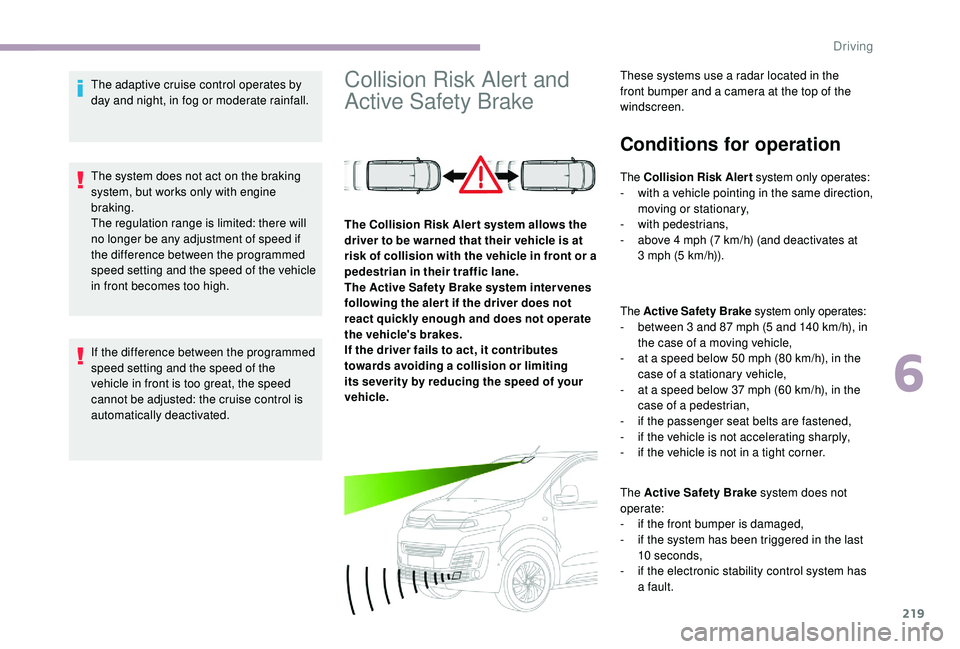
The Collision Risk Aler t system allows the
driver to be warned that their vehicle is at
risk of collision with the vehicle in front or a
pedestrian in their traffic lane.
The Active Safety Brake system inter venes
following the aler t if the driver does not
react quickly enough and does not operate
the vehicle's brakes.
If the driver fails to act, it contributes
towards avoiding a collision or limiting
its severity by reducing the speed of your
vehicle.
These systems use a radar located in the
front bumper and a camera at the top of the
windscreen.
6
Driving
Page 251 of 400
249
Passenger compartment filter
Refer to the manufacturer's
ser vice schedule for details of
the replacement inter val for this
component.
Depending on the environment (e.g. dusty
atmosphere) and the use of the vehicle
(e.g. city driving), replace it twice as often if
necessary .
A clogged passenger compartment
filter may have an adverse effect on
the per formance of the air conditioning
system and generate undesirable odours.
Oil filter
Change the oil filter each time the
engine oil is changed.
Refer to the manufacturer’s
ser vice schedule for details of
the replacement inter val for this
component.
Particle filter (Diesel)
The start of saturation of the particle
filter is indicated by the temporary
illumination of this warning lamp
accompanied by a message about
the risk of the filter clogging up. As soon as the traffic conditions permit,
regenerate the filter by driving at a speed
of at least 37
mph (60 km/h) until the
warning lamp goes off.
If the warning lamp stays on, this indicates
a low Diesel additive level.
For more information on Checking levels ,
refer to the corresponding section.
On a new vehicle, the first particle
filter regeneration operations may be
accompanied by a "burning" smell, which
is per fectly normal.
Following prolonged operation of the
vehicle at very low speed or at idle,
you may, in exceptional circumstances,
notice the emission of water vapour at the
exhaust on acceleration. This does not
affect the behaviour of the vehicle or the
environment.
Manual gearbox
The gearbox does not require any
maintenance (no oil change).
Automatic gearbox
The gearbox does not require any
maintenance (no oil change).
Electronic gearbox
The gearbox does not require any
maintenance (no oil change).
Parking brakeIf excessive travel or a loss of
effectiveness of this system is
noticed, the parking brake must
be checked, even between two
services.
Checking this system must be done by a
CITROËN dealer or a qualified workshop.
Brake padsBrake wear depends on the style
of driving, particularly in the case
of vehicles used in town, over short
distances. It may be necessary to
have the condition of the brakes
checked, even between vehicle
services.
Unless there is a leak in the circuit, a drop in
the brake fluid level indicates that the brake
pads are worn.
7
Practical information