bonnet Citroen DS3 2014 1.G Owner's Manual
[x] Cancel search | Manufacturer: CITROEN, Model Year: 2014, Model line: DS3, Model: Citroen DS3 2014 1.GPages: 376, PDF Size: 12.55 MB
Page 41 of 376
39
DS3_en_Chap01_controle-de-marche_ed01-2014
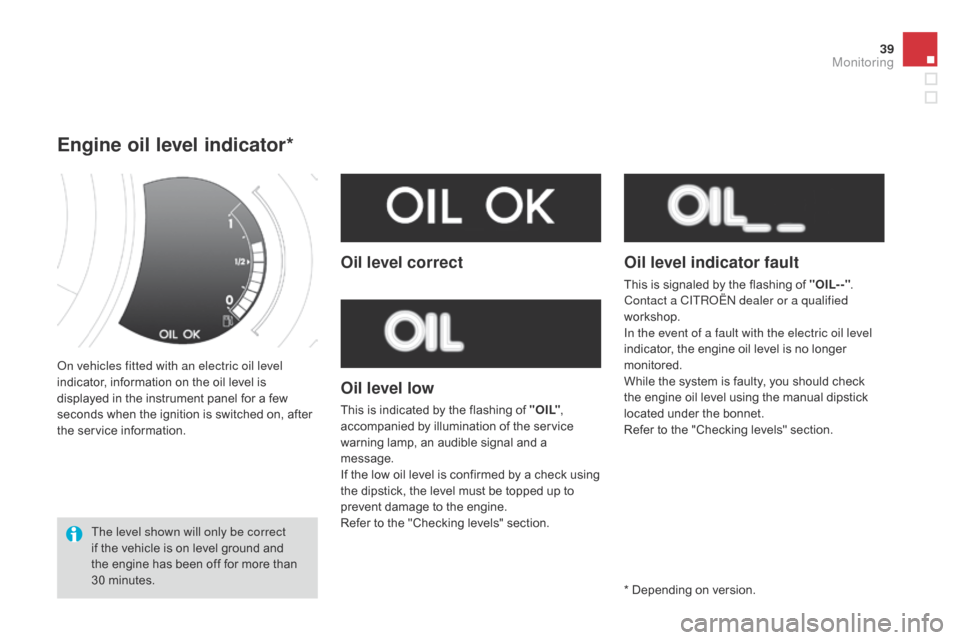
on vehicles fitted with an electric oil level
indicator, information on the oil level is
d
isplayed in the instrument panel for a few
s
econds when the ignition is switched on, after
t
he service information.
Engine oil level indicator*
The level shown will only be correct
if the vehicle is on level ground and
t
he engine has been off for more than
3
0 minutes.
Oil level correct
Oil level low
This is indicated by the flashing of " O I L" ,
a ccompanied by illumination of the service
w
arning lamp, an audible signal and a
m
essage.
If
the low oil level is confirmed by a check using
t
he dipstick, the level must be topped up to
p
revent damage to the engine.
Refer
to the "Checking levels" section.
Oil level indicator fault
This is signaled by the flashing of "OIL- -".
C ontact a CITRoË N dealer or a qualified
workshop.
In the event of a fault with the electric oil level
indicator,
the engine oil level is no longer
mon
itored.
While
the system is faulty, you should check
t
he engine oil level using the manual dipstick
l
ocated under the bonnet.
Refer
to the "Checking levels" section.
*
Depending on version.
Monitoring
Page 140 of 376
DS3_en_Chap07_visibilite_ed01-2014
Travelling abroad
LEd / Xenon front lamps
For motoring in countries that drive on the other s
ide of the road, it is necessary to adapt the
adjustment
of the dipped beams so as to not
d
azzle the drivers of approaching vehicles.
F
R
aise the bonnet for access to the adjuster
(
one adjuster per headlamp).
F
I
nsert a suitable allen key (not supplied)
i
nto the hexagonal head of the adjuster.
F
T
urn the allen key half a turn clockwise.
Headlamp adjustment
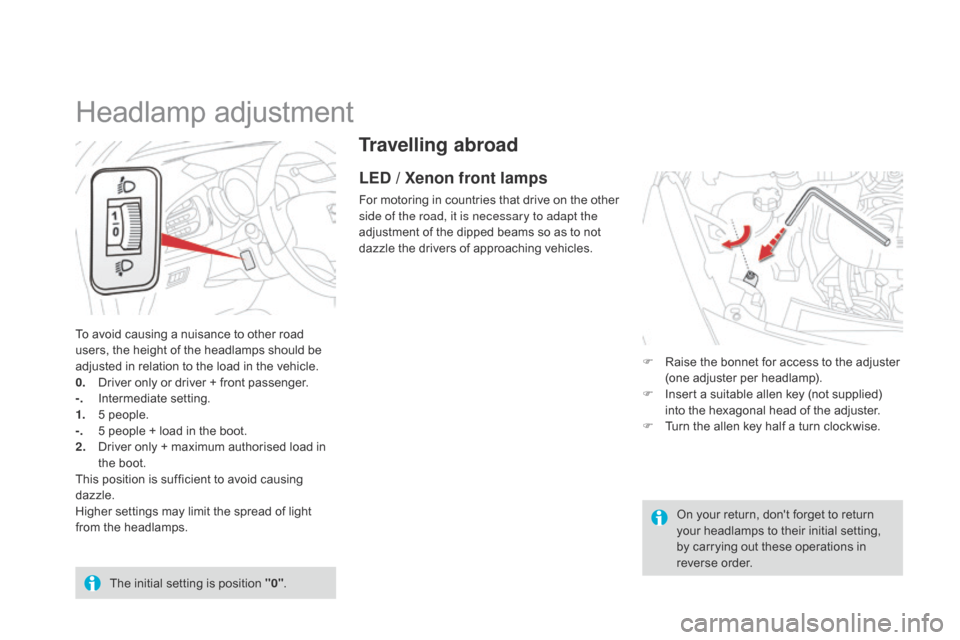
To avoid causing a nuisance to other road u
sers, the height of the headlamps should be
a
djusted in relation to the load in the vehicle.
0.
D
river only or driver + front passenger.
-.
I
ntermediate
s
etting.
1.
5
people.
-.
5
people + load in the boot.
2.
D
river only + maximum authorised load in
t
he boot.
This
position is sufficient to avoid causing
d
azzle.
Higher
settings may limit the spread of light
f
rom the headlamps.
The
initial setting is position "0". On
your return, don't forget to return
y
our headlamps to their initial setting,
b
y carrying out these operations in
r
everse
o
rder.
Page 144 of 376
DS3_en_Chap07_visibilite_ed01-2014
Operating fault
If an automatic wiping fault occurs, the wipers will operate in intermittent mode.
Have
it checked by a CITROËN dealer or a
q
ualified
w
orkshop. To retain the effectiveness of the flat
wiper
blades, it is advisable to:
-
h
andle them with care,
-
c
lean them regularly using soapy
w
ater,
-
n
ot use them to hold a sheet of
c
ardboard against the windscreen,
-
r
eplace them at the first signs of
w
e a r.
Do
not cover the rain sensor, linked
w
ith the sunshine sensor and located in
the centre of the windscreen behind the
rear
view mirror.
Switch
off the automatic wiping when
u
sing an automatic car wash.
In winter, it is advisable to wait until the
windscreen
is completely clear of ice
b
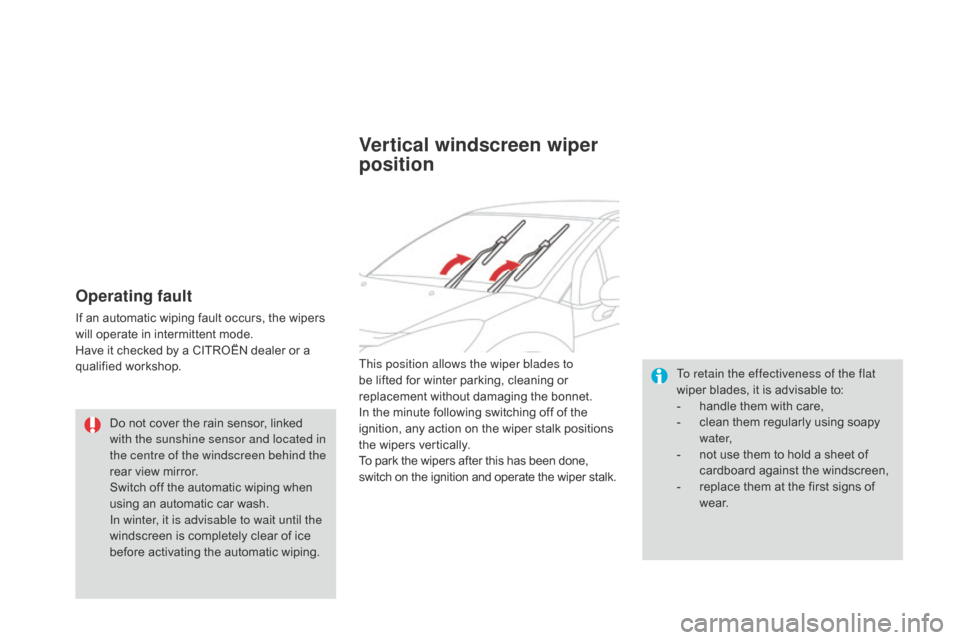
efore activating the automatic wiping.This position allows the wiper blades to
be
lifted for winter parking, cleaning or
r
eplacement without damaging the bonnet.
In
the minute following switching off of the
i
gnition, any action on the wiper stalk positions
t
he wipers vertically.
To
park the wipers after this has been done,
s
witch on the ignition and operate the wiper stalk.
Vertical windscreen wiper
position
Page 161 of 376
159
DS3_en_Chap08_securite_ed01-2014
Operating limits
The system only detects vehicles that are stationary or moving in the same direction as
y
our vehicle.
It
does not detect small vehicles
(
bicycles, motorcycles), pedestrians or
a
nimals, nor non-reflective stationary
ob
jects. In difficult weather conditions (very
heavy
rain, snow, fog, hail...), braking
d
istances increase, which can reduce
the
ability of the system to avoid a
c
ollision.
The
driver must therefore remain
par
ticularly
v
igilant.
Never
leave accumulations of snow or
a
ny object projecting above the bonnet
o
r in front of the roof: this might fall into
t
he field of vision of the sensor and
generate
a detection.
The
system is not triggered or is interrupted if t
he d river:
-
a
ccelerates strongly
-
o
r turns the steering wheel suddenly
(
avoiding
m
anoeuvre).
Safety
Page 195 of 376
193
DS3_en_Chap10_info-pratiques_ed01-2014
Running out of fuel (Diesel)If your vehicle is fitted with an HDI engine, the fuel system must be primed if you run out of fuel.
T his system consists of a priming pump and a transparent pipe under the bonnet.
F
F
ill the fuel tank with at least five litres of
D
iesel.
F
O
pen the bonnet.
F
D
epending on version, unclip the cover to
g
ain access to the priming pump.
F
S
queeze and release the priming pump
u
ntil resistance is felt (could be from the
f
irst application) and fuel appears in the
transparent
pipe with the green connector.
F
O
perate the starter until the engine starts.
F
D
epending on version, put the cover back
i
n position and clip it in place.
F
C
lose the bonnet.
BlueHdi 100 engines
F Fill the fuel tank with at least five litres of D
iesel.
F
S
witch on the ignition (without starting the
e
ngine).
F
W
ait around 6 seconds and switch off the
ignition.
F
R
epeat the operation 10 times.
F
O
perate the starter to run the engine.
If
the
engine
does
not
start
at
the
first
a
ttempt,
do
not
try
again.
Operate
the
priming
pump
again,
then
t
he
starter.
Practical information
Page 233 of 376
231
DS3_en_Chap10_info-pratiques_ed01-2014
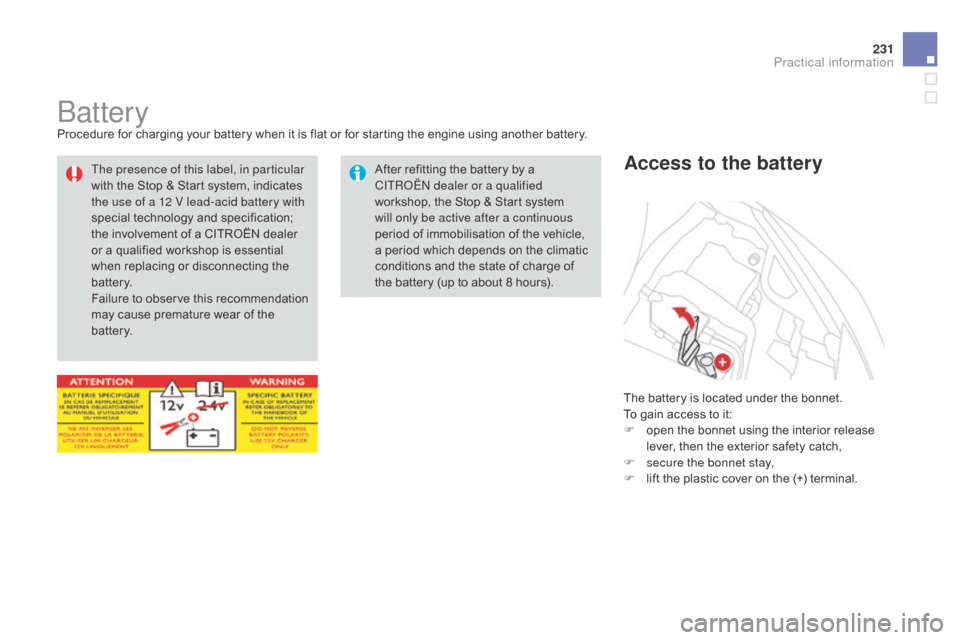
batteryProcedure for charging your battery when it is flat or for starting the engine using another battery.T he battery is located under the bonnet.
To
gain access to it:
F
o
pen the bonnet using the interior release
l
ever, then the exterior safety catch,
F
s
ecure the bonnet stay,
F
l
ift the plastic cover on the (+) terminal.
Access to the batteryAfter refitting the battery by a CITRoË N dealer or a qualified
workshop,
the Stop & Start system
w
ill only be active after a continuous
period
of immobilisation of the vehicle,
a
period which depends on the climatic
c
onditions and the state of charge of
t
he battery (up to about 8 hours).
The presence of this label, in particular
with
the
Stop
&
Start
system,
indicates
t
he use of a 12 V lead-acid battery with
special
t
echnology
a
nd
s
pecification;
t
he
involvement
of
a
CITROËN
dealer
o
r
a
qualified
workshop
is
essential
w
hen
replacing
or
disconnecting
the
b
attery.
Failure
t
o
o
bserve
t
his
r
ecommendation
m
ay
cause
premature
wear
of
the
b
attery.
Practical information
Page 237 of 376
235
DS3_en_Chap10_info-pratiques_ed01-2014
Changing a front or rear wiper bladeProcedure for replacing a worn wiper blade with a new one without the use of tools.
Before removing a front
wiper blade
F Within one minute after switching off the i
gnition, operate the wiper stalk to position
t
he wiper blades in the vertical position.
This
position must be used in order to avoid
d
amaging the wiper blade and the bonnet.
Removal
F Raise the corresponding wiper arm.
F U nclip the wiper blade and remove it.
Fitting
F At the front, check the size of the wiper b
lade as the shorter blade is fitted to the
passenger
side of the vehicle.
F
P
ut the corresponding new wiper blade in
p
lace and clip it.
F
F
old down the wiper arm carefully.
After fitting a front wiper
blade
F Switch on the ignition.
F O perate the wiper stalk again to park the
w
iper blades.
Load reduction modeSystem which manages the use of certain functions according to the level of charge
r
emaining in the battery.
When
the vehicle is being driven, the load
r
eduction function temporarily deactivates
c
ertain functions, such as the air conditioning,
t
he heated rear screen...
The deactivated functions are reactivated
automatically
as soon as conditions permit.
Practical information
Page 249 of 376
247
DS3_en_Chap11_verifications_ed01-2014
bonnetProtects the components of the engine and provides access for checking levels.
Opening
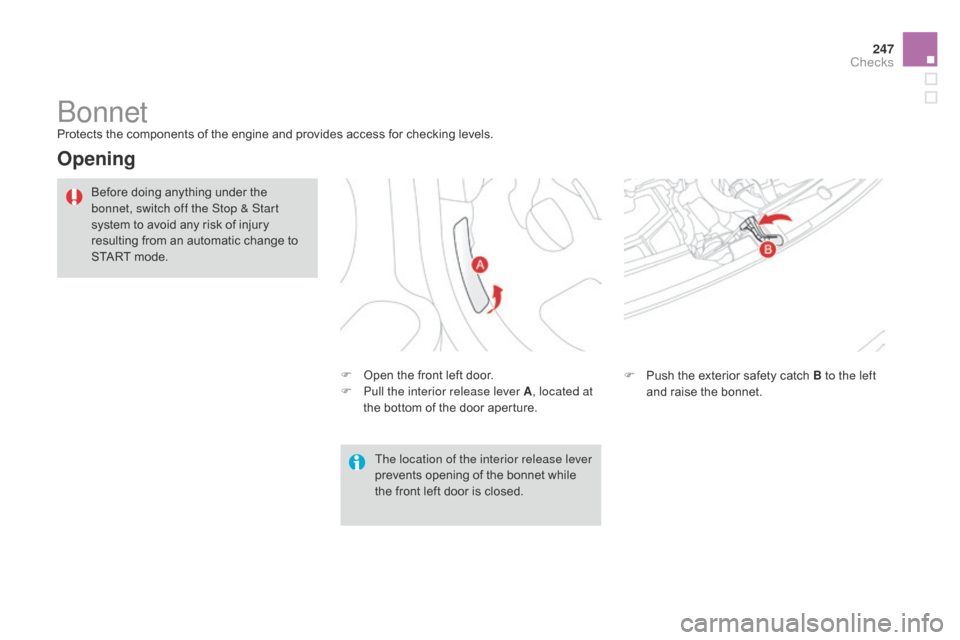
F Open the front left door.
F P ull the interior release lever A , located at
the
bottom of the door aperture.F
P ush the exterior safety catch B to the left
and
raise the bonnet.
Before
doing
anything
under
the
b
onnet, switch off the Stop & Start
system
to
avoid
any
risk
of
injury
r
esulting
from
an
automatic
change
to
S
TART
mode.
The location of the interior release lever
prevents opening of the bonnet while
t
he front left door is closed.
checks
Page 250 of 376
DS3_en_Chap11_verifications_ed01-2014
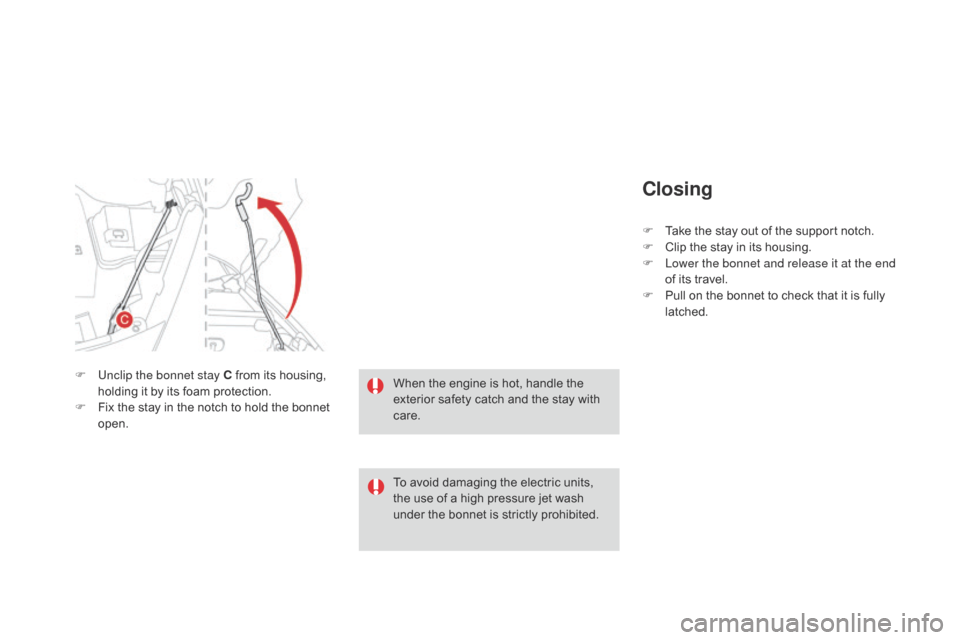
closing
F Take the stay out of the support notch.
F C lip the stay in its housing.
F
L
ower the bonnet and release it at the end
of
its travel.
F
P
ull on the bonnet to check that it is fully
l
atched.
F
U
nclip the bonnet stay
c
from
its
housing,
h
olding
it
by
its
foam
protection.
F
F
ix
the
stay
in
the
notch
to
hold
the
bonnet
ope
n. When
the
engine
is
hot,
handle
the
e
xterior
safety
catch
and
the
stay
with
c
are.
To
avoid
damaging
the
electric
units,
t
he
use
of
a
high
pressure
jet
wash
u
nder
the
bonnet
is
strictly
prohibited.
Page 276 of 376
DS3_en_Chap12_caracteristiques_ed01-2014
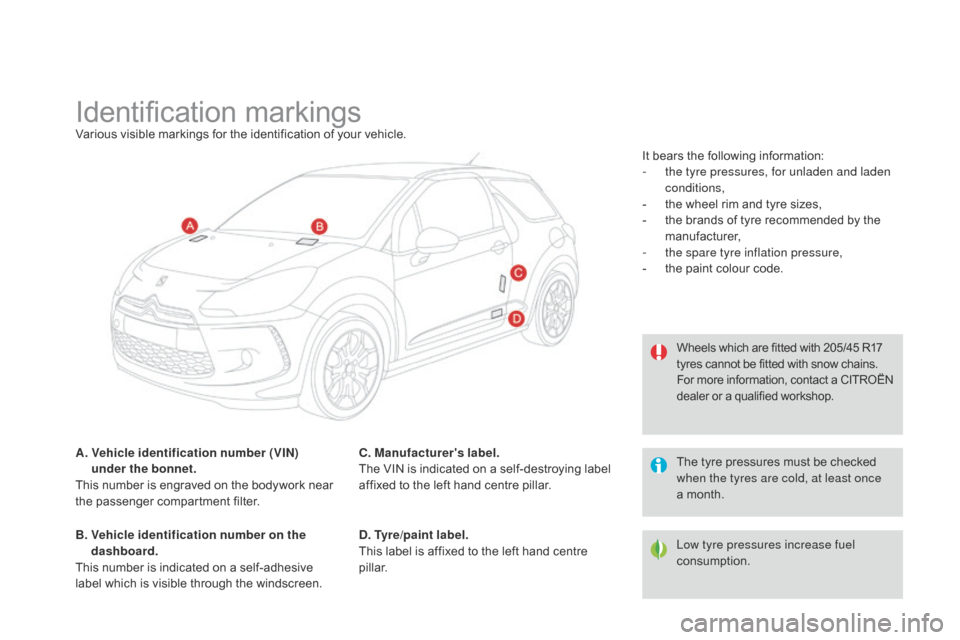
Identification markingsVarious visible markings for the identification of your vehicle.
A .
V
ehicle identification number (VIN)
under the bonnet.
This
number is engraved on the bodywork near
t
he
p
assenger
c
ompartment
f
ilter.
B.
V
ehicle identification number on the
dashboard.
This
number is indicated on a self-adhesive
l
abel which is visible through the windscreen.
d. T
yre/paint label.
This
label is affixed to the left hand centre
pillar. Wheels
which are fitted with 205/45 R17
t
yres cannot be fitted with snow chains.
F
or more information, contact a CITROËN
d
ealer or a qualified workshop.
Low tyre pressures increase fuel
consumption. The
tyre pressures must be checked
w
hen the tyres are cold, at least once
a
month.
c. M
anufacturer's label.
The
VIN is indicated on a self-destroying label
a
ffixed to the left hand centre pillar.It
bears the following information:
-
t
he tyre pressures, for unladen and laden
conditions,
-
t
he wheel rim and tyre sizes,
-
t
he brands of tyre recommended by the
ma
nufacturer,
-
t
he spare tyre inflation pressure,
-
t
he paint colour code.