eco Citroen DS3 2014 1.G Owner's Manual
[x] Cancel search | Manufacturer: CITROEN, Model Year: 2014, Model line: DS3, Model: Citroen DS3 2014 1.GPages: 376, PDF Size: 12.55 MB
Page 3 of 376
DS3_en_Chap00a_sommaire_ed01-2014
CITRoËN has a presence on every continent,
a complete product range,
bringing
together technology and a permanent spirit of innovation,
for
a modern and creative approach to mobility.
We
thank you and congratulate you on your choice.
Reading the detailed sections is essential to make the most of your vehicle, in complete
s
afety.
Your
vehicle is fitted with only some of the
e
quipment described in this document,
d
epending on the trim level, version and the
s
pecifications for the country in which it is sold.
The
fitting of electrical equipment or
a
ccessories which are not recommended
b
y CITROËN may result in a failure of
y
our vehicle's electronic system. Contact
a
CITROËN dealer for information on the
r
ecommended equipment and accessories.
at the wheel of your new vehicle,
getting to know each system,
each
control, each setting,
makes
your trips, your journeys
more
comfortable and more enjoyable.
Happy motoring!
We draw your attention to the following...
Page 7 of 376
DS3_en_Chap00a_sommaire_ed01-2014
cHEcKS
PR A
cT
IcA
L
INFORMATION TEcH
NIcA L dA TAAUdI O ANd
T ELEMATI
c
S
190 Fuel tank
192 M isfuel prevention (Diesel)
193
R
unning out of fuel (Diesel)
194
a
d
blu
e
® additive and SCR
system
(BlueHDi Diesel)
202
T
emporary puncture repair
k
it
207
C
hanging a wheel
214
S
now chains
215
C
hanging
a bu
lb
224
C
hanging
a f
use
231
b
at
tery
234
E
nergy
economy mode
235
C
hanging a wiper blade
236
T
owing
the vehicle
238
T
owing
a trailer
240
a
d
vice on care and
maintenance
242
ac
cessories 247
bo
nnet
249
Pe
trol engines
250 D iesel eng ines
251 C hecking levels
255
C
hecks 260
Pe
trol engines
263
Pe
trol weights
266 LP G e ngine
267 L PG weights
268
D
iesel
eng
ines
270
D
iesel
eng
ines
272
D
imensions
2 74
I
dentification
ma
rkings279
E
mergency or assistance
281
eMyWay
335 A udio system
0120130100 11
Page 10 of 376
DS3_en_Chap00b_vue-ensemble_ed01-2014
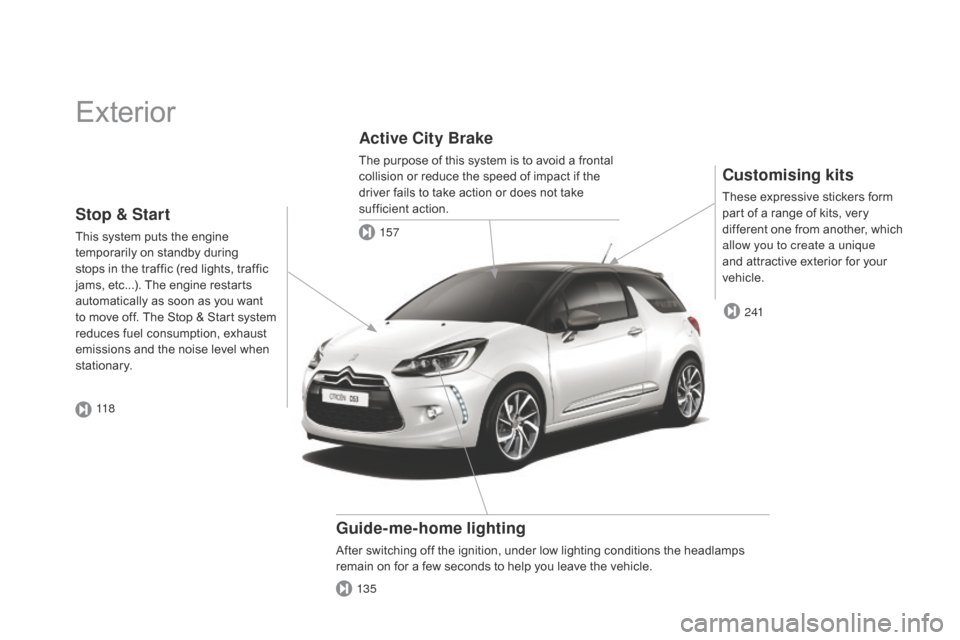
Exterior
customising kits
These expressive stickers form part of a range of kits, very
d
ifferent one from another, which
a
llow you to create a unique
and
attractive exterior for your
v
ehicle.
Guide-me-home lighting
After switching off the ignition, under low lighting conditions the headlamps remain on for a few seconds to help you leave the vehicle.
Active city Brake
The purpose of this system is to avoid a frontal collision or reduce the speed of impact if the
d
river fails to take action or does not take
s
ufficient action.
2 41
13 5 157
Stop & Start
This system puts the engine t
emporarily on standby during
s
tops in the traffic (red lights, traffic
j
ams, etc...). The engine restarts
a
utomatically as soon as you want
t
o move off. The Stop & Start system
r
educes fuel consumption, exhaust
e
missions and the noise level when
s
tationary. 118
Page 16 of 376
DS3_en_Chap00c_eco-conduite_ed01-2014
Before moving off, if the passenger compartment is too warm, ventilate it by opening the windows and air vents before using the air conditioning.
Above
30 mph (50 km/h), close the windows and leave the air vents
ope
n.
Remember
to make use of equipment that can help keep the
t
emperature in the passenger compartment down (sunroof and window
b
linds...).
Switch
off the air conditioning, unless it has automatic regulation, as
s
oon as the desired temperature is attained.
Switch
off the demisting and defrosting controls, if not automatic.
Switch
off the heated seat as soon as possible.
Switch
off the headlamps and front foglamps when the level of light
d
oes not require their use.
Avoid
running the engine before moving off, particularly in winter; your
v
ehicle will warm up much faster while driving.
Eco-driving
Eco-driving is a range of everyday practices that allow the motorist to optimise their fuel consumption and CO2 emissions.
Optimise the use of your gearbox
With a manual gearbox, move off gently and change up without waiting. During acceleration change up early.
With
an automatic or electronic gearbox, give preference to automatic
m
ode and avoid pressing the accelerator pedal heavily or suddenly.
The
gear shift indicator invites you engage the most suitable gear: as
s
oon as the indication is displayed in the instrument panel, follow it
s
traight away.
For
vehicles fitted with an electronic or automatic gearbox, this
i
ndicator appears only in manual mode.
drive smoothly
Maintain a safe distance between vehicles, use engine braking rather than the brake pedal, and press the accelerator progressively. These
p
ractices contribute towards a reduction in fuel consumption and CO
2
emissions
and
also
helps
reduce
the
background
traffic
noise.
control the use of your electrical
equipment
If your vehicle has cruise control, make use of the system at speeds a bove 25 mph (40 km/h) when the traffic is flowing well.As
a passenger, if you avoid connecting your multimedia devices
(
film, music, video game...), you will contribute towards limiting the c
onsumption of electrical energy, and so of fuel.
Disconnect your portable devices before leaving the vehicle.
Page 17 of 376
15
DS3_en_Chap00c_eco-conduite_ed01-2014
Limit the causes of excess consumption
Spread loads throughout the vehicle; place the heaviest items in the bottom of the boot, as close as possible to the rear seats.
Limit
the loads carried in the vehicle and reduce wind resistance (roof
b
ars, roof rack, bicycle carrier, trailer...). Use a roof box in preference.
Remove
roof bars and roof racks after use.
At
the end of winter, remove snow tyres and refit your summer tyres.
Observe the recommendations on
maintenance
Check the tyre pressures regularly, when cold, referring to the label in the door aperture, driver's side.
Carry
out this check in particular:
-
b
efore a long journey,
-
a
t each change of season,
-
a
fter a long period out of use.
Don't
forget the spare wheel and the tyres on any trailer or caravan.
Have
your vehicle serviced regularly (engine oil, oil filter, air filter,
p
assenger compartment filter...) and observe the schedule of
o
perations recommended in the maintenance and warranty guide.
With
a Blue HDi Diesel engine, if the SCR system is faulty your vehicle
b
ecomes polluting; go to a CITROËN dealer or a qualified workshop
w
ithout delay to have the emissions of nitrous oxides brought back to
t
he legal level.
When
refuelling, do not continue after the third cut-off of the nozzle to
a
void any over flow.
At
the wheel of your new vehicle, it is only after the first 1 800 miles
(3
000 kilometres) that you will see the fuel consumption settle down to
a
consistent average.
Eco-driving
Page 20 of 376
DS3_en_Chap01_controle-de-marche_ed01-2014
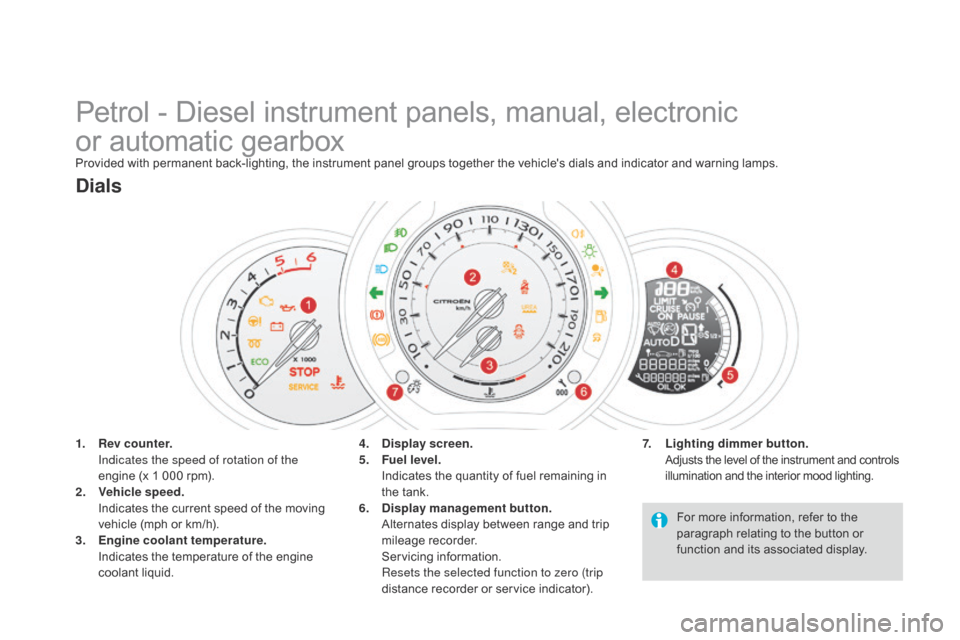
Petrol - Diesel instrument panels, manual, electronic
o r automatic gearbox
Provided with permanent back-lighting, the instrument panel groups together the vehicle's dials and indicator and warning lamps.
1.
R
ev counter.
I
ndicates the speed of rotation of the
engine
(x 1 000 rpm).
2.
V
ehicle speed.
I
ndicates the current speed of the moving
v
ehicle (mph or km/h).
3.
E
ngine coolant temperature.
I
ndicates the temperature of the engine
c
oolant
li
quid.
dials
7. Lighting dimmer button. Adjusts the level of the instrument and controls i
llumination and the interior mood lighting.4. display screen.
5. F uel level.
I
ndicates the quantity of fuel remaining in
t
he tank.
6.
di
splay management button.
A
lternates display between range and trip
mil
eage
re
corder.
S
ervicing
in
formation.
R
esets the selected function to zero (trip
distance
recorder or service indicator).For
more information, refer to the
p
aragraph relating to the button or
f
unction and its associated display.
Page 21 of 376
19
DS3_en_Chap01_controle-de-marche_ed01-2014
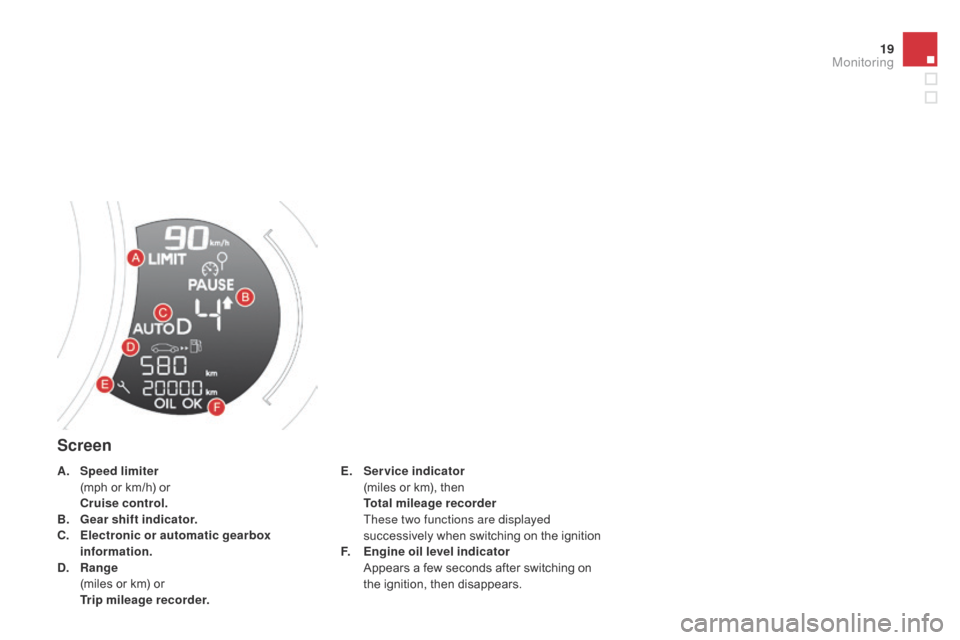
Screen
E. Service indicator (
miles or km), then
T
otal mileage recorder
T
hese two functions are displayed
successively
when switching on the ignition
F.
E
ngine oil level indicator
A
ppears a few seconds after switching on
t
he ignition, then disappears.
A. S
peed limiter
(
mph
or
km/h)
or
cr
uise control.
B.
G
ear shift indicator.
c
.
E
lectronic or automatic gearbox
information.
d
.
R
ange
(
miles
or
km)
or
T
rip mileage recorder.
Monitoring
Page 22 of 376
DS3_en_Chap01_controle-de-marche_ed01-2014
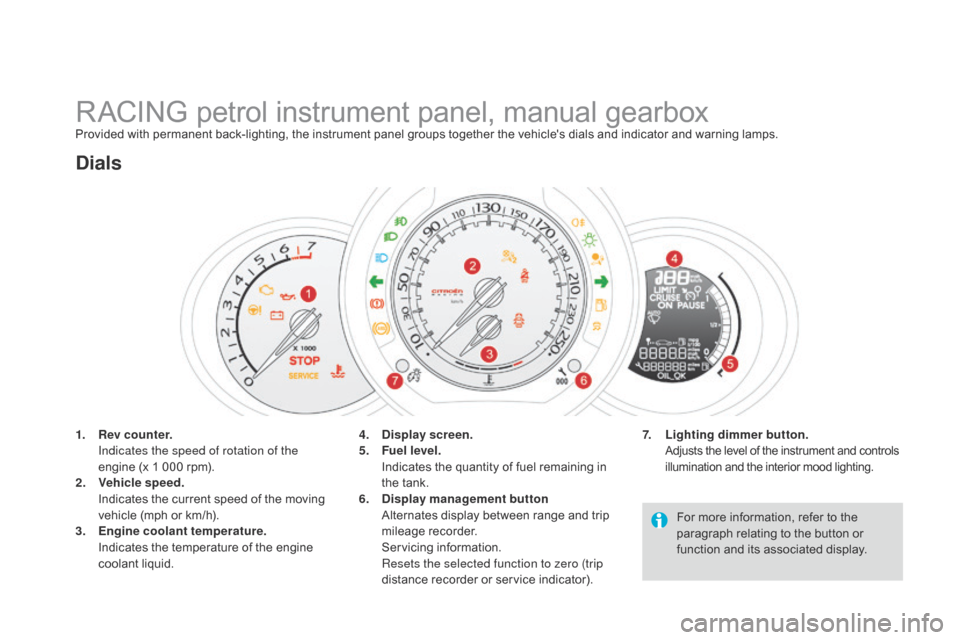
RACING petrol instrument panel, manual gearboxProvided with permanent back-lighting, the instrument panel groups together the vehicle's dials and indicator and warning lamps.
1.
R
ev counter.
I
ndicates the speed of rotation of the
engine
(x 1 000 rpm).
2.
V
ehicle speed.
I
ndicates the current speed of the moving
v
ehicle (mph or km/h).
3.
E
ngine coolant temperature.
I
ndicates the temperature of the engine
c
oolant
li
quid.
dials
7. Lighting dimmer button. Adjusts the level of the instrument and controls i
llumination and the interior mood lighting.4. display screen.
5. F uel level.
I
ndicates the quantity of fuel remaining in
t
he tank.
6.
di
splay management button
A
lternates display between range and trip
mil
eage
re
corder.
S
ervicing
in
formation.
R
esets the selected function to zero (trip
distance
recorder or service indicator).For
more information, refer to the
p
aragraph relating to the button or
f
unction and its associated display.
Page 23 of 376
21
DS3_en_Chap01_controle-de-marche_ed01-2014
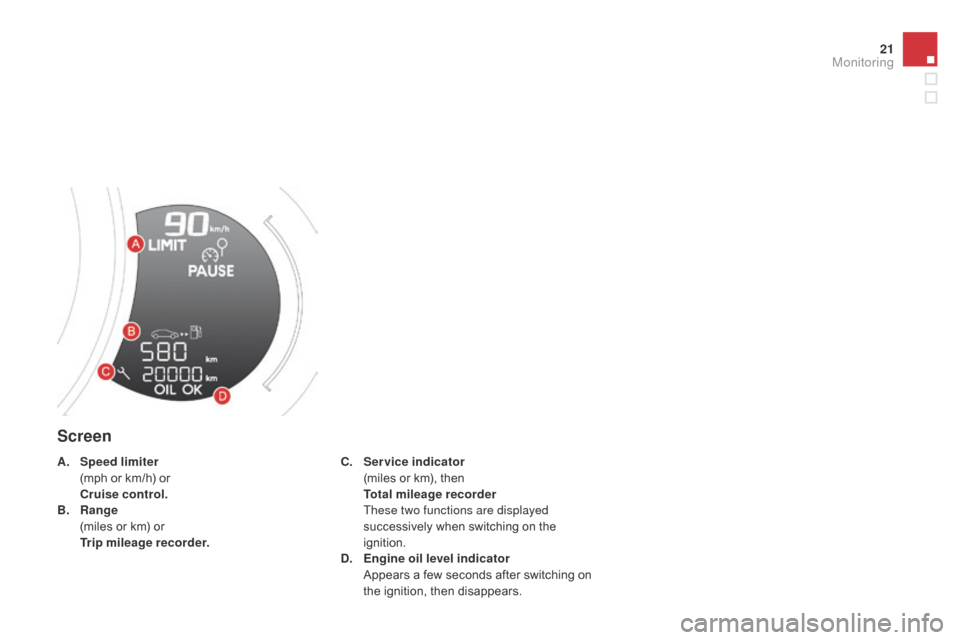
Screen
c. Service indicator (
miles or km), then
T
otal mileage recorder
These two functions are displayed
successively
when switching on the
ig
nition.
d. Engine oil level indicator A
ppears a few seconds after switching on
t
he ignition, then disappears.
A.
S
peed limiter
(
mph
or
km/h)
or
cr
uise control.
B.
R
ange
(
miles
or
km)
or
T
rip mileage recorder.
Monitoring
Page 24 of 376
DS3_en_Chap01_controle-de-marche_ed01-2014
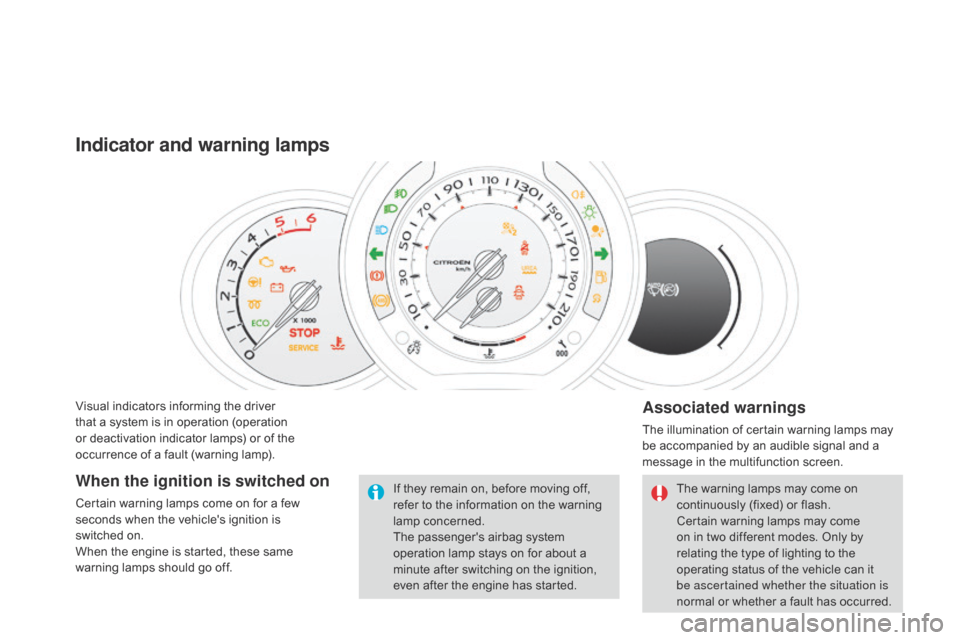
Visual indicators informing the driver that a system is in operation (operation
o
r deactivation indicator lamps) or of the
o
ccurrence of a fault (warning lamp).
Indicator and warning lamps
Associated warnings
The illumination of certain warning lamps may be accompanied by an audible signal and a
m
essage in the multifunction screen.
The
warning lamps may come on
c
ontinuously (fixed) or flash.
Certain
warning lamps may come
o
n in two different modes. Only by
r
elating the type of lighting to the
o
perating status of the vehicle can it
b
e ascertained whether the situation is
normal
or whether a fault has occurred.
If
they
remain
on,
before
moving
off,
r
efer
to
the
information
on
the
warning
lam
p
c
oncerned.
The
passenger's
airbag
system
o
peration
lamp
stays
on
for
about
a
m
inute
after
switching
on
the
ignition,
e
ven
after
the
engine
has
started.
When the ignition is switched on
Certain warning lamps come on for a few s econds when the vehicle's ignition is
switched
on.
When
the engine is started, these same
w
arning lamps should go off.