head Citroen DS3 2016 1.G User Guide
[x] Cancel search | Manufacturer: CITROEN, Model Year: 2016, Model line: DS3, Model: Citroen DS3 2016 1.GPages: 412, PDF Size: 12.7 MB
Page 139 of 412

137
DS3_en_Chap05_visibilite_ed02-2015
The temporary illumination of the dipped beam
headlamps after t he v ehicle's i gnition h as b een sw
itched
o
ff
m
akes
t
he
d
river's
e
xit
e
asier
wh
en
t
he
l
ight
i
s
p
oor.
Switching on
F With the ignition o ff, " flash" t he h eadlamps us
ing t he l ighting s talk.
F
A fu
rther "headlamp flash" switches the
function
o
ff.
Switching off
The manual guide-me-home lighting switches off a utomatically a fter a s et t ime.
Manual guide-me-home
lighting
The sidelamps and dipped beam headlamps
are switched on automatically, without any
action on the part of the driver, when a low level
of
e
xternal
l
ight
i
s
d
etected
o
r
i
n
c
ertain
c
ases
of a
ctivation
o
f
t
he
w
indscreen
w
ipers.
As
s
oon
a
s
t
he
b
rightness
r
eturns
t
o
a
n
ad
equate level or after the windscreen wipers
are switched off, these lamps are switched off
automatically
a
nd
t
he
d
aytime
r
unning
l
amps
co
me
o
n.
Automatic illumination of
headlamps
Activation
F Turn ring t o t he "A UTO" p osition. T he ac
tivation of the function is confirmed by
the
d
isplay
o
f
a m
essage.
Deactivation
F Turn ring to a p osition o ther t han "A UTO". Th
e deactivation of the function is
confirmed
b
y
t
he
d
isplay
o
f
a m
essage.
Operating fault
In the event of a fault with the
sunshine sensor, t he l ighting c ome on
,
t
his
w
arning
l
amp
i
s
d
isplayed
on t
he
i
nstrument
p
anel
a
nd/or
a me
ssage
a
ppears
i
n
t
he
s
creen,
ac
companied
b
y
a
n
a
udible
s
ignal.
Contact
a C
ITROËN
o
r
a q
ualified
w
orkshop
wo
rkshop.
Visibility
Page 140 of 412

DS3_en_Chap05_visibilite_ed02-2015
LED daytime running lampsThis daytime lighting, a signature of the vehicle, comprises t wo s ets o f l ight-emitting d iodes (L
EDs),
l
ocated
i
n
v
ertical
h
ousings
b
elow
e
ach
he
adlamp.
On
s
tarting
t
he
v
ehicle,
i
n
d
aylight
t
he
d
aytime
ru
nning
l
amps
c
ome
o
n
a
utomatically,
i
f
t
he
li
ghting
s
talk
i
s
i
n
p
osition
"
0" or "AUTO" .
If the sidelamps and headlamps are switched
on manually or automatically, the daytime
running
l
amps
g
o
o
ff.
In
f
og
o
r
s
now,
t
he
s
unshine
s
ensor
ma
y
d
etect
s
ufficient
l
ight.
T
herefore,
th
e
l
ighting
w
ill
n
ot
c
ome
o
n
auto
matically.
Do not cover the sunshine sensor,
coupled with the rain sensor and
located in the centre of the windscreen
behind
t
he
r
ear
v
iew
m
irror;
t
he
as
sociated
f
unctions
w
ould
n
o
l
onger
be con
trolled.
Automatic
guide-me-home
lighting
When the automatic illumination of headlamps
functions i
s a ctivated, i f t he a mbient l ight l evel is l
ow the dipped beam headlamps remain on
when
s
witching
o
ff
t
he
i
gnition.
Settings
Activation and deactivation, as well as the
duration of t he g uide-me-home l ighting c an be s
et
i
n
t
he
v
ehicle
c
onfiguration
o
r
s
ettings
me
nu
(
except
f
or
t
he
m
onochrome
s
creen
A
,
fo
r
w
hich
t
he
d
uration
i
s
f
ixed
a
t
6
0
s
econds).
Page 141 of 412

139
DS3_en_Chap05_visibilite_ed02-2015
Travelling abroad
LED / Xenon front lamps
For motoring in countries that drive on the other side o f t he r oad, i t i s n ecessary t o a djust t he di
pped beams so as to not dazzle the drivers of
approaching
ve
hicles.
F
Ra
ise
t
he
b
onnet
f
or
a
ccess
t
o
t
he
a
djuster
(o
ne
a
djuster
p
er
h
eadlamp).
F
In
sert
a s
uitable
a
llen
k
ey
(
not
s
upplied)
in
to
t
he
h
exagonal
h
ead
o
f
t
he
a
djuster.
F
Tu
rn
t
he
a
llen
k
ey
h
alf
a t
urn
c
lockwise.
Headlamp height adjustment
To avoid causing a nuisance to other road users, t he h eight o f t he h eadlamps s hould b e ad
justed
i
n
r
elation
t
o
t
he
l
oad
i
n
t
he
v
ehicle.
0.
Dr
iver
o
nly
o
r
d
river
+ f
ront
p
assenger.
-.
In
termediate
se
tting
1.
5 p
eople.
-.
5 p
eople
+ l
oad
i
n
t
he
b
oot.
2.
Dr
iver
o
nly
+ m
aximum
a
uthorised
l
oad
i
n
th
e
b
oot.
This
p
osition
i
s
s
ufficient
t
o
a
void
c
ausing
da
zzle.
Higher
s
ettings
m
ay
l
imit
t
he
s
pread
o
f
l
ight
fr
om
t
he
h
eadlamps.
The
i
nitial
s
etting
i
s
p
osition
"
0". On
y
our
r
eturn,
d
on't
f
orget
t
o
ad
just
y
our
h
eadlamps
b
ack
t
o
t
heir
in
itial
s
etting,
b
y
c
arrying
o
ut
t
hese
op
erations
i
n
r
everse
o
rder.
Visibility
Page 159 of 412

157
DS3_en_Chap06_securite_ed02-2015
Active City Brake
Active City Brake is a driving assistance system that aims to avoid a frontal collision
or reduce the speed of an impact if the driver
does
n
ot
r
eact
s
ufficiently
(
inadequate
b
rake
appl
ication).This
s
ystem
i
s
d
esigned
t
o
i
mprove
dr
iving
s
afety.
It
r
emains
t
he
d
river's
r
esponsibility
t
o
co
ntinuously monitor the state of the
traffic and to assess the distances and
relative
s
peeds
o
f
o
ther
v
ehicles.
Active
C
ity
B
rake
c
an
i
n
n
o
ci
rcumstances replace the need for
vigilance
o
n
t
he
p
art
o
f
t
he
d
river.
Never
l
ook
a
t
t
he
l
aser
s
ensor
t
hrough
an op
tical
ins
trument
(m
agnifying
gla
ss,
mi
croscope...)
a
t
a d
istance
o
f
l
ess
t
han
10 c
entimetres:
r
isk
o
f
e
ye
i
njury.Automatic
b
raking
o
ccurs
l
ater
t
han
i
f
do
ne by the driver, so as to intervene
only
w
hen
t
here
i
s
a h
igh
r
isk
o
f
col
lision.Principle
Using a laser sensor located at the top of the windscreen, this system detects a vehicle
running
i
n
t
he
s
ame
d
irection
o
r
s
tationary
ah
ead
o
f
y
our
v
ehicle.
When
n
ecessary,
t
he
v
ehicle's
b
raking
s
ystem
is o
perated automatically to avoid a collision
with
t
he
v
ehicle
a
head.
Conditions for activation
Active City Brake only operates if the following conditions a re m et:
●
ig
nition
o
n,
●
th
e
v
ehicle
i
s
i
n
a f
or ward
g
ear,
●
sp
eed
i
s
b
etween
a
bout
3 a
nd
1
8
m
ph
(
5
a
nd
3
0
k
m/h),
●
th
e
b
raking
a
ssistance
s
ystems
(
ABS,
EB
FD,
e
mergency
b
raking
a
ssistance)
a
re
no
t faulty,
●
th
e
t
rajectory
c
ontrol
s
ystems
(
ASR,
D
SC)
ar
e not deactivated or faulty,
●
th
e
v
ehicle
i
s
n
ot
i
n
a t
ight
c
orner,
●
th
e
s
ystem
h
as
n
ot
b
een
t
riggered
d
uring
th
e
p
revious
1
0
s
econds.
Safety
Page 160 of 412
DS3_en_Chap06_securite_ed02-2015
Operation
When your vehicle is too close to or
approaches the v ehicle a head t oo q uickly t he sy
stem
a
utomatically
a
pplies
t
he
b
rakes
t
o
av
oid
a c
ollision.
The collision can be avoided automatically if the
difference in speed between your vehicle and the
vehicle
a
head
d
oes
n
ot
e
xceed
9 m
ph
(
15
k
m/h).
Above this threshold, the system will do what
is possible to avoid or reduce the accident by
lowering
t
he
s
peed
o
f
i
mpact.
The
a
utomatic
b
raking
m
ay
b
ring
t
he
v
ehicle
t
o
a c
omplete
s
top
i
f
t
he
s
ituation
r
equires
i
t.
In this case, the vehicle is held stationary
temporarily
(
for
a
bout
1
.5
s
econds)
t
o
a
llow
th
e
d
river
t
o
t
ake
b
ack
c
ontrol
b
y
p
ressing
t
he
bra
ke
peda
l.
You are then alerted by the display of a
message.
The
b
rake
l
amps
o
n
y
our
v
ehicle
c
ome
o
n
t
o
wa
rn
o
ther
r
oad
u
sers.
After an impact, the system is
automatically
p
ut
o
ut
o
f
s
ervice:
i
t
n
o
longe
r
opera
tes.
You
m
ust
g
o
t
o
a C
ITROËN
d
ealer
o
r
a qu
alified
w
orkshop
t
o
h
ave
t
he
s
ystem
ma
de
o
perational
a
gain.
During
a
utomatic
b
raking,
t
he
d
river
ca
n
a
lways
o
btain
a h
igher
r
ate
o
f
de
celeration than that controlled by the
system,
b
y
p
ressing
f
irmly
o
n
t
he
b
rake
peda
l.
The t
riggering o f t he s ystem m ay c ause th
e
e
ngine
t
o
s
tall,
u
nless
t
he
d
river
de
presses
t
he
c
lutch
p
edal
q
uickly
en
ough
d
uring
a
utomatic
b
raking.
Deactivation
The system is deactivated in the vehicle
configuration menu, a ccessible w ith t he i gnition o n.
Its
s
tate
i
s
m
emorised
w
hen
t
he
i
gnition
i
s
sw
itched off.
When the system is deactivated, a
message i s d isplayed e very t ime t he ig
nition
i
s
s
witched
o
n,
t
o
w
arn
y
ou.
Page 171 of 412

169
DS3_en_Chap06_securite_ed02-2015
Advice
Front airbags
Do not drive holding the steering wheel by its spokes o r r esting y our h ands o n t he c entre pa
rt
o
f
t
he
w
heel.
Passengers
m
ust
n
ot
p
lace
t
heir
f
eet
o
n
t
he
dashb
oard.
Do
n
ot
s
moke
a
s
d
eployment
o
f
t
he
a
irbags
ca
n
c
ause
b
urns
o
r
t
he
r
isk
o
f
i
njury
f
rom
a ci
garette
o
r
p
ipe.
Never
r
emove
o
r
p
ierce
t
he
s
teering
w
heel
o
r
hi
t
i
t
v
iolently.
Do
n
ot
f
it
o
r
a
ttach
a
nything
t
o
t
he
s
teering
wh
eel
o
r
d
ashboard,
t
his
c
ould
c
ause
i
njuries
wi
th
d
eployment
o
f
t
he
a
irbags.
Lateral airbags
Use only approved covers on the seats,
compatible with the deployment the lateral
airbags.
F
or
i
nformation
o
n
t
he
r
ange
o
f
se
at covers suitable for your vehicle, you
can
c
ontact
a C
ITROËN dealer.
For more information on accessories, refer
to
t
he
c
orresponding
s
ection.
Do
n
ot
f
ix
o
r
a
ttach
a
nything
t
o
t
he
s
eat
ba
cks
(
clothing...).
T
his
c
ould
c
ause
i
njury
to t
he
c
hest
o
r
a
rms
i
f
t
he
l
ateral
a
irbag
i
s
de
ployed.
Do not sit with the upper part of the body
any
n
earer
t
o
t
he
d
oor
t
han
n
ecessary.
Curtain airbags
Do not fix or attach anything to the roof. This c ould c ause i njury t o t he h ead i f t he cu
rtain
a
irbag
i
s
d
eployed.
If fitted on your vehicle, do not remove the
grab
h
andles
i
nstalled
o
n
t
he
r
oof,
t
hey
p
lay
a p
art
i
n
s
ecuring
t
he
c
urtain
a
irbags.
Sit
i
n
a n
ormal
u
pright
p
osition.
Wear
a c
orrectly
a
djusted
s
eat
b
elt.
Do
no
t
le
ave
an
ything
be
tween
th
e
oc
cupants
an
d
t
he
a
irbags
(
a
c
hild,
p
et,
o
bject...),
n
or
fi
x
o
r
a
ttach
a
nything
c
lose
t
o
t
he
i
nflation
tr
ajectory
o
f
t
he
a
irbags;
t
his
c
ould
c
ause
in
juries
d
uring
t
heir
d
eployment.
Never
m
odify
t
he
o
riginal
d
efinition
o
f
y
our
ve
hicle, particularly in the area directly
around
t
he
a
irbags.
After an accident or if the vehicle has been
stolen
o
r
b
roken
i
nto,
h
ave
t
he
a
irbag
sy
stems
c
hecked.
All
w
ork
o
n
t
he
a
irbag
s
ystem
m
ust
b
e
ca
rried out by a CITROËN dealer or a
qualified
wo
rkshop.
Even if all of the precautions mentioned
are
o
bserved,
a r
isk
o
f
i
njury
o
r
o
f
m
inor
bu
rns to the head, chest or arms when an
airbag i
s d
eployed c
annot b
e r
uled o
ut. Th
e
b
ag
i
nflates
a
lmost
i
nstantly
(
within
a f
ew milliseconds)
t
hen
d
eflates
w
ithin
th
e
s
ame
t
ime
d
ischarging
t
he
h
ot
g
as
v
ia
op
enings
p
rovided
f
or
t
his
p
urpose.
For the airbags to be fully effective, observe the safety recommendations below:
Safety
Page 182 of 412
DS3_en_Chap07_securite-enfants_ed02-2015
(a) Universal child s eat: c hild s eat t hat c an b e in
stalled i n a ll v ehicles u sing a s eat b elt.
(b )
Gr
oup
0
:
f
rom
b
irth
t
o
1
0
k
g.
S
hells
s
eats
an
d baby carriers cannot be installed in the
front
pa
ssenger
seat
.
(c )
Co
nsult
t
he
l
egislation
i
n
f
orce
i
n
y
our
co
untry
b
efore
i
nstalling
y
our
c
hild
o
n
t
his
seat
.
(d)
To i
nstall a child seat on a rear seat,
rear ward
o
r
f
or ward
f
acing,
m
ove
t
he
f
ront
se
at
f
or ward,
t
hen
s
traighten
t
he
b
ackrest
to a
llow
e
nough
r
oom
f
or
t
he
c
hild
s
eat
a
nd
th
e
c
hild's
l
egs.
(e)
Wh
en
a r
ear ward
f
acing
c
hild
s
eat
i
s
in
stalled
o
n
t
he
f
ront
p
assenger
s
eat,
th
e
p
assenger's
f
ront
a
irbag
m
ust
b
e
de
activated.
O
ther wise
t
he
c
hild
w
ould
r
isk
be
ing
s
eriously
d
amaged
o
r
k
illed
d
uring
de
ployment
o
f
t
he
a
irbag.
W
hen
a f
or ward
fa
cing
c
hild
s
eat
i
s
i
nstalled
o
n
t
he
f
ront
pa
ssenger
seat
,
the pa
ssenger's
fr
ont
ai
rbag
m
ust
r
emain
a
ctive.
(f )
A c
hild
s
eat
w
ith
s
upport
l
eg
m
ust
n
ever
b
e
in
stalled
on the cen
tre
rea
r
pa
ssenger
seat
. Remove and stow the head restraint
before
i
nstalling
a c
hild
s
eat
w
ith
a ba
ckrest
o
n
a p
assenger
s
eat.
R
efit
t
he
he
ad restraint once the child seat has
been
r
emoved.
U: Se
at suitable for the installation of a
child s eat s ecured u sing a s eat b elt a nd un
iversally
a
pproved,
r
ear ward
f
acing
a
nd/or
for
ward
fa
cing.
U(R):
as f
or U,
w
ith
t
he
p
assenger
s
eat
ad
justed
t
o
i
ts
h
ighest
p
osition
a
nd
i
n
t
he
int
ermediate
lo
ngitudinal
po
sition.
Page 183 of 412
181
DS3_en_Chap07_securite-enfants_ed02-2015
Advice on child seats
The incorrect installation of a child seat in a
vehicle compromises t he c hild's p rotection in t
he
e
vent
o
f
a
n
a
ccident.
Check
t
hat
t
here
i
s
n
o
s
eat
b
elt
o
r
s
eat
b
elt
bu
ckle
u
nder
t
he
c
hild
s
eat
a
s
t
his
c
ould
des
tabilise
it
.
Remember to fasten the seat belts or the
child seat harness keeping the slack in
relation
t
o
t
he
c
hild's
b
ody
t
o a minimum,
even
f
or
s
hort
j
ourneys.
To
i
nstall
a c
hild
s
eat
u
sing
t
he
v
ehicle's
se
at belt, ensure that the belt is well
tightened
o
n
t
he
c
hild
s
eat
a
nd
t
hat
i
t
h
olds
th
e
c
hild
s
eat
f
irmly
a
gainst
t
he
v
ehicle's
se
at.
I
f
y
our
p
assenger
s
eat
i
s
a
djustable,
mov
e
i
t
f
or ward
i
f
n
ecessary.
On
t
he
r
ear
s
eats,
a
lways
l
eave
e
nough
sp
ace
b
etween
t
he
f
ront
s
eat
a
nd:
-
a r
ear ward
f
acing
c
hild
s
eat,
-
th
e
c
hild's
f
eet
w
hen
i
n
a f
or ward
f
acing
ch
ild
s
eat.
To do this, move the front seat for ward and,
if
n
ecessary,
a
lso
s
traighten
i
ts
b
ackrest.
Children at the front
The legislation on carrying a child on the front p assenger s eat i s s pecific t o e ach c o
unt r y.
Refer
t
o
t
he
c
urrent
l
egislation
i
n
y
our
c o
unt r y.
Deactivate
t
he
p
assenger's
f
ront
a
irbag
wh
en
a r
ear ward
f
acing
c
hild
s
eat
i
s
in
stalled
o
n
t
he
f
ront
s
eat.
O
ther wise
t
he
ch
ild
r
isks
b
eing
s
eriously
i
njured
o
r
k
illed
i
f
th
e
a
irbag
i
s
d
eployed.
Installation of a booster cushion
The chest part of the seat belt must be
positioned on t he c hild's s houlder w ithout to
uching
t
he
n
eck.
Ensure that the lap part of the seat belt
passes
c
orrectly
o
ver
t
he
c
hild's
t
highs.
CITROËN recommends the use of a
booster
s
eat
w
hich
h
as
a b
ack,
f
itted
w
ith
a se
at
b
elt
g
uide
a
t
s
houlder
l
evel.
As
a s
afety
p
recaution,
d
o
n
ot
l
eave:
-
on
e or more children alone and
unsupervised in a vehicle,
-
a ch
ild or an animal in a vehicle which
is
e
xposed
t
o
t
he
s
un,
w
ith
t
he
w
indows
clos
ed,
-
ke
ys
w
ithin
t
he
r
each
o
f
c
hildren
i
nside
th
e
v
ehicle.
Use
t
he
c
hild
l
ock
t
o
p
revent
a
ny
a
ccidental
op
ening
o
f
t
he
r
ear
d
oors
o
r
w
indows.
Avoid
o
pening
t
he
r
ear
w
indows
b
y
m
ore
th
an
a t
hird.
To
p
rotect
y
oung
c
hildren
f
rom
t
he
r
ays
o
f
th
e
s
un,
f
it
s
ide
b
linds
o
n
t
he
r
ear
w
indows.
For
o
ptimum
i
nstallation
o
f
a f
or ward
f
acing
ch
ild s
eat, e
nsure t
hat t
he b
ack o
f t
he c
hild se
at i
s a
s c
lose a
s p
ossible t
o t
he b
ack o
f th
e
v
ehicle's
s
eat,
i
n
c
ontact
i
f
p
ossible.
You must remove the head restraint before
fitting
a c
hild
s
eat
o
n
a p
assenger
s
eat.
En
sure that the head restraint is stowed or
attached
s
ecurely
t
o
p
revent
i
t
f
rom
b
eing
th
rown around the vehicle in the event of
sharp
b
raking.
R
efit
t
he
h
ead
r
estraint
o
nce
th
e
c
hild
s
eat
h
as
b
een
r
emoved.
Child safety
Page 184 of 412
DS3_en_Chap07_securite-enfants_ed02-2015
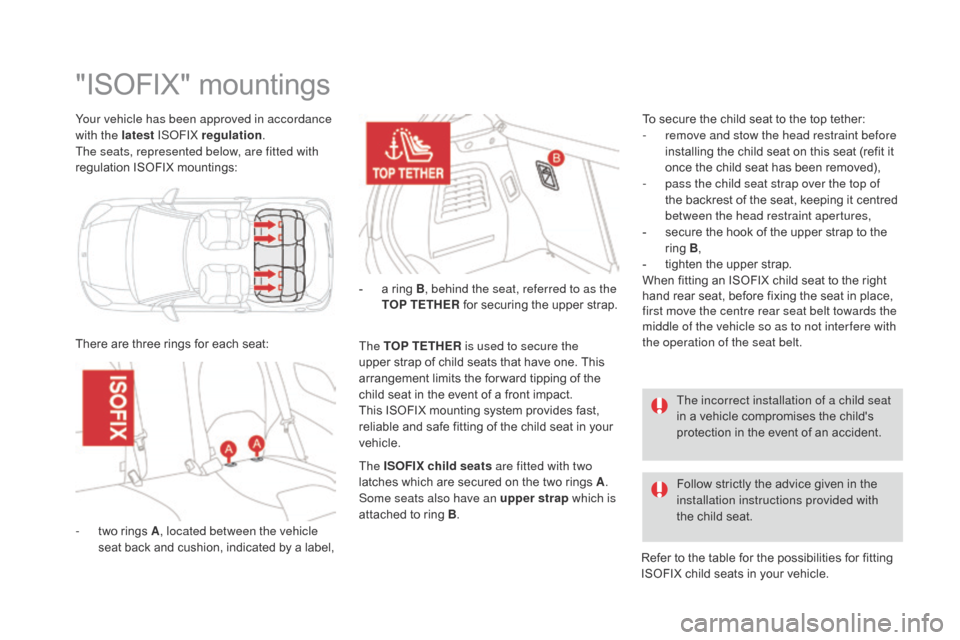
Your vehicle has been approved in accordance
with the latest ISOFIX regulation.
The seats, represented below, are fitted with
regulation
IS
OFIX
mo
untings:
"ISOFIX" mountings
There are three rings for each seat: -
a r
ing
B
, b
ehind the seat, referred to as the
TOP TETHER
f
or
s
ecuring
t
he
u
pper
s
trap.
The TOP TETHER is used to secure the
upper
s
trap
o
f
c
hild
s
eats
t
hat
h
ave
o
ne.
T
his
ar
rangement
l
imits
t
he
f
or ward
t
ipping
o
f
t
he
ch
ild
s
eat
i
n
t
he
e
vent
o
f
a f
ront
i
mpact.
This
I
SOFIX
m
ounting
s
ystem
p
rovides
f
ast,
re
liable
a
nd
s
afe
f
itting
o
f
t
he
c
hild
s
eat
i
n
y
our
ve
hicle.
-
two rings A , lo cated between the vehicle
seat b ack a nd c ushion, i ndicated b y a l abel,
The ISOFIX child seats are fitted with two
latches which a re s ecured o n t he t wo r ings A.
S
ome seats also have an upper strap which is
attached
t
o
r
ing
B. T
o
s
ecure
t
he
c
hild
s
eat
t
o
t
he
t
op
t
ether:
-
re
move and stow the head restraint before
installing
t
he
c
hild
s
eat
o
n
t
his
s
eat
(
refit
i
t
on
ce
t
he
c
hild
s
eat
h
as
b
een
r
emoved),
-
pa
ss the child seat strap over the top of
the
b
ackrest
o
f
t
he
s
eat,
k
eeping
i
t
c
entred
be
tween the head restraint apertures,
-
se
cure
t
he
h
ook
o
f
t
he
u
pper
s
trap
t
o
t
he
ri
ng
B
,
- ti
ghten
t
he
u
pper
s
trap.
When
f
itting
a
n
I
SOFIX
c
hild
s
eat
t
o
t
he
r
ight
ha
nd
r
ear
s
eat,
b
efore
f
ixing
t
he
s
eat
i
n
p
lace,
fi
rst move the centre rear seat belt towards the
middle of the vehicle so as to not inter fere with
the operation of the seat be lt.
The incorrect installation of a child seat
in
a v
ehicle
c
ompromises
t
he
c
hild's
pr
otection
i
n
t
he
e
vent
o
f
a
n
a
ccident.
Follow
s
trictly
t
he
a
dvice
g
iven
i
n
t
he
ins
tallation instructions provided with
the
c
hild
s
eat.
Refer
t
o
t
he
t
able
f
or
t
he
p
ossibilities
f
or
f
itting
IS
OFIX
c
hild
s
eats
i
n
y
our
v
ehicle.
Page 186 of 412
DS3_en_Chap07_securite-enfants_ed02-2015
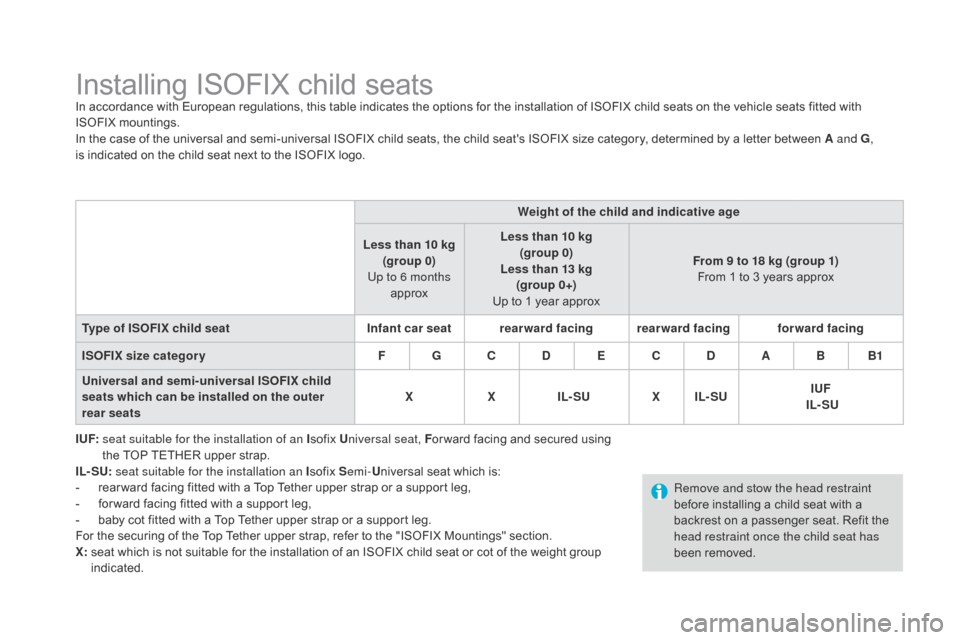
Installing ISOFIX child seatsIn accordance with European regulations, this table indicates the options for the installation of ISOFIX child seats on the vehicle seats fitted with ISOFIX mou ntings.
In
t
he
c
ase
o
f
t
he
u
niversal
a
nd
s
emi-universal
I
SOFIX
c
hild
s
eats,
t
he
c
hild
s
eat's
I
SOFIX
s
ize
c
ategory,
d
etermined
b
y
a l
etter
b
etween
A
and
g,
is i
ndicated
o
n
t
he
c
hild
s
eat
n
ext
t
o
t
he
I
SOFIX
l
ogo.
I UF:
se
at suitable for the installation of an I sofix
Un
iversal seat, For ward
f
acing
a
nd
s
ecured
u
sing
th
e
T
OP
T
ETHER
u
pper
s
trap.
IL- SU: seat suitable for the installation an I sofix
Se
mi-Universal
s
eat
w
hich
i
s:
-
re
ar ward
f
acing
f
itted
w
ith
a T
op
T
ether
u
pper
s
trap
o
r
a s
upport
l
eg,
-
fo
r ward
f
acing
f
itted
w
ith
a s
upport
l
eg,
-
ba
by
c
ot
f
itted
w
ith
a T
op
T
ether
u
pper
s
trap
o
r
a s
upport
l
eg.
For
t
he
s
ecuring
o
f
t
he
T
op
T
ether
u
pper
s
trap,
r
efer
t
o
t
he
"
ISOFIX
M
ountings"
s
ection.
X:
se
at
w
hich
i
s
n
ot
s
uitable
f
or
t
he
i
nstallation
o
f
a
n
I
SOFIX
c
hild
s
eat
o
r
c
ot
o
f
t
he
w
eight
g
roup
in
dicated. Weight of the child and indicative age
Less than 10 kg (group 0)
Up to 6 months approx Less than 10 kg
(group 0)
Less than 13 kg (group 0+)
Up
t
o
1 ye
ar
a
pproxFrom 9 to 18 kg (group 1)
From
1 t
o
3 ye
ars
a
pprox
Type of ISOFIX child seat Infant car seatrearward facing rearward facing forward facing
ISOFIX size categor y F
gC D E C D A B B1
Un
iversal and semi-universal ISOFIX child
seats which can be installed on the outer
rear seats X
XIL- SU XIL- SU IUF
IL- SU
Remove and stow the head restraint
before
i
nstalling
a c
hild
s
eat
w
ith
a ba
ckrest
o
n
a p
assenger
s
eat.
R
efit
t
he
he
ad restraint once the child seat has
been
r
emoved.