brake CITROEN DS3 CABRIO 2013 Handbook (in English)
[x] Cancel search | Manufacturer: CITROEN, Model Year: 2013, Model line: DS3 CABRIO, Model: CITROEN DS3 CABRIO 2013Pages: 421, PDF Size: 12.86 MB
Page 6 of 421
SAFETY DRIVING FITTINGS CHILD SAFETY
162Parking brake
1636 -speed manual gearbox
164 Gear effi ciency indicator
165 Electronic gearbox
170Automatic gearbox
174Stop & Start
17 7 Hill start assist
178Speed limiter
180 Cruise control
182Rear parking sensors
146 Direction indicators
146 Hazard warning lamps
147 Horn
147 Emergency or assistance call
14
8Braking assistance systems
149Tr ajectory control systems
151Front seat belts
154 Airbags
134Child seats
140ISOFIX child seats
126 Interior fi ttings
130 Boot fi ttings
008008009009006006007007
Page 13 of 421
11Familiarisation
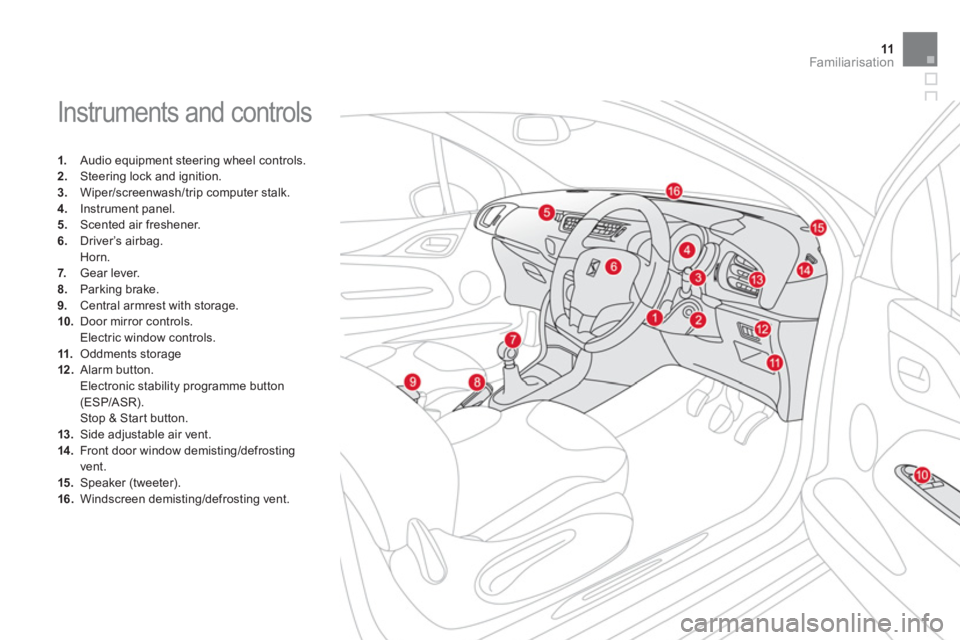
Instruments and controls
1.
Audio equipment steering wheel controls.2.Steering lock and ignition. 3.Wiper/screenwash/trip computer stalk.4.
Instrument panel.
5. Scented air freshener.
6.Driver’s airbag.
Horn. 7. Gear lever. 8.Parking brake.9.
Central armrest with storage. 10.Door mirror controls.
Electric window controls. 11. Oddments storage12.
Alarm button.
Electronic stability programme button (ESP/ASR).
Stop & Star t button.
13.Side adjustable air vent.14 .Front door window demisting/defrosting
vent. 15.Speaker (tweeter). 16. Windscreen demisting/defrosting vent.
Page 22 of 421

Driving safely
the choice of the comfort of automated
operation or the pleasure of manual gear changing.1. Gear lever 2.
Steering mounted "-" control paddle.3.
Steering mounted "+" control paddle.
Electronic gearbox
Display in the instrument panel
The gear engaged or the driving mode selected
appears in the instrument panel screen.
N
.Neutral.
R. Reverse.
1 to 5/6.Gears engaged.
AUTO.Automated mode.
Starting and moving off
)Select position N.)Press the brake pedal firmly.)Star t the engine.)Select automated mode (position A) or Amanual mode (position M) by moving the gear lever 1 ,
or
engage reverse by pushing the gear lever 1to position R
. )Release the parking brake. )Progressively take your foot off the brake pedal, then move off.
165
Page 23 of 421
21Familiarisation
Driving safely
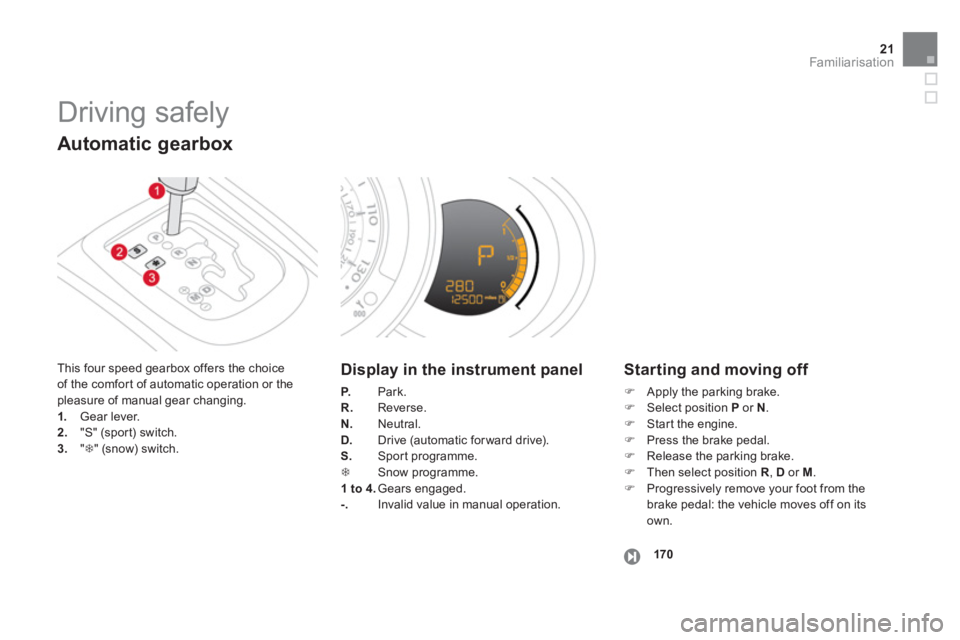
This four speed gearbox offers the choice
of the comfor t of automatic operation or the pleasure of manual gear changing. 1. Gear lever. 2."S" (sport) switch.3."7" (snow) switch.
Display in the instrument panel
P.Park.
R. Reverse.
N.Neutral. D. Drive (automatic for ward drive).
S.Spor t programme. 7 Snow programme.
1 to 4. Gears engaged.-.Invalid value in manual operation.
Starting and moving off
)
Apply the parking brake.)
Select position P
or N
. )
Start the engine.)
Press the brake pedal.)
Release the parking brake. )
Then select position R , D
or M.)
Progressively remove your foot from the
brake pedal: the vehicle moves off on itsown.
Automatic gearbox
170
Page 24 of 421

Driving safely
Stop & Start
Going into engine STOP mode
174
The "ECO"
warning lamp comes on
in the instrument panel and the enginegoes into standby automatically:
- with a manual
gearbox
: at speeds below
12 mph (20 km/h), when you put the gear lever in neutral and you release the clutch pedal,
Going into engine START mode
Deactivation
/Reactivation
You can deactivate the system at any time bypressing the "ECO OFF"
button; the button’s
warning lamp comes on.
17
5
175
The system is automatically reactivated every time the engine is star ted withthe key.
Before refuelling or doing anything under the bonnet, you must switch off the ignition with the key. Th
e "ECO"
warning lamp goes off
and the engine restarts automatically:
-
with a manual gearbox:when you fullydepress the clutch pedal.
-
with a 5 or 6 speed electronic gearbox:at speeds below 5 mph (8 km/h), when you press the brake pedal or when you put thegear lever in position N .
-
with a 5 or 6 speed electronic gearbox
:
●
gear lever in position A
or M, when you
release the brake pedal,
●
or gear lever in position N
and brakepedal released, when you put the gear
lever into position A
or M
,
●
or when you engage reverse.
In certain circumstances, the ST
OP modemay not be available; the "ECO"
warning lamp
flashes for a few seconds, then goes off. In certain circumstances, STA R T m o d e m ay be
invoked automatically; the "ECO"warning lamp
flashes for a few seconds, then goes off.
Page 26 of 421

Eco-driving
Eco-driving is a range of everyday practices that allow the motorist to optimise their fuel consumption and CO2emissions.
Optimise the use of your
gearbox
With a manual gearbox, move off gently,change up without waiting and drive by changing up quite soon. If your vehicle has the system, the gear efficiency indicator invites you to change up; it is displayed in the instrument panel, follow its instructions.
With an automatic or electronic gearbox, stay in Drive "D"or Auto "A"
, according to the type of gearbox, without pressing theaccelerator pedal heavily or suddenly.
Drive smoothly
Maintain a safe distance between vehicles, use engine braking rather than the brake pedal, and press the accelerator progressively. These practices contribute towards a reduction in fuel consumption and CO2emissions and also helpsreduce the background traffic noise.
If your vehicle has cruise control, make use of the system at speeds above 25 mph (40 km/h) when the traffic is flowing well.
Control the use of your
electrical equipment
Before moving off, if the passenger compartment is too warm, ventilate it by opening the windows and air vents before using the air conditioning. Above 30 mph (50 km/h), close the windowsand leave the air vents open.
Remember to make use of equipment that can help keep the temperature in thepassenger compar tment down (sunroof and window blinds...). Switch off the air conditioning, unless it hasautomatic digital regulation, as soon as the
desired temperature is attained.
Switch off the demisting and defrosting controls, if not automatic. Switch off the heated seat as soon as possible.
Page 36 of 421

Warning lampis onCauseAction/Observations
Diesel enginepre-heating
fixed. The ignition switch is at the
2nd position (ignition on). Wait until the warning lamp goes off before star ting.
The period of illumination of the warning lamp is
determined by the climatic conditions (up to about
thir ty seconds in extreme climatic conditions).
If the engine does not star t, switch the ignition off and
then on, wait until the warning lamp goes off again,
then star t the engine.
Parking brake
fixed. The parking brake is applied or not
properly released. Release the parking brake to switch off the warning lamp, keeping your foot on the brake pedal.
Obser ve the safety.
For fur ther information on the parking brake, refer to
the "Driving" section.
Stop & Startfixed. When the vehicle stops (red lights,
traffic jams, ...) the Stop & Start
system has put the engine into STOPmode.The warnin
g lamp goes off and the engine restarts
automatically in START mode, as soon as you want
t
o move off.
flashes for afew seconds, then goes off.
STOP mode is temporarily unavailable. or STA R T m o d e i s i n v o ke dautomatically. Re
fer to "Driving - § Stop & Start" for special cases
with STOP mode and START mode.
Page 37 of 421
35
Monitoring
Foot on thebrake pedal
fixed. The brake pedal must be pressed. With an electronic gearbox, press the brake pedal
to star t the engine (lever in position N). With an automatic gearbox, with the engine running,press the brake pedal before releasing the parking
brake, to unlock the lever and come out of position P.PIf you wish to release the parking brake without pressing the brake pedal, this warning lamp will
remain on.
flashing. With an electronic gearbox, if you hold the vehicle on an incline using
the accelerator for too long, the clutchoverheats. Use the brake pedal and
/or the parking brake.
Automatic wipingfixed. The wiper control is pushed downwards. Automatic front wiping is activated.
Passenger'sairbag systemfixed. The control switch, located in theglove box, is in the "ON" position. The passenger's front airbag is activated.
In this case, do not install a rear-
facin
g child seat.T
urn the control switch to the " OFF
" position
to deactivate the front passenger's airbag.
In this case you can install a rear-facing child seat.
Warning lampis onCauseAction/Observations
Page 40 of 421
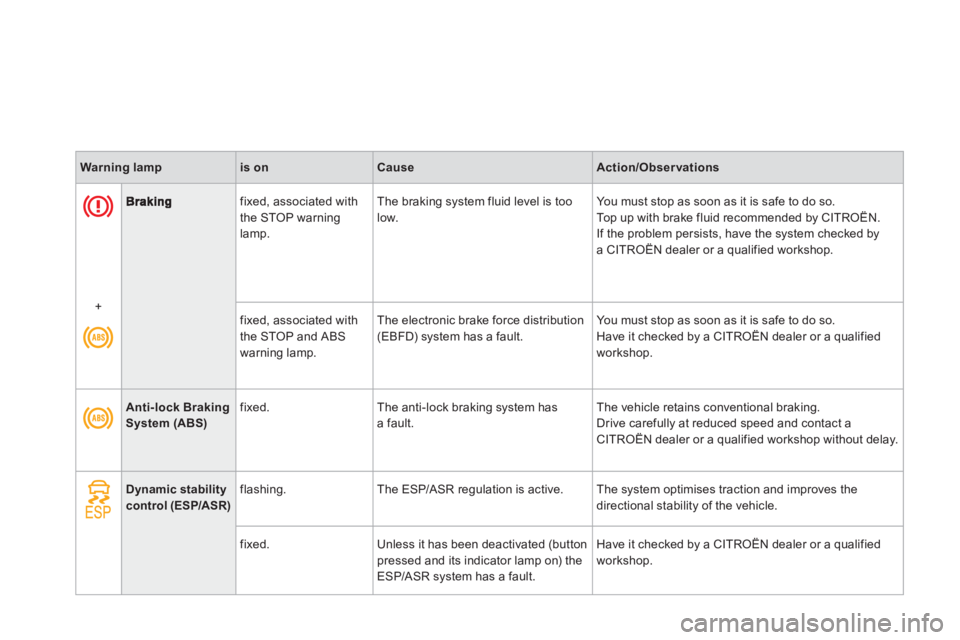
fixed, associated with
the STOP warninglamp. The brakin
g system fluid level is too low. You must stop as soon as it is safe to do so.
Top up with brake fluid recommended by CITROËN.
If the problem persists, have the system checked by
a CITROËN dealer or a qualified workshop.
+
fixed, associated with
the
STOP and ABSwarning lamp. Th
e electronic brake force distribution (EBFD) system has a fault. You must stop as soon as it is safe to do so.
Have it checked by a CITROËN dealer or a qualified
workshop.
Warning lampis onCauseAction/Observations
Anti-lock BrakingSystem (ABS) fixed. The anti-lock braking system has a fault. The vehicle retains conventional braking.
Drive carefully at reduced speed and contact aCITROËN dealer or a qualified workshop without delay.
Dynamic stability control (ESP/ASR)
flashing. The ESP/ASR regulation is active. The system optimises traction and improves the
directional stability of the vehicle.
fix
ed. Unless it has been deactivated (button
pressed and its indicator lamp on) the
ESP/ASR system has a fault. Have it checked b
y a CITROËN dealer or a qualified
workshop.
Page 150 of 421
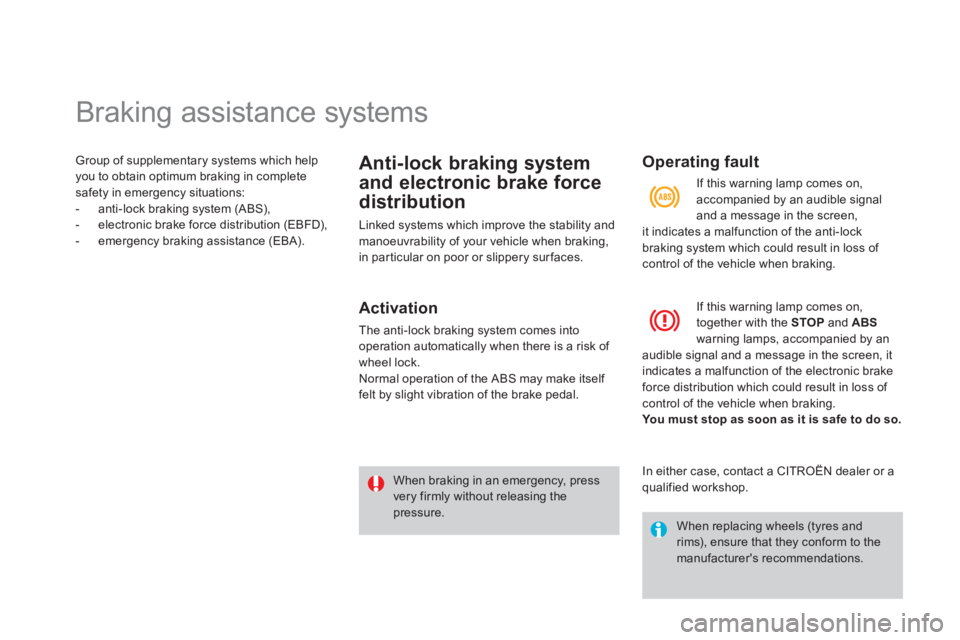
Braking assistance systems
Group of supplementary systems which helpyou to obtain optimum braking in complete safety in emergency situations:
- anti-lock braking system (ABS),
- electronic brake force distribution (EBFD),
- emergency braking assistance (EBA).
Anti-lock braking system
and electronic brake force
distribution
Linked systems which improve the stability and
manoeuvrability of your vehicle when braking,
in par ticular on poor or slippery surfaces.
Activation
The anti-lock braking system comes into
operation automatically when there is a risk of
wheel lock.
Normal operation of the ABS may make itself
felt by slight vibration of the brake pedal.
When braking in an emergency, pressvery firmly without releasing thepressure.
Operating fault
If this warning lamp comes on,
together with the STOPand ABSwarning lamps, accompanied by an
audible signal and a message in the screen, it
indicates a malfunction of the electronic brake force distribution which could result in loss of control of the vehicle when braking.You must stop as soon as it is safe to do so.
When replacing wheels (tyres andrims), ensure that they conform to themanufacturer's recommendations.
If this warnin
g lamp comes on,
accompanied by an audible signaland a message in the screen,
it indicates a malfunction of the anti-lock
braking system which could result in loss of control of the vehicle when braking.
In either case, contact a CITROËN dealer or a
qualified workshop.