engine CITROEN DS3 CABRIO 2016 Handbook (in English)
[x] Cancel search | Manufacturer: CITROEN, Model Year: 2016, Model line: DS3 CABRIO, Model: CITROEN DS3 CABRIO 2016Pages: 450, PDF Size: 17.47 MB
Page 226 of 450
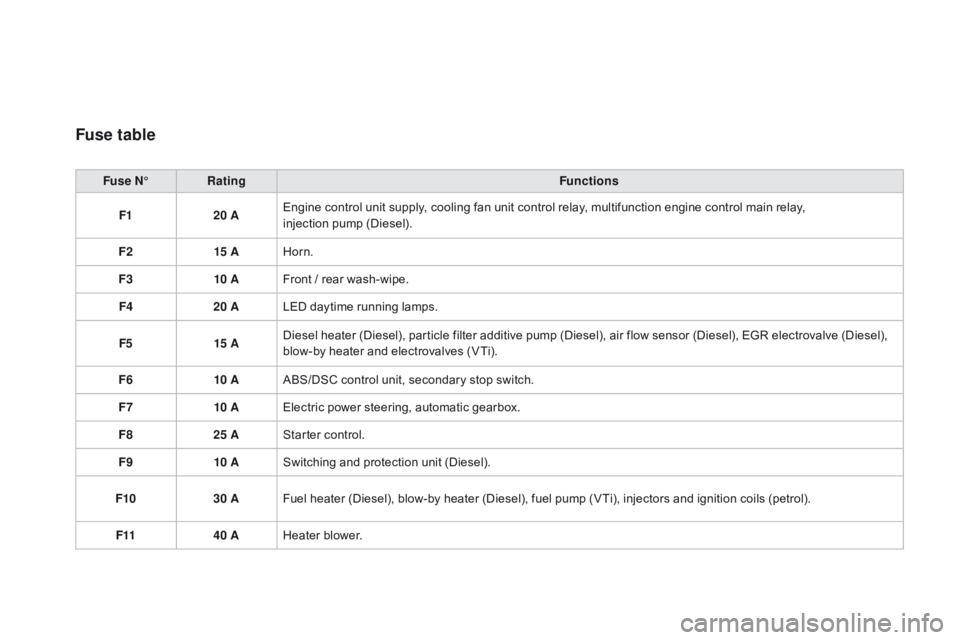
Fuse table
Fuse n°R ating Functions
F1 20 AEngine
control unit supply, cooling fan unit control relay, multifunction engine control main relay,
injection
pump (Diesel).
F2 15 AHorn.
F3 10 AFront
/ rear wash-wipe.
F4 20 ALED
daytime running lamps.
F5 15 ADiesel
heater (Diesel), particle filter additive pump (Diesel), air flow sensor (Diesel), EGR electrovalve (Diesel),
b
low-by heater and electrovalves (VTi).
F6 10 AABS/DSC
control unit, secondary stop switch.
F7 10 AElectric
power steering, automatic gearbox.
F8 25 AStarter
control.
F9 10 ASwitching
and protection unit (Diesel).
F10 30 AFuel
heater (Diesel), blow-by heater (Diesel), fuel pump (VTi), injectors and ignition coils (petrol).
F11 40 AHeater
b
lower.
Page 229 of 450

227
BatteryProcedure for charging your battery when it is flat or for starting the engine using another battery.T he battery is located under the bonnet.
To
gain access to it:
F
o
pen the bonnet using the interior release
l
ever, then the exterior safety catch,
F
s
ecure the bonnet stay,
F
l
ift the plastic cover on the (+) terminal.
Access to the batteryAfter refitting the battery by a CITROËN dealer or a qualified
w
orkshop, the Stop & Start system
w
ill only be active after a continuous
period
of immobilisation of the vehicle,
a
period which depends on the climatic
c
onditions and the state of charge of
t
he battery (up to about 8 hours).
The presence of this label, in particular
with
the
Stop
&
Start
system,
indicates
t
he
use
of
a
12
V
lead-acid
battery
with
s
pecial
t
echnology
a
nd
s
pecification;
t
he
involvement
of
a
CITROËN
dealer
o
r
a
qualified
workshop
is
essential
w
hen
replacing
or
disconnecting
the
b
attery.
Failure
t
o
o
bserve
t
his
r
ecommendation
m
ay
cause
premature
wear
of
the
b
attery.
Practical information
Page 230 of 450
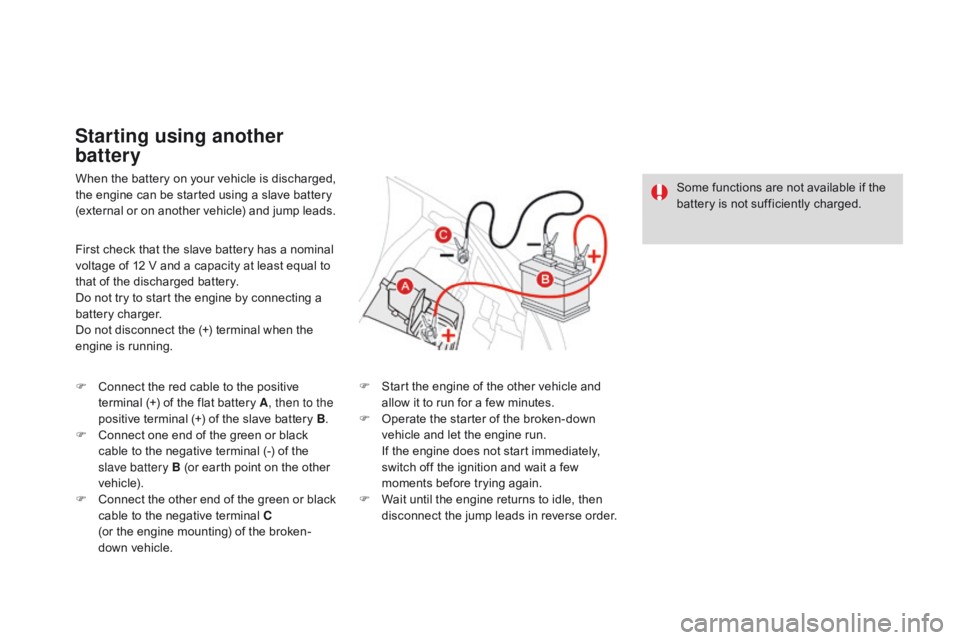
When the battery on your vehicle is discharged, the engine can be started using a slave battery
(
external or on another vehicle) and jump leads.
Starting using another
battery
First check that the slave battery has a nominal voltage of 12 V and a capacity at least equal to
t
hat of the discharged battery.
Do
not try to start the engine by connecting a
b
attery charger.
Do
not disconnect the (+) terminal when the
e
ngine is running.
F
C
onnect the red cable to the positive
t
erminal (+) of the flat battery A, then to the
positive
terminal (+) of the slave battery B.
F
C
onnect one end of the green or black
c
able to the negative terminal (-) of the
s
lave battery B (or earth point on the other
v
ehicle).
F
C
onnect
t
he
o
ther
e
nd
o
f
t
he
g
reen
o
r
b
lack
c
able to the negative terminal C
(or
the engine mounting) of the broken-
down
vehicle. F
S
tart the engine of the other vehicle and
a
llow it to run for a few minutes.
F
O
perate the starter of the broken-down
v
ehicle and let the engine run.
I
f the engine does not start immediately,
s
witch off the ignition and wait a few
m
oments before trying again.
F
W
ait until the engine returns to idle, then
d
isconnect the jump leads in reverse order.Some
functions are not available if the
b
attery is not sufficiently charged.
Page 231 of 450

229
Protect your eyes and face before handling the battery.
All
operations on the battery must be
c
arried out in a well ventilated area
a
way from naked flames and sources
o
f sparks, so as to avoid the risk of
e
xplosion and fire.
Do
not try to charge a frozen battery;
t
he battery must first be thawed out to
a
void
t
he
r
isk
o
f
e
xplosion.
I
f
t
he
b
attery
h
as been frozen, before charging have
i
t checked by a CITROËN dealer or
a
qualified workshop who will check
t
hat the internal components have not
b
een damaged and the casing is not
c
racked, which could cause a leak of
t
oxic and corrosive acid.
Do
not reverse the polarity and use
o
nly a 12 V charger.
Do
not disconnect the terminals while
t
he engine is running.
Do
not charge the batteries without
d
isconnecting the terminals first.
Wash
your hands after wards.
Do
not
push
the
vehicle
to
start
the
e
ngine
if
you
have
an
electronic
or
a
utomatic
gearbox.Charging the battery using
a battery charger
Batteries contain harmful substances such a s sulphuric acid and lead. They must be d
isposed of in accordance with regulations
a
nd must not, in any circumstances, be
d
iscarded with household waste.
Take
used remote control batteries and
v
ehicle batteries to a special collection
point.
F Follow the instructions for use provided by t
he manufacturer of the charger.
Do
not disconnect the battery to charge it.
Practical information
Page 232 of 450

Load reduction modeSystem which manages the use of certain functions according to the level of charge
r
emaining in the battery.
When
the vehicle is being driven, the load
r
eduction function temporarily deactivates
c
ertain functions, such as the air conditioning,
t
he heated rear screen...
The
deactivated functions are reactivated
a
utomatically as soon as conditions permit.Energy economy modeSystem which manages the period of use of certain functions to conserve a sufficient level of c
harge in the battery.
After
the engine has stopped, you can still use functions such as the audio equipment, windscreen
w
ipers, dipped beam headlamps, courtesy lamps, etc. for a maximum combined period of
t
hirty minutes. This
period may be greatly reduced if
t
he battery is not fully charged.
A
flat battery prevents the engine from
s
tarting.
If
the telephone is being used at the
s
ame time, it will be interrupted after
10
m
inutes.
Switching to economy mode
Once this period has elapsed, a message appears in the screen indicating that the
v
ehicle has switched to economy mode and the
a
ctive functions are put on standby.
Exiting economy mode
These functions are reactivated automatically the next time the vehicle is driven.
F
I
n order to resume the use of these
f
unctions immediately, start the engine and
l
et it run for a few minutes.
The
time available to you will then be double
t
he period for which the engine is left running.
H
owever, this period will always be between
f
ive and thirty minutes.
Page 234 of 450
Towing the vehicleProcedure for having your vehicle towed or for towing another vehicle using a removable towing eye.
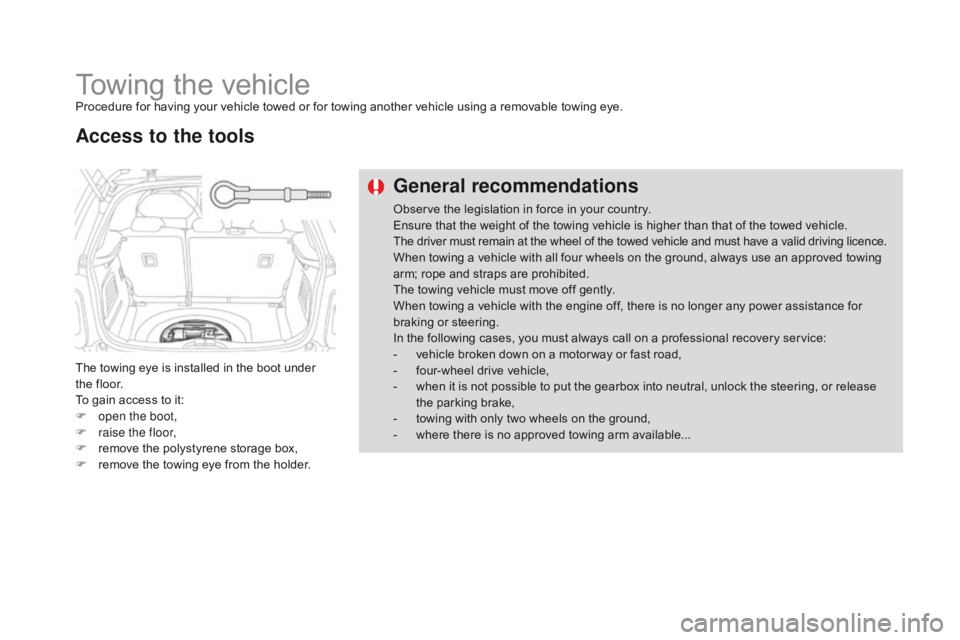
T he towing eye is installed in the boot under
t
he floor.
To
gain access to it:
F
o
pen the boot,
F
r
aise the floor,
F
r
emove the polystyrene storage box,
F
r
emove the towing eye from the holder.
Access to the tools
ge
neral recommendations
Observe the legislation in force in your country.
E nsure that the weight of the towing vehicle is higher than that of the towed vehicle.
The
driver must remain at the wheel of the towed vehicle and must have a valid driving licence.
When
towing a vehicle with all four wheels on the ground, always use an approved towing
a
rm; rope and straps are prohibited.
The
towing vehicle must move off gently.
When
towing a vehicle with the engine off, there is no longer any power assistance for
b
raking or steering.
In
the following cases, you must always call on a professional recovery service:
-
v
ehicle broken down on a motor way or fast road,
-
f
our-wheel drive vehicle,
-
w
hen it is not possible to put the gearbox into neutral, unlock the steering, or release
t
he parking brake,
-
t
owing with only two wheels on the ground,
-
w
here there is no approved towing arm available...
Page 235 of 450
233
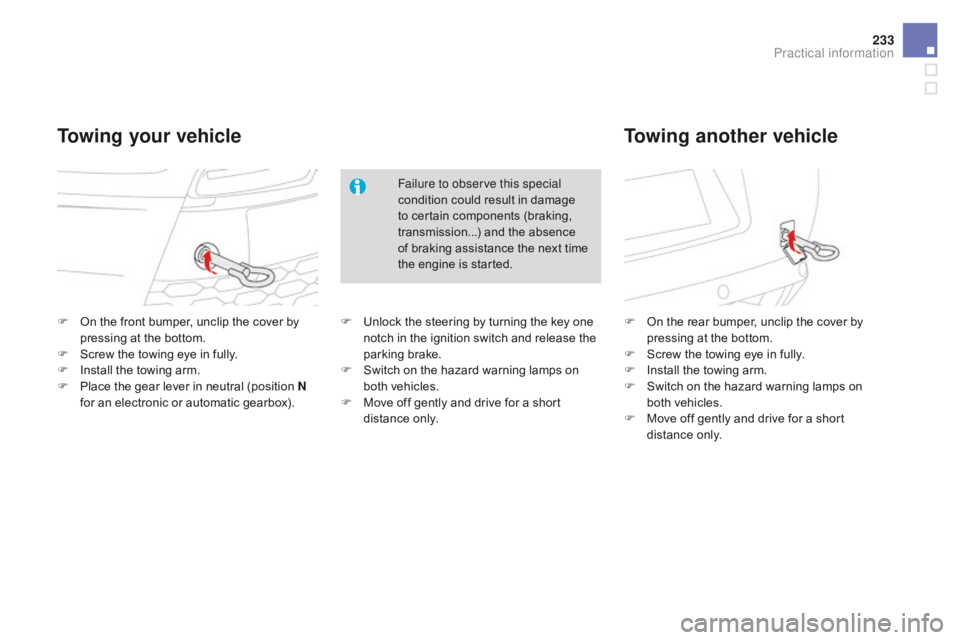
F On the front bumper, unclip the cover by p
ressing at the bottom.
F
S
crew the towing eye in fully.
F
I
nstall the towing arm.
F
P
lace the gear lever in neutral (position n
for
an electronic or automatic gearbox). F
O n the rear bumper, unclip the cover by p
ressing at the bottom.
F
S
crew the towing eye in fully.
F
I
nstall the towing arm.
F
S
witch on the hazard warning lamps on
b
oth vehicles.
F
M
ove off gently and drive for a short
d
istance
o
nly.
Towing your vehicleTowing another vehicle
Failure to observe this special
condition could result in damage
t
o certain components (braking,
t
ransmission...) and the absence
o
f braking assistance the next time
t
he engine is started.
F
U
nlock the steering by turning the key one
n
otch in the ignition switch and release the
par
king
b
rake.
F
S
witch on the hazard warning lamps on
b
oth vehicles.
F
M
ove off gently and drive for a short
d
istance
o
nly.
Practical information
Page 236 of 450
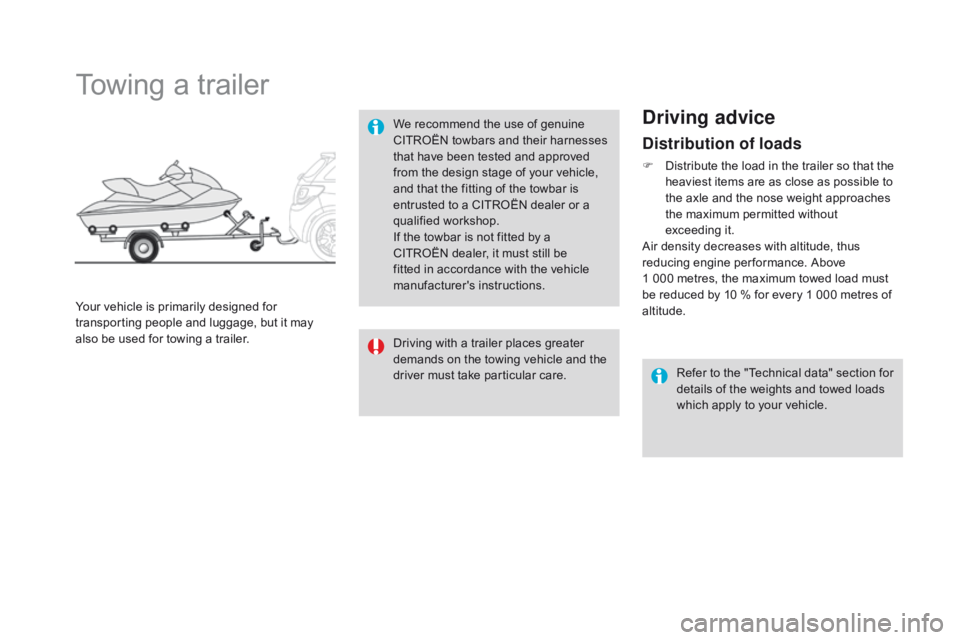
distribution of loads
F Distribute the load in the trailer so that the h
eaviest items are as close as possible to
t
he axle and the nose weight approaches
t
he maximum permitted without
e
xceeding it.
Air
density decreases with altitude, thus
r
educing engine per formance. Above
1 0
00 metres, the maximum towed load must
b
e reduced by 10 % for every 1 000 metres of
al
titude. Refer
to the "Technical data" section for
d
etails of the weights and towed loads
w
hich apply to your vehicle.
Towing a trailer
Your vehicle is primarily designed for transporting people and luggage, but it may
a
lso be used for towing a trailer. We
recommend the use of genuine
C
ITROËN towbars and their harnesses
t
hat have been tested and approved
f
rom the design stage of your vehicle,
a
nd that the fitting of the towbar is
e
ntrusted to a CITROËN dealer or a
q
ualified
w
orkshop.
If the towbar is not fitted by a
C
ITROËN dealer, it must still be
f
itted in accordance with the vehicle
m
anufacturer's
i
nstructions.
Driving with a trailer places greater
d
emands on the towing vehicle and the
d
river must take particular care.
driving advice
Page 237 of 450
235
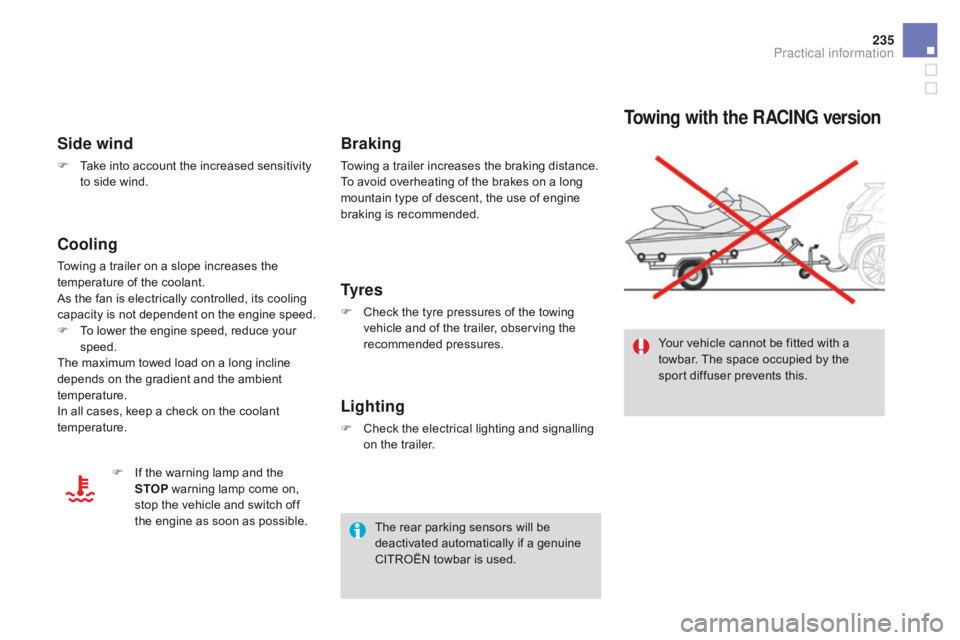
Towing with the RACIng version
Your vehicle cannot be fitted with a t
owbar. The space occupied by the
s
port diffuser prevents this.
Side wind
F Take into account the increased sensitivity t
o side wind.
Cooling
Towing a trailer on a slope increases the temperature of the coolant.
As
the fan is electrically controlled, its cooling
c
apacity is not dependent on the engine speed.
F
T
o lower the engine speed, reduce your
s
peed.
The
maximum towed load on a long incline
d
epends on the gradient and the ambient
t
emperature.
In
all cases, keep a check on the coolant
t
emperature. F
I
f the warning lamp and the
S
TOP
warning lamp come on,
s
top the vehicle and switch off
t
he engine as soon as possible.
Braking
Towing a trailer increases the braking distance.
T o avoid overheating of the brakes on a long
m
ountain type of descent, the use of engine
b
raking is recommended.
Ty r e s
F Check the tyre pressures of the towing v
ehicle and of the trailer, observing the
re
commended
p
ressures.
Lighting
F Check the electrical lighting and signalling o
n the trailer.
The
rear parking sensors will be
d
eactivated automatically if a genuine
C
ITROËN towbar is used.
Practical information
Page 244 of 450

TOTAL & CITROËN
Partners in performance and
protecting the environment
Innovation in the search for
performance
For over 40 year, the TOTAL Research and Development d epartments h ave d eveloped l
ubricants for CITROËN, to match the latest
t
echnical innovations on CITROËN vehicles, both for
competition
and for everyday motoring.
For you, this is an assurance that you will obtain the
best
per formance from your engine.
Optimum protection for
your engine
By having your CITROËN vehicle serviced with TOTAL lubricants, you
a
re contributing towards improving the
l
ife and per formance of your engine,
w
hile also protecting the environment.