weight Citroen DS3 RHD 2016 1.G Owner's Manual
[x] Cancel search | Manufacturer: CITROEN, Model Year: 2016, Model line: DS3 RHD, Model: Citroen DS3 RHD 2016 1.GPages: 380, PDF Size: 10.11 MB
Page 7 of 380
CHECKSTECHn ICAL dA TAAUdI O An d
TELEMATICS
249 Bonnet
250 Pe trol engines
251
D
iesel
eng
ines
252
C
hecking levels
256
C
hecks 260 Pe
trol engines
263 Pe trol weights
266
D
iesel
eng
ines
267
D
iesel weights
268
D
imensions
270
I
dentification
ma
rkings2 74 E
mergency or assistance
277 7 -inch touch screen tablet
345
A
udio system
010011
009
Page 178 of 380

General points relating to child seats
Although one of CITROËN main criteria when designing your vehicle, the safety of your children also depends on you.
CITROË
n
re
commends
that children
s
hould travel on the rear seats of your
vehicle:
-
r
earward facing
up to the age of 3,
-
fo
rward facing
over the age of 3.
For
maximum safety, please observe the
f
ollowing
r
ecommendations:
-
i
n accordance with European regulations,
a
ll children under the age of 12 or less
than one and a half metres tall must
travel in approved child seats suited to
their weight ,
on seats fitted with a seat
b
elt or ISOFIX mountings*,
-
s
tatistically, the safest seats in your
vehicle for carr ying children are the
rear seats,
-
a c
hild weighing less than 9 kg must
travel in the rearward facing position
both in the front and in the rear.
*
T
he regulations on carrying children are
s
pecific to each country. Refer to the
l
egislation in force in your country.
Page 185 of 380

183
Installing child seats attached with the seat beltIn accordance w ith European regulations, t his t able i ndicates t he o ptions for i nstalling c hild s eats s ecured using a seat b elt and u niversally approved (a)
in accordance with the weight of the child and the seat in the vehicle.
Weight of the child and indicative age
Seat Under 13 kg
(groups
0 (b) and 0+)
Up
to approx. 1 yearFrom 9 to 18 kg
(group
1)
1
to 3 years approx.From 15 to 25 kg
(group
2)
3
to 6 years approx.From 22 to 36 kg
(group
3)
6
to 10 years approx.
Front
p
assenger
sea
t
(c)
with
height
adjustment (e) U(R)
U(R)U(R)U(R)
Front
p
assenger
sea
t
(c)
without
height adjustment (e) U
UUU
Outer rear seats (d) UUUU
Centre rear seat (d) U (f )U (f ) UU
Child safety
Page 190 of 380
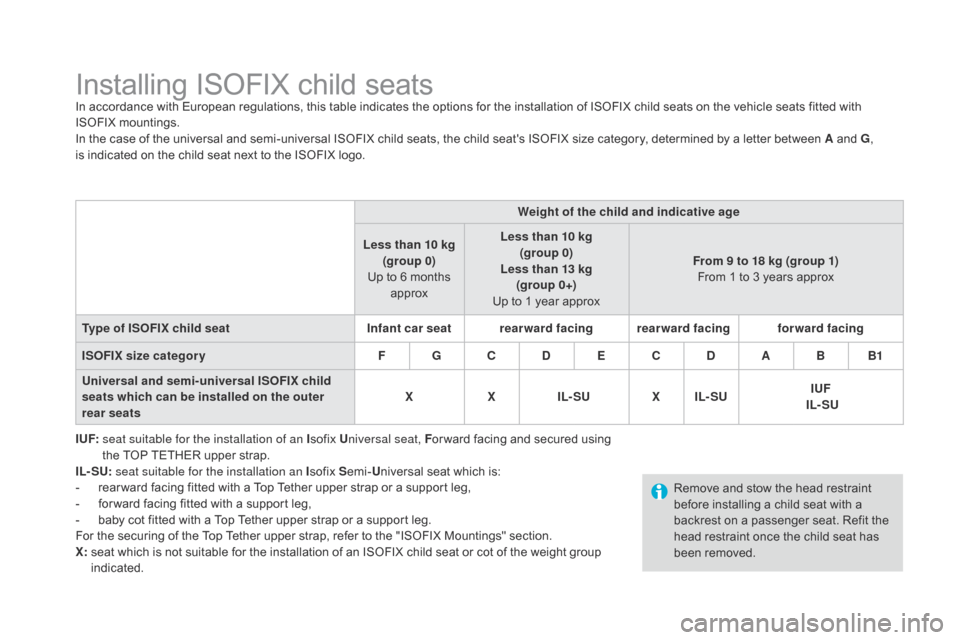
Installing ISOFIX child seatsIn accordance with European regulations, this table indicates the options for the installation of ISOFIX child seats on the vehicle seats fitted with ISOFIX m ountings.
In
the case of the universal and semi-universal ISOFIX child seats, the child seat's ISOFIX size category, determined by a letter between A and g
,
i
s indicated on the child seat next to the ISOFIX logo.
I UF:
s
eat suitable for the installation of an I sofix
Universal seat, F or ward
facing and secured using
t
he TOP TETHER upper strap.
IL- SU: seat suitable for the installation an I sofix
Semi- Universal
seat which is:
-
r
ear ward facing fitted with a Top Tether upper strap or a support leg,
-
f
or ward facing fitted with a support leg,
-
b
aby cot fitted with a Top Tether upper strap or a support leg.
For
the securing of the Top Tether upper strap, refer to the "ISOFIX Mountings" section.
X:
s
eat which is not suitable for the installation of an ISOFIX child seat or cot of the weight group
i
ndicated. Weight of the child and indicative age
Less than 10 kg (group 0)
Up
to 6 months
a
pproxLess than 10 kg
(group 0)
Less than 13 kg (group 0+)
Up
to 1 year approxFrom 9 to 18 kg (group 1)
From
1 to 3 years approx
Type of ISOFIX child seat Infant car seatrearward facing rearward facing forward facing
ISOFIX size categor y F
gCdE CdA BB1
U
niversal and semi-universal ISOFIX child
seats which can be installed on the outer
rear seats X
XIL- SU XIL- SU IUF
IL- SU
Remove
and stow the head restraint
b
efore installing a child seat with a
b
ackrest on a passenger seat. Refit the
h
ead restraint once the child seat has
b
een removed.
Page 239 of 380

237
Towing the vehicleProcedure for having your vehicle towed or for towing another vehicle using a removable towing eye.
T he towing eye is installed in the boot under
t
he floor.
To
gain access to it:
F
o
pen the boot,
F
r
aise the floor,
F
r
emove the polystyrene storage box,
F
r
emove the towing eye from the holder.
Access to the tools
ge
neral recommendations
Observe the legislation in force in your country.
E nsure that the weight of the towing vehicle is higher than that of the towed vehicle.
The
driver must remain at the wheel of the towed vehicle and must have a valid driving licence.
When
towing a vehicle with all four wheels on the ground, always use an approved towing
a
rm; rope and straps are prohibited.
The
towing vehicle must move off gently.
When
towing a vehicle with the engine off, there is no longer any power assistance for
b
raking or steering.
In
the following cases, you must always call on a professional recovery service:
-
v
ehicle broken down on a motor way or fast road,
-
f
our-wheel drive vehicle,
-
w
hen it is not possible to put the gearbox into neutral, unlock the steering, or release
t
he parking brake,
-
t
owing with only two wheels on the ground,
-
w
here there is no approved towing arm available...
Practical information
Page 241 of 380

239
distribution of loads
F Distribute the load in the trailer so that the h
eaviest items are as close as possible to
t
he axle and the nose weight approaches
t
he maximum permitted without
e
xceeding it.
Air
density decreases with altitude, thus
r
educing engine per formance. Above
1 0
00 metres, the maximum towed load must
b
e reduced by 10 % for every 1 000 metres of
al
titude. Refer
to the "Technical data" section for
d
etails of the weights and towed loads
w
hich apply to your vehicle.
Towing a trailer
Your vehicle is primarily designed for transporting people and luggage, but it may
a
lso be used for towing a trailer. We
recommend the use of genuine
C
ITROËN towbars and their harnesses
t
hat have been tested and approved
f
rom the design stage of your vehicle,
a
nd that the fitting of the towbar is
e
ntrusted to a CITROËN dealer or a
q
ualified
w
orkshop.
If the towbar is not fitted by a
C
ITROËN dealer, it must still be
f
itted in accordance with the vehicle
m
anufacturer's
i
nstructions.
Driving with a trailer places greater
d
emands on the towing vehicle and the
d
river must take particular care.
driving advice
Practical information
Page 265 of 380

263
The GTW and towed load values indicated are valid up to a maximum altitude of 1 000 metres; the towed load mentioned must be reduced by 10 % for each additional 1 000 metres of altitude.
The
speed of a towing vehicle must not exceed 60 mph (100 km/h) (comply with the legislation in force in your country).
High
ambient temperatures may result in a reduction in the per formance of the vehicle to protect the engine; if the ambient temperature is above 37 °C,
l
imit the towed load.
*
T
he weight of the braked trailer can be increased, within the GTW limit, if the GV W of the towing vehicle is reduced by an equal amount. Warning:
t
owing using a lightly loaded towing vehicle may have an adverse effect on its road holding.
Petrol engine
PureTech 82PureTech 82 S&S V Ti 120
ge
arbox
Manual
(
5-speed)
ETG electronic
(
5-speed)
Manual
(
5-speed)
Automatic
(
4-speed)
Model code:
SA... HMZ6
HMZ6/PS 5FS05FS9
Unladen weight
9 749801 075 1 089
Kerb weight
1 0491 055 1 1501 16 4
Gross vehicle weight (GV W)
1 5111 523
1 554 1 587
Gross train weight (GTW)
on a 12% gradient
2 311
2 022 2 454 2 487
Braked trailer (within the GTW limit)
o
n a 12% gradient
800
500900 900
Braked trailer* (with transfer of load within the
G
TW limit)
1 10 0
7501 150 1 150
Unbraked
t
railer
520500 570570
Recommended nose weight
46464646
Petrol weights and towed loads (in kg)
Technical data
Page 266 of 380

Petrol enginesPureTech 110PureTech 110 S&S PureTech 130
S&S THP 155
THP 15 0 **THP 165 S&S
THP 150 S&S ***
ge
arbox E AT 6
(6-speed
au
tomatic)Manual
(5-speed) E AT 6
(6-speed
a
utomatic)Manual
(6-speed) Manual
(6-speed) Manual
(6-speed)
Model code:
SA... HNVT
HNZ6/S H NZ T/S H N V T/S HNYM/S5FV8
5FN8** 5GZM/S
5GWM/S***
Unladen
weight 1 0851 0701 090 -1 090 1 090 1 140
Kerb
weight 1 1601 1451 165 -1 165 1 165 1 215
Gross
vehicle weight (GV W)1 6101 578 1 615 -1 600 1 590 1 605
Gross
train weight (GTW)
on
a 12% gradient 2 510
2 478 2 515 -2 500 2 490 2 505
Braked
trailer (within the GTW limit)
on
a 12% gradient 900
900900 -900 900900
Braked
trailer* (with transfer of
l
oad within the GTW limit)1 150 1 150 1 150
-1 150 1 150 1 150
Unbraked
t
railer 570570570 -570 570570
Recommended
nose weight 464646 -46 4646
*
T
he weight of the braked trailer can be increased, within the GTW limit, if the GV W of the towing vehicle is reduced by an equal amount. Warning:
t
owing using a lightly loaded towing vehicle may have an adverse effect on its road holding.
**
For Belgium and Russia.
***
For Brazil.
The GTW and towed load values indicated are valid up to a maximum altitude of 1 000 metres; the towed load mentioned must be reduced by 10 % for each additional
1 000 metres of altitude.
The
speed of a towing vehicle must not exceed 60 mph (100 km/h) (comply with the legislation in force in your country).
High
ambient temperatures may result in a reduction in the per formance of the vehicle to protect the engine; if the ambient temperature is above 37 °C, limit the towed load.
Petrol weights and towed loads (in kg)
Page 267 of 380

265
Petrol engine208 Racing
ge
arbox Manual
(
6-speed)
Model code: SA... 5GRM/S
Unladen
weight 1 175
Kerb
weight 1 250
Gross
vehicle weight (GV W) 1 607
Gross
train weight (GTW)
on
a 12% gradient 1 607
Braked
trailer (within the GTW limit)
on
a 12% gradient 0
Braked
trailer (with transfer of load within the
G
TW limit) 0
Unbraked
t
railer 0
Recommended
nose weight* 0
*
See the "Towing a trailer" section.
Weights (in kg) - GT RACING
Technical data
Page 269 of 380
267
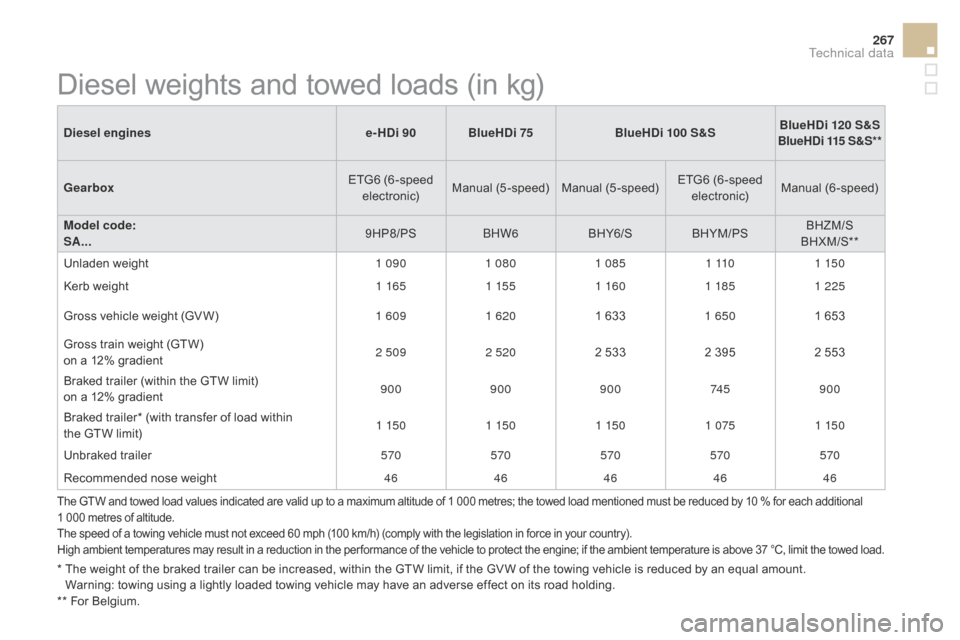
diesel engines e-H d i 90 BlueH d i 75BlueH d i 100 S&SBlueH d i 120 S&S
BlueH d i 115 S&S**
ge
arbox ETG6
(6 -speed
e
lectronic)Manual
(
5-speed) Manual
(
5-speed)ETG6
(6 -speed
e
lectronic)Manual
(
6-speed)
Model code:
SA... 9HP8/PS
BHW6BHY6/SBHYM/PS BHZM/S
BHXM/S**
Unladen
weight 1 0901 0801 085 1 11 01 150
Kerb
weight 1 1651 1551 160 1 1851 225
Gross
vehicle weight (GV W) 1 6091 6201
6331 650 1
653
Gross
train weight (GTW)
on
a 12% gradient 2 509
2 5202
5332
3952
553
Braked
trailer (within the GTW limit)
on
a 12% gradient 900
900900 74 5900
Braked
trailer* (with transfer of load within
the
GTW limit) 1 150
1 1501 150 1 0751 150
Unbraked
t
railer 570570570570570
Recommended
nose weight 4646464646
*
T
he weight of the braked trailer can be increased, within the GTW limit, if the GV W of the towing vehicle is reduced by an equal amount.
Warning:
towing using a lightly loaded towing vehicle may have an adverse effect on its road holding.
**
For Belgium.
Diesel weights and towed loads (in kg)
The GTW and towed load values indicated are valid up to a maximum altitude of 1 000 metres; the towed load mentioned must be reduced by 10 % for each additional
1 000 metres of altitude.
The
speed of a towing vehicle must not exceed 60 mph (100 km/h) (comply with the legislation in force in your country).
High
ambient temperatures may result in a reduction
i
n the per formance
o
f
t
he vehicle to protect the engine;
i
f
t
he
a
mbient temperature is above 37
°
C, limit the towed load.
Technical data