wheel CITROEN DS4 2010 Owner's Guide
[x] Cancel search | Manufacturer: CITROEN, Model Year: 2010, Model line: DS4, Model: CITROEN DS4 2010Pages: 421, PDF Size: 8.05 MB
Page 221 of 421
219
Switching on
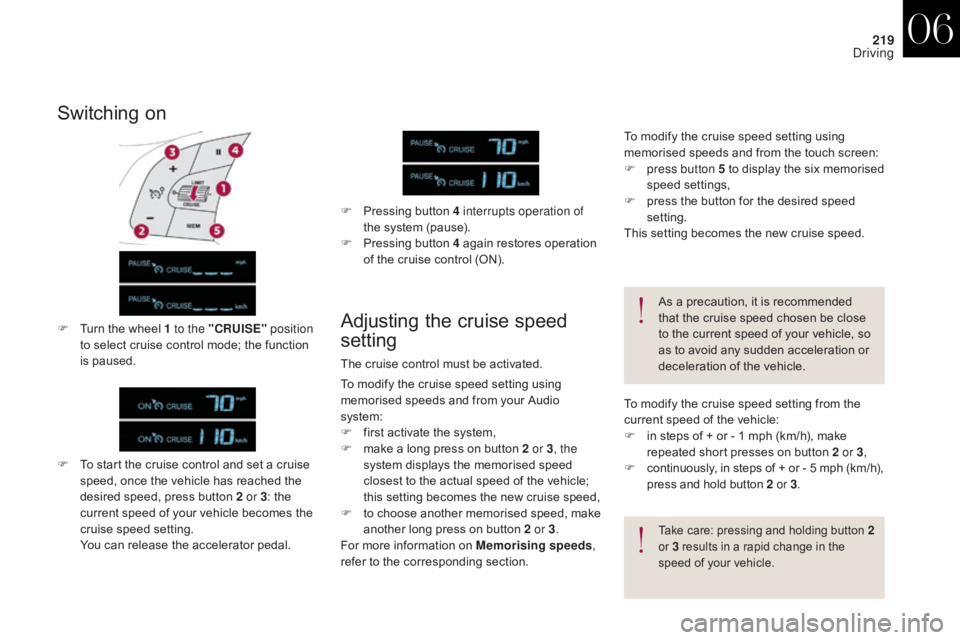
F To start the cruise control and set a cruise speed, once the vehicle has reached the
desired speed, press button 2 or 3 : the
current speed of your vehicle becomes the
cruise speed setting.
Y
ou can release the accelerator pedal.
Adjusting the cruise speed
settingF Turn the wheel 1 to the "CRUISE" position
to select cruise control mode; the function
is paused. F
P
ressing button 4 interrupts operation of
the system (pause).
F
P
ressing button 4 again restores operation
of the cruise control (ON).
The cruise control must be activated. As a precaution, it is recommended
that the cruise speed chosen be close
to the current speed of your vehicle, so
as to avoid any sudden acceleration or
deceleration of the vehicle.
Take care: pressing and holding button 2
o r 3 results in a rapid change in the
speed of your vehicle.
To modify the cruise speed setting from the
current speed of the vehicle:
F
i
n steps of + or - 1 mph (km/h), make
repeated short presses on button 2 or 3 ,
F
c
ontinuously, in steps of + or - 5 mph (km/h),
press and hold button 2 or 3.
To modify the cruise speed setting using
memorised speeds and from your Audio
system:
F
f
irst activate the system,
F
m
ake a long press on button 2 or 3 , the
system displays the memorised speed
closest to the actual speed of the vehicle;
this setting becomes the new cruise speed,
F
t
o choose another memorised speed, make
another long press on button 2 or 3.
For more information on Memorising speeds ,
refer to the corresponding section. To modify the cruise speed setting using
memorised speeds and from the touch screen:
F
p
ress button 5 to display the six memorised
speed settings,
F
p
ress the button for the desired speed
setting.
This setting becomes the new cruise speed.
06
Driving
Page 222 of 421

220
You may have to brake to control the speed of
your vehicle. In this case, the cruise control is
automatically paused.
To activate the system again, press button 4.Only use the cruise control if the traffic
conditions will allow you to drive for a
certain time at a steady speed and at a
safe distance from the vehicle ahead.
Do not activate the cruise control
in urban areas, in heavy traffic, on
winding or steep roads, on slippery
or flooded roads, or in conditions of
poor visibility (heavy rain, fog, falling
snow...).
In some circumstances, it may not
be possible to maintain or reach the
programmed speed: towing, vehicle
heavily loaded, steep climb.
Temporarily exceeding the
programmed speed
When required (overtaking manoeuvre...), it is
possible to exceed the programmed speed by
pressing the accelerator pedal.
To return to the programmed speed, simply
release the accelerator pedal.
Once the vehicle has returned to the
programmed speed, the cruise control takes
over again: the display of the programmed
speed setting becomes steady again.
When descending a steep hill, the
cruise control system cannot prevent
the vehicle from exceeding the
programmed speed.
Switching off
F Turn wheel 1 to the "0" position: the cruise
control information disappears from the
screen.
Operating fault
Flashing dashes indicate a fault with the cruise
control system.
Have it checked by a CITROËN dealer or a
qualified workshop. The use of mats not approved by
CITROËN may inter fere with the
operation of the cruise control.
To avoid any risk of jamming of the
pedals:
-
e nsure that the mat is positioned
c o r r e c t l y,
-
n
ever fit one mat on top of another.
The cruise control is temporarily overridden
and the programmed speed setting flashes.
06
Driving
Page 233 of 421
231
Snow chains
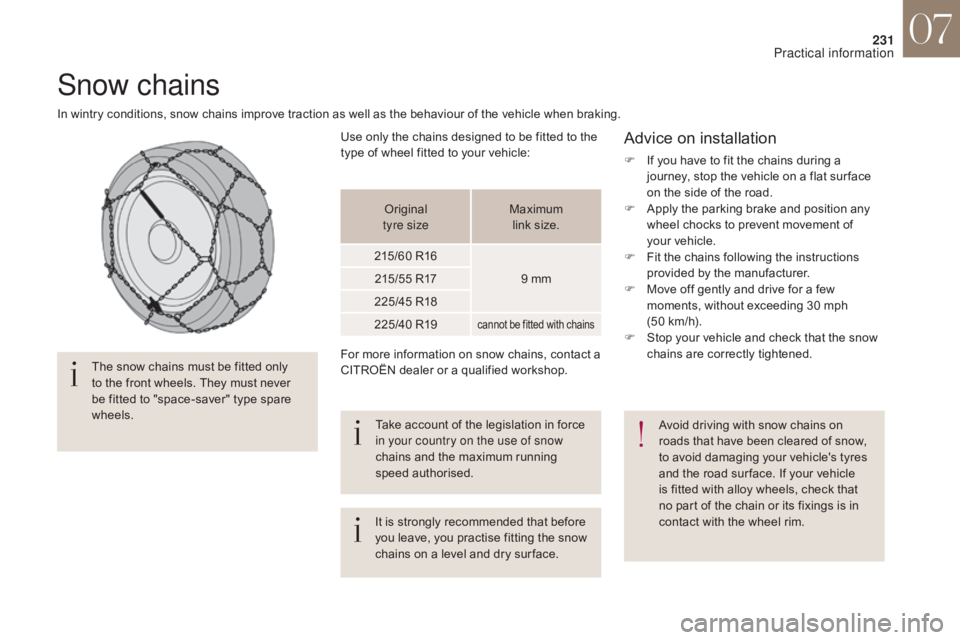
In wintry conditions, snow chains improve traction as well as the behaviour of the vehicle when braking.The snow chains must be fitted only
to the front wheels. They must never
be fitted to "space-saver" type spare
wheels. For more information on snow chains, contact a
CITROËN dealer or a qualified workshop.
Advice on installation
F If you have to fit the chains during a
journey, stop the vehicle on a flat sur face
on the side of the road.
F
A
pply the parking brake and position any
wheel chocks to prevent movement of
your
vehicle.
F
F
it the chains following the instructions
provided by the manufacturer.
F
M
ove off gently and drive for a few
moments, without exceeding 30 mph
(50
km/h).
F
S
top your vehicle and check that the snow
chains are correctly tightened.
Avoid driving with snow chains on
roads that have been cleared of snow,
to avoid damaging your vehicle's tyres
and the road sur face. If your vehicle
is fitted with alloy wheels, check that
no part of the chain or its fixings is in
contact with the wheel rim.
Take account of the legislation in force
in your country on the use of snow
chains and the maximum running
speed authorised.
Use only the chains designed to be fitted to the
type of wheel fitted to your vehicle:
Original
tyre size Maximum
link size.
215/60 R16 9 mm
215/55 R17
225/45 R18
225/40 R19
cannot be fitted with chains
It is strongly recommended that before
you leave, you practise fitting the snow
chains on a level and dry sur face.
07
Practical information
Page 235 of 421

233
Towbar with quickly detachable towball
For more information on the Technical
data and in particular the maximum
trailer weight and the recommended
nose weight, refer to the corresponding
section.
For more information on the Driving
advice , in particular when towing
a trailer, refer to the corresponding
section.
Observe the legislation in force in the
country in which you are driving.
Presentation
1.
Carrier
2. P rotective blanking plug.
3.
S
ecurity ring.
4.
F
olding trailer harness socket.
5.
D
etachable towball.
6.
L
ocking / unlocking wheel.
7.
S
ecurity key lock.
8.
L
ocking wheel protector.
9.
Ba
ll protector.
10.
St
orage bag. The locking wheel is not in contact with the
towball (gap of about 5 mm).
The green mark is visible.
The lock for the locking wheel is facing
rearward.
The locking wheel is in contact with the towball.
Then green mark is hidden.
The lock for the locking wheel is facing for ward.
This towbar allows the towball to be fitted and
removed quickly and easily without the use
of tools. Installed behind the rear bumper, the
towbar is invisible after removing the towball
and folding the trailer harness socket carrier.
A. Locked position
B. Unlocked position
07
Practical information
Page 236 of 421
234
Before each use
Check that the towball is correctly fitted by verifying the following points:
- t he towball is correctly locked in place (position A ),
-
t
he security key lock is on and the key removed; the locking wheel can no longer be
operated,
-
t
he towball must no longer move at all in its carrier; try to shake it by hand.
During use
Never unlock the device when a trailer or load carrier is fitted to the towball.
Never exceed the maximum authorised weight for the vehicle plus trailer (Gross Train
Weight - GTW).
Before driving, check the adjustment of the headlamp beam height.
For more information on Adjusting the headlamps , refer to the corresponding section.
After use
For journeys made without a trailer or load carrier, the trailer harness socket must be folded
away, the towball removed and
the blanking plug inserted in the carrier. This measure
applies particularly if the towball could hinder visibility of the number plate or lighting.
Fitting the towball
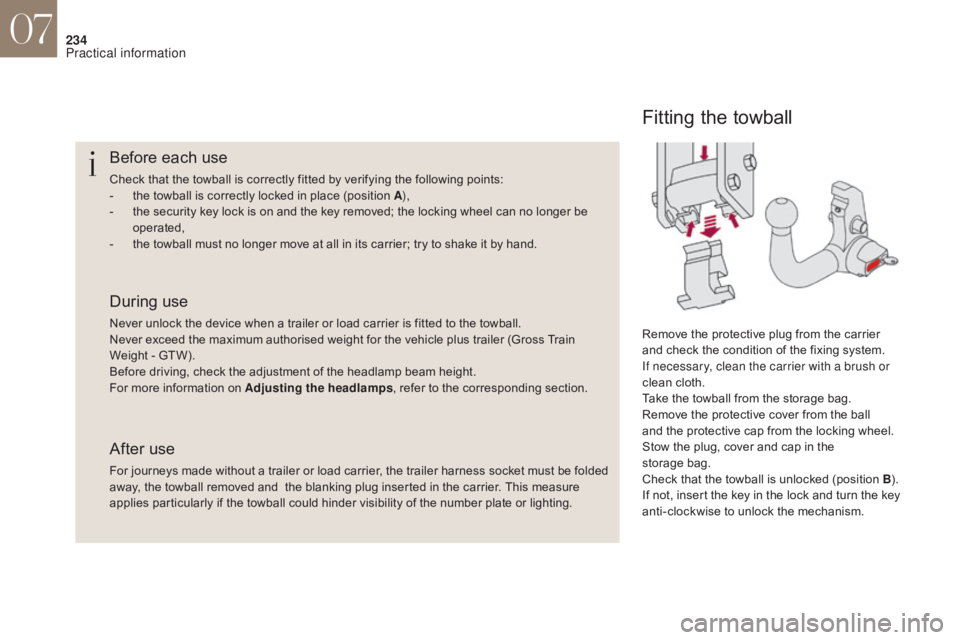
Remove the protective plug from the carrier
and check the condition of the fixing system.
If necessary, clean the carrier with a brush or
clean cloth.
Take the towball from the storage bag.
Remove the protective cover from the ball
and
the protective cap from the locking wheel.
Stow the plug, cover and cap in the
storage
bag.
Check that the towball is unlocked (position B ).
If not, insert the key in the lock and turn the key
anti-clockwise to unlock the mechanism.
07
Practical information
Page 237 of 421
235
If the key cannot be turned or removed,
this means that the towball is not fitted
correctly; start the procedure again.
If one of the locking conditions is not
met, start the procedure again.
In all cases, if the marking remains
red, do not use the towbar and contact
a CITROËN dealer or a qualified
workshop.
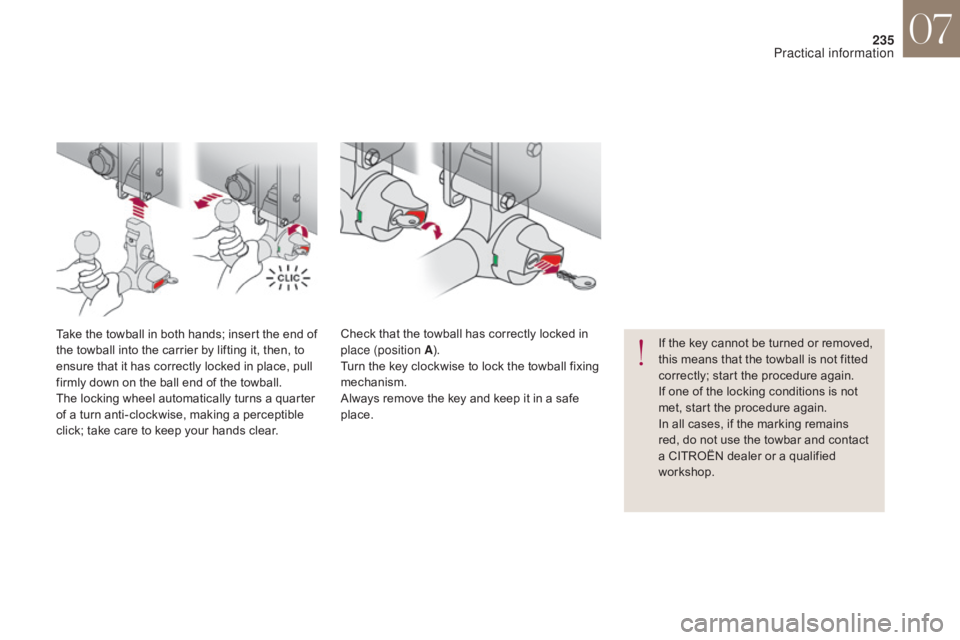
Take the towball in both hands; insert the end of
the towball into the carrier by lifting it, then, to
ensure that it has correctly locked in place, pull
firmly down on the ball end of the towball.
The locking wheel automatically turns a quarter
of a turn anti-clockwise, making a perceptible
click; take care to keep your hands clear.
Check that the towball has correctly locked in
place (position A
).
Turn the key clockwise to lock the towball fixing
mechanism.
Always remove the key and keep it in a safe
place.
07
Practical information
Page 239 of 421

237
Be ready for the weight of the towball
(around 3.5 kg). Risk of injury!
Grasp the towball firmly with one hand; with
the other hand, press and turn the locking
wheel
clockwise as far as it will go.
Extract the towball downward. Refit the protective cover for the ball and the
protective cover for the locking wheel.
Stow the towball in its bag.
Refit the protective blanking plug to the carrier.
Maintenance
Correct operation is only possible if the towball
and its carrier remain clean.
Before cleaning the vehicle with a high pressure
jet wash, the towbar harness socket carrier must
be folded away, the towball removed and the
blanking plug inserted in the carrier.
For any work on the towbar, got to a CITROËN
dealer or a qualified workshop.
07
Practical information
Page 262 of 421

260
Temporary puncture repair kit
This kit consists of a compressor and a sealant
cartridge.
It allows the temporary repair of a tyre.
You are then able to go to the nearest garage.Access to the kit
This kit is installed in the storage box, under the
boot floor.
It is designed to repair most punctures
which could affect the tyre, located on
the tyre tread or shoulder.
Its compressor can be used to check
and adjust the pressure of the tyre.
The vehicle's electric system allows the
connection of a compressor for long enough
to inflate a tyre after a puncture repair or for
inflating a small inflatable accessory.
Tyre under-inflation detection
If the vehicle is fitted with tyre under-
inflation detection, the under-inflation
warning lamp will remain on after the
wheel has been repaired until the
system is reinitialised by a CITROËN
dealer or a qualified workshop.
Only
the 12 V socket at the front of
the vehicle allows the connection of the
compressor for long enough to repair or
inflate a tyre.
The other 12 V sockets in the vehicle
are not suited to the use of the
compressor.
08
In the event of a breakdown
Page 263 of 421
261
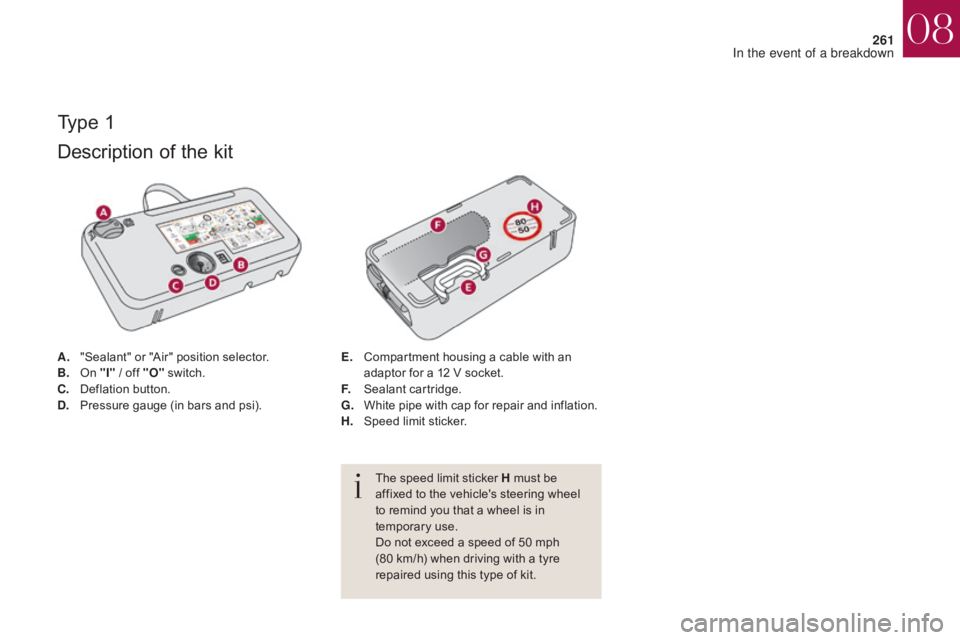
The speed limit sticker H must be
affixed to the vehicle's steering wheel
to remind you that a wheel is in
temporary use.
Do not exceed a speed of 50 mph
(80 km/h) when driving with a tyre
repaired using this type of kit.
Description of the kit
A. "Sealant" or "Air" position selector.
B. O n "I" / off "O" switch.
C.
D
eflation button.
D.
P
ressure gauge (in bars and psi). E. C
ompartment housing a cable with an
adaptor for a 12 V socket.
F.
S
ealant cartridge.
G.
W
hite pipe with cap for repair and inflation.
H.
S
peed limit sticker.
Ty p e 1
08
In the event of a breakdown
Page 269 of 421
267
Ty p e 2
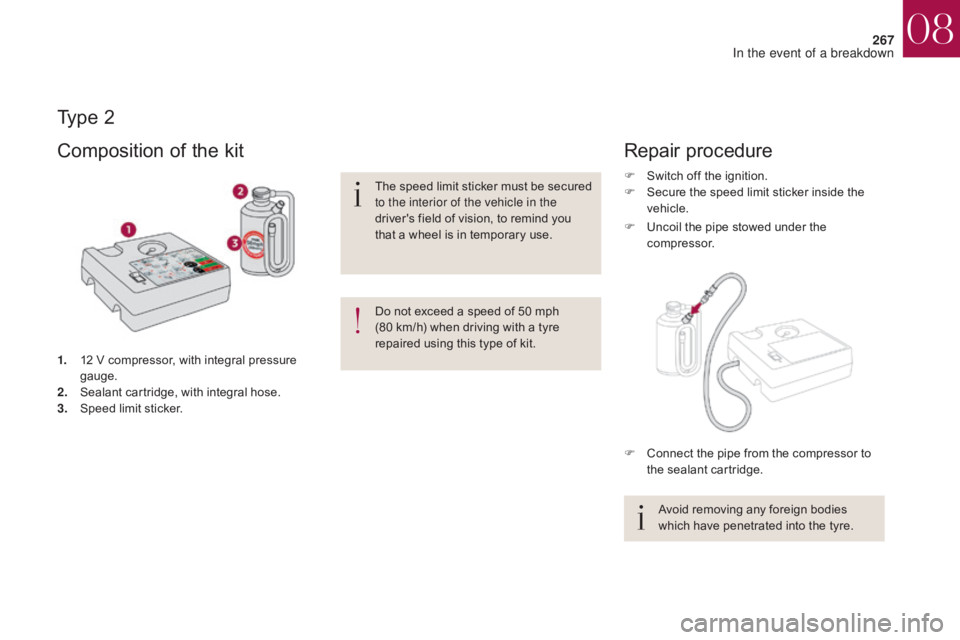
1. 12 V compressor, with integral pressure gauge.
2.
S
ealant cartridge, with integral hose.
3.
S
peed limit sticker.
Composition of the kit
The speed limit sticker must be secured
to the interior of the vehicle in the
driver's field of vision, to remind you
that a wheel is in temporary use.
Do not exceed a speed of 50 mph
(80
km/h) when driving with a tyre
repaired using this type of kit.
Repair procedure
F Switch off the ignition.
F S ecure the speed limit sticker inside the
vehicle.
Avoid removing any foreign bodies
which have penetrated into the tyre.
F
U
ncoil the pipe stowed under the
compressor.
F
C
onnect the pipe from the compressor to
the sealant cartridge.
08
In the event of a breakdown