tow CITROEN DS4 2010 Workshop Manual
[x] Cancel search | Manufacturer: CITROEN, Model Year: 2010, Model line: DS4, Model: CITROEN DS4 2010Pages: 421, PDF Size: 8.05 MB
Page 275 of 421
273
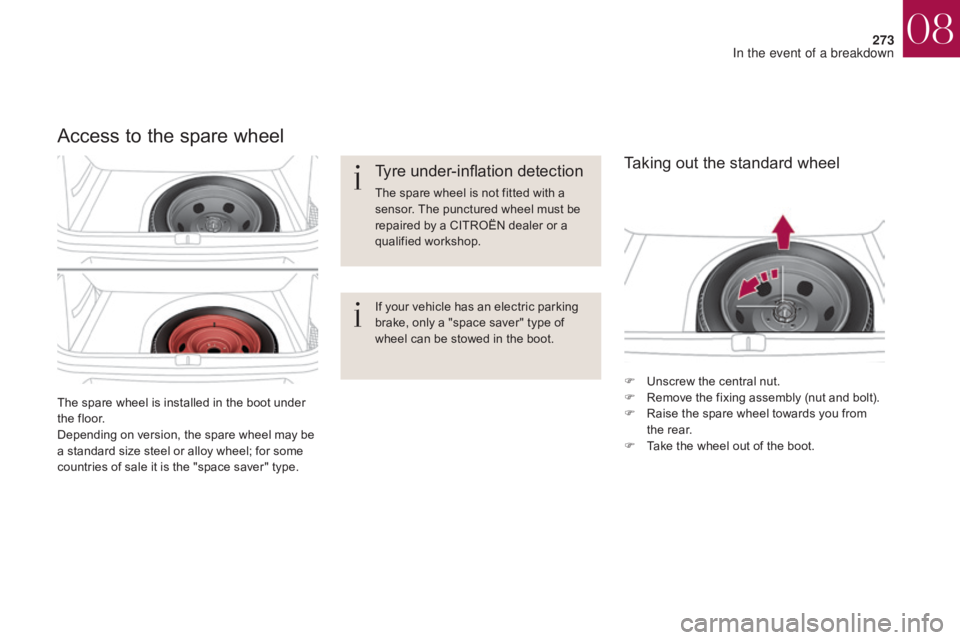
The spare wheel is installed in the boot under
the floor.
Depending on version, the spare wheel may be
a standard size steel or alloy wheel; for some
countries of sale it is the "space saver" type.
Access to the spare wheel
If your vehicle has an electric parking
brake, only a "space saver" type of
wheel can be stowed in the boot.F
U
nscrew the central nut.
F
R
emove the fixing assembly (nut and bolt).
F
R
aise the spare wheel towards you from
the rear.
F
T
ake the wheel out of the boot.
Tyre under-inflation detection
The spare wheel is not fitted with a
sensor. The punctured wheel must be
repaired by a CITROËN dealer or a
qualified workshop.
Taking out the standard wheel
08
In the event of a breakdown
Page 281 of 421

279
Changing a bulb
The headlamps have polycarbonate
lenses with a protective coating:
F
d
o not clean them using a dr y
or abrasive cloth, nor with a
detergent or solvent product,
F
u
se a sponge and soapy water or a
pH neutral product,
F
w
hen using a high pressure
washer on persistent marks, do not
keep the lance directed towards
the lamps or their edges for too
long, so as not to damage their
protective coating and seals. Changing a bulb should only be done
after the headlamp has been switched
off for several minutes (risk of serious
burns).
F
D
o not touch the bulb directly with
your fingers, use a lint-free cloth.
It is imperative to use only anti-
ultraviolet (UV) type bulbs to avoid
damaging the headlamp.
Always replace a failed bulb with a
new bulb with the same type and
specification.Light-emitting diodes (LED)
For the replacement of this type of
lamp, go to a CITROËN dealer or a
qualified workshop.
LED (light-emitting diode) replacement
kits are available from CITROËN
dealers.
Risk of electrocution
Xenon bulbs (D1S) must be replaced
by a CITROËN dealer or a qualified
workshop.
08
In the event of a breakdown
Page 285 of 421

283
F Remove the protective cover by pulling the tab.
F
D
isconnect the wiring connector.
F
T
urn the bulb holder a quarter of a turn and
extract it.
F
P
ull the bulb and change it.
To reassemble, carry out these operations in
reverse order. F
I nsert a flat screwdriver towards the centre
of the repeater between the repeater and
the base of the mirror.
F
T
ilt the flat screwdriver to extract the
repeater and remove it.
F
D
isconnect the repeater connector.
To reassemble, carry out these operations in
reverse order.
Contact a CITROËN dealer or a qualified
workshop to obtain replacement repeaters.
For the replacement of this type of LED lamp,
contact a CITROËN dealer or a qualified
workshop.
Changing daytime running lamp /
s idelamp bulbs (on models with
type
1 halogen headlamps) Changing daytime running lamp
/
sidelamp bulbs (on models with
type
2 halogen or xenon headlamps)Changing integrated direction
indicator side repeaters
08
In the event of a breakdown
Page 287 of 421

285
1. Brake lamps (P21/5W).
2. Sidelamps (LEDs) *.
3.
D
irection indicators (PY21W amber).
4.
R
eversing lamp (P21W).
5.
R
ear foglamps (P21W).
Rear lamps
Amber bulbs, such as those for the
direction indicators, must be replaced
by bulbs of the same rating and colour.
The lamps on the tailgate, other than
the guide lamps, are dummy units.
They are there for aesthetic purposes
o n l y. These three bulbs are changed from inside the boot:
F
o
pen the boot,
F
r
emove the access grille from the
corresponding side trim panel,
F s lacken the two nuts using a 10 mm tube
spanner then remove the nuts by hand,
F
u
nclip the lamp unit connector,
F
e
xtract the lamp unit carefully pulling in its
middle towards the outside,
F
r
emove the foam seal,F
u
nclip the two small secondary connectors,
F
s
pread the two tabs and remove the bulb
h o l d e r,
F t urn the bulb a quarter of a turn and change it.
To reassemble, carry out these operations in
reverse order.
Take care to engage the lamp unit in its guides,
while keeping it in line with the vehicle.
Tighten sufficiently to ensure sealing, but
without forcing, so as to avoid damaging
the
lamp.
* LED: light-emitting diodes.
Changing stop lamp, reversing lamp and direction indicator bulbs
08
In the event of a breakdown
Page 298 of 421

296
Towing the vehicleProcedure for having your vehicle towed or for towing another vehicle using a removable towing eye.
The towing eye is installed in the boot under
the floor.
To gain access to it:
F
o
pen the boot,
Access to the tools
General recommendations
Observe the legislation in force in your
c o unt r y.
Ensure that the weight of the towing
vehicle is higher than that of the towed
vehicle.
The driver must remain at the wheel
of the towed vehicle and must have a
valid driving licence.
When towing a vehicle with all four
wheels on the ground, always use an
approved towing arm; rope and straps
are prohibited.
The towing vehicle must move off
g e nt l y.
When towing a vehicle with the engine
off, there is no longer any power
assistance for braking or steering. In the following cases, you must always call
on a professional recovery service:
-
v
ehicle broken down on a motor way or
fast road,
-
f
our-wheel drive vehicle,
-
w
hen it is not possible to put the gearbox
into neutral, unlock the steering, or
release the parking brake,
-
t
owing with only two wheels on the
ground,
-
w
here there is no approved towing arm
available...
F
r
aise the floor,
F
s
ecure it by hooking its cord on the hook
on the rear parcel shelf support,
F
r
emove the towing eye from the holder.
08
In the event of a breakdown
Page 299 of 421

297
F On the front bumper, unclip the cover by pressing on the left.
F
S
crew the towing eye in fully.
F
I
nstall the towing arm.
Towing your vehicle Towing another vehicle
F Place the gear lever in neutral
(position N on an automatic
gearbox).
F
ailure to observe this instruction
could result in damage to
certain components (braking,
transmission...) and the absence
of braking assistance the next time
the engine is started.
F
U
nlock the steering and release the
parking brake.
F
S
witch on the hazard warning lamps on
both vehicles.
F
M
ove off gently, drive slowly and for a short
distance. F
O
n the rear bumper, unclip the cover by
pressing at the top.
F
S
crew the towing eye in fully.
F
I
nstall the towing arm.
F
S
witch on the hazard warning lamps on
both vehicles.
F
M
ove off gently, drive slowly and for a short
distance.
08
In the event of a breakdown
Page 304 of 421

302
Engines
Engine characteristics
The engine characteristics (capacity, maximum
power, maximum engine speed, fuel, CO
2
emissions, etc.) for your vehicle are given in
the registration document, as well as in sales
brochures.
These characteristics correspond to the
values type-approved on a test bed, under
conditions defined in European legislation
(Directive
1
999/99/EC).
For more information, contact a CITROËN
dealer or a qualified workshop.
Weights
Weights and towed loads
The maximum weights and towed loads for your
vehicle are given are given in the registration
document, as well as in sales brochures.
These values are also present on the
manufacturer's plate or label.
For more information, contact a CITROËN
dealer or a qualified workshop.
The kerb weight is equal to the unladen
weight
+ driver (75 kg).
The GTW and towed load values indicated
apply up to a maximum altitude of
1
000 metres; the towed load mentioned
must be reduced by 10 % for every additional
1
000 metres.
The weight of the braked trailer can be
increased, within the GTW limit, on condition
that the GV W of the towing vehicle is reduced
by the same amount.
The recommended nose weight is the vertical
load on the towbar ball (removable with or
without tools).
GV W:
g
ross vehicle weight, the maximum
authorised vehicle weight.
GT W:
g
ross train weight, the maximum
authorised weight of vehicle plus trailer. High exterior temperatures may result
in a reduction in the per formance of
the vehicle to protect the engine; when
the exterior temperature is higher than
37
°C, limit the towed weight.
If the exterior temperature is high, it
is recommended that the engine be
allowed to idle for 1 to 2 minutes after
the vehicle comes to a stop, to facilitate
its cooling. Towing with a lightly loaded vehicle can
adversely affect roadholding.
Braking distances are increased when
towing a trailer.
Never exceed 60 mph (100 km/h) when
towing (comply with the legislation in
force in your country).
09
Technical data
Page 323 of 421

1
7
8
12
9
13
10
14
11
15
2
3
4
5
6
321
Level 1Level 2 Level 3 Comments
Navigation
Secondary page
Enter destination Address
Current loc.
Address settings.
Point of interest
Town center
Save Save the current address.
Add waypoint Add a waypoint to the route.
Navigate to Press to calculate the route.
Contacts Addresses
Select a contact then calculate the route.
View
Navigate to
Search for contact
Call
On the map Display the map and zoom to view the roads.
Itinerary Create, add or delete a waypoint or view the
itinerary.
Stop Delete navigation information.
Navigate to Press to calculate the route.
Audio and Telematics
Page 328 of 421

1
2
10
326
Navigation - Guidance
Choosing a new destination
Select "Enter destination ". Select "
Save" to save the address
entered as a contact entry.
The system allows up to 200 entries.
Select " Confirm ".
Press on " Show route on map " to start
navigation.
Select "
Address ".
Select the " Country:" from the
list offered, then in the same
way the " City:" or its post
code, the " Road:", the " N°:".
Confirm each time. Select "
Navigate to ".
Choose the restriction criteria:
" To l l s ", "Ferries ", "Tr a f f i c ", "Strict ",
" Close ".
Choose the navigation criteria:
"
Fastest " or "Shortest " or "Time/
distance " or "Ecological". To delete navigation information, press on
"
Settings ".
Press on " Stop navigation ".
To resume navigation press on " Settings".
Press on " Resume guidance ".
Press on Navigation
to display the
primary page.
Press on the secondary page.
Towards a new destination
Or
Audio and Telematics
Page 329 of 421

1
1
3
327
Towards a recent destination
Select "Enter destination ".
Select an address from
the list offered.
Press on Navigation
to display the
primary page.
Press on the secondary page.
Select " Navigate to ".
Towards a contact
Select "Enter destination ".
Select " Contacts ".
Press on Navigation
to display the
primary page.
Press on the secondary page. Select a destination from
the contacts in the list
offered.
Select " Navigate to ".
Select the criteria then " Confirm" to
start navigation.
To be able to use navigation "towards
a contact in the directory", it is first
necessary to enter the address for your
contact.
Select the criteria then " Confirm" or
press " Show route on map " to start
navigation.
Audio and Telematics