temperature Citroen DS4 2014 1.G User Guide
[x] Cancel search | Manufacturer: CITROEN, Model Year: 2014, Model line: DS4, Model: Citroen DS4 2014 1.GPages: 444, PDF Size: 12.68 MB
Page 98 of 444

Switching the system off
F Turn the air flow control to the left until all of the indicator
lamps go off.
This switch does not operate the air conditioning, only the air fan.
When the "REST" function is activated, you cannot modify the temperature, air flow
and distribution settings: these are controlled automatically according to the ambient
temperature.
This function is not available in the STOP mode of Stop & Start. Avoid prolonged operation in interior
air recirculation mode or driving for
long periods with the system off (risk of
misting and deterioration of air quality).
On switching on the engine
-
T
he control screens come on: the function
is available.
-
P
ressing the REST button activates the
ventilation for a few minutes. Activation of
the function is confirmed by the display of
two dashes in the control screens and four
air flow level indicator lamps.
-
T
he function can be deactivated and
reactivated if the control screens are on.
-
T
he screens go off at the end of this
period. On stopping the engine
-
W
hile the control screens remain on: the
function is available.
-
P
ressing the REST button activates the
ventilation for a few minutes. Activation of
the function is confirmed by the display of
two dashes in the control screens and four
air flow level indicator lamps.
L
ocking the vehicle has no effect on this
function.
-
T
he control screens go off at the end of this
period.
P
ressing again before the end of the period
interrupts off the ventilation definitively: the
control screens go off and the function is
no longer available. This action switches off the air conditioning and
the ventilation.
Temperature related comfort is no longer
assured but a slight flow of air, due to the
movement of the vehicle, can still be felt.
F
M
odify the settings (temperature, air flow
or air distribution) or press the "AUTO"
button to reactivate the system with the
values set before it was switched off.
Page 99 of 444

97
Front demist - defrost
These markings on the control panel indicate the control positions for rapid demisting or
defrosting of the windscreen and side windows.
With manual air
conditioning
F Put the temperature, air flow and distribution controls to the dedicated
marked position.
F
P
ut the air intake control to the "Exterior air
intake" position
(
indicator lamp on the control off).
F
S
witch on the air conditioning by pressing
the "A /C " button; the warning lamp in the
button comes on.
With digital dual-zone air
conditioning
With Stop & Start, when the demisting,
air conditioning and air flow functions
are activated, STOP mode is not
available.
Automatic visibility programme
F Select this programme to demist or defrost the windscreen and side windows as
quickly as possible.
The system automatically manages the air
conditioning, air flow and air intake, and
provides optimum distribution towards the
windscreen and side windows.
F
T
o stop the programme, press either the
"visibility" button again or "AUTO" , the
warning lamp on the button goes off and
the warning lamp on the "AUTO" button
comes on.
The system starts again with the values in
use before it was overridden by the visibility
programme. With Stop & Start, when demisting has
been activated, the STOP mode is not
available.
Comfort
Page 121 of 444

11 9
Panoramic windscreen
A tinted panoramic windscreen that increases brightness and vision in the cabin. Fitted on each side with a blind to improve temperature control and a
sun visor to avoid dazzle.F
T
o open the blind, pull it by its central grip
to the desired position.
F
T
o close or stow the blind, pull it for ward by
its central grip then guide it to the desired
position.
The sun visor must be in the folded position
before moving the blind.
Blind
Fitted with a vanity mirror and ticket holder.
F L ower the sun visor to avoid dazzle from
the front.
F
D
isengage the sun visor from its central
fixing and turn it towards the door glass to
avoid dazzle from the side.
Sun visor
Do not attach or hang heavy objects on
the blinds or their slide rails.
Fittings
Page 130 of 444

Lighting controlsSystem for selection and control of the various front and rear lamps providing the vehicle's lighting.
The various front and rear lamps of the vehicle
are designed to adapt the driver's visibility
progressively according to the climatic
conditions:
-
s
idelamps, to be seen,
-
d
ipped beam headlamps to see without
dazzling other drivers,
-
m
ain beam headlamps to see clearly when
the road is clear.
Main lighting
Other lamps are provided to meet the
requirements of particular driving conditions:
-
r
ear foglamps,
-
f
ront foglamps with cornering lighting,
-
d
irectional headlamps for improved
visibility when cornering,
-
d
aytime running lamps to be more visible
during the day,
-
g
uide-me-home and welcome lighting to
facilitate access to the vehicle,
-
p
arking lamps as vehicle position markers.
Additional lighting
The setting of some functions can be adjusted:
- a utomatic illumination of headlamps,
-
g
uide-me-home lighting,
-
w
elcome lighting,
-
d
irectional lighting.
Programming
In some weather conditions (e.g. low
temperature or humidity), the presence
of misting on the internal sur face of the
glass of the headlamps and rear lamps
is normal; it disappears after the lamps
have been on for a few minutes.
Page 188 of 444

In wintry conditions, the warning lamp
can stay on for a longer period. When
the engine is hot, the warning lamp
does not come on.
In certain cases, you may have to apply
more force to the steering (wheels on
full lock, for example). If the engine does not start straight
away, switch off the ignition. Wait a
few moments before operating the
starter motor again. If the engine does
not start after several attempts, do not
keep trying: you risk damaging the
starter motor or the engine. Contact
a CITROËN dealer or a qualified
workshop.In temperate conditions, do not leave
the engine at idle to warm up but move
off straight away and drive at moderate
speed.
Never leave the engine running in
an enclosed area without adequate
ventilation: internal combustion
engines emit toxic exhaust gases,
such as carbon monoxide. Danger of
intoxication and death.
In very severe wintry conditions
(temperatures below -23°C), to ensure
the correct operation and durability of
the mechanical components of your
vehicle, engine and gearbox, it is
necessary to leave the engine running
for 4 minutes before moving off.
Starting the engine
With the parking brake applied and the gearbox
in neutral or position N
or P:
F
d
epress the clutch pedal fully (manual
gearbox),
or
F
p
ress the brake pedal firmly (electronic or
automatic gearbox),
F
i
nsert the key into the ignition switch; the
system recognises the code,
F
u
nlock the steering column by simultaneously
turning the steering and the
key.
F
W
ith a petrol engine, operate the starter
motor by turning the key to position 3
without pressing the accelerator pedal,
until the engine starts. Once the engine is
running, release the key.
F
W
ith a Diesel engine, turn the key to
position 2 , ignition on, to operate the
engine pre-heating system.Wait until this warning lamp goes off in the
instrument panel then operate the starter
motor by turning the key to position
3
without pressing the accelerator pedal,
until the engine starts. Once the engine is
running, release the key.
Page 190 of 444
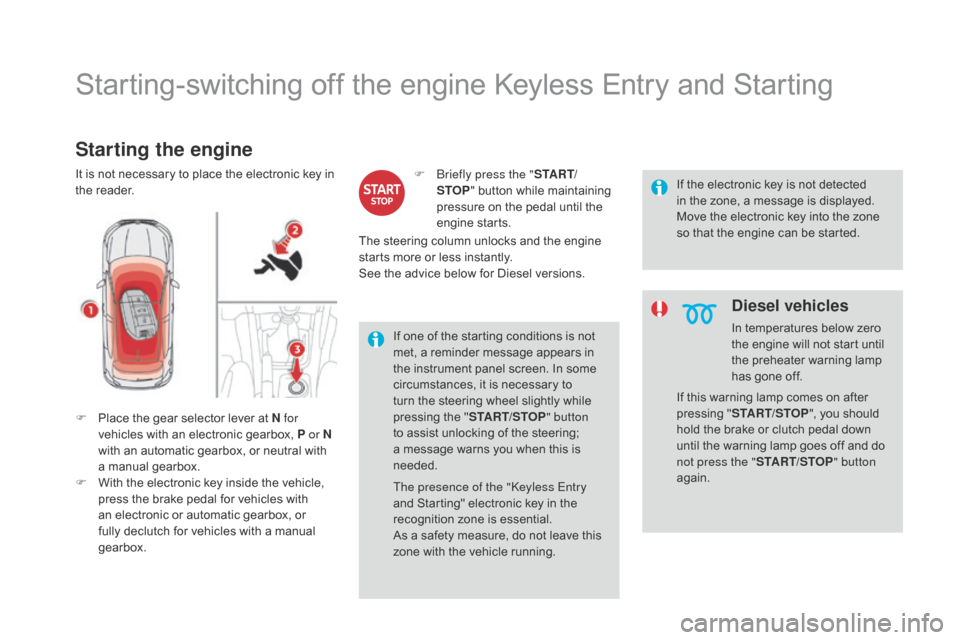
Starting-switching off the engine Keyless Entry and Starting
Starting the engine
F Place the gear selector lever at N for vehicles with an electronic gearbox, P or N
with an automatic gearbox, or neutral with
a manual gearbox.
F
W
ith the electronic key inside the vehicle,
press the brake pedal for vehicles with
an electronic or automatic gearbox, or
fully declutch for vehicles with a manual
gearbox. F
B
riefly press the "
S TA R T/
STOP " button while maintaining
pressure on the pedal until the
engine starts. If the electronic key is not detected
in the zone, a message is displayed.
Move the electronic key into the zone
so that the engine can be started.
If one of the starting conditions is not
met, a reminder message appears in
the instrument panel screen. In some
circumstances, it is necessary to
turn the steering wheel slightly while
pressing the " START/STOP " button
to assist unlocking of the steering;
a message warns you when this is
needed.
The presence of the "Keyless Entry
and Starting" electronic key in the
recognition zone is essential.
As a safety measure, do not leave this
zone with the vehicle running.
diesel vehicles
In temperatures below zero
the engine will not start until
the preheater warning lamp
has gone off.
If this warning lamp comes on after
pressing " START/STOP ", you should
hold the brake or clutch pedal down
until the warning lamp goes off and do
not press the " START/STOP" button
again.
The steering column unlocks and the engine
starts more or less instantly.
See the advice below for Diesel versions.
It is not necessary to place the electronic key in
the reader.
Page 214 of 444
Stop & StartThe Stop & Start system puts the engine temporarily into standby - STOP mode - during stops in the traffic (red lights, traffic jams, or other...).
T he engine restarts automatically - START mode - as soon as you want to move off. The restart takes place instantly, quickly and silently.
Per fect for urban use, the Stop & Start system reduces fuel consumption and exhaust emissions as well as the noise level when stationary.
Operation
Going into engine STOP mode
With an electronic gearbox, for your
comfort during parking manoeuvres,
STOP mode is not available for a
few
seconds after coming out of
reverse gear.
STOP mode does not affect the
functionality of the vehicle, such as
braking, power steering, for example.
Never refuel with the engine in STOP
mode; you must switch off the ignition
with the key or the "START/STOP"
button.
The
"ECO" warning lamp comes on
in the instrument panel and the engine
goes into standby automatically:
-
w
ith a manual gearbox
, at speeds below
12 mph (20 km/h), or vehicle stationary with
PureTech 130 petrol and BlueHDi 115 and
120 Diesel versions, when you put the gear
lever into neutral and release the clutch
pedal,
-
w
ith an electronic gearbox , at a speed
below 5 mph (8 km/h), when you press
the brake pedal or place the gear lever in
position N .
-
w
ith an automatic gearbox, vehicle
stationary, when you press the brake pedal
or place the gear lever in position N .If your vehicle is fitted with the
system, a time counter calculates
the sum of the periods in STOP
mode during a journey. It resets
itself to zero every time the
ignition is switched on with the
key or the "START/STOP" button.
STOP mode is not invoked when:
-
t
he vehicle is on a steep slope (up or
d ow n),
-
t
he driver's door is open,
-
t
he driver's seat belt is not fastened,
- t he vehicle has not exceeded 6 mph
(10 km/h) since the last engine start (using
the key or the "START/STOP" button),
-
t
he electric parking brake is applied or
being applied,
-
t
he engine is needed to maintain a
comfortable temperature in the passenger
compartment,
-
d
emisting is active,
-
s
ome special conditions (battery charge,
engine temperature, braking assistance,
ambient temperature...) where the engine is
needed to assure control of a system.
Special cases: STOP mode
unavailable
In this case, the "ECO" warning lamp
flashes for a few seconds, then goes
of f.
This operation is perfectly normal.
Page 215 of 444

213
Going into engine START mode
The "ECO" warning lamp goes off
and the engine starts automatically:
-
w
ith a manual gearbox , when you fully
depress the clutch pedal,
-
w
ith an electronic gearbox :
●
g
ear lever in position A or M , when you
release the brake pedal,
●
o
r gear lever in position N and the brake
pedal released, when you place the gear
lever in position A or M ,
●
o
r when you engage reverse gear.
-
w
ith an automatic gearbox:
●
g
ear lever in position d or M, when you
release the brake pedal,
●
o
r gear lever in position N and brake
pedal released, when you place the gear
lever in position
d or M,
●
o
r when you engage reverse gear.
Special cases: START invoked
automatically
With a manual gearbox in STOP mode,
if a gear is engaged without fully
depressing the clutch pedal, a warning
lamp comes on or an alert message
is displayed asking you to depress the
clutch pedal to restart the engine.
In this case the "ECO" warning
lamp flashes for few seconds, then
goes
off.
This operation is perfectly normal. For safety reasons or to ensure smooth
operation, START mode is invoked
automatically when:
-
y
ou open the driver's door,
-
y
ou unfasten the driver's seat belt,
-
t
he speed of the vehicle exceeds 15 mph
(25 km/h) with a manual gearbox (3 km/h
(2 mph) with PureTech 130 petrol and
BlueHDi Diesel 115 and 120 versions),
7
mph (11 km/h) with an electronic gearbox
or 2 mph (3 km/h) with an automatic
gearbox,
-
t
he electric parking brake is being applied,
-
s
ome special conditions (battery charge,
engine temperature, braking assistance,
ambient temperature...) where the engine is
needed to assure control of a system.
driving
Page 245 of 444
243
Coolant level
The coolant level should be close
to the "MA X" mark but should never
exceed it.
Fluid specification
The coolant must conform to the
manufacturer's recommendations.To check the level or top up the
fluid on vehicle fitted with headlamp
washers, immobilise the vehicle and
switch of the engine.
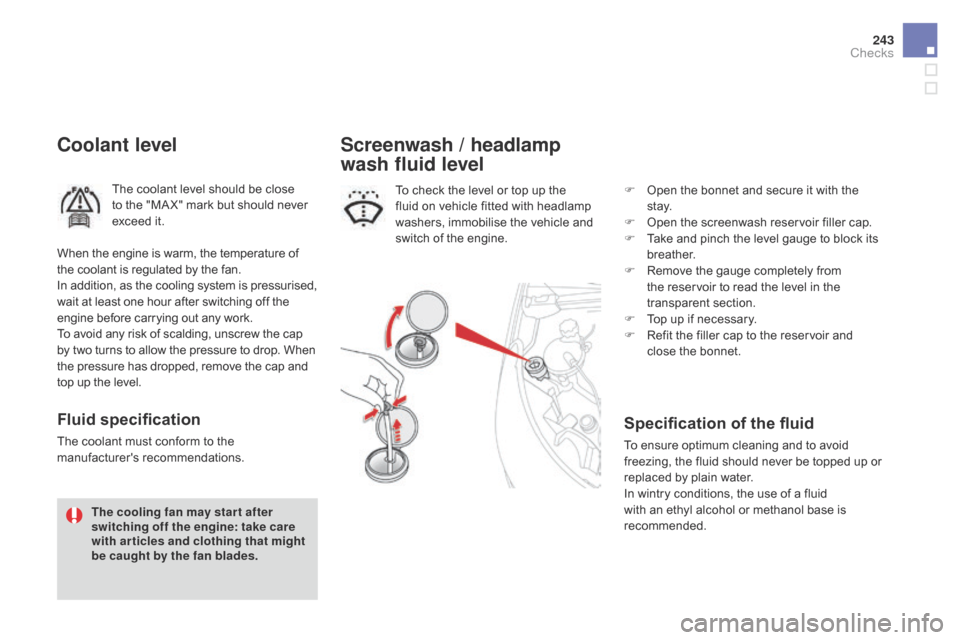
Screenwash / headlamp
wash fluid level
The cooling fan may star t after
switching off the engine: take care
with articles and clothing that might
be caught by the fan blades.
When the engine is warm, the temperature of
the coolant is regulated by the fan.
In addition, as the cooling system is pressurised,
wait at least one hour after switching off the
engine before carrying out any work.
To avoid any risk of scalding, unscrew the cap
by two turns to allow the pressure to drop. When
the pressure has dropped, remove the cap and
top up the level.
F
O
pen the bonnet and secure it with the
st ay.
F
O
pen the screenwash reservoir filler cap.
F
T
ake and pinch the level gauge to block its
breather.
F
R
emove the gauge completely from
the reservoir to read the level in the
transparent section.
F
T
op up if necessary.
F
R
efit the filler cap to the reservoir and
close the bonnet.
Specification of the fluid
To ensure optimum cleaning and to avoid
freezing, the fluid should never be topped up or
replaced by plain water.
In wintry conditions, the use of a fluid
with an ethyl alcohol or methanol base is
recommended.
Checks
Page 256 of 444

Freezing of the AdBlue® additive
The AdBlue
® additive freezes at
temperatures below around -11°C.
The SCR system includes a heater
for the AdBlue
® tank, allowing you to
continue driving in very cold conditions.
If a fault with the SCR system is confirmed
(after 30 miles (50 km) covered with the
permanent display of the message signalling
a fault), the SERVICE and engine diagnostic
warning lamps come on and the UREA
warning lamp flashes, accompanied by an
audible signal and the display of a message
(e.g.: "Emissions fault: Starting prevented in
150
miles") indicating the remaining range
express in miles or kilometres.
While driving, the message is displayed every
30 seconds while the fault with the SCR system
persists.
The alert is repeated when switching on the
ignition.
You should go to a CITROËN dealer or a
qualified workshop as soon as possible.
Other wise, you will not be able to restart your
engine.
du
ring an authorised driving phase (between
650 miles and 0 miles) (1 100 km and 0 km)Every time the ignition is switched on, the SERVICE
and engine diagnostic warning lamps come on and
the UREA warning lamp flashes, accompanied by
an audible signal and the display of the message
"Emissions fault: Starting prevented".
Starting prevented
You have exceeded the authorised
driving limit: the starting prevention
system inhibits engine starting.
To be able to start the engine, you must call on
a CITROËN dealer or a qualified workshop.