ignition Citroen DS4 2014 1.G Repair Manual
[x] Cancel search | Manufacturer: CITROEN, Model Year: 2014, Model line: DS4, Model: Citroen DS4 2014 1.GPages: 444, PDF Size: 12.68 MB
Page 205 of 444

203
Stopping the vehicleOperating fault
With the ignition on, the flashing of AUTO ,
accompanied by an audible signal and a
message in the screen, indicates a malfunction
of the gearbox.
Have it checked by a CITROËN dealer or a
qualified workshop.
When immobilising the vehicle, with
the engine running, you must place the
gear selector in neutral N .
Before carrying out any work in the
engine compartment, ensure that the
gear selector is in neutral N and that
the parking brake is applied.
Whatever the circumstances, you must
manually apply the parking brake when
parking, unless the parking brake is
programmed in automatic mode.
Before switching off the engine, you can:
-
m
ove to position N to engage neutral,
or
-
l
eave the gear engaged; in this case, it will
not be possible to move the vehicle.
To engage reverse gear R
, the vehicle must be
immobilised with your foot on the brake pedal.
F
Sel
ect position R .
At low high speed, if reverse gear is requested,
the N indicator flashes and the gearbox goes
into neutral automatically. To engage reverse,
put the gear selector in position N , then
position R . In both cases, you must apply the parking
brake
to immobilise the vehicle, unless it is
programmed in automatic mode.
Reverse
Engagement of reverse gear is
accompanied by an audible signal.
driving
Page 209 of 444
207
Invalid value during manual
operation
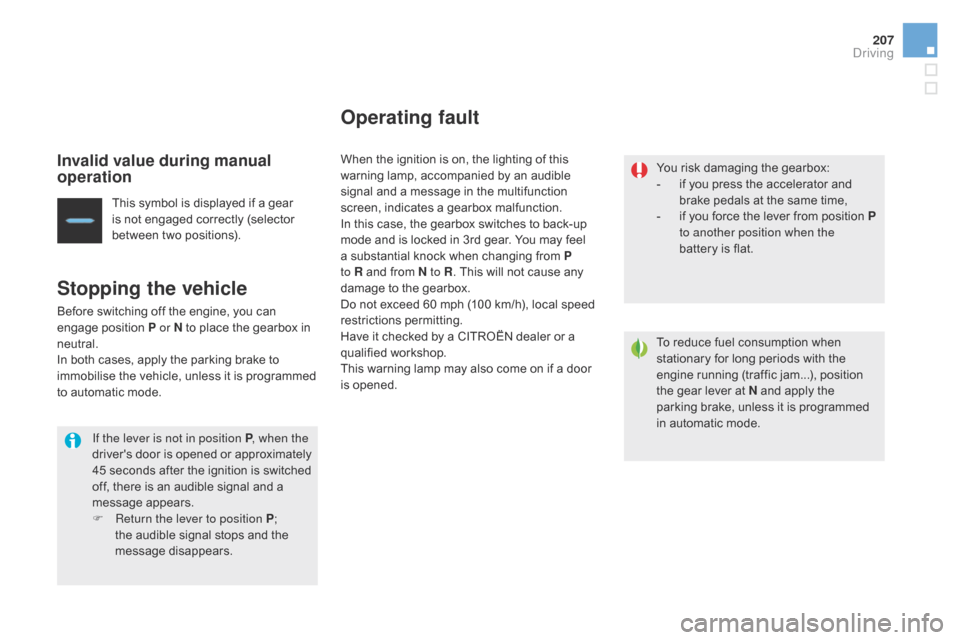
This symbol is displayed if a gear
is not engaged correctly (selector
between two positions).
Stopping the vehicle
Before switching off the engine, you can
engage position P or N to place the gearbox in
neutral.
In both cases, apply the parking brake to
immobilise the vehicle, unless it is programmed
to automatic mode.If the lever is not in position P , when the
driver's door is opened or approximately
45 seconds after the ignition is switched
off, there is an audible signal and a
message appears.
F
R
eturn the lever to position P ;
the audible signal stops and the
message disappears.
Operating fault
When the ignition is on, the lighting of this
warning lamp, accompanied by an audible
signal and a message in the multifunction
screen, indicates a gearbox malfunction.
In this case, the gearbox switches to back-up
mode and is locked in 3rd gear. You may feel
a substantial knock when changing from P
to R and from N to R . This will not cause any
damage to the gearbox.
Do not exceed 60 mph (100 km/h), local speed
restrictions permitting.
Have it checked by a CITROËN dealer or a
qualified workshop.
This warning lamp may also come on if a door
is opened. You risk damaging the gearbox:
-
i
f you press the accelerator and
brake pedals at the same time,
-
i
f you force the lever from position
P
to another position when the
battery is flat.
To reduce fuel consumption when
stationary for long periods with the
engine running (traffic jam...), position
the gear lever at N and apply the
parking brake, unless it is programmed
in automatic mode.
driving
Page 214 of 444
Stop & StartThe Stop & Start system puts the engine temporarily into standby - STOP mode - during stops in the traffic (red lights, traffic jams, or other...).
T he engine restarts automatically - START mode - as soon as you want to move off. The restart takes place instantly, quickly and silently.
Per fect for urban use, the Stop & Start system reduces fuel consumption and exhaust emissions as well as the noise level when stationary.
Operation
Going into engine STOP mode
With an electronic gearbox, for your
comfort during parking manoeuvres,
STOP mode is not available for a
few
seconds after coming out of
reverse gear.
STOP mode does not affect the
functionality of the vehicle, such as
braking, power steering, for example.
Never refuel with the engine in STOP
mode; you must switch off the ignition
with the key or the "START/STOP"
button.
The
"ECO" warning lamp comes on
in the instrument panel and the engine
goes into standby automatically:
-
w
ith a manual gearbox
, at speeds below
12 mph (20 km/h), or vehicle stationary with
PureTech 130 petrol and BlueHDi 115 and
120 Diesel versions, when you put the gear
lever into neutral and release the clutch
pedal,
-
w
ith an electronic gearbox , at a speed
below 5 mph (8 km/h), when you press
the brake pedal or place the gear lever in
position N .
-
w
ith an automatic gearbox, vehicle
stationary, when you press the brake pedal
or place the gear lever in position N .If your vehicle is fitted with the
system, a time counter calculates
the sum of the periods in STOP
mode during a journey. It resets
itself to zero every time the
ignition is switched on with the
key or the "START/STOP" button.
STOP mode is not invoked when:
-
t
he vehicle is on a steep slope (up or
d ow n),
-
t
he driver's door is open,
-
t
he driver's seat belt is not fastened,
- t he vehicle has not exceeded 6 mph
(10 km/h) since the last engine start (using
the key or the "START/STOP" button),
-
t
he electric parking brake is applied or
being applied,
-
t
he engine is needed to maintain a
comfortable temperature in the passenger
compartment,
-
d
emisting is active,
-
s
ome special conditions (battery charge,
engine temperature, braking assistance,
ambient temperature...) where the engine is
needed to assure control of a system.
Special cases: STOP mode
unavailable
In this case, the "ECO" warning lamp
flashes for a few seconds, then goes
of f.
This operation is perfectly normal.
Page 217 of 444

215
This system requires a specific battery with a
special specification and technology (reference
numbers available from a CITROËN dealer or a
qualified workshop).
Fitting a battery not listed by CITROËN
introduces the risk of malfunction of the
system.
In the event of a malfunction with the system,
the "ECO OFF" switch warning lamp flashes,
then comes on continuously.
have it checked by a CITROËN dealer or a
qualified workshop.
Operating fault
Maintenance
Before doing anything under the
bonnet, deactivate the Stop & Start
system to avoid any risk of injury
resulting from automatic operation of
START mode.
The Stop & Start system makes use
of advanced technology. All work on
this type of battery must be done only
by a CITROËN dealer or a qualified
workshop.
In the event of a fault in STOP mode, the
vehicle may stall. All of the instrument
panel warning lamps come on.
Depending on version, an alert
message may also be displayed asking
you to put the gear lever into position N
and put your foot on the brake pedal.
It is then necessary to switch off the
ignition, then restart the engine using
the key or the "START/STOP" button.
driving
Page 218 of 444
Blind spot sensors
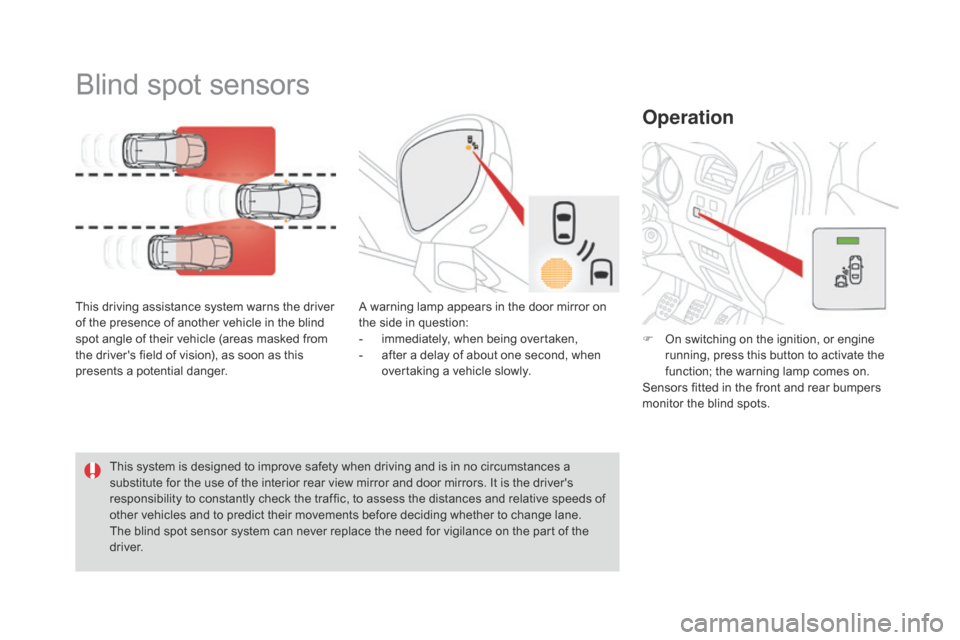
This driving assistance system warns the driver
of the presence of another vehicle in the blind
spot angle of their vehicle (areas masked from
the driver's field of vision), as soon as this
presents a potential danger.
Operation
This system is designed to improve safety when driving and is in no circumstances a
substitute for the use of the interior rear view mirror and door mirrors. It is the driver's
responsibility to constantly check the traffic, to assess the distances and relative speeds of
other vehicles and to predict their movements before deciding whether to change lane.
The blind spot sensor system can never replace the need for vigilance on the part of the
driver.F
O
n switching on the ignition, or engine
running, press this button to activate the
function; the warning lamp comes on.
Sensors fitted in the front and rear bumpers
monitor the blind spots.
A warning lamp appears in the door mirror on
the side in question:
-
i
mmediately, when being overtaken,
-
a
fter a delay of about one second, when
overtaking a vehicle slowly.
Page 220 of 444

Operating fault
In the event of a fault, the warning lamp in the
button flashes then goes off.
Have it checked by a CITROËN dealer or a
qualified workshop.The system may suffer temporary
interference in certain weather
conditions (rain, hail...).
In particular, driving on a wet sur face
or moving from a dry area to a wet area
can cause false alerts (for example, the
presence of a fog of water droplets in
the blind spot angle is interpreted as a
vehicle).
In bad or wintry weather, ensure that
the sensors are not covered by mud,
ice or snow.
Take care not to cover the warning
zone in the door mirrors or the
detection zones on the front and rear
bumpers with adhesive labels or other
objects; they may hamper the correct
operation of the system.
F
T
o deactivate the system, press this button
again; the warning lamp goes off.
The state of the system remains in memory on
switching off the ignition.
The system is automatically
deactivated when towing with a towbar
approved by CITROËN.
Page 223 of 444
221
System which prevents the vehicle from exceeding the speed programmed by the driver.
Speed limiter
The speed limiter is a driving aid that
cannot, in any circumstances, replace the
need to observe speed limits or the need
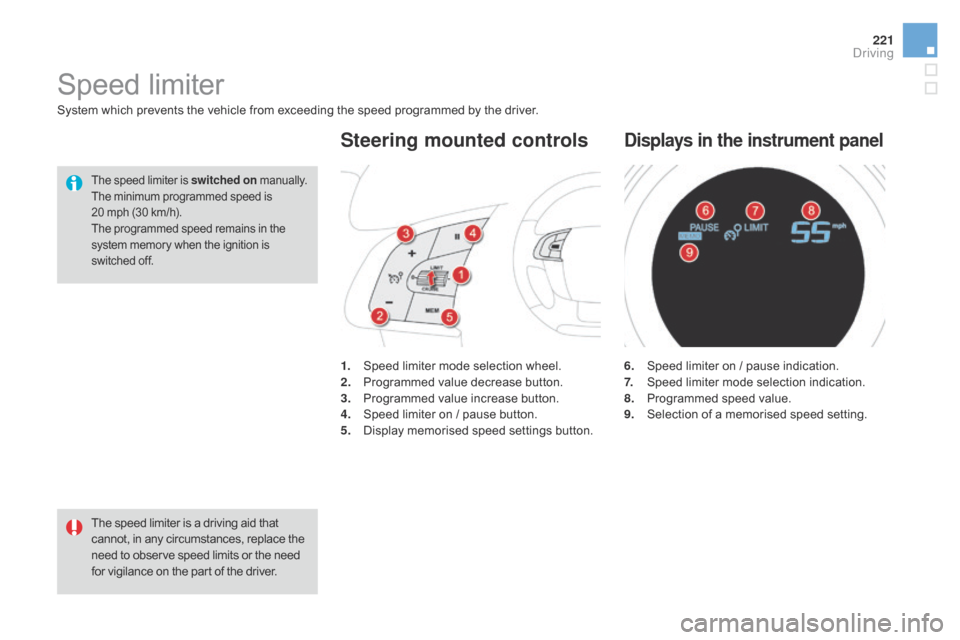
for vigilance on the part of the driver.1.
S
peed limiter mode selection wheel.
2.
P
rogrammed value decrease button.
3.
P
rogrammed value increase button.
4.
S
peed limiter on / pause button.
5.
D
isplay memorised speed settings button.
Steering mounted controls
6. Speed limiter on / pause indication.
7. S
peed limiter mode selection indication.
8.
P
rogrammed speed value.
9.
S
election of a memorised speed setting.
displays in the instrument panel
The speed limiter is switched on manually.
The minimum programmed speed is
20
mph (30 km/h).
The programmed speed remains in the
system memory when the ignition is
switched off.
driving
Page 226 of 444
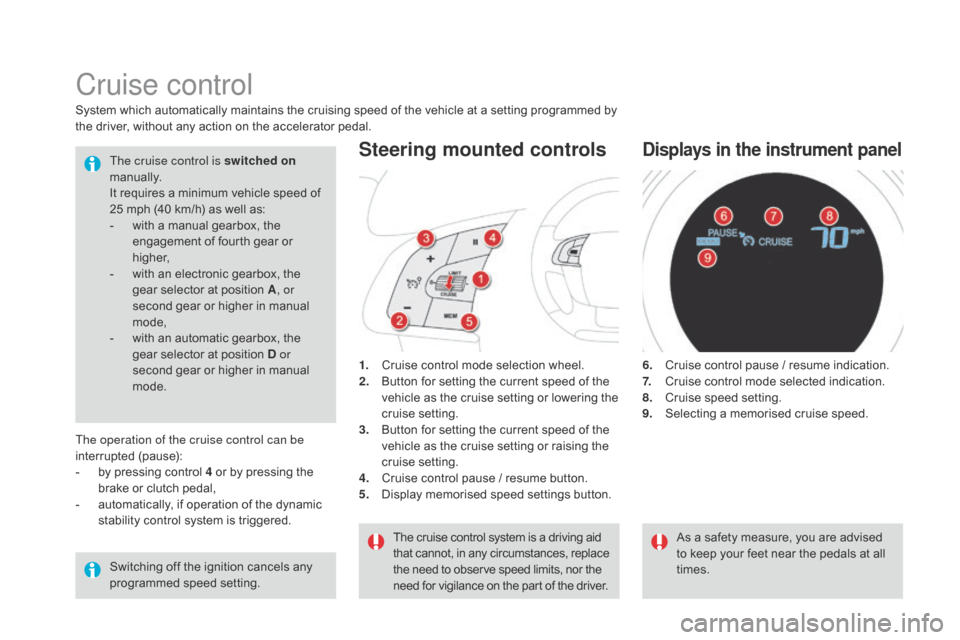
Cruise control
1. Cruise control mode selection wheel.
2. Button for setting the current speed of the
vehicle as the cruise setting or lowering the
cruise setting.
3.
B
utton for setting the current speed of the
vehicle as the cruise setting or raising the
cruise setting.
4.
C
ruise control pause / resume button.
5.
D
isplay memorised speed settings button.
Steering mounted controls
6. Cruise control pause / resume indication.
7. Cruise control mode selected indication.
8.
C
ruise speed setting.
9.
S
electing a memorised cruise speed.
displays in the instrument panel
System which automatically maintains the cruising speed of the vehicle at a setting programmed by
the driver, without any action on the accelerator pedal. The cruise control is switched on
manually.
It requires a minimum vehicle speed of
25 mph (40 km/h) as well as:
-
w
ith a manual gearbox, the
engagement of fourth gear or
higher,
-
w
ith an electronic gearbox, the
gear selector at position A , or
second gear or higher in manual
mode,
-
w
ith an automatic gearbox, the
gear selector at position
d or
second gear or higher in manual
mode.
As a safety measure, you are advised
to keep your feet near the pedals at all
times.
Switching off the ignition cancels any
programmed speed setting. The cruise control system is a driving aid
that cannot, in any circumstances, replace
the need to observe speed limits, nor the
need for vigilance on the part of the driver.
The operation of the cruise control can be
interrupted (pause):
-
b
y pressing control 4 or by pressing the
brake or clutch pedal,
-
a
utomatically, if operation of the dynamic
stability control system is triggered.
Page 235 of 444

233
Fuel tankCapacity of the tank: approximately 60 litres.
Low fuel level
When the low fuel level in the
tank is reached, this warning lamp
comes on in the instrument panel,
accompanied by an audible warning
Refuelling
F Press control A until the automatic opening of the fuel flap is heard.
T
his control remains active for a few
minutes after switching off the ignition. If
necessary, switch the ignition on again to
reactivate it.
F
T
ake care to select the pump that delivers
the correct fuel for your vehicle.
With Stop & Start, never refuel with the
system in STOP mode; you must switch
off the ignition with the key, or the
START/STOP button if your vehicle has
Keyless Entry and Starting.
Additions of fuel must be of at least 5 litres to
be registered by the fuel gauge.
Opening the filler cap may result in an inrush of
air. This vacuum is entirely normal and results
from the sealing of the fuel system.
and the display of an alert message. When it
first comes on, around 6 litres of fuel remain
in the tank.
Until sufficient fuel has been added, every
time the ignition is switched on, this warning
lamp appears, accompanied by an audible
signal and an alert message. When driving,
this audible signal and the display of this
alert message are repeated with increasing
frequency, as the level drops towards 0
.
You must refuel as soon as possible to avoid
running out.
If you run out of fuel (Diesel), refer to the
corresponding section.
Checks
Page 239 of 444

237
Running out of fuel (Diesel)
On vehicles fitted with Diesel engines, the fuel
system must be primed if you run out of fuel.
For all versions other than BlueHDi, refer to the
corresponding engine compartment view.1.6 Hdi engine
If the tank on your vehicle is fitted with
a misfuel prevention device, refer to the
"Misfuel prevention (Diesel)" section.
2.0 Hdi engine
If the engine does not start first
time, don't keep trying but start the
procedure again from the beginning.
BlueHdi engines
F Fill the fuel tank with at least five litres of Diesel.
F
S
witch on the ignition (without starting the
engine).
F
W
ait around 6 seconds and switch off the
ignition.
F
R
epeat the operation 10 times.
F
O
perate the starter to run the engine. F
F
ill the fuel tank with at least five litres of
diesel.
F
O
pen the bonnet.
F
I
f necessary, unclip the styling cover for
access to the priming pump.
F
S
queeze and release the priming pump
repeatedly until resistance is felt (there
may be resistance at the first press).
F
O
perate the starter until the engine starts
(if the engine does not start at the first
attempt, wait around 15 seconds before
trying again).
F
I
f the engine does not start after a few
attempts, operate the priming pump again
then start the engine.
F
R
efit the styling cover and clip it in place.
F C lose the bonnet.F
F
ill the fuel tank with at least five litres of
Diesel.
F
O
pen the bonnet.
F
I
f necessary, unclip the style cover for
access to the priming pump.
F
S
lacken the bleed screw.
F
S
queeze and release the priming pump
repeatedly until fuel appears in the
transparent pipe.
F
T
ighten the bleed screw.
F
O
perate the starter until the engine starts
(if the engine fails to start at the first
attempt, wait around 15 seconds before
trying again).
F
I
f the engine fails to start after a few
attempts, operate the priming pump again,
then the starter.
F P ut the style cover back in position and
clip it in place, ensuring that it has clipped
c o r r e c t l y.
F
C
lose the bonnet.
Checks