ECU CITROEN DS4 2018 User Guide
[x] Cancel search | Manufacturer: CITROEN, Model Year: 2018, Model line: DS4, Model: CITROEN DS4 2018Pages: 296, PDF Size: 9.91 MB
Page 129 of 296
127
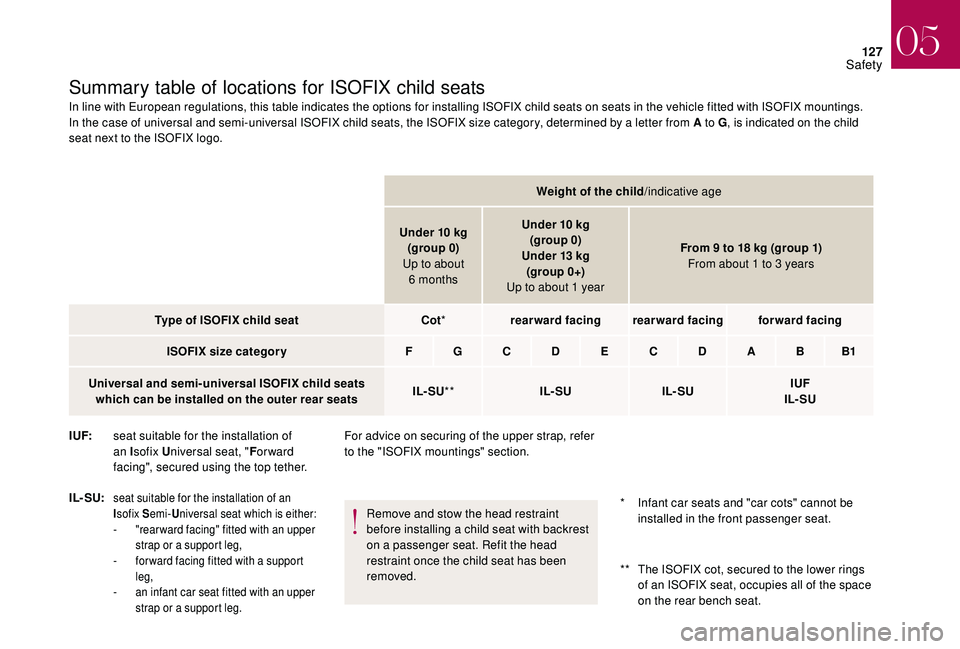
Summary table of locations for ISOFIX child seats
In line with European regulations, this table indicates the options for installing ISOFIX child seats on seats in the vehicle fitted with ISOFIX mountings.
In the case of universal and semi-universal ISOFIX child seats, the ISOFIX size category, determined by a letter from A to G, is indicated on the child
seat next to the ISOFIX logo.
Weight of the child/indicative age
Under 10 kg (group 0)
Up to about 6
monthsUnder 10 kg
(group 0)
Under 13 kg (group 0+)
Up to about 1 year From 9 to 18 kg (group 1)
From about 1 to 3 years
Type of ISOFIX child seat Cot* rearward facing rearward facing forward facing
ISOFIX size categor y F G C D E C D A B B1
Universal and semi-universal ISOFIX child seats which can be installed on the outer rear seats IL- SU
** IL- SU IL- SU IUF
IL- SU
I UF: seat suitable for the installation of
an Isofix U niversal seat, " For ward
facing", secured using the top tether.
IL- SU:
seat suitable for the installation of an
I sofix S emi-Universal seat which is either:
-
"
rear ward facing" fitted with an upper
strap or a support leg,
-
f
or ward facing fitted with a support
leg,
-
a
n infant car seat fitted with an upper
strap or a support leg.
For advice on securing of the upper strap, refer
to the "ISOFIX mountings" section.
Remove and stow the head restraint
before installing a child seat with backrest
on a passenger seat. Refit the head
restraint once the child seat has been
removed. *
I
nfant car seats and "car cots" cannot be
installed in the front passenger seat.
**
T
he ISOFIX cot, secured to the lower rings
of an ISOFIX seat, occupies all of the space
on the rear bench seat.
05
Safety
Page 130 of 296
128
The incorrect installation of a child seat in a
vehicle compromises the child's protection in
the event of an accident.
Ensure that there is no seat belt or seat belt
buckle under the child seat, as this could
destabilise it.
Remember to fasten the seat belts or the
child seat harnesses keeping the slack
relative to the child's body to a minimum,
even for short journeys.
When installing a child seat using the seat
belt, ensure that the seat belt is tightened
correctly on the child seat and that it secures
the child seat firmly on the seat of your
vehicle. If your passenger seat is adjustable,
move it for wards if necessary.
At rear seating positions, always leave
sufficient space between the front seat and:
-
a r
ear ward facing child seat,
-
t
he child's feet for a child seat fitted
forward facing.
To do this, move the front seat for wards
and, if necessary, move its backrest into the
upright position.
For optimal installation of the forward facing
child seat, verify that its backrest is as close
as possible to the backrest of the vehicle
seat, if possible in contact with it.
Advice
The head restraint must be removed
before installing a child seat with a
backrest on a passenger seat.
Ensure that the head restraint is stored or
attached securely to prevent it from being
thrown around the vehicle in the event of
sharp braking. Refit the head restraint when
the child seat is removed.
Front seat belts
The legislation on carrying children on the
front passenger seat is specific to each
country. Refer to the legislation in force in
your country.
Deactivate the passenger's front airbag when
a rear ward facing child seat is installed on the
front passenger seat.
Otherwise, the child risks being seriously
injured or killed if the airbag is deployed.
Installing a booster seat
The chest part of the seat belt must be
positioned on the child's shoulder without
touching the neck.
Ensure that the lap part of the seat belt
passes correctly over the child's thighs. We recommend using a booster seat with
a backrest equipped with a belt guide at
shoulder level.
As a safety precaution, do not leave:
-
a c
hild or children alone and unattended in
a vehicle,
-
a c
hild or an animal in a vehicle under the
sun, with the windows closed,
-
t
he keys within the reach of children inside
the vehicle.
To prevent accidental opening of the doors
and rear windows, use the child lock.
Take care not to open the rear windows by
more than one third.
To protect young children from the rays of the
sun, fit side blinds on the rear windows.
05
Safety
Page 175 of 296
173
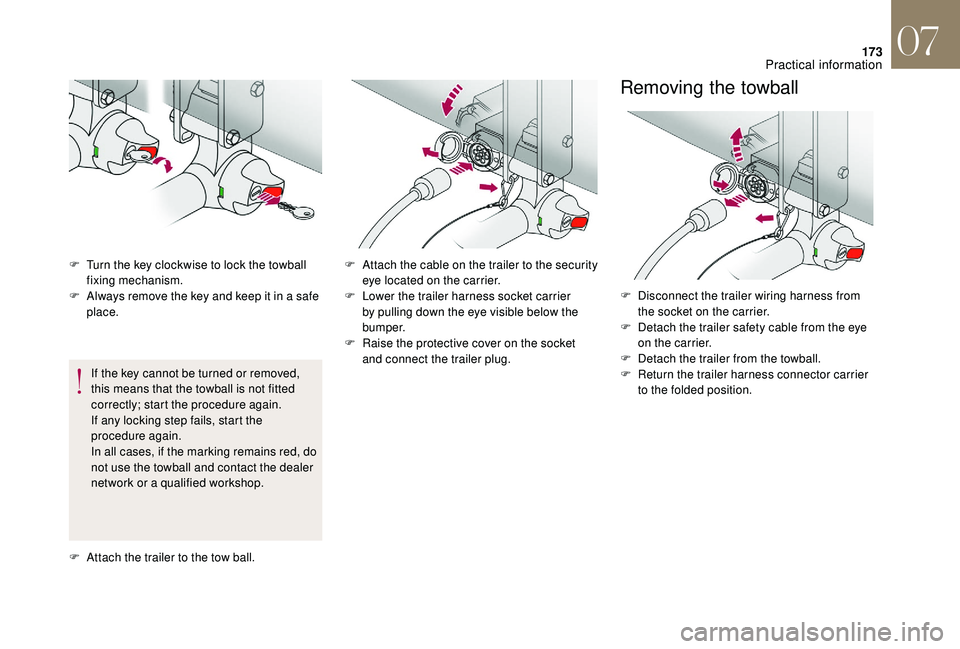
F Turn the key clockwise to lock the towball fixing mechanism.
F
A
lways remove the key and keep it in a safe
place.
If the key cannot be turned or removed,
this means that the towball is not fitted
correctly; start the procedure again.
If any locking step fails, start the
procedure again.
In all cases, if the marking remains red, do
not use the towball and contact the dealer
network or a qualified workshop.
F
A
ttach the trailer to the tow ball. F
A ttach the cable on the trailer to the security
eye located on the carrier.
F
L
ower the trailer harness socket carrier
by pulling down the eye visible below the
b u m p e r.
F
R
aise the protective cover on the socket
and connect the trailer plug.
Removing the towball
F Disconnect the trailer wiring harness from the socket on the carrier.
F
D
etach the trailer safety cable from the eye
on the carrier.
F
D
etach the trailer from the towball.
F
R
eturn the trailer harness connector carrier
to the folded position.
07
Practical information
Page 183 of 296
181
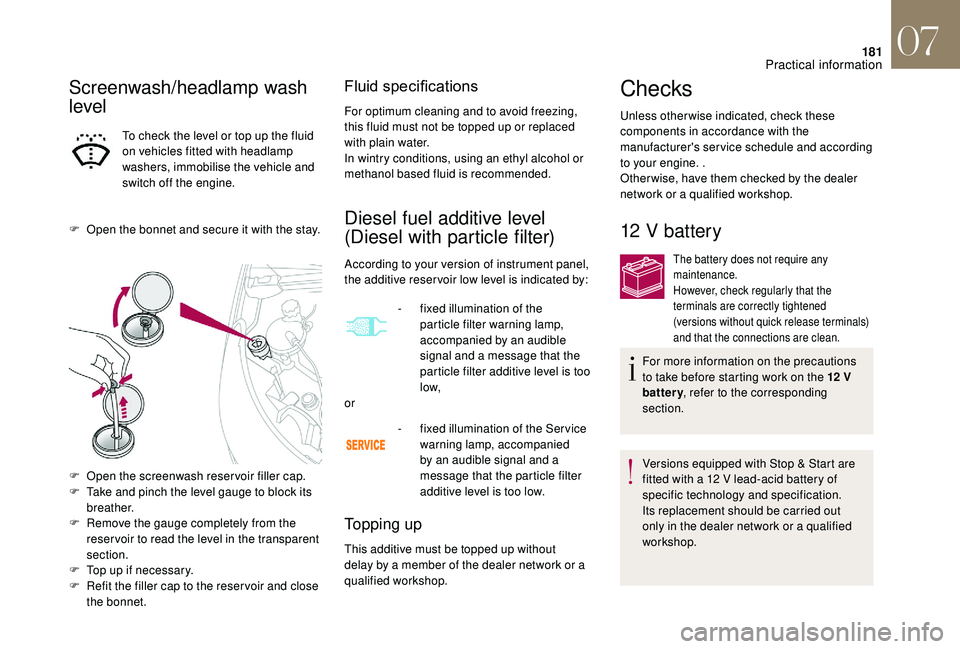
Screenwash/headlamp wash
level
To check the level or top up the fluid
on vehicles fitted with headlamp
washers, immobilise the vehicle and
switch off the engine.
F
O
pen the bonnet and secure it with the stay.
F
O
pen the screenwash reservoir filler cap.
F
T
ake and pinch the level gauge to block its
breather.
F
R
emove the gauge completely from the
reser voir to read the level in the transparent
section.
F
T
op up if necessary.
F
R
efit the filler cap to the reser voir and close
the bonnet.
Fluid specifications
For optimum cleaning and to avoid freezing,
this fluid must not be topped up or replaced
with plain water.
In wintry conditions, using an ethyl alcohol or
methanol based fluid is recommended.
Diesel fuel additive level
(Diesel with particle filter)
According to your version of instrument panel,
the additive reser voir low level is indicated by:
Topping up
This additive must be topped up without
delay by a member of the dealer network or a
qualified workshop. -
f
ixed illumination of the
particle filter warning lamp,
accompanied by an audible
signal and a message that the
particle filter additive level is too
low,
or
-
f
ixed illumination of the Ser vice
warning lamp, accompanied
by an audible signal and a
message that the particle filter
additive level is too low.
Checks
Unless otherwise indicated, check these
components in accordance with the
manufacturer's service schedule and according
to your engine. .
Otherwise, have them checked by the dealer
network or a qualified workshop.
12 V battery
The battery does not require any
maintenance.
However, check regularly that the
terminals are correctly tightened
(versions without quick release terminals)
and that the connections are clean.
For more information on the precautions
to take before starting work on the 12 V
battery , refer to the corresponding
section.
Versions equipped with Stop & Start are
fitted with a 12 V lead-acid battery of
specific technology and specification.
Its replacement should be carried out
only in the dealer network or a qualified
workshop.
07
Practical information
Page 187 of 296
185
Keep AdBlue® out of the reach of children,
in its original container or bottle.
Never transfer AdBlue
® to another
container: it would lose its purity.
Never dilute AdBlue
® with water.
Never pour AdBlue® into the Diesel fuel
tank. Containers or bottles are available from the
dealer network or a qualified workshop.
Never top up from an AdBlue
® dispenser
reserved for heavy goods vehicles.
Recommendations on storage
AdBlue® freezes below around -11°C and
deteriorates above 25°C. It is recommended
that bottles or containers be stored in a cool
place and protected from direct sunlight.
Under these conditions, the fluid can be kept
for at least a year.
If the additive has frozen, it can be used once it
has completely thawed out.
Never store bottles or containers of
AdBlue
® in your vehicle.
Procedure
Before topping up, ensure that the vehicle is
parked on a flat and level sur face.
In wintry conditions, ensure that the
temperature of the vehicle is above -11°C.
Otherwise the AdBlue
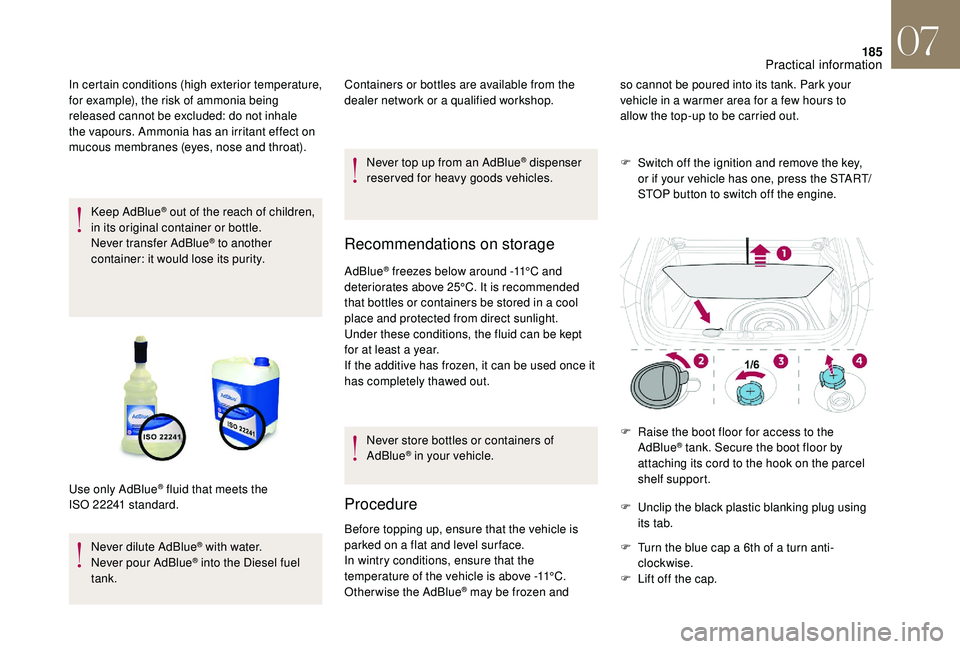
® may be frozen and F
S
witch off the ignition and remove the key,
or if your vehicle has one, press the START/
STOP button to switch off the engine.
F
R
aise the boot floor for access to the
AdBlue
® tank. Secure the boot floor by
attaching its cord to the hook on the parcel
shelf support.
F
U
nclip the black plastic blanking plug using
its tab.
F
T
urn the blue cap a 6th of a turn anti-
clockwise.
F
L
ift off the cap.
In certain conditions (high exterior temperature,
for example), the risk of ammonia being
released cannot be excluded: do not inhale
the vapours. Ammonia has an irritant effect on
mucous membranes (eyes, nose and throat).
Use only AdBlue
® fluid that meets the
ISO
22241 standard. so cannot be poured into its tank. Park your
vehicle in a warmer area for a few hours to
allow the top-up to be carried out.
07
Practical information
Page 192 of 296
190
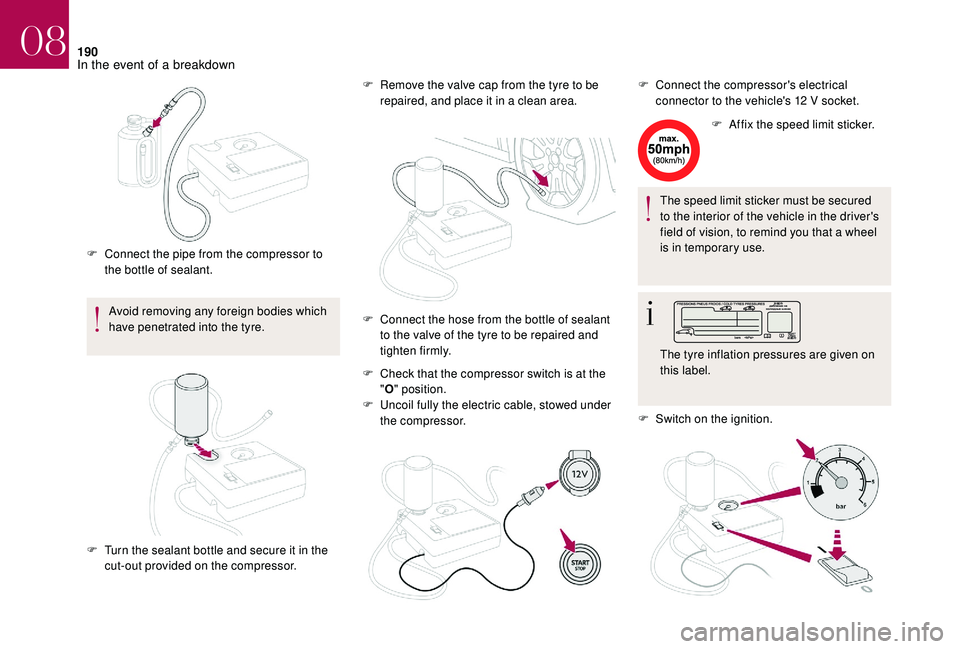
Avoid removing any foreign bodies which
have penetrated into the tyre.F
R
emove the valve cap from the tyre to be
repaired, and place it in a clean area.
F
C
heck that the compressor switch is at the
" O " position.
F
U
ncoil fully the electric cable, stowed under
the compressor. The speed limit sticker must be secured
to the interior of the vehicle in the driver's
field of vision, to remind you that a wheel
is in temporary use.
F
C
onnect the pipe from the compressor to
the bottle of sealant.
F
T
urn the sealant bottle and secure it in the
cut-out provided on the compressor. F
C onnect the hose from the bottle of sealant
to the valve of the tyre to be repaired and
tighten firmly. F
C
onnect the compressor's electrical
connector to the vehicle's 12 V socket.
The tyre inflation pressures are given on
this label.
F
S
witch on the ignition.F
A
ffix the speed limit sticker.
08
In the event of a breakdown
Page 194 of 296
192
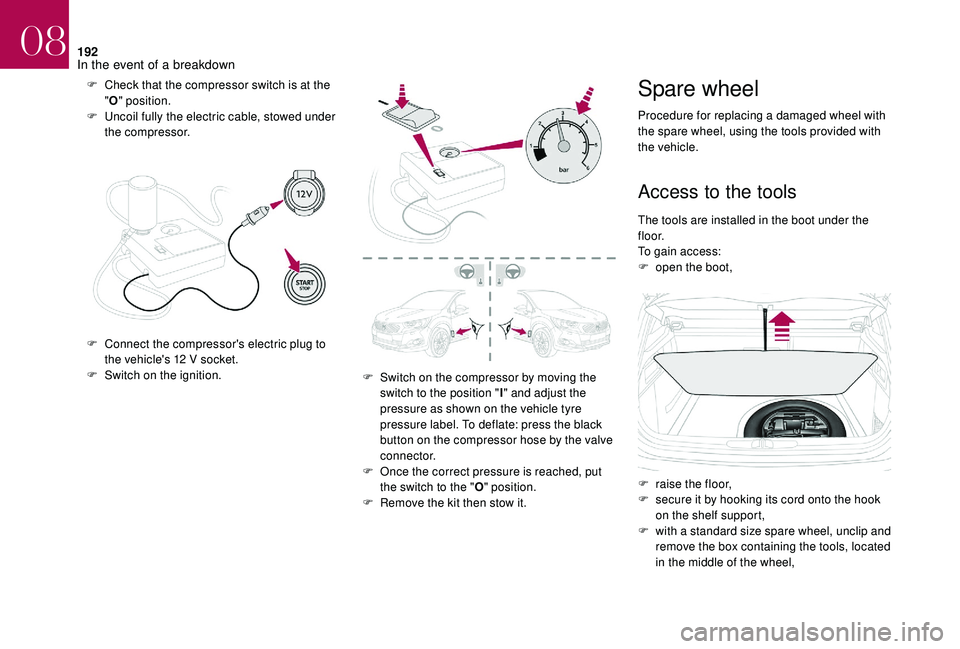
F Check that the compressor switch is at the "O " position.
F
U
ncoil fully the electric cable, stowed under
the compressor.
F
C
onnect the compressor's electric plug to
the vehicle's 12 V socket.
F
S
witch on the ignition. F
S
witch on the compressor by moving the
switch to the position " I" and adjust the
pressure as shown on the vehicle tyre
pressure label. To deflate: press the black
button on the compressor hose by the valve
connector.
F
O
nce the correct pressure is reached, put
the switch to the " O" position.
F
R
emove the kit then stow it.Spare wheel
Procedure for replacing a damaged wheel with
the spare wheel, using the tools provided with
the vehicle.
Access to the tools
The tools are installed in the boot under the
f l o o r.
To gain access:
F
o
pen the boot,
F
r
aise the floor,
F
s
ecure it by hooking its cord onto the hook
on the shelf support,
F
w
ith a standard size spare wheel, unclip and
remove the box containing the tools, located
in the middle of the wheel,
08
In the event of a breakdown
Page 195 of 296
193
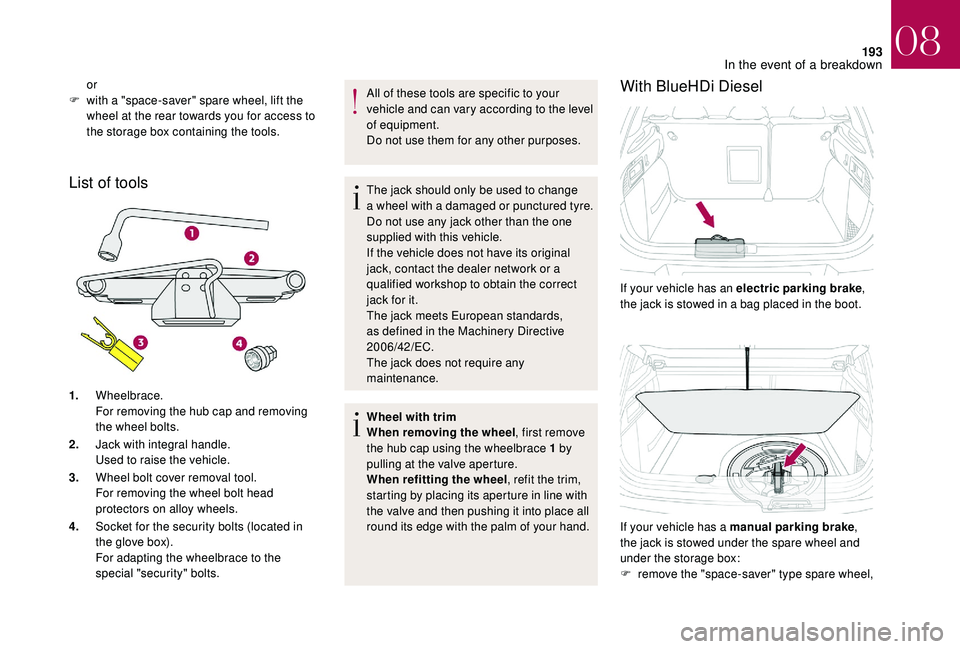
List of tools
1.Wheelbrace.
For removing the hub cap and removing
the wheel bolts.
2. Jack with integral handle.
Used to raise the vehicle.
3. Wheel bolt cover removal tool.
For removing the wheel bolt head
protectors on alloy wheels.
4. Socket for the security bolts (located in
the glove box).
For adapting the wheelbrace to the
special "security" bolts. All of these tools are specific to your
vehicle and can vary according to the level
of equipment.
Do not use them for any other purposes.
The jack should only be used to change
a wheel with a damaged or punctured tyre.
Do not use any jack other than the one
supplied with this vehicle.
If the vehicle does not have its original
jack, contact the dealer network or a
qualified workshop to obtain the correct
jack for it.
The jack meets European standards,
as defined in the Machinery Directive
2006/42/EC.
The jack does not require any
maintenance.
Wheel with trim
When removing the wheel
, first remove
the hub cap using the wheelbrace 1 by
pulling at the valve aperture.
When refitting the wheel , refit the trim,
starting by placing its aperture in line with
the valve and then pushing it into place all
round its edge with the palm of your hand.
With BlueHDi Diesel
If your vehicle has an electric parking brake ,
the jack is stowed in a bag placed in the boot.
or
F
w
ith a "space-saver" spare wheel, lift the
wheel at the rear towards you for access to
the storage box containing the tools.
If your vehicle has a manual parking brake,
the jack is stowed under the spare wheel and
under the storage box:
F
r
emove the "space-saver" type spare wheel,
08
In the event of a breakdown
Page 197 of 296
195
Tyre under-inflation detection
The spare wheel is not fitted with a sensor.
The punctured tyre must be repaired
or replaced by a member of the dealer
network or a qualified workshop.
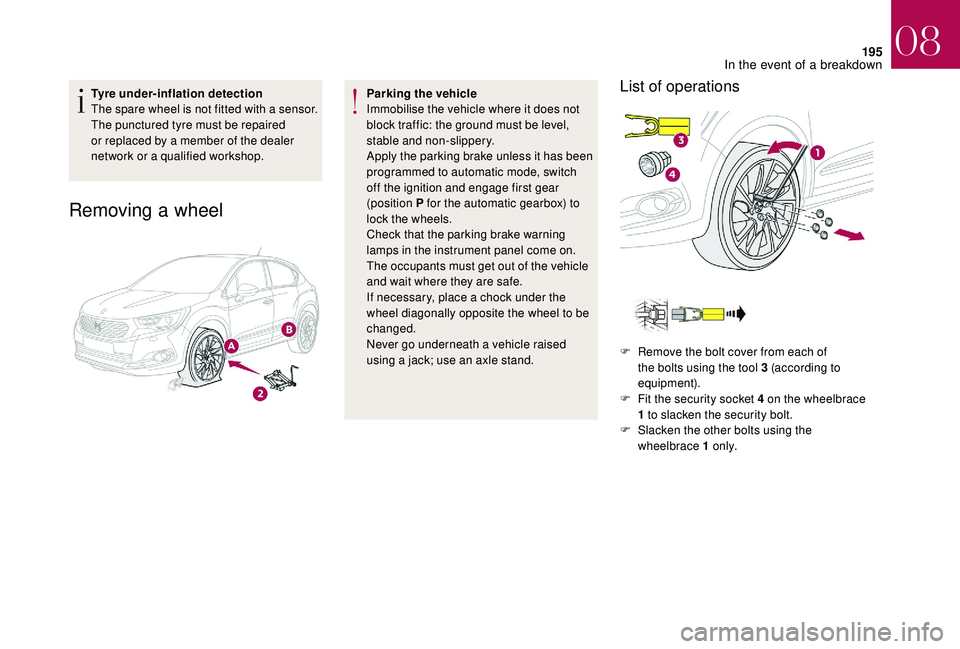
Removing a wheel
Parking the vehicle
Immobilise the vehicle where it does not
block traffic: the ground must be level,
stable and non-slippery.
Apply the parking brake unless it has been
programmed to automatic mode, switch
off the ignition and engage first gear
(position P for the automatic gearbox) to
lock the wheels.
Check that the parking brake warning
lamps in the instrument panel come on.
The occupants must get out of the vehicle
and wait where they are safe.
If necessary, place a chock under the
wheel diagonally opposite the wheel to be
changed.
Never go underneath a vehicle raised
using a jack; use an axle stand.List of operations
F Remove the bolt cover from each of the bolts using the tool 3 (according to
equipment).
F
F
it the security socket 4 on the wheelbrace
1 to slacken the security bolt.
F
S
lacken the other bolts using the
wheelbrace 1 o n l y.
08
In the event of a breakdown
Page 199 of 296
197
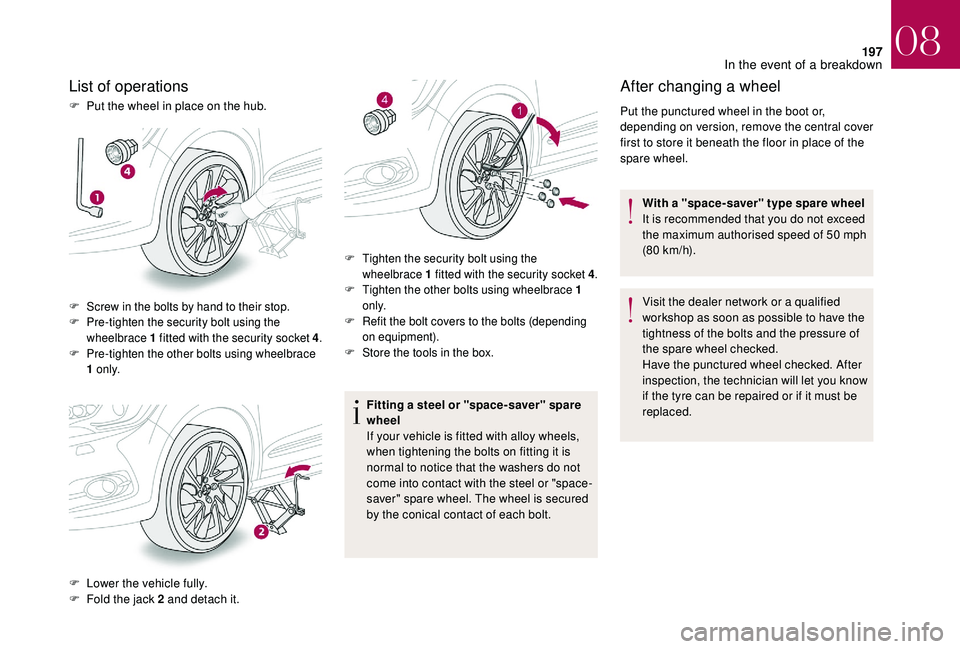
F Screw in the bolts by hand to their stop.
F P re-tighten the security bolt using the
wheelbrace 1 fitted with the security socket 4 .
F
P
re-tighten the other bolts using wheelbrace
1 o n l y.
F Lower the vehicle fully.
F F old the jack 2 and detach it.
F Tighten the security bolt using the wheelbrace 1 fitted with the security socket 4 .
F
T
ighten the other bolts using wheelbrace 1
o n l y.
F
R
efit the bolt covers to the bolts (depending
on equipment).
F
S
tore the tools in the box.
Fitting a steel or "space-saver" spare
wheel
If your vehicle is fitted with alloy wheels,
when tightening the bolts on fitting it is
normal to notice that the washers do not
come into contact with the steel or "space-
saver" spare wheel. The wheel is secured
by the conical contact of each bolt.
After changing a wheel
Put the punctured wheel in the boot or,
depending on version, remove the central cover
first to store it beneath the floor in place of the
spare wheel.With a "space-saver" type spare wheel
It is recommended that you do not exceed
the maximum authorised speed of 50 mph
(80 km/h).
Visit the dealer network or a qualified
workshop as soon as possible to have the
tightness of the bolts and the pressure of
the spare wheel checked.
Have the punctured wheel checked. After
inspection, the technician will let you know
if the tyre can be repaired or if it must be
replaced.
List of operations
F Put the wheel in place on the hub.
08
In the event of a breakdown