child lock CITROEN DS4 2018 Owners Manual
[x] Cancel search | Manufacturer: CITROEN, Model Year: 2018, Model line: DS4, Model: CITROEN DS4 2018Pages: 296, PDF Size: 9.91 MB
Page 4 of 296
2
01
02
0304
05
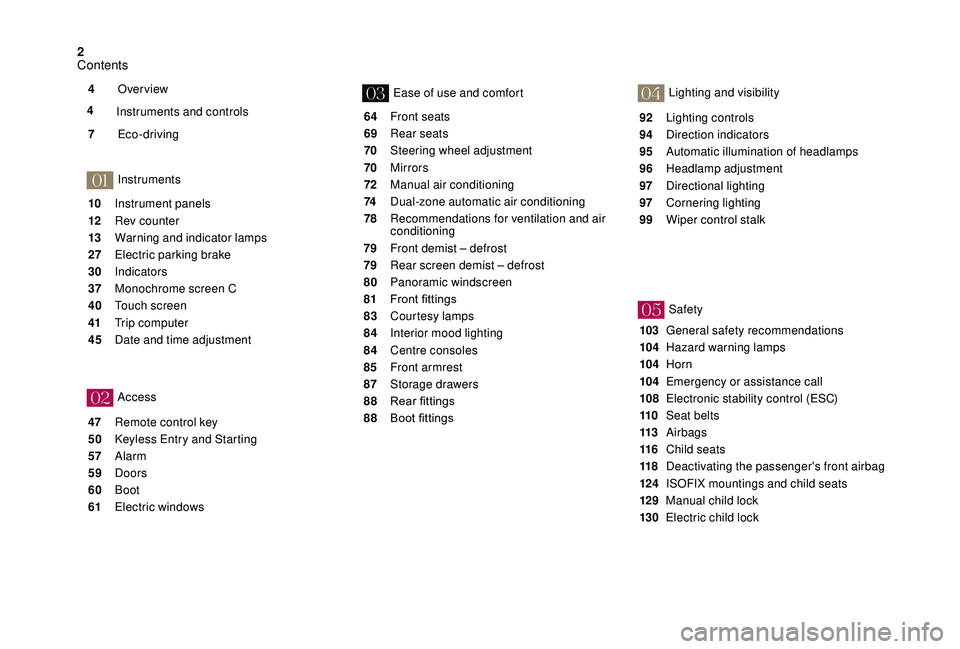
10 Instrument panels
12
R
ev counter
13
W
arning and indicator lamps
27
E
lectric parking brake
30
I
ndicators
37
M
onochrome screen C
40
T
ouch screen
41
T
rip computer
45
D
ate and time adjustment
47
R
emote control key
50
K
eyless Entry and Starting
57
Alarm
59
Doors
60
Boot
61
E
lectric windows 64
F
ront seats
69
R
ear seats
70
S
teering wheel adjustment
70
M
irrors
72
M
anual air conditioning
74 D ual-zone automatic air conditioning
78 R ecommendations for ventilation and air
conditioning
79
F
ront demist – defrost
79
R
ear screen demist – defrost
80
P
anoramic windscreen
81 Front
fittings
83
C
ourtesy lamps
84
I
nterior mood lighting
84
C
entre consoles
85
Fr
ont armrest
87
St
orage drawers
88 Rear
fi
ttings
88 Boot
fittings92
L
ighting controls
94
D
irection indicators
95
A
utomatic illumination of headlamps
96
H
eadlamp adjustment
97
D
irectional lighting
97 C ornering lighting
99
W
iper control stalk
103
G
eneral safety recommendations
104
H
azard warning lamps
104
Horn
104
E
mergency or assistance call
108
E
lectronic stability control (ESC)
110
Se
at belts
113
Airbags
116
Ch
ild seats
118
D
eactivating the passenger's front airbag
124
I
SOFIX mountings and child seats
129
M
anual child lock
130
E
lectric child lock
Over view
Instruments
Access Ease of use and comfort
Safety Lighting and visibility
Eco-driving
7 4
4 Instruments and controls
Contents
Page 8 of 296

6
Side switch panel1
Opening the fuel filler flap
2
DSC/ASR systems
3
Parking sensors
4
Stop & Start
5
Blind Spot Monitoring System
6
Lane Departure Warning
System (depending on country of sale)
7
Alarm
8
Child lock (depending on the country of sale)
Over view
Page 51 of 296
49
This will switch on the courtesy lamps and the
direction indicators will flash for around ten
seconds.
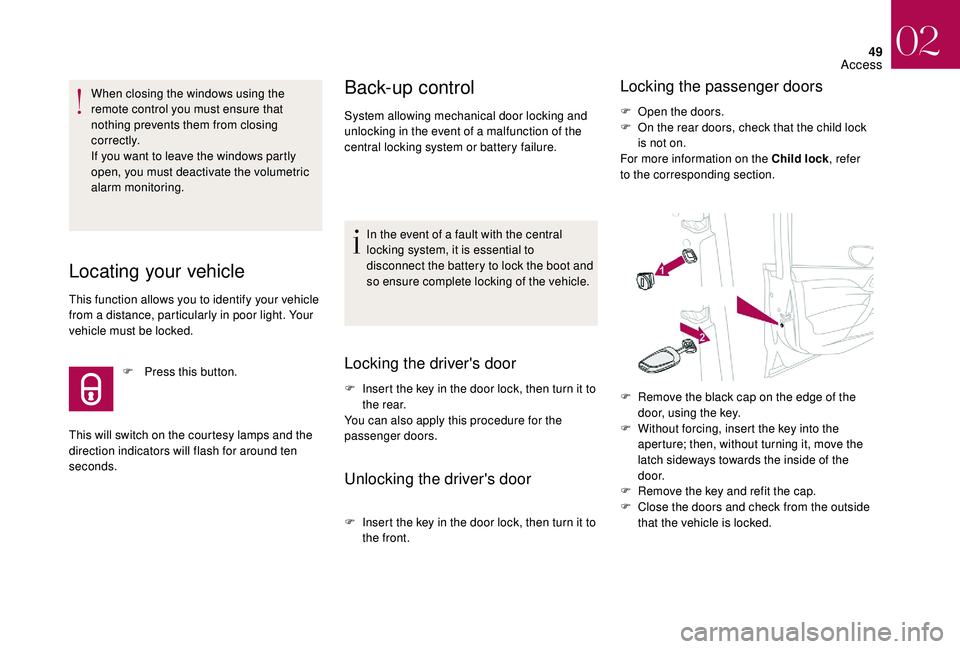
Back-up control
System allowing mechanical door locking and
unlocking in the event of a malfunction of the
central locking system or battery failure.
Locking the driver's door
F Insert the key in the door lock, then turn it to the rear.
You can also apply this procedure for the
passenger doors.
Unlocking the driver's door
F Insert the key in the door lock, then turn it to the front.
Locking the passenger doors
F Open the doors.
F O n the rear doors, check that the child lock
is not on.
For more information on the Child lock , refer
to the corresponding section.
When closing the windows using the
remote control you must ensure that
nothing prevents them from closing
c o r r e c t l y.
If you want to leave the windows partly
open, you must deactivate the volumetric
alarm monitoring.
Locating your vehicle
This function allows you to identify your vehicle
from a distance, particularly in poor light. Your
vehicle must be locked.
F
P
ress this button. F
R
emove the black cap on the edge of the
door, using the key.
F
W
ithout forcing, insert the key into the
aperture; then, without turning it, move the
latch sideways towards the inside of the
d o o r.
F
R
emove the key and refit the cap.
F
C
lose the doors and check from the outside
that the vehicle is locked.
In the event of a fault with the central
locking system, it is essential to
disconnect the battery to lock the boot and
so ensure complete locking of the vehicle.
02
Access
Page 53 of 296
51
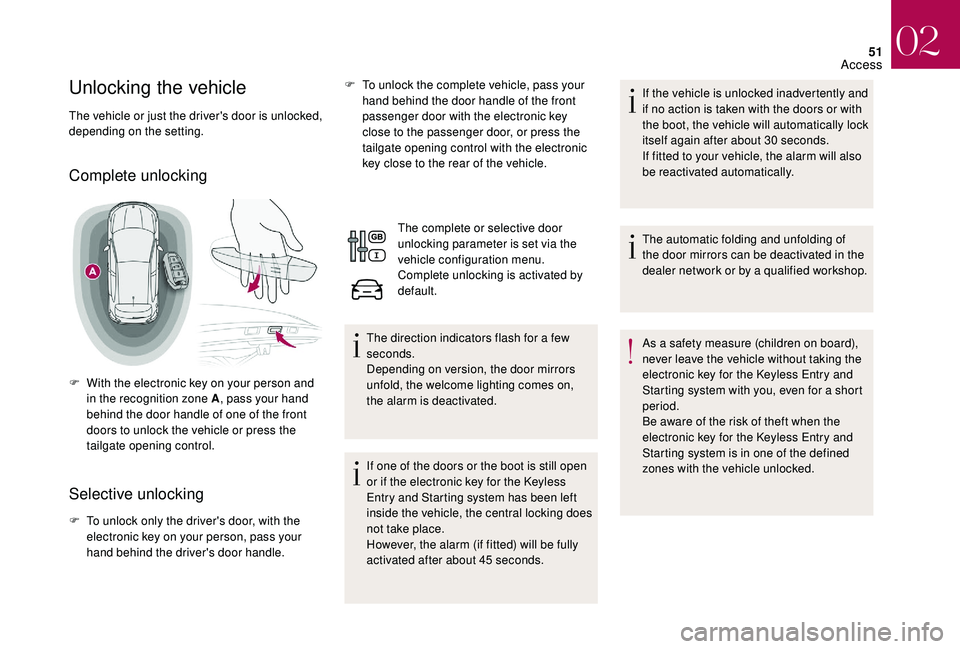
Unlocking the vehicle
The vehicle or just the driver's door is unlocked,
depending on the setting.
Complete unlocking
F With the electronic key on your person and in the recognition zone A , pass your hand
behind the door handle of one of the front
doors to unlock the vehicle or press the
tailgate opening control.
Selective unlocking
F To unlock only the driver's door, with the electronic key on your person, pass your
hand behind the driver's door handle. The complete or selective door
unlocking parameter is set via the
vehicle configuration menu.
Complete unlocking is activated by
default.
The direction indicators flash for a few
seconds.
Depending on version, the door mirrors
unfold, the welcome lighting comes on,
the alarm is deactivated.
If one of the doors or the boot is still open
or if the electronic key for the Keyless
Entry and Starting system has been left
inside the vehicle, the central locking does
not take place.
However, the alarm (if fitted) will be fully
activated after about 45 seconds. If the vehicle is unlocked inadvertently and
if no action is taken with the doors or with
the boot, the vehicle will automatically lock
itself again after about 30 seconds.
If fitted to your vehicle, the alarm will also
be reactivated automatically.
The automatic folding and unfolding of
the door mirrors can be deactivated in the
dealer network or by a qualified workshop.
As a safety measure (children on board),
never leave the vehicle without taking the
electronic key for the Keyless Entry and
Starting system with you, even for a short
period.
Be aware of the risk of theft when the
electronic key for the Keyless Entry and
Starting system is in one of the defined
zones with the vehicle unlocked.
F
T
o unlock the complete vehicle, pass your
hand behind the door handle of the front
passenger door with the electronic key
close to the passenger door, or press the
tailgate opening control with the electronic
key close to the rear of the vehicle.
02
Access
Page 54 of 296
52
In order to preser ve the battery in the
electronic key and the vehicle's battery,
the "hands-free" functions are put into
long-term standby after 21 days without
use. To restore these functions, press
one of the remote control buttons or start
the engine with the electronic key in the
reader.
For more information on starting with
Keyless Entr y and Star ting, refer to the
corresponding section.
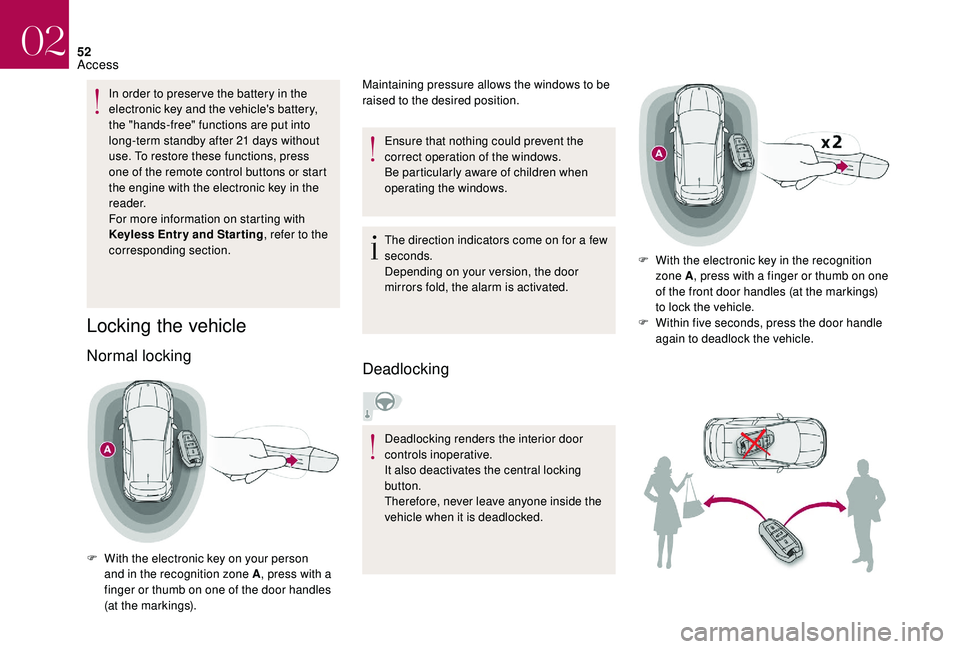
Locking the vehicle
Normal locking
F With the electronic key on your person and in the recognition zone A , press with a
finger or thumb on one of the door handles
(at the markings). Ensure that nothing could prevent the
correct operation of the windows.
Be particularly aware of children when
operating the windows.
Maintaining pressure allows the windows to be
raised to the desired position.
The direction indicators come on for a few
seconds.
Depending on your version, the door
mirrors fold, the alarm is activated.
Deadlocking
Deadlocking renders the interior door
controls inoperative.
It also deactivates the central locking
button.
Therefore, never leave anyone inside the
vehicle when it is deadlocked. F
W
ith the electronic key in the recognition
zone A , press with a finger or thumb on one
of the front door handles (at the markings)
to lock the vehicle.
F
W
ithin five seconds, press the door handle
again to deadlock the vehicle.
02
Access
Page 56 of 296
54
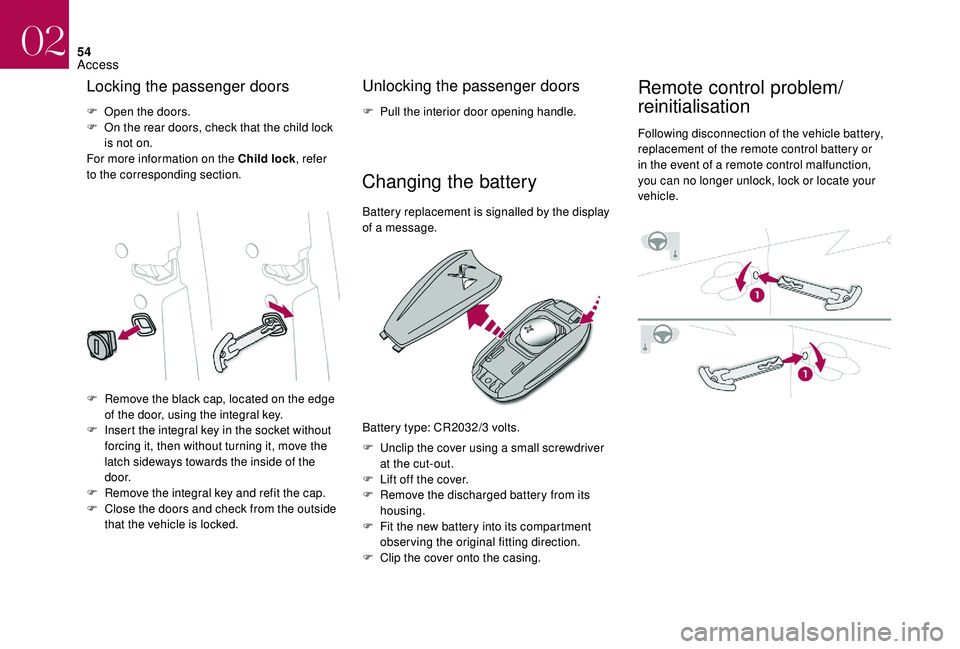
Locking the passenger doors
F Open the doors.
F O n the rear doors, check that the child lock
is not on.
For more information on the Child lock , refer
to the corresponding section.
Unlocking the passenger doors
F Pull the interior door opening handle.
Changing the battery Remote control problem/
reinitialisation
Following disconnection of the vehicle battery,
replacement of the remote control battery or
in the event of a remote control malfunction,
you can no longer unlock, lock or locate your
vehicle.
F
R
emove the black cap, located on the edge
of the door, using the integral key.
F
I
nsert the integral key in the socket without
forcing it, then without turning it, move the
latch sideways towards the inside of the
d o o r.
F
R
emove the integral key and refit the cap.
F
C
lose the doors and check from the outside
that the vehicle is locked. Battery replacement is signalled by the display
of a message.
F
U
nclip the cover using a small screwdriver
at the cut-out.
F
L
ift off the cover.
F
R
emove the discharged battery from its
housing.
F
F
it the new battery into its compartment
observing the original fitting direction.
F
C
lip the cover onto the casing.
Battery type: CR2032/3 volts.
02
Access
Page 57 of 296
55
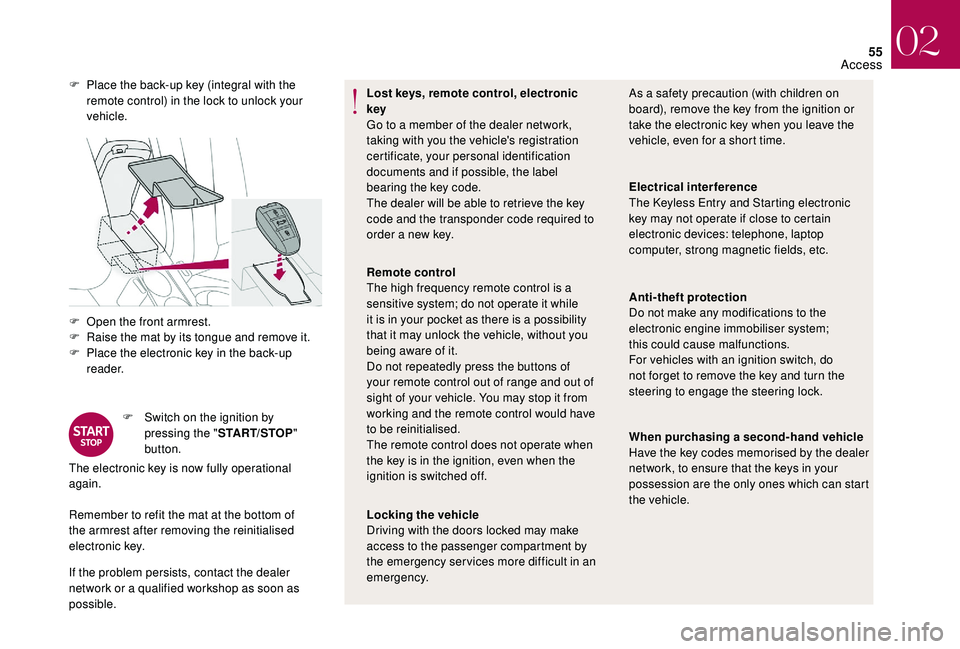
F Open the front armrest.
F R aise the mat by its tongue and remove it.
F
P
lace the electronic key in the back-up
reader.
F
S
witch on the ignition by
pressing the " START/STOP "
button.
Remember to refit the mat at the bottom of
the armrest after removing the reinitialised
electronic key.
If the problem persists, contact the dealer
network or a qualified workshop as soon as
possible. Lost keys, remote control, electronic
key
Go to a member of the dealer network,
taking with you the vehicle's registration
certificate, your personal identification
documents and if possible, the label
bearing the key code.
The dealer will be able to retrieve the key
code and the transponder code required to
order a new key.
The electronic key is now fully operational
again. F
P
lace the back-up key (integral with the
remote control) in the lock to unlock your
vehicle. As a safety precaution (with children on
board), remove the key from the ignition or
take the electronic key when you leave the
vehicle, even for a short time.
Remote control
The high frequency remote control is a
sensitive system; do not operate it while
it is in your pocket as there is a possibility
that it may unlock the vehicle, without you
being aware of it.
Do not repeatedly press the buttons of
your remote control out of range and out of
sight of your vehicle. You may stop it from
working and the remote control would have
to be reinitialised.
The remote control does not operate when
the key is in the ignition, even when the
ignition is switched off.
Locking the vehicle
Driving with the doors locked may make
access to the passenger compartment by
the emergency ser vices more difficult in an
emergency. Electrical interference
The Keyless Entry and Starting electronic
key may not operate if close to certain
electronic devices: telephone, laptop
computer, strong magnetic fields, etc.
Anti-theft protection
Do not make any modifications to the
electronic engine immobiliser system;
this
could cause malfunctions.
For vehicles with an ignition switch, do
not forget to remove the key and turn the
steering to engage the steering lock.
When purchasing a second-hand vehicle
Have the key codes memorised by the dealer
network, to ensure that the keys in your
possession are the only ones which can start
the vehicle.
02
Access
Page 64 of 296
62
Automatic operation
F Press or pull the switch fully, beyond the resistance point.
The window opens or closes
completely when the switch is
released.
F
P
ressing the switch again stops
the movement of the window.
The electric window controls remain
operational for approximately 45 seconds
after the ignition has been switched off
or, if a door has been opened, until the
vehicle is locked.
If the passenger 's window cannot be
operated from the driver's door control
panel, carry out the operation from the
passenger's door control panel, and vice
versa.
Safety anti-pinch
When the window rises and meets an obstacle,
it stops and partially lowers again.
If the window cannot be closed (for
example, in the presence of ice), once
the
window has lowered:
F
p
ress and hold the control until the
window opens fully,
F
t
hen pull the control immediately and
hold it until the window closes,
F
c
ontinue to hold the control for
approximately one second after the
window has closed.
The safety anti-pinch function is not
effective during these operations.
Reinitialisation
If a window does not rise automatically, its
operation must be reinitialised:
F
p
ull the control until the window stops,
F
r
elease the control and pull it again until the
window closes fully,
F
c
ontinue to hold the switch for
approximately one second after the window
has closed, In the event of contact (pinching) during
operation of the windows, you must
reverse the movement of the window. To
do this, press the corresponding switch.
When the driver operates the passenger's
electric window control, they must ensure
that nothing is preventing the windows
from closing correctly.
The driver must ensure that all
passengers make correct use of electric
windows.
Be particularly aware of children when
operating the windows.
Be aware of passengers and/or other
persons present when closing the
windows with the key or the "Keyless
Entry and Starting" system.
Always remove the key from the ignition
when leaving the vehicle, even for a short
time.
In order to avoid damaging the electric
window motor, a protection device
activates after ten full opening/closing
manoeuvres of the window in succession,
allowing only the closing the window.
Once the window is closed, the controls
will become available again after
approximately 40 minutes. F
p
ress the control to lower the window
automatically to the open position,
F
w
hen the window has reached the open
position, press the control again for
approximately one second.
The safety anti-pinch function is not
operational during these operations.
02
Access
Page 114 of 296
11 2
Instructions
The driver must ensure that the passengers
use the seat belts correctly and that they are
all fastened before driving.
Wherever you are seated in the vehicle,
always fasten your seat belt, even for short
journeys.
Do not interchange the seat belt buckles as
they will not completely fulfil their role.
The seat belts are equipped with an inertia
reel which allows the strap length to adjust
automatically to your shape. The seat belt is
stowed automatically when not in use.
Before and after use, ensure that the seat belt
is reeled in correctly.
The lower part of the strap must be positioned
as low as possible on the pelvis.
The upper part must be positioned in the
hollow of the shoulder.
The inertia reels have an automatic blocking
device at the time of a collision, during
sudden braking or if the vehicle turns over.
You can release the device by pulling the
strap firmly and then releasing it so that it
reels in slightly.In order to be effective, a seat belt must:
-
b e tightened as close to the body as
possible,
-
b
e pulled in front of you with a smooth
movement, checking that it does not twist,
-
b
e used to restrain only one person,
-
n
ot show any signs of cuts or fraying,
-
n
ot be converted or modified to avoid
affecting its performance.
In accordance with current safety regulations,
for all repairs on your vehicle's seat belts, go
to a qualified workshop with the skills and
equipment needed, which the dealer network
is able to provide.
Have your seat belts checked regularly in
the dealer network or a qualified workshop,
particularly if the straps show signs of
damage.
Clean the seat belt straps with soapy water or
a textile cleaning product, sold in the dealer
network.
After folding or moving a seat or a rear bench
seat, ensure that the seat belt is positioned
and reeled in correctly. Recommendations for children
Use a suitable child seat if the passenger is
less than 12 years old or shorter than one and
a half metres.
Never use the same seat belt to secure more
than one person.
Never allow a child to travel on your lap.
For more information on Child seats
, refer to
the corresponding section.
In the event of an impact
Depending on the nature and seriousness
of the impact , the pyrotechnic device may
be deployed before and independent of the
airbags. Deployment of the pre-tensioners
is accompanied by a slight discharge of
harmless smoke and a noise, due to the
activation of the pyrotechnic cartridge
incorporated in the system.
In all cases, the airbag warning lamp comes
on.
Following an impact, have the seat belt
system checked, and if necessary replaced,
in the dealer network or by a qualified
workshop.
05
Safety
Page 130 of 296
128
The incorrect installation of a child seat in a
vehicle compromises the child's protection in
the event of an accident.
Ensure that there is no seat belt or seat belt
buckle under the child seat, as this could
destabilise it.
Remember to fasten the seat belts or the
child seat harnesses keeping the slack
relative to the child's body to a minimum,
even for short journeys.
When installing a child seat using the seat
belt, ensure that the seat belt is tightened
correctly on the child seat and that it secures
the child seat firmly on the seat of your
vehicle. If your passenger seat is adjustable,
move it for wards if necessary.
At rear seating positions, always leave
sufficient space between the front seat and:
-
a r
ear ward facing child seat,
-
t
he child's feet for a child seat fitted
forward facing.
To do this, move the front seat for wards
and, if necessary, move its backrest into the
upright position.
For optimal installation of the forward facing
child seat, verify that its backrest is as close
as possible to the backrest of the vehicle
seat, if possible in contact with it.
Advice
The head restraint must be removed
before installing a child seat with a
backrest on a passenger seat.
Ensure that the head restraint is stored or
attached securely to prevent it from being
thrown around the vehicle in the event of
sharp braking. Refit the head restraint when
the child seat is removed.
Front seat belts
The legislation on carrying children on the
front passenger seat is specific to each
country. Refer to the legislation in force in
your country.
Deactivate the passenger's front airbag when
a rear ward facing child seat is installed on the
front passenger seat.
Otherwise, the child risks being seriously
injured or killed if the airbag is deployed.
Installing a booster seat
The chest part of the seat belt must be
positioned on the child's shoulder without
touching the neck.
Ensure that the lap part of the seat belt
passes correctly over the child's thighs. We recommend using a booster seat with
a backrest equipped with a belt guide at
shoulder level.
As a safety precaution, do not leave:
-
a c
hild or children alone and unattended in
a vehicle,
-
a c
hild or an animal in a vehicle under the
sun, with the windows closed,
-
t
he keys within the reach of children inside
the vehicle.
To prevent accidental opening of the doors
and rear windows, use the child lock.
Take care not to open the rear windows by
more than one third.
To protect young children from the rays of the
sun, fit side blinds on the rear windows.
05
Safety