wipers CITROEN DS4 2018 Owners Manual
[x] Cancel search | Manufacturer: CITROEN, Model Year: 2018, Model line: DS4, Model: CITROEN DS4 2018Pages: 296, PDF Size: 9.91 MB
Page 97 of 296
95
Automatic illumination of
headlamps
When a low level of ambient light is detected
by a sunshine sensor, the number plate
lamps,
sidelamps and dipped beam headlamps
are switched on automatically, without any
action on the part of the driver. They can also
come on if rain is detected, at the same time as
automatic operation of the windscreen wipers.
As soon as the brightness returns to a
sufficient level or after the windscreen wipers
are switched off, the lamps are switched off
automatically.
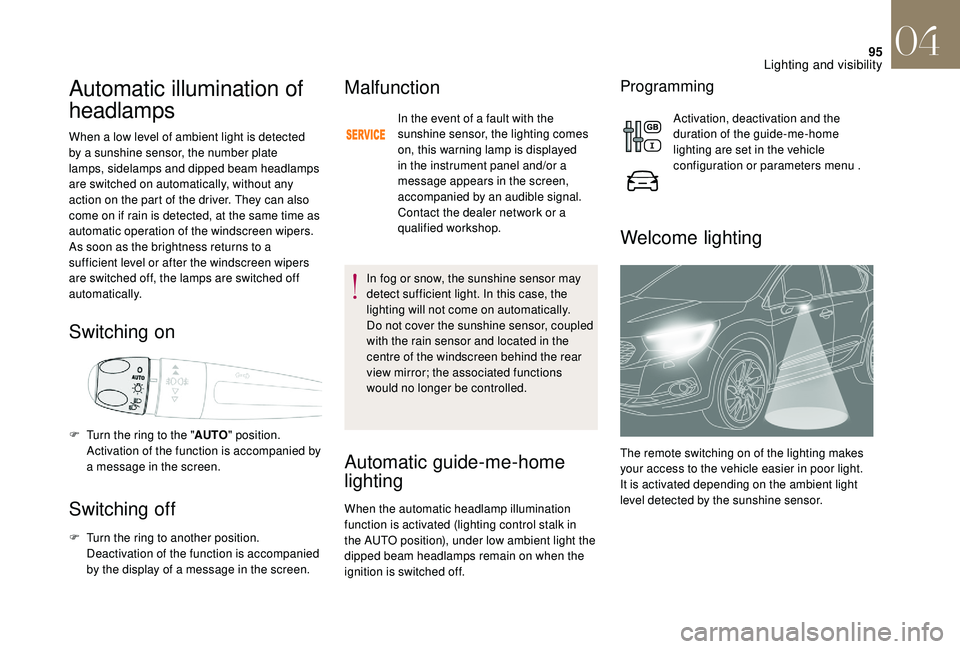
Switching on
Switching off
F Turn the ring to another position. Deactivation of the function is accompanied
by the display of a message in the screen.
Malfunction
In the event of a fault with the
sunshine sensor, the lighting comes
on, this warning lamp is displayed
in the instrument panel and/or a
message appears in the screen,
accompanied by an audible signal.
Contact the dealer network or a
qualified workshop.
In fog or snow, the sunshine sensor may
detect sufficient light. In this case, the
lighting will not come on automatically.
Do not cover the sunshine sensor, coupled
with the rain sensor and located in the
centre of the windscreen behind the rear
view mirror; the associated functions
would no longer be controlled.
Automatic guide-me-home
lighting
When the automatic headlamp illumination
function is activated (lighting control stalk in
the AUTO position), under low ambient light the
dipped beam headlamps remain on when the
ignition is switched off.
Programming
Activation, deactivation and the
duration of the guide-me-home
lighting are set in the vehicle
configuration or parameters menu .
Welcome lighting
The remote switching on of the lighting makes
your access to the vehicle easier in poor light.
It is activated depending on the ambient light
level detected by the sunshine sensor.
F
T
urn the ring to the "
AUTO" position.
Activation of the function is accompanied by
a message in the screen.
04
Lighting and visibility
Page 100 of 296
98
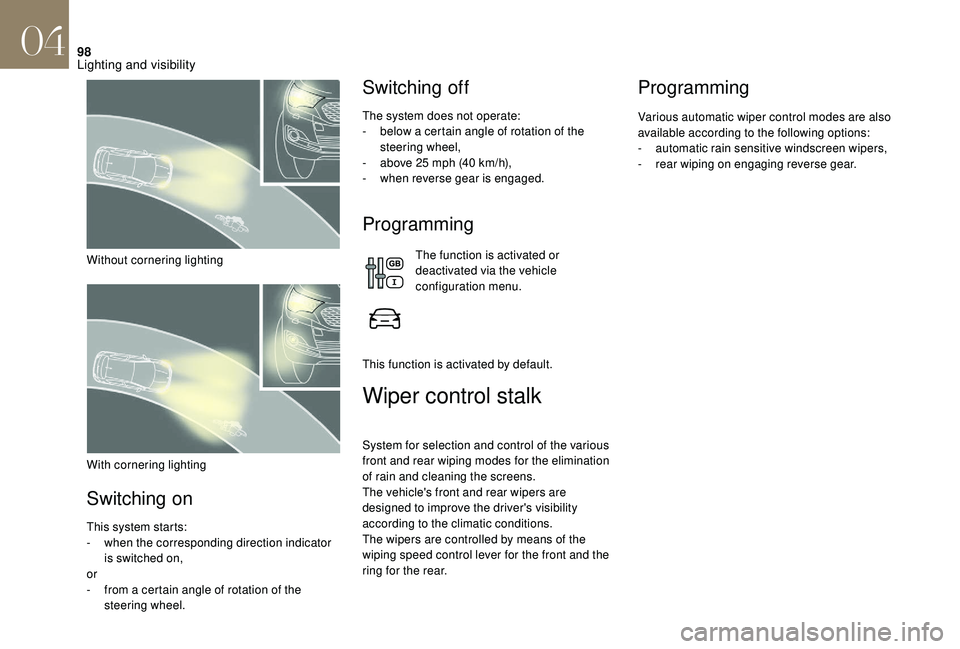
Without cornering lighting
Switching on
This system starts:
- w hen the corresponding direction indicator
is switched on,
or
-
f
rom a certain angle of rotation of the
steering wheel.
Switching off
The system does not operate:
- b elow a certain angle of rotation of the
steering wheel,
-
a
bove 25 mph (40 km/h),
-
w
hen reverse gear is engaged.
Programming
The function is activated or
deactivated via the vehicle
configuration menu.
This function is activated by default.
Wiper control stalk
System for selection and control of the various
front and rear wiping modes for the elimination
of rain and cleaning the screens.
The vehicle's front and rear wipers are
designed to improve the driver's visibility
according to the climatic conditions.
The wipers are controlled by means of the
wiping speed control lever for the front and the
ring for the rear.
Programming
Various automatic wiper control modes are also
available according to the following options:
-
a
utomatic rain sensitive windscreen wipers,
-
r
ear wiping on engaging reverse gear.
With cornering lighting
04
Lighting and visibility
Page 101 of 296
99
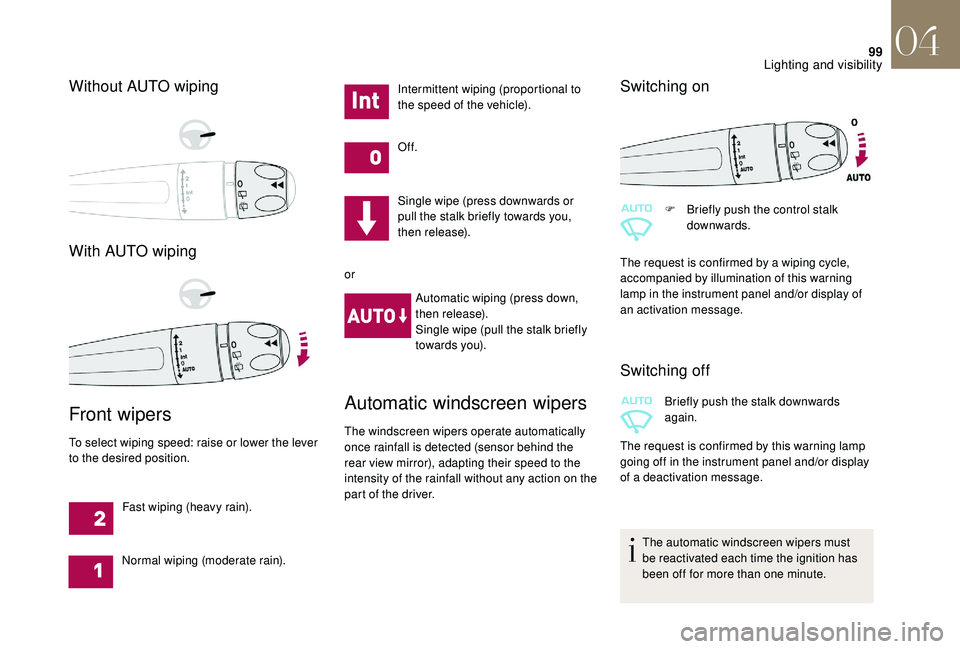
Without AUTO wiping
With AUTO wiping
Front wipers
To select wiping speed: raise or lower the lever
to the desired position.Fast wiping (heavy rain).
Normal wiping (moderate rain). Intermittent wiping (proportional to
the speed of the vehicle).
Of f.
Single wipe (press downwards or
pull the stalk briefly towards you,
then release).
or Automatic wiping (press down,
then release).
Single wipe (pull the stalk briefly
towards you).
Automatic windscreen wipers
The windscreen wipers operate automatically
once rainfall is detected (sensor behind the
rear view mirror), adapting their speed to the
intensity of the rainfall without any action on the
part of the driver.
Switching on
F Briefly push the control stalk downwards.
The request is confirmed by a wiping cycle,
accompanied by illumination of this warning
lamp in the instrument panel and/or display of
an activation message.
Switching off
Briefly push the stalk downwards
again.
The request is confirmed by this warning lamp
going off in the instrument panel and/or display
of a deactivation message.
The automatic windscreen wipers must
be reactivated each time the ignition has
been off for more than one minute.
04
Lighting and visibility
Page 102 of 296
100
Malfunction
If a fault occurs with the automatic rain sensitive
wipers, the wipers will operate in intermittent mode.
Contact the dealer network or a qualified workshop.
Do not cover the rain sensor, linked with
the sunshine sensor and located in the top
centre of the windscreen, behind the rear
view mirror.
When using an automatic car wash, switch
off the automatic rain sensitive wipers.
In winter, it is advisable to wait until the
windscreen is completely clear of ice before
activating the automatic rain sensitive wipers.
Windscreen and headlamp
wash
Front screenwashHeadlamp wash
To reduce the fluid consumption of the
headlamp wash, it operates only with
every seventh use of the screenwash or
every 25 miles (40 km) during a given
j o u r n ey.
Low screenwash/headlamp wash
fluid
level
Checking and topping up this fluid should be
done with the engine off.
The fluid level should be checked
regularly, particularly during winter.
For more information on Checking levels and,
in particular, the screenwash/headlamp wash,
refer to the corresponding section.
Special position of the
windscreen wipers
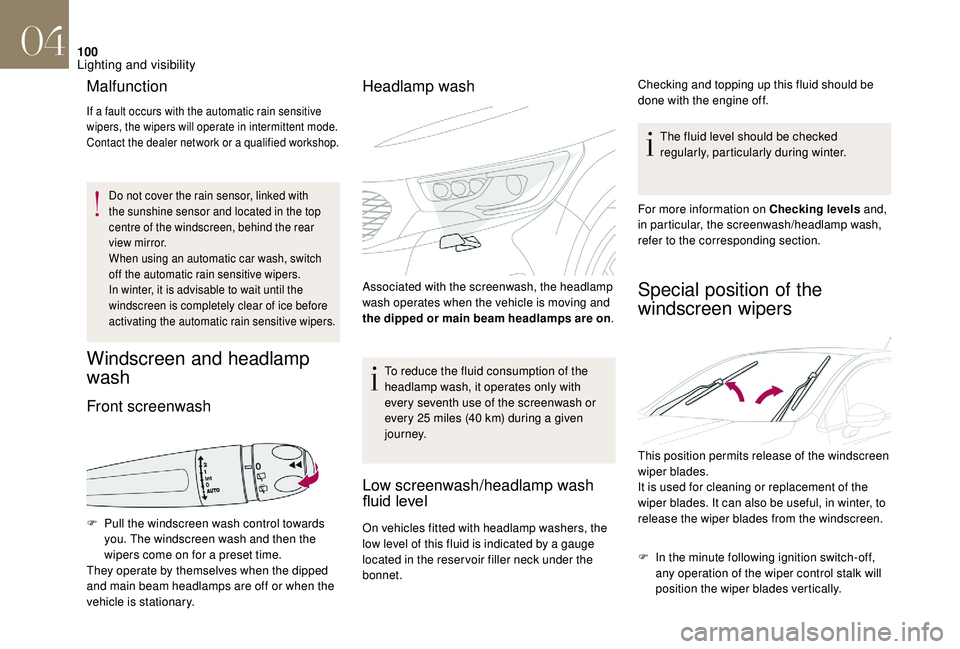
This position permits release of the windscreen
wiper blades.
It is used for cleaning or replacement of the
wiper blades. It can also be useful, in winter, to
release the wiper blades from the windscreen.
F
P
ull the windscreen wash control towards
you. The windscreen wash and then the
wipers come on for a preset time.
They operate by themselves when the dipped
and main beam headlamps are off or when the
vehicle is stationary. Associated with the screenwash, the headlamp
wash operates when the vehicle is moving and
the dipped or main beam headlamps are on
.
On vehicles fitted with headlamp washers, the
low level of this fluid is indicated by a gauge
located in the reser voir filler neck under the
bonnet. F
I
n the minute following ignition switch-off,
any operation of the wiper control stalk will
position the wiper blades vertically.
04
Lighting and visibility
Page 138 of 296
136
For more information on Energy
economy mode, refer to the
corresponding section.
Key left in
If the key has been left in the ignition
switch at position 2 (Ignition on) , the
ignition will be switched off automatically
after one hour.
To switch the ignition back on, turn the key
to position 1 (Stop) , then back to position
2 (Ignition on) .
Starting/Switching off the
engine with Keyless Entry
and Starting
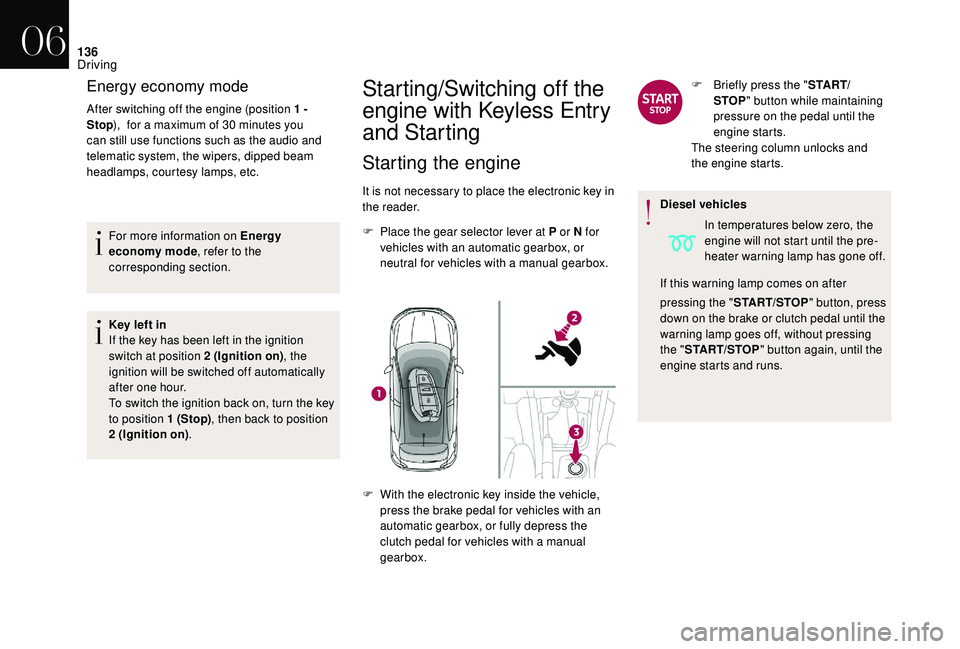
Starting the engine
It is not necessary to place the electronic key in
the reader.
F
P
lace the gear selector lever at P or N for
vehicles with an automatic gearbox, or
neutral for vehicles with a manual gearbox.
F
W
ith the electronic key inside the vehicle,
press the brake pedal for vehicles with an
automatic gearbox, or fully depress the
clutch pedal for vehicles with a manual
gearbox. F
B
riefly press the "
S TA R T/
STOP " button while maintaining
pressure on the pedal until the
engine starts.
The steering column unlocks and
the engine starts.
Diesel vehicles
Energy economy mode
After switching off the engine (position 1 -
Sto p), for a maximum of 30 minutes you
can still use functions such as the audio and
telematic system, the wipers, dipped beam
headlamps, courtesy lamps, etc.
In temperatures below zero, the
engine will not start until the pre-
heater warning lamp has gone off.
If this warning lamp comes on after pressing the " START/STOP " button, press
down on the brake or clutch pedal until the
warning lamp goes off, without pressing
the " START/STOP " button again, until the
engine starts and runs.
06
Driving
Page 177 of 296
175
Load reduction mode
System which manages the use of certain
functions according to the level of charge
remaining in the battery.
When the vehicle is being driven, the load
reduction function temporarily deactivates
certain functions, such as air conditioning,
heated rear screen...
The deactivated functions are reactivated
automatically as soon as conditions permit.
Energy saving mode
System that manages the duration of use of
certain functions to conser ve a sufficient level
of charge in the battery.
After the engine has stopped, you can
still use functions such as the audio
equipment, windscreen wipers, dipped
beam headlamps,
courtesy lamps, etc. for a
maximum combined period of thirty minutes.
This period may be greatly reduced if the
battery is not fully charged.
Switching to this mode
Once this period has elapsed, a message
appears in the screen indicating that the
vehicle has switched to the energy saving
mode and the active functions are put on
st a n d by.If the telephone was operated via
the touch screen at that moment, the
connection would be interrupted after
10
minutes.
Exiting the mode
These functions will be automatically restored
the next time the vehicle is used.
F
I
n order to restore the use of these functions
immediately, start the engine and let it run
for a few minutes.
The time available to you will then be double
the period for which the engine is left running.
However, this period will always be between
five and thirty minutes.
The engine will not start if the battery is
discharged.
For more information on the 12 V batter y ,
refer to the corresponding section.
07
Practical information
Page 210 of 296

208
Engine compartment fuses
The fusebox is located in the engine
compartment near the battery (left-hand side).
Access to the fuses
F Unclip the cover.
F C hange the fuse.
For information on the special requirements
and precautions to take before changing a fuse,
refer to the start of this section.
F
W
hen you have finished, close the cover
very carefully to ensure correct sealing of
the fusebox. Fuse No.
Rating Functions
F19 30 A
Windscreen wipers slow/fast speed.
F20 15 A
Front and rear screenwash pump.
F21 20 A
Headlamp wash pump.
F22 15 A
Horn.
F23 15 A
Right-hand main beam headlamp.
F24 15 A
Left-hand main beam headlamp.
F27 5 A
Left-hand dipped headlamp.
F28 5 A
Right-hand dipped headlamp.
08
In the event of a breakdown
Page 211 of 296

209
12 V battery
Procedure for starting the engine using another
battery or charging a discharged battery.
General points
Lead-acid starter batteries
Batteries contain harmful substances
such as sulphuric acid and lead.
They must be disposed of in accordance
with regulations and must not, in any
circumstances, be discarded with
household waste.
Take used remote control batteries and
vehicle batteries to a special collection
point.
Protect your eyes and face before
handling the battery.
All operations on the battery must be
carried out in a well ventilated area and
away from naked flames and sources of
sparks, so as to avoid the risk of explosion
or fire.
Wash your hands afterwards. If your vehicle has an automatic gearbox,
do not try to start the engine by pushing
the vehicle.
Access to the battery
The battery is located under the bonnet.
For access to the (+) terminal:
F
r
elease the bonnet using the interior lever,
then the exterior lever,
F
r
aise the bonnet and secure it with its stay,
F
l
ift the plastic cover for access to the (+)
terminal.
Starting using another battery
When your vehicle's battery is discharged, the
engine can be started using a slave battery
(external or on another vehicle) and jump leads
or a battery booster.
Never try to start the engine by connecting
a battery charger.
Never use a 24 V or higher battery
b o o s t e r.
First check that the slave battery has a
nominal voltage of 12 V and a capacity
at least equal to that of the discharged
battery.
The two vehicles must not be in contact
with each other.
Switch off all the electrical consumers
on both vehicles (audio system, wipers,
lighting, etc.).
Make sure that the jump leads are not
close to moving parts of the engine (fan,
belts, etc.).
Do not disconnect the (+) terminal while
the engine is running.
08
In the event of a breakdown
Page 212 of 296
210
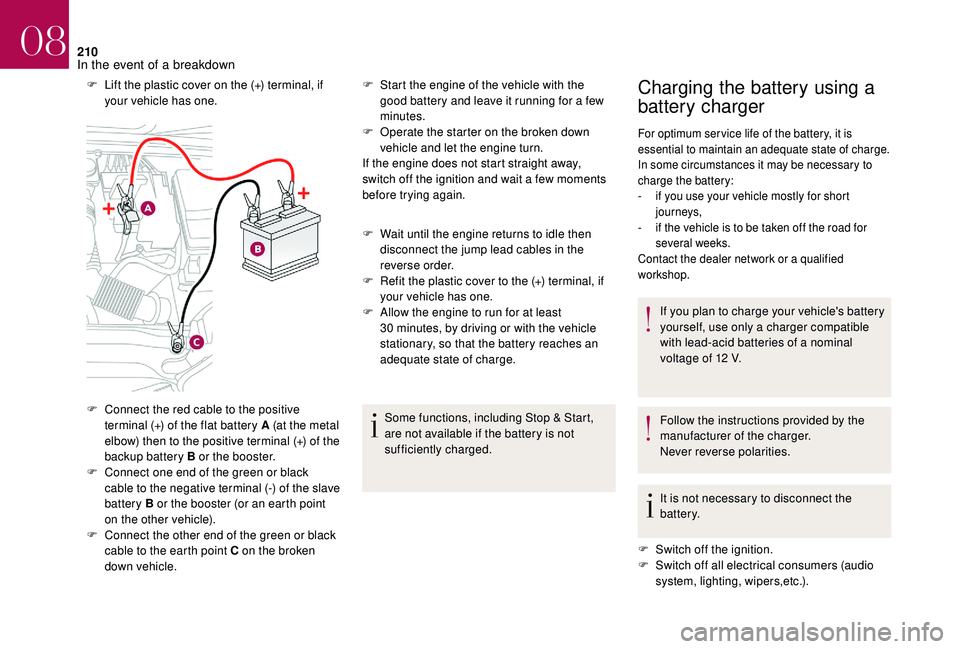
F Lift the plastic cover on the (+) terminal, if your vehicle has one.
F
C
onnect the red cable to the positive
terminal (+) of the flat battery A (at the metal
elbow) then to the positive terminal (+) of the
backup battery B or the booster.
F
C
onnect one end of the green or black
cable to the negative terminal (-) of the slave
battery B or the booster (or an earth point
on the other vehicle).
F
C
onnect the other end of the green or black
cable to the earth point C on the broken
down vehicle. F
S tart the engine of the vehicle with the
good battery and leave it running for a few
minutes.
F
O
perate the starter on the broken down
vehicle and let the engine turn.
If the engine does not start straight away,
switch off the ignition and wait a few moments
before trying again.
F
W
ait until the engine returns to idle then
disconnect the jump lead cables in the
reverse order.
F
R
efit the plastic cover to the (+) terminal, if
your vehicle has one.
F
A
llow the engine to run for at least
30
minutes, by driving or with the vehicle
stationary, so that the battery reaches an
adequate state of charge.
Some functions, including Stop & Start,
are not available if the battery is not
sufficiently charged.Charging the battery using a
battery charger
For optimum ser vice life of the battery, it is
essential to maintain an adequate state of charge.
In some circumstances it may be necessary to
charge the battery:
-
i
f you use your vehicle mostly for short
journeys,
-
i
f the vehicle is to be taken off the road for
several weeks.
Contact the dealer network or a qualified
workshop.
If you plan to charge your vehicle's battery
yourself, use only a charger compatible
with lead-acid batteries of a nominal
voltage of 12 V.
Follow the instructions provided by the
manufacturer of the charger.
Never reverse polarities.
It is not necessary to disconnect the
battery.
F
S
witch off the ignition.
F
S
witch off all electrical consumers (audio
system, lighting, wipers,etc.).
08
In the event of a breakdown
Page 213 of 296
2 11
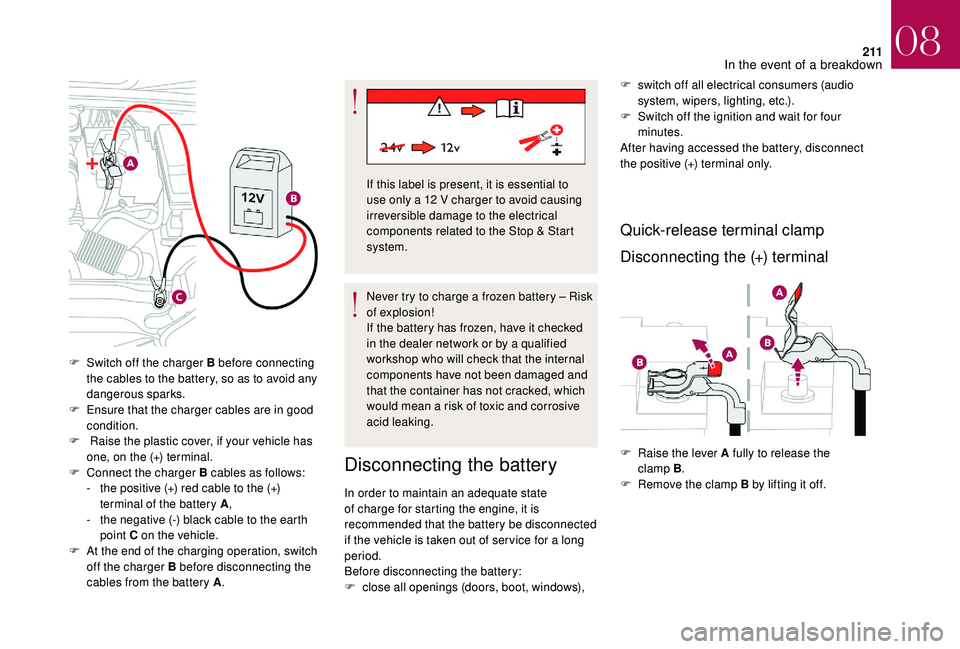
F Switch off the charger B before connecting the cables to the battery, so as to avoid any
dangerous sparks.
F
E
nsure that the charger cables are in good
condition.
F
R
aise the plastic cover, if your vehicle has
one, on the (+) terminal.
F
C
onnect the charger B cables as follows:
-
t
he positive (+) red cable to the (+)
terminal of the battery A ,
-
t
he negative (-) black cable to the earth
point C on the vehicle.
F
A
t the end of the charging operation, switch
off the charger B before disconnecting the
cables from the battery A . Never try to charge a frozen battery – Risk
of explosion!
If the battery has frozen, have it checked
in the dealer network or by a qualified
workshop who will check that the internal
components have not been damaged and
that the container has not cracked, which
would mean a risk of toxic and corrosive
acid leaking.
Disconnecting the battery
F switch off all electrical consumers (audio
system, wipers, lighting, etc.).
F
S
witch off the ignition and wait for four
minutes.
After having accessed the battery, disconnect
the positive (+) terminal only.
Quick-release terminal clamp
Disconnecting the (+) terminal
If this label is present, it is essential to
use only a 12 V charger to avoid causing
irreversible damage to the electrical
components related to the Stop & Start
system.
In order to maintain an adequate state
of charge for starting the engine, it is
recommended that the battery be disconnected
if the vehicle is taken out of ser vice for a long
period.
Before disconnecting the battery:
F
c
lose all openings (doors, boot, windows), F
Ra
ise the lever A fully to release the
clamp B .
F
R
emove the clamp B by lifting it off.
08
In the event of a breakdown