air condition CITROEN DS4 2023 User Guide
[x] Cancel search | Manufacturer: CITROEN, Model Year: 2023, Model line: DS4, Model: CITROEN DS4 2023Pages: 296, PDF Size: 9.91 MB
Page 81 of 296

79
Front demist – defrost
With manual air conditioning
F Put the temperature, air flow and distribution controls to the
dedicated marked position.
F
P
ut the air intake control to the "Exterior air
intake" position (control indicator lamp off).
F
S
witch on the air conditioning
by pressing the " A/C" button;
the indicator lamp in the button
comes on.
With automatic dual-zone air
conditioning
Automatic visibility programme
F Select this programme to demist or defrost the windscreen and
side windows as quickly as
possible.
With Stop & Start, when demisting/
defrosting has been activated, STOP
mode is not available.
The system automatically manages the air
conditioning, air flow and air intake, and provides
optimum distribution towards the windscreen and
side windows.
F
T
o stop the programme, press either the
visibility button again or " AUTO"; the
indicator lamp in the button goes off and the
indicator lamp in the " AUTO" button comes on.
The system starts again with the values in
use before it was overridden by the visibility
programme.
F It is possible to stop the demisting/defrosting operation
before it is switched off
automatically by pressing the
button again. The indicator lamp
in the button goes out.
Rear screen demist –
defrost
Switching on
Demisting – defrosting of the rear screen can
only function when the engine is running.
Switching off
Demisting/defrosting switches off automatically
to prevent an excessive consumption of current.
F Press this button to demist /defrost the rear screen and
(depending on version) the door
mirrors. The indicator lamp in
the button comes on.
These markings on the control panel
indicate the control positions for
rapid demisting or defrosting of the
windscreen and side windows.
With Stop & Start, when the demisting/
defrosting, air conditioning and air flow
functions are activated, STOP mode is not
available. The control button is located on
the air conditioning system control
panel.
03
Ease of use and comfort
Page 86 of 296

84
Interior mood lighting
The dimmed passenger compartment lighting
improves visibility in the vehicle when the light
i s p o o r.
Switching on
At night, the audio system and automatic
air conditioning illumination, together with
the illumination of the central dashboard
storage box, come on automatically when the
sidelamps are on.On certain versions, three LEDs, located in the
rail linking the rear view mirror to the roof come
on as well.
Switching off
The mood lighting switches off automatically
when the sidelamps are switched off.
It can be switched off manually by adjusting the
instrument panel lighting dimmer button to one
of the lowest settings.
Centre consoles
Semi-high version
1.
Front armrest
2. Open storage
3. Cup holders
4. Storage compartments
03
Ease of use and comfort
Page 108 of 296

106
If you purchased your vehicle outside the
dealer network, we invite you to have a
dealer check the configuration of these
ser vices and, if desired, modify them to
suit your wishes.
In a multi-lingual country, configuration is
possible in the official national language
of your choice.
For technical reasons and in particular to
improve the quality of Telematic ser vices
services to customers, the manufacturer
reser ves the right to carry out updates to
the vehicle's on-board telematic system.
Emergency or assistance
call (type 2)
Localised Emergency Call
In an emergency, press this
button for more than 2 seconds.
The flashing green LED and
the voice message confirm that
the call has been made to the
"Localised Emergency Call" call
c e nt re*.
Pressing this button again
immediately cancels the call.
The green LED goes off.
The green LED remains on (without flashing)
when communication is established.
It goes off at the end of the call.
Localised Emergency Call immediately
locates your vehicle, contacts you in your own
language** and – if necessary – requests that
relevant emergency services be dispatched**.
In countries where the ser vice is not available,
or when the locating ser vice has been
expressly declined, the call is sent directly
to the emergency services (112) without the
vehicle location.
If an impact is detected by the airbag
control unit, and independently of the
deployment of any airbags, an emergency
call is made automatically. If you benefit from the DS Connect BOX
offer with the SOS and assistance pack
included, you have available additional
ser vices in your personal space, via the
website in your country.
*
I
n accordance with the general conditions
of use for the ser vice available from dealers
and subject to technological and technical
limitations.
**
A
s per the geographic coverage of
Localised Emergency Call, Localised
Assistance Call and the official national
language chosen by the owner of the
vehicle.
The list of countries covered and Telematic
ser vices is available from dealers or on the
website for your country.
05
Safety
Page 112 of 296
11 0
ASR/DSC
These systems offer increased safety
in normal driving, but they should not
encourage the driver to take extra risks or
drive at high speed.
It is in conditions of reduced grip (rain,
snow, ice) that the risk of loss of grip
increases. It is therefore important for your
safety to keep these systems activated in
all conditions, and particularly in difficult
conditions.
The correct operation of these systems
depends on observation of the
manufacturer's recommendations, not
only about the wheels (tyres and rims),
braking and electronic components but
also the assembly and repair procedures
used in the dealer network.
To benefit in full from the effectiveness
of these systems in wintry conditions,
the vehicle must be fitted with four snow
tyres, allowing the vehicle to retain neutral
behaviour on the road.Seat belts
Front seat belts
The front seat belts are fitted with a
pretensioning and force limiting system.
This system improves safety in the front
seats in the event of a front or side impact.
Depending on the severity of the impact, the
pretensioning system instantly tightens the seat
belts against the body of the occupants.
The pretensioning seat belts are active when
the ignition is on.
The force limiter reduces the pressure of
the seat belt on the passenger’s chest, thus
improving their protection.
Fastening
F Pull the strap then insert the tongue in the buckle.
F
C
heck that the seat belt is fastened
correctly by pulling the strap.
Unfastening
F Press the red button on the buckle.
F G uide the seat belt as it reels in.
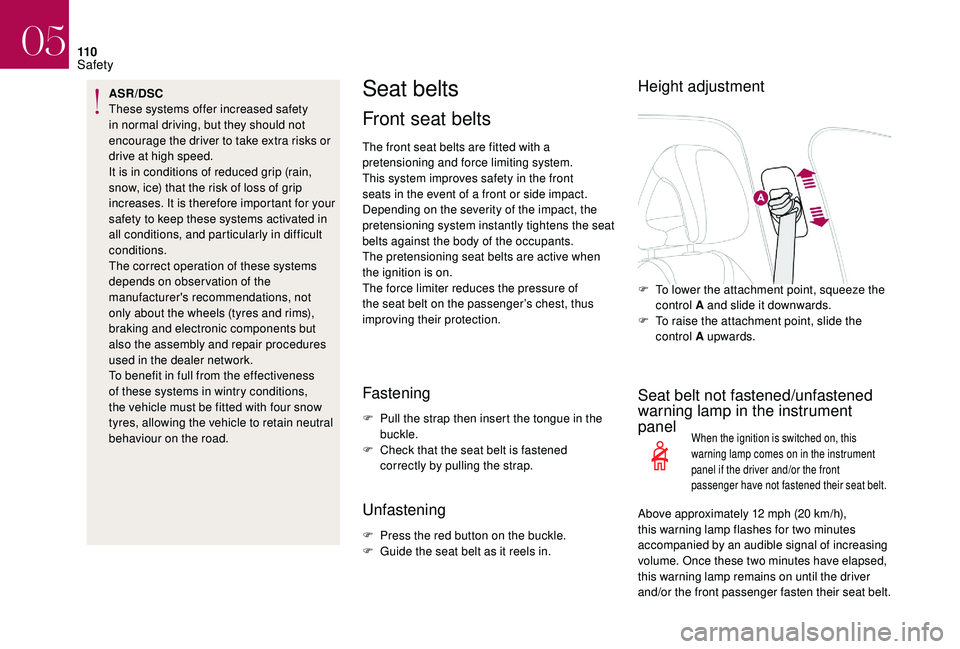
Height adjustment
F To lower the attachment point, squeeze the control A and slide it downwards.
F
T
o raise the attachment point, slide the
control A upwards.
Seat belt not fastened/unfastened
warning lamp in the instrument
panel
When the ignition is switched on, this
warning lamp comes on in the instrument
panel if the driver and/or the front
passenger have not fastened their seat belt.
Above approximately 12 mph (20 km/h),
this warning lamp flashes for two minutes
accompanied by an audible signal of increasing
volume. Once these two minutes have elapsed,
this warning lamp remains on until the driver
and/or the front passenger fasten their seat belt.
05
Safety
Page 115 of 296

11 3
Airbags
General information
This system contributes towards improving
the safety of passengers (with the exception
of the rear centre passenger) in the event of
violent collisions. The airbags supplement the
action of the seat belts fitted with force limiters
(all
except the centre rear passenger belt).
If a collision occurs, the electronic detectors
record and analyse the front and side impacts
sustained in the impact detection zones:
-
i
n the event of a serious impact, the airbags
are deployed instantly and contribute
towards better protection of the passengers
(with the exception of the rear centre
passenger); immediately after the impact,
the airbags deflate rapidly so that they
do not hinder visibility or the exit of the
passengers,
-
i
n the case of a minor or rear impact or in
certain roll-over conditions, the airbags
may not be deployed; the seat belt
alone contributes towards ensuring your
protection in these situations.
The airbags do not operate when the
ignition is switched off.
This equipment will only deploy once. If a
second impact occurs (during the same or
a subsequent accident), the airbag will not
be deployed again.
Impact detection zones
A. Front impact zone.
B. Side impact zone.
The deployment of an airbag is
accompanied by a slight emission of
smoke and a noise, due to the detonation
of the pyrotechnic charge incorporated in
the system.
This smoke is not harmful, but sensitive
individuals may experience slight irritation.
The detonation noise associated with the
deployment of an airbag may result in a
slight loss of hearing for a short time.
Front airbags
Deployment
The airbags are deployed (except the passenger's
front airbag if it is deactivated) in the event of a
serious frontal impact to all or part of the frontal
impact zone A , in the longitudinal centreline of the
vehicle on a horizontal plane and directed from
the front to the rear of the vehicle.
The front airbag inflates between the thorax and
head of the front occupant of the vehicle and the
steering wheel, driver's side, or the dashboard,
passenger's side, to cushion their for ward
movement.
This system protects the driver and front
passenger in the event of a severe frontal
impact in order to limit the risk of injury to the
head and chest.
The driver's airbag is fitted in the centre of the
steering wheel; the front passenger's airbag is
fitted in the dashboard above the glove box.
05
Safety
Page 177 of 296
175
Load reduction mode
System which manages the use of certain
functions according to the level of charge
remaining in the battery.
When the vehicle is being driven, the load
reduction function temporarily deactivates
certain functions, such as air conditioning,
heated rear screen...
The deactivated functions are reactivated
automatically as soon as conditions permit.
Energy saving mode
System that manages the duration of use of
certain functions to conser ve a sufficient level
of charge in the battery.
After the engine has stopped, you can
still use functions such as the audio
equipment, windscreen wipers, dipped
beam headlamps,
courtesy lamps, etc. for a
maximum combined period of thirty minutes.
This period may be greatly reduced if the
battery is not fully charged.
Switching to this mode
Once this period has elapsed, a message
appears in the screen indicating that the
vehicle has switched to the energy saving
mode and the active functions are put on
st a n d by.If the telephone was operated via
the touch screen at that moment, the
connection would be interrupted after
10
minutes.
Exiting the mode
These functions will be automatically restored
the next time the vehicle is used.
F
I
n order to restore the use of these functions
immediately, start the engine and let it run
for a few minutes.
The time available to you will then be double
the period for which the engine is left running.
However, this period will always be between
five and thirty minutes.
The engine will not start if the battery is
discharged.
For more information on the 12 V batter y ,
refer to the corresponding section.
07
Practical information
Page 184 of 296
182
Air filter and passenger compartment filter
Refer to the manufacturer’s
ser vice schedule for details of the
replacement intervals for these
components.
Depending on the environment (e.g. dusty
atmosphere) and the use of the vehicle (e.g.
city driving), replace them twice as often if
necessary .
A clogged passenger compartment filter may
have an adverse effect on the per formance
of the air conditioning system and generate
undesirable odours.
Oil filter
Change the oil filter each time the
engine oil is changed.
Refer to the manufacturer’s
ser vice schedule for details of
the replacement inter val for this
component.
Particle filter (Diesel)
Depending on the version of the instrument
panel you have, the start of saturation of the
particle filter is indicated by:
Manual gearbox
The gearbox does not require any
maintenance (no oil change).
Automatic gearbox
The gearbox does not require any
maintenance (no oil change).
- fixed illumination of the particle filter warning lamp, accompanied
by an audible signal and a
message that there is a risk of
blockage of the particle filter,
or
-
t
emporary illumination of
the Ser vice warning lamp,
accompanied by an audible
signal and a message that
there is a risk of blockage of the
particle filter. On a new vehicle, the first particle
filter regeneration operations may be
accompanied by a "burning" smell, which
is per fectly normal.
Following prolonged operation of the
vehicle at very low speed or at idle,
you may, in exceptional circumstances,
notice the emission of water vapour at the
exhaust on acceleration. This does not
affect the behaviour of the vehicle or the
environment.
Traffic conditions permitting, regenerate
the filter by driving at a speed of at least
37 mph (60 km/h) until the warning lamp
goes off.
If the warning lamp stays on, this indicates
a low Diesel additive level.
For more information on Checking levels ,
refer to the corresponding section.
07
Practical information
Page 289 of 296
223
ABS ...............................................................108
Accessories .......................................... 103, 13 8
Accessory position
....................................... 13 8
AdBlue
® ........................................... 20, 183 -185
Additive, AdBlue .............................................. 20
Adjusting headlamps
...................................... 96
Adjusting head restraints
................................ 66
Adjusting seats
.......................................... 64-66
Adjusting the date
......................... 37- 3 9, 45, 36
Adjusting the height and reach of the steering wheel
.................................... 70
Adjusting the seat belt height
................ 11
0 -111
Adjusting the time
......................... 37- 3 9, 45, 36
Advice on care and maintenance
.................18 6
Advice on driving
................................... 132-13 3
Airbags
...............................
.............19, 113 , 11 8
Airbags, curtain
...................................... 114 -115
Airbags, front ................................... 113 -115, 11 9
Airbags, lateral
....................................... 114 -115
Air conditioning, automatic
........................74 -7 8
Air conditioning, manual
...................... 7
2-73, 78
Alarm
......................................................... 57- 5 9
Anti-lock braking system (ABS)
....................108
Anti-pinch
.................................................. 61
- 62
Anti-slip regulation (ASR)
............................. 108
Anti-theft
....................................................... 13 4
Armrest, front
............................................ 85-86
Armrest, rear
...............................
....................88
ASR
........
....................................................... 108
Assistance call
...............................
........104 -107
Assistance, emergency braking
...................108
Audio streaming (Bluetooth)
.......................27, 7
Auxiliary
.................................................... 26-27
B
Back-up key..................................................... 53
Battery .................................... 181, 209 , 211-212
Battery, charging
.................................... 210 -211Battery, remote control
.......................
50, 54-56
Black panel ................................................ 36 -37
Blanking screen (snow shield)
......................
170
Blind
..............................
..................................
80
Blind spot sensors
.................................
157-159
BlueHDi
............................................
34, 36 , 183
Bluetooth (hands-free)
.......................... 2
8-29
, 9
Bluetooth (telephone)
................................ 28
-30
Bonnet
....................................................
17 7-178
Boot
.....................................................
60 - 61, 90
Brake discs
....................................................
183
Brake lamps
...............................
...................
203
Brakes
...........................................................
183
Bulbs (changing)
...................................
198, 203
C
Cable, audio .................................................... 26
Cable, jack ...................................................... 26
Capacity, fuel tank
................................. 166 -167
CarPlay connection ......................................... 18
CD
.......................................................... 26-27, 7
CD, MP3
............................................. 26-27, 7- 8
Central locking
.............................. 48
, 51- 5 2, 56
Centre console
................................................ 84
Changing a bulb
.................................... 19
8, 203
Changing a fuse
.................................... 20
5-208
Changing a wheel
.................................. 19
2-193
Changing a wiper blade
........................ 10
0, 176
Changing the remote control battery
........50, 54
CHECK
................
............................................ 36
Checking levels
...................................... 179 -18 0
Checking the engine oil level
....................32-33
Checking tyre pressures (using the kit) ...18 9, 191Checks ........................................... 178, 181-183
Checks, routine ...................................... 181-183
Child lock
................................................ 12 9 -13 0
Children
.......................................... 123, 125 -127
Children (safety)
..................................... 12 9 -13 0
A
Child seats ..............11 2, 11 6 -117 , 12 2-123 , 128
Child seats, conventional ..............................12 2
Child seats, ISOFIX
...............................124 -127
Cigar lighter
..................................................... 82
Cleaning (advice)
.......................................... 18 6
Closing the boot
.................................. 48
, 60 - 61
Closing the doors
.....................48, 51- 5 2, 59-60
Configuration, vehicle
..................... 11
-12, 37- 41
Connection, Bluetooth
........................ 21,
28-30
Connection, MirrorLink
...................................19
Connection, Wi-Fi network
.............................22
Control, electric windows
..........................61- 62
Control, emergency boot release
...................61
Control, emergency door
.............. 49
-50, 53-54
Control, heated seats
...................................... 68
Controls, steering mounted
...........................2-3
Control stalk, lighting
.........................23, 92 , 94
Control stalk, wipers
................................9
8 -101
Courtesy lamps
................................... 83, 95-96
Cruise control
.......................... 15 0 -151, 15 3 -15 5
Cup holder
....................................................... 84
D
DAB (Digital Audio
Broadcasting) – Digital radio ....................25, 5
Date (setting)
................................. 37- 3 9, 45, 36
Daytime running lamps
...................94, 198 , 201
Deactivating the passenger airbag
..................................... 113 -114, 11 8 -11 9
Deadlocking
.............................................. 48, 52
Demisting/defrosting
.................................79-80
Diesel
.............................................................. 26
Dimensions .............................. .....................221
Dipstick
................
.......................32-33, 179 -18 0
Direction indicators
..........23, 94 , 198 , 200 , 203
Display screen, instrument panel
......1 0 -11 , 14 6
Display screen, multifunction (with audio system)
.................................. 3
7- 3 9
Alphabetical index