light CITROEN DS4 2023 Workshop Manual
[x] Cancel search | Manufacturer: CITROEN, Model Year: 2023, Model line: DS4, Model: CITROEN DS4 2023Pages: 296, PDF Size: 9.91 MB
Page 174 of 296

172
During use
Never release the locking system with a
trailer or load carrier on the towball.
Never exceed the gross train weight
(GTW) for the vehicle.
Before setting off, check the adjustment of
the headlamp beam height.
For more information on adjusting the
headlamp beam height, refer to the
corresponding section.
After use
For journeys made without a trailer or
load carrier, the trailer socket must be
folded away, the towball removed and the
protective plug inserted in the carrier. This
measure applies particularly if the towball
could hinder visibility of the number plate
or lighting.Fitting the towball
F Remove the protective plug from the carrier and check the condition of the fixing system.
If necessary, clean the carrier with a brush
or a clean cloth.
F
T
ake the towball from the storage bag.
F
R
emove the protective cover from the ball
and the protective cap from the locking
wheel.
F
S
tow the plug, cover and cap in the storage
bag.
F
C
heck that the towball is unlocked (position
B ). If not, insert the key in the lock and
turn the key anti-clockwise to unlock the
mechanism. F
T
ake the towball in both hands; insert the
end of the towball into the carrier by lifting it,
then, to ensure that it has correctly locked in
place, pull firmly down on the ball end of the
towball.
The locking wheel then automatically rotates
anti-clockwise with an audible "click". Take
care to keep your hands clear.
F
C
heck that the towball has correctly locked
in place (position A ).
07
Practical information
Page 185 of 296

183
Manual parking brake
If excessive travel or a loss of
effectiveness of this system is
noticed, the parking brake must
be checked, even between two
services.
This system must be checked in the dealer
network or by a qualified workshop.
Electric parking brake
This system does not require any
routine servicing. However, in the
event of a problem, have the system
checked in the dealer network or by
a qualified workshop.
For more information on the Electric
parking brake , refer to the corresponding
section.
Only use products recommended by DS
AUTOMOBILES or products of equivalent
quality and specification.
In order to optimise the operation of
components as important as those in
the braking system, DS AUTOMOBILES
selects and offers very specific products.
After washing the vehicle, dampness, or
in wintry conditions, ice can form on the
brake discs and pads: braking efficiency
may be reduced. Make light brake
applications to dry and defrost the brakes.
AdBlue® (BlueHDi
engines)
To respect the environment and ensure
compliance with the Euro 6 standard, without
adversely affecting the performance or
fuel consumption of Diesel engines, DS
AUTOMOBILES has taken the decision to
equip its vehicles with a system that associates
SCR (Selective Catalytic Reduction) with a
Diesel particle filter (DPF) for the treatment of
exhaust gases.
SCR system
Using a liquid called AdBlue® that contains
urea, a catalytic converter turns up to 85% of
the oxides of nitrogen (NOx) into nitrogen and
water, which are harmless to health and the
environment.
Brake pads
Brake wear depends on the style
of driving, particularly in the case
of vehicles used in town, over short
distances. It may be necessary to
have the condition of the brakes
checked, even between vehicle
services.
Unless there is a leak in the circuit, a drop in
the brake fluid level indicates that the brake
pads are worn.
Brake disc/drum wear
For information on checking brake
disc wear, contact the dealer
network or a qualified workshop.
07
Practical information
Page 187 of 296

185
Keep AdBlue® out of the reach of children,
in its original container or bottle.
Never transfer AdBlue
® to another
container: it would lose its purity.
Never dilute AdBlue
® with water.
Never pour AdBlue® into the Diesel fuel
tank. Containers or bottles are available from the
dealer network or a qualified workshop.
Never top up from an AdBlue
® dispenser
reserved for heavy goods vehicles.
Recommendations on storage
AdBlue® freezes below around -11°C and
deteriorates above 25°C. It is recommended
that bottles or containers be stored in a cool
place and protected from direct sunlight.
Under these conditions, the fluid can be kept
for at least a year.
If the additive has frozen, it can be used once it
has completely thawed out.
Never store bottles or containers of
AdBlue
® in your vehicle.
Procedure
Before topping up, ensure that the vehicle is
parked on a flat and level sur face.
In wintry conditions, ensure that the
temperature of the vehicle is above -11°C.
Otherwise the AdBlue
® may be frozen and F
S
witch off the ignition and remove the key,
or if your vehicle has one, press the START/
STOP button to switch off the engine.
F
R
aise the boot floor for access to the
AdBlue
® tank. Secure the boot floor by
attaching its cord to the hook on the parcel
shelf support.
F
U
nclip the black plastic blanking plug using
its tab.
F
T
urn the blue cap a 6th of a turn anti-
clockwise.
F
L
ift off the cap.
In certain conditions (high exterior temperature,
for example), the risk of ammonia being
released cannot be excluded: do not inhale
the vapours. Ammonia has an irritant effect on
mucous membranes (eyes, nose and throat).
Use only AdBlue
® fluid that meets the
ISO
22241 standard. so cannot be poured into its tank. Park your
vehicle in a warmer area for a few hours to
allow the top-up to be carried out.
07
Practical information
Page 188 of 296

186
Important: if your vehicle's AdBlue® tank
i
s completely empty – which is
confirmed by the alert messages and the
impossibility of starting the engine – you
must add at least 4 litres.
F
A
fter emptying the container or bottle, wipe
away any spillage around the tank filler
using a damp cloth. If any AdBlue
® additive is spilt or splashed,
wash immediately with cold water or wipe
with a damp cloth.
If the AdBlue
® has crystallised, clean it off
using a sponge and hot water.
F
R
efit the blue cap to the tank filler and turn it
a 6th of a turn clockwise, to its stop.
F
R
efit the black plastic blanking plug, clipping
it in on the flap.
F
R
efit the boot carpet and close the tailgate.
Important: in the event of a top-up after
a breakdown because of a lack of
AdBlue, you must wait around 5 minutes
before switching on the ignition, without
opening the driver’s door, unlocking
the vehicle, introducing the key into
the ignition switch, or introducing
the key of the "Keyless Entr y and
Star ting" system into the passenger
compartment .
Switch on the ignition, then wait for
10
seconds before starting the engine.
F
O
btain a container or bottle of AdBlue
®.
After first checking the use-by date, read
carefully the instructions on use on the label
before pouring the contents of the container
or bottle into your vehicle's AdBlue
® tank.
Advice on care and maintenance
Recommendations on the care and
maintenance of your vehicle are given in the
Maintenance and Warranty Guide.
Matt finish
If your vehicle is coated with a clear, matt
varnish, it is essential that you take the
following instructions into account to avoid
damaging the paint, due to an inappropriate
treatment. These instructions are also valid for
the alloy wheels coated in a clear, matt varnish.
Textured paint
The textured paint reacts to light with variations
of appearance and finish that emphasise the
car's lines and form. This paint coating has
particles that remain visible and create a
unique satin relief effect. Its lightly granulated
texture gives it a surprising feel.
07
Practical information
Page 200 of 296

198
Changing a bulb
The headlamps have polycarbonate
lenses with a protective coating:
F
d
o not clean them using a dr y or
abrasive cloth, nor with a detergent
or solvent product,
F
u
se a sponge and soapy water or a pH
neutral product,
F
w
hen using a high pressure washer
on persistent marks, do not keep the
lance directed towards the lamps or
their edges for too long, so as not to
damage their protective coating and
seals.
Changing a bulb must only be done with
the ignition off and after the headlamp has
been switched off for several minutes –
Risk of serious burns!
F
D
o not touch the bulb directly with your
fingers, use a lint-free cloth.
It is essential only to use anti-ultraviolet
(UV) type bulbs, so as not to damage the
headlamp.
Always replace a failed bulb with a new
bulb with the same type and specification. In some weather conditions (e.g. low
temperature or humidity), the presence
of misting on the internal sur face of the
glass of the headlamps and rear lamps is
normal; it disappears after the lamps have
been on for a few minutes.
Light-emitting diodes (LED)
For the replacement of this type of lamp,
contact the dealer network or a qualified
workshop.
A LED (light-emitting diode) replacement
kit is available from the dealer network.
For bulbs with lugs, type H1, H7... take
care to position them correctly to ensure
the best lighting.
Risk of electrocution
Xenon bulbs (D1S) must be replaced
in the dealer network or by a qualified
workshop.
Front lamps
With xenon and full LED directional
lamps
1.
Daytime running lamps/sidelamps (LED).
2. Directional main beam/dipped beam
headlamps (D1S).
3. Direction indicators (LED).
4. Directional front foglamps (LED).
08
In the event of a breakdown
Page 201 of 296

199
With halogen headlamps (type 1)
1.Direction indicators (H21 clear).
2. Dipped beam headlamps (H7).
3. Main beam headlamps (H1).
4. Daytime running lamps/sidelamps
(P 21/5 W X L).
5. Foglamps (H11).
With halogen lamps and LED light
signature (type 2)
(LED: light-emitting diodes.)
1. Direction indicators (LED).
2. Daytime running lamps/sidelamps
(LEDs).
3. Dipped beam headlamps (H7).
4. Main beam headlamps (H7).
5. Foglamps (H11).
Access to bulbs
Depending on the engine and only on the left-
hand side, you must first carry out the following
operations for access to the protective covers
on the bulbs.
F
R
emove the air deflector by unclipping each
of its three attachment points.
F
U
nclip the bonnet release cable at its two
fixings.
F
M
ove the cable down.
After changing the failed bulb, remember to
put everything back in place (cable and air
deflector).
08
In the event of a breakdown
Page 205 of 296
203
Rear lamps
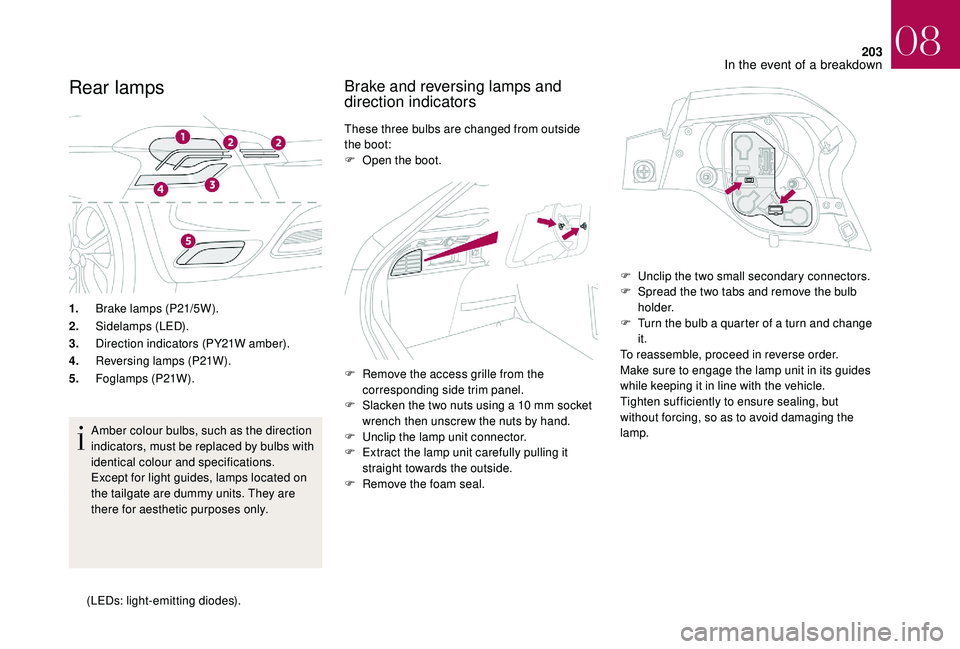
Amber colour bulbs, such as the direction
indicators, must be replaced by bulbs with
identical colour and specifications.
Except for light guides, lamps located on
the tailgate are dummy units. They are
there for aesthetic purposes only.
Brake and reversing lamps and
direction indicators
These three bulbs are changed from outside
the boot:
F
O
pen the boot.
1. Brake lamps (P21/5W).
2. Sidelamps (LED).
3. Direction indicators (PY21W amber).
4. Reversing lamps (P21W).
5. Foglamps (P21W).
(
LEDs: light-emitting diodes). F
R
emove the access grille from the
corresponding side trim panel.
F
S
lacken the two nuts using a 10 mm socket
wrench then unscrew the nuts by hand.
F
U
nclip the lamp unit connector.
F
E
xtract the lamp unit carefully pulling it
straight towards the outside.
F
R
emove the foam seal. F
U
nclip the two small secondary connectors.
F
S
pread the two tabs and remove the bulb
h o l d e r.
F
T
urn the bulb a quarter of a turn and change
it.
To reassemble, proceed in reverse order.
Make sure to engage the lamp unit in its guides
while keeping it in line with the vehicle.
Tighten sufficiently to ensure sealing, but
without forcing, so as to avoid damaging the
lamp.
08
In the event of a breakdown
Page 206 of 296

204
Light guides/sidelampsNumber plate lamps (W5W)F Insert a thin screwdriver into the cut-out outside the lens.
F
P
ush it outwards.
F
R
emove the lens.
F
R
eplace the faulty bulb.
To refit, press the lens to clip it in.
For the replacement of this type of LED lamp,
contact the dealer network or a qualified
workshop.
To facilitate removal, per form this procedure
with the tailgate half open. For the replacement of this type of light emitting
diode lamp, contact the dealer network or a
qualified workshop.
Third brake lamp (LED)
Foglamps
Take care not to touch the exhaust; there
is a risk of burns if changing a bulb within
a few minutes of switching off the ignition.
These bulbs are replaced from outside the rear
bumper:
F
p
ass your hand under the bumper,
F
t
urn the bulb holder a quarter turn and
remove it,
F
t
urn the bulb a quarter turn, pull it out and fit
a new bulb.
To reassemble, proceed in reverse order.
08
In the event of a breakdown
Page 209 of 296

207
Box 1Fuse No.Rating Functions
F8 3 AAlarm siren, alarm control unit.
F13 10 ACigar lighter/Front 12 V socket.
F14 10 A12 V socket in boot.
F16 3 ARear map reading lamps, glove box illumination.
F17 3 ASun visor illumination, front map reading lamps.
F28 15 AAudio system, audio system (after-market).
F30 20 ARear wiper.
F32 10 AHi-Fi amplifier.
Box 2
Fuse No.Rating Functions
F36 15 ARear 12 V socket.
F37 -Not used.
F38 -Not used.
F39 -Not used.
F40 25 A230 V/50 Hz socket (depending on country of sale).
08
In the event of a breakdown
Page 211 of 296
209
12 V battery
Procedure for starting the engine using another
battery or charging a discharged battery.
General points
Lead-acid starter batteries
Batteries contain harmful substances
such as sulphuric acid and lead.
They must be disposed of in accordance
with regulations and must not, in any
circumstances, be discarded with
household waste.
Take used remote control batteries and
vehicle batteries to a special collection
point.
Protect your eyes and face before
handling the battery.
All operations on the battery must be
carried out in a well ventilated area and
away from naked flames and sources of
sparks, so as to avoid the risk of explosion
or fire.
Wash your hands afterwards. If your vehicle has an automatic gearbox,
do not try to start the engine by pushing
the vehicle.
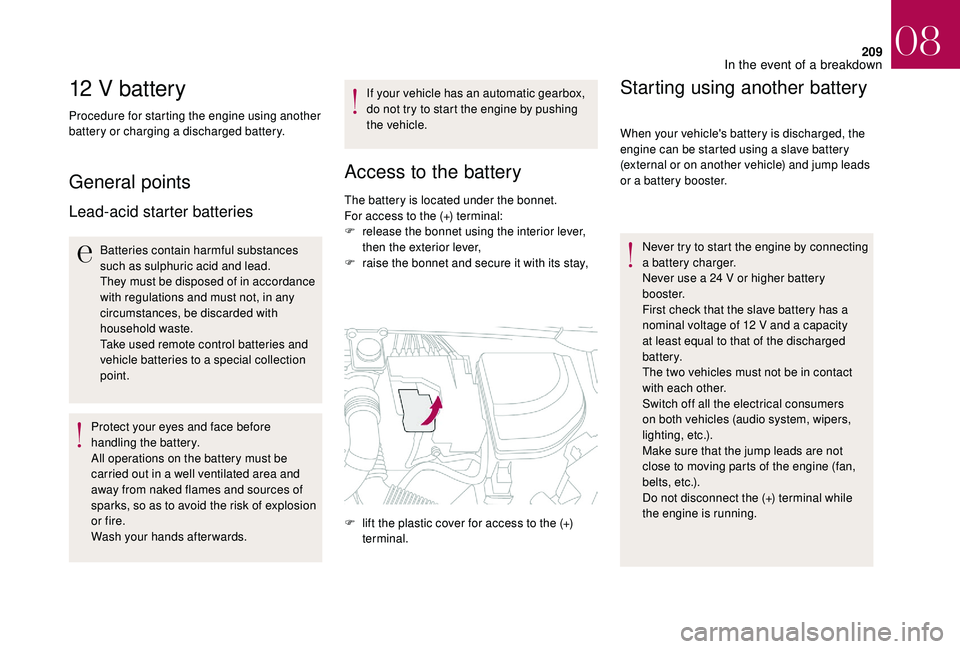
Access to the battery
The battery is located under the bonnet.
For access to the (+) terminal:
F
r
elease the bonnet using the interior lever,
then the exterior lever,
F
r
aise the bonnet and secure it with its stay,
F
l
ift the plastic cover for access to the (+)
terminal.
Starting using another battery
When your vehicle's battery is discharged, the
engine can be started using a slave battery
(external or on another vehicle) and jump leads
or a battery booster.
Never try to start the engine by connecting
a battery charger.
Never use a 24 V or higher battery
b o o s t e r.
First check that the slave battery has a
nominal voltage of 12 V and a capacity
at least equal to that of the discharged
battery.
The two vehicles must not be in contact
with each other.
Switch off all the electrical consumers
on both vehicles (audio system, wipers,
lighting, etc.).
Make sure that the jump leads are not
close to moving parts of the engine (fan,
belts, etc.).
Do not disconnect the (+) terminal while
the engine is running.
08
In the event of a breakdown