belt Citroen DS5 2012 1.G User Guide
[x] Cancel search | Manufacturer: CITROEN, Model Year: 2012, Model line: DS5, Model: Citroen DS5 2012 1.GPages: 348, PDF Size: 10.47 MB
Page 119 of 348
11 7Driving
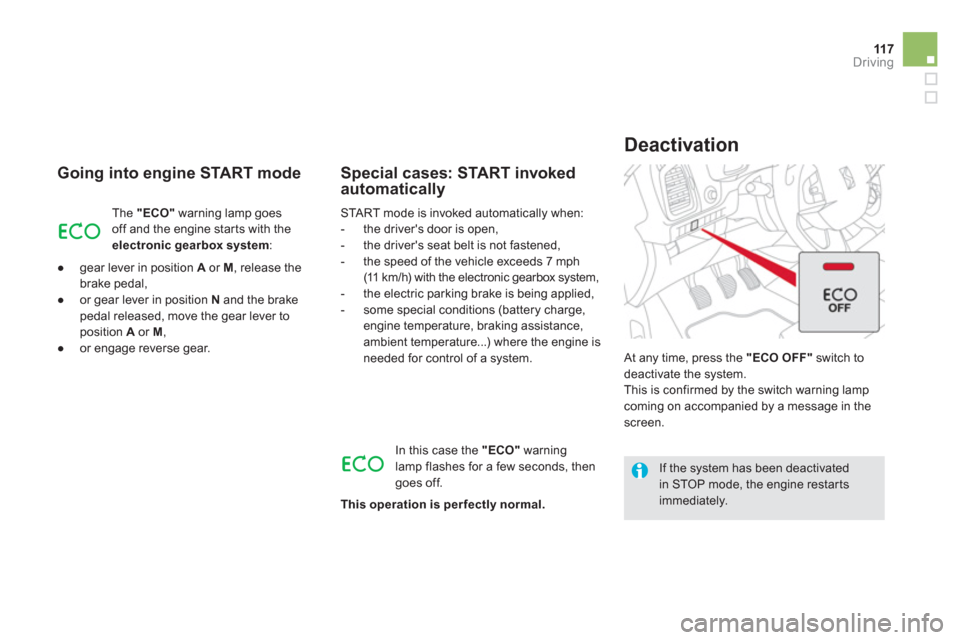
Going into engine START mode
The "ECO"warning lamp goes
off and the engine star ts with theelectronicgearboxsystem :
●
gear lever in position Aor M
, release the
brake pedal,
●
or
gear lever in position N
and the brake pedal released, move the gear lever to position A
or M,
●
or engage reverse gear.
START mode is invoked automatically when:
- the driver's door is open,
- the driver's seat belt is not fastened,
- the speed of the vehicle exceeds 7 mph
(11 k m / h) with the electronic gearbox system,
- the electric parking brake is being applied,
- some special conditions (battery charge,engine temperature, braking assistance,
ambient temperature...) where the engine is
needed for control of a system.
Special cases: START invoked automatically
If the system has been deactivatedin STOP mode, the engine restar ts immediately.
At any time, press the "ECO OFF"
switch todeactivate the system.
This is confirmed by the switch warning lamp coming on accompanied by a message in the screen.
Deactivation
In this case the "ECO"
warning
lamp flashes for a few seconds, then goes off.
This operation is per fectly normal.
Page 154 of 348
General points relating to child seats
For maximum safety, please obser ve the following recommendations:
- in accordance with European regulations,
all children under the age of 12 or less
than one and a half metres tall must
travel in a
pproved child seats suited to
their weight , on seats fitted with a seat
belt or ISOFIX mountings * ,-
statistically, the safest seats in your
vehicle for carrying children are the rear seats,-a child weighing less than 9 kg must
travel in the "rearwards-facing" position both in the front and in the rear.
CITROËN recommends that childrenshould travel in the outerrrear seatsof your vehicle:-"rearwards-facing"
up to the age of 2, - "forwards-facing"over the age of 2.
Although one of CITROËN's main criteria when designing your vehicle, the safety of your children
also depends on you.
*
The rules for carrying children are specific to each country. Refer to the legislation in force
in
your country.
Page 155 of 348
153Child safety
Child seat in the front
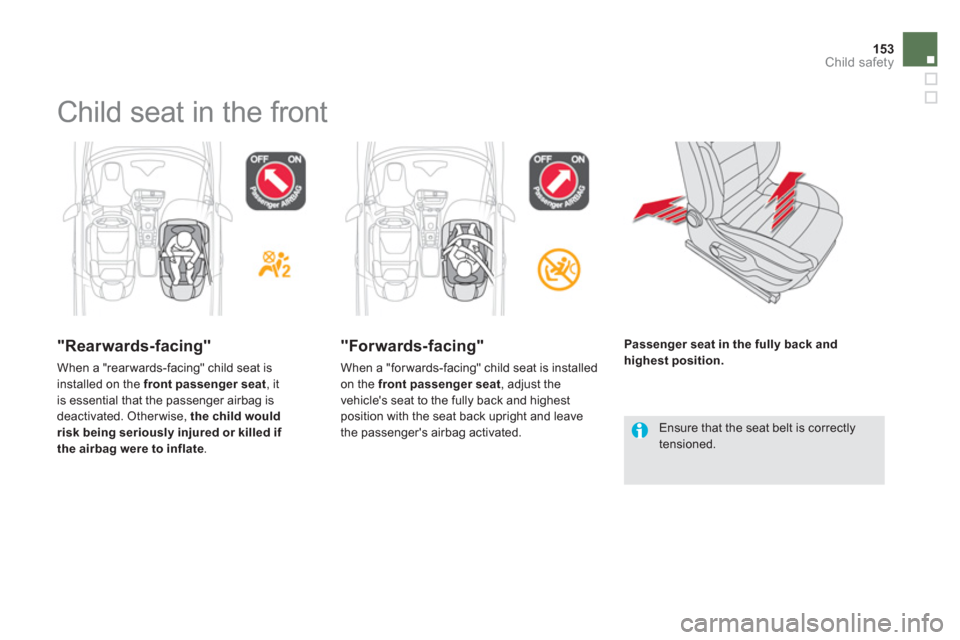
"Rearwards-facing"
When a "rear wards-facing" child seat is
installed on the front passenger seat , it
is essential that the passenger airbag is
deactivated. Otherwise, the child wouldrisk being seriously injured or killed if the airbag were to inflate.
"Forwards-facing"
When a "for wards-facing" child seat is installedon the front passenger seat, adjust the
vehicle's seat to the fully back and highest position with the seat back upright and leave
the passenger's airbag activated.
Passenger seat in the fully back and
highest position.
Ensure that the seat belt is correctlytensioned.
Page 157 of 348
155
Child safety
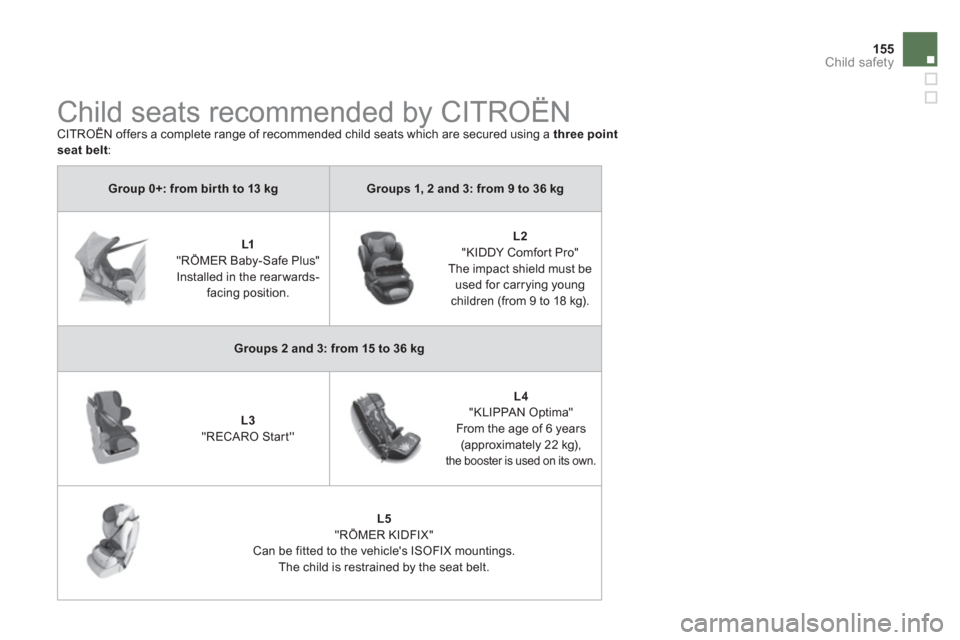
Group 0+: from bir th to 13 kgGroups 1, 2 and 3: from 9 to 36 kg
L1"RÖMER Baby-Safe Plus" Installed in the rearwards-facing position.
L2"KIDDY Comfort Pro" The impact shield must be
used for carrying young children (from 9 to 18 kg).
Groups 2 and 3: from 15 to 36 kg
L3"RECARO Start''
L4"KLIPPAN Optima"From the age of 6 years(approximately 22 kg), the booster is used on its own.
L5
"RÖMER KIDFIX" Can be fitted to the vehicle's ISOFIX mountings.The child is restrained by the seat belt.
Child seats recommended by CITROËN
CITROËN offers a complete range of recommended child seats which are secured using a ythree point
seat belt:
Page 158 of 348
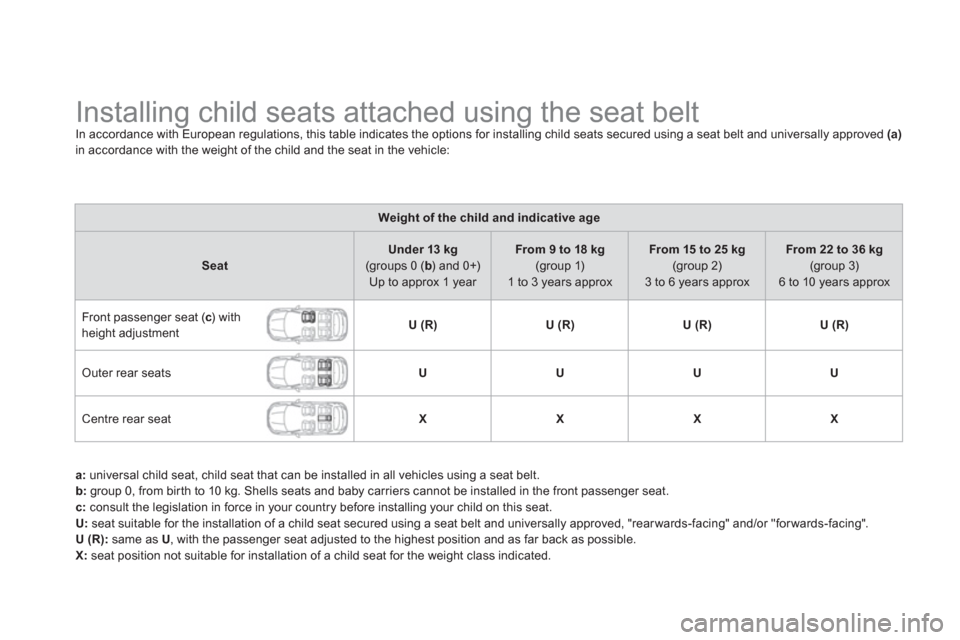
Installing child seats attached using the seat belt In accordance with European regulations, this table indicates the options for installing child seats secured using a seat belt and universally approved (a)in accordance with the weight of the child and the seat in the vehicle:
Weight of the child and indicative age
SeatUnder 13 kg
(groups 0 (b ) and 0+)
Up to approx 1 year
From 9 to 18 kg(group 1)1 to 3 years approx
From 15 to 25 kg
(group 2)3 to 6 years approx
From 22 to 36 kg(group 3)
6 to 10 years approx
Front passen
ger seat ( c
) with cheight adjustment
U (R)U (R)U (R)U (R)
Outer rear seats
UUUU
Centre rear seat
XXXX
a:
universal child seat, child seat that can be installed in all vehicles using a seat belt. b:
group 0, from bir th to 10 kg. Shells seats and baby carriers cannot be installed in the front passenger seat. c:
consult the legislation in force in your country before installing your child on this seat.U:
seat suitable for the installation of a child seat secured using a seat belt and universally approved, "rear wards-facing" and/or "forwards-facing".
U (R):same as U, with the passenger seat adjusted to the highest position and as far back as possible. X:
seat position not suitable for installation of a child seat for the weight class indicated.
Page 159 of 348
157
Child safety
The incorrect installation of a child seat in a
vehicle compromises the child's protection in the event of an accident.
Remember to fasten the seat belts or the child seat harnesses keeping the slack relative to the child's body to a minimum, even for short journeys.
When installing a child seat using the seat belt, ensure that the seat belt is tightenedcorrectly on the child seat and that it secures the child seat firmly on the seat of your vehicle. If your passenger seat is adjustable, move it for wards if necessary.
For optimum installation of the "forwards-facing" child seat, ensure that the back of the child seat is in contact with the back of the vehicle's seat and that the head restraint does not cause any discomfort.
If the head restraint has to be removed, ensure that it is stored or attached securely to prevent it from being thrown around the vehicle in the event of sharp braking.
Advice on child seats
As a safety precaution, do not leave:
- a child or children alone and unsupervised in a vehicle, - a child or an animal in a vehicle whichis exposed to the sun, with the windows closed, - the keys within reach of children inside the vehicle. To prevent accidental opening of the doors and rear windows, use the "Child lock". Take care not to open the rear windows bymore than one third.To protect young children from the rays of the sun, fit side blinds on the rear windows.
Children under the age of 10 must not travel
in the "forwards-facing" position on the front passenger seat, unless the rear seats are already occupied by other children, cannot be used or are absent.
Deactivate the passenger airbag when a "rearwards-facing" child seat is installed on the front seat. Other wise, the child would risk beingseriously injured or killed if the airbag were to inflate.
Installing a booster seat
The chest par t of the seat belt must be positioned on the child's shoulder without touching the neck.
Ensure that the lap part of the seat belt passes correctly over the child's thighs. CITROËN recommends the use of a booster seat which has a back, fitted with a seat belt guide at shoulder level.
Page 161 of 348
159Child safety
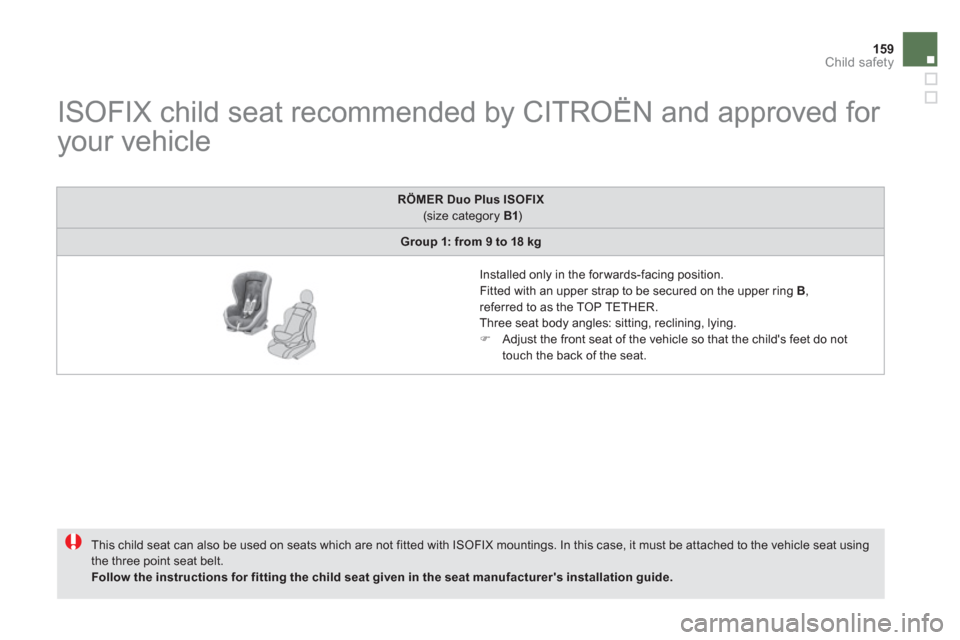
ISOFIX child seat recommended by CITROËN and approved for
your vehicle
This child seat can also be used on seats which are not fitted with ISOFIX mountings. In this case, it must be attached to the vehicle seat using the three point seat belt.Follow the instructions for fitting the child seat given in the seat manufacturer's installation guide.
RÖMERDuo Plus ISOFIX(size category B1)
Group 1: from 9 to 18 kg
Installed only in the for wards-facing position.
Fitted with an upper strap to be secured on the upper ring B,referred to as the TOP TETHER. Three seat body angles: sitting, reclining, lying. )Adjust the front seat of the vehicle so that the child's feet do not
touch the back of the seat.
Page 162 of 348
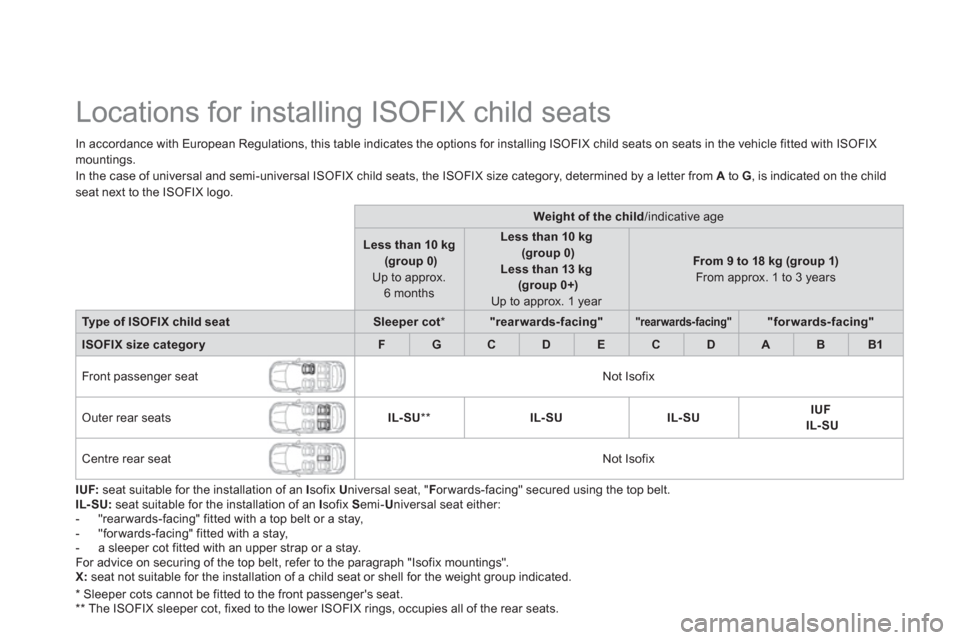
Locations for installing ISOFIX child seats
In accordance with European Regulations, this table indicates the options for installing ISOFIX child seats on seats in the vehicle fitted with ISOFIX
mountings.
In the case of universal and semi-universal ISOFIX child seats, the ISOFIX size category, determined by a letter from Ato G , is indicated on the childseat next to the ISOFIX logo.
Weight of the child /indicative age
Less than 10 kg (group 0)Up to approx. 6 months
Less than 10 kg(group 0)Less than 13 kg(group 0+)Up to approx. 1 year
From 9 to 18 kg (group 1)From approx. 1 to 3 years
Type of ISOFIX child seatSleeper cot*"rearwards-facing""rearwards-facing""forwards-facing"
ISOFIX size categoryFGCDECDABB1
Front passenger seat
Not Isofix
Outer rear seats
IL-SU
**
IL-SUIL-SUIUF
IL-SU
Centre rear seat
Not Isofix
IUF:seat suitable for the installation of an I sofix U
niversal seat, "F
orwards-facing" secured using the top belt.IL- SU:
seat suitable for the installation of an I sofix S emi-U
niversal seat either:
- "rearwards-facing" fitted with a top belt or a stay,
- "forwards-facing" fitted with a stay,
- a sleeper cot fitted with an upper strap or a stay.
For advice on securing of the top belt, refer to the paragraph "Isofix mountings". X: seat not suitable for the installation of a child seat or shell for the weight group indicated.
*
Sleeper cots cannot be fitted to the front passen
ger's seat.
**
The ISOFIX sleeper cot, fixed to the lower ISOFIX rings, occupies all of the rear seats.
Page 172 of 348
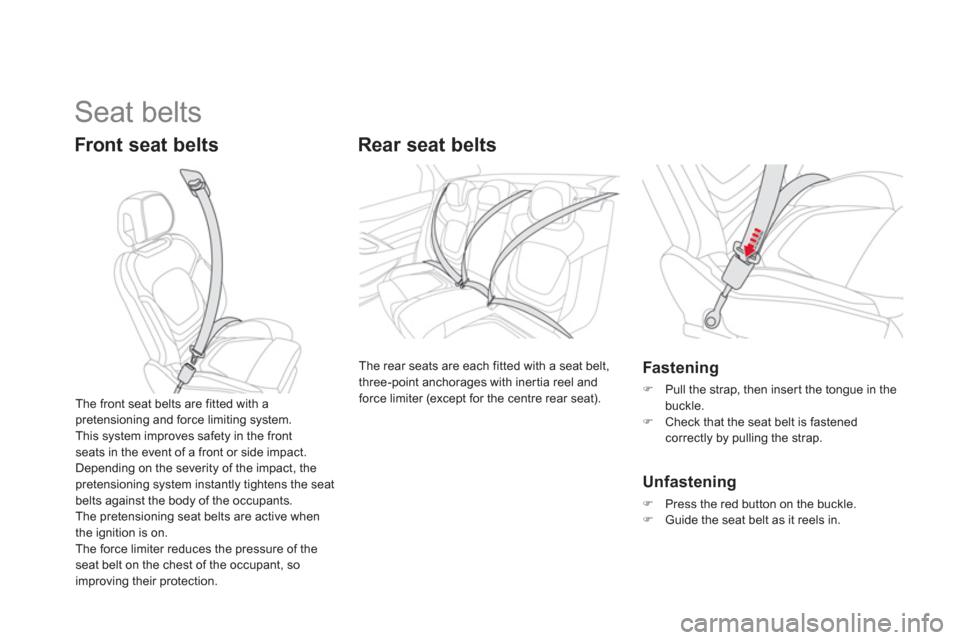
Seat belts
Front seat belt s
Rear seat belts
The rear seats are each fitted with a seat belt,
three-point anchorages with iner tia reel and
force limiter (except for the centre rear seat).
Fastening
)Pull the strap, then inser t the tongue in thebuckle.)Check that the seat belt is fastenedcorrectly by pulling the strap.
Unfastening
)Press the red button on the buckle.)Guide the seat belt as it reels in. Th
e front seat belts are fitted with a pretensioning and force limiting system.
This s
ystem improves safety in the frontseats in the event of a front or side impact.
Depending on the severity of the impact, thepretensioning system instantly tightens the seat
belts against the body of the occupants.
The pretensioning seat belts are active when
the ignition is on.
The force limiter reduces the pressure of the
seat belt on the chest of the occupant, soimproving their protection.
Page 173 of 348
171Safety
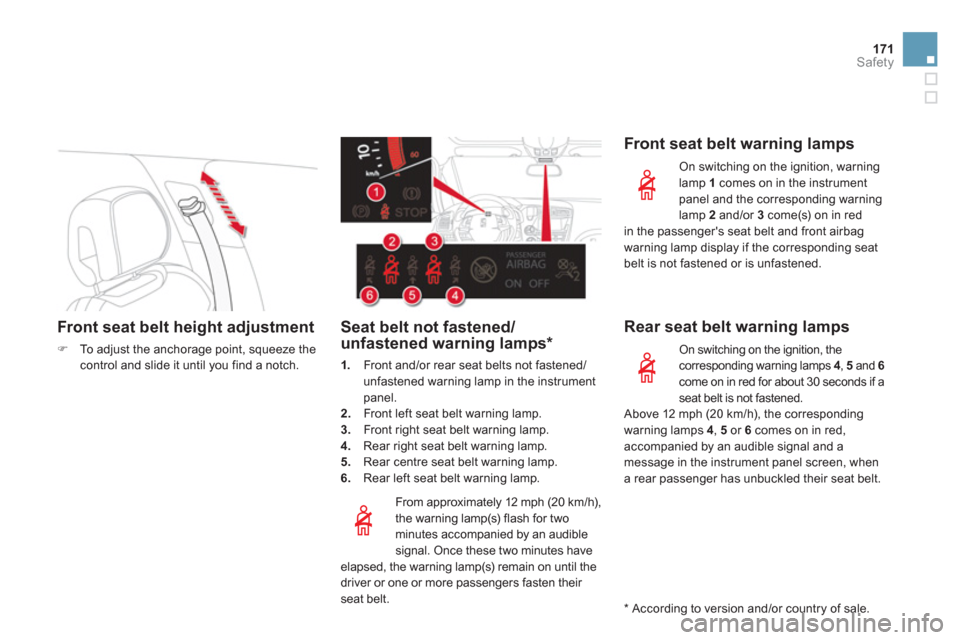
Front seat belt height adjustment
)To adjust the anchorage point, squeeze the control and slide it until you find a notch.
From approximatel
y 12 mph (20 km/h),
the warning lamp(s) flash for two
minutes accompanied by an audible signal. Once these two minutes have
elapsed, the warning lamp(s) remain on until the
driver or one or more passengers fasten their
seat belt.
Seat belt not fastened/unfastened warning lamps *
1.Front and/or rear seat belts not fastened/unfastened warning lamp in the instrument
panel.
2
. Front left seat belt warning lamp.3.
Front right seat belt warning lamp.4.
Rear right seat belt warning lamp.
5. Rear centre seat belt warning lamp. 6.
Rear left seat belt warning lamp.
Front seat belt warning lamps
On switching on the ignition, warninglamp 1
comes on in the instrument panel and the corresponding warninglamp 2
and/or 3come(s) on in red
in the passenger's seat belt and front airbagwarning lamp display if the corresponding seatbelt is not fastened or is unfastened.
Rear seat belt warning lamps
On switching on the ignition, the corresponding warning lamps 4, 5
and 6come on in red for about 30 seconds if aseat belt is not fastened.
Above 12 mph (20 km/h), the corresponding
warning lamps 4, 5 or 6
comes on in red,
accompanied by an audible signal and a
message in the instrument panel screen, when
a rear passen
ger has unbuckled their seat belt.
*
Accordin
g to version and/or country of sale.