Battery Citroen DS5 2014 1.G User Guide
[x] Cancel search | Manufacturer: CITROEN, Model Year: 2014, Model line: DS5, Model: Citroen DS5 2014 1.GPages: 372, PDF Size: 32.58 MB
Page 71 of 372
69Access
Safety anti-pinch
When the window rises and meets an obstacle,
it stops and immediately partially lowers again.
In the event of unwanted opening of the
window on closing, press the switch until the
window opens completely, then pull the switch
immediately until the window closes. Continue
to hold the switch for approximately one second
after the window has closed.
The safety anti-pinch function is not active
during this operation.
Deactivating the rear window
controls
Reinitialisation of the
electric windows
In the event of contact during operation
of the windows, you must reverse the
movement of the window. To do this,
press the switch concerned.
When operating the passenger electric
window switches, the driver must
ensure that no one is preventing correct
closing of the windows.
The driver must ensure that the
passengers use the electric windows
correctly.
Be aware of children when operating
the windows.
Be aware of passengers or other
persons present when closing the
windows using the the electronic key
or the "Keyless Entry and Starting"
system.
Following reconnection of the battery, the
safety anti-pinch function must be reinitialised.
The safety anti-pinch function is not active
during these operations:
- lower the window completely, then raise
it, it will rise in steps of a few centimetres
each time the switch is pressed. Repeat
the operation until the window closes
completely,
- continue to press the switch for at least
one second after reaching this position,
window closed.
For the safety of your children, press
switch 5
to prevent operation of the
rear windows irrespective of their
position.
The warning lamp in the button comes on,
accompanied by a message confirming
activation. It remains on, as long as the child
lock is activated.
The interior controls for the rear doors are also
deactivated.
Opening the doors from the outside and
operation of the rear electric windows from the
driver's controls remain possible.
Page 107 of 372

105Driving
Switching off using the
electronic key
Immobilise the vehicle.
Electronic key left in the reader
If the electronic key is left in the reader,
on opening the driver's door a message
appears to warn you.
Stopping with the "Keyless
Entry and Starting" system
Immobilise the vehicle.
If the vehicle is not immobilised, the
engine will not stop.
Ignition on without
starting
With the electronic key inside
the vehicle, press the " START/
STOP
" button.
The engine stops and the
steering column locks.
Press the " START/STOP
" button
The engine stops and the
steering column locks.
Anti-theft protection
Electronic engine immobiliser
The keys contain an electronic chip which has
a secret code. When the ignition is switched
on, this code must be recognised in order for
starting to be possible.
This electronic engine immobiliser locks the
engine management system a few minutes
after the ignition is switched off and prevents
starting of the engine by anyone who does not
have the key.
In the event of a malfunction, you are informed
by a message in the instrument panel screen.
In this case, your vehicle does not start; contact
a CITROËN dealer as soon as possible.
With the electronic key in the reader or the
Keyless Entry and Starting key inside the
vehicle, pressing the "START/STOP" button,
with no action on the pedals
, allows the
ignition to be switched on.
Remove the electronic key from the reader.
Press the "START/STOP" button,
the instrument panel comes on
but the engine does not start.
Press the button again to switch
off the ignition and so allow the
vehicle to be locked.
With the ignition on, the system goes
into energy economy mode when
necessary to maintain the state of
charge of the battery.
Switching off the engine leads to a loss
of braking assistance.
Page 114 of 372

Situations
Consequences
To apply the electric parking brake:
immobilise the vehicle and switch off the ignition.
pull the control for at least 5 seconds or until application is complete.
switch on the ignition and check that the electric parking brake
warning lamps come on.
The application is slower than during normal operation.
To release the electric parking brake:
switch on the ignition.
pull the control lever and hold it for approximately 3 seconds then
release it.
If the braking warning lamp is flashing or if the warning lamps do not
come on with the ignition on, these procedures will not work. Place the
vehicle on level ground and have it checked by a CITROËN dealer or a
qualified workshop.
and possibly
flashing
Display of the message " Parking brake fault
" and of the following
warning lamps:
- Only the automatic application on switching off the engine and
automatic release on acceleration functions are available.
- The manual application/release of the electric parking brake and the
emergency braking are not available.
and possibly
flashing
Display of the message "Battery charge fault".
- You must stop as soon as it is safe to do so. Switch off and
immobilise your vehicle (if necessary, place the a chock under a
wheel).
- Apply the electric parking brake before switching off the engine.
Page 115 of 372

11 3Driving
Special situations
In the event of a malfunction of the parking
brake in the on position
or a battery failure,
manual release remains possible.
To ensure correct operation, and so
your safety, the number of successive
applications and releases of the parking
brake is limited to eight cycles.
If used excessively, you are alerted by
the message "parking brake faulty" and
a flashing warning lamp.
In some circumstances (engine start...),
the parking brake may adjust the level of
application itself. This is normal operation.
To move your vehicle a few centimetres
without starting the engine, with the ignition
on, press the brake pedal and release the
parking brake by pulling
then releasing
the control lever A
. Complete release of the
parking brake is indicated by the warning
lamps in the control lever A
and in the
instrument panel going off and by the display
of the message "Parking brake off ".
Page 121 of 372

11 9Driving
Invalid value during manual
operation
This symbol is displayed if a gear
is not engaged correctly (selector
between two positions).
Stopping the vehicle
Before switching off the engine, put the lever in
position P
or N
to place the gearbox in neutral.
In both cases, apply the parking brake to
immobilise the vehicle, unless it is programmed
to automatic mode.
If the lever is not in position P
, when the
driver's door is opened or approximately
45 seconds after the ignition is switched
off, there is an audible signal and a
message appears.
Return the lever to position P
;
the audible signal stops and the
message disappears.
Operating fault
When the ignition is on, a message appears
in the instrument panel screen to indicate a
gearbox fault.
In this case, the gearbox switches to back-up
mode and is locked in 3rd gear. You may feel
a substantial knock when changing from P
to R
and from N
to R
. This will not cause any
damage to the gearbox.
Do not exceed 60 mph (100 km/h), local speed
restrictions permitting.
Have it checked by a CITROËN dealer or a
qualified workshop.
You risk damaging the gearbox:
- if you press the accelerator and
brake pedals at the same time,
- if you force the lever from position P
to another position when the
battery is flat.
To reduce fuel consumption when
stationary for long periods with the
engine running (traffic jam...), position
the gear lever at N
and apply the
parking brake, unless it is programmed
in automatic mode.
Page 129 of 372
127Driving
Stop & Start
Operation
Going into engine STOP mode
The "ECO"
warning lamp comes on
in the instrument panel and the engine
goes into standby automatically:
- with a manual gearbox
, at speeds below
12 mph (20 km/h) or vehicle stationary with
the Blue HDi 120 version, when you place
the gear lever in neutral, and you release
the clutch pedal,
- with an electronic gearbox
, at speeds
below 5 mph (8 km/h), when you press
the brake pedal or put the gear lever in
position N
,
- with an automatic gearbox
, vehicle
stationary, when you press the brake pedal
or put the gear lever in position N
. If your vehicle is fitted with the system, a time
counter calculates the sum of the periods in
STOP mode during a journey. It resets itself to
zero every time the ignition is switched on with
the START/STOP button.
Never refuel with the engine in STOP
mode; you must switch off the ignition
with the START/STOP button.
For your comfort, during parking
maoeuvres, STOP mode is not
available for a few seconds after
coming out of reverse gear.
STOP mode does not affect the
functionality of the vehicle, such as for
example, braking, power steering...
Special cases: STOP mode not
available
STOP mode is not invoked when:
- the vehicle is on a steep slop (rising or
falling),
- the driver's door is open,
- the driver's seat belt is not fastened,
- the vehicle has not exceeded 6 mph
(10 km/h) since the last engine start using
the START/STOP button,
- the electric parking brake is applied or
being applied,
- the engine is needed to maintain a
comfortable temperature in the passenger
compartment,
- demisting is active,
- some special conditions (battery charge,
engine temperature, braking assistance,
ambient temperature...) where the engine is
needed to assure control of a system.
In this case, the "ECO"
warning lamp
flashes for a few seconds then goes
off. The Stop & Start system puts the engine temporarily into standby - STOP mode - during stops in the traffic (red lights, traffic jams, or other...).
The engine restarts automatically - START mode - as soon as you want to move off. The restart takes place instantly, quickly and silently.
Per fect for urban use, the Stop & Start system reduces fuel consumption and exhaust emissions as well as the noise level when stationary.
This operation is per fectly normal.
Page 130 of 372
Going into engine START mode
The "ECO"
warning lamp goes off
and the engine starts automatically:
- with a manual gearbox
, when you fully
depress the clutch pedal,
- with an electronic gearbox
:
●
gear lever in position A
or M
, when you
release the brake pedal,
●
or gear lever in position N
and brake
pedal released, when you place the gear
lever in position A
or M
,
●
or when you engage reverse.
- with an automatic gearbox
:
●
gear lever in position D
or M
, when you
release the brake pedal,
●
or gear lever in position N
and brake
pedal released, when you place the gear
lever in position D
or M
,
●
or when you engage reverse.
START mode is invoked automatically when:
- the driver's door is open,
- the driver's seat belt is not fastened,
- the speed of the vehicle exceeds 15 mph
(25 km/h) with a manual gearbox (2 mph
(3 km/h) with the Blue HDi 120 version),
7 mph (11 km/h) with an electronic gearbox
and 2 mph (3 km/h) with an automatic
gearbox.
- the electric parking brake is being applied,
- some special conditions (battery charge,
engine temperature, braking assistance,
ambient temperature...) where the engine is
needed for control of a system.
Special cases: START invoked
automatically
If the system has been deactivated
in STOP mode, the engine restarts
immediately.
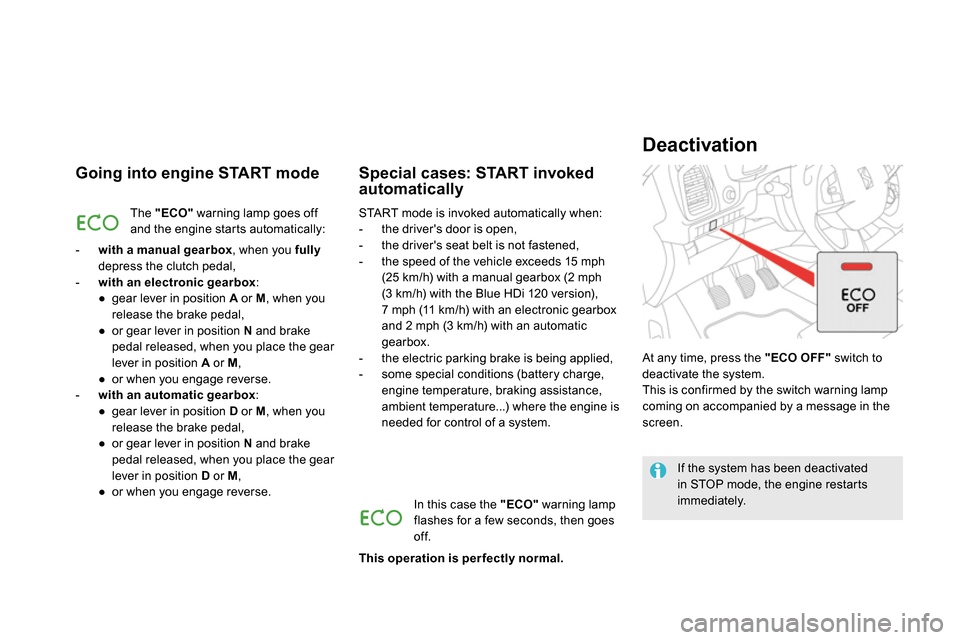
At any time, press the "ECO OFF"
switch to
deactivate the system.
This is confirmed by the switch warning lamp
coming on accompanied by a message in the
screen.
Deactivation
In this case the "ECO"
warning lamp
flashes for a few seconds, then goes
off.
This operation is per fectly normal.
Page 131 of 372

129Driving
The system is reactivated automatically
at every new start using the START/
STOP button.
Reactivation
Press the "ECO OFF"
switch again.
The system is active again; this is confirmed
by the switch warning lamp going off and a
message in the screen.
Operating fault
In the event of a fault with the system, the
"ECO OFF"
switch warning lamp flashes then
comes on continuously.
Have it checked by a CITROËN dealer or a
qualified workshop.
In the event of a fault in STOP mode, the vehicle
may stall.
All of the instrument panel warning lamps come
on.
Depending on version, an alert message may also
be displayed, asking you to place the gear lever in
position N
and put your foot on the brake pedal.
It is then necessary to switch off the ignition and
start the engine again using the "START/STOP"
button.
Before doing anything under the
bonnet, deactivate the Stop & Start
system to avoid any risk of injury
resulting from automatic operation of
START mode.
This system requires a 12 V battery with a
special specification and technology (reference
numbers available from CITROËN dealers).
Fitting a battery not listed by CITROËN
introduces the risk of malfunction of the
system.
For charging, use a 12 V charger and do not
reverse the polarity.
Maintenance
The Stop & Start system makes use of
advanced technology. For any work on
the system go to a qualified workshop
with the skills and equipment required,
which a CITROËN dealer is able to
provide.
Page 149 of 372

147Visibility
Lighting left on audible
signal
An audible signal when a front door
is opened warns the driver that the
vehicle's exterior lighting is on, with the
ignition off and in manual lighting mode.
In this case, switching off the lighting
stops the audible signal.
With the ignition off, if the dipped
headlamps remain on, the vehicle goes
into "ECO" mode to avoid discharging
the battery.
In some weather conditions (e.g. low
temperature or humidity), the presence
of misting on the internal sur face of the
glass of the headlamps and rear lamps
is normal; it disappears after the lamps
have been on for a few minutes.
The daytime running
lamps can be activated
and deactivated via the
configuration menu.
The lighting goes off when you switch
off the ignition, but you can always
switch it on again using the lighting
control stalk.
Daytime running lamps
(LEDs)
They come on when the engine is started.
Depending on the country of sale or where
required by regulations, they are used for:
- daytime running lamps in day mode and
sidelamps in night mode (they are brighter
when daytime running lamps),
or
- sidelamps in day and night mode.
Page 223 of 372
221Practical information
Engine compartment fuses
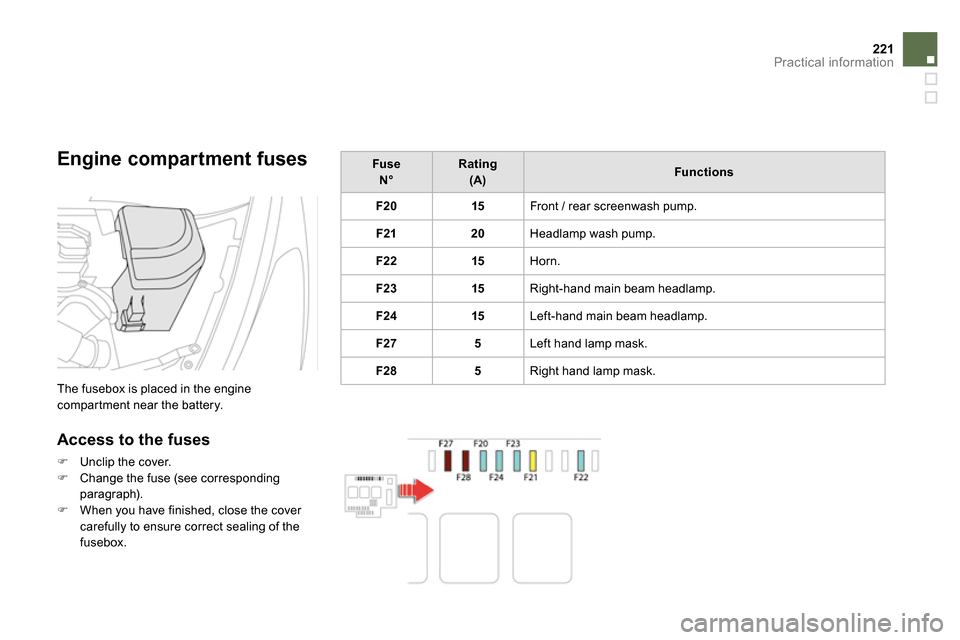
The fusebox is placed in the engine
compartment near the battery.
Access to the fuses
Unclip the cover.
Change the fuse (see corresponding
paragraph).
When you have finished, close the cover
carefully to ensure correct sealing of the
fusebox.
Fuse
N°
Rating
(A)
Functions
F20
15
Front / rear screenwash pump.
F21
20
Headlamp wash pump.
F22
15
Horn.
F23
15
Right-hand main beam headlamp.
F24
15
Left-hand main beam headlamp.
F27
5
Left hand lamp mask.
F28
5
Right hand lamp mask.