Low level Citroen DS5 2014 1.G Owner's Manual
[x] Cancel search | Manufacturer: CITROEN, Model Year: 2014, Model line: DS5, Model: Citroen DS5 2014 1.GPages: 372, PDF Size: 32.58 MB
Page 3 of 372
CITROËN has a presence on every continent,
a complete product range,
bringing together technology and a permanent spirit of innovation,
for a modern and creative approach to mobility.
We thank you and congratulate you on your choice.
The "Familiarisation" section at the start of this
document is intended as a quick way of getting
to know your vehicle. Reading the detailed
sections is essential to make the most of your
vehicle, in complete safety.
Your vehicle is fitted with only some of the
equipment described in this document,
depending on the trim level, version and the
specifications for the country in which it is sold.
The fitting of electrical equipment or
accessories which are not recommended
by CITROËN may result in a failure of your
vehicle's electronic system. Please note this
specific warning and contact a CITROËN
dealer to be shown the recommended
equipment and accessories.
At the wheel of your new vehicle,
getting to know each system,
each control, each setting,
makes your trips, your journeys
more comfortable and more enjoyable.
Happy motoring!
We draw your attention to the following...
Page 21 of 372
31 73, 45
19Familiarisation
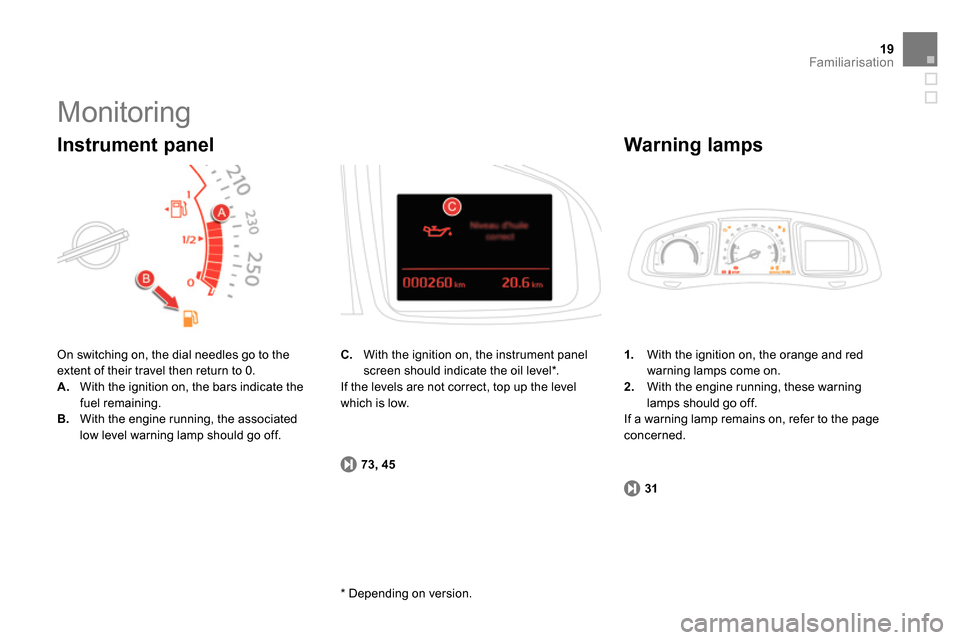
1.
With the ignition on, the orange and red
warning lamps come on.
2.
With the engine running, these warning
lamps should go off.
If a warning lamp remains on, refer to the page
concerned.
Warning lamps
On switching on, the dial needles go to the
extent of their travel then return to 0.
A.
With the ignition on, the bars indicate the
fuel remaining.
B.
With the engine running, the associated
low level warning lamp should go off.
Instrument panel
C.
With the ignition on, the instrument panel
screen should indicate the oil level * .
If the levels are not correct, top up the level
which is low.
Monitoring
* Depending on version.
Page 27 of 372
25Familiarisation
Eco-driving
Eco-driving is a range of everyday practices that allow the motorist to optimise their fuel consumption and CO2 emissions.
Optimise the use of your gearbox
With a manual gearbox, move off gently and change up without waiting.
During acceleration change up early.
With an automatic or electronic gearbox, give preference to automatic
mode and avoid pressing the accelerator pedal heavily or suddenly.
The gear shift indicator invites you engage the most suitable gear: as
soon as the indication is displayed in the instrument panel, follow it
straight away.
With an electronic or automatic gearbox, this indicator appears only in
manual mode.
Drive smoothly
Maintain a safe distance between vehicles, use engine braking rather
than the brake pedal, and press the accelerator progressively. These
practices contribute towards a reduction in fuel consumption and CO
2
emissions and also helps reduce the background traffic noise.
If your vehicle has cruise control, make use of the system at speeds
above 25 mph (40 km/h) when the traffic is flowing well.
Control the use of your electrical
equipment
Before moving off, if the passenger compartment is too warm, ventilate it
by opening the windows and air vents before using the air conditioning.
Above 30 mph (50 km/h), close the windows and leave the air vents
open.
Remember to make use of equipment that can help keep the
temperature in the passenger compartment down (sunroof and window
blinds...).
Switch off the air conditioning, unless it has automatic regulation, as
soon as the desired temperature is attained.
Switch off the demisting and defrosting controls, if not automatic.
Switch off the heated seat as soon as possible.
Switch off the headlamps and front foglamps when the level of light
does not require their use.
Avoid running the engine before moving off, particularly in winter; your
vehicle will warm up much faster while driving.
As a passenger, if you avoid connecting your multimedia devices
(film, music, video game...), you will contribute towards limiting the
consumption of electrical energy, and so of fuel.
Disconnect your portable devices before leaving the vehicle.
Page 34 of 372
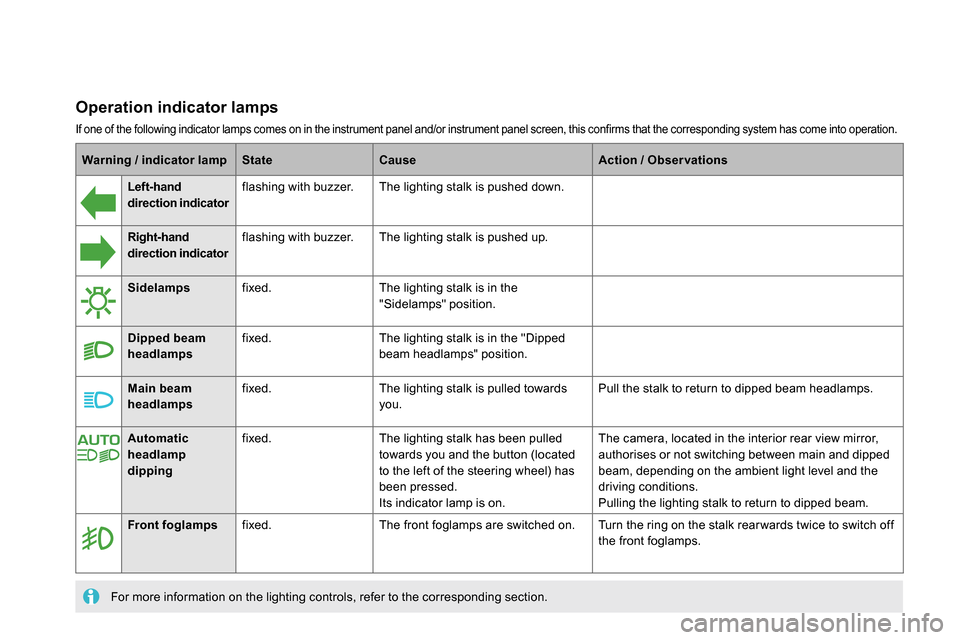
Warning / indicator lamp
State
Cause
Action / Observations
Left-hand
direction indicato
r
flashing with buzzer. The lighting stalk is pushed down.
Right-hand
direction indicator
flashing with buzzer. The lighting stalk is pushed up.
Sidelamps
fixed. The lighting stalk is in the
"Sidelamps" position.
Dipped beam
headlamps
fixed. The lighting stalk is in the "Dipped
beam headlamps" position.
Main beam
headlamps
fixed. The lighting stalk is pulled towards
you. Pull the stalk to return to dipped beam headlamps.
Front foglamps
fixed. The front foglamps are switched on. Turn the ring on the stalk rear wards twice to switch off
the front foglamps.
For more information on the lighting controls, refer to the corresponding section.
Automatic
headlamp
dipping
fixed. The lighting stalk has been pulled
towards you and the button (located
to the left of the steering wheel) has
been pressed.
Its indicator lamp is on. The camera, located in the interior rear view mirror,
authorises or not switching between main and dipped
beam, depending on the ambient light level and the
driving conditions.
Pulling the lighting stalk to return to dipped beam.
Operation indicator lamps
If one of the following indicator lamps comes on in the instrument panel and/or instrument panel screen, this confirms that the corresponding system has come into operation.
Page 39 of 372
37Monitoring
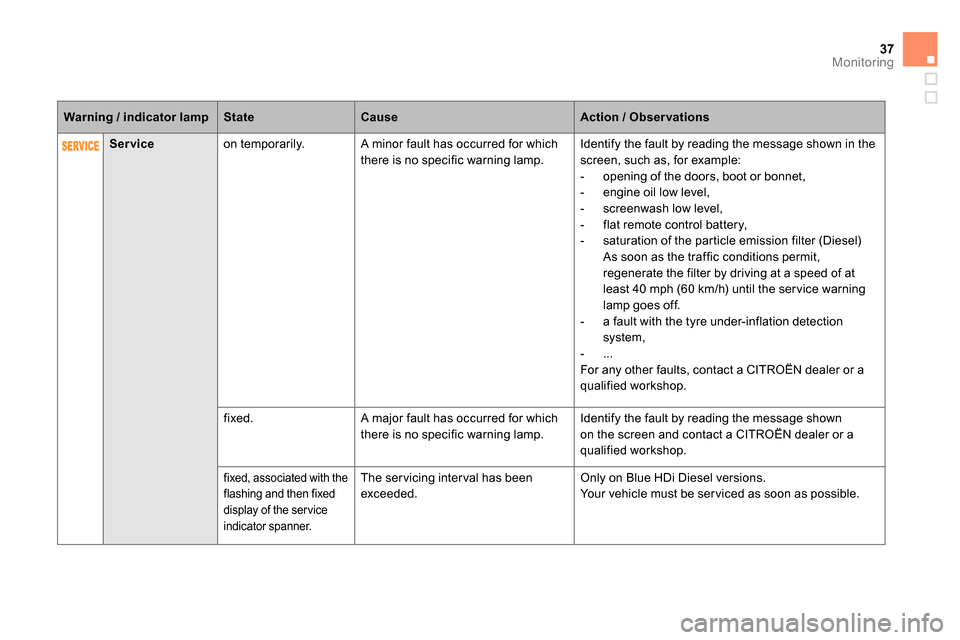
Service
on temporarily. A minor fault has occurred for which
there is no specific warning lamp. Identify the fault by reading the message shown in the
screen, such as, for example:
- opening of the doors, boot or bonnet,
- engine oil low level,
- screenwash low level,
- flat remote control battery,
- saturation of the particle emission filter (Diesel)
As soon as the traffic conditions permit,
regenerate the filter by driving at a speed of at
least 40 mph (60 km/h) until the ser vice warning
lamp goes off.
- a fault with the tyre under-inflation detection
system,
- ...
For any other faults, contact a CITROËN dealer or a
qualified workshop.
fixed. A major fault has occurred for which
there is no specific warning lamp. Identify the fault by reading the message shown
on the screen and contact a CITROËN dealer or a
qualified workshop.
fixed, associated with the
flashing and then fixed
display of the ser vice
indicator spanner.
The ser vicing inter val has been
exceeded. Only on Blue HDi Diesel versions.
Your vehicle must be ser viced as soon as possible.
Warning / indicator lamp
State
Cause
Action / Observations
Page 42 of 372
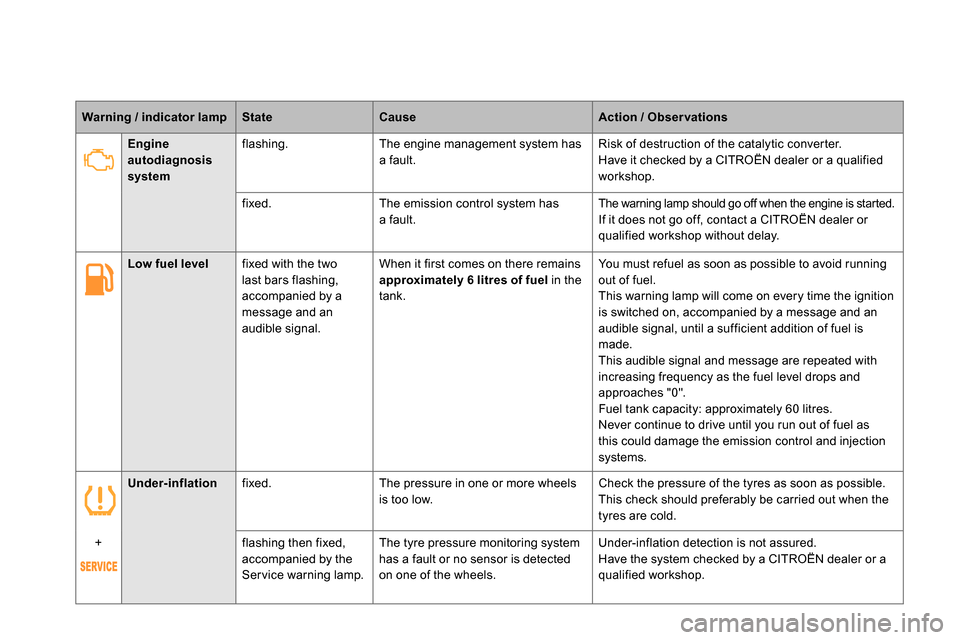
Under-inflation
fixed. The pressure in one or more wheels
is too low. Check the pressure of the tyres as soon as possible.
This check should preferably be carried out when the
tyres are cold.
+
flashing then fixed,
accompanied by the
Ser vice warning lamp. The tyre pressure monitoring system
has a fault or no sensor is detected
on one of the wheels. Under-inflation detection is not assured.
Have the system checked by a CITROËN dealer or a
qualified workshop.
Warning / indicator lamp
State
Cause
Action / Observations
Engine
autodiagnosis
system
flashing. The engine management system has
a fault. Risk of destruction of the catalytic converter.
Have it checked by a CITROËN dealer or a qualified
workshop.
fixed. The emission control system has
a fault.
The warning lamp should go off when the engine is started.
If it does not go off, contact a CITROËN dealer or
qualified workshop without delay.
Low fuel level
fixed with the two
last bars flashing,
accompanied by a
message and an
audible signal. When it first comes on there remains
approximately 6 litres of
fuel
in the
tank. You must refuel as soon as possible to avoid running
out of fuel.
This warning lamp will come on every time the ignition
is switched on, accompanied by a message and an
audible signal, until a sufficient addition of fuel is
made.
This audible signal and message are repeated with
increasing frequency as the fuel level drops and
approaches "0".
Fuel tank capacity: approximately 60 litres.
Never continue to drive until you run out of fuel as
this could damage the emission control and injection
systems.
Page 44 of 372
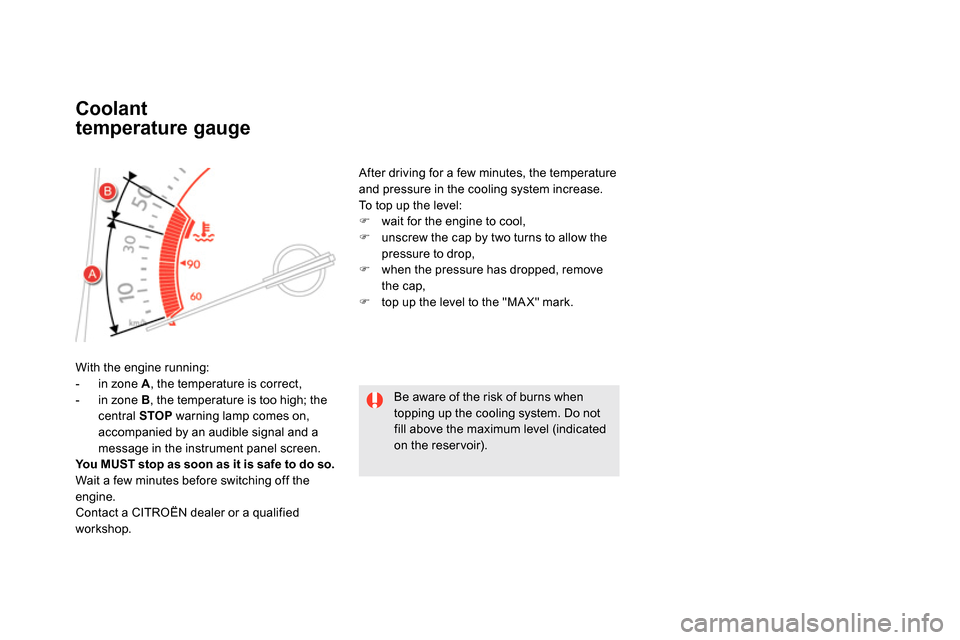
Coolant
temperature gauge
With the engine running:
- in zone A
, the temperature is correct,
- in zone B
, the temperature is too high; the
central STOP
warning lamp comes on,
accompanied by an audible signal and a
message in the instrument panel screen.
You MUST stop as soon as it is safe to do so.
Wait a few minutes before switching off the
engine.
Contact a CITROËN dealer or a qualified
workshop.
After driving for a few minutes, the temperature
and pressure in the cooling system increase.
To top up the level:
wait for the engine to cool,
unscrew the cap by two turns to allow the
pressure to drop,
when the pressure has dropped, remove
the cap,
top up the level to the "MA X" mark.
Be aware of the risk of burns when
topping up the cooling system. Do not
fill above the maximum level (indicated
on the reser voir).
Page 47 of 372
45Monitoring
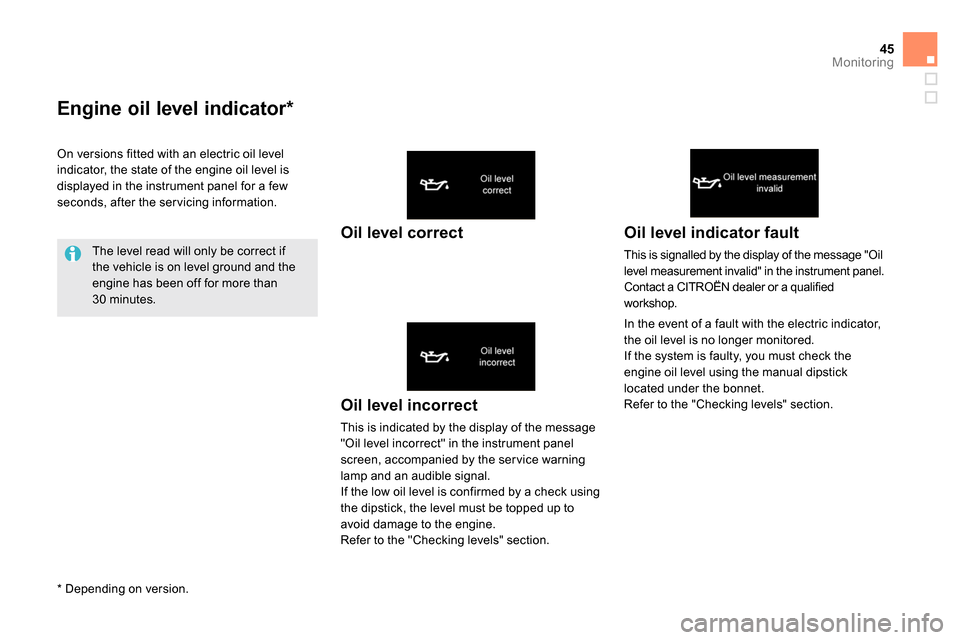
Engine oil level indicator *
Oil level incorrect
This is indicated by the display of the message
"Oil level incorrect" in the instrument panel
screen, accompanied by the ser vice warning
lamp and an audible signal.
If the low oil level is confirmed by a check using
the dipstick, the level must be topped up to
avoid damage to the engine.
Refer to the "Checking levels" section.
Oil level indicator fault
This is signalled by the display of the message "Oil
level measurement invalid" in the instrument panel.
Contact a CITROËN dealer or a qualified
workshop.
In the event of a fault with the electric indicator,
the oil level is no longer monitored.
If the system is faulty, you must check the
engine oil level using the manual dipstick
located under the bonnet.
Refer to the "Checking levels" section.
On versions fitted with an electric oil level
indicator, the state of the engine oil level is
displayed in the instrument panel for a few
seconds, after the ser vicing information.
The level read will only be correct if
the vehicle is on level ground and the
engine has been off for more than
30 minutes.
Oil level correct
*
Depending on version.
Page 75 of 372
73Access
Low fuel level
When the low fuel level in the
tank is reached, this warning lamp
comes on in the instrument panel,
accompanied by an audible warning
and a message in the instrument
panel screen.
When it first comes on, around 6 litres of fuel
remain in the tank.
Until sufficient fuel has been added, this
warning lamp appears every time the ignition
is switched on, accompanied by an audible
signal and a message. This audible signal
and message are repeated with increasing
frequency as the fuel level drops and
approaches "0".
You must refuel as soon as possible to avoid
running out.
Fuel supply cut- of f
Your vehicle is equipped with a safety device
which cuts off the fuel supply in the event of a
collision. It remains possible to use a fuel can to
fill the tank.
In order to ensure a good flow of fuel,
do not place the nozzle of the fuel can
in direct contact with the flap of the
misfuel prevention device and pour
slowly.
Misfuel prevention (Diesel) *
Mechanical device which prevents filling the tank of a Diesel vehicle with petrol. It avoids the risk of
engine damage that can result from filling with the wrong fuel.
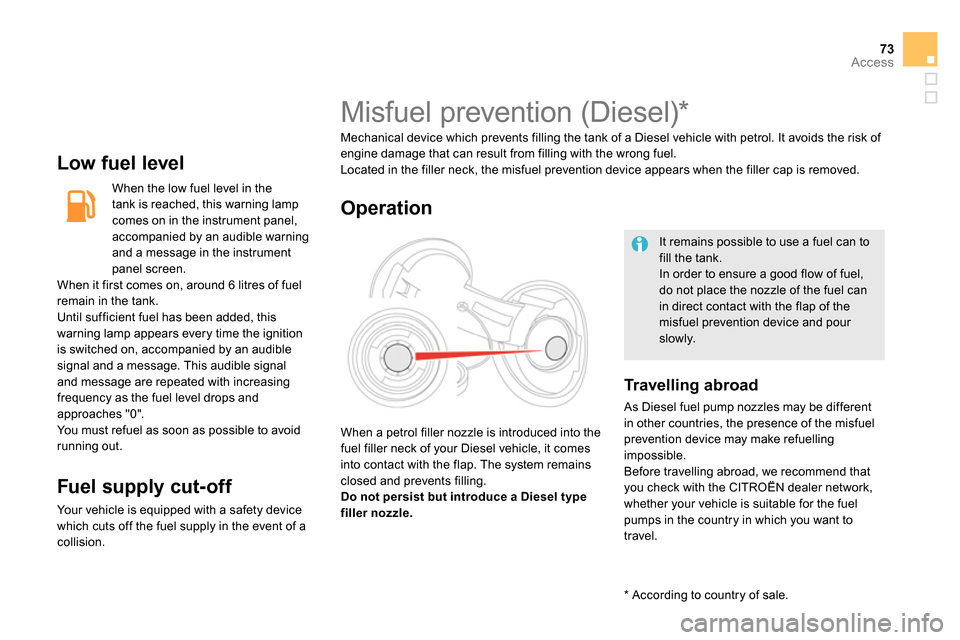
Located in the filler neck, the misfuel prevention device appears when the filler cap is removed.
When a petrol filler nozzle is introduced into the
fuel filler neck of your Diesel vehicle, it comes
into contact with the flap. The system remains
closed and prevents filling.
Do not persist but introduce a Diesel type
filler nozzle.
Operation
Travelling abroad
As Diesel fuel pump nozzles may be different
in other countries, the presence of the misfuel
prevention device may make refuelling
impossible.
Before travelling abroad, we recommend that
you check with the CITROËN dealer network,
whether your vehicle is suitable for the fuel
pumps in the country in which you want to
travel.
*
According to country of sale.
Page 80 of 372
Front seats
Manual
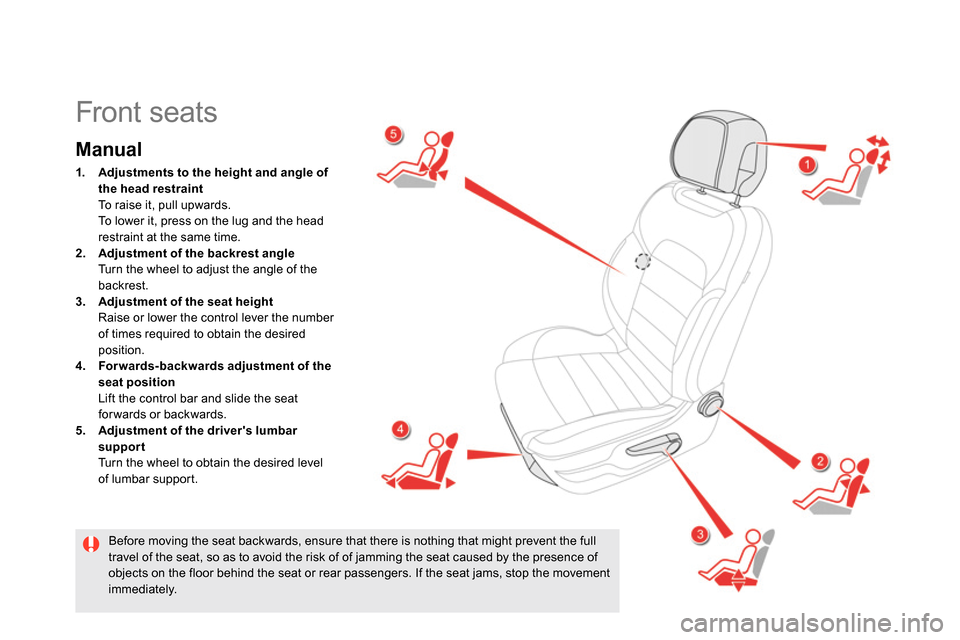
1.
Adjustments to the height and angle
of
the head restraint
To raise it, pull upwards.
To lower it, press on the lug and the head
restraint at the same time.
2.
Adjustment of the backrest angle
Turn the wheel to adjust the angle of the
backrest.
3.
Adjustment of the seat height
Raise or lower the control lever the number
of times required to obtain the desired
position.
4.
For wards-backwards adjustment of the
seat position
Lift the control bar and slide the seat
for wards or backwards.
5.
Adjustment of the driver's lumbar
support
Turn the wheel to obtain the desired level
of lumbar support.
Before moving the seat backwards, ensure that there is nothing that might prevent the full
travel of the seat, so as to avoid the risk of of jamming the seat caused by the presence of
objects on the floor behind the seat or rear passengers. If the seat jams, stop the movement
immediately.