ignition Citroen DS5 HYBRID4 2012 1.G Owner's Guide
[x] Cancel search | Manufacturer: CITROEN, Model Year: 2012, Model line: DS5 HYBRID4, Model: Citroen DS5 HYBRID4 2012 1.GPages: 358, PDF Size: 10.91 MB
Page 106 of 358
Mirrors
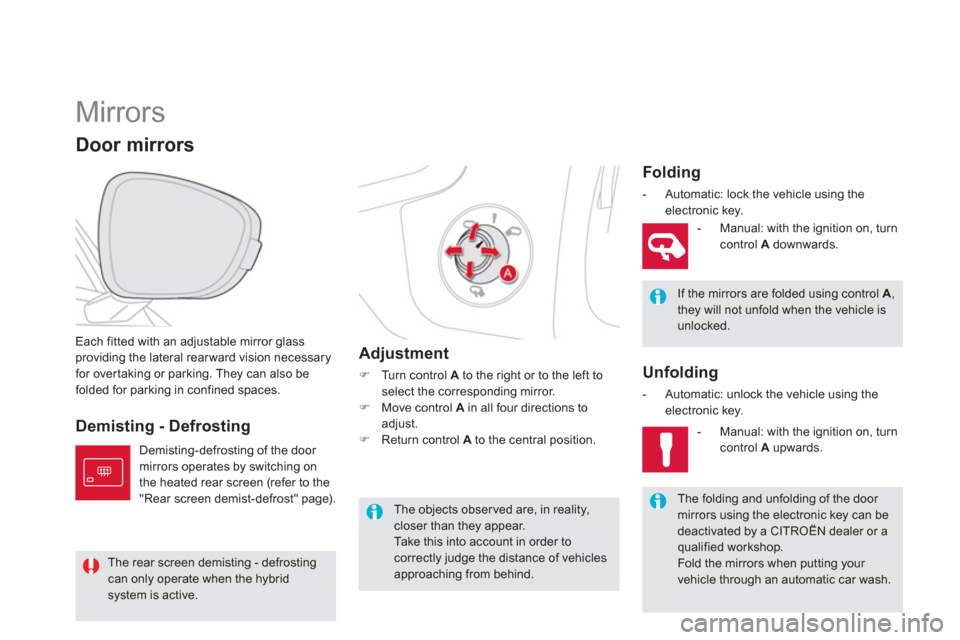
Each fitted with an adjustable mirror glassproviding the lateral rearward vision necessaryfor overtaking or parking. They can also be
folded for parking in confined spaces.
Door mirrors
If the mirrors are folded using control A ,they will not unfold when the vehicle is unlocked.
The folding and unfolding of the door mirrors using the electronic key can bedeactivated by a CITROËN dealer or a qualified workshop.
Fold the mirrors when putting your vehicle through an automatic car wash.
The objects observed are, in reality, closer than they appear.Take this into account in order to correctly judge the distance of vehicles approaching from behind.
Demisting - Defrosting
Ad
justment
)
Turn control A
to the right or to the left toselect the corresponding mirror. )
Move control Ain all four directions toadjust. )
Return control Ato the central position.
Folding
- Automatic: lock the vehicle using the electronic key.
Unfolding
- Automatic: unlock the vehicle using the electronic key.
-
Manual: with the ignition on, turn control Adownwards.
- Manual: with the i
gnition on, turn control Aupwards.
Demisting-defrosting of the door
mirrors operates by switching on
the heated rear screen (refer to the "Rear screen demist-defrost" page).
The rear screen demisting - defrostingcan only operate when the hybridsystem is active.
Page 125 of 358
123Driving
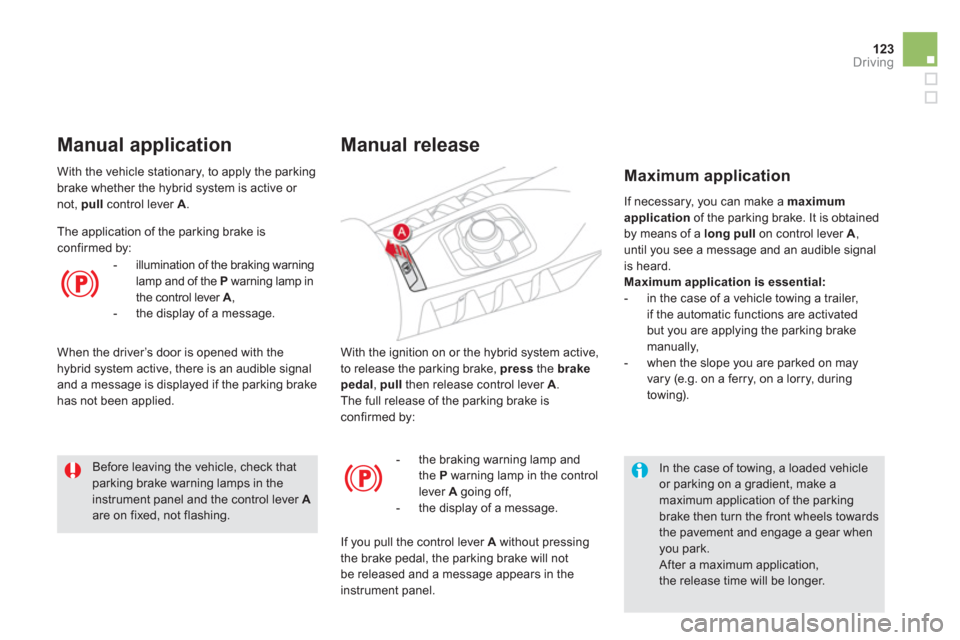
With the ignition on or the hybrid system active,
to release the parking brake, press the brakepedal, pullthen release control lever A.The full release of the parking brake isconfirmed by:
Manual release
- the braking warning lamp and
the Pwarning lamp in the control lever A
going off,
- the display of a message.
I
f you pull the control lever A
without pressing
the brake pedal, the parking brake will not
be released and a message appears in the
instrument panel.
If necessar
y, you can make a maximum application
of the parking brake. It is obtained
by means of a long pull on control lever A ,
until you see a message and an audible signalis heard.
Maximum application is essential:
- in the case of a vehicle towing a trailer,
if the automatic functions are activated
but you are applying the parking brakemanually,
- when the slope you are parked on mayvary (e.g. on a ferry, on a lorry, duringtowing).
Maximum application
In the case of towing, a loaded vehicle or parking on a gradient, make amaximum application of the parkingbrake then turn the front wheels towardsthe pavement and engage a gear whenyou park.
After a maximum application, the release time will be longer.
Before leaving the vehicle, check that parking brake warning lamps in the instrument panel and the control lever Aare on fixed, not flashing. With the vehicle stationar
y, to apply the parkingbrake whether the hybrid system is active or not, pull
control lever A .
Manual application
The application of the parking brake is confirmed by:
- illumination of the brakin
g warning
lamp and of the P warning lamp in
the control lever A ,
- the display of a message.
When the driver
’s door is opened with the hybrid system active, there is an audible signal
and a message is displayed if the parking brakehas not been applied.
Page 126 of 358
Before leaving the vehicle, check thatparking brake warning lamps in the instrument panel and in the control lever Aare on fixed (not flashing). Never leave a child alone inside thevehicle with the ignition on, as theycould release the parking brake.
Automatic application,
engine off
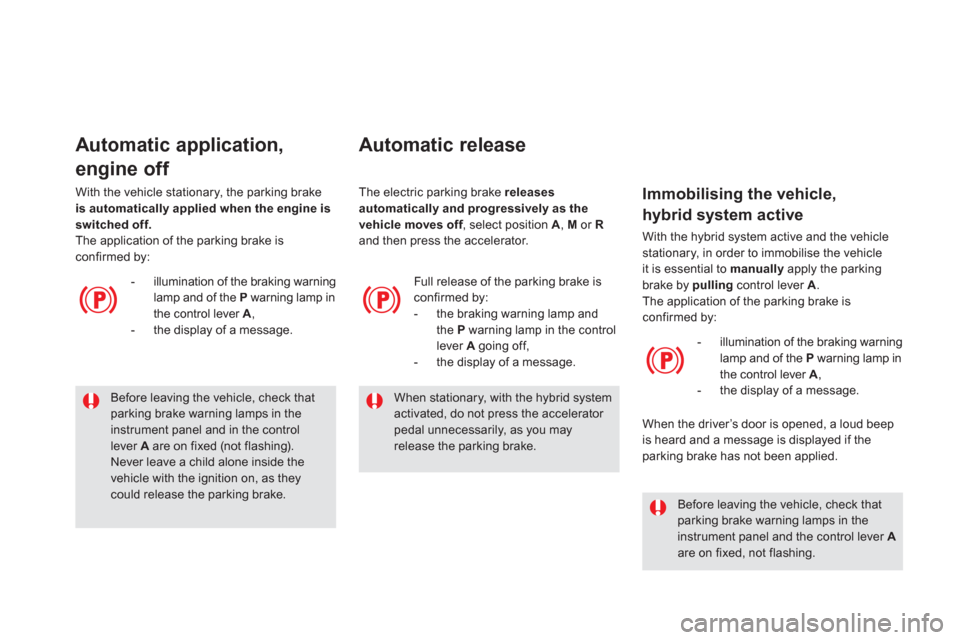
- illumination of the braking warning lamp and of the Pwarning lamp in
the control lever A,- the display of a message. With the vehicle stationar
y, the parking brake is automatically applied when the engine is
switched off.The application of the parking brake is confirmed by:
Automatic release
Full release of the parking brake is confirmed by:
- the braking warning lamp and
the P warning lamp in the controllever A
going off,
- the display of a message.
When stationary, with the hybrid system activated, do not press the accelerator pedal unnecessarily, as you may release the parking brake.
Before leaving the vehicle, check that parking brake warning lamps in the instrument panel and the control lever Aare on fixed, not flashing.
Immobilising the vehicle,
hybrid system active
With the hybrid system active and the vehiclestationary, in order to immobilise the vehicle
it is essential to manuallyapply the parking
brake by pulling control lever A
.
The application of the parking brake is confirmed by:
- illumination of the brakin
g warninglamp and of the P
warning lamp in
the control lever A,
- the display of a message.
When the driver’s door is opened, a loud beep
is heard and a messa
ge is displayed if the parking brake has not been applied. The electric parkin
g brake releases
automatically and progressively as thevehicle moves off, select position fA , M or Rand then press the accelerator.
Page 127 of 358
125
Driving
Emergency braking
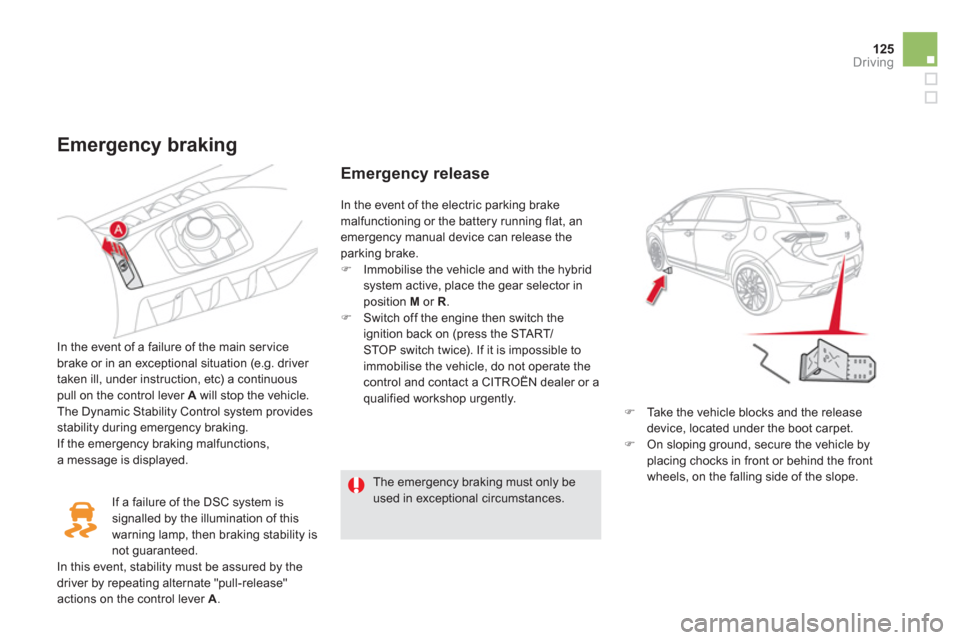
In the event of a failure of the main servicebrake or in an exceptional situation (e.g. driver
taken ill, under instruction, etc) a continuouspull on the control lever A will stop the vehicle.
The Dynamic Stability Control system provides stability during emergency braking.
If the emer
gency braking malfunctions,
a message is displayed.
Emergency release
) Take the vehicle blocks and the release
device, located under the boot carpet.
) On sloping ground, secure the vehicle byplacing chocks in front or behind the front
wheels, on the falling side of the slope. In the event of the electric parkin
g brake
malfunctioning or the battery running flat, an
emergency manual device can release theparking brake. ) Immobilise the vehicle and with the hybridsystem active, place the gear selector inposition M
or R.)
Switch off the engine then switch the
ignition back on (press the STA R T/STOP switch twice). If it is impossible to
immobilise the vehicle, do not operate the
control and contact a CITROËN dealer or a qualified workshop urgently.
The emergency braking must only be used in exceptional circumstances.
If a failure of the DSC system is
signalled by the illumination of this warning lamp, then braking stability isnot guaranteed.
In this event, stability must be assured by the
driver by repeating alternate "pull-release" actions on the control lever A.
Page 128 of 358
For safety reasons, you must contact a
CITROËN dealer as soon as possible to replace the protective cover. Ta k e care not to allow moisture or dust in the proximity of the protective cover.
Following an emergency unlocking, immobilisation of the vehicle is no longer guaranteed once the manualemergency release has been deployed and the manual control does not allow the re-application of your parking brake. Take no action, either on the controllever A, or stopping or star ting the engine while the release device is engaged.
To r e - e ngage the electric parking brake(after correction of the fault or battery problem), make a long pull on the control lever A
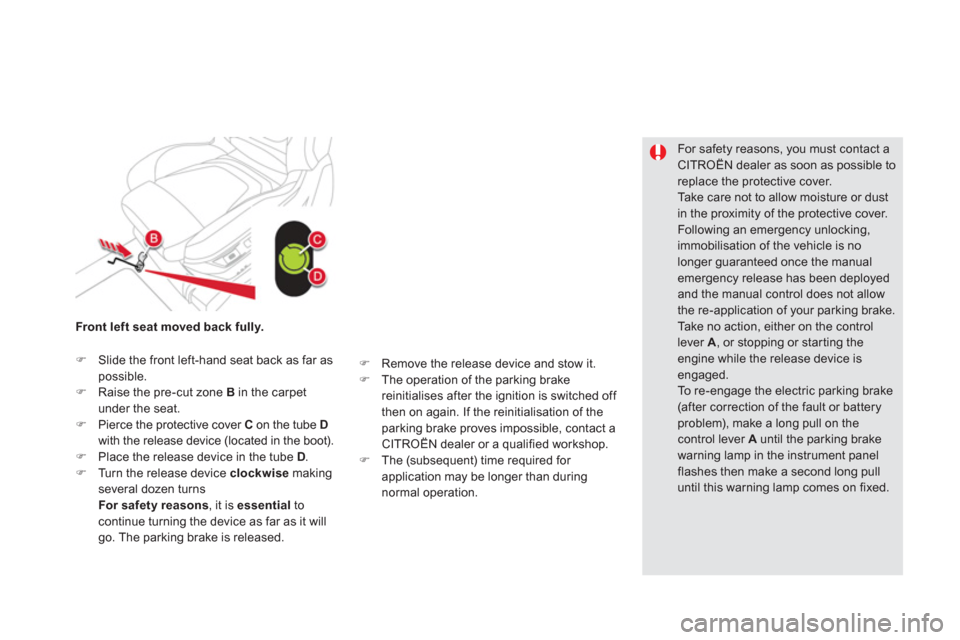
until the parking brake warning lamp in the instrument panel flashes then make a second long pulluntil this warning lamp comes on fixed. Front left seat moved back full
y.
)Slide the front left-hand seat back as far aspossible. )Raise the pre-cut zone B in the carpetunder the seat.)Pierce the protective cover Con the tube Dwith the release device (located in the boot). )Place the release device in the tube D.)Turn the release device clockwisemaking several dozen turnsFor safety reasons, it is essential
tocontinue turning the device as far as it will
go. The parking brake is released.
)
Remove the release device and stow it. )
The operation of the parking brake
reinitialises after the ignition is switched off
then on again. If the reinitialisation of the
parking brake proves impossible, contact a
CITROËN dealer or a qualified workshop.) The (subsequent) time required for
application may be longer than during
normal operation.
Page 130 of 358
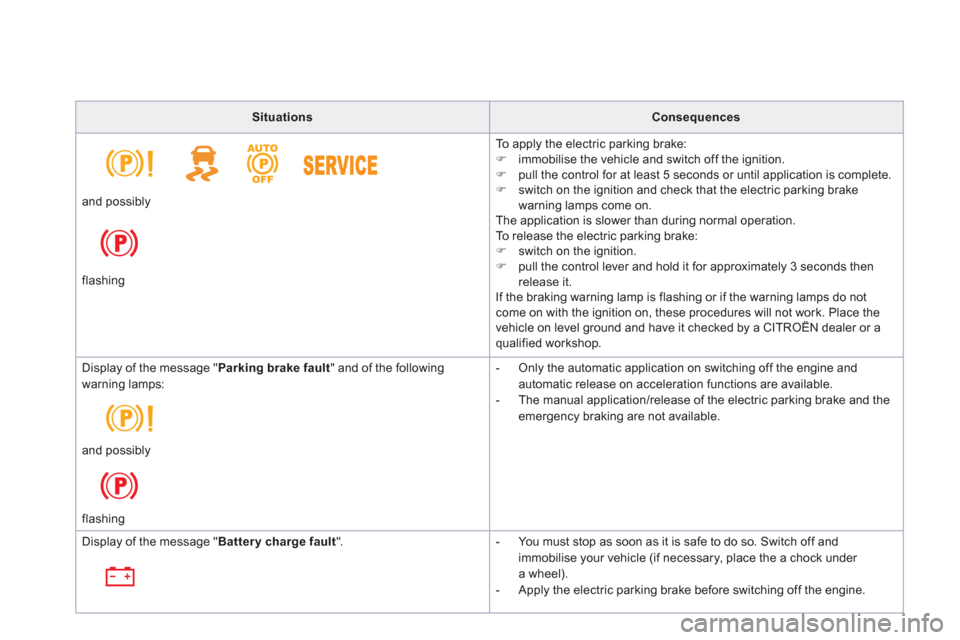
SituationsConsequences
To a p p l
y the electric parking brake:) immobilise the vehicle and switch off the ignition. )
pull the control for at least 5 seconds or until application is complete.)
switch on the ignition and check that the electric parking brake
warning lamps come on.
The application is slower than during normal operation.
To release the electric parking brake:) switch on the ignition.)
pull the control lever and hold it for approximately 3 seconds then
release it.
If the braking warning lamp is flashing or if the warning lamps do not come on with the ignition on, these procedures will not work. Place the
vehicle on level ground and have it checked by a CITROËN dealer or a qualified workshop. and possibl
y
flashing
Display of the message "Parking brake fault" and of the following
warning lamps:
- Only the automatic application on switching off the engine and automatic release on acceleration functions are available.
- The manual application/release of the electric parking brake and theemergency braking are not available.
an
d possibly
flashing
Display of the message "Batter y charge fault".
- You must stop as soon as it is safe to do so. Switch off and
immobilise your vehicle (if necessary, place the a chock under
a wheel).
- Apply the electric parking brake before switching off the engine.
Page 131 of 358
129Driving
Special situations
In the event of a malfunction of the parkingbrake in the on position
or a battery failure,manual release remains possible possible. To ensure correct operation, and soyour safety, the number of successive applications and releases of the parking brake is limited to eight cycles.
If used excessively, you are aler ted by the message "parking brake faulty" and aflashing warning lamp.
In some circumstances (engine start...),the parking brake may adjust the level of application itself. This is normal operation.
To m o v e your vehicle a few centimetres without starting the engine, with the ignitionon, press the brake pedal and release the parking brake by pullingthen releasingthe control lever A
. Complete release of theparking brake is indicated by the warninglamps in the control lever Aand in theinstrument panel going off and by the display of the message "Parking brake off".
Page 134 of 358
Engagement of reverse gear is accompanied by an audible signal.
If you leave the vehicle, place the gear selector in position Nand then you muststop the hybrid system by switching off the ignition (Ready
lamp off).
If the gear selector is not in position Non starting, Nflashes in the instrumentpanel, accompanied by an audible signal and a message in the instrument panel screen.Foot on brake
flashes on theinstrument panel, accompanied by anaudible signal and a message in theinstrument panel screen, if the brakepedal is not pressed on star ting.
When the engine is idling with the
brakes off, if position R, Aor M
is selected, the vehicle will move off on its own without any action on theaccelerator.
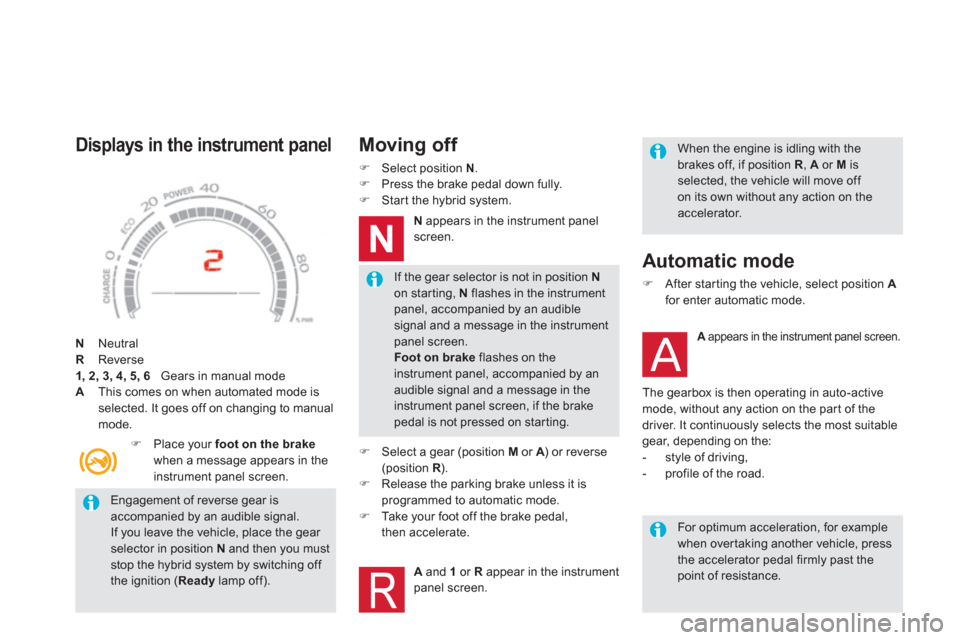
Displays in the instrument panel
NNeutral RReverse1, 2, 3, 4, 5, 6
Gears in manual mode AThis comes on when automated mode is
selected. It goes off on changing to manual mode.
)Place your foot on the brakewhen a message appears in the
instrument panel screen.
Moving off
)
Select position N
. )
Press the brake pedal down fully.)
Star t the hybrid system.
Nappears in the instrument panel
screen.
)
Select a gear (position M
or A) or reverse A(position R
).R)
Release the parking brake unless it is
programmed to automatic mode. ) Ta k e your foot off the brake pedal,
then accelerate.
Aand 1
or Rappear in the instrument panel screen.
Automatic mode
)After star ting the vehicle, select position Afor enter automatic mode.
A
appears in the instrument panel screen.A
The gearbox is then operating in auto-active mode, without any action on the par t of thedriver. It continuously selects the most suitable gear, depending on the:
- style of driving,
- profile of the road.
For optimum acceleration, for example when overtaking another vehicle, press the accelerator pedal firmly past the point of resistance.
Page 136 of 358
When immobilising the vehicle, with the hybrid system active, you must place the gear selector in neutral N.Before carrying out any work in the
engine compar tment, check that the gear selector is in neutral N and that the parking brake is applied.
Stopping the vehicle
With the ignition on, the flashing of this warning lamp,
accompanied by an audible
signal and a message
in the instrument panel screen, indicates a
malfunction of the gearbox.
Have it checked by a CITROËN dealer or a qualified workshop. Be
fore switching off the engine, you can choose to:
- move to position N
to engage neutral,
- leave the gear engaged; in this case, it will
not be possible to move the vehicle.
In both cases, you should apply the parkingbrake to immobilise the vehicle.
Operating fault
You must press the brake pedal when star ting the engine.
Whatever the circumstances, you must manually apply the parking brake when
parking, unless the parking brake isprogrammed in automatic mode.
Never leave children unsupervised in the vehicle with the hybrid system active.
For your safety, this function will only be activated if you press the brakepedal when engaging for ward drive or reverse.
This function is deactivated if thedriver's door is opened. To reactivate it, close the door and then press the brake or accelerator pedal.
Creep function (moving
without the accelerator
)
This function facilitates manoeuvring of the
vehicle at low speed (when parking, in traffic jams, …).
With the hybrid system active and the parking
brake released, if position A, M or R
is selected, the vehicle moves as soon as you
take your foot off the brake pedal (even without any action on the accelerator).
Page 137 of 358
135
Driving
Lane departure warning system
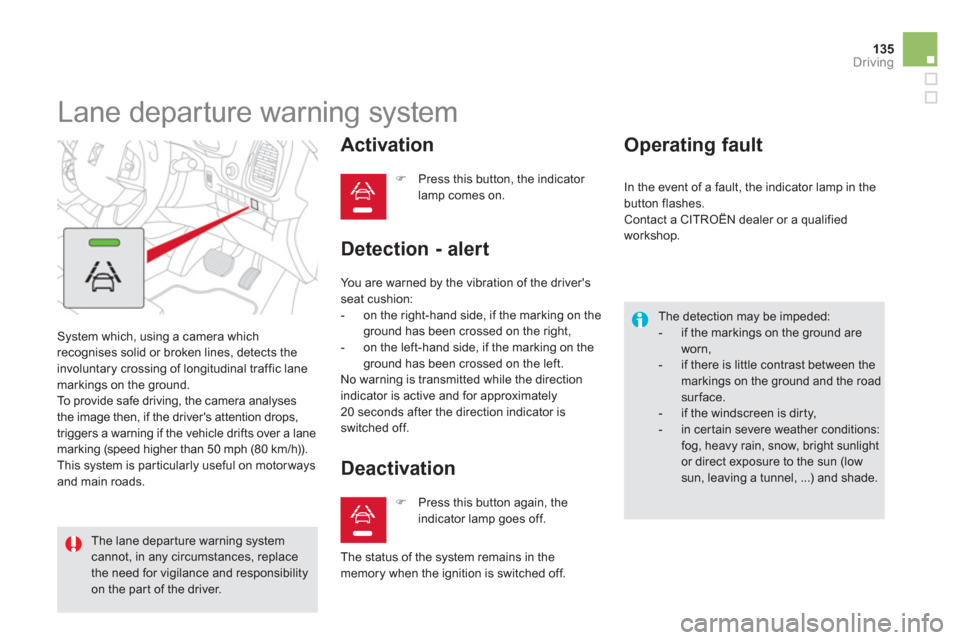
System which, using a camera which
recognises solid or broken lines, detects the
involuntary crossing of longitudinal traffic lane markings on the ground.
To provide safe driving, the camera analyses
the image then, if the driver's attention drops,
triggers a warning if the vehicle drifts over a lanemarking (speed higher than 50 mph (80 km/h)).
This system is par ticularly useful on motor waysand main roads.
Activation
)
Press this button, the indicator
lamp comes on.
The lane depar ture warning systemcannot, in any circumstances, replacethe need for vigilance and responsibility on the par t of the driver.
Deactivation
You are warned by the vibration of the driver's seat cushion:
- on the right-hand side, if the marking on theground has been crossed on the right,
- on the left-hand side, if the marking on the ground has been crossed on the left.
No warning is transmitted while the direction indicator is active and for approximately 20 seconds after the direction indicator is switched off.
Detection - alert
Operatin
g fault
The detection may be impeded:
- if the markings on the ground are worn,
- if there is little contrast between themarkings on the ground and the road surface.
- if the windscreen is dir ty,-in certain severe weather conditions:fog, heavy rain, snow, bright sunlightor direct exposure to the sun (low sun, leaving a tunnel, ...) and shade.
)
Press this button again, the
indicator lamp goes off. In the event of a fault, the indicator lamp in the
button flashes.
Contact a CITROËN dealer or a qualified
workshop.
The status of the s
ystem remains in the
memory when the ignition is switched off.