bonnet Citroen DS5 RHD 2014 1.G User Guide
[x] Cancel search | Manufacturer: CITROEN, Model Year: 2014, Model line: DS5 RHD, Model: Citroen DS5 RHD 2014 1.GPages: 400, PDF Size: 37.32 MB
Page 243 of 400
241Checks
Checking levels
Take care when working under the bonnet, as certain areas of the engine may be extremely hot (risk of burns) and the cooling fan could start at
any time (even with the ignition off).
Engine oil level
The check is carried out either when
the ignition is switched on using the
oil level indicator in the instrument
panel for vehicles with and electric oil
level gauge, or using the dipstick.
It is normal to top up the oil level between
two ser vices (or oil changes). CITROËN
recommends that you check the level, and top
up if necessary, every 3 000 miles (5 000 kms).
To ensure that the reading is correct,
your vehicle must be on level ground
and the engine has been off for more
than 30 minutes.
Check all of these levels regularly, in line with the maintenance and warranty guide. Top them up if necessary, unless other wise indicated.
If a level drops significantly, have the corresponding system checked by a CITROËN dealer or a qualified workshop.
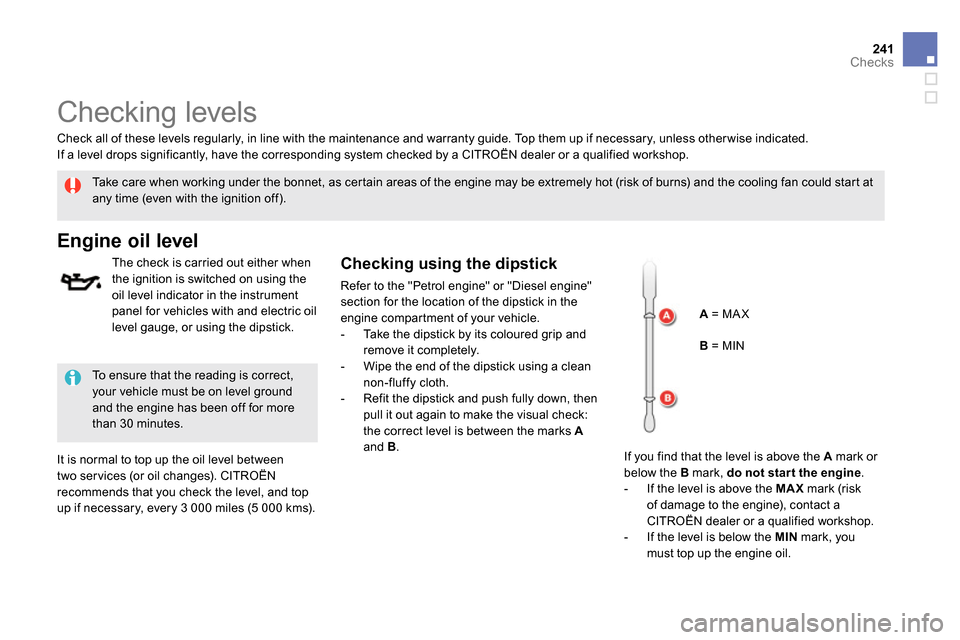
Checking using the dipstick
Refer to the "Petrol engine" or "Diesel engine"
section for the location of the dipstick in the
engine compartment of your vehicle.
- Take the dipstick by its coloured grip and
remove it completely.
- Wipe the end of the dipstick using a clean
non-fluffy cloth.
- Refit the dipstick and push fully down, then
pull it out again to make the visual check:
the correct level is between the marks A
and B
.
A
= MA X
B
= MIN
If you find that the level is above the A
mark or
below the B
mark, do not star t the engine
.
- If the level is above the MAX
mark (risk
of damage to the engine), contact a
CITROËN dealer or a qualified workshop.
- If the level is below the MIN
mark, you
must top up the engine oil.
Page 245 of 400

243Checks
Coolant level
The coolant level should be close
to the "MA X" mark but should never
exceed it.
Fluid specifi cation
The coolant must conform to the
manufacturer's recommendations.
In addition, as the cooling system is
pressurised, wait at least one hour after
switching off the engine before carrying
out any work.
To avoid any risk of scalding, unscrew
the cap by two turns to allow the
pressure to drop. When the pressure
has dropped, remove the cap and top
up the level. When the engine is warm, the temperature of
the coolant is regulated by the fan.
The cooling fan may star t after switching
off the engine: take care with ar ticles and
clothing that might become caught by the
fan blades.
Specifi cation of the fl uid
To ensure optimum cleaning and to avoid
freezing, the fluid should never be topped up or
replaced by plain water.
In wintry conditions, the use of an ethyl alcohol
or methanol base fluid is recommended.
Screenwash / headlamp
wash level
To check the level or top up the fluid on vehicle
fitted with headlamp washers, immobilise the
vehicle and switch of the engine.
Before opening the bonnet, ensure that the
engine has completely stopped.
Open the screenwash reser voir filler cap.
Take and pinch the level gauge to block its
breather.
Remove the gauge completely from the reservoir
to read the level in the transparent section.
Top up if necessary.
Refit the filler cap to the reser voir and close the
bonnet.
Page 262 of 400
Identifi cation markings
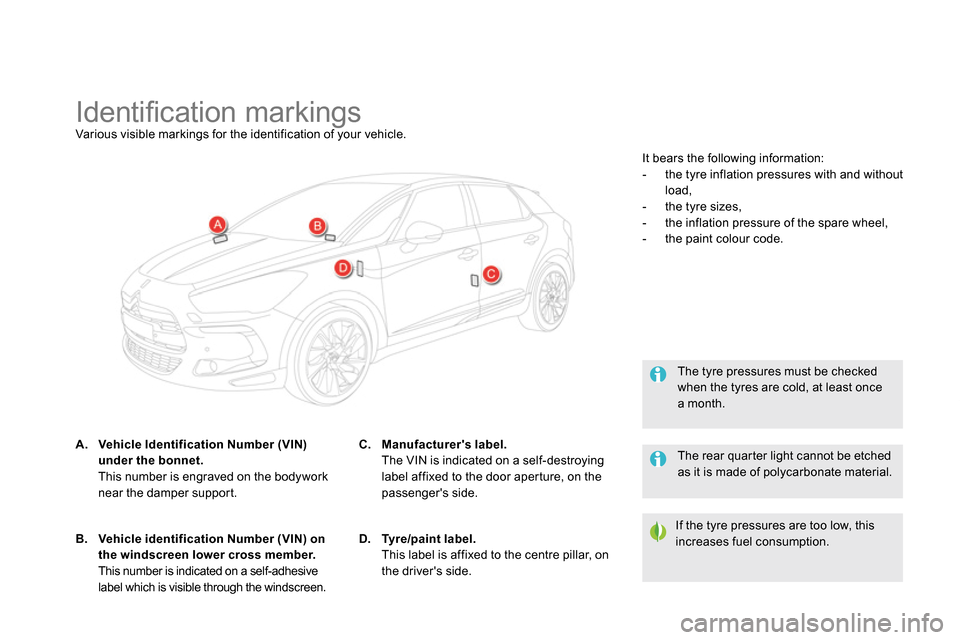
Various visible markings for the identification of your vehicle.
A.
Vehicle Identification Number (VIN)
under the bonnet.
This number is engraved on the bodywork
near the damper support.
The tyre pressures must be checked
when the tyres are cold, at least once
a month.
If the tyre pressures are too low, this
increases fuel consumption.
B.
Vehicle identification Number (VIN) on
the windscreen lower cross member.
This number is indicated on a self-adhesive
label which is visible through the windscreen.
C.
Manufacturer's label.
The VIN is indicated on a self-destroying
label affixed to the door aperture, on the
passenger's side.
D.
Ty r e / p a i n t l a b e l .
This label is affixed to the centre pillar, on
the driver's side. It bears the following information:
- the tyre inflation pressures with and without
load,
- the tyre sizes,
- the inflation pressure of the spare wheel,
- the paint colour code.
The rear quarter light cannot be etched
as it is made of polycarbonate material.
Page 364 of 400
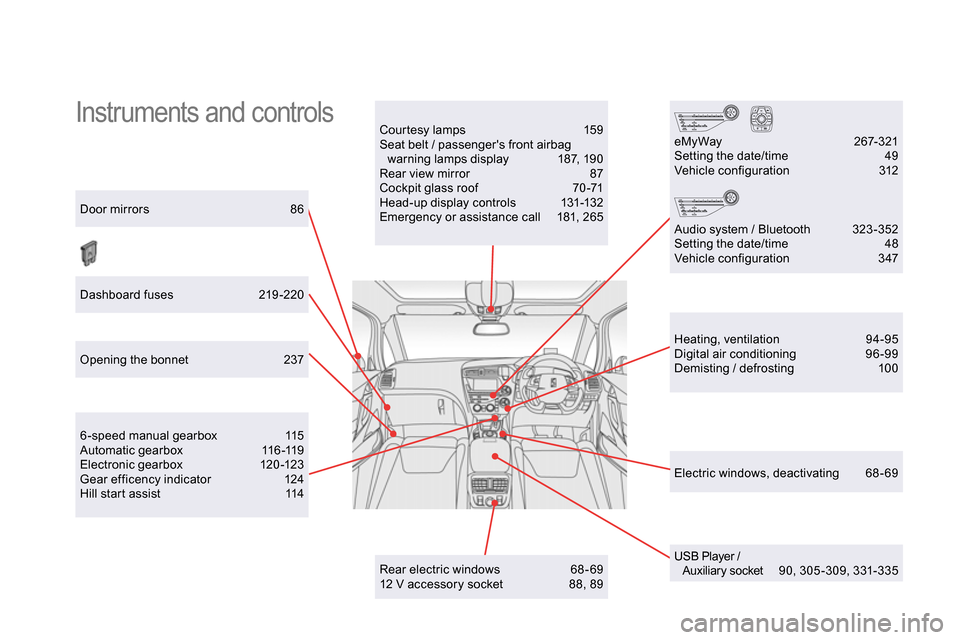
Instruments and controls
Courtesy lamps 159
Seat belt / passenger's front airbag
warning lamps display 187, 190
Rear view mirror 87
Cockpit glass roof 70 -71
Head-up display controls 131-132
Emergency or assistance call 181, 265
Door mirrors 86
Heating, ventilation 94-95
Digital air conditioning 96 -99
Demisting / defrosting 100
USB Player /
Auxiliary socket 90, 305-309, 331-335
Dashboard fuses 219 -220
6 -speed manual gearbox 115
Automatic gearbox 116 -119
Electronic gearbox 120 -123
Gear efficency indicator 124
Hill start assist 114
eMyWay 267-321
Setting the date/time 49
Vehicle configuration 312
Audio system / Bluetooth 323 -352
Setting the date/time 48
Vehicle configuration 347
Opening the bonnet 237
Rear electric windows 68- 69
12 V accessory socket 88, 89
Electric windows, deactivating 68-69
Page 367 of 400
365Visual search
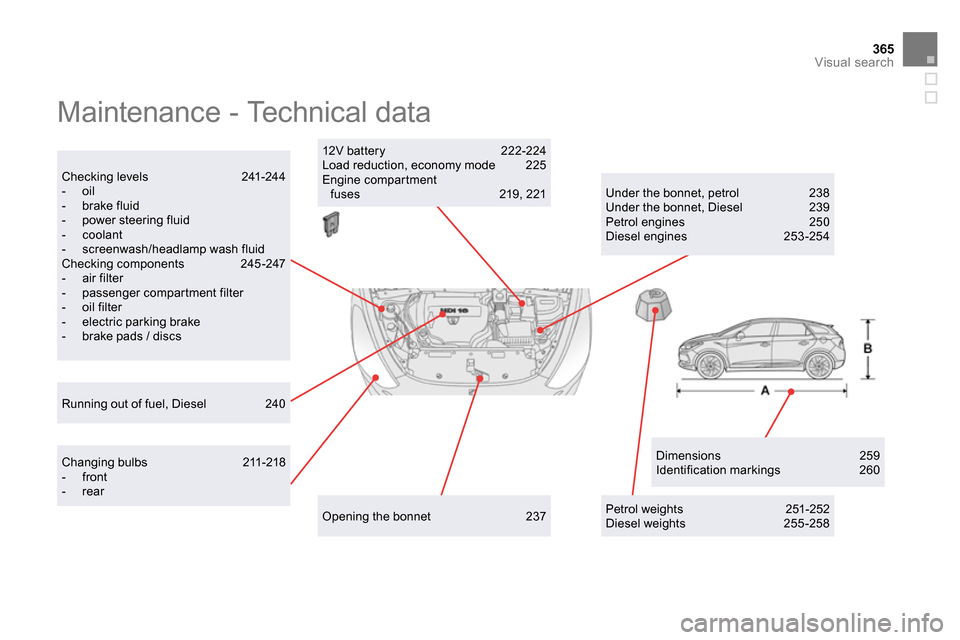
Maintenance - Technical data
Dimensions 259
Identification markings 260
Checking levels 241-244
- oil
- brake fluid
- power steering fluid
- coolant
- screenwash/headlamp wash fluid
Checking components 245-247
- air filter
- passenger compartment filter
- oil filter
- electric parking brake
- brake pads / discs
Changing bulbs 211-218
- front
- rear
12V battery 222-224
Load reduction, economy mode 225
Engine compartment
fuses 219, 221
Opening the bonnet 237
Petrol weights 251-252
Diesel weights 255 -258
Running out of fuel, Diesel 240
Under the bonnet, petrol 238
Under the bonnet, Diesel 239
Petrol engines 250
Diesel engines 253-254