towing Citroen DS5 RHD 2014 1.G User Guide
[x] Cancel search | Manufacturer: CITROEN, Model Year: 2014, Model line: DS5 RHD, Model: Citroen DS5 RHD 2014 1.GPages: 400, PDF Size: 37.32 MB
Page 205 of 400
203Practical information
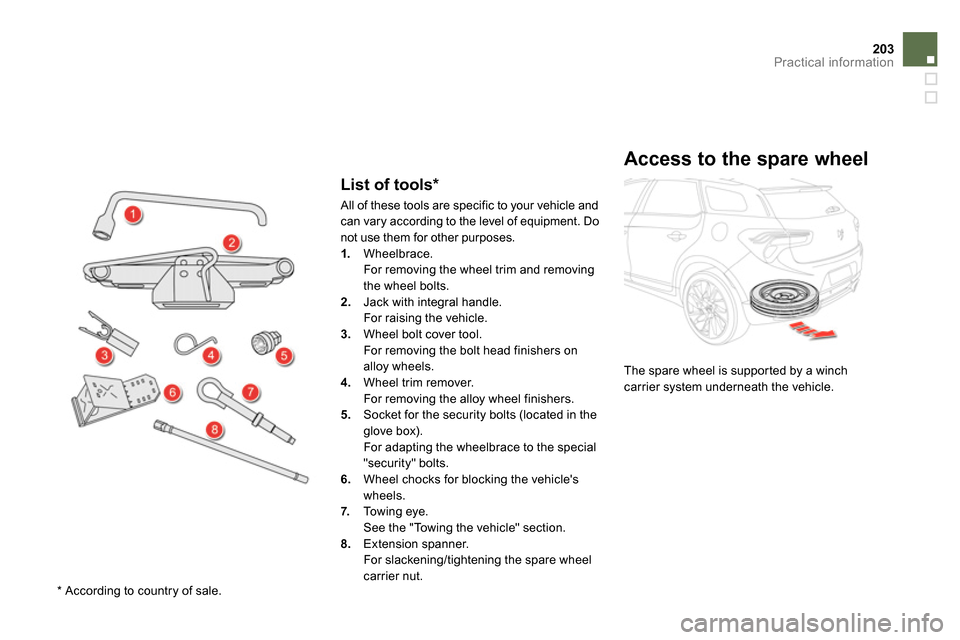
List of tools *
Access to the spare wheel
The spare wheel is supported by a winch
carrier system underneath the vehicle.
All of these tools are specific to your vehicle and
can vary according to the level of equipment. Do
not use them for other purposes.
1.
Wheelbrace.
For removing the wheel trim and removing
the wheel bolts.
2.
Jack with integral handle.
For raising the vehicle.
3.
Wheel bolt cover tool.
For removing the bolt head finishers on
alloy wheels.
4.
Wheel trim remover.
For removing the alloy wheel finishers.
5.
Socket for the security bolts (located in the
glove box).
For adapting the wheelbrace to the special
"security" bolts.
6.
Wheel chocks for blocking the vehicle's
wheels.
7.
To w i n g e y e .
See the "Towing the vehicle" section.
8.
Extension spanner.
For slackening/tightening the spare wheel
carrier nut.
*
According to country of sale.
Page 229 of 400

227Practical information
Towing the vehicle
Procedure for having your vehicle towed or
for towing another vehicle using a removable
towing eye.
Towing your vehicle
Towing another vehicle
Access to the tools
The towing eye is installed in the boot under
the floor.
To gain access to it:
open the boot,
remove the towing eye, located in the tool
box.
On the front bumper, unclip the cover by
pressing at the bottom to disengage the
securing lugs.
Screw the towing eye in fully.
Install the towing bar.
Switch on the hazard warning lamps on the
towed vehicle.
On the rear bumper, unclip the cover by
levering at the left with the point of the
towing eye.
Screw the towing eye in fully.
Install the towing bar.
Switch on the hazard warning lamps on the
towed vehicle.
When towing with all four wheels on the
ground, always use a towing bar.
When towing with only two wheels on
the ground, always use professional
lifting equipment.
When towing with the engine off, there
is no longer any braking or steering
assistance.
Place the gear lever in neutral
(position N
with an electronic or
automatic gearbox).
Failure to follow this advice could
result in damage to certain braking
components and the absence of
braking assistance the next time
the engine is started.
Page 230 of 400

Towing a trailer
We recommend the use of genuine
CITROËN towbars and their harnesses
that have been tested and approved
from the design stage of your vehicle,
and that the fitting of the towbar is
entrusted to a CITROËN dealer or a
qualified workshop.
If the towbar is not fitted by a CITROËN
dealer, it is imperative that it is
fitted in accordance with the vehicle
manufacturer's instructions.
Towbar suitable for the attachment of a trailer
or installation of a bicycle carrier,
with additional lighting and signalling.
When not towing a trailer, remove the
quickly-detachable tow ball before
driving, so as to avoid masking the
central rear lamp.
Driving with a trailer places greater
demands on the towing vehicle and the
driver must take particular care.
Your vehicle is primarily designed for
transporting people and luggage, but it may
also be used for towing a trailer.
Page 231 of 400

229Practical information
Driving advice
Distribution of loads
Distribute the load in the trailer so that the
heaviest items are as close as possible to
the axle and the nose weight approaches
the maximum permitted without
exceeding it.
Air density decreases with altitude, thus
reducing engine per formance. Above
1 000 metres, the maximum towed load must
be reduced by 10 % for every 1 000 metres of
altitude.
Side wind
Take into account the increased sensitivity
to side wind.
Cooling
Towing a trailer on a slope increases the
temperature of the coolant.
As the fan is electrically controlled, its cooling
capacity is not dependent on the engine speed.
To lower the engine speed, reduce your
speed.
The maximum towed load on a long incline
depends on the gradient and the ambient
temperature.
In all cases, keep a check on the coolant
temperature.
If the warning lamp and the
STOP
warning lamp come on,
stop the vehicle and switch off
the engine as soon as possible.
Braking
Towing a trailer increases the braking distance.
To avoid overheating of the brakes on a long
mountain type of descent, the use of engine
braking is recommended.
Ty r e s
Check the tyre pressures of the towing
vehicle and of the trailer, obser ving the
recommended pressures.
Lighting
Check the electrical lighting and signalling
on the trailer.
The rear parking sensors will be
deactivated automatically if a genuine
CITROËN towbar is used.
Refer to the "Technical data" section for details
of the weights and towed loads which apply to
your vehicle.
Page 253 of 400

251Te c h n i c a l d a t a
Petrol weights and towed loads (in kg)
Petrol engines
THP
1
55 hp
THP
15 0 hp
THP
160
hp
THP
200 hp
Gearbox
es
Automatic
(6-speed)
Automatic
(6-speed)
Automatic
(6-speed)
Manual
(6-speed)
Model codes
5FVA - A /1
5FEA
5FMA - Y - A /D
5FU8
- Unladen weight
1 420
1 497
1 495
1 430
- Kerb weight *
1 495
1 570
1 570
1 505
- Gross vehicle weight (GV W)
2 035
2 030
2 030
2 050
- Gross train weight (GTW)
on a 12 % gradient
3 335
2 830
2 830
2 800
- Braked trailer (within GTW limit)
on a 10 % or 12 % gradient
1 300
800
800
750
- Braked trailer ** (with load transfer within the
GTW limit)
1 500
800
800
1 050
- Unbraked trailer
74 5
74 5
74 5
750
- Recommended nose weight
75
75
75
75
*
The kerb weight is equal to the unladen weight + driver (75 kg).
**
The weight of the braked trailer can be increased, within the GTW limit, if the GV W of the towing vehicle is reduced by an equal amount; warning,
towing using a lightly loaded towing vehicle may have an adverse effect on its road holding.
The GTW and towed load values indicated are valid up to a maximum altitude of 1 000 metres; the towed load mentioned must be reduced by 10 % for
each additional 1 000 metres of altitude.
The speed of a towing vehicle must not exceed 60 mph (100 km/h) (comply with the legislation in force in your country).
High ambient temperatures may result in a reduction in the per formance of the vehicle to protect the engine; if the ambient temperature is above 37 °C,
limit the towed load.
Page 254 of 400

* The kerb weight is equal to the unladen weight + driver (75 kg).
Petrol engines
THP
155 hp
THP
200 hp
Gearboxes
Automatic
(6-speed)
Manual
(6-speed)
Model codes
5FVA - A /1
5FU8
- Unladen weight
1 540
1 572
- Kerb weight *
1 615
1 647
- Gross vehicle weight (GV W)
2 170
2 195
- Gross train weight (GTW)
on a 12% gradient
3 320
2 795
- Braked trailer (within the GTW limit)
on a 10% or 12% gradient
1 150
600
- Unbraked trailer
74 5
600
- Recommended nose weight
75
75
The GTW and towed load values indicated are valid up to a maximum altitude of 1 000 metres; the towed load mentioned must be reduced by 10 % for
each additional 1 000 metres of altitude.
The speed of a towing vehicle must not exceed 60 mph (100 km/h) (comply with the legislation in force in your country).
High ambient temperatures may result in a reduction in the per formance of the vehicle to protect the engine; if the ambient temperature is above 37 °C,
limit the towed load.
Petrol weights and towed loads (in kg) - Commercial versions
Page 257 of 400

255Te c h n i c a l d a t a
The GTW and towed load values indicated are valid up to a maximum altitude of 1 000 metres; the towed load mentioned must be reduced by 10 % for
each additional 1 000 metres of altitude.
The speed of a towing vehicle must not exceed 60 mph (100 km/h) (comply with the legislation in force in your country).
High ambient temperatures may result in a reduction in the per formance of the vehicle to protect the engine; if the ambient temperature is above 37 °C,
limit the towed load.
*
The kerb weight is equal to the unladen weight + driver (75 kg).
**
The weight of the braked trailer can be increased, within the GTW limit, if the GV W of the towing vehicle is reduced by an equal amount; warning,
towing using a lightly loaded towing vehicle may have an adverse effect on its road holding.
Diesel engines
e-HDi
115 h p
Blue HDi
115 h p
Blue HDi
120 hp
Gearboxes
Electronic
(6-speed)
Manual
(6-speed)
Manual
(6-speed)
Model codes
9HR - 9HD8/PS
BHZ - BHXM/S - M/1S - M/2S
BHZ - BHXM/S - M/1S - M/2S
- Unladen weight
1 420
1 428
1 428
- Kerb weight *
1 495
1 503
1 503
- Gross vehicle weight (GV W)
2 020
2 020
2 020
- Gross train weight (GTW)
on a 12% gradient
3 120
3 120
3 120
- Braked trailer (within GTW limit)
on a 10% or 12% gradient
1 100
1 100
1 100
- Braked trailer ** (with load transfer with the
GTW limit)
1 400
1 400
1 400
- Unbraked trailer
74 5
74 5
74 5
- Recommended nose weight
75
75
75
Diesel weights and towed loads (in kg)
Page 258 of 400

* The kerb weight is equal to the unladen weight + driver (75 kg).
**
The weight of the braked trailer can be increased, within the GTW limit, if the GV W of the towing vehicle is reduced by an equal amount; warning,
towing using a lightly loaded towing vehicle may have an adverse effect on its road holding.
The GTW and towed load values indicated are valid up to a maximum altitude of 1 000 metres; the towed load mentioned must be reduced by 10 % for
each additional 1 000 metres of altitude.
The speed of a towing vehicle must not exceed 60 mph (100 km/h) (comply with the legislation in force in your country).
High ambient temperatures may result in a reduction in the per formance of the vehicle to protect the engine; if the ambient temperature is above 37 °C,
limit the towed load.
Diesel engines
HDi
160 hp
HDi
160 hp
HDi
135 hp
HDi
135 hp
Blue HDi
180 hp
Gearboxes
Manual
(6-speed)
Automatic
(6-speed)
Manual
(6-speed)
Automatic
(6-speed)
Automatic
(6-speed)
Model codes
RRH - RHD8 -
8/1 - 8/1V
RRH - RHDA -
A/1
RRH - RHD8 -
8/1 - 8/1V
RRH - RHDA -
A/1
AHWT/S - T/1S -
T/2S
- Unladen weight
1 530
1 540
1 530
1 540
1 540
- Kerb weight *
1 605
1 615
1 605
1 615
1 615
- Gross vehicle weight (GV W)
2 130
2 125
2 130
2 125
2 125
- Gross train weight (GTW)
on a 12% gradient
3 330
3 325
3 330
3 325
3 325
- Braked trailer (within GTW limit)
on a 10% or 12% gradient
1 200
1 200
1 200
1 200
1 200
- Braked trailer ** (with load transfer
with the GTW limit)
1 500
1 500
1 500
1 500
1 500
- Unbraked trailer
750
750
750
750
750
- Recommended nose weight
75
75
75
75
75
Diesel weights and towed loads (in kg)
Page 259 of 400

257Te c h n i c a l d a t a
The GTW and towed load values indicated are valid up to a maximum altitude of 1 000 metres; the towed load mentioned must be reduced by 10 % for
each additional 1 000 metres of altitude.
The speed of a towing vehicle must not exceed 60 mph (100 km/h) (comply with the legislation in force in your country).
High ambient temperatures may result in a reduction in the per formance of the vehicle to protect the engine; if the ambient temperature is above 37 °C,
limit the towed load.
*
The kerb weight is equal to the unladen weight + driver (75 kg).
Diesel engines
e-HDi
115
hp
HDi
160 hp PEF
HDi
160 hp PEF
Gearboxes
Electronic
(6 speed)
Manual
(6-speed)
Automatic
(6-speed)
Model codes
9HR - 9HD8/PS
RHH8 - 8/1V
RHHA - A /1
- Unladen weight
1 528
1 643
1 634
- Kerb weight *
1 603
1 718
1 709
- Gross vehicle weight (GV W)
2 150
2 265
2 255
- Gross train weight (GTW)
on a 12% gradient
3 150
3 315
3 305
- Braked trailer (within the GTW limit)
on a 10% or 12% gradient
1 000
1 050
1 050
- Unbraked trailer
74 5
750
- Recommended nose weight
75
Diesel weights and towed loads (in kg) - Commercial versions
Page 260 of 400

* The kerb weight is equal to the unladen weight + driver (75 kg).
The GTW and towed load values indicated are valid up to a maximum altitude of 1 000 metres; the towed load mentioned must be reduced by 10 % for
each additional 1 000 metres of altitude.
The speed of a towing vehicle must not exceed 60 mph (100 km/h) (comply with the legislation in force in your country).
High ambient temperatures may result in a reduction in the per formance of the vehicle to protect the engine; if the ambient temperature is above 37 °C,
limit the towed load.
Diesel engines
Blue HDi
120 hp
Blue HDi
180
hp
Gearboxes
Manual
(6-speed)
Automatic
(6-speed)
Model codes
BHZMS - M/1S - M/2S
AHWTS - T/1S - T/2S
- Unladen weight
1 528
1 634
- Kerb weight *
1 603
1 709
- Gross vehicle weight (GV W)
2 150
2 255
- Gross train weight (GTW)
on a 12% gradient
3 150
3 305
- Braked trailer (within GTW limit)
on a 10% or 12% gradient
1 000
1 050
- Unbraked trailer
74 5
750
- Recommended nose weight
75
75
Diesel weights and towed loads (in kg) - Commercial versions