tow Citroen DS5 RHD 2014 1.G Owner's Guide
[x] Cancel search | Manufacturer: CITROEN, Model Year: 2014, Model line: DS5 RHD, Model: Citroen DS5 RHD 2014 1.GPages: 400, PDF Size: 37.32 MB
Page 141 of 400

139Driving
In bad weather or in winter, ensure
that the sensors are not covered with
mud, ice or snow. When reverse gear is
engaged, an audible signal (long beep)
indicates that the sensors may be dirty.
Certain sound sources (motorcycle,
lorry, pneumatic drill, etc.) may trigger
the audible signals of the parking
sensor system.
In the event of a malfunction
of the system, when reverse
gear is engaged this warning
lamp is displayed in the instrument panel
and/or a message appears in the screen,
accompanied by an audible signal (short beep).
Contact a CITROËN dealer or a qualified
workshop.
Operating fault
In addition to the rear parking sensors, the
front parking sensors are triggered when an
obstacle is detected in front and the speed of
the vehicle is still below 6 mph (10 km/h).
The front parking sensors are interrupted if
the vehicle stops for more than three seconds
in for ward gear, if no further obstacles are
detected or when the speed of the vehicle
exceeds 6 mph (10 km/h).
Front parking sensors
The function will be deactivated
automatically if a trailer is being towed
or a bicycle carrier is fitted (vehicle
fitted with a towbar or bicycle carrier
recommended by CITROËN).
Deactivation / Activation of the
front and rear parking sensors
The function is deactivated by pressing this button.
The indicator lamp in the button comes on.
Pressing this button again reactivates the function.
The indicator lamp in the button goes off.
The sound emitted by the speaker (front
or rear) indicates whether the obstacle
is in front or behind.
Page 157 of 400

155Visibility
Wiper controls
Programming
Various automatic wiper control modes are also
available according to the following options:
- automatic rain sensitive windscreen wipers,
- rear wiping on engaging reverse gear.
Manual controls
The wipers are controlled directly by the driver. The vehicle's front and rear wipers are
designed to improve the driver's visibility
progressively according to the climatic
conditions.
Windscreen wipers
Wiping speed:
fast (heavy rain),
normal (moderate rain),
intermittent (proportional to the
speed of the vehicle),
park,
automatic (press down and
release),
single wipe (pull the stalk briefly towards you).
Page 158 of 400

Rear wiper
If a significant accumulation of snow
or ice is present, or when using a
bicycle carrier on the boot, deactivate
the automatic rear wiper via the
configuration menu. park,
intermittent wipe,
wash-wipe (set duration).
Reverse gear
When reverse gear is engaged, the rear wiper
will come into operation if the windscreen
wipers are operating.
The function is activated or
deactivated via the configuration
menu.
This function is activated by default.
Programming
Pull the windscreen wiper stalk towards
you. The windscreen wash then the
windscreen wipers operate for a fixed
period.
The headlamp washers only operate when the
dipped or main beam headlamps are on
,
with the vehicle moving
.
Windscreen and headlamp
wash
Rear wiper selection ring:
To reduce the consumption of the fluid by the
headlamp washers, they operate only with
every seventh use of the screenwash or every
25 miles (40 km) during a given journey.
Page 173 of 400
171Child safety
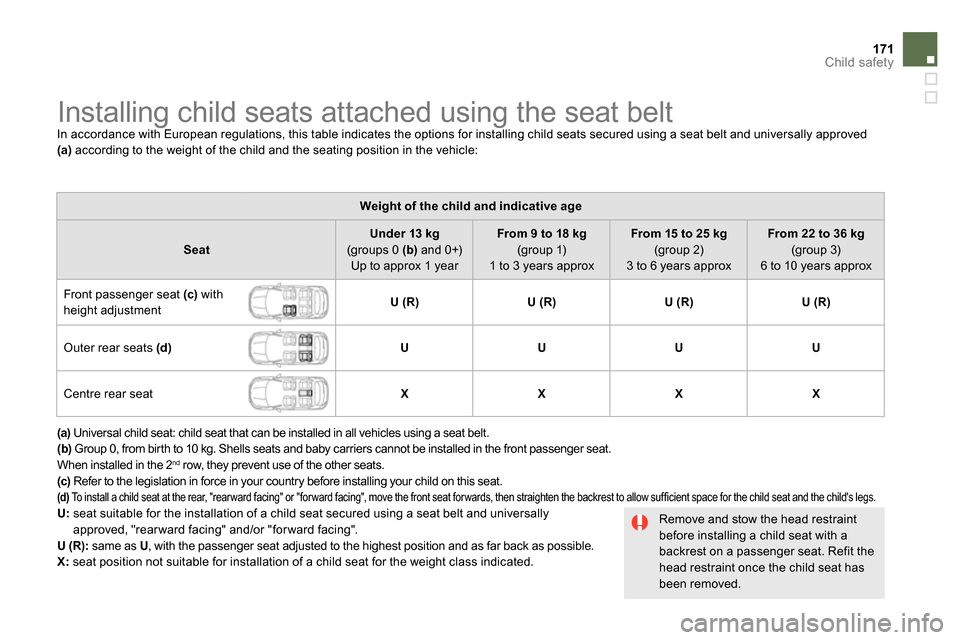
Installing child seats attached using the seat belt
In accordance with European regulations, this table indicates the options for installing child seats secured using a seat belt and universally approved
(a)
according to the weight of the child and the seating position in the vehicle:
Weight of the child and indicative age
Seat
Under 13 kg
(groups 0 ( b ) and 0+)
Up to approx 1 year
From 9 to 18 kg
(group 1)
1 to 3 years approx
From 15 to 25 kg
(group 2)
3 to 6 years approx
From 22 to 36 kg
(group 3)
6 to 10 years approx
Front passenger seat ( c ) with
height adjustment
U (R)
U (R)
U (R)
U (R)
Outer rear seats (d)
U
U
U
U
Centre rear seat
X
X
X
X
(a)
Universal child seat: child seat that can be installed in all vehicles using a seat belt.
(b)
Group 0, from birth to 10 kg. Shells seats and baby carriers cannot be installed in the front passenger seat.
When installed in the 2
nd row, they prevent use of the other seats.
(c)
Refer to the legislation in force in your country before installing your child on this seat.
(d)
To install a child seat at the rear, "rear ward facing" or "for ward facing", move the front seat for wards, then straighten the backrest to allow sufficient space for the child seat and the child's legs.
Remove and stow the head restraint
before installing a child seat with a
backrest on a passenger seat. Refit the
head restraint once the child seat has
been removed.
U:
seat suitable for the installation of a child seat secured using a seat belt and universally
approved, "rear ward facing" and/or "for ward facing".
U (R):
same as U
, with the passenger seat adjusted to the highest position and as far back as possible.
X:
seat position not suitable for installation of a child seat for the weight class indicated.
Page 174 of 400
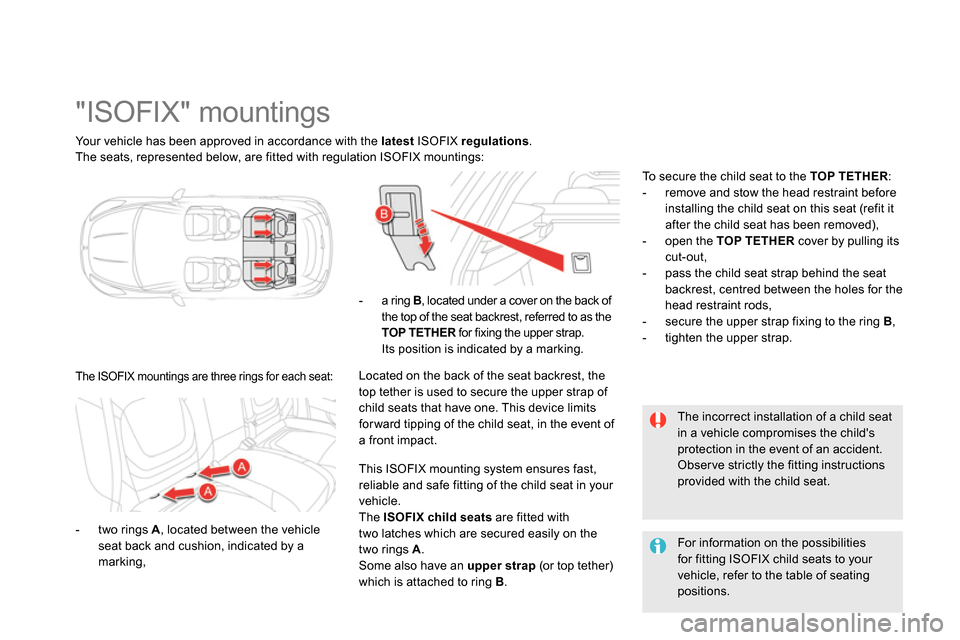
Your vehicle has been approved in accordance with the latest ISOFIX regulations
.
The seats, represented below, are fitted with regulation ISOFIX mountings:
"ISOFIX" mountings
- two rings A
, located between the vehicle
seat back and cushion, indicated by a
marking,
This ISOFIX mounting system ensures fast,
reliable and safe fitting of the child seat in your
vehicle.
The ISOFIX child seats
are fitted with
two latches which are secured easily on the
two rings A
.
Some also have an upper strap
(or top tether)
which is attached to ring B
.
The incorrect installation of a child seat
in a vehicle compromises the child's
protection in the event of an accident.
Obser ve strictly the fitting instructions
provided with the child seat.
- a ring B
, located under a cover on the back of
the top of the seat backrest, referred to as the
TOP TETHER
for fixing the upper strap.
Its position is indicated by a marking.
To secure the child seat to the TOP TETHER
:
- remove and stow the head restraint before
installing the child seat on this seat (refit it
after the child seat has been removed),
- open the TOP TETHER
cover by pulling its
cut-out,
- pass the child seat strap behind the seat
backrest, centred between the holes for the
head restraint rods,
- secure the upper strap fixing to the ring B
,
- tighten the upper strap.
The ISOFIX mountings are three rings for each seat:
Located on the back of the seat backrest, the
top tether is used to secure the upper strap of
child seats that have one. This device limits
for ward tipping of the child seat, in the event of
a front impact.
For information on the possibilities
for fitting ISOFIX child seats to your
vehicle, refer to the table of seating
positions.
Page 177 of 400
175Child safety
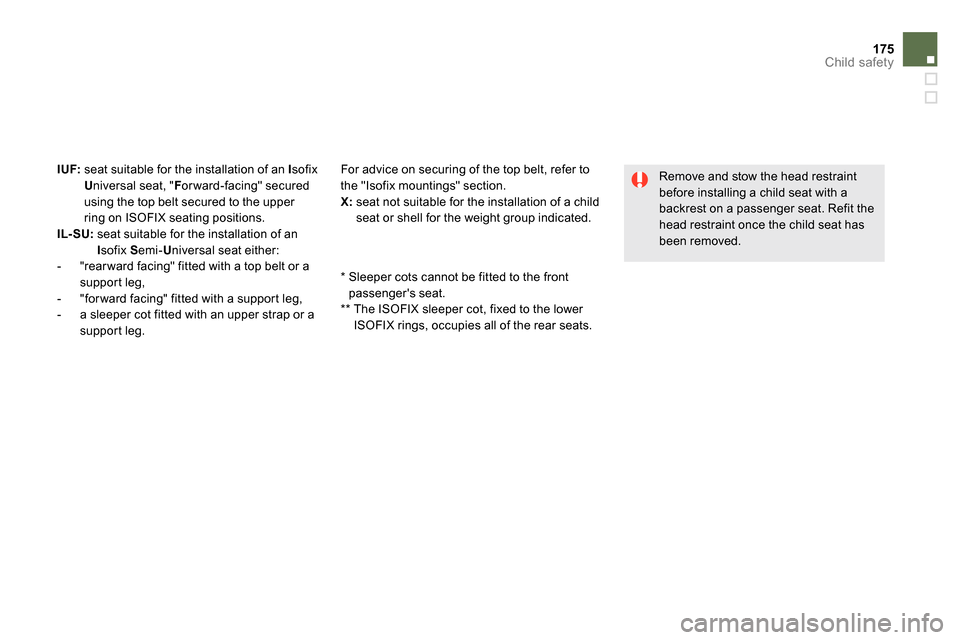
IUF:
seat suitable for the installation of an I
sofix
U
niversal seat, " F
or ward-facing" secured
using the top belt secured to the upper
ring on ISOFIX seating positions.
IL-SU:
seat suitable for the installation of an
I
sofix S
emi- U
niversal seat either:
- "rear ward facing" fitted with a top belt or a
support leg,
- "for ward facing" fitted with a support leg,
- a sleeper cot fitted with an upper strap or a
support leg.
*
Sleeper cots cannot be fitted to the front
passenger's seat.
**
The ISOFIX sleeper cot, fixed to the lower
ISOFIX rings, occupies all of the rear seats.
Remove and stow the head restraint
before installing a child seat with a
backrest on a passenger seat. Refit the
head restraint once the child seat has
been removed. For advice on securing of the top belt, refer to
the "Isofix mountings" section.
X:
seat not suitable for the installation of a child
seat or shell for the weight group indicated.
Page 190 of 400
The driver must ensure that passengers use
the seat belts correctly and that they are all
restrained securely before setting off.
Wherever you are seated in the vehicle,
always fasten your seat belt, even for short
journeys.
Do not interchange the seat belt buckles as
they will not fulfil their role fully.
The seat belts are fitted with an inertia reel
permitting automatic adjustment of the
length of the strap to your size. The seat belt
is stowed automatically when not in use.
Before and after use, ensure that the seat
belt is reeled in correctly.
The lower part of the strap must be
positioned as low as possible on the pelvis.
The upper part must be positioned in the
hollow of the shoulder.
The inertia reels are fitted with an automatic
locking device which comes into operation in
the event of a collision, emergency braking
or if the vehicle rolls over. You can release
the device by pulling firmly on the strap and
releasing it so that it reels in slightly.
Recommendations for children
Use a suitable child seat if the passenger is
less than 12 years old or shorter than one
and a half metres.
Never use the same seat belt to secure more
than one person.
Never allow a child to travel on your lap. In order to be effective, a seat belt must:
- be tightened as close to the body as
possible,
- be pulled in front of you with a smooth
movement, checking that it does not
twist,
- be used to restrain only one person,
- not bear any trace of cuts or fraying,
- not be converted or modified to avoid
affecting its per formance.
In accordance with current safety
regulations, for all repairs on your vehicle,
go to a qualified workshop with the skills
and equipment needed, which a CITROËN
dealer is able to provide.
Have your seat belts checked regularly by
a CITROËN dealer or a qualified workshop,
particularly if the straps show signs of
damage.
Clean the seat belt straps with soapy
water or a textile cleaning product, sold by
CITROËN dealers.
After folding or moving a seat or rear bench
seat, ensure that the seat belt is positioned
and reeled in correctly.
In the event of an impact
Depending on the nature and
seriousness of the impact
, the
pretensioning device may be deployed
before and independently of the airbags.
Deployment of the pretensioners is
accompanied by a slight discharge of
harmless smoke and a noise, due to the
activation of the pyrotechnic cartridge
incorporated in the system.
In all cases, the airbag warning lamp
comes on.
Following an impact, have the seat belts
system checked, and if necessary replaced,
by a CITROËN dealer or a qualified
workshop.
Page 191 of 400

189Safety
Airbags
System designed to maximise the safety of the
occupants (with the exception of the rear centre
passenger) in the event of violent collisions.
The airbags supplement the action of the force-
limiting seat belts (with the exception of the
centre rear passenger).
If a collision occurs, the electronic detectors
record and analyse the front and side impacts
sustained in the impact detection zones:
- in the case of a serious impact, the airbags
are deployed instantly and contribute
towards better protection of the occupants
of the vehicle (with the exception of the
rear centre passenger); immediately after
the impact, the airbags deflate rapidly so
that they do not hinder visibility or the exit
of the occupants,
- in the case of a minor or rear impact
or in certain roll-over conditions, the
airbags will not be deployed; the seat belt
alone contributes towards ensuring your
protection in these situations.
The airbags do not operate when the
ignition is switched off.
This equipment will only deploy once.
If a second impact occurs (during the
same or a subsequent accident), the
airbag will not be deployed again. Deployment of the airbag(s) is
accompanied by a slight emission
of smoke and a noise, due to the
activation of the pyrotechnic cartridge
incorporated in the system.
This smoke is not harmful, but sensitive
individuals may experience slight
irritation.
The noise of the detonation may result in
a slight loss of hearing for a short time.
Impact detection zones
A.
Front impact zone.
B.
Side impact zone.
Front airbags
Deployment
The airbags are deployed, except the passenger's
front airbag if it is deactivated, in the event of a serious
front impact to all or part of the front impact zone A
,
in the longitudinal centreline of the vehicle on a
horizontal plane and directed from the front to the rear
of the vehicle.
The front airbag inflates between the thorax and head
of the front occupant of the vehicle and the steering
wheel, driver's side, and the dashboard, passenger's
side to cushion their for ward movement.
System which protects the driver and front
passenger in the event of a serious front impact
in order to limit the risk of injury to the head and
thorax.
The driver's airbag is fitted in the centre of the
steering wheel; the front passenger's airbag is
fitted in the dashboard above the glove box.
Page 193 of 400

191Safety
Lateral airbags
Deployment
The lateral airbags are deployed unilaterally in
the event of a serious side impact applied to all
or part of the side impact zone B
, perpendicular
to the longitudinal centreline of the vehicle on a
horizontal plane and directed from the outside
towards the inside of the vehicle.
The lateral airbag inflates between the hip and
shoulder of the front occupant of the vehicle
and the corresponding door trim panel. System which protects the driver and front
passenger in the event of a serious side impact
in order to limit the risk of injury to the chest,
between the hip and the shoulder.
Each lateral airbag is fitted in the seat backrest
frame, door side.
Impact detection zones
A.
Front impact zone.
B.
Side impact zone.
Curtain airbags
System which protects the driver and
passengers (with the exception of the rear
centre passenger) in the event of a serious side
impact in order to limit the risk of injury to the
side of the head.
Each curtain airbag is built into the pillars and
the upper passenger compartment area. In the event of a minor impact or bump
on the side of the vehicle or if the
vehicle rolls over, the airbag may not be
deployed.
In the event of a rear or front collision,
the curtain airbag is not deployed.
Deployment
The curtain airbag is deployed at the same
time as the corresponding lateral airbag in the
event of a serious side impact applied to all or
part of the side impact zone B
, perpendicular
to the longitudinal centreline of the vehicle on a
horizontal plane and directed from the outside
towards the inside of the vehicle.
The curtain airbag inflates between the front or
rear occupant of the vehicle and the windows.
If this warning lamp comes on in the
instrument panel, accompanied by an
audible signal and a message in the
instrument panel screen, contact a
CITROËN dealer or a qualified workshop to have
the system checked. The airbags may no longer
be deployed in the event of a serious impact.
Operating fault
Page 198 of 400

This kit is installed in the storage box, under the
boot floor.
Complete system consisting of a compressor
and a sealant cartridge which permits
temporary repair
of a tyre so that you can
drive to the nearest garage.
It is designed to repair most punctures which
could affect the tyre, located on the tyre tread
or shoulder.
Temporary puncture repair kit
Access to the kit
List of tools
All of these tools are specific to your vehicle
and can vary according to equipment. Do not
use them for other purposes.
1.
12 V compressor.
Contains a sealant cartridge for the
temporary repair of a tyre and can also be
used for adjusting tyre pressures.
2.
Chocks * to block the wheels of the vehicle.
3.
Bolt "covers * " tool.
For removing the wheel bolt protectors
(covers) on alloy wheels.
4.
Wheel finisher remover.
For removing the wheel finishers on alloy
wheels.
5.
Removable towing eye.
See "Towing the vehicle".
*
Depending on country of sale or equipment.