spare wheel Citroen DS5 RHD 2014 1.G Owner's Manual
[x] Cancel search | Manufacturer: CITROEN, Model Year: 2014, Model line: DS5 RHD, Model: Citroen DS5 RHD 2014 1.GPages: 400, PDF Size: 37.32 MB
Page 28 of 400
Limit the causes of excess consumption
Spread loads throughout the vehicle; place the heaviest items in the
bottom of the boot, as close as possible to the rear seats.
Limit the loads carried in the vehicle and reduce wind resistance (roof
bars, roof rack, bicycle carrier, trailer...). Use a roof box in preference.
Remove roof bars and roof racks after use.
At the end of winter, remove snow tyres and refit your summer tyres.
Observe the recommendations on maintenance
Check the tyre pressures regularly, when cold, referring to the label in
the door aperture, driver's side.
Carry out this check in particular:
- before a long journey,
- at each change of season,
- after a long period out of use.
Don't forget the spare wheel and the tyres on any trailer or caravan.
Have your vehicle ser viced regularly (engine oil, oil filter, air filter...) and
obser ve the schedule of operations recommended by the manufacturer.
When refuelling, do not continue after the third cut-off of the nozzle to
avoid any over flow.
At the wheel of your new vehicle, it is only after the first 1 800 miles
(3 000 kilometres) that you will see the fuel consumption settle down
to a consistent average.
Page 127 of 400
125Driving
Ty r e u n d e r - i nfl ation detection
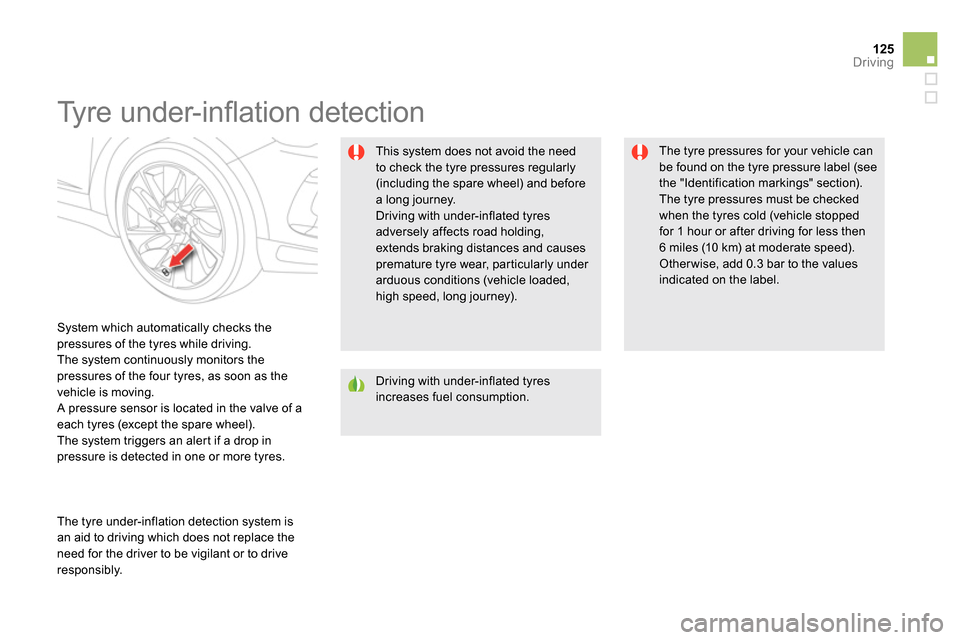
System which automatically checks the
pressures of the tyres while driving.
The system continuously monitors the
pressures of the four tyres, as soon as the
vehicle is moving.
A pressure sensor is located in the valve of a
each tyres (except the spare wheel).
The system triggers an alert if a drop in
pressure is detected in one or more tyres.
This system does not avoid the need
to check the tyre pressures regularly
(including the spare wheel) and before
a long journey.
Driving with under-inflated tyres
adversely affects road holding,
extends braking distances and causes
premature tyre wear, particularly under
arduous conditions (vehicle loaded,
high speed, long journey).
Driving with under-inflated tyres
increases fuel consumption.
The tyre pressures for your vehicle can
be found on the tyre pressure label (see
the "Identification markings" section).
The tyre pressures must be checked
when the tyres cold (vehicle stopped
for 1 hour or after driving for less then
6 miles (10 km) at moderate speed).
Other wise, add 0.3 bar to the values
indicated on the label.
The tyre under-inflation detection system is
an aid to driving which does not replace the
need for the driver to be vigilant or to drive
responsibly.
Page 128 of 400
Under-inflation alert
The aler t is given by the fixed illumination
of this warning lamp, accompanied by
an audible signal, and depending on
equipment, the display of a message.
In the event of a problem on one of the tyres,
the symbol or the message appears, according
to equipment, to identify it.
Reduce speed, avoid sudden steering
movements or harsh brake applications.
Stop as soon as it is safe to do so.
In the event of a puncture, use the
temporary puncture repair kit or the spare
wheel (according to equipment),
or
if you have a compressor, the one in the
temporary puncture repair kit for example,
check the four tyre pressures when cold,
or
if it is not possible to check the tyre
pressures at the time, drive carefully at
reduced speed.
The alert is maintained until the tyre or
tyres concerned is reinflated, repaired
or replaced.
The spare wheel (space-saver type or a
steel rim) does not have a sensor.
The loss of pressure detected does not
always lead to visible deformation of the
tyre. Do not rely on just a visual check.
Operating fault
The flashing and then fixed
illumination of the under-inflation
warning lamp accompanied by the
illumination of the "ser vice" warning
lamp indicates a fault with the system.
This alert is also displayed when one or
more wheels is not fitted with a sensor
(for example, a space-saver or steel
spare wheel).
Go to a CITROËN dealer or a qualified
workshop to have the system checked or,
following the repair of a puncture, to have the
original wheel, equipped with a sensor, refitted.
In this case, monitoring of the tyre pressures is
not assured.
Page 204 of 400
Changing a wheel
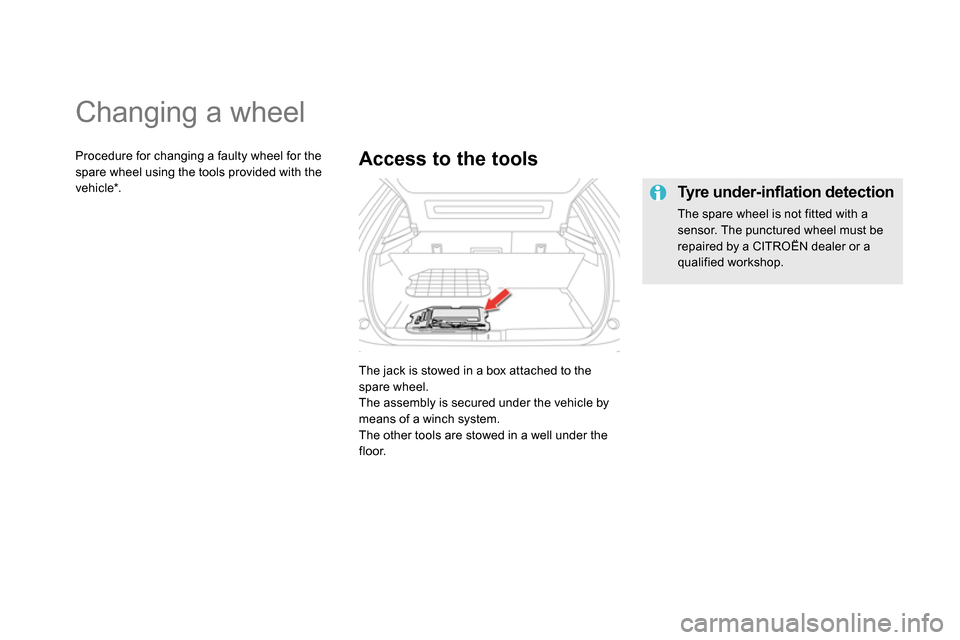
The jack is stowed in a box attached to the
spare wheel.
The assembly is secured under the vehicle by
means of a winch system .
The other tools are stowed in a well under the
floor.
Access to the tools
Ty r e u n d e r - i nfl ation detection
The spare wheel is not fitted with a
sensor. The punctured wheel must be
repaired by a CITROËN dealer or a
qualified workshop.
Procedure for changing a faulty wheel for the
spare wheel using the tools provided with the
vehicle * .
Page 205 of 400
203Practical information
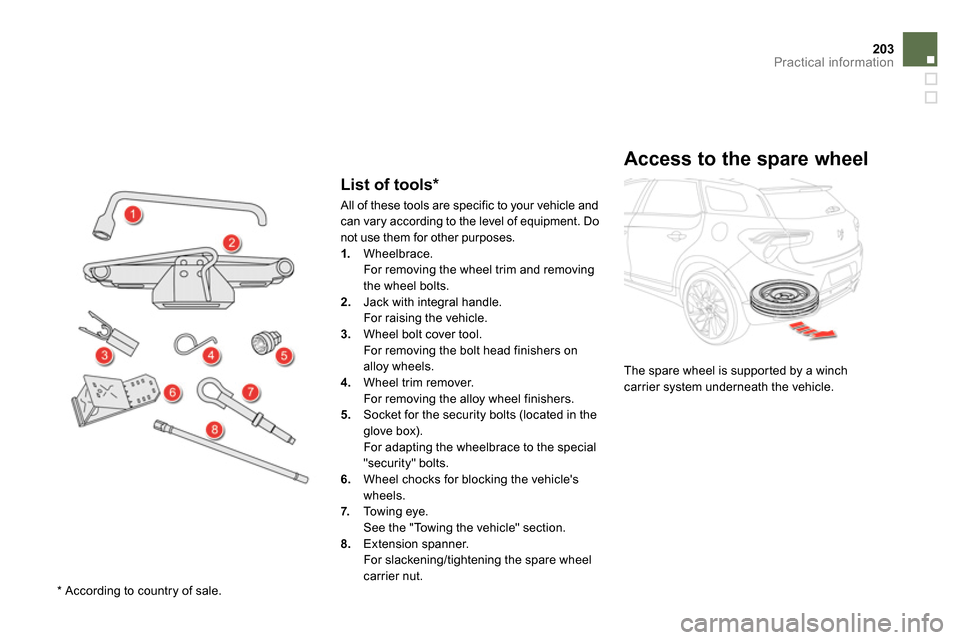
List of tools *
Access to the spare wheel
The spare wheel is supported by a winch
carrier system underneath the vehicle.
All of these tools are specific to your vehicle and
can vary according to the level of equipment. Do
not use them for other purposes.
1.
Wheelbrace.
For removing the wheel trim and removing
the wheel bolts.
2.
Jack with integral handle.
For raising the vehicle.
3.
Wheel bolt cover tool.
For removing the bolt head finishers on
alloy wheels.
4.
Wheel trim remover.
For removing the alloy wheel finishers.
5.
Socket for the security bolts (located in the
glove box).
For adapting the wheelbrace to the special
"security" bolts.
6.
Wheel chocks for blocking the vehicle's
wheels.
7.
To w i n g e y e .
See the "Towing the vehicle" section.
8.
Extension spanner.
For slackening/tightening the spare wheel
carrier nut.
*
According to country of sale.
Page 206 of 400
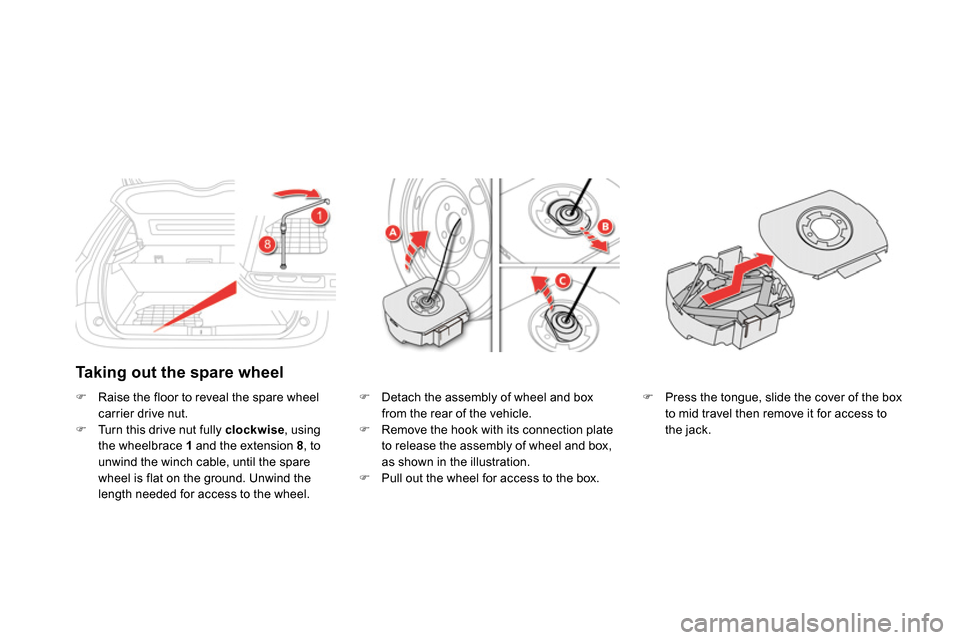
Press the tongue, slide the cover of the box
to mid travel then remove it for access to
the jack.
Taking out the spare wheel
Raise the floor to reveal the spare wheel
carrier drive nut.
Turn this drive nut fully clockwise
, using
the wheelbrace 1
and the extension 8
, to
unwind the winch cable, until the spare
wheel is flat on the ground. Unwind the
length needed for access to the wheel.
Detach the assembly of wheel and box
from the rear of the vehicle.
Remove the hook with its connection plate
to release the assembly of wheel and box,
as shown in the illustration.
Pull out the wheel for access to the box.
Page 207 of 400
205Practical information
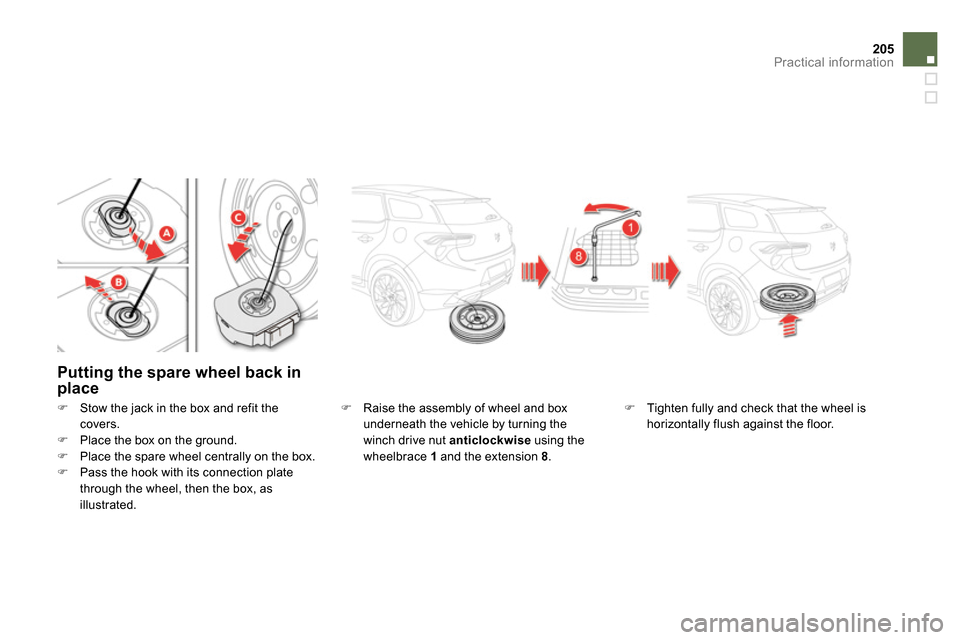
Putting the spare wheel back in
place
Stow the jack in the box and refit the
covers.
Place the box on the ground.
Place the spare wheel centrally on the box.
Pass the hook with its connection plate
through the wheel, then the box, as
illustrated.
Raise the assembly of wheel and box
underneath the vehicle by turning the
winch drive nut anticlockwise
using the
wheelbrace 1
and the extension 8
.
Tighten fully and check that the wheel is
horizontally flush against the floor.
Page 209 of 400

207Practical information
Place the jack 2
in contact with one of the
two front A
or rear B
locations provided on
the underbody, whichever is closest to the
wheel to be changed.
Raise the vehicle until there is sufficient
space between the wheel and the ground
to admit the spare (not punctured) wheel
easily.
Remove the bolts and store them in a clean
place.
Remove the wheel.
Extend the jack 2
until its base plate is in
contact with the ground. Ensure that the
centreline of the jack base plate is directly
below the location A
or B
used.
Page 210 of 400
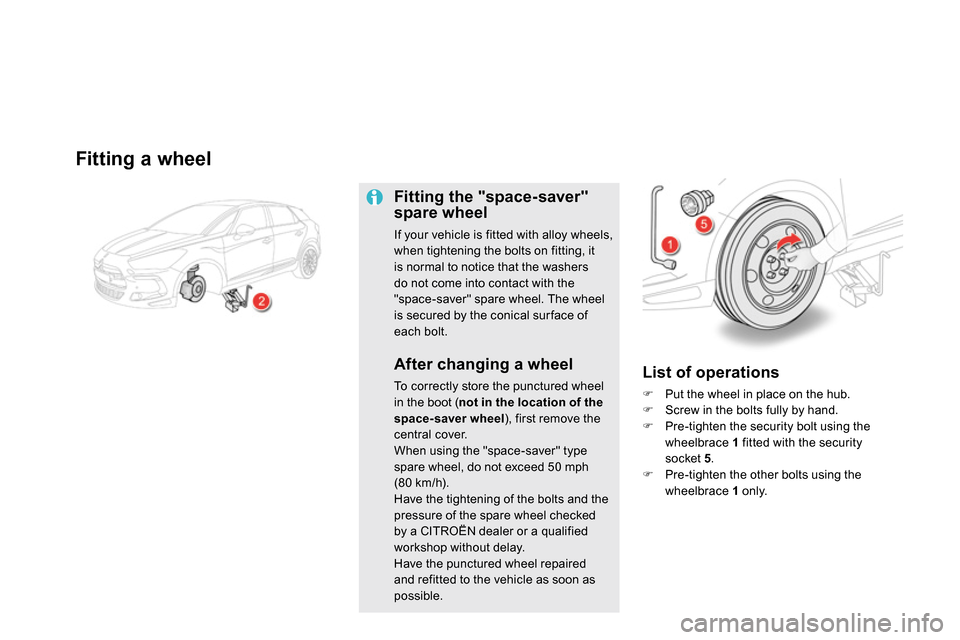
Fitting a wheel
Fitting the "space-saver"
spare wheel
If your vehicle is fitted with alloy wheels,
when tightening the bolts on fitting, it
is normal to notice that the washers
do not come into contact with the
"space-saver" spare wheel. The wheel
is secured by the conical sur face of
each bolt.
After changing a wheel
To correctly store the punctured wheel
in the boot ( not in the location of the
space-saver wheel
), first remove the
central cover.
When using the "space-saver" type
spare wheel, do not exceed 50 mph
(80 km/h).
Have the tightening of the bolts and the
pressure of the spare wheel checked
by a CITROËN dealer or a qualified
workshop without delay.
Have the punctured wheel repaired
and refitted to the vehicle as soon as
possible.
List of operations
Put the wheel in place on the hub.
Screw in the bolts fully by hand.
Pre-tighten the security bolt using the
wheelbrace 1
fitted with the security
socket 5
.
Pre-tighten the other bolts using the
wheelbrace 1
only.
Page 212 of 400
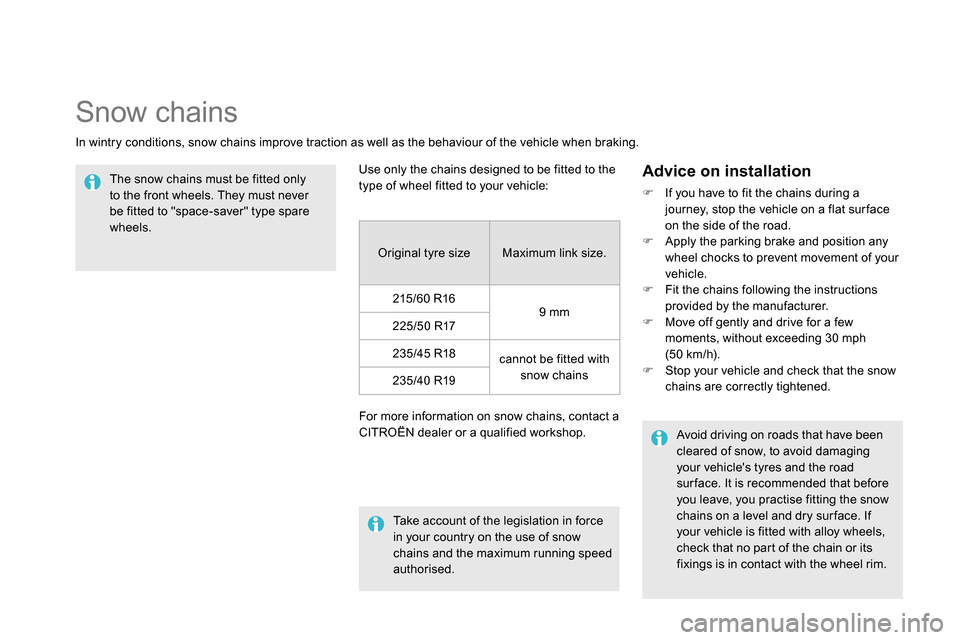
Snow chains
In wintry conditions, snow chains improve traction as well as the behaviour of the vehicle when braking.
The snow chains must be fitted only
to the front wheels. They must never
be fitted to "space-saver" type spare
wheels.
Take account of the legislation in force
in your country on the use of snow
chains and the maximum running speed
authorised.
Advice on installation
If you have to fit the chains during a
journey, stop the vehicle on a flat sur face
on the side of the road.
Apply the parking brake and position any
wheel chocks to prevent movement of your
vehicle.
Fit the chains following the instructions
provided by the manufacturer.
Move off gently and drive for a few
moments, without exceeding 30 mph
(50 km/h).
Stop your vehicle and check that the snow
chains are correctly tightened.
Avoid driving on roads that have been
cleared of snow, to avoid damaging
your vehicle's tyres and the road
sur face. It is recommended that before
you leave, you practise fitting the snow
chains on a level and dry sur face. If
your vehicle is fitted with alloy wheels,
check that no part of the chain or its
fixings is in contact with the wheel rim.
Use only the chains designed to be fitted to the
type of wheel fitted to your vehicle:
Original tyre size Maximum link size.
215/60 R16
9 mm
225/50 R17
235/45 R18
cannot be fitted with
snow chains
235/40 R19
For more information on snow chains, contact a
CITROËN dealer or a qualified workshop.