wheel CITROEN E-MEHARI 2022 User Guide
[x] Cancel search | Manufacturer: CITROEN, Model Year: 2022, Model line: E-MEHARI, Model: CITROEN E-MEHARI 2022Pages: 84, PDF Size: 3.48 MB
Page 50 of 84
48
Before installing a child seat, check that
t here is nothing that might inter fere with its
fixing to the two anchorage points.
You will not be able to correctly secure
a
child seat to the two anchorage points if
they are not clear of obstruction.
A child restraint system in a
vehicle parked
in the sun can become very hot.
Always check the sur face of the child seat
before placing the child in it, to avoid any
risk of injury.
The incorrect installation of a
child seat
compromises the protection and safety of
the child and the occupants of the vehicle
in the event of a
collision.Visual indicators
Direction indicators
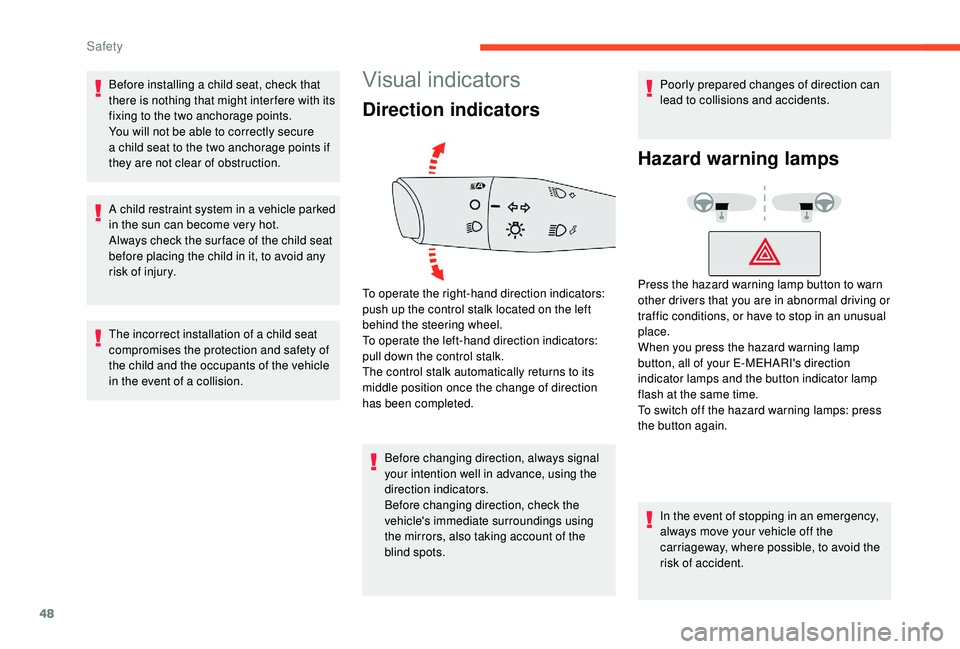
To operate the right-hand direction indicators:
push up the control stalk located on the left
behind the steering wheel.
To operate the left-hand direction indicators:
pull down the control stalk.
The control stalk automatically returns to its
middle position once the change of direction
has been completed.Before changing direction, always signal
your intention well in advance, using the
direction indicators.
Before changing direction, check the
vehicle's immediate surroundings using
the mirrors, also taking account of the
blind spots. Poorly prepared changes of direction can
lead to collisions and accidents.
Hazard warning lamps
Press the hazard warning lamp button to warn
other drivers that you are in abnormal driving or
traffic conditions, or have to stop in an unusual
place.
When you press the hazard warning lamp
button, all of your E-MEHARI's direction
indicator lamps and the button indicator lamp
flash at the same time.
To switch off the hazard warning lamps: press
the button again.
In the event of stopping in an emergency,
always move your vehicle off the
carriageway, where possible, to avoid the
risk of accident.
Safety
Page 51 of 84
49
Use the hazard warning lamps only to
signal unusual action on your part and
only if your vehicle presents a safety
risk to other drivers: an emergency stop
because of a
vehicle failure, the need to
drive abnormally slowly, etc...
While the hazard warning lamps are on,
your E-MEHARI's direction indicators can
no longer be used to indicate changes of
direction.
Horns and audible
warnings
" Standard " horn
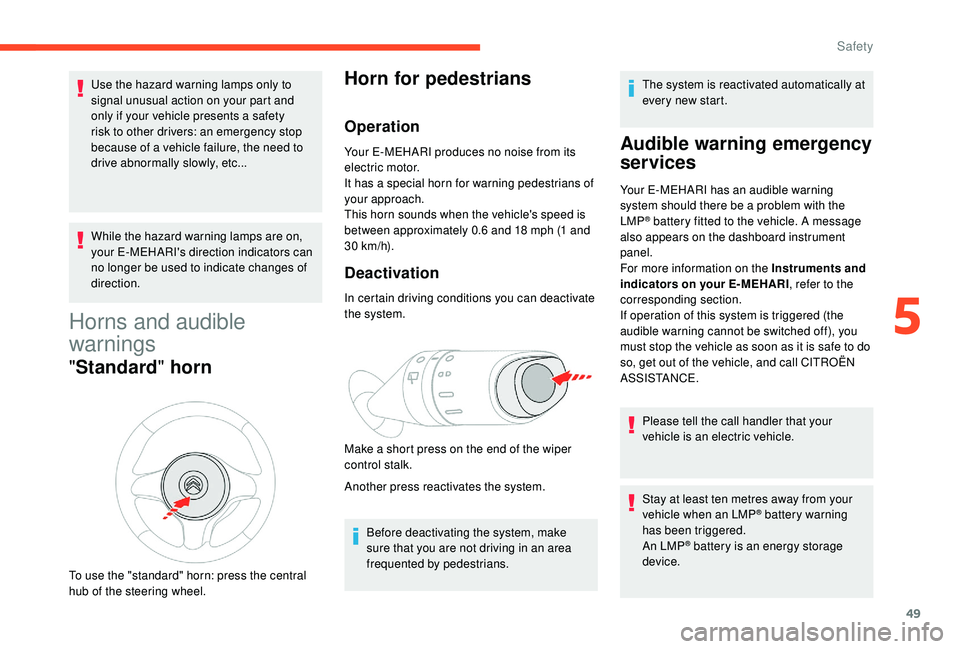
To use the "standard" horn: press the central
hub of the steering wheel.
Horn for pedestrians
Operation
Your E-MEHARI produces no noise from its
electric motor.
It has a
special horn for warning pedestrians of
your approach.
This horn sounds when the vehicle's speed is
between approximately 0.6
and 18 mph (1 and
30
km/h).
Deactivation
In certain driving conditions you can deactivate
the system.
Make a
short press on the end of the wiper
control stalk.
Another press reactivates the system.
Before deactivating the system, make
sure that you are not driving in an area
frequented by pedestrians. The system is reactivated automatically at
every new start.
Audible warning emergency
services
Your E-MEHARI has an audible warning
system should there be a
problem with the
LMP
® battery fitted to the vehicle. A message
also appears on the dashboard instrument
panel.
For more information on the Instruments and
indicators on your E-MEHARI , refer to the
corresponding section.
If operation of this system is triggered (the
audible warning cannot be switched off), you
must stop the vehicle as soon as it is safe to do
so, get out of the vehicle, and call CITROËN
ASSISTANCE.
Please tell the call handler that your
vehicle is an electric vehicle.
Stay at least ten metres away from your
vehicle when an LMP
® battery warning
has been triggered.
An LMP
® battery is an energy storage
device.
5
Safety
Page 52 of 84
50
Driving recommendations
Observe the driving regulations and remain
vigilant whatever the traffic conditions.
Pay close attention to the traffic and keep your
hands on the wheel so that you are ready to
react at any time to any eventuality.
As a safety measure, the driver must only carry
out any operations that require close attention
when the vehicle is stationary.
On a
long journey, a break every two hours is
strongly recommended.
In bad weather, drive smoothly, anticipate the
need to brake and increase the distance from
other vehicles.
Important!
Never drive with the parking brake applied
– Risk of overheating and damage to the
braking system!
Never leave a
vehicle unsuper vised with
the motor running. If you have to leave
your vehicle with the motor running,
apply the parking brake and put the drive
selector into position N or P .
Driving on flooded roads
We strongly advise against driving on flooded
roads, as this could cause serious damage
to the motor or gearbox, as well as to the
electrical systems of your vehicle.
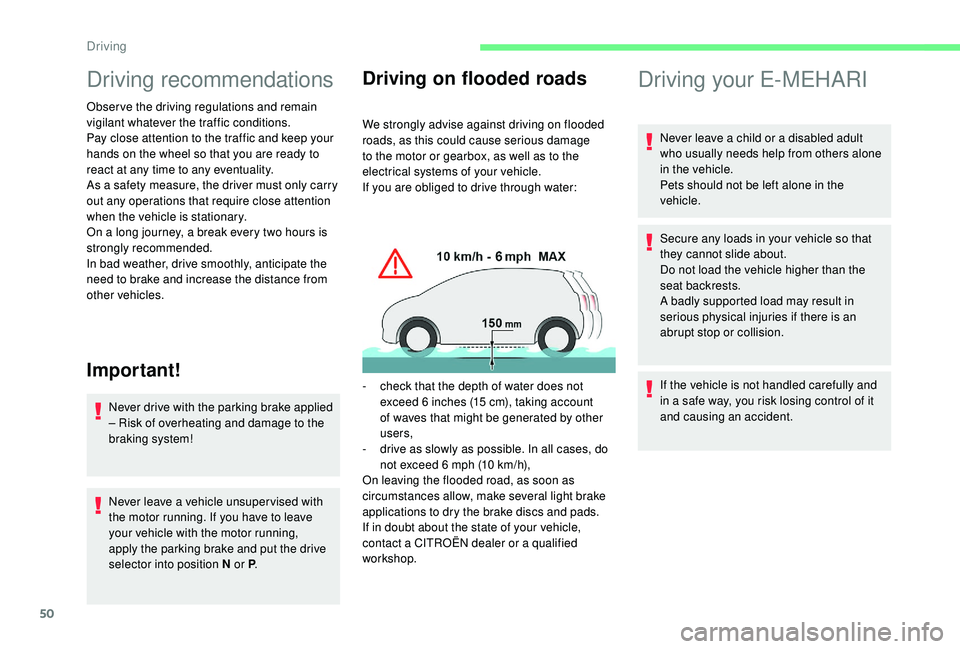
If you are obliged to drive through water:
-
c
heck that the depth of water does not
exceed 6
inches (15 cm), taking account
of waves that might be generated by other
users,
-
d
rive as slowly as possible. In all cases, do
not exceed 6
mph (10 km/h),
On leaving the flooded road, as soon as
circumstances allow, make several light brake
applications to dry the brake discs and pads.
If in doubt about the state of your vehicle,
contact a
CITROËN dealer or a qualified
workshop.
Driving your E-MEHARI
Never leave a child or a disabled adult
w ho usually needs help from others alone
in the vehicle.
Pets should not be left alone in the
vehicle.
Secure any loads in your vehicle so that
they cannot slide about.
Do not load the vehicle higher than the
seat backrests.
A badly supported load may result in
serious physical injuries if there is an
abrupt stop or collision.
If the vehicle is not handled carefully and
in a
safe way, you risk losing control of it
and causing an accident.
Driving
Page 53 of 84
51
The following actions may increase the
risk of losing control of the vehicle if
the tyres are not properly inflated:
-
s
udden harsh application of the
brakes,
-
r
eleasing the accelerator pedal
suddenly,
-
t
urning the steering wheel too quickly.
Note: The vehicle generally moves
towards or pulls in the direction of the
under-inflated tyre.
Never drive under the influence of alcohol
or drugs.
The presence of alcohol or drugs in your
bloodstream reduces coordination, slows
reaction and impairs judgement.
Driving after taking alcohol or drugs
increases the risk of being involved in
an accident causing injuries, suffered by
yourself or inflicted on others.
Note also that, in the event of an accident,
there is a
risk that the alcohol or drugs
will increase the severity of the injuries
suffered.
Never take medicines that might affect
your ability to drive and control the vehicle
before setting off. Never leave the starting switch in the
"MAR" position for a
long period when the
vehicle is not being used.
This can reduce the range of the vehicle.
When you stop your vehicle on a
rising
slope, do not hold the vehicle by pressing
the accelerator.
Always use the brake pedal for this.
Starting/Switching off the
vehicle
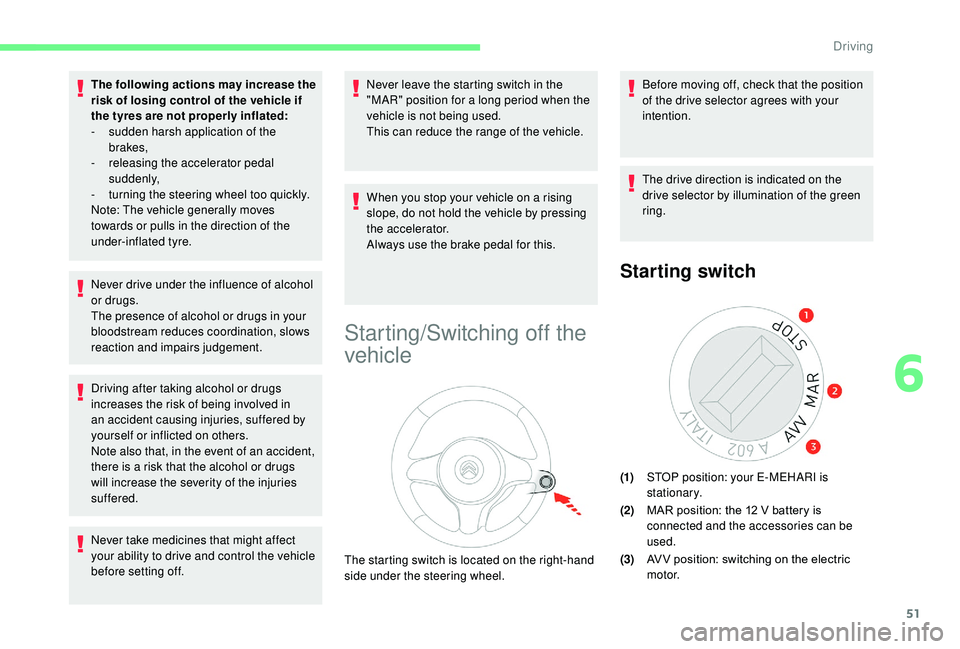
The starting switch is located on the right-hand
side under the steering wheel. Before moving off, check that the position
of the drive selector agrees with your
intention.
The drive direction is indicated on the
drive selector by illumination of the green
ring.
Starting switch
(1)
STOP position: your E-MEHARI is
stationary.
(2) MAR position: the 12
V battery is
connected and the accessories can be
used.
(3) AV V position: switching on the electric
motor.
6
Driving
Page 55 of 84
53
Manual parking brake
Always check that your manual parking
brake is applied before leaving the vehicle.
When parking on a slope, turn the front
wheels into the kerb, apply the parking
brake and switch off at the starting switch.
Check that the parking brake is released
before moving off.
Not releasing the parking brake could
result in its failure and cause an accident.
Never release the parking brake from
outside the vehicle. Never leave children unsuper vised inside
the vehicle.
They might release the parking brake and
cause an accident.
Only release the brake pedal once the
parking brake has been fully applied.
Failure to apply the parking brake could
allow the vehicle to move on its own and
cause an accident.
In very cold conditions, the manual
parking brake could freeze and be
impossible to release.
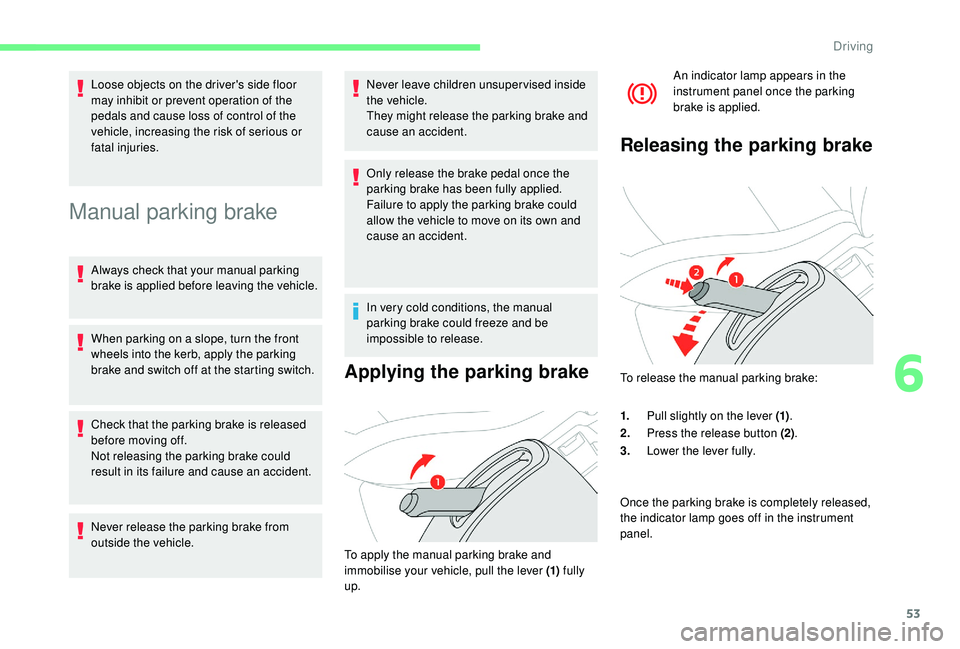
Applying the parking brake
To apply the manual parking brake and
immobilise your vehicle, pull the lever (1)
fully
up. An indicator lamp appears in the
instrument panel once the parking
brake is applied.
Releasing the parking brake
Loose objects on the driver's side floor
may inhibit or prevent operation of the
pedals and cause loss of control of the
vehicle, increasing the risk of serious or
fatal injuries.
To release the manual parking brake:
1.Pull slightly on the lever (1) .
2. Press the release button (2) .
3. Lower the lever fully.
Once the parking brake is completely released,
the indicator lamp goes off in the instrument
panel.
6
Driving
Page 57 of 84
55
Tyre under-inflation
detection
System which automatically checks the
pressures of the tyres while driving.
The system monitors the pressure in all four
tyres, once the vehicle is moving.
The system triggers an alert as soon as it
detects a drop in the pressure of one or more
tyres.
The tyre under-inflation detection system
does not replace the need for vigilance on
the part of the driver.
This system still requires you to check the
tyre inflation pressure (including the spare
wheel, where fitted) every month as well
as before a
long journey.
Driving with under-inflated tyres impairs
handling, extends braking distances and
causes premature tyre wear, particularly
in adverse conditions (heavy loads, high
speeds, long journeys).
Driving with under-inflated tyres
increases energy consumption. The tyre pressure specifications for your
vehicle can be found on the tyre pressure
label.
For more information on the
Identification markings
, refer to the
corresponding section.
Tyre pressures should be checked when
the tyres are "cold" (vehicle stopped for
1
hour or after a journey of less than
6
miles (10 km) at moderate speeds).
Other wise (when hot), add 0.3
bar to the
pressures shown on the label.
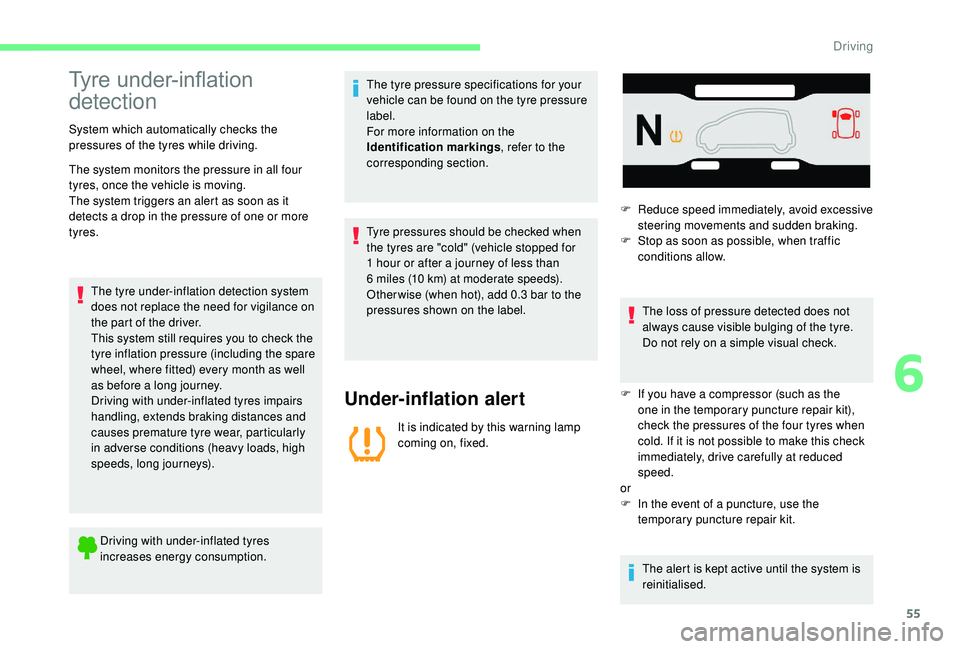
Under-inflation alert
It is indicated by this warning lamp
coming on, fixed. F
Reduce speed immediately, avoid excessive
steering movements and sudden braking.
F Stop as soon as possible, when traffic
conditions allow.
The loss of pressure detected does not
always cause visible bulging of the tyre.
Do not rely on a simple visual check.
F If you have a compressor (such as the
one in the temporary puncture repair kit),
check the pressures of the four tyres when
cold. If it is not possible to make this check
immediately, drive carefully at reduced
speed.
or
F In the event of a
puncture, use the
temporary puncture repair kit.
The alert is kept active until the system is
reinitialised.
6
Driving
Page 58 of 84
56
Reinitialisation
The system must be reinitialised after any
adjustment to the pressures of one or more
tyres, and after changing one or more wheels.Before reinitialising the system, ensure
that the pressures of the four tyres are
correct for the use of the vehicle and in
line with the recommendations on the tyre
pressure label.
The under-inflation detection system
does not give a
warning if a pressure is
incorrect at the time of reinitialisation.
The system must be reinitialised with the
ignition on and the vehicle stationary, via the
vehicle's configuration menu, in Advanced
settings.
The under-inflation alert can only be relied
on if the reinitialisation of the system has
been done with the pressures in the four
tyres correctly adjusted.
Driving
Page 66 of 84
64
Under the bonnet
The underbonnet of the vehicle is
a dangerous area that could cause
serious injuries.
Under the bonnet of your E-MEHARI there
are the vehicle's drive train and the reser voirs
containing the fluids needed for the correct
operation of your E-MEHARI (brake fluid,
coolant and screenwash fluid).
The drive train is directly powered by the
LMP
® battery fitted to your E-MEHARI.
Never try to do anything to the high
voltage components of your vehicle.
Incorrect handling of these components
could cause an electric shock and serious
or fatal injuries.
Always keep children well away from
the underbonnet and never leave them
unsupervised.
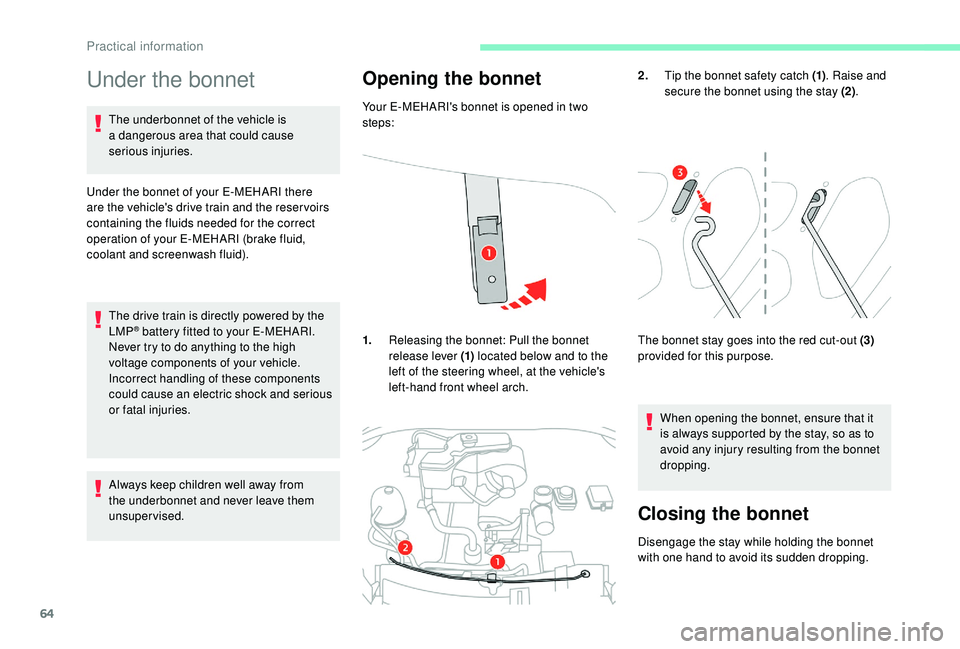
Opening the bonnet
Your E-MEHARI's bonnet is opened in two
steps:
1. Releasing the bonnet: Pull the bonnet
release lever (1) located below and to the
left of the steering wheel, at the vehicle's
left-hand front wheel arch. 2.
Tip the bonnet safety catch (1) . Raise and
secure the bonnet using the stay (2) .
The bonnet stay goes into the red cut-out (3)
provided for this purpose.
When opening the bonnet, ensure that it
is always supported by the stay, so as to
avoid any injury resulting from the bonnet
dropping.
Closing the bonnet
Disengage the stay while holding the bonnet
with one hand to avoid its sudden dropping.
Practical information
Page 76 of 84

74
Tyres/Tyre pressures
Tyres fitted to your E- MEHARISize 185/65
R15
Ty p e "Cross Climate" or
equivalent
Brand Michelin
Spare wheel None (temporary
puncture repair kit)
Tyre pressures Front 2.4
bar
/Rear 2.4
barCheck the tyre pressures regularly and
always obser ve the inflation pressures
indicated above.
Low tyre pressures can cause premature
wear of the tyres and introduce the risk of
the tyres bursting.
The tyre pressures must be regularly
checked with the tyres cold, and adjusted
if necessary.
Replace worn tyres only by tyres of the
same model as the original fitment, or
equivalent, and have them fitted by a
tyre
fitting specialist.
The responsibility for having the correct
tyre pressures lies with the driver.
Never exceed the speed rating or load
index of the tyres fitted to the vehicle.
It is for the driver to check the wear of the
tyres using the wear indicators in the tyre
tread.
Weights
Weights of your E-MEHARI
Gross vehicle weight
(maximum laden weight)1,8 3 8 kg
Kerb weight 1, 4 51
kg
Exceeding the weights specified above
risks damaging your E-MEHARI and could
cause an accident and serious injuries.
The authorised weights must never be
exceeded.
Technical data
Page 78 of 84

76
Brakes and suspension
Brakes and suspension on your E-MEHARI
Brakes Discs
Front /rear brake disc diameter 257
mm/250 mm
Front suspension MacPherson
Rear suspension Trailing arms with
stabilising bars
Braking assistance Electric braking
assistance
Braking system
Your E-MEHARI has two braking systems:
- A n energy recovery braking system
-
A h
ydraulic braking system
Energy recovery braking
system
The level of regeneration braking helping the
hydraulic braking depends on the state of
charge of the LMP
® battery.
If the state of charge of the LMP® battery is
100%, the energy recovery braking does not
operate.
Hydraulic braking system
The hydraulic braking system is similar to that
used on conventional vehicles.
When driving on slippery sur faces, take
care when braking and accelerating.
Sudden braking could cause the wheels
to lose grip and lead to an accident and
serious injuries.
Technical data