ESP CITROEN E-MEHARI 2023 User Guide
[x] Cancel search | Manufacturer: CITROEN, Model Year: 2023, Model line: E-MEHARI, Model: CITROEN E-MEHARI 2023Pages: 84, PDF Size: 3.48 MB
Page 38 of 84
36
Power cut-off in the event
of an impact
In the event of an impact or accident, an impact
detection system on your E-MEHARI cuts off
the vehicle's high voltage power supply.
Anti-theft protection/
Electronic immobiliser
Your E-MEHARI is fitted with an electronic
immobiliser.
This immobiliser is directly linked to your
personal RFID key ring.
Only your personal RFID key ring gives
authorisation to use your E-MEHARI.Check that your key is at the STOP
position of the starting switch or removed
from the starting switch before locking
your E-MEHARI.
Assistance call
Your E-MEHARI is equipped with an assistance
call control button.
This ser vice puts you in 24/7 contact with an
adviser trained to help you take the appropriate
action and who will have answers for situations
where you may encounter problems.
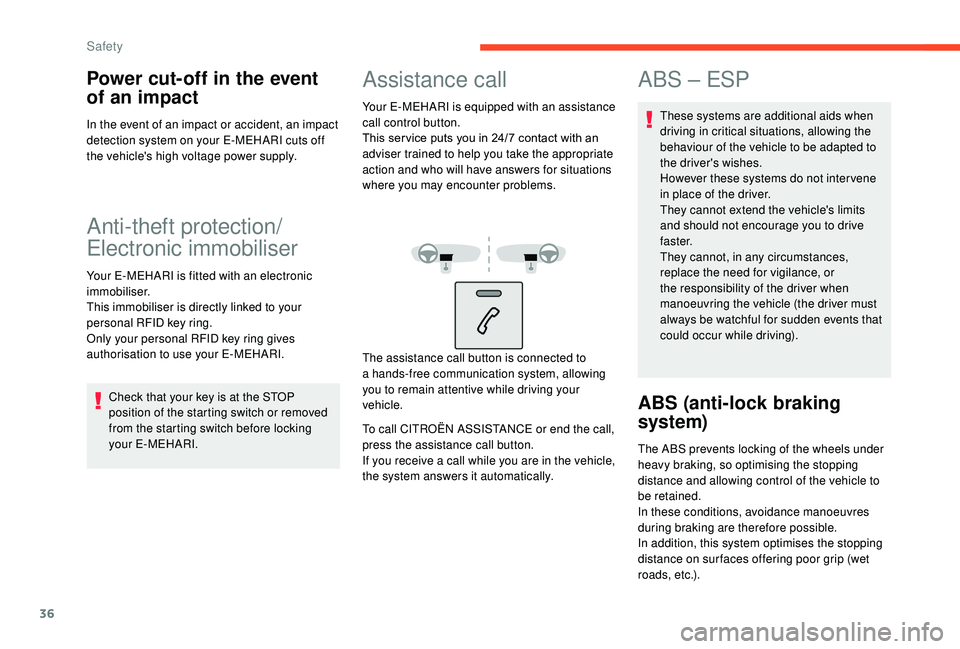
The assistance call button is connected to
a
hands-free communication system, allowing
you to remain attentive while driving your
vehicle.
To call CITROËN ASSISTANCE or end the call,
press the assistance call button.
If you receive a
call while you are in the vehicle,
the system answers it automatically.
ABS – ESP
These systems are additional aids when
driving in critical situations, allowing the
behaviour of the vehicle to be adapted to
the driver's wishes.
However these systems do not inter vene
in place of the driver.
They cannot extend the vehicle's limits
and should not encourage you to drive
f a s t e r.
They cannot, in any circumstances,
replace the need for vigilance, or
the responsibility of the driver when
manoeuvring the vehicle (the driver must
always be watchful for sudden events that
could occur while driving).
ABS (anti-lock braking
system)
The ABS prevents locking of the wheels under
heavy braking, so optimising the stopping
distance and allowing control of the vehicle to
be retained.
In these conditions, avoidance manoeuvres
during braking are therefore possible.
In addition, this system optimises the stopping
distance on sur faces offering poor grip (wet
roads, etc.).
Safety
Page 39 of 84
37
Operation of the system can be felt by vibration
in the brake pedal.
The ABS does not improve the "physical"
per formance possible, which depends on the
grip between the tyres and the road.
It follows that the normal safe driving practices
must be obser ved (distance between vehicles,
e t c .) .In an emergency, it is recommended that you
apply the brakes firmly and continuously.
It is not necessary to successively apply and
release the brakes (pumping the pedal).
The ABS will modulate the brake effort
applied.
ABS (warning lamp)
It comes on when the vehicle is switched on
and then goes off shortly after wards.
If it comes on when driving, it signals a fault in
the anti-lock braking system.
The braking system then operates as on
a
vehicle not fitted with ABS. Contact
a
CITROËN authorised repairer or a qualified
professional without delay.
ESP
This system helps retain control of the vehicle
in "critical" driving situations (avoiding an
obstacle, loss of grip in a
corner, etc.).
Principle of operation
A steering wheel sensor provides information
on the trajectory wanted by the driver.
Other sensors around the vehicle measure the
actual trajectory.
The system compares the driver's wishes with
the actual trajectory of the vehicle, correcting
the latter if necessary by acting on certain
brakes and/or the motor power.
ESP (warning lamp)
It comes on when the vehicle is switched on
and then goes off shortly after wards.
The ESP warning lamp flashes in regulation
mode, when it is called on to maintain grip.
If it comes on when driving, it signals a
fault
in the ESP system: contact a
CITROËN
authorised repairer or a
qualified professional
without delay.
Seat belts
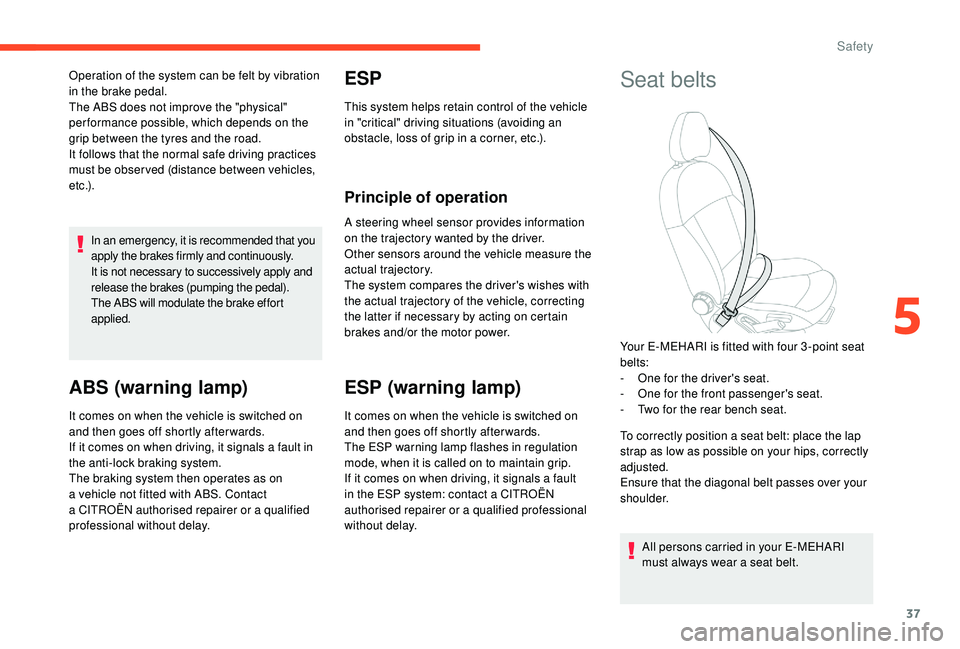
Your E-MEHARI is fitted with four 3 -point seat
belts:
-
O
ne for the driver's seat.
-
O
ne for the front passenger's seat.
-
T
wo for the rear bench seat.
To correctly position a
seat belt: place the lap
strap as low as possible on your hips, correctly
adjusted.
Ensure that the diagonal belt passes over your
shoulder.
All persons carried in your E-MEHARI
must always wear a
seat belt.
5
Safety
Page 40 of 84
38
Never leave children unsuper vised in the
vehicle playing with the seat belts.
Most current seat belts have an automatic
locking reel (ALR).
If a seat belt wrapped around a child's
neck were to retract or lock, the child
could be seriously injured or killed.
This can happen even with the vehicle
stationary.
If this scenario occurs, cut the safety belt
as quickly as possible in order to free the
child.
Before fastening the seat belts, check
that all of the backrests are vertical and
engaged in a
latched position.
Other wise, the occupants of the vehicle
could be seriously injured during an
accident or abrupt stop.
Never carry an infant or child on your lap
and never try to use your seat belt for both
of you.
Take care not to prevent the correct
operation of the seat belts. Never try to repair or modify the seat belts
yourself.
Any repair or modification to the seat belts
or their components must only be done by
a
CITROËN dealer.
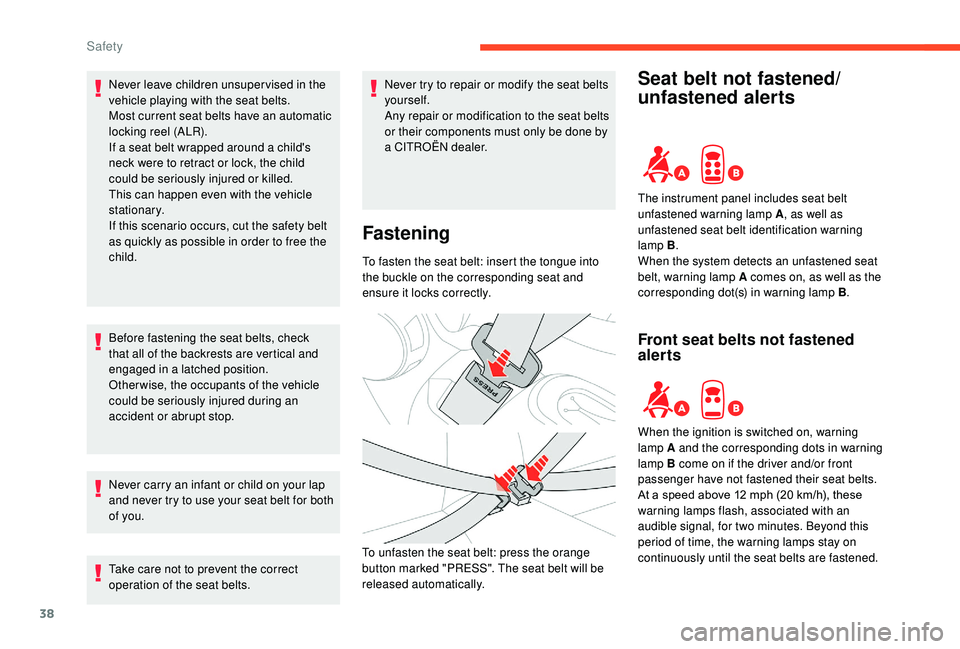
Fastening
To fasten the seat belt: insert the tongue into
the buckle on the corresponding seat and
ensure it locks correctly.
To unfasten the seat belt: press the orange
button marked "PRESS". The seat belt will be
released automatically.
Seat belt not fastened/
unfastened alerts
Front seat belts not fastened
alerts
The instrument panel includes seat belt
unfastened warning lamp A , as well as
unfastened seat belt identification warning
lamp B .
When the system detects an unfastened seat
belt, warning lamp A comes on, as well as the
corresponding dot(s) in warning lamp B .
When the ignition is switched on, warning
lamp A and the corresponding dots in warning
lamp B come on if the driver and/or front
passenger have not fastened their seat belts.
At a
speed above 12 mph (20 km/h), these
warning lamps flash, associated with an
audible signal, for two minutes. Beyond this
period of time, the warning lamps stay on
continuously until the seat belts are fastened.
Safety
Page 41 of 84
39
Rear seat belts not fastened
alerts
Seat belts unfastened alert
When the ignition is switched on, with the
motor running or the vehicle driving above
6 mph (10 km/h), warning lamp A and the
corresponding dots in warning lamp B come on
for around thirty seconds, if one or more rear
passengers have not fastened their seat belts.
After the ignition is switched on, warning
lamp A and the corresponding dots in warning
lamp B come on if the driver and/or one or
more passengers unfasten their seat belts.
These warning lamps flash for 30
seconds,
accompanied by an audible signal. Beyond
this period of time, the warning lamps stay on
continuously until the seat belts are fastened.
Airbags
General information
This system contributes towards improving the
safety of passengers (with the exception of the
rear centre passenger) in the event of violent
collisions. The airbags supplement the action
of the seat belts fitted with force limiters (with
the exception of the rear centre passenger).
If a
collision occurs, the electronic detectors
record and analyse the front and side impacts
sustained in the impact detection zones:
-
i
n the event of a serious impact, the airbags
are deployed instantly and contribute
towards better protection of the passengers
(with the exception of the rear centre
passenger); immediately after the impact,
the airbags deflate rapidly so that they
do not hinder visibility or the exit of the
passengers,
-
i
n the case of a minor or rear impact or in
certain roll-over conditions, the airbags
may not be deployed; the seat belt
alone contributes towards ensuring your
protection in these situations.
The airbags do not operate when the
ignition is switched off.
This equipment will only deploy once. If
a
second impact occurs (during the same
or a
subsequent accident), the airbag will
not be deployed again.
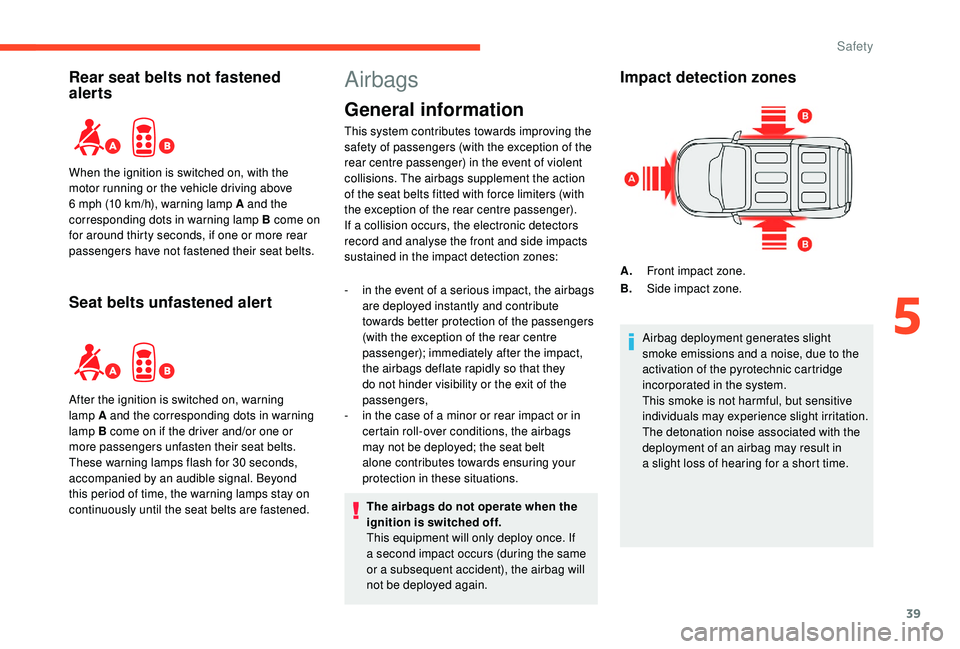
Impact detection zones
A. Front impact zone.
B. Side impact zone.
Airbag deployment generates slight
smoke emissions and a
noise, due to the
activation of the pyrotechnic cartridge
incorporated in the system.
This smoke is not harmful, but sensitive
individuals may experience slight irritation.
The detonation noise associated with the
deployment of an airbag may result in
a
slight loss of hearing for a short time.
5
Safety
Page 42 of 84
40
Front airbags
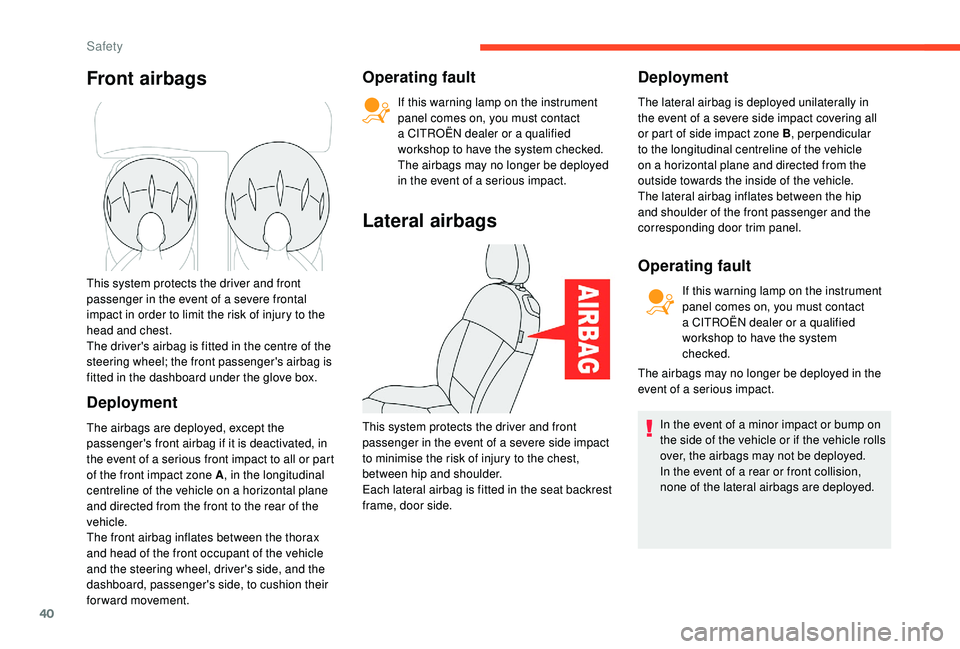
This system protects the driver and front
passenger in the event of a severe frontal
impact in order to limit the risk of injury to the
head and chest.
The driver's airbag is fitted in the centre of the
steering wheel; the front passenger's airbag is
fitted in the dashboard under the glove box.
Deployment
The airbags are deployed, except the
passenger's front airbag if it is deactivated, in
the event of a
serious front impact to all or part
of the front impact zone A , in the longitudinal
centreline of the vehicle on a
horizontal plane
and directed from the front to the rear of the
vehicle.
The front airbag inflates between the thorax
and head of the front occupant of the vehicle
and the steering wheel, driver's side, and the
dashboard, passenger's side, to cushion their
for ward movement.
Operating fault
If this warning lamp on the instrument
panel comes on, you must contact
a
CITROËN dealer or a qualified
workshop to have the system checked.
The airbags may no longer be deployed
in the event of a
serious impact.
Lateral airbags
This system protects the driver and front
passenger in the event of a severe side impact
to minimise the risk of injury to the chest,
between hip and shoulder.
Each lateral airbag is fitted in the seat backrest
frame, door side.
Deployment
The lateral airbag is deployed unilaterally in
the event of a severe side impact covering all
or part of side impact zone B , perpendicular
to the longitudinal centreline of the vehicle
on a
horizontal plane and directed from the
outside towards the inside of the vehicle.
The lateral airbag inflates between the hip
and shoulder of the front passenger and the
corresponding door trim panel.
Operating fault
If this warning lamp on the instrument
panel comes on, you must contact
a
CITROËN dealer or a qualified
workshop to have the system
checked.
The airbags may no longer be deployed in the
event of a
serious impact.
In the event of a
minor impact or bump on
the side of the vehicle or if the vehicle rolls
over, the airbags may not be deployed.
In the event of a
rear or front collision,
none of the lateral airbags are deployed.
Safety
Page 46 of 84
44
For more information on the Airbags,
refer to the corresponding section.
Deactivating the
passenger's front airbag
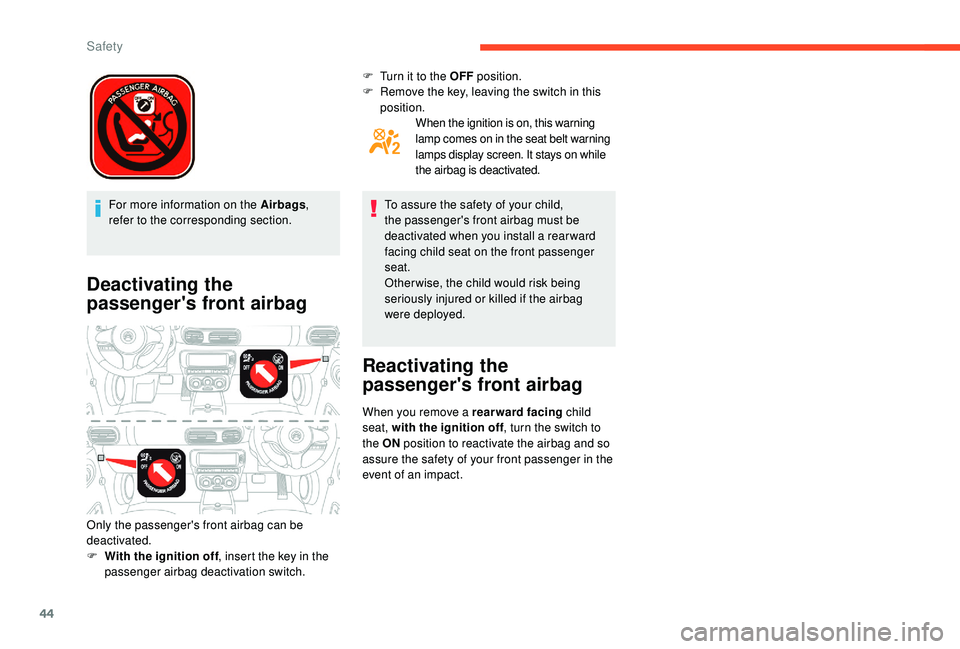
F Turn it to the OFF position.
F Remove the key, leaving the switch in this
position.
When the ignition is on, this warning
lamp comes on in the seat belt warning
lamps display screen. It stays on while
the airbag is deactivated.
To assure the safety of your child,
the passenger's front airbag must be
deactivated when you install a
rear ward
facing child seat on the front passenger
seat.
Otherwise, the child would risk being
seriously injured or killed if the airbag
were deployed.
Reactivating the
passenger's front airbag
When you remove a rearward facing c hild
seat, with the ignition off , turn the switch to
the ON position to reactivate the airbag and so
assure the safety of your front passenger in the
event of an impact.
Only the passenger's front airbag can be
deactivated.
F With the ignition off , insert the key in the
passenger airbag deactivation switch.
Safety
Page 47 of 84
45
AR
BG НИКОГА НЕ инсталирайте детско столче на седалка с АКТИВИРАНА предна ВЪЗДУШНА ВЪЗГЛАВНИЦА. Това може да причини
СМЪРТ или СЕРИОЗНО НАРАНЯВАНЕ на детето.
CS NIKDY neumisťujte dětské zádržné zařízení orientované směrem dozadu na sedadlo chráněné AKTIVOVANÝM čelním AIRBAGEM. Hrozí
nebezpečí SMRTI DÍTĚTE nebo VÁ ŽNÉHO ZR ANĚNÍ.
DA Brug ALDRIG en bagudvendt barnestol på et sæde, der er beskyttet af en AKTIV AIRBAG. BARNET risikerer at blive ALVORLIGT K VÆSTET
eller DR ÆBT.
DE Montieren Sie auf einem Sitz mit AKTIVIERTEM Front-Airbag NIEMALS einen Kindersitz oder eine Babyschale entgegen der Fahrtrichtung,
das Kind könnte schwere oder sogar tödliche Verletzungen erleiden.
EL Μη χρησιμοποιείτε ΠΟΤΕ παιδικό κάθισμα με την πλάτη του προς το εμπρός μέρος του αυτοκινήτου, σε μια θέση που προστατεύεται από
ΜΕΤΩΠΙΚΟ αερόσακο που είναι ΕΝΕΡΓΟΣ. Αυτό μπορεί να έχει σαν συνέπεια το ΘΑΝΑΤΟ ή το ΣΟΒΑΡΟ ΤΡΑΥΜΑΤΙΣΜΟ του ΠΑΙΔΙΟΥ
EN NEVER use a
rear ward facing child restraint on a seat protected by an ACTIVE AIRBAG in front of it, DEATH or SERIOUS INJURY to the
CHILD can occur
ES NO INSTALAR NUNCA un sistema de retención para niños de espaldas al sentido de la marcha en un asiento protegido mediante un AIRBAG
frontal ACTIVADO, ya que podría causar lesiones GR AVES o
incluso la MUERTE del niño.
ET Ärge MITTE KUNAGI paigaldage "seljaga sõidusuunas" lapseistet juhi kõr valistmele, mille ESITURVAPADI on AKTIVEERITUD. Tur vapadja
avanemine võib last TÕSISELT või ELUOHTLIKULT vigastada.
FI ÄLÄ KOSK A AN aseta lapsen tur vaistuinta selkä ajosuuntaan istuimelle, jonka edessä suojana on käyttöön aktivoitu TURVAT Y YNY. Sen
laukeaminen voi aiheuttaa LAPSEN KUOLEMAN tai VAK AVAN LOUKK A ANTUMISEN.
FR NE JAMAIS installer de système de retenue pour enfants faisant face vers l'arrière sur un siège protégé par un COUSSIN GONFLABLE frontal
ACTIVÉ. Cela peut provoquer la MORT de l'ENFANT ou le BLESSER GR AVEMENT.
HR NIK ADA ne postavljati dječju sjedalicu leđima u
smjeru vožnje na sjedalo zaštićeno UKLJUČENIM prednjim ZR AČNIM JASTUKOM. To bi
moglo uzrokovati SMRT ili TEŠKU OZLJEDU djeteta.
HU SOHA ne használjon menetiránynak háttal beszerelt gyermekülést AKTIVÁLT (BEK APCSOLT) FRONTLÉGZSÁKK AL védett ülésen. Ez
a
gyermek HALÁLÁT vagy SÚLYOS SÉRÜLÉSÉT okozhatja.
IT NON installare MAI seggiolini per bambini posizionati in senso contrario a
quello di marcia su un sedile protetto da un AIRBAG frontale
ATTIVATO. Ciò potrebbe provocare la MORTE o
FERITE GR AVI al bambino.
5
Safety
Page 51 of 84
49
Use the hazard warning lamps only to
signal unusual action on your part and
only if your vehicle presents a safety
risk to other drivers: an emergency stop
because of a
vehicle failure, the need to
drive abnormally slowly, etc...
While the hazard warning lamps are on,
your E-MEHARI's direction indicators can
no longer be used to indicate changes of
direction.
Horns and audible
warnings
" Standard " horn
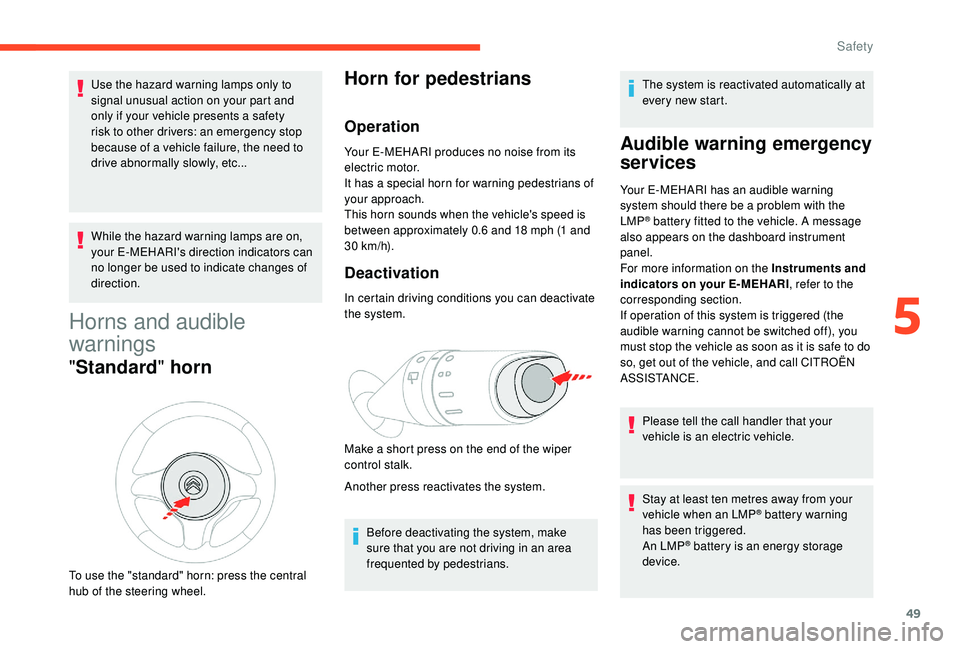
To use the "standard" horn: press the central
hub of the steering wheel.
Horn for pedestrians
Operation
Your E-MEHARI produces no noise from its
electric motor.
It has a
special horn for warning pedestrians of
your approach.
This horn sounds when the vehicle's speed is
between approximately 0.6
and 18 mph (1 and
30
km/h).
Deactivation
In certain driving conditions you can deactivate
the system.
Make a
short press on the end of the wiper
control stalk.
Another press reactivates the system.
Before deactivating the system, make
sure that you are not driving in an area
frequented by pedestrians. The system is reactivated automatically at
every new start.
Audible warning emergency
services
Your E-MEHARI has an audible warning
system should there be a
problem with the
LMP
® battery fitted to the vehicle. A message
also appears on the dashboard instrument
panel.
For more information on the Instruments and
indicators on your E-MEHARI , refer to the
corresponding section.
If operation of this system is triggered (the
audible warning cannot be switched off), you
must stop the vehicle as soon as it is safe to do
so, get out of the vehicle, and call CITROËN
ASSISTANCE.
Please tell the call handler that your
vehicle is an electric vehicle.
Stay at least ten metres away from your
vehicle when an LMP
® battery warning
has been triggered.
An LMP
® battery is an energy storage
device.
5
Safety
Page 54 of 84
52
Starting the vehicle
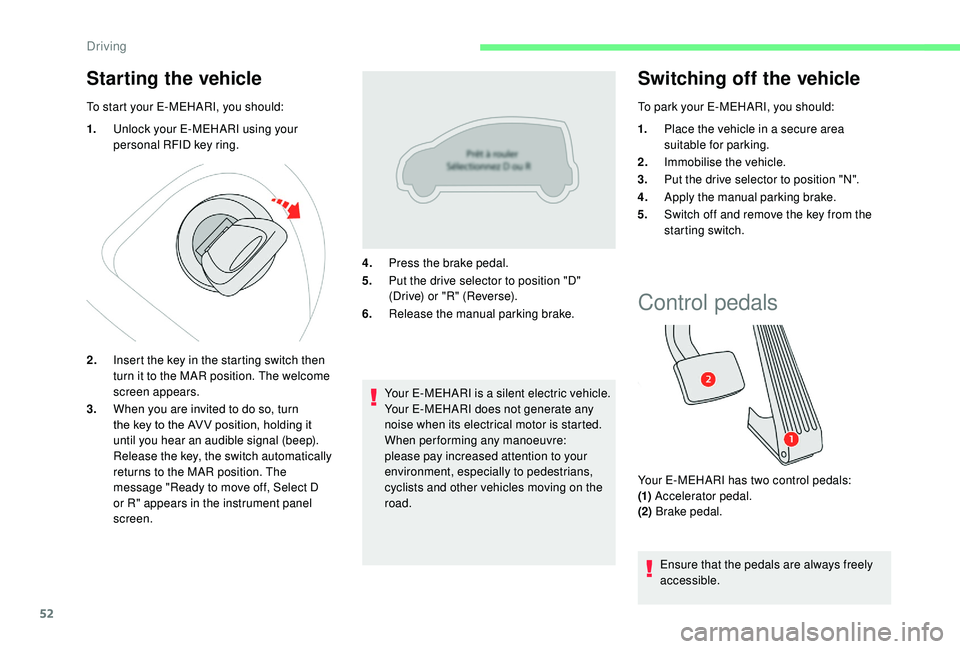
To start your E-MEHARI, you should:
1.Unlock your E-MEHARI using your
personal RFID key ring.
2. Insert the key in the starting switch then
turn it to the MAR position. The welcome
screen appears.
3. When you are invited to do so, turn
the key to the AV V position, holding it
until you hear an audible signal (beep).
Release the key, the switch automatically
returns to the MAR position. The
message "Ready to move off, Select D
or R" appears in the instrument panel
screen. 4.
Press the brake pedal.
5. Put the drive selector to position "D"
(Drive) or "R" (Reverse).
6. Release the manual parking brake.
Your E-MEHARI is a silent electric vehicle.
Your E-MEHARI does not generate any
noise when its electrical motor is started.
When performing any manoeuvre:
please pay increased attention to your
environment, especially to pedestrians,
cyclists and other vehicles moving on the
road.
Switching off the vehicle
To park your E-MEHARI, you should:
1. Place the vehicle in a
secure area
suitable for parking.
2. Immobilise the vehicle.
3. Put the drive selector to position "N".
4. Apply the manual parking brake.
5. Switch off and remove the key from the
starting switch.
Control pedals
Your E-MEHARI has two control pedals:
(1) Accelerator pedal.
(2) Brake pedal.
Ensure that the pedals are always freely
accessible.
Driving
Page 57 of 84
55
Tyre under-inflation
detection
System which automatically checks the
pressures of the tyres while driving.
The system monitors the pressure in all four
tyres, once the vehicle is moving.
The system triggers an alert as soon as it
detects a drop in the pressure of one or more
tyres.
The tyre under-inflation detection system
does not replace the need for vigilance on
the part of the driver.
This system still requires you to check the
tyre inflation pressure (including the spare
wheel, where fitted) every month as well
as before a
long journey.
Driving with under-inflated tyres impairs
handling, extends braking distances and
causes premature tyre wear, particularly
in adverse conditions (heavy loads, high
speeds, long journeys).
Driving with under-inflated tyres
increases energy consumption. The tyre pressure specifications for your
vehicle can be found on the tyre pressure
label.
For more information on the
Identification markings
, refer to the
corresponding section.
Tyre pressures should be checked when
the tyres are "cold" (vehicle stopped for
1
hour or after a journey of less than
6
miles (10 km) at moderate speeds).
Other wise (when hot), add 0.3
bar to the
pressures shown on the label.
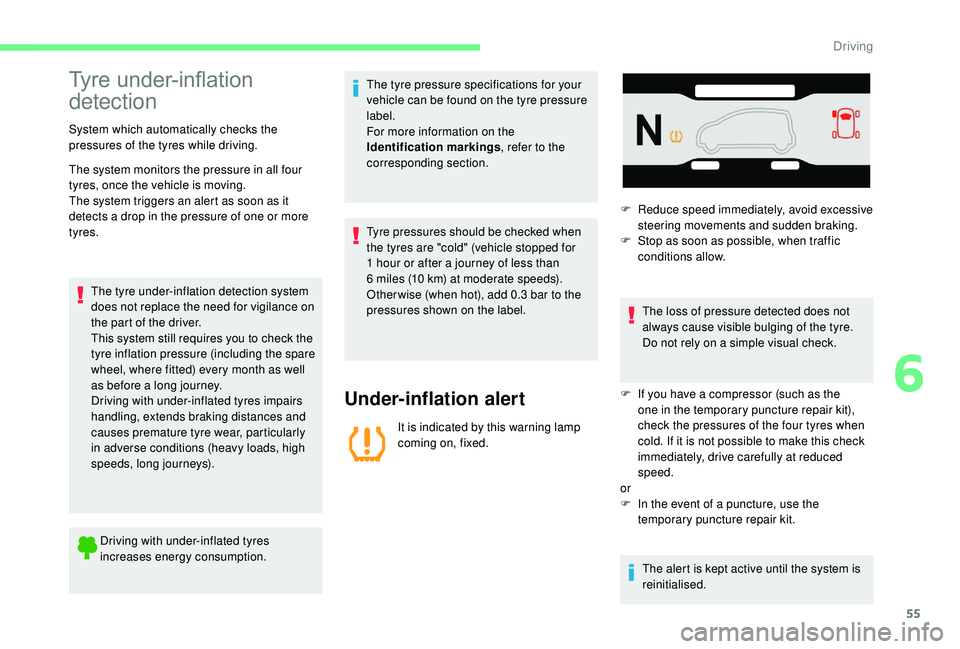
Under-inflation alert
It is indicated by this warning lamp
coming on, fixed. F
Reduce speed immediately, avoid excessive
steering movements and sudden braking.
F Stop as soon as possible, when traffic
conditions allow.
The loss of pressure detected does not
always cause visible bulging of the tyre.
Do not rely on a simple visual check.
F If you have a compressor (such as the
one in the temporary puncture repair kit),
check the pressures of the four tyres when
cold. If it is not possible to make this check
immediately, drive carefully at reduced
speed.
or
F In the event of a
puncture, use the
temporary puncture repair kit.
The alert is kept active until the system is
reinitialised.
6
Driving