warning CITROEN E-MEHARI 2023 User Guide
[x] Cancel search | Manufacturer: CITROEN, Model Year: 2023, Model line: E-MEHARI, Model: CITROEN E-MEHARI 2023Pages: 84, PDF Size: 3.48 MB
Page 41 of 84
39
Rear seat belts not fastened
alerts
Seat belts unfastened alert
When the ignition is switched on, with the
motor running or the vehicle driving above
6 mph (10 km/h), warning lamp A and the
corresponding dots in warning lamp B come on
for around thirty seconds, if one or more rear
passengers have not fastened their seat belts.
After the ignition is switched on, warning
lamp A and the corresponding dots in warning
lamp B come on if the driver and/or one or
more passengers unfasten their seat belts.
These warning lamps flash for 30
seconds,
accompanied by an audible signal. Beyond
this period of time, the warning lamps stay on
continuously until the seat belts are fastened.
Airbags
General information
This system contributes towards improving the
safety of passengers (with the exception of the
rear centre passenger) in the event of violent
collisions. The airbags supplement the action
of the seat belts fitted with force limiters (with
the exception of the rear centre passenger).
If a
collision occurs, the electronic detectors
record and analyse the front and side impacts
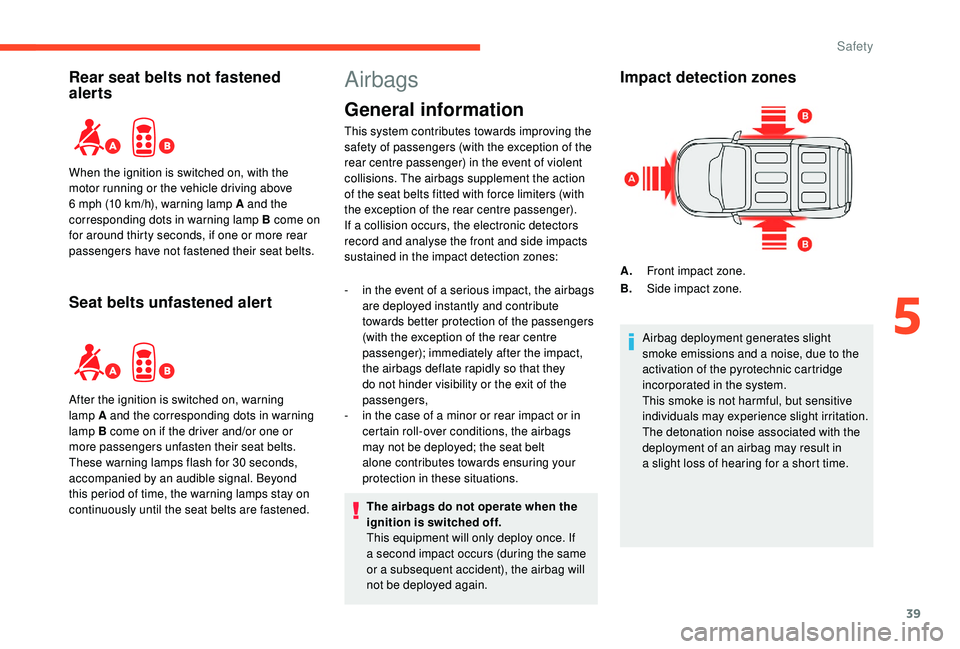
sustained in the impact detection zones:
-
i
n the event of a serious impact, the airbags
are deployed instantly and contribute
towards better protection of the passengers
(with the exception of the rear centre
passenger); immediately after the impact,
the airbags deflate rapidly so that they
do not hinder visibility or the exit of the
passengers,
-
i
n the case of a minor or rear impact or in
certain roll-over conditions, the airbags
may not be deployed; the seat belt
alone contributes towards ensuring your
protection in these situations.
The airbags do not operate when the
ignition is switched off.
This equipment will only deploy once. If
a
second impact occurs (during the same
or a
subsequent accident), the airbag will
not be deployed again.
Impact detection zones
A. Front impact zone.
B. Side impact zone.
Airbag deployment generates slight
smoke emissions and a
noise, due to the
activation of the pyrotechnic cartridge
incorporated in the system.
This smoke is not harmful, but sensitive
individuals may experience slight irritation.
The detonation noise associated with the
deployment of an airbag may result in
a
slight loss of hearing for a short time.
5
Safety
Page 42 of 84
40
Front airbags
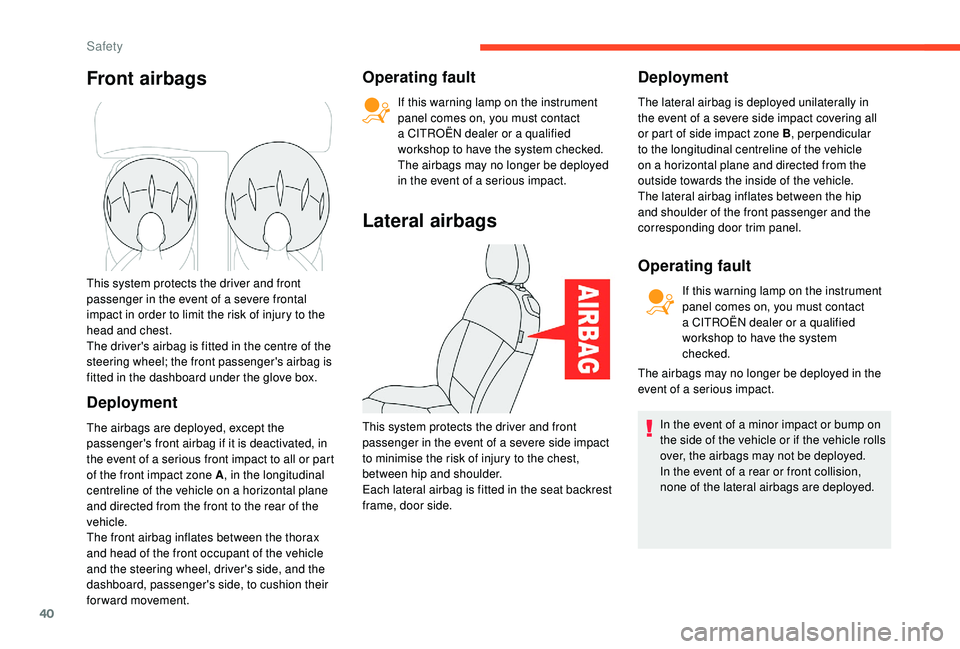
This system protects the driver and front
passenger in the event of a severe frontal
impact in order to limit the risk of injury to the
head and chest.
The driver's airbag is fitted in the centre of the
steering wheel; the front passenger's airbag is
fitted in the dashboard under the glove box.
Deployment
The airbags are deployed, except the
passenger's front airbag if it is deactivated, in
the event of a
serious front impact to all or part
of the front impact zone A , in the longitudinal
centreline of the vehicle on a
horizontal plane
and directed from the front to the rear of the
vehicle.
The front airbag inflates between the thorax
and head of the front occupant of the vehicle
and the steering wheel, driver's side, and the
dashboard, passenger's side, to cushion their
for ward movement.
Operating fault
If this warning lamp on the instrument
panel comes on, you must contact
a
CITROËN dealer or a qualified
workshop to have the system checked.
The airbags may no longer be deployed
in the event of a
serious impact.
Lateral airbags
This system protects the driver and front
passenger in the event of a severe side impact
to minimise the risk of injury to the chest,
between hip and shoulder.
Each lateral airbag is fitted in the seat backrest
frame, door side.
Deployment
The lateral airbag is deployed unilaterally in
the event of a severe side impact covering all
or part of side impact zone B , perpendicular
to the longitudinal centreline of the vehicle
on a
horizontal plane and directed from the
outside towards the inside of the vehicle.
The lateral airbag inflates between the hip
and shoulder of the front passenger and the
corresponding door trim panel.
Operating fault
If this warning lamp on the instrument
panel comes on, you must contact
a
CITROËN dealer or a qualified
workshop to have the system
checked.
The airbags may no longer be deployed in the
event of a
serious impact.
In the event of a
minor impact or bump on
the side of the vehicle or if the vehicle rolls
over, the airbags may not be deployed.
In the event of a
rear or front collision,
none of the lateral airbags are deployed.
Safety
Page 46 of 84
44
For more information on the Airbags,
refer to the corresponding section.
Deactivating the
passenger's front airbag
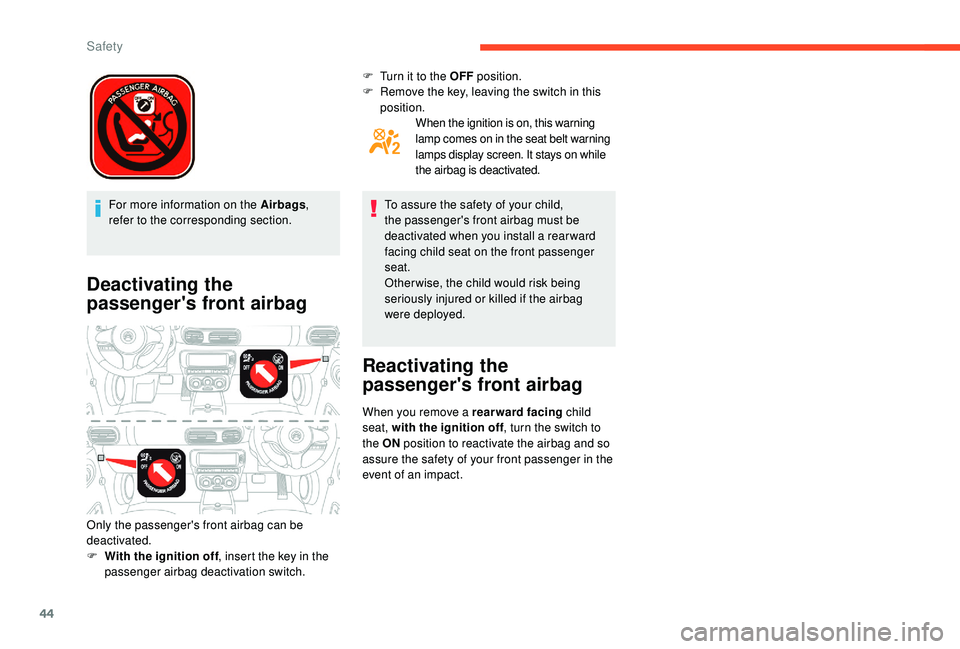
F Turn it to the OFF position.
F Remove the key, leaving the switch in this
position.
When the ignition is on, this warning
lamp comes on in the seat belt warning
lamps display screen. It stays on while
the airbag is deactivated.
To assure the safety of your child,
the passenger's front airbag must be
deactivated when you install a
rear ward
facing child seat on the front passenger
seat.
Otherwise, the child would risk being
seriously injured or killed if the airbag
were deployed.
Reactivating the
passenger's front airbag
When you remove a rearward facing c hild
seat, with the ignition off , turn the switch to
the ON position to reactivate the airbag and so
assure the safety of your front passenger in the
event of an impact.
Only the passenger's front airbag can be
deactivated.
F With the ignition off , insert the key in the
passenger airbag deactivation switch.
Safety
Page 49 of 84
47
ISOFIX mountings (child
seats)
(The legislation on carrying children is specific
to each country. Refer to the legislation in force
in your country.)
ISOFIX is an ISO standard for child seat
mountings (ISO standard 13216 -1: 1999).
This system avoids the use of the vehicle's seat
belts for securing the child seat: two latches
on the child seat engage on two anchorage
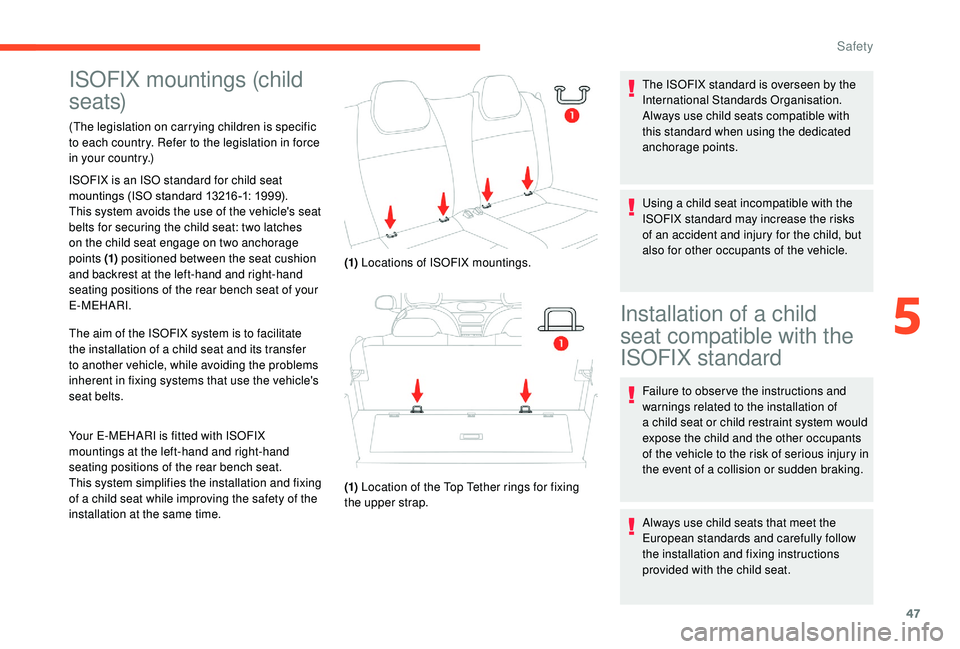
points (1) positioned between the seat cushion
and backrest at the left-hand and right-hand
seating positions of the rear bench seat of your
E-MEHARI.
The aim of the ISOFIX system is to facilitate
the installation of a
child seat and its transfer
to another vehicle, while avoiding the problems
inherent in fixing systems that use the vehicle's
seat belts.
Your E-MEHARI is fitted with ISOFIX
mountings at the left-hand and right-hand
seating positions of the rear bench seat.
This system simplifies the installation and fixing
of a
child seat while improving the safety of the
installation at the same time. (1)
Locations of ISOFIX mountings.
(1) Location of the Top Tether rings for fixing
the upper strap. The ISOFIX standard is overseen by the
International Standards Organisation.
Always use child seats compatible with
this standard when using the dedicated
anchorage points.
Using a
child seat incompatible with the
ISOFIX standard may increase the risks
of an accident and injury for the child, but
also for other occupants of the vehicle.
Installation of a child
s eat compatible with the
ISOFIX standard
Failure to obser ve the instructions and
warnings related to the installation of
a
child seat or child restraint system would
expose the child and the other occupants
of the vehicle to the risk of serious injury in
the event of a
collision or sudden braking.
Always use child seats that meet the
European standards and carefully follow
the installation and fixing instructions
provided with the child seat.
5
Safety
Page 50 of 84
48
Before installing a child seat, check that
t here is nothing that might inter fere with its
fixing to the two anchorage points.
You will not be able to correctly secure
a
child seat to the two anchorage points if
they are not clear of obstruction.
A child restraint system in a
vehicle parked
in the sun can become very hot.
Always check the sur face of the child seat
before placing the child in it, to avoid any
risk of injury.
The incorrect installation of a
child seat
compromises the protection and safety of
the child and the occupants of the vehicle
in the event of a
collision.Visual indicators
Direction indicators
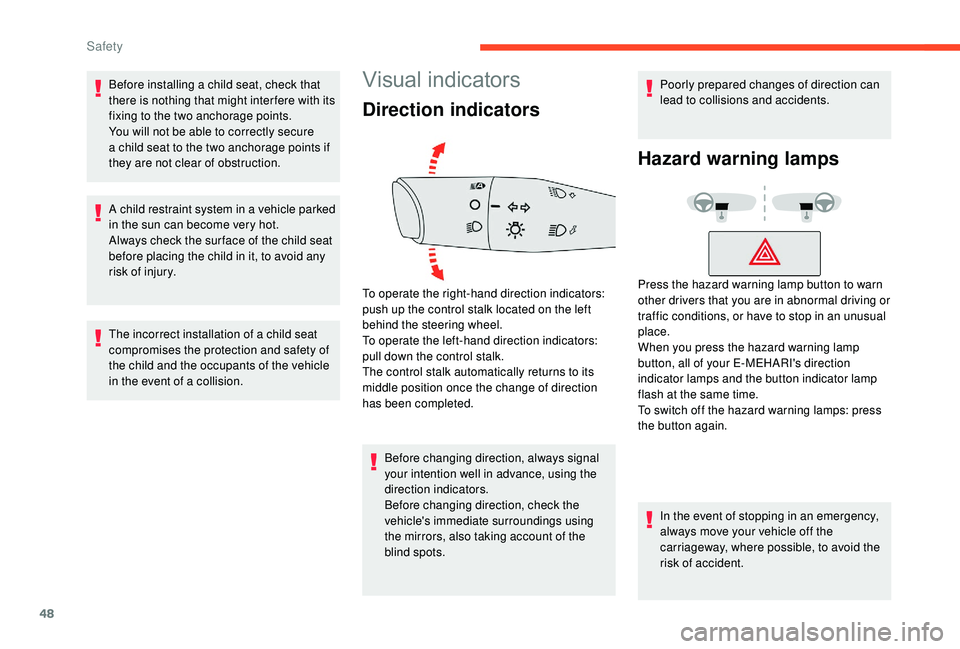
To operate the right-hand direction indicators:
push up the control stalk located on the left
behind the steering wheel.
To operate the left-hand direction indicators:
pull down the control stalk.
The control stalk automatically returns to its
middle position once the change of direction
has been completed.Before changing direction, always signal
your intention well in advance, using the
direction indicators.
Before changing direction, check the
vehicle's immediate surroundings using
the mirrors, also taking account of the
blind spots. Poorly prepared changes of direction can
lead to collisions and accidents.
Hazard warning lamps
Press the hazard warning lamp button to warn
other drivers that you are in abnormal driving or
traffic conditions, or have to stop in an unusual
place.
When you press the hazard warning lamp
button, all of your E-MEHARI's direction
indicator lamps and the button indicator lamp
flash at the same time.
To switch off the hazard warning lamps: press
the button again.
In the event of stopping in an emergency,
always move your vehicle off the
carriageway, where possible, to avoid the
risk of accident.
Safety
Page 51 of 84
49
Use the hazard warning lamps only to
signal unusual action on your part and
only if your vehicle presents a safety
risk to other drivers: an emergency stop
because of a
vehicle failure, the need to
drive abnormally slowly, etc...
While the hazard warning lamps are on,
your E-MEHARI's direction indicators can
no longer be used to indicate changes of
direction.
Horns and audible
warnings
" Standard " horn
To use the "standard" horn: press the central
hub of the steering wheel.
Horn for pedestrians
Operation
Your E-MEHARI produces no noise from its
electric motor.
It has a
special horn for warning pedestrians of
your approach.
This horn sounds when the vehicle's speed is
between approximately 0.6
and 18 mph (1 and
30
km/h).
Deactivation
In certain driving conditions you can deactivate
the system.
Make a
short press on the end of the wiper
control stalk.
Another press reactivates the system.
Before deactivating the system, make
sure that you are not driving in an area
frequented by pedestrians. The system is reactivated automatically at
every new start.
Audible warning emergency
services
Your E-MEHARI has an audible warning
system should there be a
problem with the
LMP
® battery fitted to the vehicle. A message
also appears on the dashboard instrument
panel.
For more information on the Instruments and
indicators on your E-MEHARI , refer to the
corresponding section.
If operation of this system is triggered (the
audible warning cannot be switched off), you
must stop the vehicle as soon as it is safe to do
so, get out of the vehicle, and call CITROËN
ASSISTANCE.
Please tell the call handler that your
vehicle is an electric vehicle.
Stay at least ten metres away from your
vehicle when an LMP
® battery warning
has been triggered.
An LMP
® battery is an energy storage
device.
5
Safety
Page 56 of 84
54
Drive selector
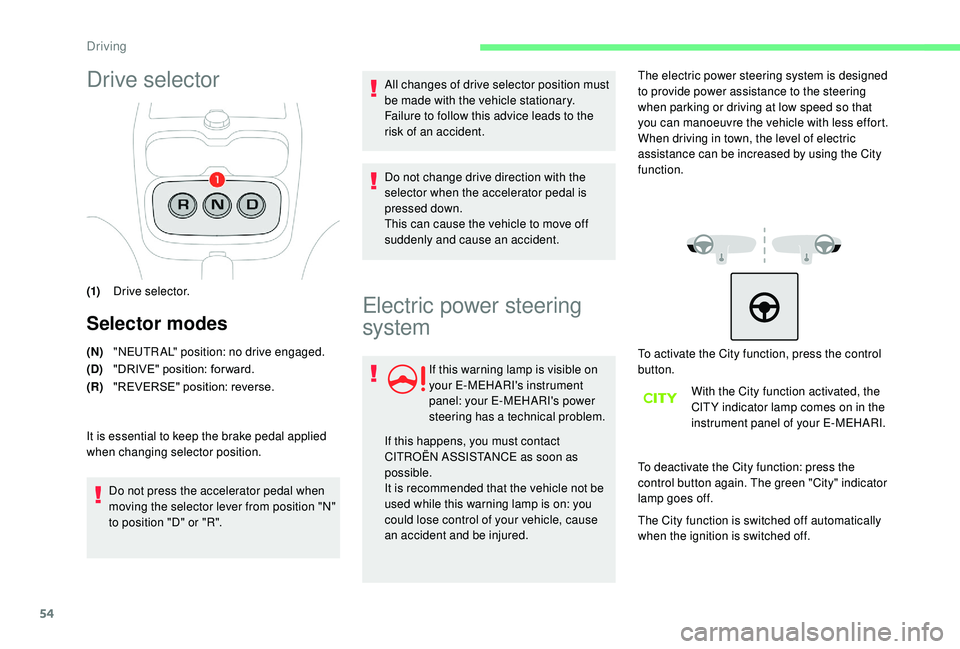
(1)Drive selector.
Selector modes
(N)"NEUTRAL" position: no drive engaged.
(D) "DRIVE" position: for ward.
(R) "REVERSE" position: reverse.
It is essential to keep the brake pedal applied
when changing selector position. Do not press the accelerator pedal when
moving the selector lever from position "N"
to position "D" or "R". All changes of drive selector position must
be made with the vehicle stationary.
Failure to follow this advice leads to the
risk of an accident.
Do not change drive direction with the
selector when the accelerator pedal is
pressed down.
This can cause the vehicle to move off
suddenly and cause an accident.
Electric power steering
system
If this warning lamp is visible on
your E-MEHARI's instrument
panel: your E-MEHARI's power
steering has a
technical problem.
If this happens, you must contact
CITROËN ASSISTANCE as soon as
possible.
It is recommended that the vehicle not be
used while this warning lamp is on: you
could lose control of your vehicle, cause
an accident and be injured. The electric power steering system is designed
to provide power assistance to the steering
when parking or driving at low speed so that
you can manoeuvre the vehicle with less effort.
When driving in town, the level of electric
assistance can be increased by using the City
function.
To activate the City function, press the control
button.
With the City function activated, the
CIT Y indicator lamp comes on in the
instrument panel of your E-MEHARI.
To deactivate the City function: press the
control button again. The green "City" indicator
lamp goes off.
The City function is switched off automatically
when the ignition is switched off.
Driving
Page 57 of 84
55
Tyre under-inflation
detection
System which automatically checks the
pressures of the tyres while driving.
The system monitors the pressure in all four
tyres, once the vehicle is moving.
The system triggers an alert as soon as it
detects a drop in the pressure of one or more
tyres.
The tyre under-inflation detection system
does not replace the need for vigilance on
the part of the driver.
This system still requires you to check the
tyre inflation pressure (including the spare
wheel, where fitted) every month as well
as before a
long journey.
Driving with under-inflated tyres impairs
handling, extends braking distances and
causes premature tyre wear, particularly
in adverse conditions (heavy loads, high
speeds, long journeys).
Driving with under-inflated tyres
increases energy consumption. The tyre pressure specifications for your
vehicle can be found on the tyre pressure
label.
For more information on the
Identification markings
, refer to the
corresponding section.
Tyre pressures should be checked when
the tyres are "cold" (vehicle stopped for
1
hour or after a journey of less than
6
miles (10 km) at moderate speeds).
Other wise (when hot), add 0.3
bar to the
pressures shown on the label.
Under-inflation alert
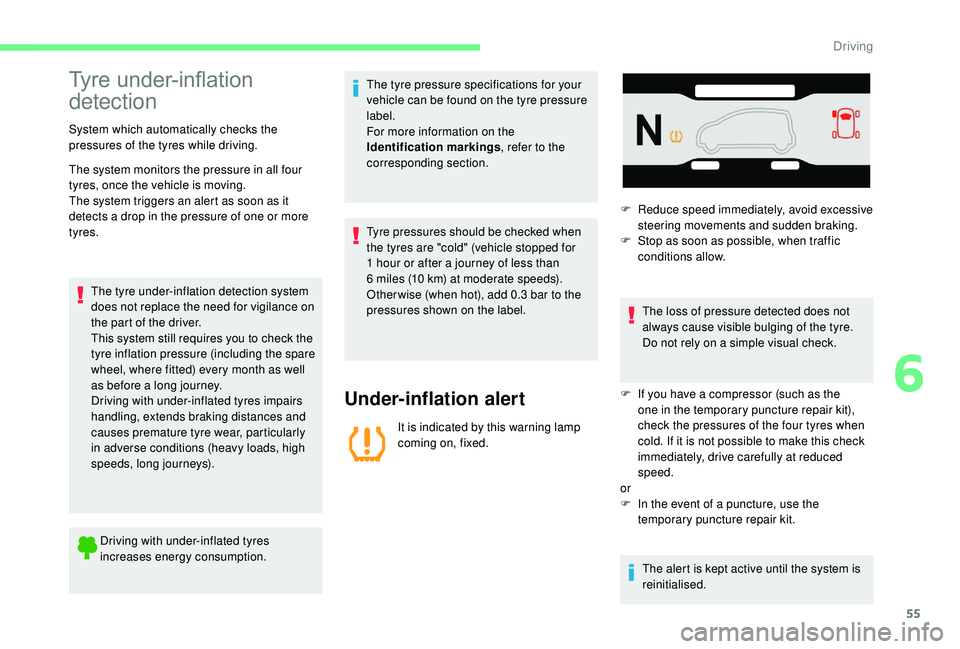
It is indicated by this warning lamp
coming on, fixed. F
Reduce speed immediately, avoid excessive
steering movements and sudden braking.
F Stop as soon as possible, when traffic
conditions allow.
The loss of pressure detected does not
always cause visible bulging of the tyre.
Do not rely on a simple visual check.
F If you have a compressor (such as the
one in the temporary puncture repair kit),
check the pressures of the four tyres when
cold. If it is not possible to make this check
immediately, drive carefully at reduced
speed.
or
F In the event of a
puncture, use the
temporary puncture repair kit.
The alert is kept active until the system is
reinitialised.
6
Driving
Page 58 of 84
56
Reinitialisation
The system must be reinitialised after any
adjustment to the pressures of one or more
tyres, and after changing one or more wheels.Before reinitialising the system, ensure
that the pressures of the four tyres are
correct for the use of the vehicle and in
line with the recommendations on the tyre
pressure label.
The under-inflation detection system
does not give a
warning if a pressure is
incorrect at the time of reinitialisation.
The system must be reinitialised with the
ignition on and the vehicle stationary, via the
vehicle's configuration menu, in Advanced
settings.
The under-inflation alert can only be relied
on if the reinitialisation of the system has
been done with the pressures in the four
tyres correctly adjusted.
Driving
Page 62 of 84
60
Obser ve the safety rules and follow the
steps indicated before use.
-
Us
e only the original charging cable.
-
D
o not attempt to dismantle or repair the
charging cable.
-
D
o not use an extension lead or adapter.
-
I
ncorrect use of the charging cable would
risk causing an accident such as an
electrical discharge or fire.
-
I
mmediately stop using the charging cable
if a
fault or problem occurs or if the FAULT
warning lamp lights up or flashes.
-
E
nsure that the plug is not allowed to
become wet.
-
D
o not touch the terminals on the charging
cable or the vehicle's charging socket.
-
D
o not use the charging cable if parts of
it are broken, frayed, cracked, open or
showing any other sign of damage.
-
K
eep the charging cable out of reach of
children.
-
W
hen using the charging cable, the
ambient temperature must not exceed
45
degrees Celsius.
-
H
andle the charging cable with care, avoid
dropping it and do not pull heavily on the
cable or the cord. The components of your E-MEHARI
comply with electromagnetic emission
standards. However, as a
precaution,
if you have a
pacemaker or any other
electrical medical device, ask your doctor
about any precautions to take.
-
E nsure that the electrical power supply is
220 -240 V 50 Hz alternating current.
-
B
efore connecting the charging cable,
check the nominal current indicated on
the charging cable, to ensure that the
power point and supply circuit are rated
sufficiently highly to charge your vehicle.
-
T
he charging cable allows 10 A of
continuous consumption, you must ensure
that the electrical installation (socket,
cables, etc.) for the charging have this
value of nominal current at a
minimum
and comply with the most recent electrical
cable standards and regulations in force in
your country or region.
-
T
he maximum nominal current depends
on the country.
-
T
he socket and wiring circuit must be
earthed and protected by a
circuit breaker
specifically designed for this purpose or
a
fuse to avoid any accident of electrical
origin.
-
C
ontact a qualified electrician if in any
doubt over the power point and wiring
circuit.
Practical information