ESP CITROEN JUMPER 2011 User Guide
[x] Cancel search | Manufacturer: CITROEN, Model Year: 2011, Model line: JUMPER, Model: CITROEN JUMPER 2011Pages: 184, PDF Size: 4.98 MB
Page 99 of 184
TECHNOLOGY ON BOAR
D
Bluetooth hands-free system
4
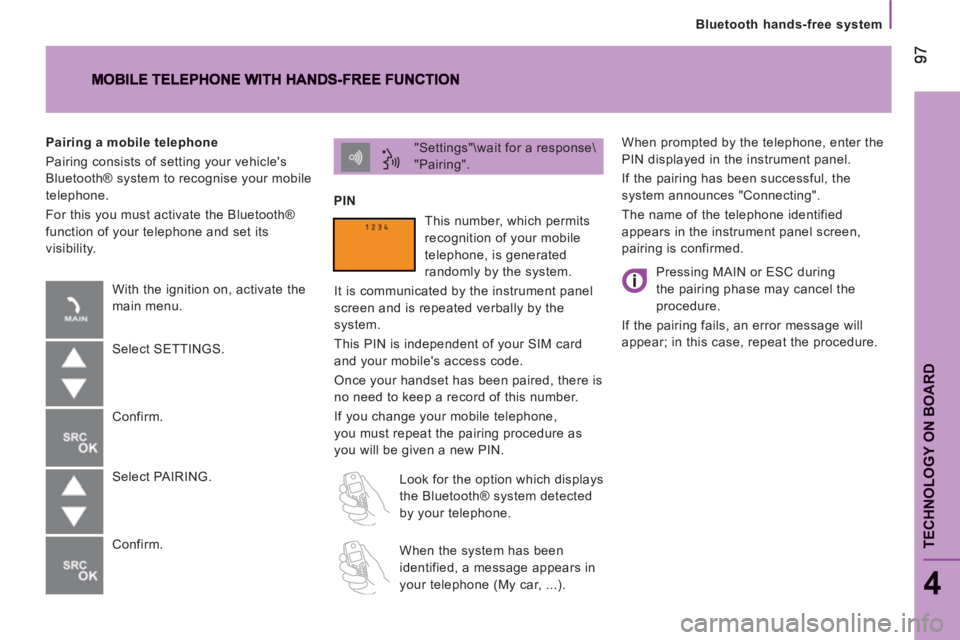
When prompted by the telephone, enter the
PIN displayed in the instrument panel.
If the pairing has been successful, the
system announces "Connecting".
The name of the telephone identified
appears in the instrument panel screen,
pairing is confirmed. "Settings"\wait for a response\
"Pairing".
PIN
Pairing a mobile telephone
Pairing consists of setting your vehicle's
Bluetooth® system to recognise your mobile
telephone.
For this you must activate the Bluetooth®
function of your telephone and set its
visibility.
With the ignition on, activate the
main menu.
Select SETTINGS.
Confirm.
Select PAIRING.
Confirm. This number, which permits
recognition of your mobile
telephone, is generated
randomly by the system.
It is communicated by the instrument panel
screen and is repeated verbally by the
system.
This PIN is independent of your SIM card
and your mobile's access code.
Once your handset has been paired, there is
no need to keep a record of this number.
If you change your mobile telephone,
you must repeat the pairing procedure as
you will be given a new PIN.
Look for the option which displays
the Bluetooth® system detected
by your telephone.
When the system has been
identified, a message appears in
your telephone (My car, ...).
Pressing MAIN or ESC during
the pairing phase may cancel the
procedure.
If the pairing fails, an error message will
appear; in this case, repeat the procedure.
Page 115 of 184
11
3
5
Driving safely
SAFETY
TRACTION CONTROL (ASR) AND DYNAMIC STABILITY CONTROL (ESP)
These systems are linked and complement
the ABS.
The ASR system is very useful for
maintaining optimum drive and avoiding
losses of control of the vehicle on
acceleration.
The system optimises drive to prevent the
wheels skidding, by acting on the brakes of
the drive wheels and on the engine. It also
allows the directional stability of the vehicle
to be improved on acceleration.
Use the ESP to hold your course without
attempting to countersteer. If there is a variation between the trajectory
followed by the vehicle and that required
by the driver, the ESP system automatically
acts on the engine and the brake of one
or more wheels, in order to put the vehicle
back on course.
In certain exceptional conditions (when
starting a vehicle stuck in mud or snow, or
on loose ground...), it could prove useful
to deactivate the ASR system to make the
wheels spin and regain grip.
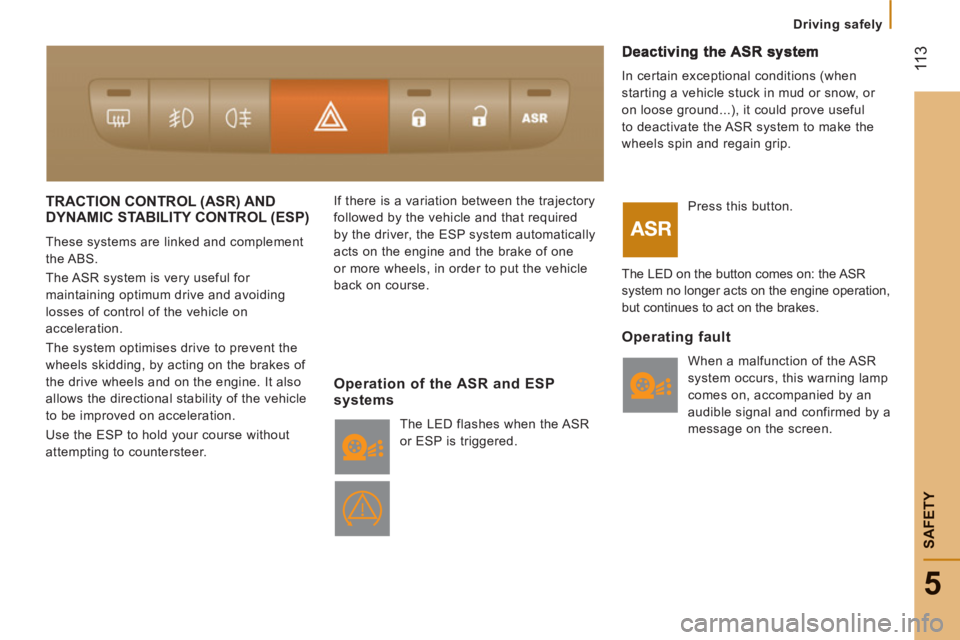
Operation of the ASR and ESP
systems
The LED flashes when the ASR
or ESP is triggered. Press this button.
The LED on the button comes on: the ASR
system no longer acts on the engine operation,
but continues to act on the brakes.
Operating fault
When a malfunction of the ASR
system occurs, this warning lamp
comes on, accompanied by an
audible signal and confirmed by a
message on the screen.
Page 116 of 184
11 4
Driving safely
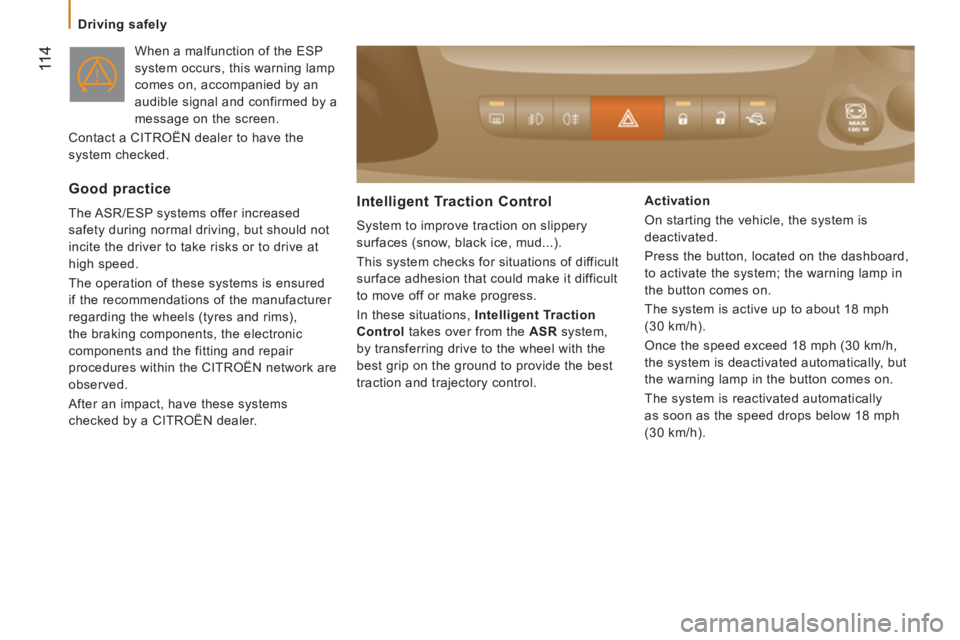
When a malfunction of the ESP
system occurs, this warning lamp
comes on, accompanied by an
audible signal and confirmed by a
message on the screen.
Contact a CITROËN dealer to have the
system checked.
Good practice
The ASR/ESP systems offer increased
safety during normal driving, but should not
incite the driver to take risks or to drive at
high speed.
The operation of these systems is ensured
if the recommendations of the manufacturer
regarding the wheels (tyres and rims),
the braking components, the electronic
components and the fitting and repair
procedures within the CITROËN network are
observed.
After an impact, have these systems
checked by a CITROËN dealer. Intelligent Traction Control
System to improve traction on slippery
surfaces (snow, black ice, mud...).
This system checks for situations of difficult
surface adhesion that could make it difficult
to move off or make progress.
In these situations, Intelligent Traction
Control
takes over from the ASR
system,
by transferring drive to the wheel with the
best grip on the ground to provide the best
traction and trajectory control.
Activation
On starting the vehicle, the system is
deactivated.
Press the button, located on the dashboard,
to activate the system; the warning lamp in
the button comes on.
The system is active up to about 18 mph
(30 km/h).
Once the speed exceed 18 mph (30 km/h,
the system is deactivated automatically, but
the warning lamp in the button comes on.
The system is reactivated automatically
as soon as the speed drops below 18 mph
(30 km/h).
Page 140 of 184
Checks
138
CHECKS
Air filter and passenger compartment filter
A clogged passenger compartment filter
may reduce the performance of the
air conditioning system and generate
undesirable odours. The replacement
intervals for these components are indicated
in the servicing booklet.
Depending on the environment (dusty
atmosphere...) and the use of the vehicle
(urban driving...), change them twice as
often if necessary, refer to the "Under the
bonnet" section of chapter 7.
Manual gearbox
Have the level checked in accordance with
the manufacturer's servicing schedule.
To check the main levels and certain
components, in accordance with the
manufacturer's servicing schedule, refer to
the pages of the servicing booklet which
correspond to your vehicle's engine.
Only use products recommended by
CITROËN or products of equivalent quality
and specification.
In order to optimise the operation of units as
important as the braking system, CITROËN
selects and offers specific products.
In order to avoid damaging the electrical
units, high pressure washing to clean the
engine compartment is strictly prohibited.
Parking brake
Where the parking brake travel is too great
or there is a reduction in the performance
of the system, the parking brake should be
adjusted, even between services.
Have the system checked by a CITROËN
dealer.
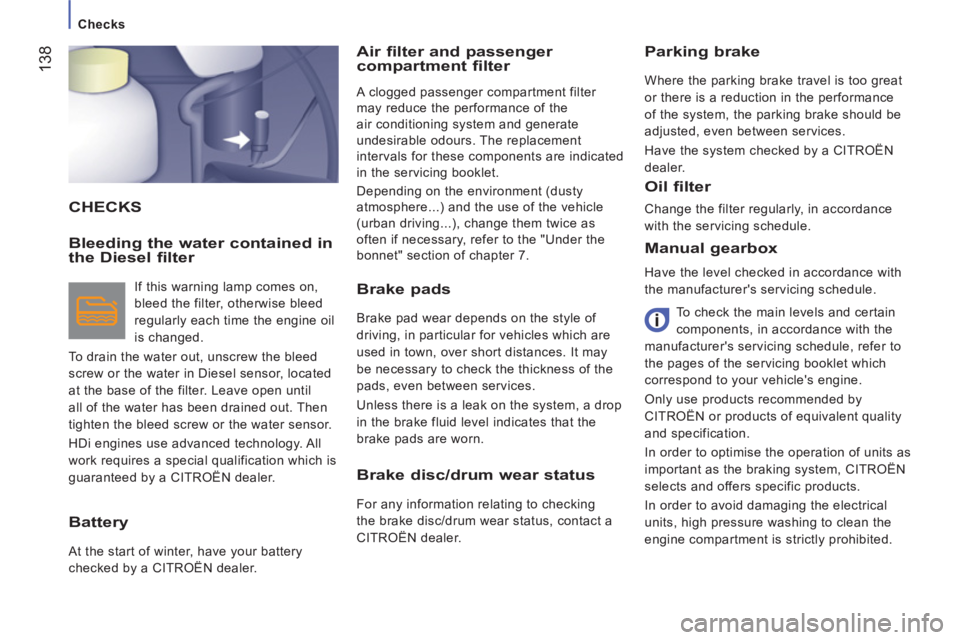
Bleeding the water contained in
the Diesel filter
If this warning lamp comes on,
bleed the filter, otherwise bleed
regularly each time the engine oil
is changed.
To drain the water out, unscrew the bleed
screw or the water in Diesel sensor, located
at the base of the filter. Leave open until
all of the water has been drained out. Then
tighten the bleed screw or the water sensor.
HDi engines use advanced technology. All
work requires a special qualification which is
guaranteed by a CITROËN dealer.
Battery
At the start of winter, have your battery
checked by a CITROËN dealer.
Brake pads
Brake pad wear depends on the style of
driving, in particular for vehicles which are
used in town, over short distances. It may
be necessary to check the thickness of the
pads, even between services.
Unless there is a leak on the system, a drop
in the brake fluid level indicates that the
brake pads are worn.
Brake disc/drum wear status
For any information relating to checking
the brake disc/drum wear status, contact a
CITROËN dealer.
Oil filter
Change the filter regularly, in accordance
with the servicing schedule.
Page 150 of 184
Changing a wheel
- If a pressure of at least 3 bars
is not
reached within 5 minutes, disconnect
the compressor from the valve and the
power socket, then move the vehicle
forward by approximately 10 metres to
distribute the sealant fluid inside the
tyre.
- Then repeat the inflating operation:
●
if a pressure of at least 3 bars
is not
reached within 10 minutes, switch off
your vehicle: the tyre has suffered
too much damage and repair has not
been possible. Consult a CITROËN
dealer.
●
if the tyre has been inflated to a
pressure of 4 bars
, set off again
immediately.
After driving for approximately 10 minutes,
stop and check the pressure of the tyre
again.
Adjust the pressure if necessary and contact
a CITROËN dealer as soon as possible.
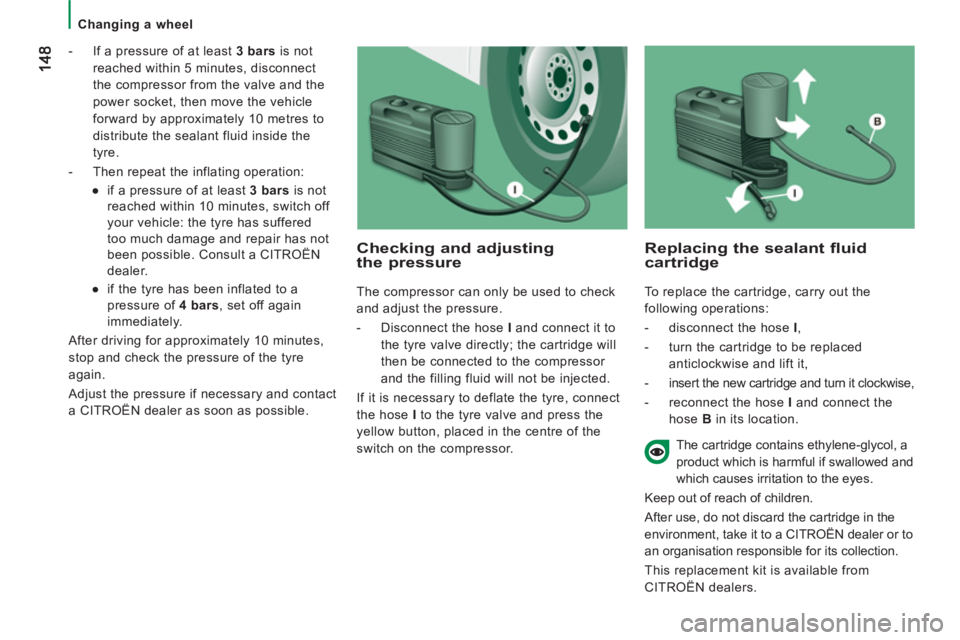
Checking and adjustingthe pressure
The compressor can only be used to check
and adjust the pressure.
- Disconnect the hose I
and connect it to
the tyre valve directly; the cartridge will
then be connected to the compressor
and the filling fluid will not be injected.
If it is necessary to deflate the tyre, connect
the hose I
to the tyre valve and press the
yellow button, placed in the centre of the
switch on the compressor.
Replacing the sealant fluidcartridge
To replace the cartridge, carry out the
following operations:
- disconnect the hose I
,
- turn the cartridge to be replaced
anticlockwise and lift it,
- insert the new cartridge and turn it clockwise,
- reconnect the hose I
and connect the
hose B
in its location.
The cartridge contains ethylene-glycol, a
product which is harmful if swallowed and
which causes irritation to the eyes.
Keep out of reach of children.
After use, do not discard the cartridge in the
environment, take it to a CITROËN dealer or to
an organisation responsible for its collection.
This replacement kit is available from
CITROËN dealers.
Page 155 of 184

153
QUICK HELP
8
Changing a fuse
The three fuseboxes are placed in the
dashboard on the passenger’s side, in
the driver’s door pillar and in the engine
compartment.
Descriptions are given only for fuses that
can be changed by the user. For all other
work on the fuses, go to a CITROËN dealer
or a qualified workshop.
Removing and fitting a fuse
Before changing a fuse, the cause of the
fault must be found and rectified. The fuse
numbers are indicated on the fusebox.
Always replace a failed fuse with a fuse
of the same rating.
CHANGING A FUSE
CITROËN declines to accept any
responsibility for expenses incurred for
repairs to your vehicle or for any malfunctions
resulting from the installation of additional
accessories which are not supplied or
recommended by CITROËN the manufacturer
and which are not installed in accordance with
its instructions, in particular when the combined
consumption of all of the additional equipment
connected exceeds 10 milliamperes.
Good
Failed
Motor trade professionals: for compete
information on the fuses and relays,
refer to the diagrams in the workshop
procedure documents available at dealers.
Page 156 of 184

154
Changing a fuse
PASSENGER’S SIDE DASHBOARD FUSES
- Remove the bolts and tilt the box to access the fuses.
Fuses
A (amps)
Allocation
12
7.5
Right-hand dipped beam headlamp
13
7.5
Left-hand dipped beam headlamp
31
5
Relay supply
32
7.5
Interior lighting
33
20
Battery sensor
34
20
Minibus interior lighting - Hazard warning
36
10
Audio system - Diagnostic socket - Alarm siren - Programmable additional heating controls -
Air conditioning controls - Tachograph - Battery
37
7.5
Brake lamps switch - Third brake lamp - Instrument panel
38
20
Central locking
42
5
ABS control unit and sensor - ASR sensor - ESP sensor - Brake lamps switch
43
20
Windscreen wiper motor
47
20
Driver’s electric window motor
48
20
Passenger electric window motor
49
5
Audio system - Instrument panel controls
50
7.5
Airbags and pre-tensioners unit
51
5
Tachograph - Cruise control - Air conditioning controls - Reversing lamps -
water in Diesel sensor
53
7.5
Instrument panel
89
-
Not used
90
7.5
Left hand main beam headlamp
91
7.5
Right han main beam headlamp
92
7.5
Left hand foglamp
93
7.5
Right hand foglamp
Page 175 of 184
17
3
Exterior
10
VISUAL SEARCH
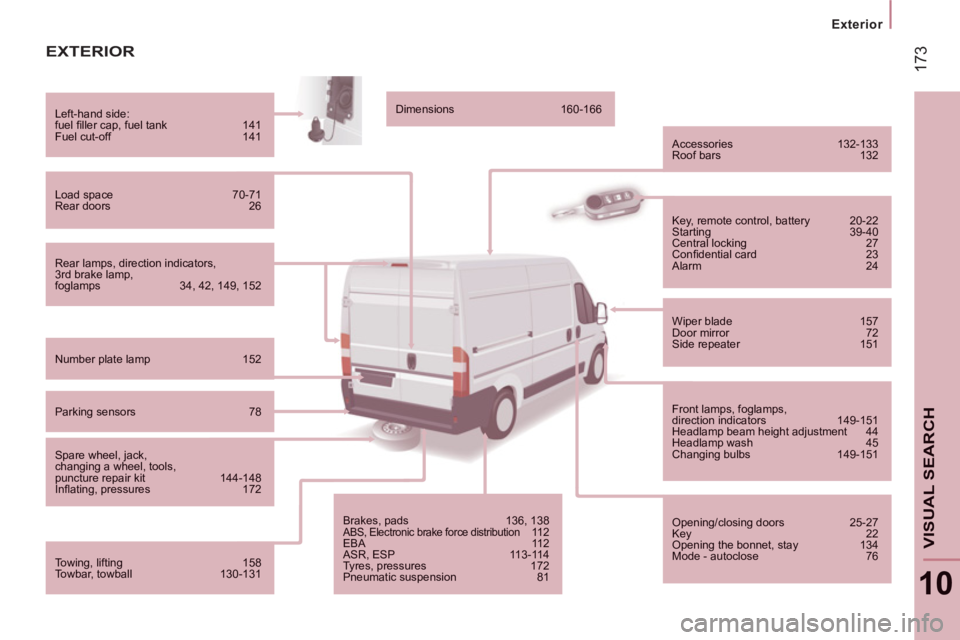
EXTERIOR
Rear lamps, direction indicators,3rd brake lamp,foglamps 34, 42, 149, 152
Left-hand side:fuel fi ller cap, fuel tank 141 Fuel cut-off 141
Load space 70-71 Rear doors 26
Number plate lamp 152
Parking sensors 78
Spare wheel, jack, changing a wheel, tools, puncture repair kit 144-148 Infl ating, pressures 172
Towing, lifting 158 Towbar, towball 130-131
Dimensions 160-166
Accessories 132-133
Roof bars 132
Brakes, pads 136, 138ABS, Electronic brake force distribution 11 2
EBA 112 ASR, ESP 113-114
Tyres, pressures 172
Pneumatic suspension 81
Key, remote control, battery 20-22 Starting 39-40
Central locking 27
Confi dential card 23
Alarm 24
Wiper blade 157
Door mirror 72
Side repeater 151
Front lamps, foglamps,direction indicators 149-151 Headlamp beam height adjustment 44
Headlamp wash 45 Changing bulbs 149-151
Opening/closing doors 25-27
Key 22 Opening the bonnet, stay 134
Mode - autoclose 76
Page 177 of 184
17
5
Instruments and controls
10
VISUAL SEARC
H
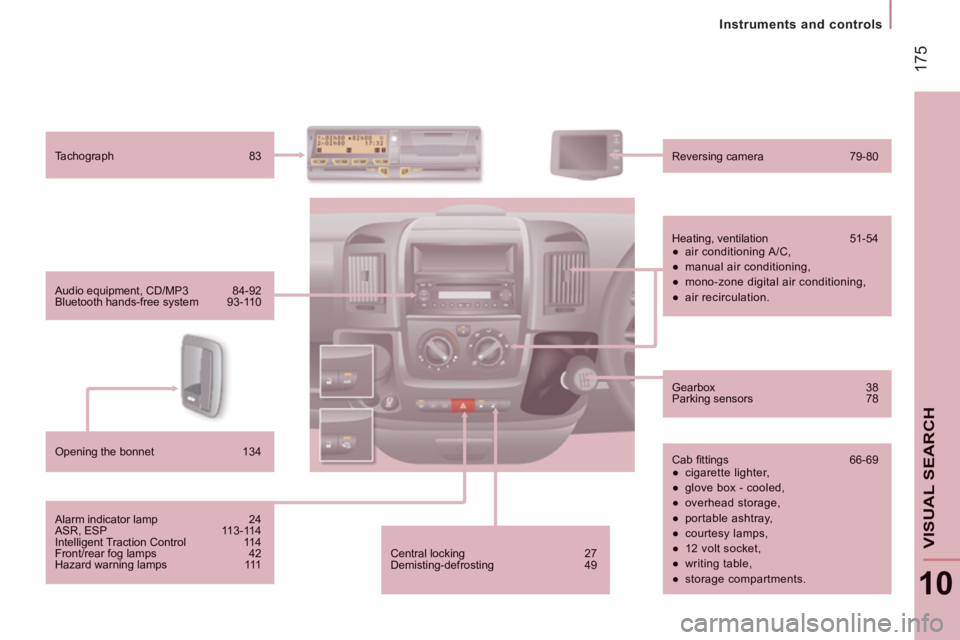
Central locking 27 Demisting-defrosting 49
Audio equipment, CD/MP3 84-92 Bluetooth hands-free system 93-110
Tachograph 83
Reversing camera 79-80
Heating, ventilation 51-54
●
air conditioning A/C,
●
manual air conditioning,
●
mono-zone digital air conditioning,
●
air recirculation.
Cab fi ttings 66-69
●
cigarette lighter,
●
glove box - cooled,
●
overhead storage,
●
portable ashtray,
●
courtesy lamps,
●
12 volt socket,
●
writing table,
●
storage compartments.
Gearbox 38
Parking sensors 78
Alarm indicator lamp 24
ASR, ESP 113-114 Intelligent Traction Control 114 Front/rear fog lamps 42 Hazard warning lamps 111
Opening the bonnet 134