brake CITROEN JUMPER 2011 User Guide
[x] Cancel search | Manufacturer: CITROEN, Model Year: 2011, Model line: JUMPER, Model: CITROEN JUMPER 2011Pages: 184, PDF Size: 4.98 MB
Page 115 of 184
11
3
5
Driving safely
SAFETY
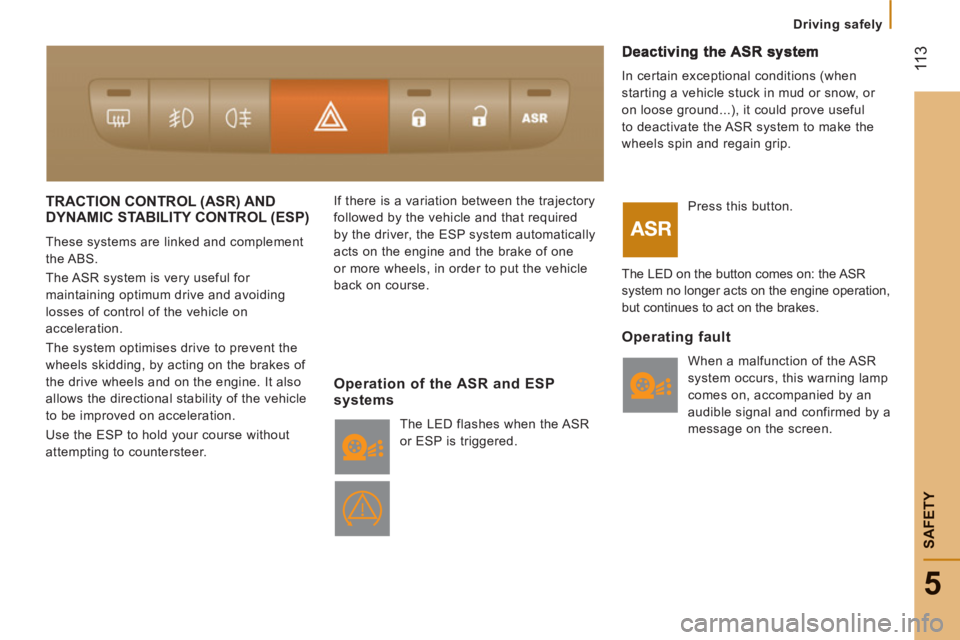
TRACTION CONTROL (ASR) AND DYNAMIC STABILITY CONTROL (ESP)
These systems are linked and complement
the ABS.
The ASR system is very useful for
maintaining optimum drive and avoiding
losses of control of the vehicle on
acceleration.
The system optimises drive to prevent the
wheels skidding, by acting on the brakes of
the drive wheels and on the engine. It also
allows the directional stability of the vehicle
to be improved on acceleration.
Use the ESP to hold your course without
attempting to countersteer. If there is a variation between the trajectory
followed by the vehicle and that required
by the driver, the ESP system automatically
acts on the engine and the brake of one
or more wheels, in order to put the vehicle
back on course.
In certain exceptional conditions (when
starting a vehicle stuck in mud or snow, or
on loose ground...), it could prove useful
to deactivate the ASR system to make the
wheels spin and regain grip.
Operation of the ASR and ESP
systems
The LED flashes when the ASR
or ESP is triggered. Press this button.
The LED on the button comes on: the ASR
system no longer acts on the engine operation,
but continues to act on the brakes.
Operating fault
When a malfunction of the ASR
system occurs, this warning lamp
comes on, accompanied by an
audible signal and confirmed by a
message on the screen.
Page 133 of 184
131
6
Towing a trailer
ACCESSORIE
S
Cooling:
towing a trailer on a slope
increases the coolant temperature.
As the fan is electrically controlled, its
cooling capacity is not dependent on the
engine speed.
On the contrary, use a high gear to lower the
engine speed and reduce your speed.
In all cases, pay attention to the coolant
temperature.
Tyres:
check the tyre pressures of the
towing vehicle (see the "Identification
markings" section of chapter 9) and of
the trailer, observing the recommended
pressures.
We recommend the use of original
CITROËN towbars and their harnesses,
which have been tested and approved from
the design stage of your vehicle and that
the fitting of this equipment is entrusted to a
CITROËN dealer.
If this equipment is not fitted by a CITROËN
dealer, it is imperative that it is fitted using
the electrical pre-equipment installed at the
rear of the vehicle and in accordance with
the manufacturer's instructions.
Good practice
In certain cases of particularly arduous
use (towing the maximum load up a steep
slope in high temperatures), the engine
automatically limits its power. In this
case, the automatic cutting off of the air
conditioning allows the engine power to be
recovered.
If the coolant temperature
warning lamp comes on, stop the
vehicle and switch off the engine
as soon as possible.
See the "Levels" section of chapter 7.
Brakes:
towing increases the braking
distance. Drive at a moderate speed,
change down early and brake gradually.
Side wind:
sensitivity to side wind is
increased. Drive smoothly and at a
moderate speed.
ABS:
the system only controls the vehicle,
not the trailer.
Rear parking
sensors
:
the system does not
operate while the vehicle is towing.
Page 137 of 184
Under the bonnet
135
7
CHECK
S
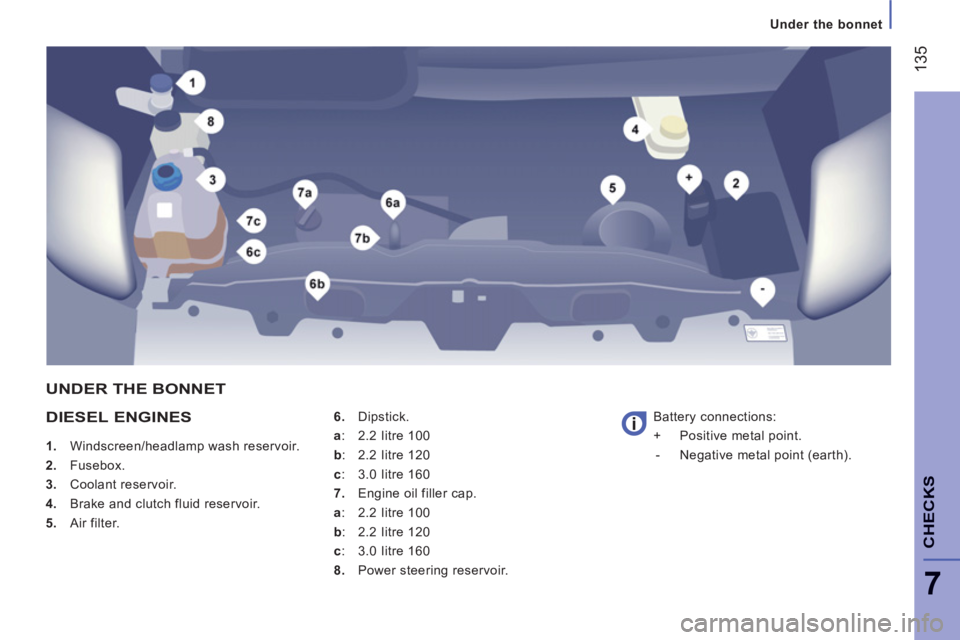
DIESEL ENGINES
1.
Windscreen/headlamp wash reservoir.
2.
Fusebox.
3.
Coolant reservoir.
4.
Brake and clutch fluid reservoir.
5.
Air filter.
6.
Dipstick.
a
: 2.2 Iitre 100
b
: 2.2 Iitre 120
c
: 3.0 Iitre 160
7.
Engine oil filler cap.
a
: 2.2 Iitre 100
b
: 2.2 Iitre 120
c
: 3.0 Iitre 160
8.
Power steering reservoir. Battery connections:
+ Positive metal point.
- Negative metal point (earth).
UNDER THE BONNET
Page 138 of 184
Levels
136
LEVELS
These regular maintenance operations
will keep your vehicle in good running
order. Ask for advice at a CITROËN dealer
or consult the servicing booklet enclosed in
the handbook pack. To maintain the reliability of engines and
emission control systems, the use of
additives in engine oil is prohibited.
Changing the brake fluid
The brake fluid must be changed at
the intervals stated, according to the
manufacturer’s servicing schedule.
Use fluids recommended by the
manufacturer, which fulfil DOT4 standards.
The level must be between the MIN
and
MAX
marks on the reservoir.
If fluid has to be added frequently, this
indicates a failure which must be checked by
a CITROËN dealer as soon as possible. If you have to remove/refit the engine
style cover, handle it with care to avoid
damaging the fixing clips.
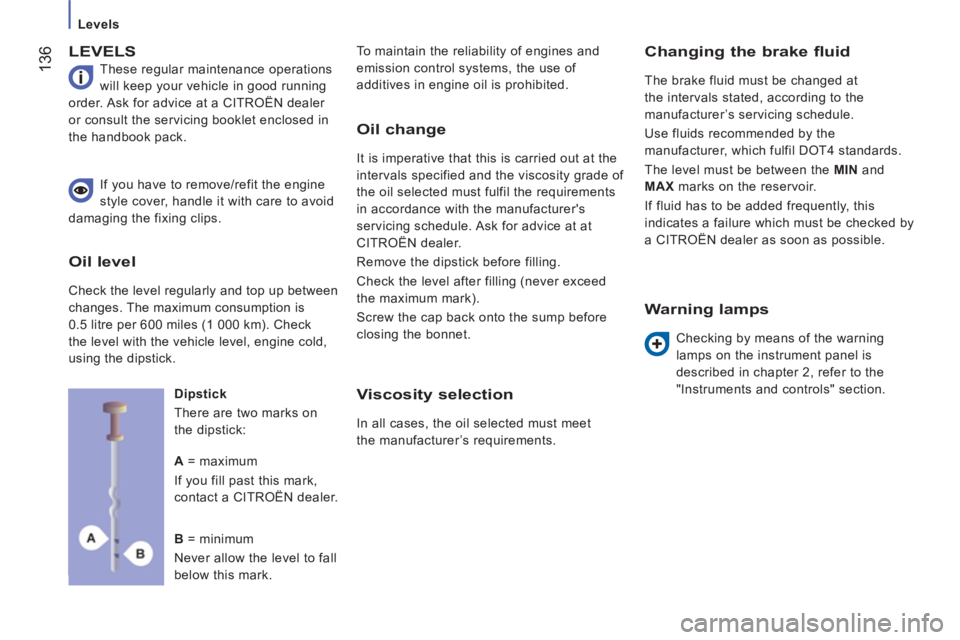
Dipstick
There are two marks on
the dipstick:
Oil change
It is imperative that this is carried out at the
intervals specified and the viscosity grade of
the oil selected must fulfil the requirements
in accordance with the manufacturer's
servicing schedule. Ask for advice at at
CITROËN dealer.
Remove the dipstick before filling.
Check the level after filling (never exceed
the maximum mark).
Screw the cap back onto the sump before
closing the bonnet.
Viscosity selection
In all cases, the oil selected must meet
the manufacturer’s requirements.
Warning lamps
Checking by means of the warning
lamps on the instrument panel is
described in chapter 2, refer to the
"Instruments and controls" section.
A
= maximum
If you fill past this mark,
contact a CITROËN dealer.
B
= minimum
Never allow the level to fall
below this mark.
Oil level
Check the level regularly and top up between
changes. The maximum consumption is
0.5 litre per 600 miles (1 000 km). Check
the level with the vehicle level, engine cold,
using the dipstick.
Page 139 of 184
Levels
137
7
CHECK
S
Cooling system
Only use the fluid recommended by the
manufacturer. Otherwise, you risk seriously
damaging your engine. When the engine
is warm, the temperature of the coolant is
controlled by the engine fan. As this fan can
operate with the ignition key removed and
because the cooling system is pressurised,
wait for at least one hour after the engine
has stopped before carrying out any work.
Slacken the cap by 1/4 of a turn to release
the pressure to prevent any risk of scalding.
When the pressure has dropped, remove
the cap and top up the level with coolant.
If fluid has to be added frequently, this
indicates a failure which must be checked by
a CITROËN dealer as soon as possible.
Power steering fluid level
The vehicle must be parked on level ground
with the engine cold. Unscrew the cap
integrated with the gauge and check the
level which must be between the MIN
and
MAX
marks.
Used oil
Avoid prolonged contact of used oil with
the skin.
Brake fluid is harmful to health and very
corrosive.
Do not dispose of used oil, brake fluid or
coolant into drains or into the ground but
into the containers dedicated to this use
at CITROËN dealerships (France) or to an
authorised waste disposal site.
Topping up
The level must be between the MIN
and
MAX
marks on the expansion bottle. If
more than 1 litre of fluid is required to top
up the level, have the system checked by a
CITROËN dealer.
Windscreen wash and headlamp
wash level
For best quality cleaning and to prevent
freezing, this fluid must not be topped up or
replaced with plain water.
Capacity of the reservoir: approximately
5.5 litres.
Page 140 of 184
Checks
138
CHECKS
Air filter and passenger compartment filter
A clogged passenger compartment filter
may reduce the performance of the
air conditioning system and generate
undesirable odours. The replacement
intervals for these components are indicated
in the servicing booklet.
Depending on the environment (dusty
atmosphere...) and the use of the vehicle
(urban driving...), change them twice as
often if necessary, refer to the "Under the
bonnet" section of chapter 7.
Manual gearbox
Have the level checked in accordance with
the manufacturer's servicing schedule.
To check the main levels and certain
components, in accordance with the
manufacturer's servicing schedule, refer to
the pages of the servicing booklet which
correspond to your vehicle's engine.
Only use products recommended by
CITROËN or products of equivalent quality
and specification.
In order to optimise the operation of units as
important as the braking system, CITROËN
selects and offers specific products.
In order to avoid damaging the electrical
units, high pressure washing to clean the
engine compartment is strictly prohibited.
Parking brake
Where the parking brake travel is too great
or there is a reduction in the performance
of the system, the parking brake should be
adjusted, even between services.
Have the system checked by a CITROËN
dealer.
Bleeding the water contained in
the Diesel filter
If this warning lamp comes on,
bleed the filter, otherwise bleed
regularly each time the engine oil
is changed.
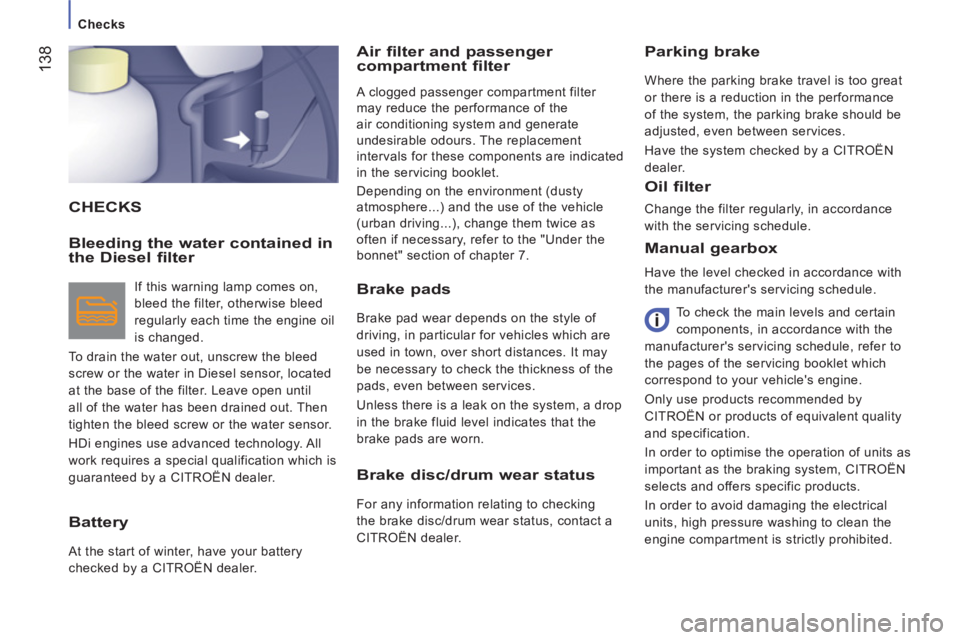
To drain the water out, unscrew the bleed
screw or the water in Diesel sensor, located
at the base of the filter. Leave open until
all of the water has been drained out. Then
tighten the bleed screw or the water sensor.
HDi engines use advanced technology. All
work requires a special qualification which is
guaranteed by a CITROËN dealer.
Battery
At the start of winter, have your battery
checked by a CITROËN dealer.
Brake pads
Brake pad wear depends on the style of
driving, in particular for vehicles which are
used in town, over short distances. It may
be necessary to check the thickness of the
pads, even between services.
Unless there is a leak on the system, a drop
in the brake fluid level indicates that the
brake pads are worn.
Brake disc/drum wear status
For any information relating to checking
the brake disc/drum wear status, contact a
CITROËN dealer.
Oil filter
Change the filter regularly, in accordance
with the servicing schedule.
Page 146 of 184
144
Changing a wheel
1. PARKINGTHE VEHICLE
As far as possible, park the vehicle on level,
stable and non-slippery ground.
Apply the parking brake, switch off the
ignition and engage first gear.
Put on a high visibility jacket and position
the warning triangle.
If possible, place a chock under the wheel
diagonally opposite the wheel to be changed. 2. TOOLS
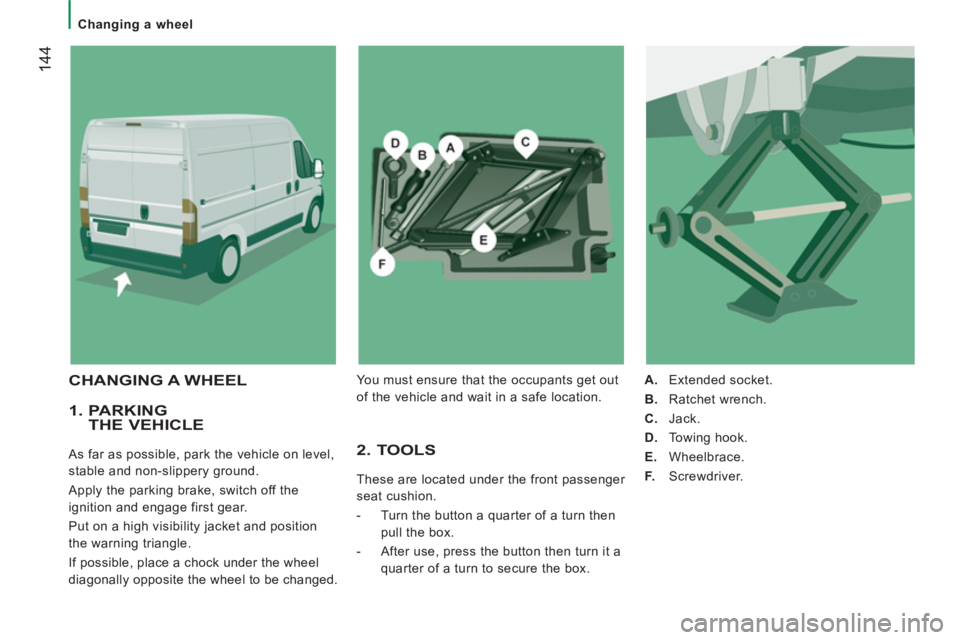
These are located under the front passenger
seat cushion.
- Turn the button a quarter of a turn then
pull the box.
- After use, press the button then turn it a
quarter of a turn to secure the box.
A.
Extended socket.
B.
Ratchet wrench.
C.
Jack.
D.
Towing hook.
E.
Wheelbrace.
F.
Screwdriver.
CHANGING A WHEEL
You must ensure that the occupants get out
of the vehicle and wait in a safe location.
Page 149 of 184
14
7
QUICK HEL
P
8
Changing a wheel
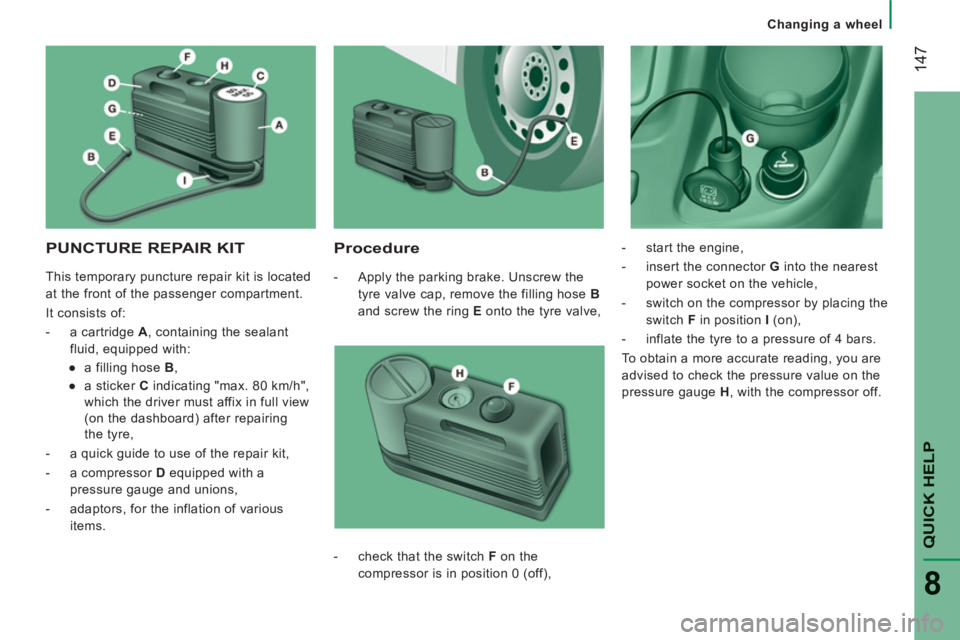
PUNCTURE REPAIR KIT
Procedure
- Apply the parking brake. Unscrew the
tyre valve cap, remove the filling hose B
and screw the ring E
onto the tyre valve,
- start the engine,
- insert the connector G
into the nearest
power socket on the vehicle,
- switch on the compressor by placing the
switch F
in position I
(on),
- inflate the tyre to a pressure of 4 bars.
To obtain a more accurate reading, you are
advised to check the pressure value on the
pressure gauge H
, with the compressor off.
- check that the switch F
on the
compressor is in position 0 (off), This temporary puncture repair kit is located
at the front of the passenger compartment.
It consists of:
- a cartridge A
, containing the sealant
fluid, equipped with:
●
a filling hose B
,
●
a sticker C
indicating "max. 80 km/h",
which the driver must affix in full view
(on the dashboard) after repairing
the tyre,
- a quick guide to use of the repair kit,
- a compressor D
equipped with a
pressure gauge and unions,
- adaptors, for the inflation of various
items.
Page 154 of 184
152
Changing a bulb
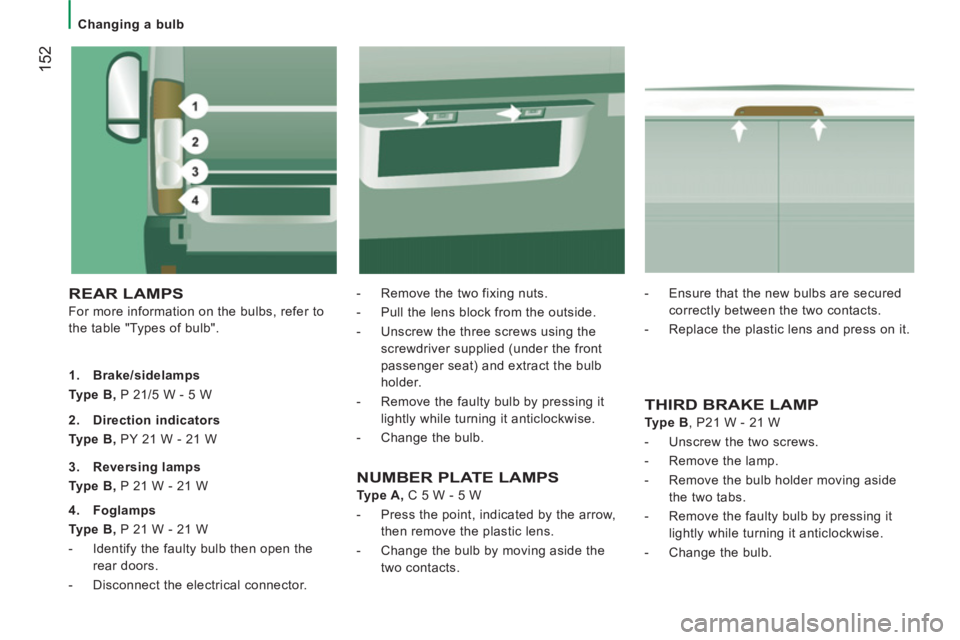
REAR LAMPS
For more information on the bulbs, refer to
the table "Types of bulb".
- Remove the two fixing nuts.
- Pull the lens block from the outside.
- Unscrew the three screws using the
screwdriver supplied (under the front
passenger seat) and extract the bulb
holder.
- Remove the faulty bulb by pressing it
lightly while turning it anticlockwise.
- Change the bulb.
1.
Brake/
sidelamps
Type B,
P 21/5 W - 5 W
THIRD BRAKE LAMP
Type B
, P21 W - 21 W
- Unscrew the two screws.
- Remove the lamp.
- Remove the bulb holder moving aside
the two tabs.
- Remove the faulty bulb by pressing it
lightly while turning it anticlockwise.
- Change the bulb.
2.
Direction indicators
Type B,
PY 21 W - 21 W
3.
Reversing
lamps
Type B,
P 21 W - 21 W
4.
Foglamps
Type B,
P 21 W - 21 W
- Identify the faulty bulb then open the
rear doors.
- Disconnect the electrical connector.
NUMBER PLATE LAMPS
Type A,
C 5 W - 5 W
- Press the point, indicated by the arrow,
then remove the plastic lens.
- Change the bulb by moving aside the
two contacts.
- Ensure that the new bulbs are secured
correctly between the two contacts.
- Replace the plastic lens and press on it.
Page 156 of 184

154
Changing a fuse
PASSENGER’S SIDE DASHBOARD FUSES
- Remove the bolts and tilt the box to access the fuses.
Fuses
A (amps)
Allocation
12
7.5
Right-hand dipped beam headlamp
13
7.5
Left-hand dipped beam headlamp
31
5
Relay supply
32
7.5
Interior lighting
33
20
Battery sensor
34
20
Minibus interior lighting - Hazard warning
36
10
Audio system - Diagnostic socket - Alarm siren - Programmable additional heating controls -
Air conditioning controls - Tachograph - Battery
37
7.5
Brake lamps switch - Third brake lamp - Instrument panel
38
20
Central locking
42
5
ABS control unit and sensor - ASR sensor - ESP sensor - Brake lamps switch
43
20
Windscreen wiper motor
47
20
Driver’s electric window motor
48
20
Passenger electric window motor
49
5
Audio system - Instrument panel controls
50
7.5
Airbags and pre-tensioners unit
51
5
Tachograph - Cruise control - Air conditioning controls - Reversing lamps -
water in Diesel sensor
53
7.5
Instrument panel
89
-
Not used
90
7.5
Left hand main beam headlamp
91
7.5
Right han main beam headlamp
92
7.5
Left hand foglamp
93
7.5
Right hand foglamp