warning CITROEN JUMPER 2011 Owner's Manual
[x] Cancel search | Manufacturer: CITROEN, Model Year: 2011, Model line: JUMPER, Model: CITROEN JUMPER 2011Pages: 184, PDF Size: 4.98 MB
Page 41 of 184
Starting and stopping
39
2
READY TO G
O
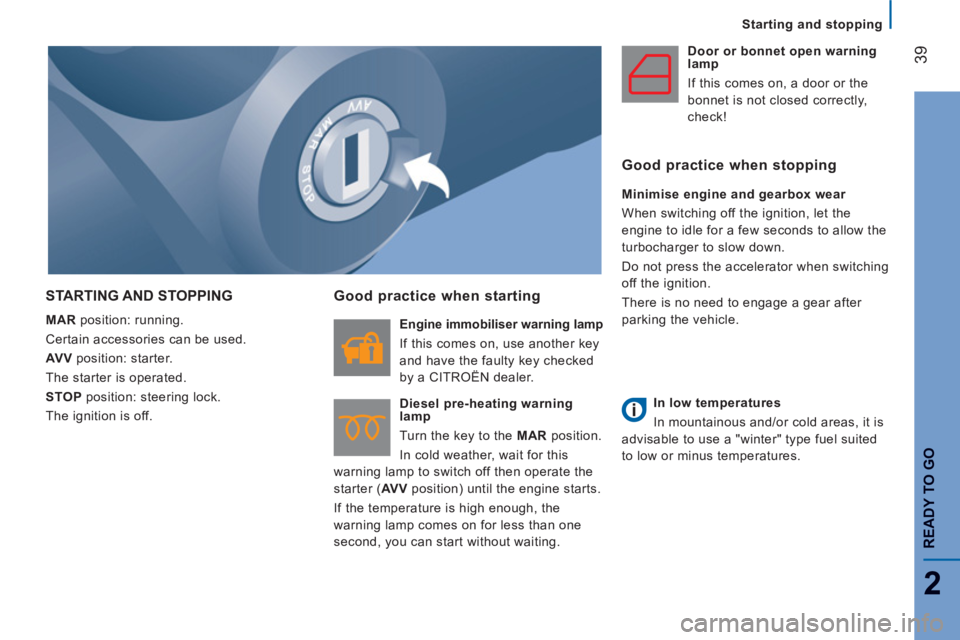
STARTING AND STOPPING
MAR
position: running.
Certain accessories can be used.
AV V
position: starter.
The starter is operated.
STOP
position: steering lock.
The ignition is off.
Good practice when starting
Engine immobiliser warning lamp
If this comes on, use another key
and have the faulty key checked
by a CITROËN dealer.
Diesel pre-heating warning
lamp
Turn the key to the MAR
position.
In cold weather, wait for this
warning lamp to switch off then operate the
starter ( AV V
position) until the engine starts.
If the temperature is high enough, the
warning lamp comes on for less than one
second, you can start without waiting.
Door or bonnet open warning
lamp
If this comes on, a door or the
bonnet is not closed correctly,
check!
Good practice when stopping
Minimise engine and gearbox wear
When switching off the ignition, let the
engine to idle for a few seconds to allow the
turbocharger to slow down.
Do not press the accelerator when switching
off the ignition.
There is no need to engage a gear after
parking the vehicle.
In low temperatures
In mountainous and/or cold areas, it is
advisable to use a "winter" type fuel suited
to low or minus temperatures.
Page 42 of 184
40
Starting and stopping
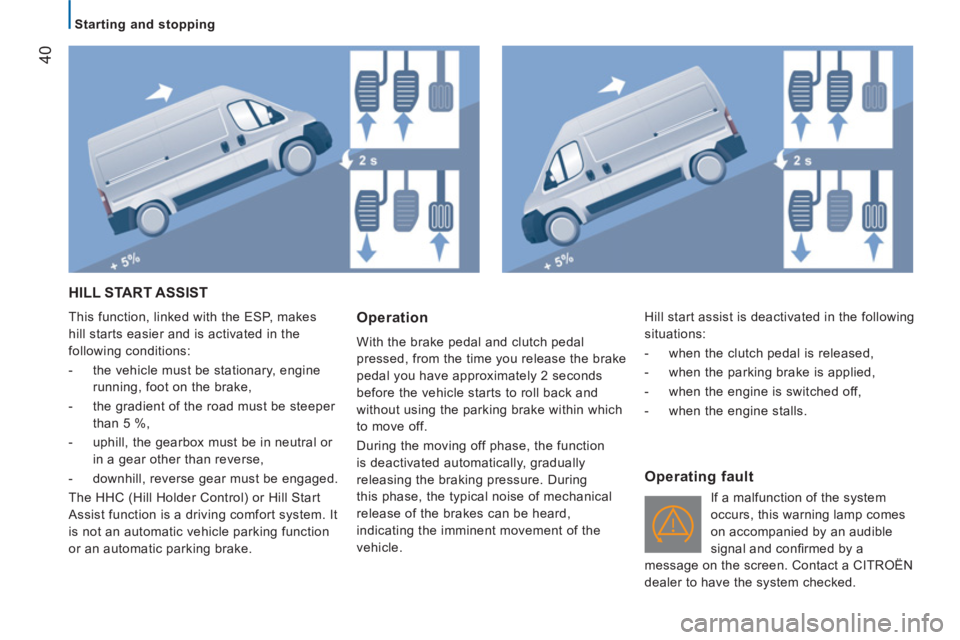
HILL START ASSIST
This function, linked with the ESP, makes
hill starts easier and is activated in the
following conditions:
- the vehicle must be stationary, engine
running, foot on the brake,
- the gradient of the road must be steeper
than 5 %,
- uphill, the gearbox must be in neutral or
in a gear other than reverse,
- downhill, reverse gear must be engaged.
The HHC (Hill Holder Control) or Hill Start
Assist function is a driving comfort system. It
is not an automatic vehicle parking function
or an automatic parking brake. Operation
With the brake pedal and clutch pedal
pressed, from the time you release the brake
pedal you have approximately 2 seconds
before the vehicle starts to roll back and
without using the parking brake within which
to move off.
During the moving off phase, the function
is deactivated automatically, gradually
releasing the braking pressure. During
this phase, the typical noise of mechanical
release of the brakes can be heard,
indicating the imminent movement of the
vehicle.
Operating fault
If a malfunction of the system
occurs, this warning lamp comes
on accompanied by an audible
signal and confi rmed by a
message on the screen. Contact a CITROËN
dealer to have the system checked. Hill start assist is deactivated in the following
situations:
- when the clutch pedal is released,
- when the parking brake is applied,
- when the engine is switched off,
- when the engine stalls.
Page 46 of 184
44
Steering mounted controls
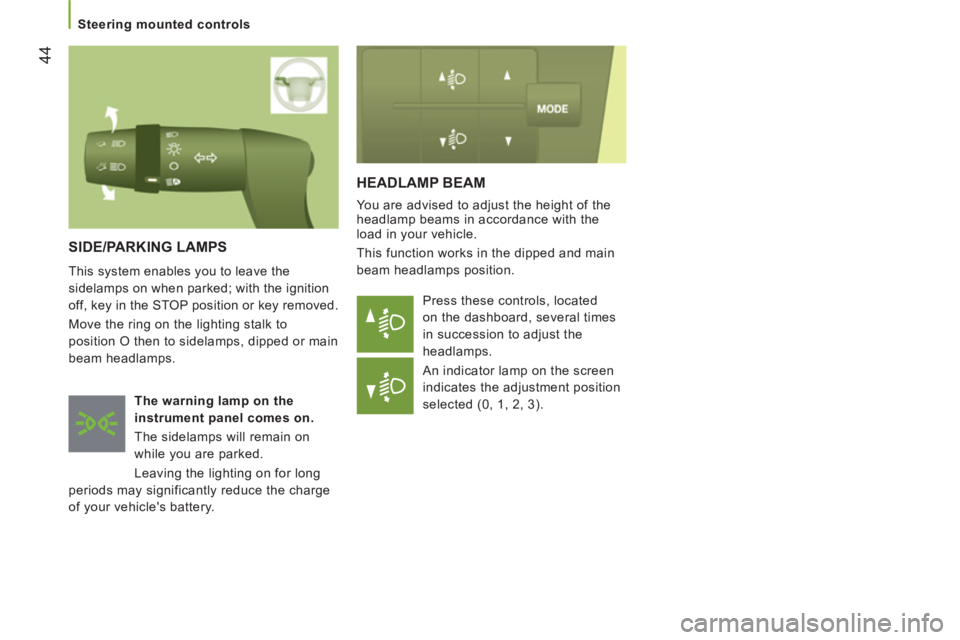
HEADLAMP BEAM
You are advised to adjust the height of the
headlamp beams in accordance with the
load in your vehicle.
This function works in the dipped and main
beam headlamps position.
Press these controls, located
on the dashboard, several times
in succession to adjust the
headlamps.
An indicator lamp on the screen
indicates the adjustment position
selected (0, 1, 2, 3).
SIDE/PARKING LAMPS
This system enables you to leave the
sidelamps on when parked; with the ignition
off, key in the STOP position or key removed.
Move the ring on the lighting stalk to
position O then to sidelamps, dipped or main
beam headlamps.
The warning
lamp
on the
instrument panel comes on.
The sidelamps will remain on
while you are parked.
Leaving the lighting on for long
periods may significantly reduce the charge
of your vehicle's battery.
Page 79 of 184
77
4
TECHNOLOGY ON BOAR
D
Mode
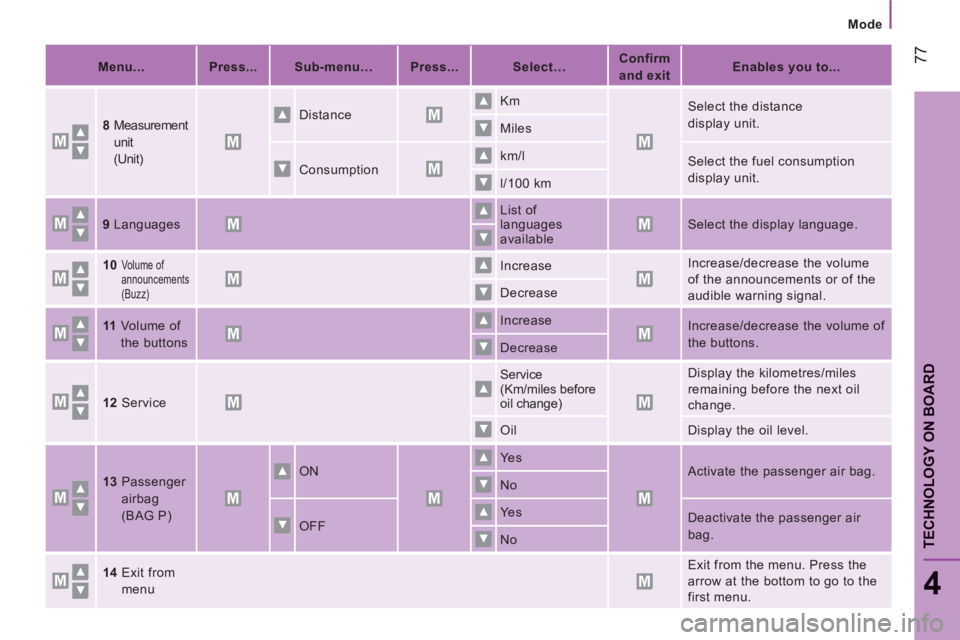
Menu...
Press...
Sub-menu…
Press...
Select…
Confirm
and exit
Enables you to...
8
Measurement
unit
(Unit) Distance
Km
Select the distance
display unit.
Miles
Consumption km/l
Select the fuel consumption
display unit.
l/100 km
9
Languages
List of
languages
available
Select the display language.
10
Volume of
announcements
(Buzz) Increase
Increase/decrease the volume
of the announcements or of the
audible warning signal. Decrease
11
Volume of
the buttons Increase
Increase/decrease the volume of
the buttons.
Decrease
12
Service
Service
(Km/miles before
oil change) Display the kilometres/miles
remaining before the next oil
change.
Oil Display the oil level.
13
Passenger
airbag
(BAG P) ON
Ye s
Activate the passenger air bag.
No
OFF Ye s
Deactivate the passenger air
bag.
No
14
Exit from
menu Exit from the menu. Press the
arrow at the bottom to go to the
first menu.
Page 80 of 184
kmCITY
Parking sensors
78
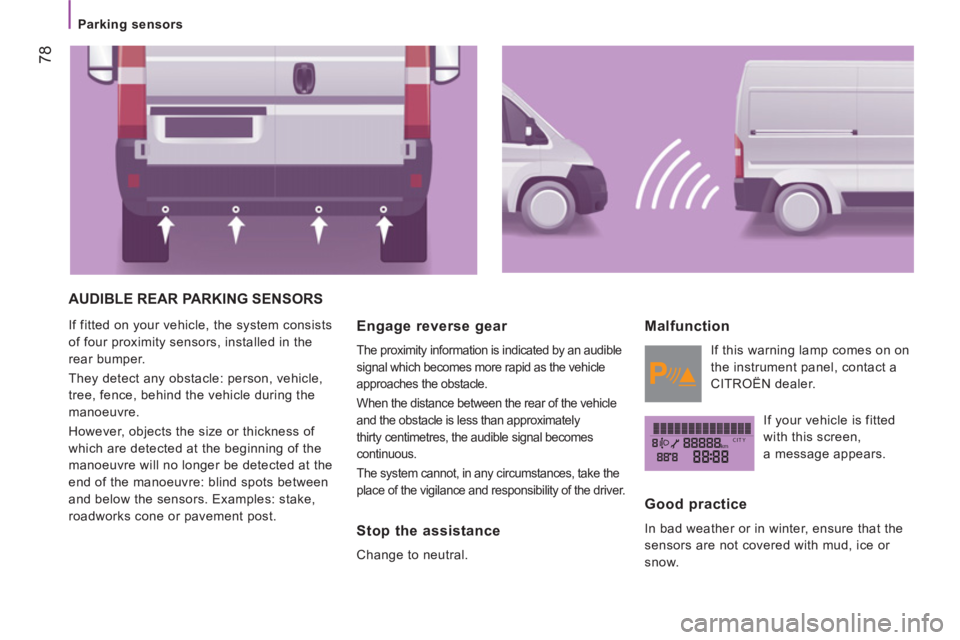
AUDIBLE REAR PARKING SENSORS
If fitted on your vehicle, the system consists
of four proximity sensors, installed in the
rear bumper.
They detect any obstacle: person, vehicle,
tree, fence, behind the vehicle during the
manoeuvre.
However, objects the size or thickness of
which are detected at the beginning of the
manoeuvre will no longer be detected at the
end of the manoeuvre: blind spots between
and below the sensors. Examples: stake,
roadworks cone or pavement post. Engage reverse gear
The proximity information is indicated by an audible
signal which becomes more rapid as the vehicle
approaches the obstacle.
When the distance between the rear of the vehicle
and the obstacle is less than approximately
thirty centimetres, the audible signal becomes
continuous.
The system cannot, in any circumstances, take the
place of the vigilance and responsibility of the driver.
Stop the assistance
Change to neutral.
Malfunction
If this warning lamp comes on on
the instrument panel, contact a
CITROËN dealer.
If your vehicle is fitted
with this screen,
a message appears.
Good practice
In bad weather or in winter, ensure that the
sensors are not covered with mud, ice or
snow.
Page 84 of 184
82
Deactivation
Make a long press on both controls
simultaneously to deactivate the system.
The LEDs remain on.
Return to the nominal floor height
Press the same number of times in reverse
as the level of the position displayed.
Reactivation
A second long press on both controls
simultaneously reactivates the system.
The LEDs go off.
Automatic correction of loading
floor height
Above 12 mph (20 km/h), the system
automatically returns the rear height to its
nominal value.
Warning lamp
Refer to the "Instruments and controls"
section of chapter 2.
Good practice
Driving with the suspension set too high or
too low risks damaging components under
the body.
The height may be adjusted automatically to
take account of changes of temperature or
loading.
You must avoid using this control in the
following circumstances:
- when working underneath the vehicle,
- when changing a wheel,
- when the vehicle is being transported by
lorry, train, ferry, boat, ...
Above 3 mph (5 km/h), the system
reactivates automatically.
Page 113 of 184
111
5
Driving safely
SAFETY
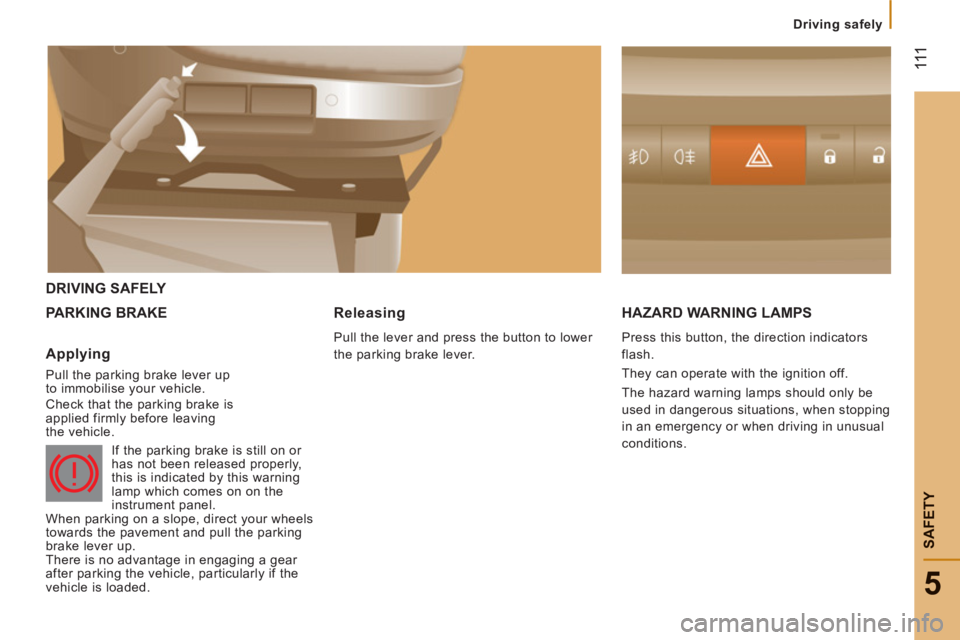
DRIVING SAFELY
PARKING BRAKE HAZARD WARNING LAMP
S
Press this button, the direction indicators
flash.
They can operate with the ignition off.
The hazard warning lamps should only be
used in dangerous situations, when stopping
in an emergency or when driving in unusual
conditions.
Applying
Pull the parking brake lever up
to immobilise your vehicle.
Check that the parking brake is
applied firmly before leaving
the vehicle.
If the parking brake is still on or
has not been released properly,
this is indicated by this warning
lamp which comes on on the
instrument panel.
When parking on a slope, direct your wheels
towards the pavement and pull the parking
brake lever up.
There is no advantage in engaging a gear
after parking the vehicle, particularly if the
vehicle is loaded.
Releasing
Pull the lever and press the button to lower
the parking brake lever.
Page 114 of 184
11 2
Driving safely
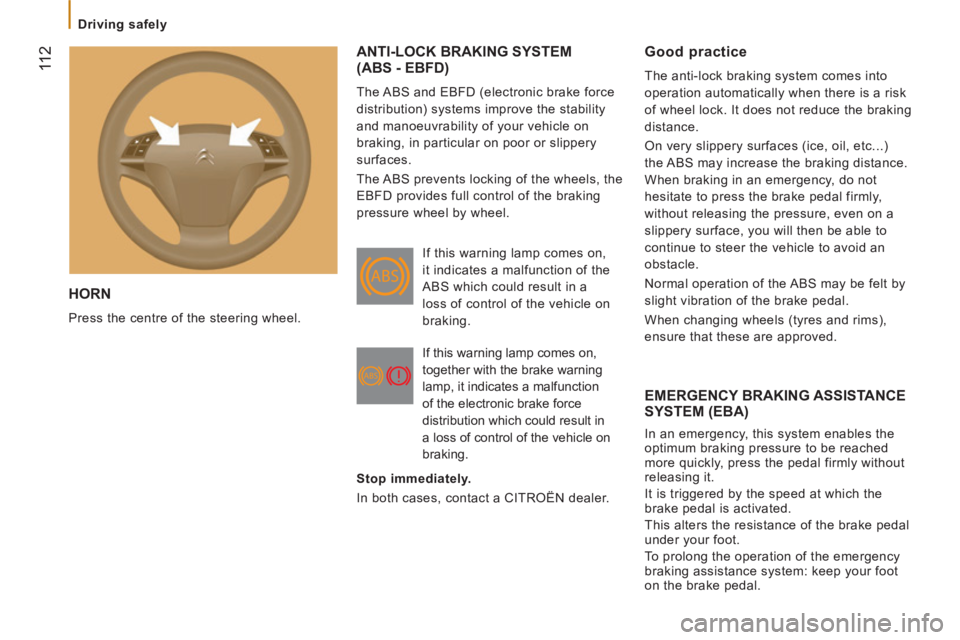
HORN
Press the centre of the steering wheel.
ANTI-LOCK BRAKING SYSTEM (ABS - EBFD)
The ABS and EBFD (electronic brake force
distribution) systems improve the stability
and manoeuvrability of your vehicle on
braking, in particular on poor or slippery
surfaces.
The ABS prevents locking of the wheels, the
EBFD provides full control of the braking
pressure wheel by wheel.
EMERGENCY BRAKING ASSISTANCE
SYSTEM (EBA)
In an emergency, this system enables the
optimum braking pressure to be reached
more quickly, press the pedal firmly without
releasing it.
It is triggered by the speed at which the
brake pedal is activated.
This alters the resistance of the brake pedal
under your foot.
To prolong the operation of the emergency
braking assistance system: keep your foot
on the brake pedal.
Good practice
The anti-lock braking system comes into
operation automatically when there is a risk
of wheel lock. It does not reduce the braking
distance.
On very slippery surfaces (ice, oil, etc...)
the ABS may increase the braking distance.
When braking in an emergency, do not
hesitate to press the brake pedal firmly,
without releasing the pressure, even on a
slippery surface, you will then be able to
continue to steer the vehicle to avoid an
obstacle.
Normal operation of the ABS may be felt by
slight vibration of the brake pedal.
When changing wheels (tyres and rims),
ensure that these are approved. If this warning lamp comes on,
it indicates a malfunction of the
ABS which could result in a
loss of control of the vehicle on
braking.
If this warning lamp comes on,
together with the brake warning
lamp, it indicates a malfunction
of the electronic brake force
distribution which could result in
a loss of control of the vehicle on
braking.
Stop immediately.
In both cases, contact a CITROËN dealer.
Page 115 of 184
11
3
5
Driving safely
SAFETY
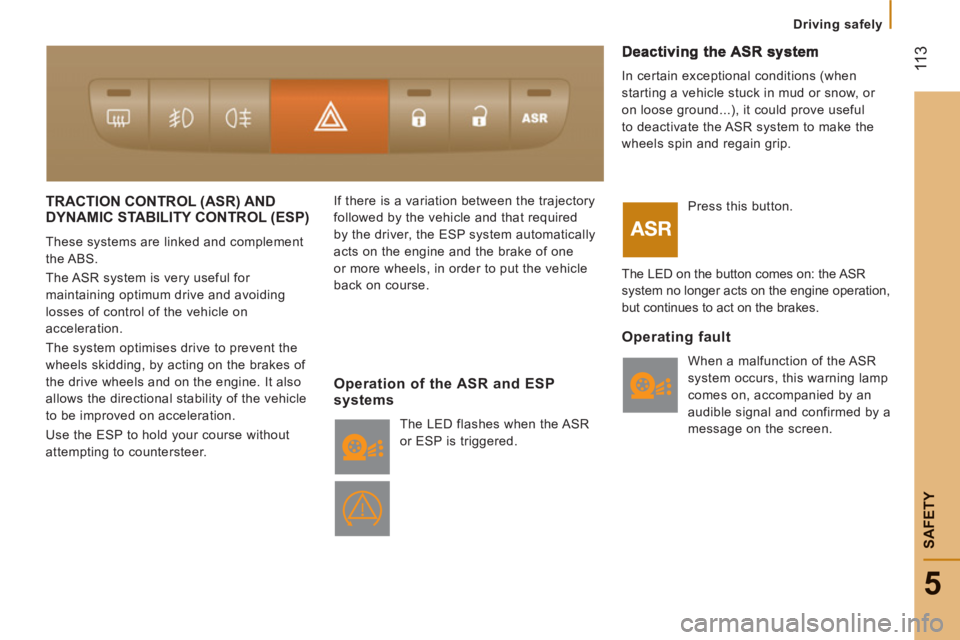
TRACTION CONTROL (ASR) AND DYNAMIC STABILITY CONTROL (ESP)
These systems are linked and complement
the ABS.
The ASR system is very useful for
maintaining optimum drive and avoiding
losses of control of the vehicle on
acceleration.
The system optimises drive to prevent the
wheels skidding, by acting on the brakes of
the drive wheels and on the engine. It also
allows the directional stability of the vehicle
to be improved on acceleration.
Use the ESP to hold your course without
attempting to countersteer. If there is a variation between the trajectory
followed by the vehicle and that required
by the driver, the ESP system automatically
acts on the engine and the brake of one
or more wheels, in order to put the vehicle
back on course.
In certain exceptional conditions (when
starting a vehicle stuck in mud or snow, or
on loose ground...), it could prove useful
to deactivate the ASR system to make the
wheels spin and regain grip.
Operation of the ASR and ESP
systems
The LED flashes when the ASR
or ESP is triggered. Press this button.
The LED on the button comes on: the ASR
system no longer acts on the engine operation,
but continues to act on the brakes.
Operating fault
When a malfunction of the ASR
system occurs, this warning lamp
comes on, accompanied by an
audible signal and confirmed by a
message on the screen.
Page 116 of 184
11 4
Driving safely
When a malfunction of the ESP
system occurs, this warning lamp
comes on, accompanied by an
audible signal and confirmed by a
message on the screen.
Contact a CITROËN dealer to have the
system checked.
Good practice
The ASR/ESP systems offer increased
safety during normal driving, but should not
incite the driver to take risks or to drive at
high speed.
The operation of these systems is ensured
if the recommendations of the manufacturer
regarding the wheels (tyres and rims),
the braking components, the electronic
components and the fitting and repair
procedures within the CITROËN network are
observed.
After an impact, have these systems
checked by a CITROËN dealer. Intelligent Traction Control
System to improve traction on slippery
surfaces (snow, black ice, mud...).
This system checks for situations of difficult
surface adhesion that could make it difficult
to move off or make progress.
In these situations, Intelligent Traction
Control
takes over from the ASR
system,
by transferring drive to the wheel with the
best grip on the ground to provide the best
traction and trajectory control.
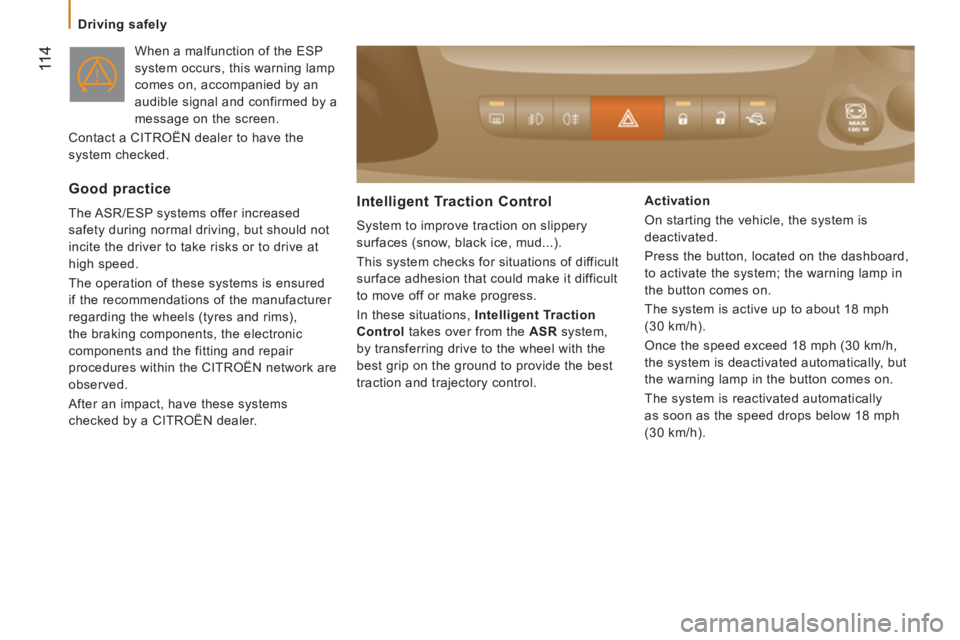
Activation
On starting the vehicle, the system is
deactivated.
Press the button, located on the dashboard,
to activate the system; the warning lamp in
the button comes on.
The system is active up to about 18 mph
(30 km/h).
Once the speed exceed 18 mph (30 km/h,
the system is deactivated automatically, but
the warning lamp in the button comes on.
The system is reactivated automatically
as soon as the speed drops below 18 mph
(30 km/h).