front light Citroen JUMPER 2012 2.G Owner's Manual
[x] Cancel search | Manufacturer: CITROEN, Model Year: 2012, Model line: JUMPER, Model: Citroen JUMPER 2012 2.GPages: 164, PDF Size: 4.52 MB
Page 4 of 164
2
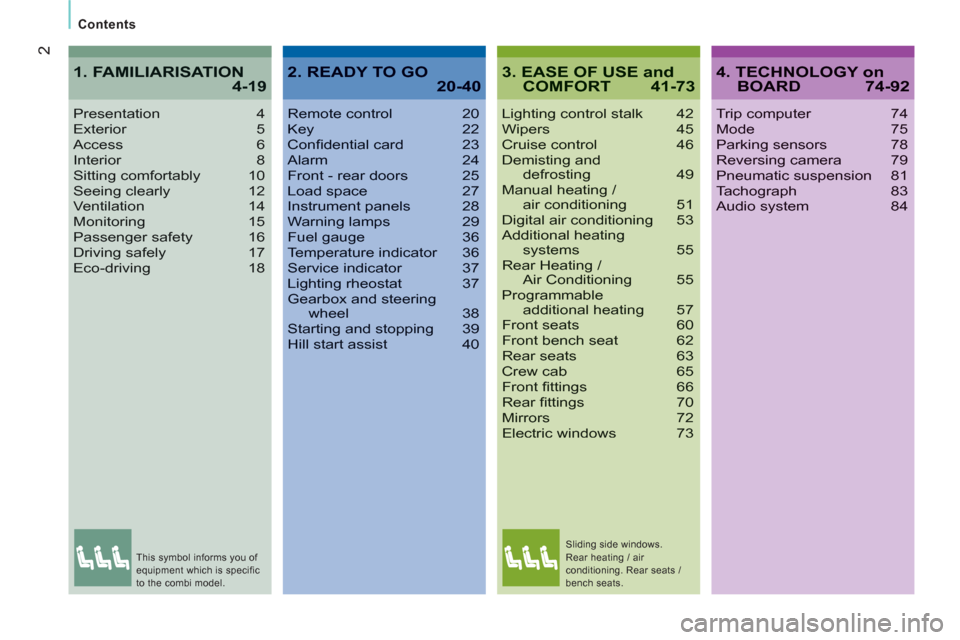
Contents
3. EASE OF USE andCOMFORT 41-73
Lighting control stalk 42Wipers 45Cruise control 46Demisting anddefrosting 49Manual heating / air conditioning 51Digital air conditioning 53Additional heatingsystems 55Rear Heating /Air Conditioning 55Programmableadditional heating 57Front seats 60Front bench seat 62Rear seats 63Crew cab 65Front fi ttings 66Rear fi ttings 70Mirrors 72Electric windows 73
Presentation4Exterior 5Access6Interior 8Sitting comfortably 10Seeing clearly 12Ventilation 14Monitoring 15Passenger safety 16Driving safely 17Eco-driving 18
1. FAMILIARISATION4-194. TECHNOLOGY onBOARD 74-92
Trip computer 74Mode 75Parking sensors 78Reversing camera 79Pneumatic suspension 81Tachograph 83Audio system 84
2. READY TO GO 20-40
Remote control 20Key 22Confi dential card 23Alarm 24Front - rear doors 25Load space 27Instrument panels 28Warning lamps 29Fuel gauge 36Temperature indicator 36Service indicator 37Lighting rheostat 37Gearbox and steeringwheel 38Starting and stopping 39Hill start assist 40
This symbol informs you of
equipment which is specific
to the combi model. Sliding side windows.
Rear heating / air
conditioning. Rear seats /
bench seats.
Page 7 of 164
4
34
2
1
FAMILIARISATION
5
Familiarisation
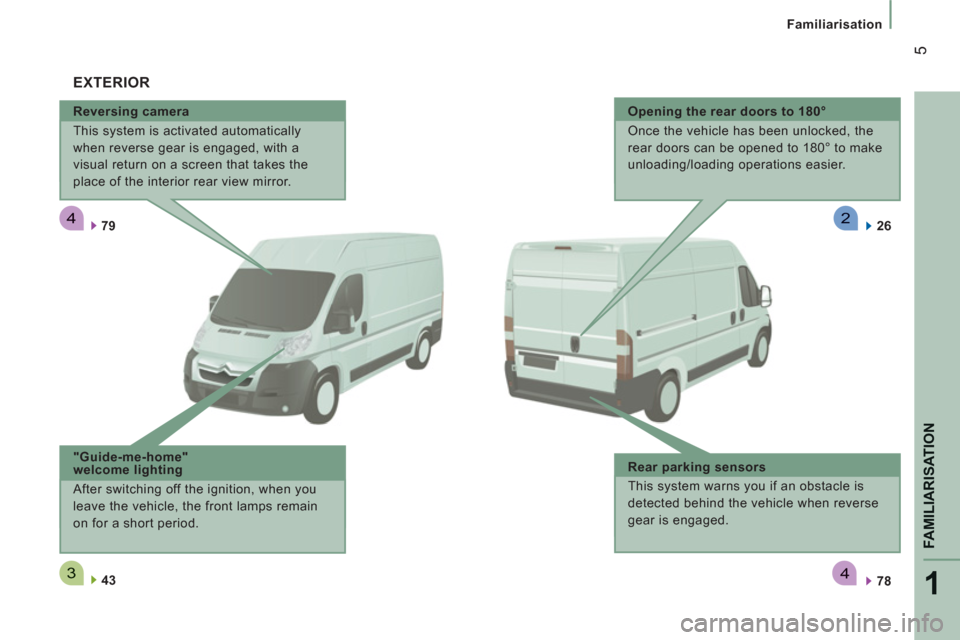
Reversing camera
This system is activated automatically
when reverse gear is engaged, with a
visual return on a screen that takes the
place of the interior rear view mirror.
79
78
43
EXTERIOR
"Guide-me-home"
welcome lighting
After switching off the ignition, when you
leave the vehicle, the front lamps remain
on for a short period.
Opening the rear doors to 180°
Once the vehicle has been unlocked, the
rear doors can be opened to 180° to make
unloading/loading operations easier.
Rear parking sensors
This system warns you if an obstacle is
detected behind the vehicle when reverse
gear is engaged.
26
Page 11 of 164
1
FAMILIARISATION
9
Familiarisation
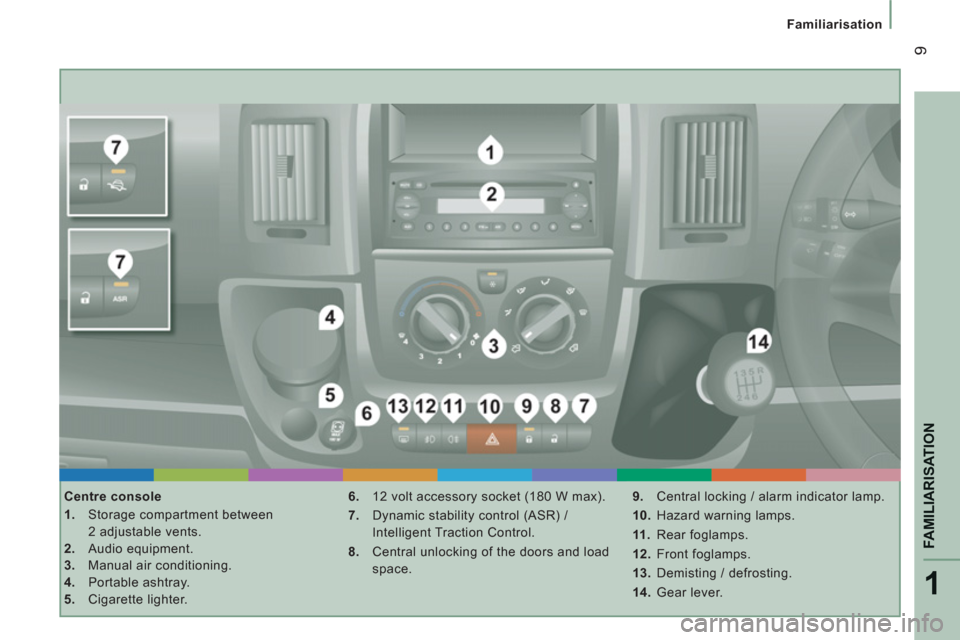
Centre console
1.
Storage compartment between
2 adjustable vents.
2.
Audio equipment.
3.
Manual air conditioning.
4.
Portable ashtray.
5.
Cigarette lighter.
6.
12 volt accessory socket (180 W max).
7.
Dynamic stability control (ASR) /
Intelligent Traction Control.
8.
Central unlocking of the doors and load
space.
9.
Central locking / alarm indicator lamp.
10.
Hazard warning lamps.
11 .
Rear foglamps.
12.
Front foglamps.
13.
Demisting / defrosting.
14.
Gear lever.
Page 14 of 164
33
12
Familiarisation
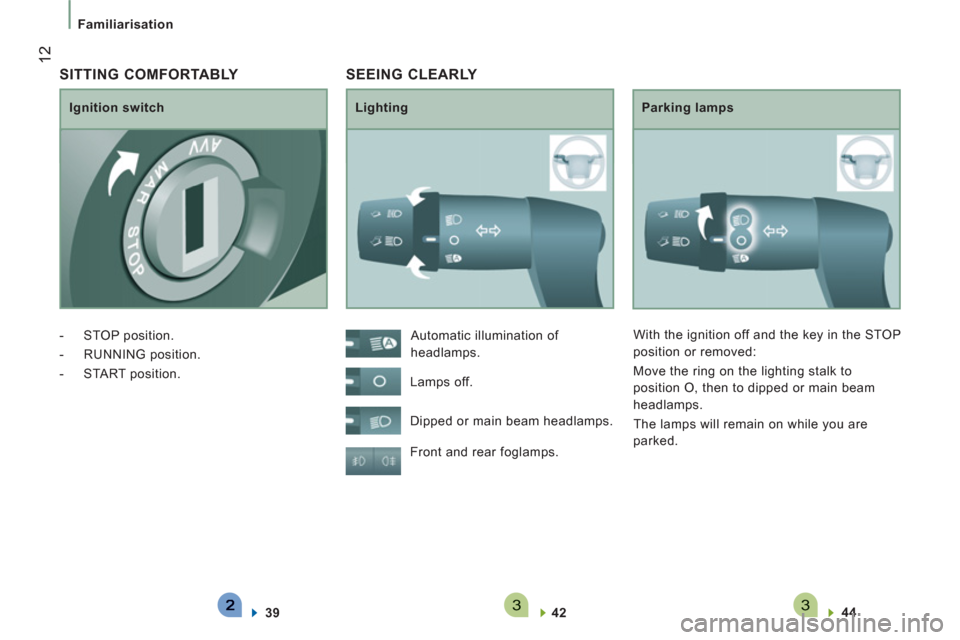
SEEING CLEARLY
Lighting
Parking lamps
Front and rear foglamps.
42
44
Automatic illumination of
headlamps.
Lamps off.
Dipped or main beam headlamps. With the ignition off and the key in the STOP
position or removed:
Move the ring on the lighting stalk to
position O, then to dipped or main beam
headlamps.
The lamps will remain on while you are
parked.
SITTING COMFORTABLY
Ignition switch
- STOP position.
- RUNNING position.
- START position.
39
Page 20 of 164
18
ECO-DRIVING
Eco-driving is a range of everyday practices that allow the motorist to optimise their fuel consumption and CO2 emissions.
Optimise the use of your gearbox
With a manual gearbox, move off gently,
change up without waiting and drive by
changing up quite soon. If your vehicle
has the system, the gear efficiency
indicator invites you to change up; it is
displayed in the instrument panel, follow
its instructions.
With an automatic or electronic gearbox,
stay in Drive "D"
or Auto "A"
, according to
the type of gearbox, without pressing the
accelerator pedal heavily or suddenly.
Drive smoothly
Maintain a safe distance between vehicles,
use engine braking rather than the
brake pedal, and press the accelerator
progressively. These practices contribute
towards a reduction in fuel consumption
and CO
2 emissions and also helps reduce
the background traffic noise.
If your vehicle has cruise control, make
use of the system at speeds above 25 mph
(40 km/h) when the traffic is flowing well.
Control the use of your electricalequipment
Before moving off, if the passenger
compartment is too warm, ventilate it by
opening the windows and air vents before
using the air conditioning.
Above 30 mph (50 km/h), close the windows
and leave the air vents open.
Remember to make use of equipment
that can help keep the temperature in the
passenger compartment down (sunroof and
window blinds...).
Switch off the air conditioning, unless it has
automatic digital regulation, as soon as the
desired temperature is attained.
Switch off the demisting and defrosting
controls, if not automatic.
Switch off the heated seat as soon as
possible.
Switch off the headlamps and front foglamps
when the level of light does not require their
use.
Avoid running the engine before moving
off, particularly in winter; your vehicle will
warm up much faster while driving.
As a passenger, if you avoid connecting
your multimedia devices (film, music,
video game...), you will contribute towards
limiting the consumption of electrical
energy, and so of fuel.
Disconnect your portable devices before
leaving the vehicle.
Page 36 of 164
34
Instruments and controls
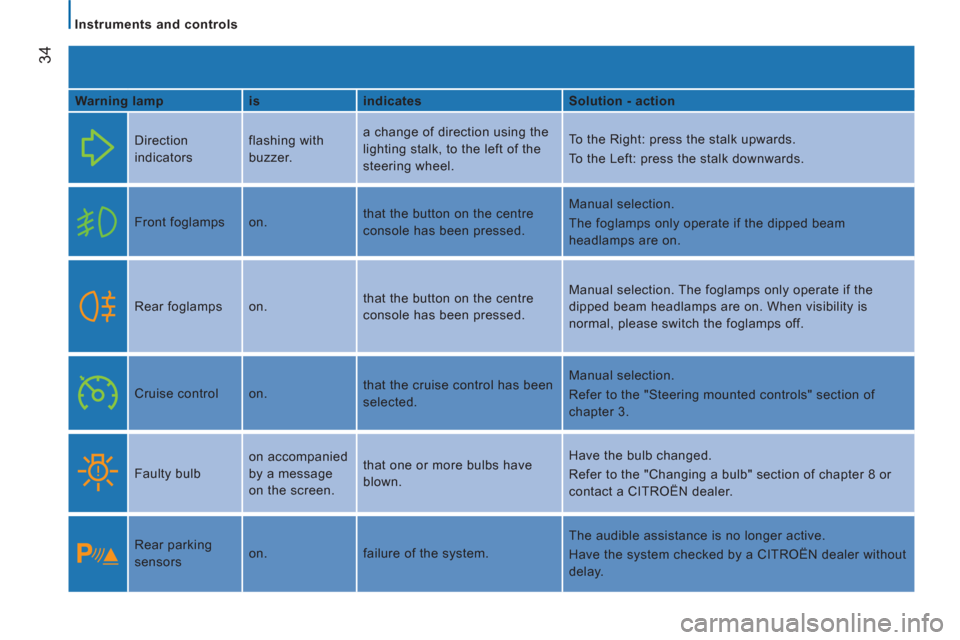
Warning lamp
is
indicates
Solution - action
Direction
indicators flashing with
buzzer. a change of direction using the
lighting stalk, to the left of the
steering wheel. To the Right: press the stalk upwards.
To the Left: press the stalk downwards.
Front foglamps on. that the button on the centre
console has been pressed. Manual selection.
The foglamps only operate if the dipped beam
headlamps are on.
Rear foglamps on. that the button on the centre
console has been pressed. Manual selection. The foglamps only operate if the
dipped beam headlamps are on. When visibility is
normal, please switch the foglamps off.
Cruise control on. that the cruise control has been
selected. Manual selection.
Refer to the "Steering mounted controls" section of
chapter 3.
Faulty bulb on accompanied
by a message
on the screen. that one or more bulbs have
blown. Have the bulb changed.
Refer to the "Changing a bulb" section of chapter 8 or
contact a CITROËN dealer.
Rear parking
sensors on. failure of the system. The audible assistance is no longer active.
Have the system checked by a CITROËN dealer without
delay.
Page 44 of 164
42
Steering mounted controls
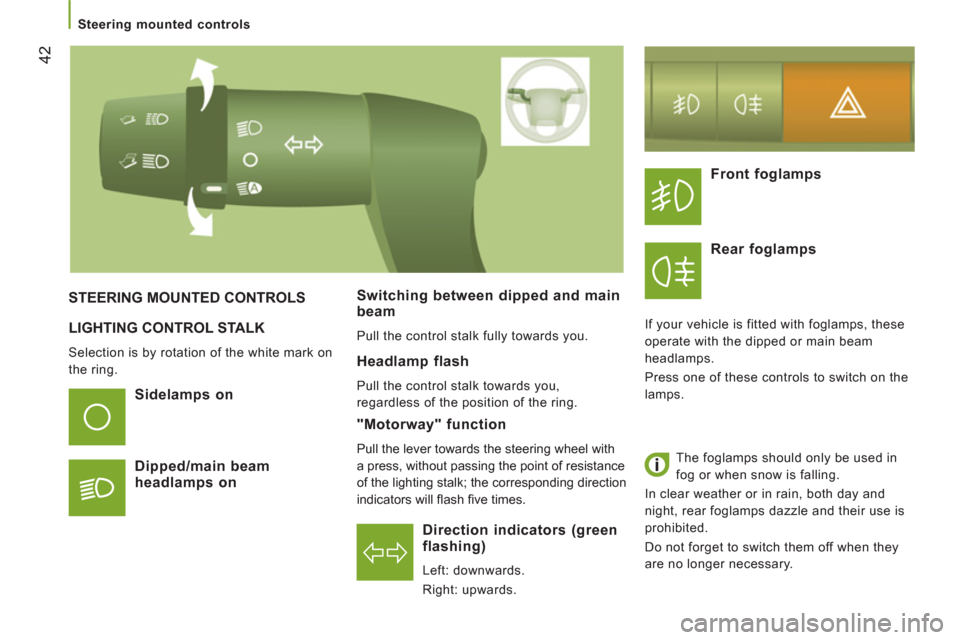
LIGHTING CONTROL STALK
Selection is by rotation of the white mark on
the ring.
Direction indicators (greenflashing)
Left: downwards.
Right: upwards.
STEERING MOUNTED CONTROLS
Sidelam
ps on
Di
pped/main beam headlamps on Switchin
g between dipped and main beam
Pull the control stalk fully towards you.
Headlamp flash
Pull the control stalk towards you,
regardless of the position of the ring.
Front foglamps
Rear fo
glamps
If your vehicle is fitted with foglamps, these
operate with the dipped or main beam
headlamps.
Press one of these controls to switch on the
lamps.
The foglamps should only be used in
fog or when snow is falling.
In clear weather or in rain, both day and
night, rear foglamps dazzle and their use is
prohibited.
Do not forget to switch them off when they
are no longer necessary.
"Motorway" function
Pull the lever towards the steering wheel with
a press, without passing the point of resistance
of the lighting stalk; the corresponding direction
indicators will fl ash fi ve times.
Page 73 of 164
3
EASE OF USE
and
COMFOR
T
Practical information
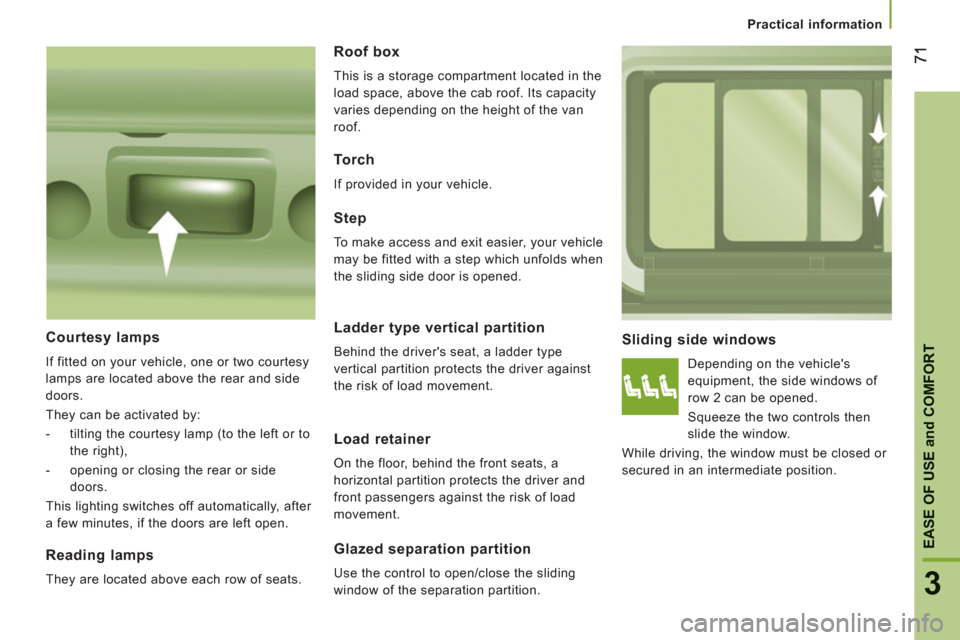
Sliding side windows
Depending on the vehicle's
equipment, the side windows of
row 2 can be opened.
Squeeze the two controls then
slide the window.
While driving, the window must be closed or
secured in an intermediate position.
Step
To make access and exit easier, your vehicle
may be fitted with a step which unfolds when
the sliding side door is opened.
Courtesy lamps
If fitted on your vehicle, one or two courtesy
lamps are located above the rear and side
doors.
They can be activated by:
- tilting the courtesy lamp (to the left or to
the right),
- opening or closing the rear or side
doors.
This lighting switches off automatically, after
a few minutes, if the doors are left open.
Reading lamps
They are located above each row of seats.
Roof box
This is a storage compartment located in the
load space, above the cab roof. Its capacity
varies depending on the height of the van
roof.
Torch
If provided in your vehicle.
Ladder type vertical partition
Behind the driver's seat, a ladder type
vertical partition protects the driver against
the risk of load movement.
Load retainer
On the floor, behind the front seats, a
horizontal partition protects the driver and
front passengers against the risk of load
movement.
Glazed separation partition
Use the control to open/close the sliding
window of the separation partition.
Page 101 of 164
99
5
SAFETY
Seat belts
The force limiter reduces the pressure of the
seat belt against the body of the occupants.
The pretensioning seat belts are active when
the ignition is switched on.
The inertia reels are fitted with a device
which automatically locks the strap in the
event of a collision or emergency braking or
if the vehicle rolls over.
You can unfasten the seat belt by pressing
the red button on the buckle. Guide the seat
belt after unfastening.
Good practice
The driver must ensure that passengers use
the seat belts correctly and that they are all
strapped in securely before moving off.
Wherever you are seated in the vehicle,
always fasten your seat belt, even for short
journeys.
The seat belts are fitted with an inertia reel
which automatically adjusts the length of the
strap to your size.
Do not use accessories (clothes pegs, clips,
safety pins, etc.) which permit a clearance
with the seat belt straps.
Ensure that the seat belt has reeled in
correctly after use.
After folding or moving a seat or a rear
bench seat, ensure that the seat belt has
reeled in correctly and that the buckle is
ready to accommodate the tongue.
Depending on the nature and seriousness
of any impact, the pretensioning device may
be triggered before and independently of
inflation of the airbags. It instantly tightens
the seat belts against the body of the
occupants. Triggering of the pretensioners
is accompanied by a slight discharge of
harmless smoke and a noise, due to the
activation of the pyrotechnic cartridge
incorporated in the system. The airbag warning lamp comes
on if the pretensioners are
triggered. Consult a CITROËN
dealer.
In order to be effective, a seat belt must:
- restrain one person only,
- must not be twisted, check by pulling in
front of you with an even movement,
- be tightened as close to the body as
possible.
The upper part of the seat belt should be
positioned in the hollow of the shoulder.
The lap part should be placed as low as
possible on the pelvis.
Do not invert the seat belt buckles as they
will not fulfil their role completely. If the seats are fitted with armrests, the lap
part of the seat belt should always pass
under the armrest.
Check that the seat belt is fastened correctly
by pulling the strap firmly.
Recommendations for children:
- use a suitable child seat if the
passenger is less than 12 years old or
shorter than one metre fifty,
- never allow a child to travel on your lap,
even with the seat belt fastened.
For more information on child seats,
refer to the "Child safety" section of
chapter 5.
Your CITROËN dealer can ensure that
all work or any checks, from testing to
maintenance on your seat belt equipment
meets current regulations.
Have the seat belts checked regularly
(even after a minor impact) by a CITROËN
dealer: they must not show any signs of
wear, cutting or fraying and they must not be
converted or modified.
Clean the seat belt straps with soapy
water or a textile cleaning product, sold
by CITROËN dealers.
Page 103 of 164
101
5
SAFETY
Airbags
AIRBAGS
The airbags have been designed to
maximise the safety of the occupants in the
event of a serious collision; they work in
conjunction with the force limiting seat belts.
In the event of a serious collision, the
electronic detectors record and analyse any
abrupt deceleration of the vehicle:
if the triggering threshold is reached, the
airbags inflate instantly and protect the
occupants of the vehicle.
Immediately after the impact, the airbags
deflate rapidly, so that they do not hinder the
visibility of the occupants nor their possible
exit from the vehicle. The airbags will not be deployed in collisions
which are not serious, for which the seat belt
is sufficient to provide maximum protection.
The seriousness of the collision depends on
the nature of the obstacle and the speed of
the vehicle at the moment of impact.
Airbags only operate when the ignition is
switched on. Front airbags
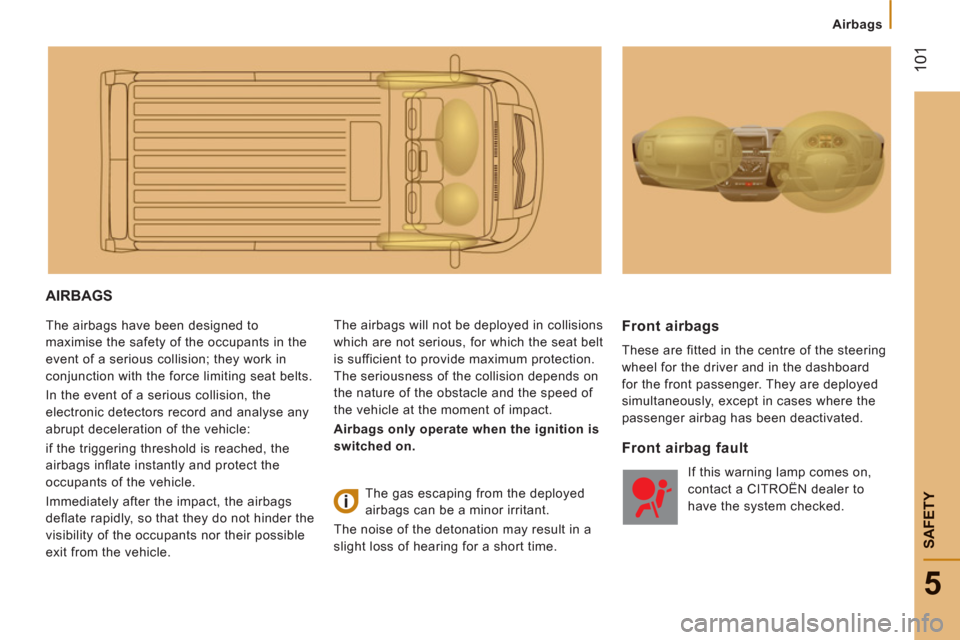
These are fitted in the centre of the steering
wheel for the driver and in the dashboard
for the front passenger. They are deployed
simultaneously, except in cases where the
passenger airbag has been deactivated.
The gas escaping from the deployed
airbags can be a minor irritant.
The noise of the detonation may result in a
slight loss of hearing for a short time.
Front airbag fault
If this warning lamp comes on,
contact a CITROËN dealer to
have the system checked.