Lock Citroen JUMPER 2014 2.G Owner's Guide
[x] Cancel search | Manufacturer: CITROEN, Model Year: 2014, Model line: JUMPER, Model: Citroen JUMPER 2014 2.GPages: 240, PDF Size: 7.71 MB
Page 80 of 240
Practical information
78
JUMPER-PAPIER_EN_CHAP03_ERGO ET CONFORT_ED01-2014
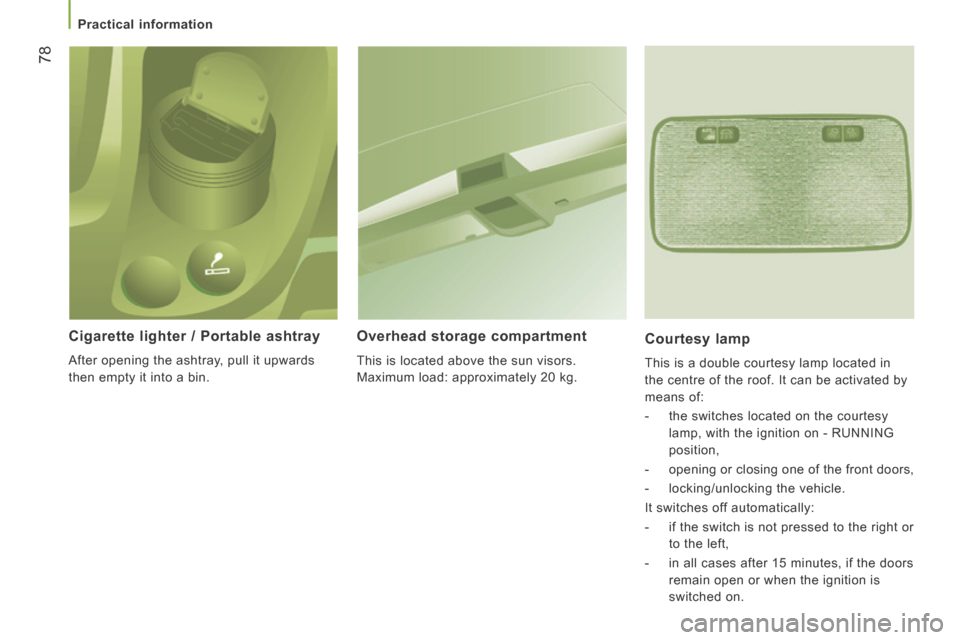
Cigarette lighter / Portable ashtray
After opening the ashtray, pull it upwards
then empty it into a bin.
Overhead storage compartment
This is located above the sun visors.
Maximum load: approximately 20 kg.
Courtesy lamp
This is a double courtesy lamp located in
the centre of the roof. It can be activated by
means of:
- the switches located on the courtesy lamp, with the ignition on - RUNNING
position,
- opening or closing one of the front doors,
- locking/unlocking the vehicle.
It switches off automatically:
- if the switch is not pressed to the right or to the left,
- in all cases after 15 minutes, if the doors remain open or when the ignition is
switched on.
Page 87 of 240
Vehicle configuration
85
4
TECHNOLOGY
on
BOARD
JUMPER-PAPIER_EN_CHAP04_TECHNOLOGIE A BORD_ED01-2014
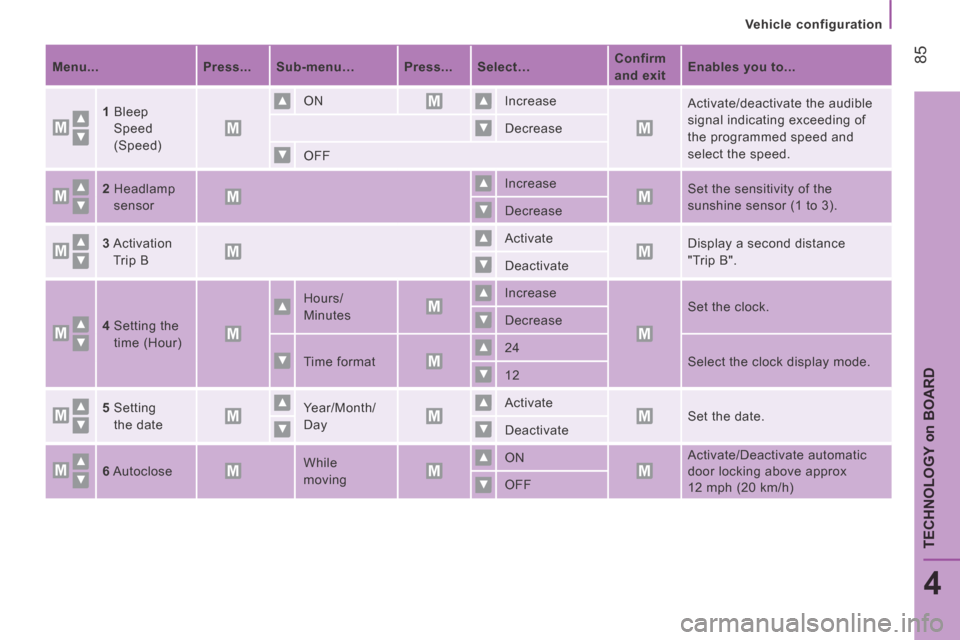
Menu... Press... Sub-menu… Press... Select… Confirm
and exit
Enables you to...
1 Bleep
Speed
(Speed) ON
Increase
Activate/deactivate the audible
signal indicating exceeding of
the programmed speed and
select the speed.
Decrease
OFF
2 Headlamp
sensor
Increase
Set the sensitivity of the
sunshine sensor (1 to 3).
Decrease
3 Activation
Trip B
Activate
Display a second distance
"Trip B".
Deactivate
4 Setting the
time (Hour)
Hours/
Minutes Increase
Set the clock.
Decrease
Time format 24
Select the clock display mode.
12
5 Setting
the date Year/Month/
Day Activate
Set the date.
Deactivate
6 Autoclose While
moving ON
Activate/Deactivate automatic
door locking above approx
12 mph (20 km/h)
OFF
Page 89 of 240
Vehicle configuration
87
4
TECHNOLOGY
on
BOARD
JUMPER-PAPIER_EN_CHAP04_TECHNOLOGIE A BORD_ED01-2014
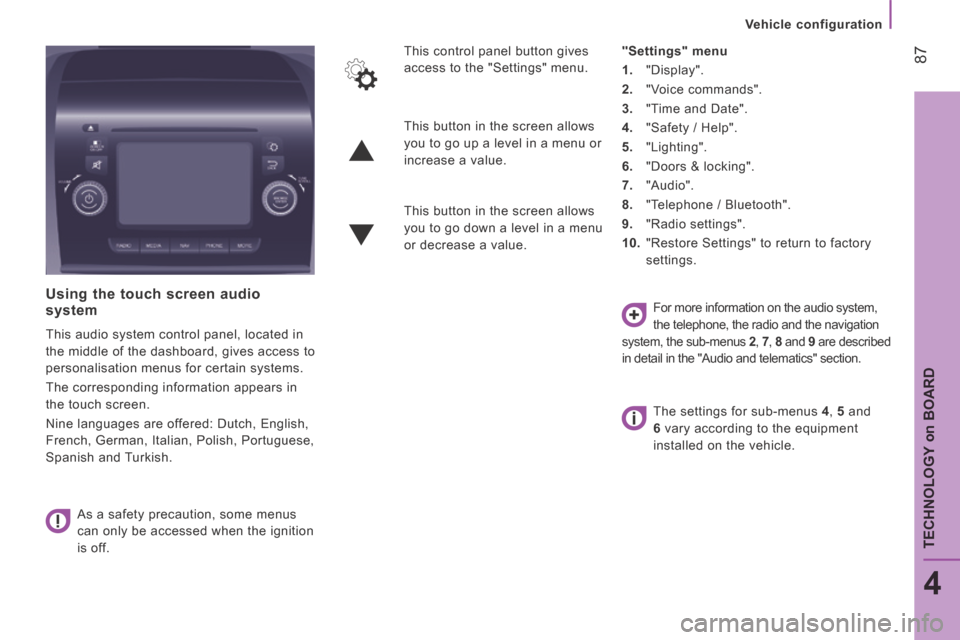
Using the touch screen audio system
This audio system control panel, located in
the middle of the dashboard, gives access to
personalisation menus for certain systems.
The corresponding information appears in
the touch screen.
Nine languages are offered: Dutch, English,
French, German, Italian, Polish, Portuguese,
Spanish and Turkish. As a safety precaution, some menus
can only be accessed when the ignition
is off. This control panel button gives
access to the "Settings" menu.
"Settings" menu
1. "Display".
2. "Voice commands".
3. "Time and Date".
4. "Safety / Help".
5. "Lighting".
6. "Doors & locking".
7. "Audio".
8. "Telephone / Bluetooth".
9. "Radio settings".
10. "Restore Settings" to return to factory
settings.
This button in the screen allows
you to go up a level in a menu or
increase a value.
This button in the screen allows
you to go down a level in a menu
or decrease a value.
For more information on the audio system,
the telephone, the radio and the navigation
system, the sub-menus 2 , 7 , 8 and 9 are described
in detail in the "Audio and telematics" section.
The settings for sub-menus 4 , 5 and
6 vary according to the equipment
installed on the vehicle.
Page 90 of 240
Vehicle configuration
88
JUMPER-PAPIER_EN_CHAP04_TECHNOLOGIE A BORD_ED01-2014
From the "Safety / Help" sub menu, you can:
- select "Reversing camera" to activate or deactivate its use (On, Off),
- select "Passenger airbag" to activate or deactivate its use (On, Off).
From the "Lighting" sub-menu, you can:
- select "Day lamps" to activate or deactivate their use (On, Off),
- select "Headlamp sensor" to adjust its sensitivity (1, 2, 3).
From the "Doors & locking", you can:
- select "Autoclose" to activate or deactivate its use (On, Off).
From the "Display" sub-menu, you can:
- select "Languages" and choose one of
the languages listed above,
- select "Units of measurement" to choose the units for fuel consumption
(l/100 km, mpg), distance (miles, km)
and temperature (°C, °F),
- select "Display Trip B" to switch trip B On or Off in the trip computer.
From the "Time and Date" sub-menu, you
can:
- select "Adjust time and format" to set the hour, minutes and seconds and choose
the format (24 h, 12 h with am or pm),
- select "Adjust Date" to set the day, month and year.
To set the time manually, "Synch Time"
must be Off.
Page 97 of 240
95
5
Driving safely
SAFETY
JUMPER-PAPIER_EN_CHAP05_SECURITE_ED01-2014
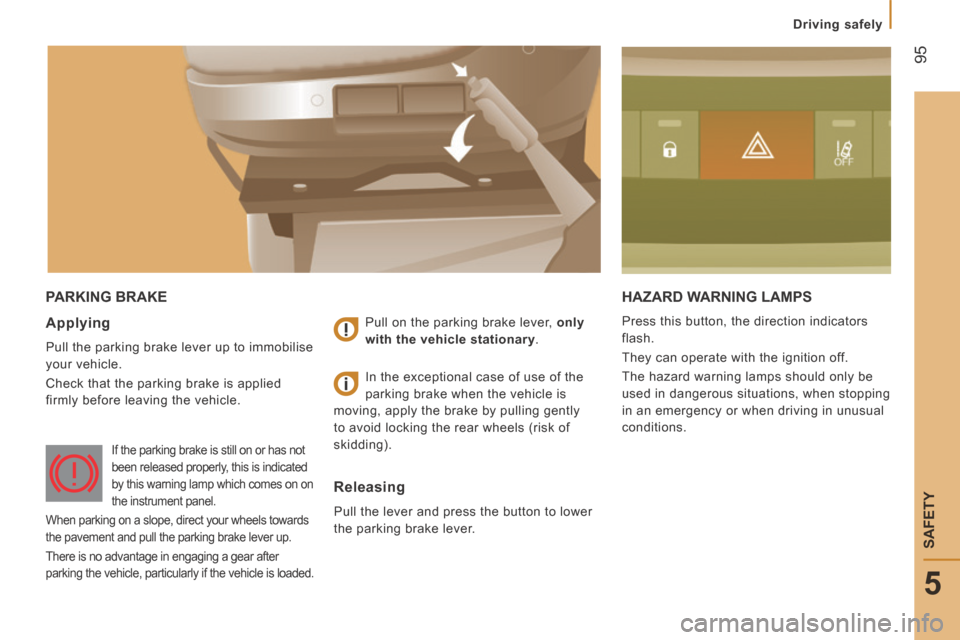
PARKING BRAKE HAZARD WARNING LAMPS
Press this button, the direction indicators
flash.
They can operate with the ignition off.
The hazard warning lamps should only be
used in dangerous situations, when stopping
in an emergency or when driving in unusual
conditions. Applying
Pull the parking brake lever up to immobilise
your vehicle.
Check that the parking brake is applied
firmly before leaving the vehicle. Pull on the parking brake lever,
only
with the vehicle stationary .
Releasing
Pull the lever and press the button to lower
the parking brake lever. In the exceptional case of use of the
parking brake when the vehicle is
moving, apply the brake by pulling gently
to avoid locking the rear wheels (risk of
skidding).
If the parking brake is still on or has not
been released properly, this is indicated
by this warning lamp which comes on on
the instrument panel.
When parking on a slope, direct your wheels towards
the pavement and pull the parking brake lever up.
There is no advantage in engaging a gear after
parking the vehicle, particularly if the vehicle is loaded.
Page 98 of 240
96
Driving safely
JUMPER-PAPIER_EN_CHAP05_SECURITE_ED01-2014
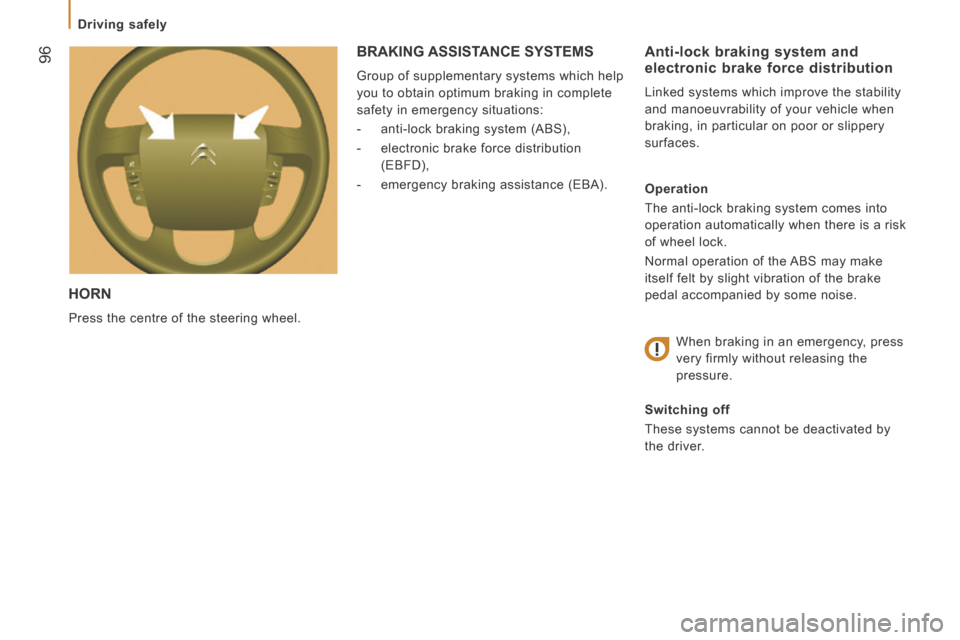
HORN
Press the centre of the steering wheel.
Anti-lock braking system and electronic brake force distribution
Linked systems which improve the stability
and manoeuvrability of your vehicle when
braking, in particular on poor or slippery
surfaces.
Operation
The anti-lock braking system comes into
operation automatically when there is a risk
of wheel lock.
Normal operation of the ABS may make
itself felt by slight vibration of the brake
pedal accompanied by some noise.
When braking in an emergency, press
very firmly without releasing the
pressure.
Switching off
These systems cannot be deactivated by
the driver.
BRAKING ASSISTANCE SYSTEMS
Group of supplementary systems which help
you to obtain optimum braking in complete
safety in emergency situations:
- anti-lock braking system (ABS),
- electronic brake force distribution (EBFD),
- emergency braking assistance (EBA).
Page 99 of 240
97
5
Driving safely
SAFETY
JUMPER-PAPIER_EN_CHAP05_SECURITE_ED01-2014
Good practice
The ABS system does not provide shorter
braking distances. On very slippery surfaces
(black ice, oil...) the ABS can extend braking
distances. For emergency braking, press the
brake pedal hard and do not release it, even
on a slipper surface; you will then be able to
steer the vehicle and avoid an obstacle.
When replacing wheels (tyres and
rims), ensure that they conform to the
manufacturer's recommendations. Emergency braking assistance
System which, in an emergency, enables
you to obtain the optimum braking pressure
more quickly, thus reducing the stopping
distance.
Operation
It is triggered by the speed at which the
brake pedal is pressed.
The effect of this is a reduction in the
resistance of the pedal and an increase in
braking efficiency.
Switching off
This system cannot be deactivated by
the driver.
Operating fault
If this warning lamp comes on,
accompanied by an audible signal
and a message in the instrument
panel screen, it indicates a fault with
the anti-lock braking system which could result in
loss of control of the vehicle when braking.
For maximum braking efficiency, a
bedding-in period of around 300 miles
(500 kilometres) is needed. During this
period it is recommended that you avoid
harsh, repeated or prolonged braking. If this warning lamp comes on,
together with the
ABS warning
lamp, accompanied by a message
in the instrument panel screen,
it indicates a fault with the electronic brake
force distribution which could result in loss
of control of the vehicle when braking.
You must stop as soon as it is safe to do so.
In either case, contact a CITROËN dealer or
a qualified workshop. When braking in an emergency, press
firmly without releasing the pressure.
Page 104 of 240
Seat belts
102
JUMPER-PAPIER_EN_CHAP05_SECURITE_ED01-2014
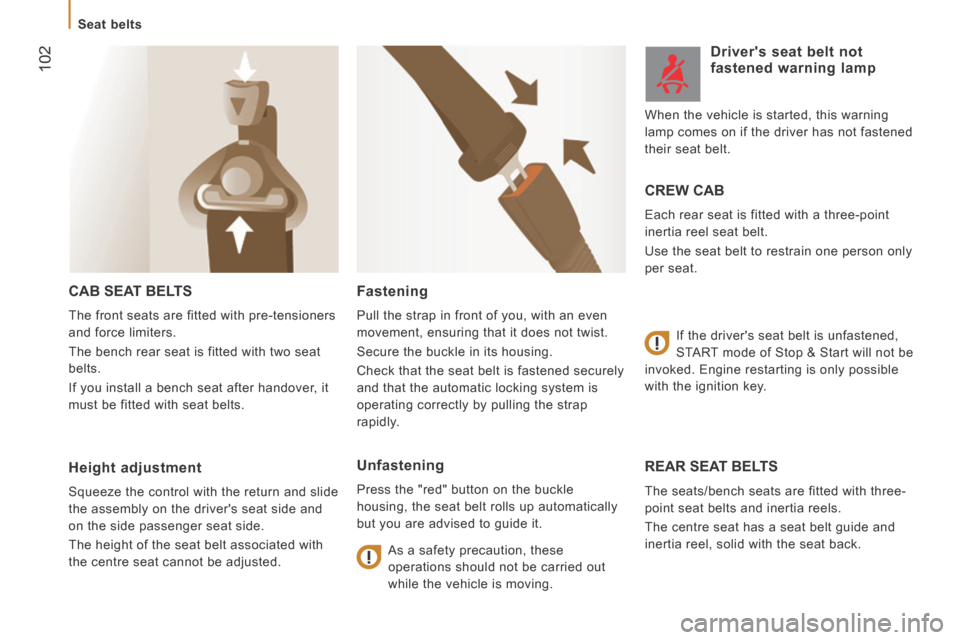
CAB SEAT BELTS
The front seats are fitted with pre-tensioners
and force limiters.
The bench rear seat is fitted with two seat
belts.
If you install a bench seat after handover, it
must be fitted with seat belts.
REAR SEAT BELTS
The seats/bench seats are fitted with three-
point seat belts and inertia reels.
The centre seat has a seat belt guide and
inertia reel, solid with the seat back.
Height adjustment
Squeeze the control with the return and slide
the assembly on the driver's seat side and
on the side passenger seat side.
The height of the seat belt associated with
the centre seat cannot be adjusted.
Fastening
Pull the strap in front of you, with an even
movement, ensuring that it does not twist.
Secure the buckle in its housing.
Check that the seat belt is fastened securely
and that the automatic locking system is
operating correctly by pulling the strap
rapidly.
Unfastening
Press the "red" button on the buckle
housing, the seat belt rolls up automatically
but you are advised to guide it. As a safety precaution, these
operations should not be carried out
while the vehicle is moving.
Driver's seat belt not fastened warning lamp
CREW CAB
Each rear seat is fitted with a three-point
inertia reel seat belt.
Use the seat belt to restrain one person only
per seat.
If the driver's seat belt is unfastened,
START mode of Stop & Start will not be
invoked. Engine restarting is only possible
with the ignition key. When the vehicle is started, this warning
lamp comes on if the driver has not fastened
their seat belt.
Page 105 of 240
Seat belts
103
5
SAFETY
JUMPER-PAPIER_EN_CHAP05_SECURITE_ED01-2014
The force limiter reduces the pressure
of the seat belt against the body of the
occupants.
The pretensioning seat belts are active when
the ignition is switched on.
The inertia reels are fitted with a device
which automatically locks the strap in the
event of a collision or emergency braking or
if the vehicle rolls over.
You can unfasten the seat belt by pressing
the red button on the buckle. Guide the seat
belt after unfastening. Good practice
The driver must ensure that passengers
use the seat belts correctly and that they
are all strapped in securely before
moving off.
Wherever you are seated in the vehicle,
always fasten your seat belt, even for short
journeys.
The seat belts are fitted with an inertia reel
which automatically adjusts the length of the
strap to your size.
Do not use accessories (clothes pegs, clips,
safety pins, etc.) which allow the seat belt
straps to fit loosely.
Ensure that the seat belt has reeled in
correctly after use.
After folding or moving a seat or
a rear bench seat, ensure that the seat
belt has reeled in correctly and that
the buckle is ready to accommodate
the tongue.
Depending on the nature and seriousness of
any impact, the pretensioning device may be
deployed before and independently of infl ation
of the airbags. It instantly tightens the seat
belts against the body of the occupants.
Deployment of the pretensioners is
accompanied by a slight discharge of
harmless smoke and a noise, due to the
activation of the pyrotechnic cartridge
incorporated in the system. The airbag warning lamp also
comes on if the pretensioners are
deployed. Contact a CITROËN
dealer or a qualified workshop.
In order to be effective, a seat belt:
- must restrain one person only,
- must not be twisted, check by pulling in front of you with an even movement,
- must be tightened as close to the body as possible.
The upper part of the seat belt should be
positioned in the hollow of the shoulder.
The lap part should be placed as low as
possible on the pelvis. Do not invert the seat belt buckles as they
will not fulfil their role completely. If the
seats are fitted with armrests, the lap part of
the seat belt should always pass under the
armrest.
Check that the seat belt is fastened correctly
by pulling the strap firmly.
Recommendations for children
Use an appropriate child seat if the
passenger is under 12 years or less than
one and a half metres tall.
Never carry a child on your knees, even with
the seat belt fastened.
For more information on child seats,
refer to the "Safety - Children on board"
section.
In accordance with current safety
regulations, your CITROËN dealer can
guarantee all work or any checks, from
testing to maintenance, on your seat belt
equipment.
Have the seat belts checked regularly (even
after a minor impact) by a CITROËN dealer
or a qualified workshop: they must not show
any signs of wear, cutting or fraying and they
must not be converted or modified.
Clean the seat belt straps with soapy
water or a textile cleaning product, sold
by CITROËN dealers.
Page 106 of 240
Improved safety and security
104
JUMPER-PAPIER_EN_CHAP05_SECURITE_ED01-2014
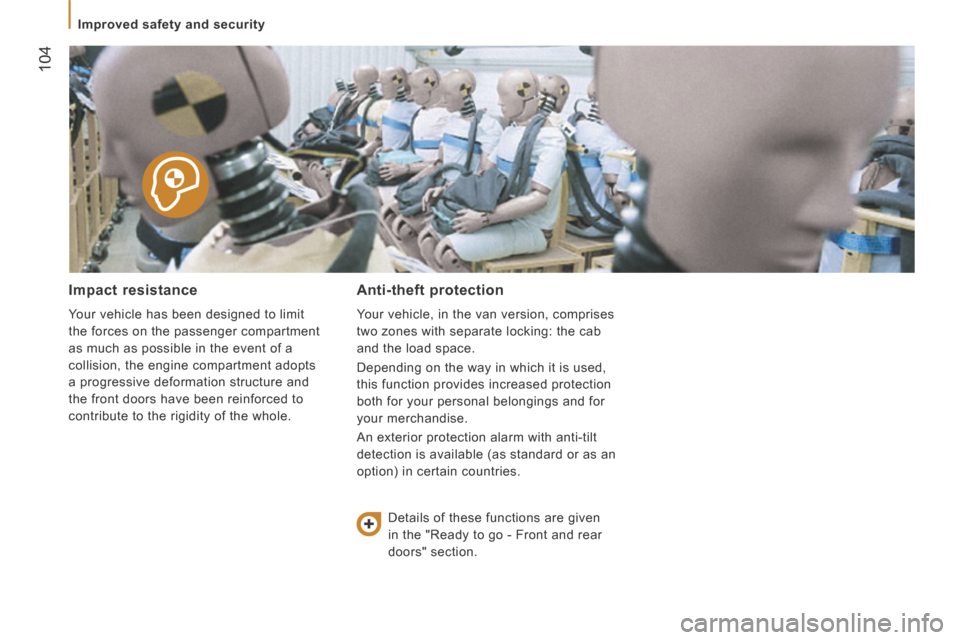
Impact resistance
Your vehicle has been designed to limit
the forces on the passenger compartment
as much as possible in the event of a
collision, the engine compartment adopts
a progressive deformation structure and
the front doors have been reinforced to
contribute to the rigidity of the whole.
Anti-theft protection
Your vehicle, in the van version, comprises
two zones with separate locking: the cab
and the load space.
Depending on the way in which it is used,
this function provides increased protection
both for your personal belongings and for
your merchandise.
An exterior protection alarm with anti-tilt
detection is available (as standard or as an
option) in certain countries. Details of these functions are given
in the "Ready to go - Front and rear
doors" section.