sport CITROEN JUMPY 2008 Owners Manual
[x] Cancel search | Manufacturer: CITROEN, Model Year: 2008, Model line: JUMPY, Model: CITROEN JUMPY 2008Pages: 252, PDF Size: 12.15 MB
Page 81 of 252
79
Rear suspension
EASE OF USE
and
COMFORT
3
Metal suspension
This equipment adopts long movement limiters
which make it possible to guarantee stable
behaviour both when loaded and when empty.
No action on your part is required except to
ensure that maintenance is carried out and that
the authorised loads are complied with. irrespective of the weight of the load, within
the limit of the authorised values. On board,
the increasing or lightening of the load on the
vehicle's platform is detected by two height
sensors. When all of the doors are closed,
the sensors trigger the automatic height
correction and determine the optimum height
of the sill for the vehicle's driving conditions.
Deactivation of automatic height correction
The control which permits deactivation of
automatic regulation is located on the right-
hand side, at the rear of the vehicle.
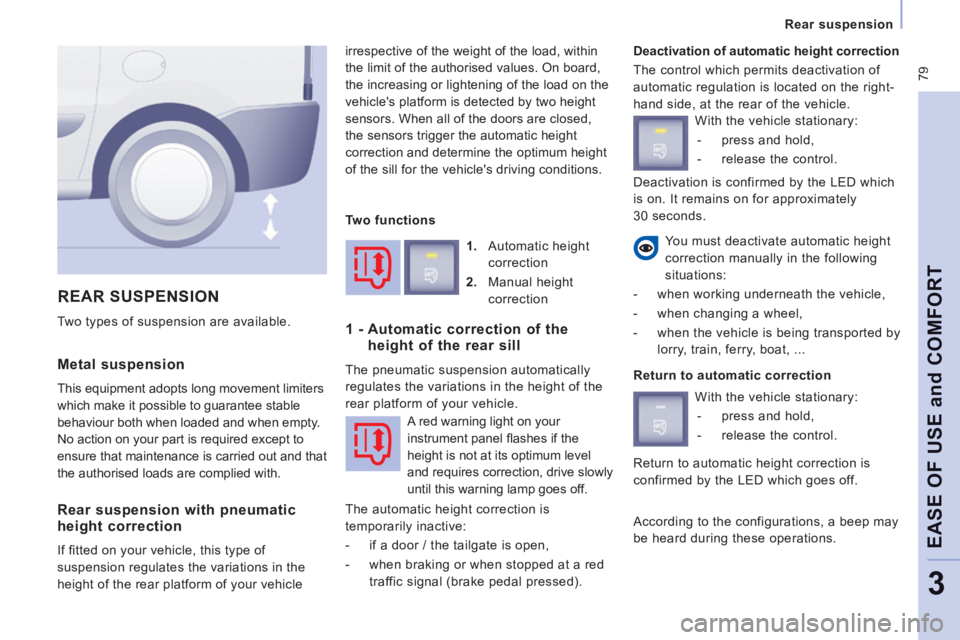
REAR SUSPENSION
You must deactivate automatic height
correction manually in the following
situations:
- when working underneath the vehicle,
- when changing a wheel,
- when the vehicle is being transported by lorry, train, ferry, boat, ...
Two types of suspension are available.
Rear suspension with pneumatic
height correction
If fi tted on your vehicle, this type of
suspension regulates the variations in the
height of the rear platform of your vehicle 1. Automatic height
correction
2. Manual height correction
1 - Automatic correction of the height of the rear sill
The pneumatic suspension automatically
regulates the variations in the height of the
rear platform of your vehicle.
A red warning light on your
instrument panel fl ashes if the
height is not at its optimum level
and requires correction, drive slowly
until this warning lamp goes off.
The automatic height correction is
temporarily inactive:
- if a door / the tailgate is open,
- when braking or when stopped at a red traffic signal (brake pedal pressed). With the vehicle stationary:
- press and hold,
- release the control.
Return to automatic correction With the vehicle stationary: - press and hold,
- release the control.
According to the configurations, a beep may
be heard during these operations.
Two functions
Return to automatic height correction is
confirmed by the LED which goes off. Deactivation is confirmed by the LED which
is on. It remains on for approximately
30 seconds.
Page 83 of 252

81
Rear suspension
EASE OF USE
and
COMFORT
3
Deactivation of manual height correction Good practice
When stationary and with the ignition key
removed, excessive use of the system
consumes battery power. Long term parking
Avoid parking for a long duration on ground
which could present a potential obstacle as
your vehicle could lower.
Following a long period out of use, the
height of the platform may change due to the
automatic height correction on unlocking or
on opening one of your vehicle's doors.
With the vehicle stationary:
- press and hold,
- release the control.
Return to manual height correction
According to the configuration, a beep may
be heard during these operations. You must deactivate the manual height
correction in the following situations:
- when working underneath the vehicle,
- when changing a wheel,
- when the vehicle is being transported by lorry, train, ferry, boat, ... Warning lamp
Driving with the height of the rear platform:
- too low, risks damaging the technical
components underneath the vehicle,
- too high, risks unstable driving.
With the vehicle stationary:
- press and hold,
- release the control. Refer to the "Instruments and controls"
section of chapter 2.
If you start and the warning lamp flashes, to
switch it off:
- correct the position of the manual
control which is still at the lower or
upper limit,
- or drive slowly at above 6 mph (10 km/h), until height correction returns to automatic
mode.
Return to manual correction is confirmed by
the LED which goes off. Deactivation is confirmed by the LED which
is on. It remains on for approximately
30 seconds.
Page 88 of 252

86
Parking sensors
Engage reverse gear
An audible signal confirms the activation of
the system by engaging reverse gear.
The proximity information is indicated by an
audible signal which becomes more rapid as
the vehicle approaches the obstacle. When
the distance between the rear of the vehicle
and the obstacle is less than approximately
thirty centimetres, the audible signal
becomes continuous.
Stop the assistance
Change to neutral.
REAR PARKING SENSORS
The audible and/or visual rear parking
sensor system consists of four proximity
sensors, installed in the rear bumper. The
sensors detect any obstacle which enters
the field: person, vehicle, tree, fence, behind
the vehicle during the manoeuvre.
Certain objects detected at the beginning of
the manoeuvre will no longer be detected
at the end of the manoeuvre due to the
blind spots between and below the sensors.
Examples: stake, roadworks cone or
pavement post.
Activation / Deactivation
You can activate or deactivate the
system by pressing this button.
The activation or deactivation of
the system is stored when the
vehicle stops.
Malfunction
In the event of a malfunction, when reverse
gear is engaged the LED in the button
comes on, accompanied by an audible
signal and a message in the screen. Contact
a CITROËN dealer or a qualified workshop.
Good practice
In bad weather or in winter, ensure that the
sensors are not covered with mud, ice or
snow.
The system will be deactivated automatically
if a trailer is being towed or if a bicycle
carrier is fitted (vehicle fitted with a
towbar or bicycle carrier recommended by
CITROËN).
The parking assistance cannot, in any
circumstances, take the place of the
vigilance and responsibility of the driver.
Display in the screen
You are advised to deactivate the system if
your vehicle is fitted with a rear ladder or if
you are transporting a load which exceeds
the length of the vehicle.
Page 100 of 252

98
Child safety
GENERAL POINTS ON CHILD SEATS
"Rearward facing"
When a "rearward facing" child seat is
installed on the front passenger seat, it is
essential that the passenger's front airbag is
deactivated. Otherwise, the child would risk
being seriously injured or even killed if the
airbag were deployed. "Forward facing"
When a "forward facing" child seat is
installed on the front passenger seat, leave
the passenger's front airbag activated.
Installing a child seat at the front
The rules for carrying children are specific to
each country. Consult the current legislation
in your country.
Please consult the list of seats approved
in your country. The Isofix mountings, the
rear seats, the passenger airbag and the
deactivation of this airbag depend on the
version sold.
Although one of CITROËN's main criteria
when designing your vehicle, the safety of
your children also depends on you.
For maximum safety, please follow these
precautions:
- all children under the age of 12 or less
than one metre fifty tall must travel in
approved child seats suited to their
weight, on seats fitted with a seat belt or
ISOFIX mountings,
- statistically, the safest seats in your vehicle for the transportation of children
are the rear seats,
- a child weighing less than 9 kg must travel in the "rearward facing" position
both in the front and in the rear,
- the passenger must not travel with a child on their lap.
Page 126 of 252

124
Changing a wheel
CHANGING A WHEEL
If your vehicle is equipped with a spare
wheel located underneath the vehicle, follow
these instructions.
1. PARKING THE VEHICLE
- You must ensure that the occupants get out of the vehicle and wait in a safe
location.
- If possible, park the vehicle on level, stable and non-slippery ground.
- Apply the parking brake, switch off the ignition and engage first or reverse gear.
- If available, place a chock under the wheel diagonally opposite the one to be
changed.
On certain types of ground and/or if heavy
loads are being transported, the vehicle
must be raised in order to disengage
the spare wheel from the carrier. Call a
CITROËN dealer or a qualified workshop. If your vehicle is fitted with suspension
with pneumatic height correction,
please deactivate the system. Refer to the
"Rear suspension" section of chapter 3.
2. TOOLS
- If fitted on your vehicle, open the plastic flap located at the rear left of the
vehicle.
- Unscrew the nut then take out the jack and the wheelbrace.
1. Wheelbrace.
2. Jack.
3. Towing eye.
The jack and the tool kit are specific to
your vehicle. Do not use them for other
purposes.
Page 169 of 252

9.15
05
Service station
Garage
CITROËN
Motor racing circuit
Covered car park
Car park
Rest area
Hotel
Restaurant
Cafeteria
Bed and breakfast
Airport
Bus station
Port
Industrial estate
Supermarket
Bank
Vending machine
Sports complex, sports centre, sports ground
Swimming pool
Winter sports resort
Entertainment, show
Cinema
Railway station
Hospital, Chemist, Vet
Police station
School
Town hall
Post offi ce
Museum, Culture, Theatre, Historic monument
Tourist information, Tourist attraction
Risk area *
Theme parks
LIST OF PRINCIPAL POINTS OF INTEREST (POI)
NAVIGATION - GUIDANCE
This icon appears when several POIs are grouped together in the same area. Zooming in on this icon shows details of the POIs.
* According to availability in the country.
University
The detailed procedure for updating POIs can be found at "http://citroen\
.navigation.com".